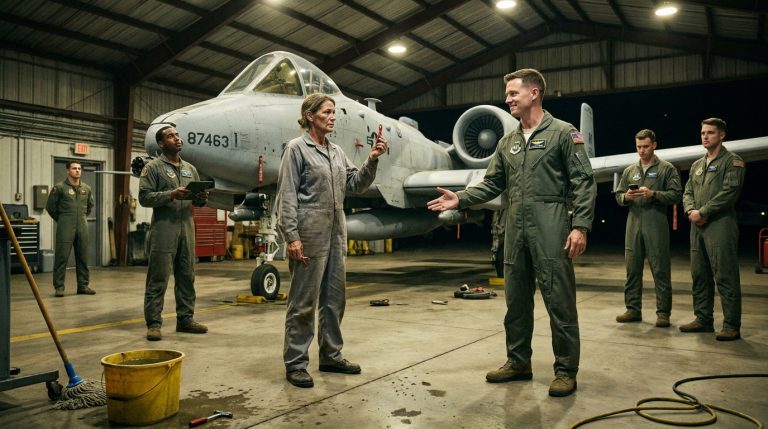
The Weight of Iron and Sky: A Tale of the Quiet Watch at Norfolk Pier
CHAPTER 1: THE FRICTION OF THE GATE
The heels of Rear Admiral Thompson’s polished black oxfords ground into the sunbaked asphalt with a rhythmic, grating bite. The air at Naval Station Norfolk didn’t just move; it hung heavy with the smell of scorched JP-5 fuel, salt pork, and the bitter tang of industrial gray paint curing in the mid-morning heat. Every breath tasted like iron.
Evelyn Reed didn’t look at the stars on his collar. She looked at the slight tremor in the hand holding the identification card.
“Sir, with all due respect, protocol requires a visual confirmation from the command post,” Evelyn said. Her voice was flat, dried out by forty-two years of living and twenty of them spent listening to the scream of Pratt & Whitney turbofans. “If the digital scan fails, it will only take a moment.”
“I don’t have time for this,” Thompson said, leaning forward so close she could smell the stale coffee on his breath. “This is General Miller. His credentials are unimpeachable. You are blocking a two-star arrival because your terminal has salt-crust on the sensors.”
Evelyn didn’t move her boots. The safety boots were heavy, the steel toes thick beneath the scuffed black leather, but they anchored her to the deck. Beneath her left navy blue pant leg, the titanium pin in her femur throbbed—a dull, rhythmic ache that always flared when the humidity hit eighty percent. She adjusted her grip on the hand-held scanner, her thumb resting on the worn plastic bezel where the gray paint had long since rubbed away.
To her left, the general sat in the rear passenger seat of the sedan, his eyes fixed straight ahead, treating her like a temporary obstruction in the road.
“The terminal is functioning, Admiral,” she murmured, her eyes scanning the dashboard of the vehicle, then the seal on the windshield, then the slight, irregular gap where the front bumper met the quarter panel. A three-millimeter drop. A hard impact somewhere on the road from Richmond that wasn’t in the log. “The network hasn’t cleared the digital signature. We wait for the green light from the shack.”
Thompson’s face went the color of a wet brick. “Your job is to facilitate, not obstruct. Now, step aside, or I will have you removed from this base permanently.”
The threat hung in the thick air, static and dead. From fifty yards away, the brass band near the commissioning stage began tuning their instruments, the low, mournful blast of a tuba vibrating through the soles of Evelyn’s feet. A few junior officers waiting in the logistics line shifted their weight, their eyes darting away from the civilian contractor at the gate. They saw a woman in a faded knit polo, her hair pinned back in an unappealing, tight knot, her face lined by gray salt-shadows.
She didn’t answer him. Dialogue was a transaction of resources; she had no information to buy, and he had nothing she needed to sell. Instead, she turned her wrist slightly, letting the heavy, unpolished silver band around her forearm slide down against her skin. The cold metal hit the edge of the puckered skin beneath her sleeve—the irregular, jagged ridge where the canopy glass had taken part of her arm with it during the descent over the Nevada basin.
Her earpiece gave a sharp, double-click of static.
“Gate One, Command Post. Alpha-Six credential cleared. Input error on the dispatch log. Clear the vehicle.”
Evelyn lowered her hand. She stepped back exactly twelve inches, her posture remaining straight, her thumb clicking the gate release toggle on her belt. “Clear to pass, sir. Enjoy the ceremony.”
Thompson didn’t acknowledge her. The staff car surged forward with a sharp hiss of rubber against the grit, leaving a small puff of exhaust that smelled of unburnt sulfur. Evelyn watched the trunk drop as it hit the incline toward the pier. She didn’t look at the officers who had witnessed the exchange. She looked down at the concrete where the car had been idling.
A single drop of fresh, dark fluid had stained the dry, gray stone near the curb. It wasn’t engine oil. It was hydraulic fluid, clear and red as cherry wine, and it had come from the undercarriage of the general’s cleared vehicle.
CHAPTER 2: THE CORROSION OF THE FENCE
The cherry-red droplet didn’t evaporate. Evelyn knelt on the rough apron of the perimeter road, her fingertips hovering a millimeter above the dark spot on the coarse asphalt. It had a strange, iridescent sheen under the mid-day sun, an oily film that didn’t belong to standard-issue Navy grease. When she brought her thumb close enough to catch the heat radiating from the stone, she smelled the distinct, chemical sharpness of high-pressure fluid that had been pushed past its thermal limits.
It wasn’t an ordinary leak. It was aviation-grade hydraulic fluid, synthetic and expensive, the kind used in high-performance actuators—not the crude mineral oil found in the steering racks of a standard staff car.
Evelyn stood up, her left knee popping with a dry, metallic click that vibrated up her thigh. She adjusted her duty belt, the heavy webbed nylon cutting into her hip as she turned her back to the main staging area where the VIP stands were being erected. The brass band’s scales were more frequent now, a wall of discordant noise designed to mask the subtle operational rhythms of the base. To anyone else, it was preparation for a celebration. To Evelyn, it was an acoustic shroud.
She walked the perimeter line toward the back gate, her slight limp more pronounced against the loose gravel at the shoulder of the road. Her eyes never left the chainlink fence. It was nine feet of galvanized steel topped with outriggers of triple-strand razor wire, designed to look imposing to a casual trespasser. But Evelyn didn’t look at the wire. She looked at the bottom tension line.
Near the corner where the shadow of Hangar 4 cut a cold, dark wedge across the dust, the wire looked wrong. The gray zinc coating had been rubbed raw, exposing the dark, vulnerable iron beneath to the salty Atlantic air. Rust had already begun to flower there, a bright, powdery orange that rubbed off on her skin as she slid her fingers along the mesh.
It wasn’t natural weathering. The corrosion was concentrated around a single fence post where the concrete footing had begun to crack and break away into soft, grey sand.
“Everything to your satisfaction, contractor?”
The voice came from behind her, sharp and wet with exertion. Rear Admiral Thompson had broken his jog, his grey physical training shirt dark with sweat across the shoulders. He stood five feet back, his breathing heavy but controlled, his eyes narrowed as he watched her touch the rusted iron.
“The wire is showing signs of corrosion near this post, sir,” Evelyn said without turning around. Her voice remained deadened, matching the flat tone she had used at the gate. “And the ground here is softer than the surrounding area. It could be a potential breach point.”
Thompson scoffed, the sound dry and humorless. He took two steps closer, his running shoes crunching loudly on the gravel. “I’ve been running this perimeter for ten years, Reed. The fence is fine. The base is secure. Get back to your post and stop inventing problems to justify your contract hours.”
Evelyn turned slowly. She looked at the salt-stains on his shirt, then at the small, dark smudge of gray grease on the tongue of his left running shoe. A specific grade of molybdenum disulfide grease. The kind used to lubricate heavy-duty lift mechanisms.
“The post has been undermined from the outside, Admiral,” she said, her voice dropping lower to counter the rising blast of a nearby trumpet rehearsal. “Someone used an acidic compound to accelerate the oxidation on the tie-wires. It’s not weathering. It’s chemistry.”
“Enough,” Thompson snapped, his jaw tightening until the skin over his cheekbones went white. “You have an overactive imagination and a fundamental misunderstanding of your authority on this installation. If I see you poking around the structural assets again instead of directing foot traffic at the pier, I won’t just terminate your supervisor’s contract—I’ll have base security escort you to the civilian side of the line in zip-ties. Is that clear?”
Evelyn didn’t blink. She watched a drop of sweat run down the side of his neck, disappearing into the collar of his shirt. “Crystal, sir.”
He didn’t wait for her to move. He surged forward again, his stride long and angry as he continued his loop around the perimeter road, his shoes throwing up small plumes of dry dust that settled over the rusted section of the fence.
Evelyn waited until the sound of his breathing had completely faded into the ambient hum of the naval base. She knelt back down by the cracked concrete footing, her fingers sinking into the soft earth at the base of the post. Her knuckles brushed against something solid buried beneath the loose topsoil—something that didn’t feel like stone or old construction debris.
She pulled it free. It was a six-inch length of threaded steel rod, heavily oxidized but completely straight, wrapped in a thin layer of greasy black electrical tape. One end had been notched with a hand file, a precise, deliberate cut meant to allow the rod to snap under a specific amount of lateral pressure.
It wasn’t maintenance trash. It was a shear-pin, designed to hold a heavy load in place until a remote command or a specific mechanical strain forced it to fail. And it smelled exactly like the cherry-red hydraulic fluid she had found at the VIP gate.
She slid the rod into her deep cargo pocket, the heavy iron clinking against the tarnished silver bracelet on her wrist. The metal was cold against her thigh, a physical weight that confirmed what her eyes had already tracked. The vulnerability wasn’t just on the perimeter; it was already moving toward the center of the pier, disguised as standard operational friction.
A shadow fell over the gravel. Evelyn didn’t look up immediately. She let her hand rest on the rusted wire, her internal clock counting the seconds before she turned to face whoever had followed her from the main terminal.
CHAPTER 3: THE SNAP OF THE BOLT
“I believe I gave you an explicit directive, contractor.”
The words cut across the salt-crusted concrete of Pier 3, dry and low, carrying the unmistakable friction of twenty-four years of unchallenged command. Admiral Thompson didn’t look at Evelyn’s face. His eyes were fixed on her left cargo pocket, where the heavy weight of the filed steel shear-pin caused the faded navy blue cloth to sag against her knee.
Evelyn kept her hands loose at her sides, her right thumb resting against the rough texture of her webbed belt. The midday sun had turned the pier into an anvil of white heat, making the air ripple over the long lines of white dress uniforms. Behind the admiral, the newly arrived Navy SEAL detachment stood in a loose, silent crescent—their weathered skin and sand-bleached utility uniforms a stark contrast to the immaculate starched laundry of the station staff. Their commanding officer, a tall lieutenant commander with sharp, assessing eyes, was watching the weight of her stride as she came to a halt.
“My apologies, Admiral,” Evelyn said, keeping her tone within the flat, rhythmless boundary she had spent years cultivating. “I was verifying the perimeter clearance behind Hangar 4 before the late VIP party processed through the checkpoint.”
“Your job is to clear the foot traffic away from the ceremonial stage, not to conduct freelance engineering assessments,” Thompson said. A vein beneath his jaw throbbed in rhythm with the distant thud of an amphibious assault ship’s diesel generators. “You have delayed a general officer, you have questioned the structural stability of my fencing, and now you are drifting across the main deck like a ghost without an assignment.”
The crowd closest to the VIP awning fell completely silent, the low murmur of conversation dying away as the base security chief shifted his weight from heel to toe. The humiliation was designed to be absolute—a public excision of a civilian element that refused to blend seamlessly into the rigid geometry of the base.
“Your contract with base security requires implicit compliance with station authority,” Thompson continued, his voice expanding to ensure the junior officers at the perimeter line caught every syllable. “Your presence on this pier is a liability. You will hand your access credentials to the chief petty officer, report directly to your supervisor’s office outside the main gate, and inform him that you have been permanently removed from duty on this base. Is that understood?”
Evelyn didn’t shift her weight. Her left femur didn’t ache from the insult; it ached from the barometric pressure dropping as a localized front pushed in from the Chesapeake. She reached for the lanyard around her neck, her skin catching on the coarse nylon braid as she unclipped the laminated gray badge. The metal clip made a sharp, clean click as she laid it across the master-at-arms’ open palm.
“Understood, sir,” she said.
She turned on her heel, her movements fluid despite the stiff resistance in her lower leg. She didn’t look at the pitying glances from the crowd or the smug satisfaction tightening the corners of Thompson’s mouth. She looked at the mobile lighting tower positioned twelve yards to the left of the main speaker’s podium.
The tower was a four-ton lattice of tubular steel, extended thirty feet into the air to carry the heavy high-intensity halogen arrays. The main hydraulic cylinder at its base was weeping. A thin, ruby-colored film was crawling down the silver piston rod, dripping into the salt-crusted channel of the deck.
And then she saw the bolt.
The primary tension lock at the pivot point wasn’t the standard hexagonal heavy-grade fastener specified in the station’s structural manual. It was a dark, unpolished rod of iron, its face notched with the identical, precise hand-file mark as the pin currently resting in her pocket. The metal wasn’t weathering under the weight; it was splitting, a microscopic hairline fracture expanding along the filed line as the weight of the overhead arrays shifted in the harbor wind.
The timeline didn’t have minutes left. It had seconds.
“Get down!” Evelyn’s voice didn’t rise; it exploded. The flat, dried-out cadence of the gate guard vanished, replaced by the raw, resonant authority of a flight lead cutting through a jammed tactical frequency. It was a command that bypassed logic, striking directly at the instinct of every uniform on the pier.
A high-pitched, metallic screech ripped through the air—the sound of overstressed iron shearing under four thousand pounds of lateral pressure. The primary tension bolt snapped with a sound like a pistol shot, the filed metal fragments sparking against the concrete as the entire upper structure of the lighting tower lunged toward the crowded VIP bleachers.
Thompson froze, his face blank with the sudden, catastrophic disruption of his order. The master-at-arms dropped the badge, his hand going down to his holster in a useless, instinctual reaction to the noise.
Evelyn didn’t look back to see if they were moving. Her bad leg drove into the asphalt, the titanium pin holding her together as she lunged toward the edge of the platform, her mind already calculating the trajectory of the falling steel with the cold, geometric spatial awareness of a pilot watching a mid-air breakup.
“Brace and cover!” she roared, her arm striking the chest of a paralyzed junior officer, hurling him clear of the primary impact zone as the shadow of the falling steel widened over the deck.
The air went thick with the scent of burning hydraulic fluid and pulverized concrete. The structural failure wasn’t an accident of time; the trap had just sprung, and she was the only operator left on the ground who knew the depth of the mechanism.
CHAPTER 4: THE GEOMETRY OF PRESSURE
The four-ton lattice tower did not drop clean. It rolled as it sheared, its upper crossbeams catching the stiff harbor wind and arcing down toward the third tier of the VIP bleachers with a sickening, heavy weight. Concrete under Evelyn’s boots shuddered as the structural base kicked out, spitting sheared rivet heads across the deck like shrapnel.
Evelyn didn’t look at the sky; she looked at the escape vectors. Her mind, hard-wired by hundreds of hours tracking multiple targets inside a dynamic combat envelope, mapped the pier in a grid of intersecting velocities.
“VIPs against the bulkhead! Stage right!” she bellowed. The force of her voice hit the panicked cluster of dignitaries like an impact wave, shattering the frozen paralysis that had gripped the front row. “Move!”
She did not slide or drop. She ran parallel to the collapsing steel, her damaged left leg locking and driving into the asphalt with a brutal, functional rhythm. The pain was just data—a dull heat signature at the edge of her awareness. To her left, two young seaman apprentices stood rooted to the deck, their eyes wide and glassy as the shadow of the main halogen array widened directly over their heads.
Evelyn reached them in three strides. Her hands caught the coarse wool of their dress collars, her weight shifting backward to alter their momentum as she dragged them toward the narrow opening of an unmapped maintenance hatch.
“You two get the children clear now,” she ordered, shoving them into the dark concrete recess. “Use that maintenance corridor. Move, or you’re under the footprint.”
They scrambled down into the darkness just as the tower’s primary crossmember tore through the upper awning. The sound of canvas ripping was followed immediately by the deafening, bass-heavy boom of four tons of structural iron impacting the empty seats. The shockwave rattled the silver bracelet against her wrist, the metal biting into the scarred flesh of her arm as she threw her shoulder against the solid steel bulkhead of the neighboring security shack to absorb the force of the blast.
Dust rose in a gray, choking screen, smelling of pulverized limestone and hot zinc. Through the haze, the silence that followed was dense, broken only by the thin sizzle of severed electrical leads snapping against the damp concrete.
Evelyn stood up from the bulkhead. Her navy blue polo shirt was coated in fine gray grit, the fabric torn at the elbow where she had scraped the wall. She didn’t check herself for injuries. She cleared her eyes with a quick, horizontal swipe of her forearm and scanned the wreckage. The bleachers were crushed flat where the boys had been standing three seconds prior, but the evacuation vector she had forced had kept the path clean. No blood on the deck. No dynamic fractures in the primary crowd.
Across the clearing, the Navy SEAL detachment had already moved into a security perimeter, their movements precise and silent. Their lieutenant commander wasn’t looking at the fallen tower. He was standing near the crushed base of the lift, his fingers trailing over the clean, non-oxidized metal where the tension bolt had parted. His gaze shifted slowly across the dust, tracking the path of the gray-clad contractor who had just orchestrated a mass casualty evacuation in the span of five heartbeats.
His eyes locked on her face. There was no confusion in his expression—only the deep, dangerous recognition of a man who had studied the operational footprints of old ghosts.
Evelyn turned her back to him, her fingers sliding into her pocket to confirm the presence of the notched rod she had pulled from the fence. The metal was still hot from her body heat, but as her thumb traced the edge of the filed groove, her eyes traveled past the wreckage toward the VIP parking enclosure fifty yards away.
The general’s staff car was still idling, its tailpipes puffing rhythmic white plumes into the salt air. But the rear door was unlatched. A thin gap of dark space showed between the frame and the seal, and the cherry-red stain on the asphalt beneath the chassis had spread into a wide, glistening pool.
The mechanical failure hadn’t been designed to kill the admiral or the general. It had been designed to draw every pair of eyes on the pier to the western edge of the deck for exactly ninety seconds.
Evelyn adjusted her webbed belt, her thumb clicking against the empty plastic cradle where her access badge had been. The decoy had functioned perfectly. The real penetration was happening behind them, inside the blind spot she had warned Thompson about less than an hour ago, and the clock was still ticking down toward the final extraction.
CHAPTER 5: THE SOVEREIGN WATCH
“Major Reed.”
The name didn’t travel across the smoke-choked pier on a wave of sound; it fell into the dust like an anchor dropping onto soft mud. The SEAL lieutenant commander stood exactly three feet from her, his boots crusted with gray stone dust and his hand pinned to his brow in a salute so tense the stitching on his sleeve looked ready to snap. Behind him, five operators clicked into formation, their movements identical, their eyes locked onto the torn, ash-smeared navy blue polo shirt of the civilian gate guard.
Evelyn didn’t raise her hand. She stood with her feet planted wide, her weight shifted back to ease the fierce, burning pressure where the titanium pin met her pelvic bone. She let her gaze travel from the stiff corners of the commander’s salute down to the crushed base of the lighting rig, where the smell of burnt electrical insulation still drifted in thin, blue ribbons.
“You’re off your station, Commander,” Evelyn said. Her voice had returned to its dry, flat cadence—the rhythm of a machine that had survived its primary operating lifecycle but refused to stop turning. “The VIP sector is clear. Your citation party is waiting on the hangar deck.”
“The citation can wait, ma’am,” the commander said, his arm remaining rock-steady. “The team knows the footprint. We know who sat in the seat during the breakout over the salt flats.”
Admiral Thompson marched into the clearing, his face drained of brick-red fury, replaced by a gray, paper-like pale that made the liver spots on his temples stand out like grease stains. His polished shoes crunched over broken glass and pulverized limestone. He stopped a foot short of the SEAL line, his eyes moving from the rigid salutes of his elite operators to the scuffed safety boots of the woman he had fired five minutes ago.
“What is the meaning of this, Commander?” Thompson’s voice lacked its gravel. It was thin, catching on the dust in his throat. “Who is this contractor?”
The lieutenant commander didn’t break his gaze from Evelyn’s face. “Sir, with all due respect, you are addressing Major Evelyn Reed, United States Air Force, retired. Operational call sign: Wraith.”
The word hit the pier and stayed there, cold and heavy as iron plate. Among the junior officers and the security personnel forming the secondary perimeter, a slow, rustling murmur rose then died instantly. The name wasn’t just a personnel record; it was a ghost story told in the ready rooms of fifth-generation fighter squadrons—the first pilot to log three hundred combat hours in classified airspace, the recipient of a silver star whose citation was just an empty folder in the Pentagon archives, and the woman who had walked away from a ninety-thousand-foot ejection with enough shattered metal in her legs to scrap a jeep.
Thompson’s mouth opened slightly, a small, involuntary twitch disturbing the hard set of his jaw. “Major… Reed?”
Evelyn ignored the admiral’s hand as it drifted toward his brow. She reached into her pocket, her rough fingers sliding past the silver bracelet on her wrist to pull out the notched steel rod she had retrieved from Hangar 4’s perimeter fence. She dropped it onto the hood of a nearby security vehicle with a sharp, heavy clink.
“The lighting rig wasn’t an equipment failure, Admiral,” Evelyn said, her voice cutting through the distant wail of base fire engines. “This is a mechanical shear-pin. It was filed to drop when the wind shear hit twenty knots. The hydraulic fluid I found at the gate wasn’t from a leaking steering rack; it was bled from the rig’s main bypass valve to guarantee a clean collapse when the VIPs arrived.”
The admiral looked down at the notched iron rod, then back to Evelyn. “A diversion.”
“A ninety-second window,” Evelyn murmured, pointing toward the parking enclosure where General Miller’s staff car remained idling. The rear door was wide open now, the interior dome light shining yellow through the fading dust. “The general’s credentials didn’t fail at the scanner because of salt-crust. The network loop was intentionally flooded from the base maintenance shack to force his driver to leave the vehicle unattended while the command post cleared the logs. Look at the data terminal on the dashboard.”
The SEAL commander didn’t wait for Thompson’s order. He threw a sharp signal to his master chief, who sprinted toward the vehicle with his weapon low. Two seconds later, the chief’s voice came back over the tactical radio: “Drive is pulled, sir. The core log interface has been scraped clean.”
The realization hit Thompson like a physical blow, his shoulders dropping two inches as the institutional certainty of his rank crumbled into the reality of a compromised command. The decoy had covered the final truth: the entire commissioning ceremony was an extraction window for the transit profiles of every fleet asset on the eastern seaboard.
Slowly, his arm feeling the full weight of the forty years of service behind it, Admiral Thompson brought his hand to his brow. His salute was formal, stiff, and held so long his fingers began to tremble against the gold leaf of his visor. It wasn’t an acknowledgment of rank; it was a submission to the watch.
Evelyn watched him. She didn’t return the gesture. She reached down into the dust, picked up her laminated gray civilian security badge from the concrete where the master-at-arms had dropped it, and wiped the gray stone-crust off her face with the back of her scarred hand.
“The base is still open, Admiral,” she said, her voice flat, pragmatic, and entirely clear of triumph. “And the gate needs a guard who knows what an iron leak looks like.”
She turned away from the salutes, her slight limp dragging her scuffed boot through the gravel as she walked back toward the perimeter fence, her hand already reaching for the radio on her belt to report the post secure.