The Silver Link: A Reckoning in the Shadows of a Torino Legacy
CHAPTER 1: The Weight of Steel
The city lights were a smear of yellow oil on wet pavement, blurred by the persistent, needles-and-pins drizzle that clung to the windows of the Torino estate. Vincent sat in the dark, the only illumination coming from the muted glow of the desk lamp, casting sharp, jagged shadows against the leather-bound spines of books he hadn’t touched in a decade.
His phone lay on the mahogany surface, a black rectangle of potential violence. The message had been clear. The threat was specific. And for the first time since the night of the fire, the cold, clinical apathy that usually defined Vincent’s existence was replaced by a singular, burning clarity.
He didn’t look at the phone again. Instead, he looked at the security feed on his monitor. He had cycled through the cameras twice, his eyes scanning for anomalies. There—the north perimeter gate. A camera flickered, a stutter in the feed that lasted less than a micro-second, but it was there. A shadow that didn’t belong. A footprint in the mud that hadn’t been there ten minutes ago.
He rose, his joints stiff, the charcoal suit still pristine despite the hour. He reached into the top drawer, his fingers closing over the cold, checkered grip of his handgun. It felt like an extension of his own hand, a tool for a craft he hadn’t practiced in years but hadn’t forgotten.
He moved to the door, his steps silent on the thick Persian rug. He needed to verify the perimeter before checking on Emma. If they were already here, if the reach of their deception extended into the sanctuary of his own grounds, then the game had shifted from pursuit to survival.
He stepped out into the hallway, the air cool and biting. The house felt different tonight, transformed by the presence of a child sleeping down the hall—a fragile, living thing that had been dumped into the middle of his war. He stopped by the guest room door, listening.
Silence. Only the faint, rhythmic breathing of a child who had finally found warmth.
He turned toward the kitchen, his mind already mapping the route to the northern fence. As he passed the console, he noticed something. A stack of mail, delivered by his staff an hour ago, sat neatly on the table. A single envelope sat apart from the others. It was plain, white, and bore no return address.
He hadn’t placed it there.
He picked it up, the paper heavy, professional grade. He didn’t tear it open. He felt the weight of it, the way the edges were precisely square. He tilted it, and a small, metallic object slid out, clicking softly against the marble floor.
It was a piece of charcoal—a broken, charred remnant of a drawing tool. And taped to the center of the envelope, holding it shut, was a single, silver hair.
Vincent’s blood turned to ice. He hadn’t been just watched; he had been measured. And whoever was out there knew exactly how to make him bleed.
CHAPTER 2: Echoes in the Charcoal
The silver hair didn’t just sit on the desk; it seemed to accuse him. Vincent stared at it, the sharp, needle-like filament catching the lamplight. It was thin, brittle, and impossibly fragile—exactly the kind of evidence that shouldn’t exist after twelve years. He didn’t touch it. He let his hand drop to his side, the weight of the Sig Sauer pulling at the fabric of his jacket, a grounding anchor in a room that suddenly felt tilted on its axis.
The charcoal shard clicked again as he shifted his weight, the sound small but deafening in the vacuum of his study. He felt a phantom pressure in his own chest, a tightening of ribs that mirrored the fire he had once stood before, watching his life turn to ash. This was not a random intruder. This was someone who knew the anatomy of his grief and was using it as a surgical instrument.
His pulse was a steady, rhythmic thrum against his ears, the only sound in the house other than the distant hum of the security system. He moved toward the door, his gaze darting to the surveillance monitor. The glitch was gone. The north perimeter was back to a serene, static image of darkened trees and manicured hedges, mocking him with its normalcy.
He stepped out into the hall, the darkness pressing against his eyes. The house felt like a labyrinth now, the architecture he had designed for safety transformed into a theater of paranoia. He reached the guest room door and pressed his ear against the wood. Silence. Emma was still breathing, deep and untroubled. He felt a flash of protective rage—whoever had left that envelope had dared to approach the door where she slept. They had bypassed layers of security that were supposed to be impenetrable.
Vincent didn’t go inside. He turned instead toward the mudroom, his mind churning with the precision of a master tactician. If the perimeter had been breached, they wouldn’t have left through the gate. They would have retreated into the dense foliage that buffered his estate from the city’s sprawl. He needed to get to the docks. If he was going to find out who had been profiting off his family’s “death,” he had to move outside the lines of his own empire.
He pulled his phone from his pocket. The screen was black, a mirror of his own resolve. He dialed a sequence that hadn’t been triggered in years, a direct line to Marco, bypassing the switchboard. The ring lasted only once before the connection went live. There was no greeting, just the sharp, rhythmic breathing of a man who was already waiting for a call.
“Boss?” Marco’s voice was low, a jagged rasp.
“The perimeter at the estate,” Vincent said, his voice stripped of everything but the essential. “It was compromised. Someone left a calling card in my study. I want the logs for the last two hours. Not the doctored feed—I want the raw, unfiltered data from the motion sensors and the pressure pads at the north gate.”
“The system didn’t flag anything, Vincent.”
“I know it didn’t,” Vincent replied, his gaze flickering back toward the dark hallway. “That’s exactly why I want the raw data. Someone went through the effort of masking their signature. Find out who has the override codes for that specific sector. And Marco—”
“Yeah?”
“If you find out who it was, don’t report back to the office. Send the location to my private device. I’m going to the docks.”
Vincent killed the call and moved to the heavy oak door that led to the garage. He didn’t take the armored sedan. He took the older, nondescript coupe he kept for occasions when he needed to blend into the city’s grey machinery. As he backed out of the garage, the headlights cut a harsh, piercing path through the drizzle, illuminating the slick gravel.
He drove in silence, his mind flickering back to the charcoal. He remembered Sophia in the kitchen, the way she would clutch her crayon until her knuckles turned white, the way she would draw lines that never quite connected. The intruder hadn’t just left a message; they had curated a nightmare.
Every mile toward the docks felt like a descent into the city’s underbelly. The streetlights flickered, failing under the weight of the downpour. He felt the cold iron of the car’s wheel, the vibration of the engine a dull, metallic hum that mirrored the ache in his shoulders. He wasn’t just looking for a culprit anymore. He was looking for the architect of his twelve-year lie.
The harbor appeared ahead, a graveyard of rusted hulls and salt-caked shipping containers. It was the place where he had started, the place where he had learned that in this city, a secret was only as safe as the person holding the gun to keep it. He pulled into the shadows of a warehouse, the scent of brine and damp steel filling the air. He turned the engine off, letting the silence swallow him, and waited. The shadow he was hunting wasn’t far behind. He could feel it. The hunter had become the prey, and for the first time in a decade, Vincent Torino felt perfectly at home.
CHAPTER 3: The Ghost Broker
The harbor was a landscape of skeletal cranes and stacked steel, the containers forming a labyrinth of industrial silence. Vincent left the coupe in the deep shadow of a corrugated warehouse, the engine ticking as it cooled—a sharp, rhythmic contraction of metal in the humid night air. He didn’t lock the doors. He didn’t need to; in this part of the city, there were few who would dare touch a vehicle that carried the unmistakable, silent threat of Torino engineering.
He moved toward the meeting point, a small office shack nestled between two hulking vessels that looked like they hadn’t moved in a decade. His footsteps were measured, deliberate. The salt spray stung his face, a cold, abrasive grit that kept his mind razor-sharp. He wasn’t looking for Marco yet; he was looking for the tail. If someone had breached the estate, they were likely keeping him in their sights, waiting to see what he would do when the mask of the grieving widower began to slip.
A sudden, sharp mechanical whine tore through the stillness—the sound of a high-pressure valve releasing nearby. Vincent froze, dropping into a crouch behind a stack of rusted pallets. His hand traced the familiar, reassuring curve of his sidearm. It was just a pipe, a structural necessity of the docks, but his heart rate had spiked, a cold jolt of adrenaline that he welcomed. He was no longer the man who built empires with phone calls; he was the man who had survived the fire, and he was back to basics.
“You’re late, Vincent,” a voice murmured from the shadows.
Marco stepped out, a thin, gaunt figure draped in a trench coat that seemed to swallow his frame. He looked as though he hadn’t slept since the turn of the century. He leaned against the rusted frame of a crane, his eyes darting toward the darkness behind Vincent.
“I had an unexpected visitor at the estate,” Vincent said, closing the distance between them. “I need the logs, Marco. The raw data. I want to see the ghost who bypassed the motion sensors.”
Marco pulled a tablet from his coat, the screen emitting a sickly, pale light that illuminated the deep lines around his mouth. He didn’t hand it over; he tapped a few keys, his fingers trembling ever so slightly. “It wasn’t a bypass, Vincent. That’s the problem. The system didn’t flag the intruder because the intruder had an authorized keycard. A master access token.”
“Which one?”
“The one assigned to the security chief. The one you signed off on for Sarah Martinez before she… left.”
Vincent felt the cold air tighten around his lungs. Sarah Martinez—the name he had seen on the insurance files, the woman he had trusted with the keys to his world twelve years ago. “She’s been dead for a decade, Marco. Or so the paperwork says.”
“The paperwork is a work of fiction,” Marco muttered, handing the tablet over. “Look at the time stamps. The breach happened precisely at 3:14 a.m. But look at the account signature.”
Vincent studied the screen. The data was dry, technical, a series of binary commands, but the signature on the authorization token was unmistakable. It was encrypted, a proprietary code that only he and his inner circle had ever possessed. But woven into the metadata was a tiny, recurring pattern—a sequence that mirrored the way a child draws a line, over and over, until the paper tears. It was a thumbprint of a person, not a program.
“She’s alive,” Vincent whispered, the realization sinking in with the weight of lead. “And she’s been using the access I gave her to watch me for twelve years.”
Before Marco could respond, a beam of light cut through the gloom, sweeping over the top of the shipping containers like a searchlight. It was a harbor patrol vehicle, its heavy tires crunching against the gravel as it prowled the perimeter of the loading zone. The timing was too clean, too precise. It wasn’t a patrol; it was a cleanup crew.
“Move,” Vincent commanded, grabbing Marco by the collar and shoving him toward the gap between two containers.
They scrambled into the narrow, dark corridor of steel, the metallic walls echoing with the thud of their boots. The patrol vehicle stopped just feet from their hiding spot. The engine roared, a deep, guttural sound that vibrated through the ground beneath them. Vincent’s back pressed against the corrugated iron, his breath held in his chest. He could hear the crackle of a radio, the garbled, static-filled voices of men who were clearly not interested in maritime security.
They were being hunted, and the hunter knew exactly where to find them. The decoy secret—the insurance fraud—was already crumbling, revealing a much larger, more dangerous machine. Someone had not only taken his family; they had been orchestrating his entire existence from the shadows, watching him rise while they held the leash.
Vincent looked at Marco, whose face was a mask of sheer terror. “Don’t move,” Vincent whispered. He felt the cold condensation of the night air on his skin, his mind pivoting. If they were here to finish the job, they had made a mistake. They had underestimated the man they had spent twelve years creating. He reached into his coat, checking the tension of the slide. They were going to have to walk out of this, and by the time they did, he would have more than just names—he would have a target.
CHAPTER 4: The Threat
Vincent remained pressed against the iron wall, the cold bite of the corrugated metal seeping through his jacket. Beside him, Marco was barely breathing, his hands clamped over his own mouth to stifle the tremors of his fear. The patrol vehicle idled, the engine’s low-frequency thrum vibrating through the soles of Vincent’s shoes. He didn’t look at the vehicle; he watched the shadow it cast across the wet gravel.
The shadow moved.
It wasn’t the erratic jitter of a man walking a beat. It was the deliberate, slow-motion slide of a predator testing the wind. Whoever was behind the wheel had killed the lights. They were using the darkness to draw out a reaction. Vincent looked down at the tablet in his hand. The screen was black, but the reflection caught the faint, pale glow of the streetlamp half a mile away, revealing the patrol vehicle’s registration plate.
He narrowed his eyes. The plate format was standard, but the specific series—G-H-992—was a designation he had seen before. It wasn’t city harbor security. It was the serial block for his own internal fleet.
The realization hit with the force of a physical blow. The breach wasn’t just using his security codes; they were using his own assets. The “bad people” were not some external force he had yet to identify. They were the very infrastructure he had built to protect his empire. They had been feeding on his resources, weaponizing his own logistics against him while he slept in the silence of his fortress.
Vincent nudged Marco, his movements precise and economical. He signaled toward the edge of the shipping container—a narrow, three-inch gap that opened onto the backlot. He didn’t speak. He didn’t need to. Marco followed, his boots making no sound on the oil-slicked concrete.
They reached the perimeter of the loading zone, the scent of stagnant water and old diesel thick in the air. Vincent peeked around the corner. Two men were standing near the patrol car, their silhouettes framed by the dull grey of the night. They weren’t dressed as security. They wore the high-visibility, nondescript gear of city utility workers—a classic, clean-cut disguise that allowed them to move anywhere in the city without drawing a second glance.
One of the men raised a radio to his lips. “Target is no longer at the estate. He’s at the harbor. Proceed to intercept, but keep it quiet. He’s still worth more alive than dead.”
Vincent’s jaw tightened. Alive. They weren’t here to kill him. They were here to ensure he kept the cycle going, to ensure he remained the figurehead of an empire they had already gutted. He felt a surge of cold, calculated fury—the kind that didn’t burn, but instead illuminated every path before him with the clarity of a blade.
He pulled his sidearm, the weight familiar and grounding. He didn’t aim at the men. He aimed at the rear tire of the patrol car. He needed to create a diversion, a break in the rhythm of their pursuit. He fired once—a muffled, compressed thwip—and the tire hissed, the sudden depressurization sending a shockwave through the quiet harbor.
The two men spun toward the sound, their weapons drawn in a synchronized motion that betrayed their professional training. They weren’t guards. They were special ops.
“Now,” Vincent whispered to Marco.
They bolted, not toward their own car, but into the labyrinth of crates to the east. He knew the layout of these docks better than the men hunting him; he had financed the construction of this entire terminal. He led Marco through a narrow service duct that opened into a maintenance tunnel, the air stale and humid.
“Who are they, Vincent?” Marco hissed as they stopped to catch their breath in the bowels of the structure. “They’re using your own fleet, your own codes. They’re running your organization from the inside out.”
“They aren’t just running it,” Vincent replied, his voice barely audible. “They’re waiting for me to hit a wall. They want me to dig up enough to implicate myself, to tear down what’s left of the Torino name so they can pick up the pieces.”
He thought of Emma, sleeping in his guest room, oblivious to the fact that she was the linchpin in a game she didn’t even know she was playing. If the organization was compromised at the core, then his home was no longer a sanctuary—it was a trap. Every person he had trusted over the last decade was now a potential adversary.
He leaned against the cold concrete of the tunnel, his mind racing through the inventory of his inner circle. He had to prune the garden. He had to find out who had given the authorization codes to “Sarah Martinez.”
He looked at Marco. “Get to the server farm in the city center. Don’t go back to your office. Wipe your digital footprint, then start a deep-dive trace on the payroll logs for the last quarter. Look for anyone who moved money through the same Cayman shell companies that paid the coroner twelve years ago. If you find a name, don’t tell me. Get it to Father Rodriguez at the cathedral. He’s the only one whose communications won’t be tapped.”
“And you?”
“I’m going back to the estate,” Vincent said, his eyes hard and unyielding. “I need to make sure the trap is sprung before they realize I’m the one holding the hammer.”
He turned and disappeared into the darkness of the tunnel, leaving Marco alone in the damp silence. Vincent knew the risks—if he walked back into that house, he might never walk out—but he also knew that for the first time in twelve years, he was no longer playing by their rules. He was setting his own.
CHAPTER 5: The Fortress Breach
The walk back to the estate felt like a traversal of a different world. The city lights had faded into a dull, pulsing glow on the horizon, leaving the suburban sprawl in an eerie, shadow-drenched quiet. Vincent didn’t use the main drive. He approached from the western quadrant, where the perimeter fence was obscured by a thicket of overgrown hemlock and iron-wrought ivy. He knew every blind spot of his own security system, every flickering camera, every sensor delay. It was a cruel irony: he had spent years crafting this fortress to keep the world out, never realizing he was simply building a box for his own entrapment.
He climbed the fence with the economy of a man who had long ago traded his youth for instinct. His feet touched the manicured grass of the estate, and he froze. He didn’t move toward the front door. He didn’t head for the kitchen entrance. He moved toward the conservatory, a glass-walled structure that jutted out from the rear of the mansion. It was the only part of the estate he hadn’t fully integrated into the security grid, a holdover from Maria’s love for orchids and sunlight.
The air inside the conservatory was thick, humid, and smelled of damp earth and blooming jasmine—a jarring contrast to the metallic, ozone-scented reality of the harbor. He moved through the foliage, his silhouette merging with the shadows of the palms. He heard a sound—the faint, rhythmic click of a laptop key.
He rounded a giant fern and saw it.
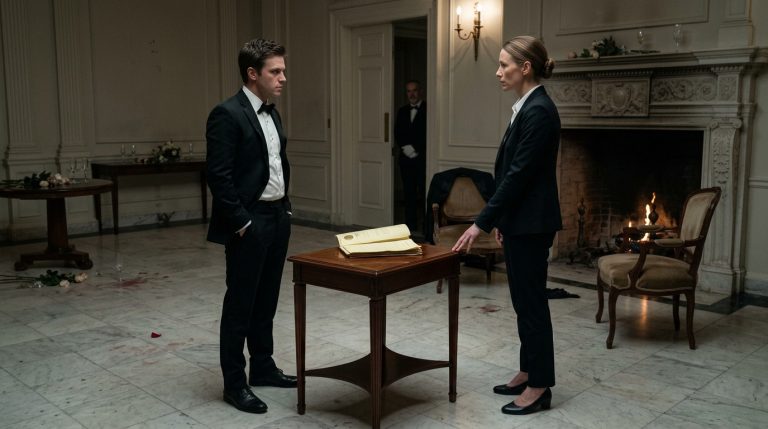
Sitting in a wicker chair, backlit by the moonlight filtering through the glass roof, was a figure. They were dressed in black, the material matte and light-absorbent. The laptop screen was bright, illuminating a face that Vincent hadn’t seen in twelve years. It was Sarah Martinez. Or at least, the woman who had signed the documents. She looked older, her features sharpened by time and, perhaps, the same hardening process that had turned Vincent from a mid-level enforcer into a kingpin.
She didn’t look up. She typed with a steady, clinical rhythm.
“You’re late, Vinnie,” she said. Her voice was like dry leaves skittering over pavement—familiar, yet devoid of the warmth he remembered.
Vincent stopped, the cold iron of his sidearm steady in his grip. “The name is Vincent. And you’re supposed to be dead.”
She closed the laptop. The sudden loss of the blue light made the conservatory seem even darker, the shadows stretching and pulling like liquid. She turned in the chair. Her eyes were hard, lacking any trace of the fear he had expected.
“Dead is a perspective, Vincent. Some people survive because they are forced to, and others survive because they find the right people to pay the coroner.” She stood up, her movements fluid and unhurried. “You think you’ve been running this city for twelve years. You think you built this empire on your own terms. But every dollar you made, every enemy you removed, every move you made on the board—I was the one setting the table.”
“Why?” Vincent asked, the word a blade of glass in his throat.
“Because you were too soft,” she snapped, stepping into the moonlight. “You had a wife, a child, and a moral compass that would have gotten us all killed by the time the next regime change rolled through. I saved you, Vincent. I saved them by pulling them out of your life. I gave you a clean slate—a tragic, fueling, burning slate—that allowed you to become the monster you needed to be to survive.”
Vincent stepped closer, his boots silent on the stone floor. “And the girl? Emma? She’s my granddaughter.”
A flicker of something crossed her face—not regret, but a sharp, analytical disappointment. “She was a contingency. A way to ensure you never stopped building. I needed you to have a stake, a reason to keep the machine running, a reason to be vulnerable. But you’re getting sentimental. You’re looking for truths that were buried for a reason.”
She reached into her jacket. Vincent’s finger tightened on the trigger, but she didn’t pull a weapon. She pulled out a small, silver pendant—the match to the one Emma wore.
“Do you know why she wears this, Vincent? It’s not a keepsake. It’s a tracker. A localized, low-frequency beacon. I haven’t just been watching you; I’ve been waiting for the moment you decided to prioritize the child over the empire. That moment is now.”
A dull, distant thud echoed from the front of the mansion—the sound of a door being breached. More thuds followed, the coordinated rhythm of a tactical team. Sarah smiled, a thin, colorless expression.
“That’s the board reset, Vincent. They’re here to clean up the assets. Starting with you.”
She moved toward the glass door, but Vincent didn’t let her pass. He stepped into her path, his presence a wall of cold, unyielding resolve. “You think I’m the only one who prepared for this? You forgot one thing, Sarah. You taught me how to think like you. But you never taught me how to lose.”
He didn’t fire. Instead, he reached out and grabbed the edge of the laptop she had left on the table. It was still recording, the microphone active and streaming to a secure, off-site server—the one Marco was currently accessing. He tapped the ‘send’ key, transmitting the entire conversation to the one person in the city who could dismantle the architecture of their control: Father Rodriguez.
Sarah’s eyes widened, her composure finally fracturing. She lunged, not for him, but for the laptop. Vincent swerved, his hand catching her arm in a grip that would have left bruises, but he didn’t strike her. He simply watched, his eyes reflecting the cold, sharp truth of the situation: the decoy was gone, and for the first time in twelve years, the game was entirely his to dictate.
CHAPTER 6: The Confession
Vincent didn’t look back as he breached the servant’s passage, his movements driven by the cold, kinetic necessity of survival. The mansion was no longer his home; it was a series of tactical hazards, a structure he knew intimately but that now felt hostile. Behind him, the conservatory door splintered under the force of a battering ram. He heard the sharp, rhythmic commands of the intruders—a language he had taught his own security details, now repurposed to hunt him.
He reached the mudroom, grabbed a heavy rain slicker from the rack, and slipped out into the drenching, midnight rain. The estate’s gardens were a sea of shifting grey, the shadows of the oaks looking like grasping fingers in the downpour. He didn’t head for the garage. He headed for the perimeter wall, the one place that wouldn’t be under electronic surveillance. If the organization was compromised, then the high-tech, digital-first approach he had relied on for a decade was his greatest vulnerability.
He was running, but he wasn’t fleeing. He was repositioning.
As he vaulted the low brick wall and landed in the alleyway, his phone buzzed. It was a cryptic string of characters—a location. Father Rodriguez. The cathedral was miles away, but it was the only piece of the puzzle that hadn’t been filtered through his own compromised security apparatus. He broke into a run, the rain plastering his suit to his skin, his breath coming in sharp, disciplined hitches. Every shadow in the alley was a potential threat, every sound of a car engine a possible tail.
The city was a sprawling, indifferent grid of light and rain. By the time he reached the cathedral, his lungs burned and his clothes were heavy with water. The heavy oak doors were locked, but he knew the side entrance—a small, unassuming iron gate that led to the sacristy. He slipped inside, the sudden drop in temperature and the smell of ancient incense and cold stone hitting him with the force of a physical barrier.
The cathedral was a cavern of silence. He moved toward the altar, his boots echoing against the marble floor. There, kneeling in the front pew, was Father Rodriguez. He didn’t turn when Vincent approached. He didn’t even look up from his rosary.
“You’re late, Vincent,” the priest murmured, his voice sounding thin and brittle in the vast, hollow space.
“I had to burn the house down to get here,” Vincent replied, leaning against a pew to catch his breath. “The organization is compromised. Every system, every code, every asset—it was all a shell game, Father. They weren’t protecting me. They were keeping me in a cage.”
The priest finally turned. His face was a map of sorrows, his eyes rimmed with red. He held up a small, worn book—the parish register from twelve years ago. “I’ve been waiting for you to realize that for a long time, Vincent. I didn’t hold back the truth to spare your feelings. I held it back because I didn’t know who you were when you walked into my office. I didn’t know if you were the man who loved Maria, or the man who had become the king of the city.”
“And now?”
“Now,” the priest said, standing up, “I think you’re neither. You’re just a man with a target on his back.” He walked toward the altar and pulled back a heavy velvet curtain, revealing a small, hidden floor safe. He spun the dial with a mechanical proficiency that spoke of years of practice. “You asked who authorized the payments. You asked who lied about the bodies. It wasn’t Sarah Martinez. She was just the delivery mechanism.”
He pulled out a thick envelope and handed it to Vincent. “It was the people who needed you to stay in the dark. The board members of the holding company that owned the apartment building where your family lived. They didn’t just want to hide your family; they wanted to erase the evidence that the building was structurally unsound and that they had been warned for years.”
Vincent opened the envelope. Inside were internal memos, signed and notarized, detailing the intentional negligence that had led to the explosion. At the bottom of the stack was a birth certificate. Not for Emma, but for Sophia.
“She didn’t die, Vincent,” the priest said, his voice dropping to a whisper. “She survived. And she spent the last decade trying to build the evidence to take them down. Emma isn’t the weapon they gave you. Emma is the proof she’s been trying to get into your hands.”
The realization was not a liberation; it was a death sentence. He had been holding the weapon, but he had been too blinded by his own narrative to see the target. The organization hadn’t been hunting him to keep him in power—they had been hunting him because he held the only remaining link to the woman who was systematically dismantling their fortune.
Vincent looked at the birth certificate, the reality of the deception stretching out before him like a jagged, insurmountable cliff. Sophia hadn’t been hiding from him; she had been protecting herself from him, from the very machine he had been funding. He felt a sudden, crushing sense of vertigo. Everything he had done—every life he had ruined, every bridge he had burned—had been in the name of a vengeance he had misdirected for twelve years.
Outside, the first sirens began to wail—a rhythmic, piercing sound that cut through the silence of the cathedral. The hunt had moved from the docks, through his home, and now, it was standing at the threshold of the only place he felt safe. He looked at the priest, his eyes hard. The cycle had to end. He wasn’t the hunter, and he wasn’t the prey. He was the only one left who could burn the board to the ground.
CHAPTER 7: The Calculated Counter
The sirens didn’t just announce the arrival of the authorities; they announced the arrival of the end of Vincent’s world. He shoved the envelope into the inner pocket of his slicker, the paper feeling unnaturally heavy, a leaden weight against his ribs. Father Rodriguez moved toward a side door, his robes rustling with a frantic, uncharacteristic speed.
“They won’t stop at the doors, Vincent,” the priest said, not looking back. “The board owns the police, the fire department, the zoning boards—there is no law left in this city that isn’t signed in their ink. If you walk out there, you are a ghost. You died twelve years ago, remember? That is the only legal status you possess.”
“I don’t need the law,” Vincent replied, his voice a low, gravelly vibration. He moved toward the altar, his eyes tracking the red lights flashing through the stained-glass windows—the vibrant, shifting patterns of an incoming tactical unit. “I need the leverage.”
He pulled his phone and toggled a frequency he hadn’t used in a decade. It wasn’t encrypted by the organization’s servers. It was a private, analog line he had set up during his first year as an enforcer, a fallback for the kind of chaos that the digital age had forgotten how to handle. He waited, the silence of the cathedral punctuated only by the distant, rhythmic thud of boots nearing the main entrance.
A click. A voice answered—not Marco, but a younger, sharper tone. It was the head of the local longshoreman’s union, a man who still owed Vincent for a life saved back when the docks were a war zone.
“I need the shipping manifests for the last forty-eight hours,” Vincent said, his words measured, leaving no room for negotiation. “Everything coming through the north terminal. I need to know which containers are listed under the board’s shell corporations and where they’re being diverted.”
“Vincent, the union’s staying neutral. We saw the news. They say the Torino estate was hit. If we help you, we’re dead.”
“If you don’t help me,” Vincent countered, his voice dripping with the cold, absolute certainty of a man with nothing left to lose, “you’re going to be held responsible for the shipment that’s about to be seized by the federal authorities. I’m giving you a chance to clear your books by handing me the one container that will burn them all down. Your choice.”
He cut the line before the man could protest. He had gambled on the only thing that actually functioned in this city: fear of the fallout.
The cathedral doors exploded inward.
The sound was a hollow, echoing crack, followed by the heavy, tactical tread of men in ceramic-plated vests. They weren’t police. They were cleaners. Vincent didn’t wait for them to reach the altar. He slipped through the narrow gap the priest had provided, the scent of damp basement air filling his lungs. He felt the cold touch of stone walls as he descended the stairs, his pulse a steady, metronomic drumbeat.
He was in the crypts now, the final resting place of the city’s forgotten elite. It was a maze of marble and granite, a perfect place to vanish. But he wasn’t vanishing. He was moving toward the sub-basement—the old drainage tunnels that fed into the harbor’s main outflow. If the manifest data was accurate, the container with the board’s ledger was waiting for him at the terminal, tucked away in a shipment that was scheduled to leave on the morning tide.
He hit the drainage pipes, the water ankle-deep and freezing. He looked back one last time at the ceiling, at the faint, flickering red light of the tactical team’s infrared lasers scanning the sanctuary above. They were playing his game now, hunting for a ghost in a tomb.
He realized then that Sarah had been wrong. She thought she had made him a monster so he would survive. She hadn’t realized that the same crucible that turned him into a monster had also burned away everything he needed to stay shackled to her control. He had been forged in fire, but he was the only one who knew how to walk through the flames without turning to ash.
He pulled the pendant from his pocket—not the one he found, but the one Emma had carried. He looked at it, the silver cross dull and scratched, the same way his grandmother’s had been. It wasn’t just a tracker. It was a key—a digital key that contained the encrypted access to the board’s offshore accounts. Sophia hadn’t just given him proof; she had given him the entire inheritance of their crimes.
He began to run again, his boots splashing through the dark, cold water. The climax wasn’t approaching; it was already here. Every step was a calculation, every breath a strike against the people who had erased his world. He didn’t care about his own safety anymore. He cared about the moment he would walk into that shipping yard and show them exactly what happens when you decide to destroy a man’s life without making sure he’s actually dead.
CHAPTER 8: The Weight of Evidence
The harbor terminal was a graveyard of industrial ambition, the containers towering like obsidian monoliths against the charcoal sky. Vincent knelt on the slick concrete, his lungs burning with the exertion of the run through the tunnels. The cold air felt like shards of glass in his chest, but he forced himself to focus. He reached out to the lock of the container identified in the manifest, his fingers trembling—not from the exhaustion, but from the terrifying, electric realization that he wasn’t alone.
The security seal wasn’t just broken; it had been melted, the plastic housing warped into an unrecognizable, slagged mess. Someone had gotten here first.
He didn’t need to see the interior to know what was gone. The ledger, the signed memos, the proof of the board’s negligence—it had all been sanitized. He felt a sudden, hollow ache in his gut. They were faster than he had calculated, and more thorough than he had anticipated. He had spent his life believing that power was about control, about the ability to force the world to bend to his will, but standing here in the dark, he realized that true power was the ability to erase one’s own footsteps.
He pulled the pendant from his pocket. The silver felt heavy, an anchor in a world that was rapidly losing its gravity. If the paper trail was gone, if the legal evidence had been vaporized, then the digital key was his only remaining leverage. But it was just a file. A series of bits and bytes that needed a vessel to be broadcast.
A sudden, rhythmic thrumming sound echoed across the yard. The sound of a heavy diesel engine, idling in the distance. He turned, his gaze scanning the gaps between the stacks. A black sedan, lights doused, was weaving through the rows of containers, moving with the slow, predatory grace of a shark.
He didn’t run. He stood his ground, the cold rain blurring his vision. He had nothing left to protect—not his estate, not his empire, and certainly not the lie he had been feeding himself for twelve years.
The sedan stopped, its nose dipping slightly as the brakes engaged. The driver’s door opened, and a woman stepped out. She wasn’t Sarah. She was younger, her hair cut in a sharp, pragmatic bob, her face a mirror of the woman he had buried so long ago. She moved with the same, unconscious grace that Maria had possessed when she hummed while folding laundry.
“Vincent,” she said. Her voice was steady, calm, and utterly devoid of the fear he had expected to see.
“Sophia,” he whispered.
The name didn’t feel like a greeting; it felt like a funeral. She didn’t come closer. She watched him with eyes that were cold, intellectual, and completely detached—the eyes of a woman who had spent a decade dissecting her own tragedy to find the machinery underneath.
“You’re here for the ledger,” she said, her voice cutting through the sound of the rain. “You’re too late. I moved it hours ago. I didn’t want it to be part of your reckoning. I wanted it to be the fuel for the fire that burns the board to the ground, with or without you.”
“Why didn’t you come to me?” Vincent asked, the question feeling pathetic even as he uttered it.
“Because you were the problem, Papa,” she replied, the endearment feeling like a slap. “You were the man who made the Torino name a synonym for violence. I couldn’t expose the people who killed my mother without exposing the man who gave them the reason to do it in the first place. You had to be the target. You had to be the distraction.”
The wind shifted, carrying the scent of salt and oil, and Vincent realized with a jolt of horror that Sarah’s “betrayal” was not the end of the mystery, but the beginning of a larger, more intricate one. Sophia hadn’t been hiding. She had been observing. She had watched him grow into the monster she needed him to be, and she had waited for him to reach the point where he was ready to destroy the board, knowing that his own destruction would be the natural byproduct.
The sedan’s engine roared, and a figure emerged from the passenger side—Emma, holding a small, digital tablet, her face pale in the faint light. She looked at Vincent, then at Sophia, her expression a mix of confusion and terrifying, learned composure. She wasn’t just a child. She was the final, perfectly honed instrument of Sophia’s campaign.
“The upload is ready,” Sophia said, turning back to the tablet. “In five minutes, every offshore account, every bribe record, and every piece of evidence of the board’s negligence will be sent to every news agency and regulatory body in the country. You had a choice to play the hero, Vincent. But you spent too long playing the king.”
Vincent looked at the daughter he had mourned and the granddaughter he had only just discovered, realizing that he was not the architect of this moment. He was the debris. He had built the foundation, he had provided the resources, and he had created the chaos, but he was never the one in control. The silence in the harbor was absolute now, the heavy weight of the steel containers closing in, and as the screen on the tablet began to pulse with a bright, blue light, he realized that the only way to save the future was to accept the total, absolute annihilation of the man he had forced himself to become.
CHAPTER 9: The Final Reckoning
The harbor was silent, save for the hum of the sedan and the rhythmic, hollow slapping of water against the concrete pylons. Vincent stood motionless, the rain sluicing down his face, washing away the grit of the tunnels and the exhaustion of his long, distorted journey. He watched the progress bar on the tablet hit one hundred percent. It was a simple, digital confirmation that the world he had occupied—the world of backroom handshakes, bought coroners, and calculated brutality—was being dismantled in real-time.
Sophia stood a few paces away, her posture rigid, her eyes fixed on the device. She didn’t look like a victor; she looked like a woman who had finally put down a weight she had been forced to carry for half her life. Emma stood beside her, eyes wide, clutching the silver pendant as if it were an anchor keeping her tethered to a reality she had only ever heard in whispers.
“It’s done,” Sophia said, her voice devoid of triumph. “The board, the shell companies, the false identities—it’s all there. Every bribe, every casualty, every lie that allowed them to thrive while we lived in the shadows.”
Vincent looked at her, really looked at her, seeing for the first time the woman Maria had raised—the resilience, the sharp, defensive intelligence, the desperate need for a justice that had no room for him. He had been the ghost of a father, a figure of ruin and consequence, and he had finally earned his exit.
He didn’t need to ask if they would stay. He didn’t need to ask for forgiveness. The weight of his actions was a debt that could not be settled with a few words or a grand gesture. He reached into his coat and produced the key to the estate—the property that had been his fortress, his tomb, and his legacy. He laid it on the hood of the sedan, the metal clicking against the steel.
“You have what you need,” he said, his voice quiet, stripped of the authority that had once commanded the underworld. “The board will fall by sunrise. The authorities will have more than enough to act, and the people responsible for the fire will never see the outside of a cell again.”
Sophia finally met his gaze. There was no warmth, but the cold, analytical detachment had receded, replaced by a weary, hollow understanding. “You were never the monster I painted, Vincent. You were just the most convenient lie they had to tell. But you were still a lie.”
She didn’t wait for him to respond. She got into the driver’s seat, the engine turning over with a clean, efficient purr. Emma slid into the passenger side, glancing back at him one last time. For a heartbeat, the child looked like his daughter had, a flicker of recognition that cut through the years of smoke and regret. Then, the door closed, and the sedan pulled away, its taillights fading into the gloom of the shipping yard until they were nothing more than dying sparks in the dark.
Vincent was alone.
He walked to the edge of the dock and looked down at the black water of the harbor. His hands were empty. For the first time in twelve years, he held no weapon, no leverage, no secret. He was a man with no status, no empire, and no name that the world would recognize.
He reached into his pocket and found a small, jagged fragment of charcoal—the one that had been left in his study. He tossed it into the water. It hit the surface with a tiny, inconsequential splash and vanished, taken by the tide.
He didn’t head for the main gate. He turned toward the city, walking the long, grey line of the terminal fences, listening to the first stirrings of the morning. In the distance, the first sirens of the day were not for him, but for the people who had built their success on the bones of his family. The empire was gone. The hunt was over.
He felt a strange, terrifying sense of peace—not the peace of a man who had won, but the peace of a man who had finally stopped pretending he was still alive. He kept walking, his footsteps steady on the wet pavement, a silhouette fading into the grey, atmospheric morning as the city began to wake, oblivious to the fact that the architecture of its own darkness had been stripped bare.