The Weight of a Single Stitch: How One Nurse Chose Human Compassion Over Cold Bureaucracy
CHAPTER 1: THE BLEEDING EDGE
The linoleum floor beneath Rachel’s shoes was ice-cold. She gripped the edge of the nurses’ station counter, watching the tall, gray-haired man stumble through the sliding glass doors of St. Ann’s Hospital.
His olive-green jacket was frayed at the cuffs, soaked dark with a sluggish stain on the left sleeve. He smelled faintly of rust and damp earth. Nancy raised a manicured hand from behind the reception desk, her voice clipped and practiced.
“Sir, I need you to stop right there. Do you have insurance? Identification? We need to check you in.”
Samuel patted his pockets with trembling fingers, his breath coming in shallow, ragged gasps. A battered leather wallet slipped from his grip, hitting the tile with a dull thud. A tattered photograph fluttered face-down beside it.
Rachel felt the familiar, heavy pull in her chest. Protocol dictated a cold pause, a demand for paperwork, a bureaucratic waiting game that could easily stretch for hours.
“Get a wheelchair, Nancy,” Rachel said, stepping past the counter before her caution could catch up to her feet. “And page Dr. Morrison right now.”
“He hasn’t been processed, Rachel,” Nancy hissed, her eyes widening in disbelief. “You know the rules.”
“He’s crashing,” Rachel replied, dropping to one hand beside Samuel’s sagging frame as his knees buckled. “We don’t have time for paperwork. We need an IV and broad-spectrum antibiotics before that infection reaches his heart.”
CHAPTER 2: THE DIGITAL ERASER
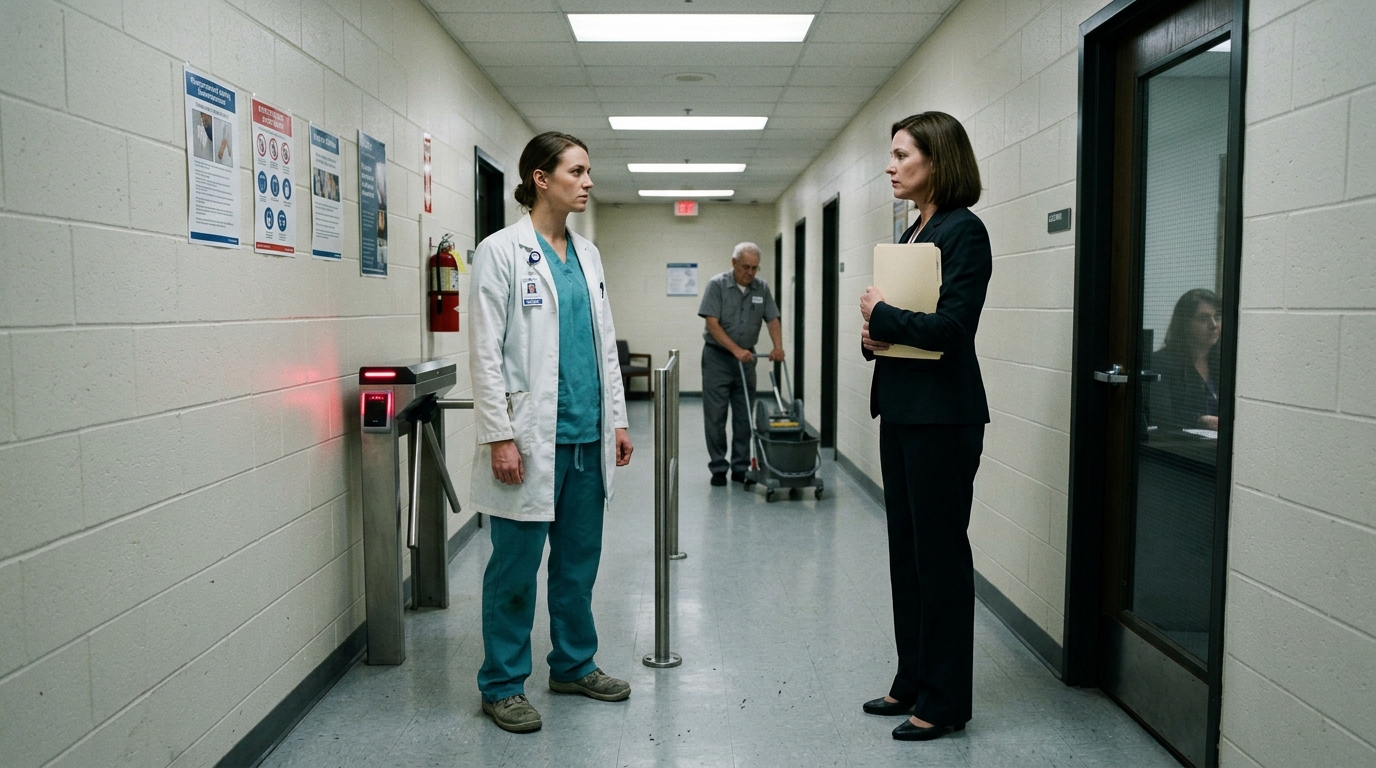
Rachel swiped her employee badge against the glass turnstile of St. Ann’s administrative wing, waiting for the familiar green flash. Instead, a harsh, low-pitched double-beep echoed off the tile. The light blinked an unforgiving, sterile crimson.
“Access revoked,” the machine stated flatly, its automated voice devoid of human pity.
Ellenar Green stepped out from the hallway corner, her posture rigidly upright, holding a manila folder against her chest like a shield. She didn’t look at Rachel’s face; her eyes locked onto the red light glowing above the turnstile.
“The board has reviewed the incident from yesterday,” Ellenar said, her voice clipped and professional. “Effective immediately, your clearance is suspended pending a formal disciplinary inquiry.”
“I stabilized a crashing patient on that floor, Ellenar,” Rachel replied, her voice dropping into a low, dangerous register as she kept her hands steady. “If I had waited for registration to clear, he would have coded before the chart was even printed.”
“You bypassed mandatory physician authorization,” Ellenar retorted, taking a sharp step forward to close the distance. “And worse, the digital security footage of your little stunt has already been flagged and scrubbed from our central servers. There is no record of his vital signs crashing. Officially, according to our system, you assaulted a non-registered trespasser.”
Rachel’s breath hitched, her fingers tightening around the brass pen in her pocket until her knuckles turned white. She realized then that the hospital wasn’t just disciplining her—they were wiping the slate clean to protect their liability. The viral video filmed by a bystander had vanished from social feeds within the hour, scrubbed by invisible hands.
“You didn’t just suspend me,” Rachel said, narrowing her gaze at the administrator’s polished lapel. “You erased him.”
“I protected this institution,” Ellenar snapped, turning on her heel with a sharp click of her heels against the linoleum. “Clean out your locker by five o’clock.”
CHAPTER 3: THE COLD CORRIDOR
The hospital hallway smelled of industrial floor wax and stale disinfectant. Rachel walked toward the exit with her box of personal effects, her boots clicking a sharp rhythm against the tile.
Linda looked up from the nurses’ station computer, her fingers hovering nervously over the keyboard. She didn’t speak, but her jaw tightened in a silent display of caution.
“Don’t worry, Linda,” Rachel said, her voice steady as she paused by the counter. “I’m not asking you to risk your pension.”
“They’re calling it an administrative realignment in the staff memo,” Linda whispered, her eyes darting toward the administrative hallway. “They told us not to talk about the veteran you brought in.”
Rachel reached into her pocket, her thumb brushing against the cold, smooth metal of the 1968 graduation badge Samuel had dropped. The faint engraving on the back offered no unit numbers, only a name and a year that felt increasingly out of place in a hospital run by spreadsheets.
“They can scrub the servers and rewrite the memos,” Rachel replied, setting the cardboard box down for a second to turn the metal token over in her palm. “They can’t erase what happened in that trauma bay.”
She turned toward the glass exit doors, leaving the sterile corridors behind. Outside, the evening air was biting, carrying the unmistakable chill of a town that had decided looking the other way was safer than asking questions.
CHAPTER 4: THE UNSEEN SHADOW
A single black SUV sat idling directly beneath the streetlamp across the curb, its headlights dark and its tinted windows swallowing the interior glow.
Rachel’s phone buzzed sharply against her palm, vibrating with an uninvited pulse.
A text flashed across the dark screen from an unknown number: Do you know who you saved today?
Her pulse hammered a heavy, irregular rhythm against her ribs. She gripped the metal 1968 graduation badge in her pocket, its sharp edges biting into her thumb as a grounding anchor against the rising panic.
“They’re watching the building,” she muttered aloud to the empty room, her gaze locked on the vehicle’s unmoving frame.
The hospital hadn’t just fired her to save face; they had triggered a chain reaction that reached far beyond the sterile walls of St. Ann’s. Whoever was parked downstairs knew she had the badge, and they knew she was asking questions the administration wanted buried forever.
CHAPTER 5: THE UNIFORMED ARRIVAL
Lieutenant Colonel Marcus Reed marched through the sliding entrance at the head of a double column, white gloves gripping polished leather folders.
The hospital lobby froze mid-breath. Ellenar Green rushed out from behind the reception desk, her hands twitching against her blazer lapels as she tried to intercept the line.
“You can’t just march in here without an appointment,” Ellenar snapped, her voice pitching slightly higher than professional composure allowed. “This is a private medical facility, and we have strict protocols regarding—”
Reed did not break stride or slow his pace. He stopped one inch short of blocking her path, his stone-hard gaze fixed entirely on her face.
“Your protocols nearly killed a decorated veteran of classified operations,” Reed said, his voice carrying the smooth, crushing weight of absolute command. “Colonel Samuel Brooks survived because one nurse refused to look away from a dying man.”
Flashbacks of the scrubbed servers flickered in Ellenar’s mind. She swallowed hard, her mouth opening and closing without sound as cameras from staff cell phones began recording every square inch of the confrontation.
“We followed standard institutional risk assessment,” Ellenar stammered, stepping back as the rows of Marines fanned out to secure the perimeter.
“You traded a man’s life for a clean ledger,” Reed replied, gesturing sharply toward the entrance doors where Rachel stepped into view, flanked by two solemn servicemen. “And now, you answer for it.”
CHAPTER 6: THE QUIET THRESHOLD
The heavy oak front door of her apartment clicked shut behind them, leaving the noise of the media vans and administrative fallout far outside.
Samuel Brooks sat down carefully in the wooden rocking chair, his joints settling with a soft sigh as he leaned his cane against the floorboards.
“They gave back the badge,” Rachel said quietly, setting two mugs of steaming tea on the small side table between them. “And the suspension notice has been officially expunged from the record.”
Samuel picked up his mug, wrapping his weathered fingers around the ceramic warmth. A faint, tired smile touched the corners of his mouth.
“Bureaucrats hate a paper trail when the public starts looking too closely,” Samuel said, his voice raspy but steady. “They thought scrubbing a database would make the problem vanish.”
“They forgot that people aren’t just files on a screen,” Rachel replied, taking her seat across from him.
The afternoon sun filtered through the porch lattice, casting long, peaceful shadows across the floor. There were no cameras rolling, no military escorts standing guard at the curb, and no frantic pages echoing down a sterile hallway.
For the first time in weeks, the weight of the hospital’s rigid walls lifted entirely off her shoulders, leaving only the quiet truth of a choice made when it mattered most.