The Quiet Weight of Honor: How an Aging Veteran Found Grace Outside the Sacred Gates
CHAPTER 1: THE IRON GATE
Is this some kind of joke?
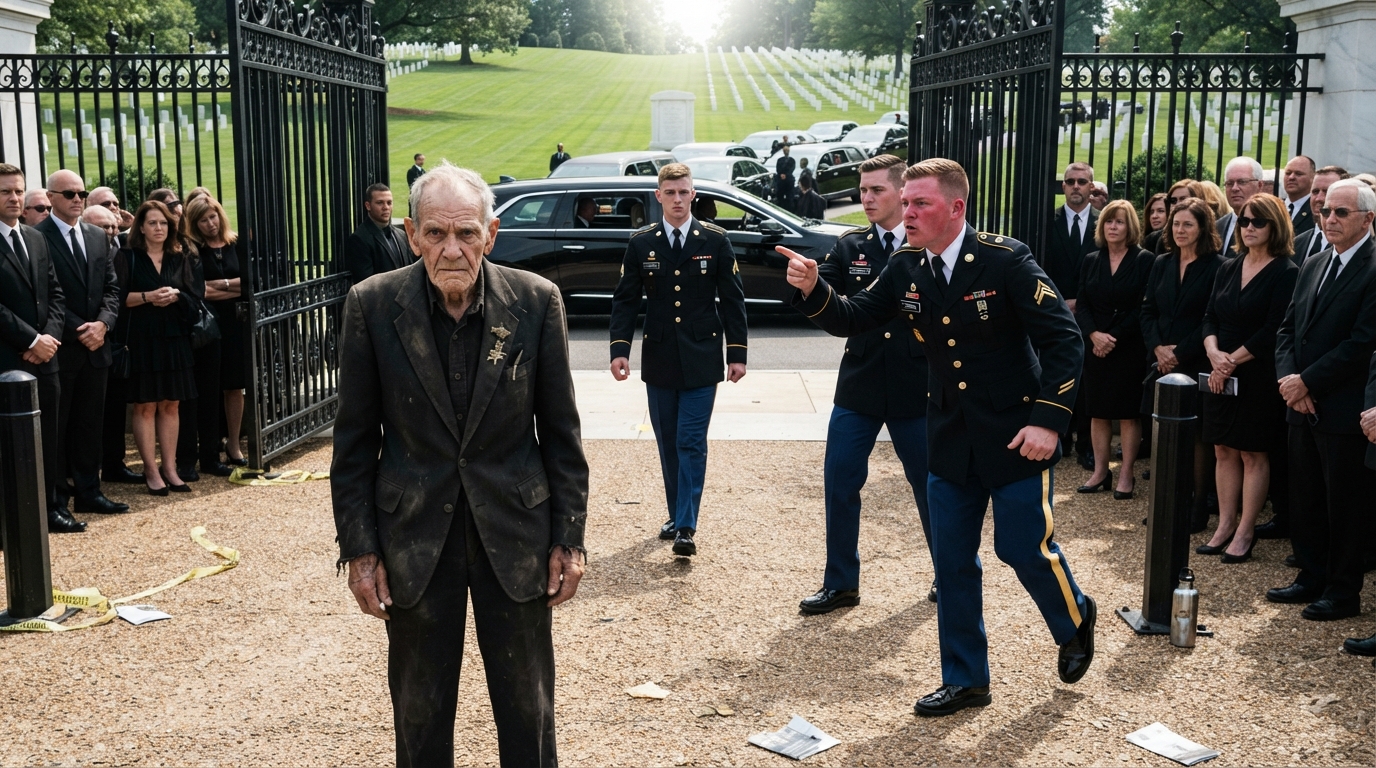
The guard’s voice cut through the solemn morning air with sharp disdain. He stood with arms crossed, a human barricade in a crisp dress uniform blocking the grand entrance to Arlington National Cemetery.
John Miller stood silent. At eighty-seven, his frame was stooped and his face mapped by a hard life. He wore a simple dark suit with frayed cuffs, perfectly clean, representing the only one he owned.
His clear gaze remained fixed on the green hills beyond the gate. The younger guard, Jennings, stepped forward with theatrical impatience.
Look, Grandpa, I don’t have time for this. The motorcade is arriving soon.
John kept his hands steady at his sides. The phantom weight of old burdens rested quietly in his bones.
I’m here for the general, John said. He would have wanted me here.
Corporal Davis let out a short, humorless laugh. Right. You and the general, best pals. General Wallace was a four-star. He didn’t have time for people without an invitation.
More cars began to queue behind the gates, their occupants casting curious glances at the old man. John felt the weight of their scrutiny, but his breathing remained slow and controlled. He had weathered worse storms than a pair of arrogant boys behind a desk.
My name is John Miller, he said evenly. Just tell them John Miller is here.
Jennings stepped closer, violating personal space with deliberate intimidation. Names don’t mean anything without the right paperwork, old-timer. You have no medals on your suit, no proof of service.
John’s hand drifted subconsciously toward his lapel. The air grew heavy with the sharp smell of gravel and impending conflict.
CHAPTER 2: ECHOES IN THE MUDS
The lieutenant’s polished shoe stopped inches from the scuffed leather of John’s old shoes.
You are making a serious mistake, old-timer, the officer said, his voice tight with manufactured authority. Step back or we clear the path ourselves.
John didn’t step back. Instead, his thumb brushed the crooked edge of the tarnished metal pinned to his chest. The touch triggered a sudden, icy drop in the air. The manicured lawns of Arlington dissolved.
The sucking mud of a jungle valley swallowed the sound of the present. Torrential rain beat down on a shattered canopy. The scent of cut grass vanished, replaced by the choking, metallic tang of cordite and fresh blood.
A young captain lay pinned beneath a heavy banyan branch, his leg twisted at an impossible angle. That young captain was David Wallace. His hands, smeared with mud and crimson, shoved a jagged piece of warm shrapnel into John’s palm.
Keep this, Wallace had gasped, his voice tight with agony. It’s not regulation. But it means you were there.
The vision shattered back into the blinding morning sunlight. The young guard was still glaring, his hand reaching out toward John’s lapel with casual disrespect.
What is this junk? Jennings muttered, his fingers grazing the edge of the makeshift pin.
John’s hand moved with the swift, hard precision of a man who had survived a hundred ambushes. He caught Jennings’ wrist, stopping the insult cold.
Don’t touch that, John said, his voice dropping an octave into a low, gravelly weight.
Jennings tried to jerk his arm back, his face flushing with sudden, frustrated anger as the old man’s grip held like a vice made of iron and sinew.
CHAPTER 3: THE BREAKING POINT
Jennings yanked his arm back, his face flushing with sudden, frustrated anger as the old man’s grip held like a vise made of iron and sinew.
Let go of me, you old fool—Jennings hissed, stumbling half a step backward on the loose gravel.
A junior lieutenant strode over from the checkpoint, his boots striking the ground with practiced severity. What is the meaning of this? Why hasn’t this civilian been removed yet?
Davis pointed an accusing finger at John’s chest. He assaulted an officer, sir. Grabbed Jennings by the wrist.
The lieutenant looked down at John with an expression of sharp disdain, adjusting the crisp bars on his shoulders. You are making a grave mistake, old man. You are trespassing on federal property during a restricted state event.
John released his grip, wiping his palm slowly against his threadbear coat as if brushing away dust. I’m here for the general.
The lieutenant sneered, stepping into John’s personal space to block his view of the rolling green hills. You don’t have an invitation, you don’t have credentials, and now you’re resisting security. Turn around and put your hands behind your back.
The crowd of mourners murmured softly behind the perimeter, their eyes fixed on the confrontation with a mix of discomfort and morbid curiosity.
Jennings and Davis lunged forward, grabbing John by both arms to force him toward the holding vehicle.
John’s feet dug deep into the gravel, his muscles locking against the sudden, humiliating pull of youth and authority.
CHAPTER 4: THE SILENT STAND
The rough concrete of the security van bumper pressed against John’s lower back as the two guards forced him backward.
Get inside and keep your mouth shut—Jennings barked, shoving hard against John’s shoulder.
John did not stumble. He planted his heels firmly into the dirt, using his weight to halt their momentum completely. The old man’s breathing remained slow and controlled, a stark contrast to the agitated huffing of the younger men.
The lieutenant hurried over, his face flushed with irritation at the delay. What’s taking so long? Push him in before the actual mourners start asking questions.
You don’t need a vehicle, John said, his voice carrying a quiet, immovable weight that cut through the morning air. I’m staying right here until the gate opens for everyone.
Davis tightened his grip on John’s arm until his knuckles turned white. You don’t get a choice, old man. You’re causing a public disturbance.
John looked past the guards, fixing his calm gaze entirely on the lieutenant. Arresting an unarmed man outside a memorial won’t cover up the fact that you’ve forgotten why these gates are open in the first place.
The lieutenant stiffened, his jaw clenching as the surrounding crowd of high-ranking officers and civilians began to slow their pace, watching the standoff with intense, quiet scrutiny.
CHAPTER 5: THE TURNING TIDE
The murmurs from the gathering mourners swelled into a distinct, restless hum.
The lieutenant glanced back at the rows of solemn faces, his institutional confidence fracturing under the weight of public scrutiny.
You are making a public spectacle of yourself, old man—the officer snapped, his voice pitching higher as he tried to regain control of the perimeter.
John did not blink. His weathered fingers reached up slowly, deliberately brushing against the dull, misshapen metal pinned crookedly to his lapel.
This isn’t a spectacle, John said, his voice cutting through the lieutenant’s panic like a razor. This is a debt.
The lieutenant stared at the tarnished piece of iron, his eyes widening as a sudden, chilling realization hit his chest. No database printed this. No standard regulation accounted for it.
Davis shifted uneasily behind John, letting his grip slacken on the old man’s sleeve. Sir, maybe we should just—
Shut up—the lieutenant barked, his face draining of color as he realized he had nowhere left to hide behind his own rules.
CHAPTER 6: THE DUSTY ROAD
The morning service proceeded past the iron gates under a heavy, contemplative silence.
The lieutenant and his guards remained stationed at the perimeter, their arrogant posture entirely replaced by a grim, exhausting realization of their own failure.
John walked past them once the gates finally parted for the public, his steps slow and measured on the paved path.
He didn’t demand an apology. He didn’t seek out high-ranking officers to punish the boys.
He simply stood quietly at the edge of the general’s resting place, paying a silent debt forged in mud and blood decades ago.
Months later, at a rainy diner far from the prestige of Arlington, the former lieutenant slid a ten-dollar bill onto the counter next to a steaming cup of coffee.
For the coffee, sir—the younger man muttered, his eyes carrying the heavy mark of humility. And for the lesson. Thank you.
John looked up from his mug, offering a small, knowing nod to the changed officer before turning his gaze back out toward the rain.