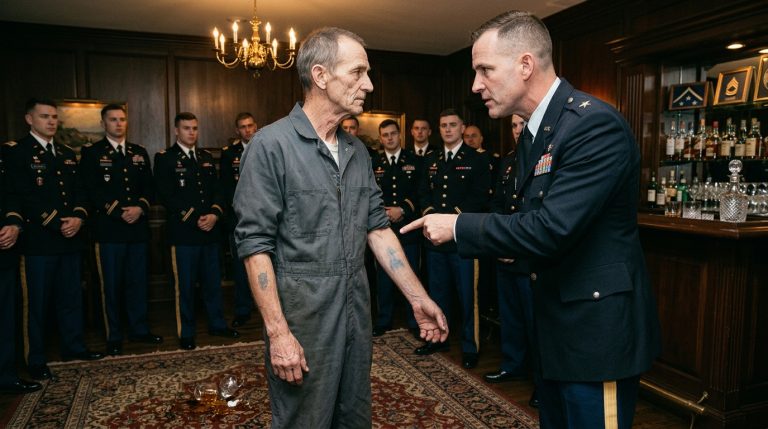
The Weight of the Wrench: Finding Wisdom Beneath the Surface of a Broken War Machine
CHAPTER 1: THE FRICTION OF YOUTH
The maintenance bay was a cathedral of noise, or at least it should have been. Now, it was a tomb of silence, broken only by the rhythmic, taunting scrape of a broom against concrete.
Sergeant Miller stared at the sprocket, his breath hitching in his chest. The track lay coiled on the floor like a severed limb. According to the diagnostic tablet in his hand—the glowing, high-tech oracle that had defined his entire tenure as a motorpool sergeant—the tension was within nominal limits. The screen pulsed a serene, confident green. The tank, however, was clearly not moving.
“Get that crane in here, now!” Miller’s voice didn’t sound like his own. It was a jagged, desperate thing that echoed off the corrugated steel walls. “We are done. This piece of junk isn’t moving!”
He hurled his heavy wrench, the one issued by the Army for “precision torque,” across the bay. It struck the concrete with a deafening clang that seemed to mock the millions of dollars in technology surrounding them. He wiped a smear of black grease from his forehead, his hands trembling—a symptom of the heat, he told himself. It was the 90-degree ambient temperature, not the crushing weight of the 1400-hour deadline looming like a guillotine.
Behind him, the Abrams sat in defiant inertia. Its left track was a mangled mess, the teeth of the sprocket stubbornly refusing to bite into the end connectors.
“You don’t need a crane,” a voice said.
It wasn’t a commanding voice. It was gravelly, low, and possessed the quality of sandpaper on weathered wood. Miller spun, his patience already evaporated, his eyes stinging with the salt of his own sweat.
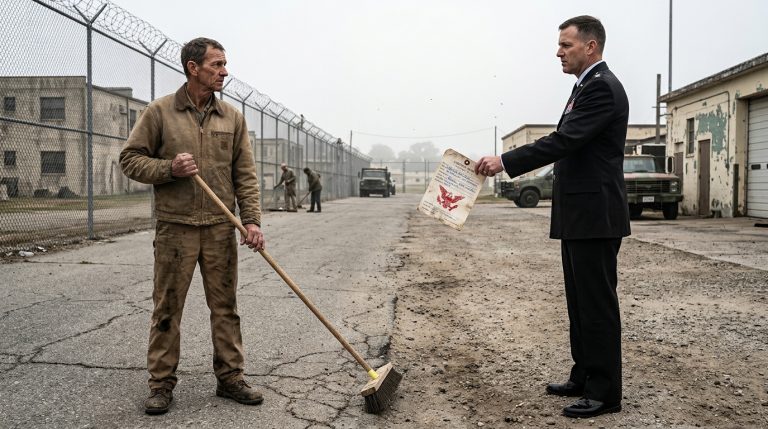
Bill stood five feet away. The janitor. He was draped in the drab, faded gray jumpsuit that made him look like a phantom of the facility, a man who had been bleached by the same sunlight that had weathered the concrete. He held his broom with a grip that looked less like a cleaning task and more like a permanent state of being.
“I said,” Miller snapped, his voice tight, “stay out of the way, Bill. This is a technical failure. Keep the floor clean, that’s your lane.”
Bill didn’t move. He leaned on the broom handle, the wood polished smooth by years of labor. His eyes, hidden behind thick, smudged lenses, drifted toward the twisted track. He didn’t look at the tablet. He didn’t look at the diagnostic data. He looked at the rubber pads, noting the way the weight of the massive tank caused the metal hull to sit at a three-degree cant against the incline of the floor.
“You’re fighting the tension, Sergeant,” Bill whispered, his gaze intense. “The machine is tired. You’re trying to force it to be something it isn’t right now.”
Miller laughed, a harsh, humorless sound. “It’s a tank, Bill. It doesn’t get tired. It’s a series of hydraulic actuators and electronic controllers. It either works or it doesn’t. And right now, it doesn’t.”
He turned his back on the old man, signaling to his crew to stop the futile hydraulic purge. His gaze flickered to the clock on the wall. 11:35 AM. He looked down at the track link once more, and in the harsh glare of the halogen lights, he noticed something his tablet had ignored. A hairline fracture in the metal, not of the track itself, but a slight, anomalous bending of the mounting bolt—the kind of microscopic discrepancy a sensor would classify as noise, but which told a different story entirely.
He had never noticed it before. He had never needed to look that closely.
The silence that followed wasn’t empty; it was heavy with the realization that the manual he had memorized was suddenly, terrifyingly incomplete.
CHAPTER 2: THE ANATOMY OF A FRACTURE
The silence in the motorpool was no longer empty; it was a physical weight, pressing against Miller’s eardrums until they hummed. He remained frozen, his eyes locked onto that singular, unforgiving streak of light reflected off the warped mounting bolt. It was a microscopic error—an imperfection in the geometry of the machine that the diagnostic tablet had dismissed as irrelevant telemetry noise. But to Miller, it felt like a scream.
“Sergeant?” The corporal’s voice was thin, nervous. “The lift team is still two hours out. Should I… should I prep the secondary seal?”
Miller didn’t answer. He couldn’t. His world, once defined by the unwavering logic of digitized manuals and the binary certainty of software diagnostics, had just developed a fracture of its own. He stepped closer, the concrete floor vibrating under the massive, silent weight of the Abrams. He ignored the tablet—the screen was still pulsing that infuriating, serene green—and reached out, his own fingers brushing the cold, grease-slicked steel of the sprocket.
He felt it then. Not through a sensor, not through an interface, but through the callouses of his own skin. A low-frequency vibration, faint as a heartbeat, radiating from the binding point. The tank was shifting, settling under its own immense gravity, and the manual’s prescribed pressure settings were essentially squeezing the life out of the suspension.
Bill was still in the corner, his presence a dark, hunched shadow against the corrugated steel wall. He hadn’t moved to help, nor had he walked away. He was watching, his faded blue eyes tracking Miller’s every movement, waiting to see if the sergeant would continue to look at the screen or finally look at the machine.
Miller exhaled, a ragged sound that felt like he was expelling a lifetime of rigid, classroom-based certainty. He crouched lower, the grit of the bay floor digging into his knees. “Forget the secondary seal,” Miller muttered, his voice barely audible over the low hum of the ventilation fans. “If we hit the hydraulic release now, the pressure differential is going to snap that mount entirely.”
He looked back at Bill. The old man didn’t react, but there was a flicker of something—an infinitesimal softening in the set of his jaw.
“The geometry,” Miller said, more to himself than to the crew. “The incline of the bay floor. It’s not just the weight; it’s the angle of the sprocket’s engagement.”
He stood up, his legs stiff, and walked toward the tool rack. He didn’t reach for the pneumatic drivers. He didn’t go for the laser alignment tools that sat in their foam-lined cases, pristine and unused. He bypassed the modern gear, his hand hovering over the row of iron, eventually settling on a pry bar. It wasn’t the six-foot monster Bill had held, but a smaller, heavy-duty crowbar—an relic of a different era, coated in a fine layer of dust that had gone undisturbed for years.
As his fingers closed around the cold, rusted iron, a sudden, sharp hiss erupted from the tank’s belly.
The entire bay lurched. A high-pressure hydraulic line, stressed beyond its limit by the uneven torque Miller had forced minutes earlier, began to bulge. It was a balloon of synthetic fluid ready to burst. The room seemed to tilt. The corporal scrambled back, shouting a warning, but Miller stayed put, his eyes fixed on the line. This wasn’t a computer error. This was immediate, physical, and catastrophic.
“Get back!” Miller roared, but his feet didn’t move. He had to counteract the pressure, not with more force, but with leverage.
He moved to the tank’s undercarriage, the smell of hot oil becoming thick and cloying. He didn’t know what he was doing by the book, but he knew, with a sudden, intuitive clarity, that if he didn’t stabilize the idler arm within the next sixty seconds, the entire track assembly would shear off the hull. He wedged the tip of the crowbar into the gap he had been studying—the one the diagnostic tablet had deemed a non-issue.
The metal groaned, a sound of profound mechanical protest. Miller leaned into the bar, his muscles screaming, his boots sliding slightly on the oil-slicked concrete. He wasn’t thinking about the general’s arrival. He wasn’t thinking about his rank. He was just trying to keep the piece of iron from snapping, feeling the sheer, terrifying power of sixty tons of steel pushed to its breaking point.
For a heartbeat, he was terrified. Then, he felt Bill’s hand—gnarled, dry, and surprisingly steady—rest on the shaft of the crowbar, just above his own grip.
“Lower,” Bill whispered, his voice like the grinding of gears. “You’re fighting the frame. Give it to the steel.”
Miller didn’t argue. He didn’t care about protocol. He adjusted his stance, felt the weight shift, and for the first time, he felt the tank move—not because he forced it, but because he finally understood where it wanted to go.
CHAPTER 3: THE ECHO OF THE GENERALS RECOGNITION
The metallic thud of the track seating itself into place felt like a tectonic shift within Miller’s chest. The tension that had held the suspension in a state of agonizing, rigid suspense suddenly slackened, the sixty tons of steel settling into the concrete with a sigh that seemed almost human.
Miller let go of the crowbar, his hands shaking so violently he had to tuck them into the pockets of his coveralls. He looked at Bill, who had already stepped back, his posture as nonchalant as if he had merely been shooing a fly from a countertop. The old man reached into his breast pocket and produced a rag, casually wiping the residual grease from the iron tool before placing it back on the wall rack.
“She’s sitting true now,” Bill said, his voice flat, devoid of any demand for credit.
“How?” Miller whispered. His voice was raw, his eyes darting from the track to the diagnostic tablet, which was still displaying a frantic, nonsensical loop of red and green errors. “The manual… the pressure rating—I followed every step, Bill. By the book.”
Bill paused, his fingers lingering on the wooden handle of his broom. “The book was written by men who wanted to standardize the world, Sergeant. But the world doesn’t like to be standardized.”
Before Miller could press him further, the rhythmic crunch of tires on gravel outside pulled their attention toward the bay doors. The massive hangar entrance rolled upward, a cavernous aperture letting in a shaft of white-hot afternoon light that sliced through the dust motes dancing in the air.
A Humvee led the procession, flanked by two staff cars, their chrome surfaces polished to a blinding sheen. Miller’s stomach dropped. It was 13:50. General Sterling had arrived early.
The mechanics scrambled, dropping their tablets and straightening their uniforms, their faces masks of disciplined terror. Miller stood frozen, a smear of grease still streaking his cheek, his hands stained dark with the work he had just performed. He looked at the tank—perfectly aligned, the sprocket teeth locked into the connectors with an elegance the hydraulics never could have achieved—and then at the janitor, who had retreated to the far wall, his broom rhythmically sweeping up the metal shavings he had created just by being there.
General Sterling stepped out of the lead vehicle. He was a mountain of a man, his presence turning the vast motorpool into a confined, high-pressure cockpit. He walked with a heavy, purposeful gait, his eyes scanning the bay not with the detached interest of an inspector, but with the sharp, predatory intensity of a combat commander.
“Sergeant!” The General’s voice cut through the mechanical hum of the ventilation fans like a blade.
Miller snapped to attention, his salute instinctive, his heart hammering against his ribs. “Sir! Maintenance platoon reports the unit is mission-ready.”
Sterling stopped in front of the Abrams. He didn’t look at the maintenance tablets. He didn’t ask for the logbooks. He walked a slow, deliberate circle around the tank, his gloved hand tracing the fender. He paused at the track, his eyes narrowing as he inspected the seat of the sprocket. He leaned in, his face inches from the metal, and then he stood up, a slow, grim smile spreading across his granite features.
“Good tension,” Sterling murmured. He turned to look at the crew, his gaze resting finally on Miller. “Who is your lead mechanic? This is a level of alignment I haven’t seen since the Gulf.”
Miller’s throat went dry. The pride he usually felt—the need to own the accomplishment, to prove his technical proficiency to the three-star general—clashed with the raw, uncomfortable truth of the last ten minutes. He glanced at the dim corner of the bay, where Bill was methodically clearing a pile of debris.
“Sir,” Miller began, his voice wavering. He looked at his own hands, the grease still tacky on his skin. “I… I can’t take credit for this. The electronic interface failed us. The facility caretaker, sir—he intervened.”
Sterling’s brow furrowed, his eyebrows knitting into a thick, dark line. “The caretaker?”
“Yes, sir. Bill Williams.”
The General’s expression shifted, the hard lines around his eyes softening, a flicker of something ancient and unreadable crossing his face. He didn’t look at Miller anymore. He turned toward the corner, his eyes widening as he squinted into the gloom.
“Bill?” The General’s voice wasn’t a command; it was a question, filled with a sudden, uncharacteristic vulnerability.
Bill stopped his sweeping. He stood straight, and in that moment, the slouch disappeared, the limp seemed to lose its prominence, and the janitor vanished. A Master Sergeant stood in the shadows.
“Hello, Mike,” Bill said.
The silence that followed was absolute. Miller watched as the General walked across the oil-slicked floor, ignoring the protocol, ignoring the junior officers staring in disbelief. He watched as the man who held the careers of hundreds of soldiers in his hands reached out and pulled the man with the broom into a long, silent embrace.
In the periphery of Miller’s vision, as he stood stunned, he noticed something on the workbench near the corner—a forgotten, hand-annotated maintenance ledger, its pages yellowed and filled with margin notes written in a familiar, jagged script. It was tucked behind a diagnostic unit as if hidden. Miller moved toward it, his curiosity overriding his caution. He flipped it open. The pages were filled not with electronic specs, but with hand-drawn diagrams of tank suspensions, each annotated with dates from 1991 and notes on “the wedge.” It was the source. The ghost manual.
He realized then that the “janitor” hadn’t just been a soldier; he had been the architect of the very rules Miller had been trying to follow.
CHAPTER 4: THE SHIFT
Miller held the ledger as if it were made of glass. The General and Bill had moved toward the staff car, their conversation a low, rhythmic murmur that didn’t drift back to the bay. The maintenance crew was still scattered, caught between the shock of the General.
CHAPTER 4: THE SHIFT OF WEIGHT
The ledger felt heavier than the iron crowbar, though it was composed of nothing more than brittle, yellowing paper and faded ink. Miller stared at the cover—a plain, gray-cardstock binder marked with a military identification code that had been decommissioned nearly thirty years ago. His fingers, still stained with the dark, pervasive grease of the Abrams’ chassis, left faint, oily smudges on the edges of the pages as he flipped through them.
He moved away from the corner, his steps silent on the concrete, and retreated into the cramped, glass-walled office that overlooked the maintenance bay. He needed the space. He needed the walls to contain the sudden, frantic expansion of his own perspective.
The mechanics were still standing at attention near the tank, their eyes fixed on the empty space where the janitor had been. They looked lost, like children who had suddenly realized the ground beneath them was not, in fact, solid. Miller ignored them. He sat at the metal desk, the swivel chair creaking in protest, and opened the ledger beneath the harsh, flickering fluorescent light.
The entries were meticulous. They were not merely logs of repair times or parts replaced; they were observations of human movement and machine response. “14 Feb, 1991. The suspension binds if the hull is leveled at an angle exceeding three degrees,” one note read, written in that familiar, jagged hand. “It isn’t a mechanical fault; it is an interaction between the vibration frequency and the road-wheel density.”
Miller felt a chill that had nothing to do with the drafty hangar. He had spent years—his entire career, really—insisting that the machine obeyed the digital code, that if the sensors were green, the machine was healthy. He had treated the tank as a closed system, a logical circuit. But these pages described a living, breathing entity.
He glanced through the glass partition at the M1 Abrams. It sat in the dim light of the bay, a dormant leviathan. Through the lens of these notes, it no longer looked like an assembly of parts; it looked like a complex, temperamental organism.
A sudden, jarring vibration outside caught his attention. He looked up, his pulse spiking, as he saw the General’s staff car idling near the bay entrance. General Sterling was standing beside the open door, his silhouette framed against the vast, empty sky beyond. He was pinning a set of combat ribbons onto his jacket—the sight of the crimson and gold silk triggered a sudden, intrusive memory in Miller’s mind: a failed training drill, years ago, where a tank had locked its tracks in the mud, and he, in his arrogance, had ordered the crew to punch the override, resulting in a shattered transmission and a career-ending mark on his file.
He closed his eyes, the memory of the screaming gears and the subsequent humiliation washing over him like cold water. The General’s ribbons were the same as the ones he had seen in the training manuals—they were the symbols of the “Standard Procedure” that had guided him into that failure.
“Sergeant.”
Miller jumped, the ledger nearly sliding from his desk. The corporal was standing at the office door, his face pale, his eyes wide with a mix of confusion and lingering shock.
“The team… the heavy lift unit is outside, sir. They want to know if they should begin the standard tow-down procedure now that the inspection is over.”
Miller looked at the corporal, then back to the ledger. The “standard procedure” was the same logic he had used to justify the initial failure. It was the logic that kept the tank broken.
“Tell them to wait,” Miller said, his voice steadying.
“But sir, the inspection is finished. The protocol dictates—”
“I don’t care about the protocol,” Miller interrupted, and for the first time, he didn’t feel the sting of insubordination. He felt the weight of the machine in his bones. “Tell them we’ve already performed the realignment. Tell them the tank is operational, but it’s sitting in a specific load-balance state. If they try to tow it now, they’ll break the sprocket assembly.”
The corporal hesitated, his hand lingering on the doorframe. “Sir, if we deviate from the standard tow-down—”
“Then we’ll be the ones who have to fix it, just like we did ten minutes ago,” Miller finished. He turned back to the ledger, his gaze dropping to a page dated mid-March, 1991. The heading was simply: The Vow.
He didn’t read it. He couldn’t yet. He felt as though he were standing on the edge of a precipice, staring into the dark reality of what true competence actually cost. He looked at his grease-stained hands, then at the pristine, untouched diagnostic tablet sitting on the corner of his desk. With a deliberate, measured movement, he reached out and clicked the tablet’s power button, watching as the green light faded into a flat, empty black.
He wasn’t going to look at the screen anymore. He was going to look at the machine.
CHAPTER 5: THE SATURDAY CLINIC
The motorpool was a cavernous void on a Saturday morning. The usual roar of pneumatic tools and the aggressive barking of NCOs were replaced by a dead, ringing quiet that seemed to amplify the sound of Miller’s own breathing. He stood in the center of the bay, the hand-annotated ledger resting on a workbench beside him.
His crew was assembled—a skeleton team of three mechanics, their faces weary, their posture defensive. They looked at the tank, then at Miller, then at the empty corner where Bill usually stood.
“I don’t get it, Sarge,” the corporal said, his voice hesitant. “We’ve got the full diagnostic suite. We’ve got the technical manuals. Why are we doing this… ‘clinic’?”
Miller didn’t answer immediately. He walked to the Abrams, his hand hovering over the track. The metal felt cold, indifferent. He thought back to the way Bill had touched it—not like a surgeon handling a patient, but like a musician checking the tension of a string.
“Because,” Miller said, his voice hitting the high, hollow ceiling and scattering, “the machine knows things the software doesn’t. And if we want to be masters of this equipment, we have to stop reading about it and start listening to it.”
He didn’t wait for their approval. He reached for the crowbar. He held it for a moment, feeling the weight—the balance of it, the way it acted as a physical extension of his own arm. He moved to the rear idler wheel.
“I want you to engage the transmission,” Miller commanded, looking at the driver. “Neutral steer. Left side only. Just a bump.”
“Sarge, the computer’s diagnostic loop is still active,” the driver argued, tapping his headset. “It’s throwing a fault code on the torque sensor. It’s telling me the hydraulic pressure is unstable.”
“Ignore the sensor,” Miller snapped, his eyes locking onto the driver’s. “Listen to the engine. Listen to the track.”
The driver hesitated, his hands hovering over the control grip. For a long, agonizing second, the silence stretched, thick with the tension of two competing realities: the screen’s digital certainty versus the old, analog promise of the ledger. The driver took a breath and engaged the transmission.
The turbine began to whine—a high, piercing note that quickly deepened into a heavy, thrumming roar.
Miller stepped in, his boots planting firmly in the dust. He found the fulcrum point. He didn’t look at the tank’s exterior; he felt the internal resistance, the subtle, shifting friction of the track teeth fighting against the sprocket. He braced himself, leaning into the leverage.
Clack.
The sound was sharp, definitive. The track shifted, seating itself with a mechanical finality that was unmistakable.
But then, a second sound followed. A grinding, metallic screech that tore through the bay.
The crew flinched. Miller felt the crowbar jolt in his hands, a violent, buzzing vibration that traveled straight up his arms and into his teeth. The sprocket continued to spin, but the track wasn’t catching; it was slipping, the teeth scraping against the end connectors.
“Stop!” Miller shouted.
The driver slammed the controls, but the turbine surged, a momentary, uncontrolled spike in output. Miller felt the crowbar kicked out of his hands, clattering across the floor as the sprocket spun free, completely out of alignment.
A red light flickered to life on the diagnostic panel. The siren began to wail—a harsh, rhythmic pulse that filled the bay with a sense of impending disaster.
“The torque sensor!” the corporal yelled over the siren. “It’s not just reporting a fault, Sarge—it’s overriding the transmission!”
Miller watched, paralyzed, as the tank’s internal safety protocols engaged. The machine wasn’t just stalling; it was locking down. The automatic locking pins on the road wheels slammed home, a cascade of mechanical engagement that made the whole bay shudder.
He stared at the machine, his breath coming in shallow, ragged gasps. He had done exactly what Bill had shown him. He had applied the same leverage, the same timing. But the machine had resisted.
“It’s not working,” the driver said, his voice laced with the cold, hard realization of failure. “The machine is fighting us, Sarge. The computer… it’s locked the whole assembly. We can’t move it manually now.”
Miller looked at the ledger, sitting innocuously on the bench. He had thought it was a map to mastery. Now, looking at the locked-down, unresponsive hulk of the tank, he realized with a sinking heart that he had missed something critical. The machine wasn’t just a physical object. It was a defensive system, and he had treated it like a plaything.
His eyes scanned the bay, searching for something—a shadow, a clue, a hint of what he had overlooked. And that was when he saw it. A faint, oily residue on the road-wheel hub, a sign of a slow, internal pressure leak that wasn’t showing up on any sensor, but which explained the entire geometry failure.
He hadn’t been fixing a track. He had been ignoring a catastrophe that was happening on the inside.
CHAPTER 6: THE GHOST IN THE MACHINE
Miller’s fingers hovered over the road-wheel hub, the oil feeling thick and viscous against his skin. It wasn’t standard lubricant; it had a slight, bitter scent and a dark, charcoal-like consistency. It was debris—fine, metal-on-metal shavings that had been circulating through the hydraulic lines for weeks, maybe months.
“The filter,” Miller breathed, the realization hitting him like a physical blow. “It’s bypassing the bypass.”
He stood up, his knees cracking in the silence of the bay. He looked at the diagnostic tablet, now a black, dead slab of glass on the desk. All those weeks of ‘green’ status reports, all those hours spent trusting the automated health-check sequences—they were a lie. The system wasn’t malfunctioning; it was being fed false data by a degraded sensor array that was physically unable to detect the contamination.
“Sarge?” The corporal was standing a few feet away, his face etched with anxiety. “The locking pins have engaged. We can’t disengage them through the interface. The computer thinks there’s a critical pressure breach and it’s refusing to cycle the system.”
Miller turned to him. “It’s not a breach, Corporal. It’s a clog. The sensor is blinded.”
He looked back at the tank, the Abrams a hulking mass of shadows in the dim hangar. He needed to clear the line, but to do that, he had to physically open the manifold while the system was under full, trapped pressure. It was a hazardous maneuver—the kind they specifically warned against in the training manuals. If the seal popped, it could take a finger off.
“Get the manual override wrench,” Miller said, his voice dropping into a register of calm, cold precision.
“Sarge, the manual says—”
“I know what the manual says,” Miller interrupted, his eyes fixed on the manifold. “The manual assumes the system is functioning as designed. But this system is already broken. If we wait for the heavy lift team, the internal pressure is going to blow the seal on the actuator itself, and then the tank is truly dead. We have one chance to bleed it manually.”
He watched the corporal scramble to the tool wall. Miller felt a strange, detached sense of clarity. For his entire career, he had feared the wrong things. He had feared the paperwork, the reprimands, the “out-of-spec” warnings on his screen. He had never feared the machine itself. But looking at the Abrams, he felt a strange, haunting kinship. It was a veteran, too. It was tired, it was clogged, and it was screaming for relief.
As the corporal returned, Miller took the wrench. He knelt by the manifold, the concrete cold against his legs. He placed the tool on the bolt, his heart rate steadying. He thought of Bill, and the way the old man had looked at the tank—not with fear, but with a kind of profound, weary patience.
He applied pressure. The bolt resisted, seized by years of heat cycles and oxidized grime. Miller didn’t force it. He felt the tension, the subtle give of the metal. He waited, applying just enough torque to coax the bolt, rather than break it.
Creak.
A tiny, hairline fissure opened in the seal. A thin, pressurized spray of black fluid hissed out, misting the air with the smell of scorched oil. Miller didn’t flinch. He stayed low, his face shielded, watching as the pressure gauge on the side of the housing began to drop.
One PSI. Two. Five.
He was breathing in sync with the machine, feeling the release of the trapped energy. As the pressure leveled, he felt a strange, sinking sensation—the realization that he was the only thing standing between this machine and total catastrophic failure.
“It’s dropping,” the corporal whispered. “The pressure is dropping, Sarge.”
“Keep it steady,” Miller murmured, his eyes locked on the manifold.
He was nearly there. But then, a flicker of movement caught his eye. A shadow, long and thin, stretched across the bay floor from the hangar entrance. A security detail, flanked by a young officer with a tablet, was marching toward the bay. They weren’t inspectors; they were maintenance-oversight.
“Sergeant Miller!” the officer called out, his voice echoing in the rafters. “We’ve logged an automatic diagnostic failure in this sector. You are currently in violation of standing safety protocols by manually overriding the manifold assembly. Stand down immediately or you will be relieved of duty.”
Miller didn’t look up. He felt the bolt yield another fraction of an inch. He was so close. The entire tank was waiting for this one release—this one simple, manual act of mercy. If he stopped now, the pressure would build back up, and the tank would be lost.
“Corporal,” Miller said, his voice hard. “Keep them away from the workbench. I’m not done yet.”
“Sarge, they’re ordering us to shut it down!” the corporal hissed, his voice shaking.
Miller finally looked up, his face grim, a smear of black fluid across his brow. “If we shut it down, we let it die. Is that what you want? To be the ones who stood by while the machine broke because the computer told you to?”
He turned back to the bolt, his hands steady. He had found the fulcrum, and now, he had to hold the line.
CHAPTER 7: THE GHOST IN THE MACHINE
The bolt yielded with a sound like a dry branch snapping in winter.
For a heartbeat, there was no sound at all—only the sudden, violent release of pressure. Then, the hiss turned into a roar. Black hydraulic fluid, pressurized and hot, erupted from the manifold, spraying across Miller’s coveralls and splashing against the concrete in a widening, shimmering pool. He didn’t pull back. He couldn’t. His hand was still on the wrench, his shoulder braced against the tank’s chassis to maintain the seal as the system purged the trapped air and debris.
The oversight team stopped in their tracks. The young officer, his face pale and eyes wide, stood frozen as the oily spray misted the air around Miller.
“Sergeant! I ordered you to cease!” the officer shouted, his voice cracking. “Do you have any idea what you’re doing? You’re dumping restricted-class hydraulic fluid and compromising a mission-critical asset!”
Miller didn’t look at him. He couldn’t. If he moved his hand, the fluid would spray into the open electronics bay, shorting out the entire tank’s command module. He was locked in a physical struggle with the machine, fighting to control the bleed until the pressure dropped low enough to seat the new seal.
“Corporal!” Miller roared, his voice straining against the hiss. “The valve! Close it now!”
The corporal, galvanized by the sheer intensity of the command, lunged for the secondary bleed valve. He didn’t look at the officer. He didn’t look at the warning signs. He slammed the valve shut just as the stream of fluid slowed to a dribble.
Silence returned, though it was now filled with the sharp, metallic tang of hot oil.
Miller slumped back, his hand finally dropping away from the wrench. He was coated in black fluid, his face streaked, his clothes heavy and slick. He looked up, his chest heaving, to find the young officer standing over him, hand on his sidearm, his expression one of pure, unadulterated shock.
“You’re done, Miller,” the officer hissed, his face twisted. “You’ve willfully destroyed government property and ignored a direct order from a superior officer. You are relieved of duty, effective immediately. Get out of this bay.”
The officer’s team moved in, their boots splashing in the oil, their movements aggressive and fast. But Miller didn’t scramble. He didn’t beg. He felt a strange, terrifying sense of peace. He looked at the tank—the M1 Abrams, which had been silent and immobile just moments ago—and saw it shift.
A soft, pneumatic chuff echoed from the suspension. The locking pins, now that the pressure was normalized and the clog cleared, clicked open. The tank settled, its tracks perfectly aligned, its suspension once again balanced, ready.
“I didn’t destroy it,” Miller said, his voice quiet, almost eerily calm. “I fixed it.”
The officer stepped forward, grabbing Miller by the arm to haul him to his feet. “You’re delusional. You just jeopardized the readiness of the entire battalion for an old janitor’s superstition. We’re scrubbing the entire system, and you—you’re going to be looking at a court-martial.”
Miller allowed himself to be hauled up. He looked past the officer, toward the bay doors. General Sterling was standing there, his arms crossed over his chest, his face an unreadable mask of granite. Beside him, Bill stood with his broom, his expression as neutral as the day Miller had first met him.
The General walked forward, his boots steady on the concrete. The officer immediately snapped to attention, his face flushing red.
“General, sir! We have a situation—Sergeant Miller has violated protocol and damaged the asset—”
“I see the asset,” Sterling interrupted, his voice low and dangerous. He walked right up to the tank, ignoring the mess on the floor. He ran a hand over the track, checked the tension, and then looked at the diagnostic tablet, which was still dark. “It’s alive, isn’t it?”
The officer blinked, confused. “Sir?”
“The machine,” Sterling said, his eyes shifting to Miller. “He understood that it wasn’t a computer file. He understood that it was a machine that needed to be heard.”
The General turned to Bill. The old master sergeant leaned on his broom, his faded blue eyes meeting Sterling’s with an intensity that seemed to hold the weight of their shared history.
“He’s got the touch, Mike,” Bill said, his voice barely a whisper in the vast, silent bay. “He’s got the touch.”
Sterling looked back at Miller. The shame Miller had felt hours ago—the need to justify himself, the fear of losing his stripes—vanished. He saw the General look at the wrench on the floor, then at the oil-stained hands of his sergeant.
“Pack your things, Miller,” Sterling said.
“Sir?”
“Not your kit,” the General said, a slow, grim smile appearing on his face. “Pack your technical manuals. We’re going to rewrite them. Starting tomorrow.”
The officer stood by, jaw slack, as the General walked out, Bill trailing behind him. Miller looked at the tank one last time—his tank—and for the first time in his life, he didn’t need a computer to know it was ready.
CHAPTER 8: THE LEGACY OF THE WEDGE
Miller watched the General and Bill disappear through the bay doors. The silence that rushed back in to fill the space was different this time; it wasn’t the heavy, suffocating silence of a dead machine, but the quiet, expectant stillness of something waiting to be understood. He stood by the Abrams, his clothes heavy and cold against his skin, his hands still trembling from the adrenaline.
He walked over to the workbench, his boots creating a rhythmic, hollow sound against the concrete. The hand-annotated ledger lay open, its yellowed pages ruffled by a draft from the open hangar. He reached it and picked it up. He turned the pages to the one he had glanced at earlier: The Vow.
The writing was less jagged, more deliberate than the other notes. “March 14, 1991. We lost the third tank today. The transmission seized because we pushed it, following the manual to the letter, ignoring the friction I felt in the drive-train. They died because I trusted the paper more than my own hands. I swore then that no one under my command would ever rely on a manual to solve what only intuition could bridge. I would be the ghost in the machine, ensuring the steel doesn’t kill the spirit.”
Miller read the words twice, the ink blurring slightly. The “Williams Wedge” wasn’t just a technical trick. It was a penance. It was a thirty-year exercise in discipline—a man who had witnessed the ultimate cost of technological detachment, and who had spent his remaining life trying to ensure that the next generation of tankers wouldn’t make the same fatal error.
He looked at the iron crowbar resting on the wall rack. It was just a tool, but it felt like a holy relic.
He didn’t need the General’s new manuals. He didn’t need the oversight team’s tablets. He walked over to the crowbar and took it down. He carried it to the workbench, found a clean rag, and began to wipe away the oxidation and the grime, his movements slow, deliberate, and reverent. He felt the texture of the iron—the chips, the scratches, the honest, hard-earned wear of a tool that had seen things no computer would ever understand.
He worked in the fading evening light, the bay growing dim as the sun dipped below the horizon, casting long, orange bars across the floor. The tank sat in the center of the bay, a silent sentinel, its suspension settled, its track perfectly seated. It wasn’t just a machine anymore. It was a partner.
He thought about the “consulting role” Sterling had mentioned. He thought about the clinics, the Saturdays, the young mechanics who would come in looking for shortcuts, looking for a way to let a machine do their thinking for them. He would be there. He would have the crowbar. He would have the ledger. And he would teach them the touch.
He finished cleaning the tool and hung it back in its place, dead-center on the rack. He stepped back and surveyed the bay. It looked the same as it had when he had walked in that morning, but everything had changed. The clutter, the grease, the chaos—it wasn’t a mess. It was an environment. It was a living, breathing space where a machine could be understood, not just managed.
He walked to the hangar doors and reached for the manual release. With a steady, firm tug, he began to pull the heavy steel doors down, the mechanical groan of the tracks sounding like a deep, satisfied growl. As the world outside faded—the distant roar of the base, the artificial lights, the relentless, high-tech pace of the 21st century—he felt the silence settle into a warm, comfortable hum.
He had expected the end of his career. Instead, he had found the beginning of his mastery.
He turned off the overhead lights, leaving only the soft, ambient glow of the exit sign casting a shadow across the Abrams’ armor. He didn’t lock the bay. He didn’t need to. He walked toward the exit, his gait steady, his mind clear. He didn’t look back. He knew the machine would be there in the morning, waiting for him, and for the first time in his life, he knew exactly how to listen.