The Piano Wire Tensioner: A Kinetic Novel of Blood, Grease, and the Ghost in the Machine
CHAPTER 1: THE SLACK IN THE STEEL
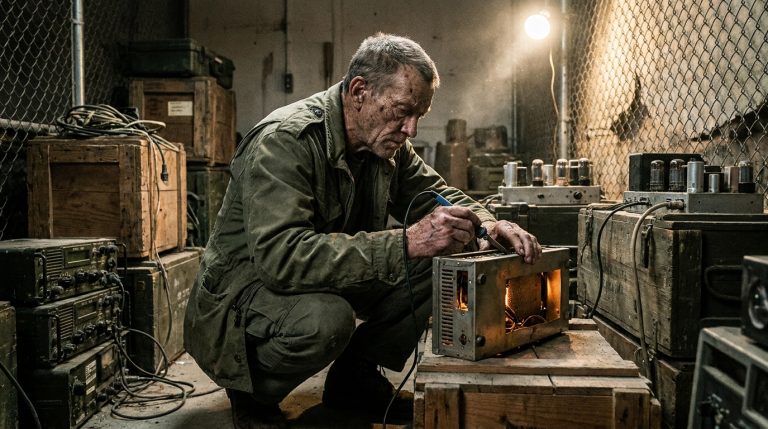
The air inside the maintenance bay did not move. It sat heavy with the reek of high-octane aviation fuel, cooked hydraulic fluid, and the damp, rotting salt of the New Guinea coast. At 2300 hours, the generators a mile down the line hummed a low, vibrating drone that rattled the marrow in Technical Sergeant James McKenna’s teeth.
He stood beneath the left boom of Lieutenant Hayes’s P-38 Lightning, his fingers slick with black graphite grease. The metal skin of the aircraft was still radiating the heat of the afternoon sun, a dull, feverish warmth against his cheek. Everyone else was asleep in the tents. Only the insects remained, heavy-bodied and blind, slamming themselves against the bare bulbs overhead.
McKenna reached up into the dark cavity of the inspection port. His calloused fingers found the primary aileron control cable where it ran through the pulley assembly toward the tail. He gave it a sharp, downward yank.
Twang.
It was a wet, loose sound. A lazy note. He pulled harder, feeling the dead space before the steel strands caught against the copper grooves of the wheel. Three-eighths of an inch. To the desk-bound engineers in Burbank, California, seven thousand miles away, three-eighths of an inch was an acceptable tolerance line on a blue-lined blueprint. To a twenty-three-year-old farm kid from Iowa flying into a cloud of Mitsubishi Zeros, it was the brief, silent gap where a twenty-millimeter cannon shell tore through the cockpit floor.
“Factory specs,” McKenna spat into the dirt.
His right hand was cramped from hours of holding the heavy iron pliers. He sat flat on the oil-stained planks of the hangar floor, pulling his tool bag between his boots. From the bottom compartment, wrapped in an oily rag, he pulled the six-inch strip of high-tensile piano wire he’d salvaged from the wreckage of a ground-looped rudder assembly. It was stiff, gray, and unyielding.
He gripped the wire with the teeth of the pliers and leaned his weight into the metal. The wire fought back, springing against his grip with vicious elasticity. On the second bend, the pliers slipped off the slick iron. The jagged edge of the wire gouged deep into the meat of his right thumb.
He didn’t make a sound. He watched the dark, sluggish blood well up, thick in the humid air, dripping onto his stained cotton coveralls. He wiped the slickness from the steel against his thigh and clamped the pliers down again, grinding his jaws together until his teeth clicked. He forced the metal into a tight, rigid Z-shape. An inline tensioner. A bootleg spring designed to pull the slack out of the military machine.
The space inside the boom was tight enough to bruise a man’s ribs. McKenna wedged his shoulder into the access hatch, the sharp edge of the aluminum skin biting through his shirt into his collarbone. He held the small flashlight between his teeth, the taste of alkaline battery juice bitter on his tongue. The beam flickered, throwing long, skeletal shadows of the control rods against the interior ribs of the wing.
His fingers fumbled with the standard clevis pin at the pulley junction. His thumb was slippery with fresh blood, losing its grip. The small iron pin dropped.
It clicked twice against the inner framework, then silence.
McKenna froze, his breath catching in his throat. His heart hammered a frantic rhythm against his ribs. If the morning inspection crew found that pin loose—or worse, if they saw him shining a light into the flight systems after hours—it wouldn’t just be a reprimand. It would be a guardhouse in Australia. A court-martial for sabotage.
He lowered his hand into the dark bottom of the boom, his fingertips scraping across cold rivet heads and forgotten metal shavings. For five agonizing minutes, he felt through the dark until his nail caught the small, rounded edge of the pin.
He pulled it out, wiped it clean of his own blood, and forced the Z-wire into the line between the cable end and the pulley block. He had to use his full body weight, pressing his chest against the structure until the steel pin finally slipped home with a clean, metallic clack.
He reached out and plucked the cable again.
The note was different now. A high, sharp, dangerous ring that died instantly in the humid air. No slack. No delay.
McKenna pulled his head from the hatch, his face glistening with sweat and red grease. He slammed the inspection panel shut, turning the screws until they locked flush with the skin. He gathered his tools in the dark, his hands trembling with the sudden realization of what he had just done. He had altered a flight control system with a piece of scrap wire.
As he stepped out into the heavy tropical night, the distant, uneven thrum of Japanese night raiders began to echo across the water of the gulf, a sound that made his belly drop like lead.
CHAPTER 2: SEVEN MINUTES OVER HUON
“Check the left boom again, McKenna. Do it now before the brass walks the line.”
Lieutenant Robert Hayes didn’t look like a man who had just torn the throat out of a Japanese fighter formation. He looked like an corpse dug out of the Iowa mud, his flight suit stiffened with dried salt, his knuckles white where they clamped around the lip of the cockpit. The twin Allison engines of the P-38 Lightning were still ticking as they cooled, a irregular, metallic snapping that sounded like a cooling stove in an empty house. The smell of scorched zinc chromate and hot iron rolled off the cowlings, thick enough to coat the tongue.
McKenna didn’t answer with words. He used the flat of his hand, slapping the hot aluminum skin of the tail boom, feeling the vibration through his leather gloves. The skin was hot enough to blister, coated in a fine, gritty layer of volcanic ash and unburnt oil that had drifted over from the strip.
“Get down out of the front office, Lieutenant,” McKenna said, his voice raspy from the dust. “You’re leaking hydraulic fluid from the starboard main gear, and if the captain sees those three kills painted on your nose before the logs are stamped, he’s going to start asking why your aircraft isn’t handling like the rest of the squadron’s trucks.”
He swung his legs over the horizontal stabilizer, his boots striking the sun-baked earth with a heavy, unyielding thud. Every muscle in his back felt like it had been scraped with a wire brush. He pulled his standard-issue inspection mirror from his back pocket—the glass was cracked down the middle, held together by a strip of friction tape—and angled it into the dark cavity of the lower pulley block.
Through the glass, the small Z-shaped piece of piano wire sat wedged between the primary cable terminal and the copper sleeve. It was under incredible load. The constant friction of the hard combat turns over the Huon Gulf had chewed into the zinc coating of the wire, leaving a tiny pile of silver dust inside the casing.
But it had held.
“It didn’t lag,” Hayes said, his boots crunching into the dry dirt as he dropped from the wing. He was shaking. Not the loose tremble of fear, but the deep, rhythmic shudder of an engine run past its redline. He reached out, his hand hovering over the small access panel McKenna had bolted down six hours ago. “I moved the stick two inches to the left to clear a snap-roll, and the nose went exactly where I pointed it. No mud. No waiting. I caught the second one right in the root because the airplane didn’t fight the roll.”
“Keep your voice down,” McKenna growled, stepping between the pilot and the main taxi track.
A hundred yards away, an engineering officer was walking the line with a clipboard, his khaki uniform crisp despite the midday glare. That clipboard held the factory specification sheets—the rigid lines of paper logic that said three-eighths of an inch of play was safe, that said field modifications were a straight path to a military prison.
“Mitchell saw it,” Hayes whispered, leaning his back against the tire, his eyes fixed on the distant ridge of the Owen Stanley mountains where the clouds were turning the color of iron slag. “He was at fifteen thousand. He said it looked like my Lightning was missing half its weight. He’s going to ask questions, Sergeant. He’s already looking for you.”
McKenna pulled a greasy rag from his belt and began aggressively wiping down the access rivets, his thumb pressing hard against the metal to feel for any structural distortion. The steel cables inside were silent now, but as his fingers traced the line of the boom, he noticed something that made his chest tighten. The inspection plate wasn’t sitting flush. The metal around the rivets was slightly warped, bulged outward by a fraction of a millimeter.
He looked closer, ignoring the sweat that ran into his eyes, stinging like lye. It wasn’t mechanical deformation from the strain of the turn. It was something else. The aluminum skin near the pulley blocks felt different—swollen, tight, like a boot that had been soaked in water and left to dry in the sun.
“McKenna.”
The voice was dry, clipped, and close.
McKenna didn’t look up immediately. He finished turning a single screw with the tip of his pocketknife, allowing the grease on his palms to smudge the seam before he stood and faced Captain Frank Mitchell.
The flight leader’s goggles were still pushed up on his helmet, leaving two pale circles on a face blackened by engine exhaust. He didn’t have his clipboard. He had an empty twenty-millimeter shell casing in his left hand, turning it over and over between his fingers with a rhythmic, metallic tink-tink-tink.
“Sir,” McKenna said, saluting with a hand that smelled of aviation gasoline and his own dried blood.
Mitchell didn’t return the salute. He looked past McKenna’s shoulder, his gaze drilling straight into the access port on the left boom of Hayes’s aircraft. He didn’t speak for a long time, the only sound between them being the distant roar of a bomber group warming up on the main strip.
“Rodriguez told me Morrison’s cables checked out within specifications after the crash,” Mitchell said softly. His voice didn’t have any anger in it; it had the flat, dangerous weight of an anchor dropping into deep water. “He said the book showed thirty pounds of tension at the tail. But Morrison’s wingman said he looked like he was pulling an anchor through a swamp when he tried to split-S away from those two Zeros.”
McKenna kept his eyes fixed on the silver insignia on Mitchell’s collar. “The manual allows for variance under tropical conditions, Captain.”
“The manual is written in California, Sergeant,” Mitchell stepped closer, the heat radiating from his flight jacket mixing with the heavy stench of the line. He dropped the empty casing into McKenna’s open tool bag. It hit the iron wrench with a dull chime. “I watched Hayes turn inside a three-plane element today. He didn’t drop his nose, and he didn’t use his altitude. He just rolled. A P-38 doesn’t do that unless the hand of God is pulling the wing down.”
He leaned in, his eyes narrowed against the glare of the sun reflecting off the unpainted metal of the fuselage.
“My flight loses two more ships this week, and we don’t have enough operational airframes to cover the morning sweep. You tell me what’s in that boom, McKenna. And you tell me before I have to ask the engineering officer to look at the maintenance logs.”
The silence that followed was heavy with the weight of the heat, the rusted metal of the hangar line creaking as the sun hit its peak.
CHAPTER 3: THE INFECTION OF WORD
“Eight minutes per aircraft, Mitchell. That’s all I’m giving you.”
McKenna didn’t look at the captain’s face. He kept his head down, his shoulder crammed back into the jagged interior of the P-38’s left tail boom. The desaturated gray metal was freezing under the midnight moisture, sweating oily condensation that dripped directly onto his forehead. His fingers, cracked and raw from working the coarse iron files, dragged another six-inch strand of piano wire through the grease-blackened pliers. The wire resisted with a mechanical stiffness, scraping hard against the skin of his thumb where the old cut had re-opened, leaving a rusty smudge on the aluminum stringer.
“Eight minutes is enough to get us court-martialed three times over,” Captain Mitchell muttered from the darkness outside the hatch. His voice was a dry raspy whisper, barely rising above the rhythmic clicking of cooling engines down the line. His shadow blocked the faint, humid moonlight spilling through the hangar doors. “The engineering officer spent two hours checking the line after dinner. He’s got an itch, McKenna. He noticed the cable tension logs don’t match what the inspectors recorded in Brisbane.”
“The Brisbane inspectors weren’t working in ninety percent humidity with air that smells like rotting jungle,” McKenna grunted, his jaw clamping hard onto his tongue as he forced the pliers to make the final, sharp Z-bend. The iron tool bit deep into the wire, producing a tiny, high-pitched scrape that sounded like an animal catching its leg in a steel trap. “He can check the logs all he wants. The factory specs say thirty pounds of tension. He puts his gauge on these lines, he’s going to get exactly thirty pounds.”
“Then why are the inspection plates bulging?”
McKenna stopped. The file stayed frozen against the steel strand. He slowly tilted his cracked inspection mirror up, catching the reflection of Mitchell’s dark, hollow eyes through the narrow access port. The micro-mystery of the warped aluminum skin around the rivets had been eating at him since noon. He’d felt it on Hayes’s ship, then on Watkins’s, and now here, on Mitchell’s own left boom. It wasn’t the tensioner twisting the metal. The wire only pulled forty-tenths of a pound.
“The alloy’s growing,” McKenna said, his voice dropping into a flat, pragmatic tone. He shoved his fingers deeper into the dark recess, tracing the edge of the internal pulley block. The block wasn’t iron; it was cast aluminum, bolted to the heavy steel frame of the boom. “The California plant uses dry-spec tolerances. Out here, the heat cooks the grease right out of the bearings, and the moisture gets inside the porous castings. The blocks are swelling in the heat, Captain. That’s what’s taking up the slack when the planes sit on the ground. The logs say thirty pounds because the blocks expand when they’re baking on the tarmac. But up at twenty thousand feet, where the air freezes, that metal shrinks back down in seconds. The slack comes back. The mud comes back.”
Mitchell was silent for three long seconds. The empty twenty-millimeter shell casing he always carried clicked twice against his ring. “So the manual isn’t just wrong. It’s a dead letter.”
“It’s a blueprint for a coffin,” McKenna said, leaning his weight forward to force the clevis pin into the wire junction. The metal resisted, iron grinding on iron with a wet, gritty friction that sent a shudder straight up his arm. “The engineers built a machine for a dry desert sweep or a cool European sky. They didn’t calculate for the New Guinea rust. If I don’t put this preload on the lines, the cold air at altitude turns these cables into jump-ropes the minute you try to pull seven Gs inside a Zero’s turn.”
“How many have you done?” Mitchell asked.
“Nine,” McKenna muttered, his fingers slick with a mixture of graphite grease and cold sweat as he locked the cotter pin into place. “Watkins did four more over at Gusap. Word’s moving faster than the malaria, Captain. Every crew chief on the line is looking for high-tensile wire now. They’re stripping old rudder assemblies, checking the scrap heaps behind the depot, cutting up salvaged piano wire in the dark.”
“It’s an infection,” Mitchell said, his hand reaching into the hatch to pass McKenna a rag. The fabric was rough, smelling of stale laundry and fuel oil. “If one of those bootleg tensioners snaps during a high-speed dive, the aileron locks wide open. The ship rolls until the wings come off the center section. You know that, don’t you?”
“I know Morrison’s wings didn’t come off,” McKenna said, pulling his bruised shoulder out of the hatch with a sharp grunt. He stood up straight, his spine popping twice in the humid stillness of the hangar. He wiped his greasy palms on his coveralls, leaving two dark streaks across the faded cloth. “Morrison followed the book, and he went into the trees at four hundred miles an hour because he couldn’t roll away from two twenty-millimeter streams. I’d rather face a court-martial for a snapped wire than look at another empty cot in the tent.”
Mitchell looked down at the small piece of cut wire lying in the dirt between McKenna’s boots. He didn’t pick it up. He just stepped back into the deeper shadow of the wing, his face desaturated by the grey mist rolling off the strip.
“The squadron leader ordered a full-squadron scramble for 0500,” the captain said, his voice dropping to a flat, level frequency. “Wewak. The Japanese are moving a fresh air fleet down from Truk. Experienced pilots. If your nine ships don’t hold their turns tomorrow, McKenna, the engineering officer won’t have any aircraft left to inspect.”
McKenna grabbed his heavy iron wrench, the cold metal biting into his raw palm. He didn’t say goodbye. He just watched Mitchell’s shadow vanish into the fog, then turned his light back toward the next P-38 waiting in the dark line, its loose cables humming a low, sloppy note as the midnight wind rattled the hangar roof.
CHAPTER 4: THE SHADOW OF THE ACE
The sound of the impact didn’t travel through the air; it traveled through the baked earth of Doadura strip, a heavy, dead thud that vibrated directly into the soles of McKenna’s grease-stained boots.
Smoke rose over the kunai grass to the northwest, a thick, oily column the color of wet slate. It wasn’t Hayes’s ship. It wasn’t Mitchell’s. It was one of the newly modified P-38s from the 475th, returning early from the intercept over Wewak with its starboard engine dead and the control surfaces unresponsive in the final three hundred feet of the glide.
McKenna didn’t wait for the ambulance. He grabbed his heavy canvas tool roll and ran toward the perimeter line, his boots churning through the loose, gray volcanic dust. The air was a blistering blast furnace, smelling of parched grass and scorched lacquer. By the time he reached the edge of the ravine where the aircraft had pancaked, the crash crew was already swinging their axes into the canopy frame, the iron blades throwing sparks against the crumpled nose section.
“Get back, Sergeant!” a lieutenant shouted, but McKenna ignored him, sliding down the dirt bank through the sharp, dry brush that ripped at his coveralls.
He didn’t care about the regulations. He didn’t care about the guards. His eyes were fixed entirely on the tail boom, which had broken clean at the radio compartment door. The jagged edges of the aluminum skin were peeled back like a tin can, exposing the inner skeleton of the aircraft to the blinding glare of the midday sun.
He dropped to his knees in the hot dirt, the sharp shale cutting through the fabric into his shin. His hands reached into the smoking gap, tearing aside frayed electrical bundles until his fingers found the main control cable run.
The wire tensioner he had taught the other crew chiefs to build was gone. Not snapped—shattered. The tiny six-inch piece of piano wire had been crushed into a flat, distorted knot between the steel terminal and the guide frame.
“It checked out,” a voice raspy with dust muttered behind him. It was Rodriguez. His shirt was soaked through with sweat, his eyes wide and vacant as he stared at the broken tail assembly. “We checked the lines at dawn, McKenna. Thirty pounds on the gauge. Perfect spec. The inspector signed the book before the props even turned.”
“The gauge was wrong,” McKenna said, his voice dropping into a dangerous, rhythmic growl as he pulled his pocketknife and dug the tip into the cast aluminum pulley block. The metal didn’t flake; it came away in dry, crumbly grains. The casting was swollen, the surface cracked into a spiderweb pattern from the intense pressure of the metal expanding against its iron mounting brackets. “The block didn’t shrink when he went up. It jammed. The heat down here didn’t just expand the metal; it baked the bearing dry, and when he hit twenty thousand feet, the whole assembly seized solid.”
He stood up, his joints popping with the grinding sound of dry hinges. He could see it now—the terrible flaw in their makeshift salvation. The piano wire hadn’t failed because it was weak; it had failed because it was fighting the machine itself. By removing the three-eighths of an inch of slack, they had left no room for the distortion caused by the jungle climate. The factory specifications weren’t just an arbitrary baseline; they were a shield against a physical variable the engineers in Burbank had never actually seen with their own eyes.
“They’re coming back,” Rodriguez whispered, pointing a trembling finger toward the southern gap.
The sound of the returning squadron was an uneven, limping rattle. Only fourteen ships broke through the grey haze over the ridge line. Hayes’s aircraft was among them, but the right boom was covered in dark streaks of engine oil, and the elevator was canted three degrees to the left.
McKenna didn’t wait for the props to stop. He ran toward the revetment as Hayes cut the mixture controls, the twin Allisons dying with a ragged, whistling hiss that sounded like a dying breath.
Hayes didn’t pull back the canopy. He sat inside the glass, his forehead pressed against the top of the instrument panel, his hands still clamped around the control yoke. When McKenna climbed onto the wing and forced the emergency release, the pilot didn’t move.
“They knew,” Hayes said, his breath fogging the glass of his instrument dials. His voice was a thin, threadbare wire. “The Zeros. They didn’t try to out-climb us today. They didn’t try to dive away. One of them—an ace, had a black stripe on the fuselage—he stayed right inside my turning circle. Every time I reversed, he reversed before my nose even cleared the horizon. It was like he knew exactly where the delay was going to hit me.”
McKenna reached down and grabbed Hayes by the shoulder, his leather glove leaving a greasy smear on the pilot’s flight suit. “Get out of the office, Lieutenant. Now.”
“The controls felt like iron, McKenna,” Hayes said, turning his head slowly, his eyes bloodshot and rimmed with grey soot. “The wire didn’t snap, but the stick wouldn’t move more than an inch either way. I had to use both hands to pull out of the final dive. If Mitchell hadn’t dropped from the sun to clear my tail, I’d be in the grass with Miller.”
McKenna looked back down at the lower inspection port of Hayes’s ship. The metal around the rivets wasn’t just bulging now; the skin had split open along the seam, exposing the raw, oxidized edge of the internal frame. The secret was out. The line inspectors were already walking down from the operations hut, their clipboards held like weapons against their chests.
“They’re grounding the group,” Mitchell said, dropping heavily from his own wing onto the taxi track. His face was white beneath the grime. “The engineering officer found three more altered ships in the second element. They’re calling it systematic sabotage, McKenna. They’ve got the MPs at the maintenance tent right now.”
McKenna didn’t look at the officers. He didn’t look at the smoke still rising from the ravine. He reached into his tool roll, pulled out his heavy iron wire-cutters, and leaned into the split skin of Hayes’s tail boom, his jaw locked tight as he prepared to cut away the only thing keeping them alive.
CHAPTER 5: THE SILENT RECORD
The concrete floor of the Long Beach garage was cracked into long, erratic fissures that filled with dry dust whenever the wind blew in from the coast. It was 1991. The heat here didn’t have the heavy, suffocating moisture of the Huon Gulf, but it still carried the faint, sharp tang of salt and old iron.
James McKenna leaned over the open block of a Buick straight-eight engine, his seventy-three-year-old knuckles scarred and stiffened by five decades of handling hard wrenches. His fingers were stained with a permanent residue of carbon grease, the black lines deeply embedded into the whorls of his skin like an old tattoo. He adjusted the socket wrench, his movements deliberate, calculated to save the remaining strength in his shoulders. Every turn of the bolt was paid for with a dull, familiar ache that started in his neck and ran down to his lower back.
The shop smelled of gasoline, turpentine, and ancient rubber—the universal scent of a lifetime spent keeping machines from falling into decay. In the back office, the light was dim, filtered through a yellowed window screen covered in a layer of fine highway grit.
“Mr. McKenna?”
The voice was thin, formal, entirely disconnected from the heavy clatter of the air compressor in the corner. A young man stood in the doorway, a canvas briefcase tucked under his arm. He didn’t look like he had ever cleaned a oil pan or split a frozen cotter pin. He had a clean notebook and a tape recorder that looked too light to be made of real metal.
McKenna didn’t drop his wrench. He picked up a rag—faded, frayed at the edges, cut from an old pair of cotton work pants—and slowly wiped the grease from his palms. “If you’re here about the transmission on the Chevy, it won’t be ready until Thursday.”
“I’m not here about a car,” the young man said, stepping into the small office. He pointed toward a small, sun-bleached frame hanging on the wall behind the desk. “My name is Miller. I’m a military historian. I’ve been going through the Fifth Air Force maintenance records from August of forty-three, and I found your signature on a series of structural deviation logs from Doadura.”
McKenna stopped wiping his hands. His gaze drifted to the frame. Inside was a single, silver-toned photograph, the edges curled and yellowed by thirty years of southern California smog. A younger version of himself stood next to the massive, unpainted nose of a P-38 Lightning, his coveralls black with engine oil, his face narrowed into a squint against a tropical sun that had set half a century ago.
“Fixed airplanes,” McKenna said, his voice flat, dropping the rag into an empty iron oil drum. “That’s all. The war’s been over a long time, son.”
“The Lockheed reports from December of forty-three attribute the correction of the aileron lag to a factory engineering analysis,” the historian said, opening his briefcase, the brass latches popping with a sharp, hollow click. He pulled out a sheaf of photocopied blueprints, the official white lines stark against a dark blue background. “But I found a buried field memorandum from an inspection team that visited New Guinea in November of that year. They found forty-two aircraft using an unauthorized inline wire modification. They estimated those pieces of wire saved between eighty and a hundred pilots before the J-model ever left the assembly line.”
McKenna walked into the small office, his boots creaking on the dry fir floorboards. He looked down at the blueprints. His eyes didn’t fix on the crisp, clean titles or the formal signatures of the corporate vice presidents in the corner. They went straight to the tail boom schematic—to the small, round pulley block that ran the control cables.
“The factory didn’t know about the blocks,” McKenna murmured, almost to himself. He reached out, his thick, rough index finger tracing the blueprint’s pristine lines, his nail catching on the paper. “They designed them in California. Beautiful rooms. No dust. No salt. They didn’t know that when you put those aluminum castings into the jungle, the metal swells up like wood in a flood. They thought the pilots were just pulling too hard on the sticks.”
“Why didn’t you say anything when the Lockheed team arrived?” Miller asked, his pen poised over the clean white page of his notebook. “Your name isn’t on any of the commendation lists. The official history says the change came from the engineering committee.”
McKenna sat down in his old wooden swivel chair, the springs groaning beneath his weight. He looked out the window at the sun-bleached street, where the light was turning the pale, desaturated color of old zinc.
“The committee had the ink,” McKenna said, his jaw tightening just enough to cause the muscle in his cheek to twitch. “We had the grease. If we waited for the paperwork to clear the department in Burbank, Hayes would have been a hole in the kunai grass before the first meeting was called. The regulations aren’t there to keep the kids alive, mister. They’re there to make sure every nut and bolt looks exactly like the one that came before it.”
He reached into his desk drawer and pulled out a small, round object. It was an old twenty-millimeter shell casing, the brass oxidized into a dark, greenish-brown crust, the base scarred by the firing pin of a fighter that had ceased to exist decades ago. He turned it over in his hand, feeling the rough, pitted texture of the metal, the weight of it familiar and cold against his palm.
“Every August seventeenth, the phone rings,” McKenna said softly, the ticking of the garage clock suddenly loud in the small room. “It’s Hayes. He’s back in Iowa. Got a farm, got grandkids. He doesn’t ask about the blueprints. He doesn’t ask about Lockheed. He just says it worked.”
He set the empty casing down on top of the blue papers, a heavy, unyielding weight that held the edges from curling back up.
“The paperwork doesn’t matter,” McKenna said, picking up his iron wrench from the desk and turning back toward the door where the Buick engine waited in the sun. “The machines either run or they don’t. The rest is just ink.”