The Frequency of Ghosts: A Veteran’s Silent War Against the Obsolescence of Truth and Steel
CHAPTER 1: The Gatekeeper’s Disdain
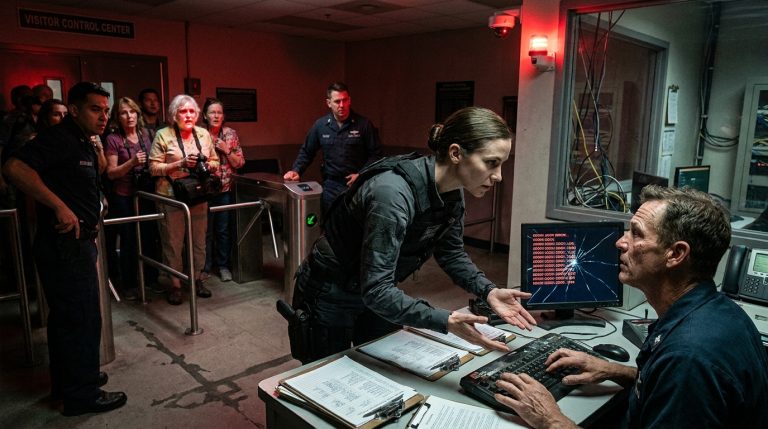
The air inside the communications tent tasted of recycled ozone and the bitter, sterile exhaustion of men who had spent too many hours staring at liquid crystal displays. Captain Derek Holland stood at the center of the hub, his posture a stiff, engineered cage of authority. He did not look like a man who was losing a war; he looked like a man who was losing a math equation he was certain he had balanced.
Harold Meeks stepped across the threshold, his heavy, worn boots dragging slightly against the rubberized mat. He was a piece of friction in a world trying to achieve perfect, frictionless efficiency. The fabric of his olive drab jacket was thin at the elbows, a faded testament to decades of movement, standing in sharp contrast to the crisp, unblemished uniforms of the staff.
“Get that old man out of my comm center before he breaks something.”
The order didn’t startle Harold. He didn’t blink. He only saw the dead rows of consoles—black glass reflecting the frustration of two thousand soldiers effectively severed from the spinal cord of their command. To Holland, these screens were the pinnacle of connectivity. To Harold, they were fragile, brittle things, easily shattered by the very atmosphere they tried to conquer.
Harold stopped, his gaze settling on a master control node that flickered with a rhythmic, dying stutter. He didn’t look at Holland; he looked at the wire feeds trailing like exposed veins from the junction box.
“Your satcom birds are being jammed, Captain,” Harold said, his voice as dry and steady as desert sand. “Or it’s a solar event hitting your K-band frequencies. Either way, your digital backbone is hollow. You’re trying to reboot a heart that has already stopped.”
Holland spun around, his jaw a hard, jagged line of frustration. He saw an old man with spotted hands and a posture ruined by a war that history had tucked away in a dusty corner. He didn’t see an asset; he saw an interruption.
“This is a restricted area, sir,” Holland barked, his voice rising, weaponizing his rank against the silence. “You are compromising a sensitive deployment. Get out. Now.”
Harold shifted, his weight leaning, as always, to the left—a permanent anchor to a frozen ridge in Korea. He looked at the Captain, not with anger, but with the hollow, detached patience of a man watching a child try to catch the wind with a net made of thread. He noticed the tremor in Holland’s fingers as the man tapped furiously at his tablet, trying to force a handshake protocol that had no response on the other end of the line.
“You’re wasting cycles, Captain,” Harold said, his voice dropping, forcing Holland to strain to hear him. “The silence out there isn’t a glitch. It’s a message.”
Before Holland could call for the guards, Harold turned. He didn’t hurry. He didn’t offer a rebuttal. He simply walked toward the tent flap, his eyes already drifting toward the silhouette of the old storage buildings on the edge of the perimeter. He knew the scent of copper and solder waiting in the dark, and he knew that in ten minutes, the silence in this room would become something far more terrifying than a failed exercise.
He reached the edge of the tent, and for a split second, he paused, his shadow stretching long and thin across the dirt floor. He glanced back, noticing a single, glowing red light on a secondary router—a status indicator that was supposed to be green.
It wasn’t a solar event. It was something far more precise. And if he didn’t reach that storage unit in time, the entire network wouldn’t just stay dark—it would start bleeding data to an audience that was already listening.
CHAPTER 2: The Scavengers Eye
Harold didn’t head for the parking lot. He didn’t head for his truck. He walked with a steady, limping gait directly toward the periphery of the base, his eyes tracing the line where the pristine, modern asphalt met the cracked, neglected concrete of the older storage sector. The tent behind him—the site of Holland’s prideful collapse—faded into a background hum of static.
The storage unit was a rectangular slab of corrugated steel, its paint flaking away in long, gray strips like dead skin. The metal groaned under the heat of the Kansas sun, a slow, metallic contraction that Harold felt through the soles of his boots. He approached the side door. It was padlocked, but the hasp was rusted, the steel pitted by years of indifferent maintenance.
He didn’t need a key. He needed a moment of privacy. He pressed his ear against the corrugated wall.
There.
Underneath the low-frequency drone of the base’s distant generators, there was a click. It wasn’t the rhythmic heartbeat of a computer. It was erratic, sharp, like a fingernail tapping against a hollow pipe. Click. Pause. Double-click. It was a mechanical twitch, an irregularity that didn’t belong in a decommissioned building housing nothing but historical exhibits. His mind, trained on the jagged waveforms of a hundred theaters of war, identified it instantly: a relay switch struggling to seat itself.
He moved to the corner of the building. The chain-link fence here was sagging, caught on a protruding piece of rebar. He squeezed through the gap, his jacket snagging on the wire. He didn’t pull away; he held still, letting the fabric tear, prioritizing the silence of his movement over the preservation of his clothes.
Inside the unit, the air was stagnant, heavy with the scent of ozone and the dry, sweet smell of dust. It was cooler here, though the heat still radiated from the roof. He stood in the threshold, letting his eyes adjust to the gloom. The room was a graveyard of military history. Stacks of wooden crates were covered in thick, graying tarps. PRC-10 radio sets, field telephones with their cords snarled like dead vines, and towers of vacuum tubes sat in chaotic piles.
He moved toward the back, where the clicking was loudest. His hand found the edge of a heavy canvas, and he pulled it back.
It was a BC-1000 transceiver, buried beneath a layer of discarded signal cables. It looked like a carcass picked clean by scavengers. The handset was missing, the battery compartment was open, and a mess of copper wire spilled out like tangled intestines. Yet, to Harold, it was a map. He reached out, his fingers hovering inches above the corroded chassis.
The clicking intensified. It was coming from deeper in the wall, behind a panel that had been hastily screwed into the interior siding. This wasn’t a display piece. It was an anomaly.
He felt the weight of his own age in the stillness—the ache in his left knee, the slight tremor in his hand. But the instinct was sharper than it had been in decades. He wasn’t just here to tinker; he was here to intercept. Whatever was driving that relay switch behind the wall wasn’t a malfunction of the exercise. It was a secondary, clandestine signal being piggybacked on the digital blackout.
He reached into his pocket and pulled out a small, multi-purpose tool—his own, not the military’s. He began to unscrew the panel, his movements efficient, practiced, and utterly silent. He didn’t care about the consequences of trespassing. He didn’t care about Captain Holland’s authority. He cared about the signal.
As the last screw came loose, the clicking stopped abruptly.
The silence that followed was heavy, almost physical. Harold peeled the panel back. Inside, hidden away from the prying eyes of the modern battalion, was a secondary, modified transceiver, its wiring freshly soldered, glowing with a dim, amber light that shouldn’t have been there. It was drawing power directly from the building’s main conduit, siphoning the very energy that was supposed to be keeping the base’s infrastructure stable.
He stared at it. It wasn’t just a piece of old tech. It was a bridge—a gateway that was currently broadcasting a pulse of data that had nothing to do with a training exercise.
He reached out, his heart rate steady despite the discovery, and touched the metal casing of the hidden device. It was warm. It had been running for a long time.
“Not today,” he whispered, his voice a gravelly rasp in the enclosed space.
He realized then that the blackout wasn’t the disaster. The blackout was the cover. And if he didn’t tear this system down, the truth wouldn’t just remain hidden—it would be transmitted, buried under the noise of a digital collapse, to someone who was waiting to receive it. He didn’t need to be a soldier to know that he was the only one on base who understood the language of this particular ghost.
He turned his attention to the wiring, looking for the primary lead, his eyes narrowing as he calculated the necessary move. He would have to bypass the relay, isolate the transmission, and kill the feed without triggering the fail-safe. He was a master at this. He had been doing it for fifty years, and he was the only one who still knew how to fight a war that had no screens, no satellites, and no mercy.
He gripped the soldering iron he’d snatched from the maintenance locker earlier, his resolve hardening like cooling lead. The game wasn’t over. It had only just entered the frequency he understood best.
CHAPTER 3: The Soldering of Memory
Harold didn’t move. He kept the soldering iron steady, the tip glowing a dull, angry orange. The ambient light of the room seemed to shrink, focusing entirely on the exposed guts of the transceiver. As he leaned in, a thin curl of smoke rose from a scorched capacitor, and the smell of ozone and burnt resin hit him with the force of a physical blow.
Suddenly, the cold air of the Kansas afternoon dissolved. He was no longer in a Fort Riley storage unit; he was in a shallow, frozen foxhole, the air thick with the acrid stench of cordite and the smell of a PRC-10 radio smoldering in his lap. He remembered the desperate, frantic speed of his younger hands, the way the frost bit into his knuckles, and the sound of mortar rounds thumping into the ridge line like heavy footsteps. The memory was so vivid he could feel the phantom ache of the shrapnel wound in his knee that had never truly healed.
He blinked, shaking the phantom cold from his shoulders. He was back in the annex. The smell of the burnt insulation was real, but it wasn’t from a battlefield; it was from this hacked, clandestine device.
A floorboard creaked near the entrance. Harold’s head snapped up.
Specialist Rivera stood in the doorway, framed by the harsh, vertical light of the outside world. She looked small, her uniform too new, her eyes wide as she scanned the shadowed clutter of the building. She had clearly been sent to retrieve something, but the sight of the old man—hunched over a wall panel, wires trailing like a surgeon’s tools—had stalled her breath.
“Sir?” she whispered. Her voice carried no malice, only a sharp, needle-like curiosity. She took a tentative step into the gloom, her boots crunching on the grit that covered the floor. “The MP at the gate said you were escorted out. What… what are you doing?”
Harold didn’t stand. He didn’t hide the device. He kept his posture guarded, his left side braced against the wall. He needed a leverage point, and he saw it in the way her gaze didn’t linger on his lack of authorization, but on the complexity of the wiring he had exposed.
“You’re a signal specialist,” Harold said, his voice raspy but authoritative. He didn’t ask; he stated it. He gestured with the soldering iron toward the amber-lit transceiver. “Tell me, Specialist. If you were running a digital exercise and your entire network failed, would you look for a hardware glitch, or would you look for who was using the airwaves you left empty?”
Rivera stepped closer, her curiosity overcoming her training. She ignored the warning bells that should have been ringing in her head. She looked at the modified radio, at the way the copper wire was coiled, and at the steady, rhythmic pulse of the amber light. Her brow furrowed, a slow dawning of realization replacing the confusion in her expression.
“That shouldn’t be here,” she said, her voice barely audible. “This building is supposed to be clean. It’s just heritage equipment.”
“Nothing is ever just what it looks like,” Harold said. He picked up a pair of needle-nose pliers from the workbench. “The Captain thinks this is a simple solar interference. He thinks it’s a failure of his gear. But he’s not looking at the signal density. Look at the frequency output on that relay, Specialist. Tell me what you see.”
Rivera hesitated, then moved behind him, leaning over his shoulder to study the diagnostic readout he had rigged to a small, portable monitor. She gasped softly.
“It’s… it’s a burst transmission,” she muttered, her fingers twitching as if she were already typing on a console. “It’s encrypted. But it’s not using our protocols. It’s too narrow. It’s like a whisper inside a hurricane.”
“Precisely,” Harold said. He felt a grim satisfaction. He didn’t need her loyalty, but he needed her eyes. “If this was just a glitch, it would be static. This is intent. Someone is using the cover of your exercise to push data out of this base, using the very infrastructure you guys think is dead.”
He turned slightly, his joints popping in the silence. He saw the shift in her—the moment she went from a soldier following an order to a technician solving a problem. She looked at his hands, steady and methodical, then back to the device.
“Captain Holland said you were a civilian,” she said, her voice dropping. “But you’re not building a display, are you?”
Harold focused back on the solder joint, his hand moving with a precision that defied the tremor he felt in his nerves. “I’m doing what I’ve always done, Specialist. I’m listening. If you want to help, you’ll stop asking who I am and start helping me isolate this transmission before it completes its cycle. We have maybe twenty minutes before the relay auto-resets and clears the buffer.”
Rivera didn’t argue. She didn’t turn around to call the MPs. She knelt beside him, the cold concrete pressing against her knees. She picked up a length of spare wire, her movements suddenly synchronized with his.
“What do I do?” she asked.
“You ground the circuit,” Harold commanded, his voice tight. “But be careful. If you cross the wrong line, the whole thing goes dark, and we lose the trace. This isn’t digital, Rivera. It’s analog. It’s raw. You make a mistake here, and you’ll feel the spark.”
She nodded, her face set in a mask of determination. In that corner of the rusting storage shed, away from the sterile, high-tech failure of the command tent, the two of them—one a relic of a forgotten war, the other a product of a digitized future—began to dismantle the hidden signal.
Harold felt the weight of the air change. He wasn’t just fixing a radio anymore. He was teaching, and in that transmission of knowledge, he felt the first, fragile threads of a new connection. But even as they worked, he knew the clicking had started again—deeper, faster, and more aggressive. Someone on the other end knew they were being tapped.
CHAPTER 4: The First Pulse
The room plunged into an intermittent, rhythmic darkness. One moment, Harold was looking at the precise, steady hand of the young specialist; the next, she was a silhouette against a strobe of dying fluorescent light. The hum of the building—the low, guttural vibration of the base’s power grid—pitched higher, then cut out entirely.
“Don’t move,” Harold snapped, his voice slicing through the sudden silence.
The soldering iron in his hand was still live, glowing with its own internal heat, providing the only stable light source in the room. He used it to navigate the space, holding it carefully as he stabilized the ground-plane wire Rivera had just finished attaching. The strobing lights had stopped, leaving them in a suffocating, heavy gloom, save for the weak, dying pulse of the amber transceiver.
Rivera’s breathing was audible, sharp and uneven. “The power,” she whispered. “That wasn’t just the solar event. The grid just dumped.”
“It didn’t dump,” Harold corrected, his eyes tracking the transceiver’s output. “It was redirected. Look.”
He gestured to the portable monitor. The strobe had caused a momentary glitch in the buffer, but in that failure, a sequence of data had spilled onto the screen. It wasn’t the scrambled noise of a solar flare. It was a clean, repetitive string of hexadecimal code. It was a destination address.
Rivera leaned in, her face illuminated by the amber glow of the device. She stared at the screen, her eyes widening. “That’s not exercise traffic. That’s a routing table for the SATCOM uplink. Someone is forcing a handshake with an off-base server.”
She reached out, her finger hovering over a control key on the monitor, but Harold caught her wrist. His grip was firm, surprisingly strong for a man of his years.
“Don’t,” he warned. “If you try to block it, you’ll trigger the anti-tamper protocol. You’ll erase the trace before we can identify where it’s going.”
“But they’re stealing bandwidth,” Rivera argued, her voice rising with a mixture of fear and professional indignation. “They’re using the exercise’s satellite capacity to mask a data exfiltration. If the Command post sees this, they’ll lock down the entire sector.”
“Which is exactly what they want,” Harold said, his eyes scanning the rusted interior of the shed, searching for the source of the power drain. “Think, Specialist. If the base goes into total lockdown, the digital security protocols reset. In that reset, there’s a three-second window where the encryption keys are dumped into a temporary cache. If they’re fast enough, they can pull the keys right out of the air.”
The weight of his words settled on her. She looked at the transceiver, then at the vast, silent dark of the base outside the storage building. “They’re using our own security against us.”
“They’re using the system’s own rules,” Harold said. He let go of her wrist and picked up a length of copper wire he had been stripping. “We don’t block the signal. We shadow it.”
He worked with a speed that belied his age, his fingers dancing over the contacts of the modified radio. He was connecting their improvised relay to the transceiver’s output, creating a bridge that would mirror the data stream without interrupting the flow. It was dangerous, delicate work, and one wrong move would send a surge through the device that would burn it—and them—out.
“I need you to modulate the frequency,” Harold said, not looking up. “When I initiate the sync, you have to keep the signal within the narrow band of the base’s natural electrical noise. If you let it spike, the monitoring software will pick up the interference.”
Rivera nodded, her hands shaking slightly as she took control of the tuning dial. She felt the heavy, textured resistance of the old equipment, a stark contrast to the touch-screens she had spent her career mastering. She closed her eyes, listening to the static—the low, chaotic hiss that Harold had told her was the sound of the world breathing.
She turned the dial. A millimeter to the left. A millimeter to the right.
Suddenly, the static changed. It sharpened into a rhythmic, harmonic thrum.
“Got it,” she whispered.
“Good,” Harold said, his voice grim. “Now, we watch.”
On the monitor, the hexadecimal string continued to scroll, a waterfall of data that was now being copied and routed through their own improvised, rusted bridge. It was a digital ghost, being captured by a machine built in a time before the internet existed.
They sat in the dark, the scent of ozone thick enough to taste, watching the progress bar crawl toward completion. Every percentage point gained felt like a tactical victory, a small, hard-won stand against the invisible theft occurring right under the noses of two thousand soldiers.
Harold watched the monitor, but his ears remained tuned to the outside. The base was deathly quiet, the silence of a machine that had been forced to stop. But he knew better. The machine wasn’t dead. It was being dismantled, and he and the girl in the shadows were the only ones holding the pieces together.
“It’s finishing,” Rivera said, her voice tight with tension.
The progress bar hit 100%. The amber light of the transceiver flared bright, then faded to a dull, cold gray. The link was dead.
“Pull it,” Harold ordered.
Rivera yanked the ground wire. The building went completely dark, the only remaining light the faint, dying glow of the soldering iron on the workbench. They sat in the silence, both of them breathing hard, the weight of what they had just witnessed pressing down on them. They had the data—a map of a breach, a record of a theft—but they were still trapped in a shed with a piece of scrap metal and no way to explain it to the command that had already thrown them out.
“Now what?” Rivera asked.
Harold stood up, his knee protesting the movement, his eyes fixed on the door. He knew the answer. The data they had wasn’t just evidence; it was a target. And whoever was behind this hadn’t just been stealing bandwidth—they had been waiting for someone to notice.
“Now,” Harold said, his hand resting on the handle of his multi-purpose tool, “we make sure the right person sees it.”
CHAPTER 5: The Shadow Echo
The gravel outside the storage shed crunched—a deliberate, heavy sound. Harold didn’t need to see the silhouette against the door to know it was Holland. The Captain moved like a man who owned the terrain, his steps synchronized with the cold, measured authority of his rank.
“Specialist Rivera?”
Holland’s voice was clipped, echoing slightly against the corrugated metal walls. He wasn’t yelling; he was hunting.
Harold didn’t hesitate. He swept the portable monitor off the workbench, shielding the screen with his body as he tucked the device into a recess behind a crate of obsolete vacuum tubes. He looked at Rivera. She was pale, her hands still trembling from the residual voltage of the improvised circuit. He put a finger to his lips, his expression a command of absolute silence.
The door swung open. A wedge of harsh, blinding sunlight pierced the gloom, turning the swirling dust motes into tiny, golden sparks. Holland stood in the threshold, his silhouette framed by the stark Kansas horizon. His uniform was immaculate, his sidearm holstered with practiced, tactical ease. He stood there for a heartbeat, his eyes adjusting, sweeping the cluttered space with the cold, diagnostic precision of a man looking for a bug in his machine.
“I asked a question, Specialist,” Holland said, stepping inside. He didn’t look at Harold. He looked at the floor, noting the fresh tracks in the dust, the way the tarp had been dragged aside.
“Sir,” Rivera said, her voice wavering only for a fraction of a second before she straightened her back. “I was just checking the inventory as you requested, Captain. The humidity in here is causing a lot of damage to the older units.”
Holland walked forward, his boots kicking aside a tangled mess of field wire. He stopped just inches from the workbench where Harold stood. He turned his head slowly, his eyes locking onto the old man with a look of sharpened, predatory curiosity.
“Meeks,” Holland said. It wasn’t a greeting; it was a label of annoyance. “I told you to leave the sector. You have no business in a restricted annex.”
Harold remained still, his lean to the left giving him the appearance of a man who was braced against a gale. He kept his hands in his pockets, his fingers curled around the small, multi-purpose tool. He felt the cold iron of it—a reminder of the work they had just finished.
“I was just looking for a bit of shade, Captain,” Harold said, his voice level. “Old habits. I spent a lot of time in places like this.”
Holland narrowed his eyes, his gaze flickering toward the workbench, then to the wall panel Harold had only partially secured. He took a step closer, invading Harold’s personal space. The air between them tasted of iron and the lingering, sharp ozone of the transceiver’s last pulse.
“You think you’re clever, don’t you?” Holland said, his voice dropping to a low, dangerous register. “You think you can play these little games with legacy gear while I’m trying to keep a command structure from collapsing. I know what you’re doing, Meeks. You’re trying to justify your own existence by tearing mine down. You want to prove that the ‘old ways’ are better because you can’t stand the fact that the world has moved on without you.”
Harold didn’t flinch. He looked at Holland, really looked at him—not as a Captain, but as a man whose competence was being cannibalized by his own arrogance. He saw the tension in Holland’s neck, the way his hand hovered near his belt, the subtle, twitching rhythm of his jaw. Holland wasn’t just angry; he was desperate. He was protecting something, and it wasn’t the exercise.
“I don’t need to prove anything, Captain,” Harold said, his tone devoid of challenge, which seemed to infuriate Holland more. “But if you’re looking for a failure in your system, you shouldn’t be looking at me. You should be looking at who gave you the authorization to prioritize the network over the mission.”
Holland stiffened. For a split second, the mask of the commander slipped, and underneath, there was a flash of something else—fear. He knew. He knew the data was being moved, but he didn’t know how much they had captured.
“You’re a trespasser, Meeks,” Holland said, his hand finally moving to grip the edge of the workbench. “And this is military property. I am giving you one chance to leave before I have you detained for interference with an active operation. And Specialist Rivera? Consider yourself on report for insubordination.”
Rivera didn’t move. Her jaw set, her eyes flashing toward the spot where Harold had hidden the monitor.
Harold saw the shift in the room’s temperature. Holland wasn’t going to let them walk away easily. He was cornered, and like any predator, he was going to snap. Harold took a step forward, his boot scuffing against the concrete.
“If you want me gone, Captain, you can try to move me,” Harold said. His voice was quiet, but it filled the room, carrying the weight of the ridge lines and the frozen valleys he had survived fifty years ago. “But before you do, you might want to consider what happens when the exercise ends and the data from today’s blackout is audited.”
Holland’s face went white. The room felt suddenly cramped, the air thick with the realization of the move Harold had made. The Captain looked at the transceiver, then back at Harold, his mind racing to calculate the cost of a confrontation. He wasn’t just fighting an old man anymore. He was fighting the possibility that the secret he was protecting had already been compromised.
“You don’t have anything,” Holland hissed, his confidence fraying at the edges.
“Don’t I?” Harold asked.
He didn’t need to say more. He watched as Holland turned, his movements jerky, the facade of his authority shattering. He walked toward the door, stopping only long enough to throw a look back at them—a look of cold, calculating malice.
“You’re not going anywhere, Meeks,” Holland said, his voice deadly. “You’ve just made a very big mistake.”
As he stepped out into the blinding light, the door swung shut, locking them in the sudden, ringing silence of the annex. Harold reached into the recess and pulled out the monitor. The screen was black. He tapped a key, and a single, blinking line of text appeared: Transmission Complete. Audit Log: Active.
He looked at Rivera. Her eyes were fixed on the door, then back to the monitor. They had the evidence, but the trap had just been set. Holland wasn’t going to let them leave the base. He was going to turn the entire command against them.
“We have to get this to the Colonel,” Rivera said, her voice trembling again, but this time with a surge of purpose.
“No,” Harold said, his hand hovering over the monitor. “He won’t believe it until he sees the source. And the source isn’t here anymore. It’s already in the wind.”
He realized then that they were in the middle of a war, one that was being fought in the silence between the heartbeats of the base’s digital network. And they were the only ones who knew the frequency.
CHAPTER 6: The Frequency of Consequences
Harold’s hand went to his pocket, his fingers closing over the small, handheld receiver he had cobbled together from the salvage. The whine was irregular, pulsing with a frequency that felt like grit beneath his skin. It wasn’t just a signal; it was a beacon. They hadn’t just captured the data; they had tagged their location.
“We have to move,” Harold said, his voice stripped of all emotion, replaced by the cold, tactical clarity of a man who had seen his shadow fall across a trap before.
Rivera looked at the monitor, then at the door. “Holland will have the perimeter locked down. If we step out there with this device, we’re finished. He’ll call it theft. He’ll call it espionage.”
“He’s already calling it that,” Harold replied. He stood, his knee giving a sharp, hot protest, but he ignored it. He swept the monitor into his satchel, then checked the door lock. It was a simple bolt, already rusted. “But he’s working on a timeline of digital perfection. He expects us to run to the Command Post, to try and report this through the proper channels. He’s counting on us to believe that the system still works.”
“Doesn’t it?” Rivera asked, her voice tight.
“The system is a tool, Specialist. And right now, the tool is being used by the person who built the cage.”
Harold moved to the back of the annex, where a stack of heavy, wooden crates held the remnants of a Vietnam-era field maintenance kit. He began to clear them, his movements surprisingly fluid, his hands searching for a seam in the floorboards. He knew this building. He knew that fifty years ago, this sector had been a hub for deep-field signals intelligence, and some of the original architectural contingencies—the dead drops, the hidden conduits—had never been mapped in the modern digital grid.
He pried up a board. Beneath it lay a dark, narrow crawlspace that smelled of dry earth and old copper.
“Get in,” he ordered.
“You’re not serious,” Rivera said, her eyes wide.
“The beacon in my pocket is tracking our location within three meters. Holland isn’t coming for us with a warrant; he’s coming with a containment team. If you want to get this data to someone who actually understands the cost of keeping it, you go through the old conduits. They don’t have sensors. They don’t have uplinks.”
“And you?”
Harold pulled a length of copper wire from the bench and began wrapping it around the receiver in his pocket. He was creating a faraday cage, a crude, effective dampener for the beacon. “I’m going to draw him off. He wants the thief? I’ll give him one.”
“That’s suicide, Harold.”
Harold looked at her. For the first time, his expression softened, just a fraction. He saw the same hunger he had felt fifty years ago—the drive to see the mission through, no matter the cost. “It’s not suicide if it’s a calculated move, Specialist. Now, go. The exit is near the perimeter fence, three hundred yards north. Don’t look back, and don’t trust any signal that sounds too clear. They’ll be spoofing the radios.”
Rivera hesitated, then slipped into the crawlspace. As she disappeared into the darkness, Harold replaced the board, his movements heavy and deliberate. He stood up, adjusted his jacket, and walked toward the door.
He didn’t wait for Holland to arrive. He stepped out into the blinding, harsh light of the base, his posture steady. He felt the cold iron of the multi-purpose tool in his pocket, a small, heavy anchor in a world that felt increasingly ephemeral.
He hadn’t made it more than ten paces when a black SUV screeched around the corner, its tires spitting gravel. It slammed to a halt, boxing him in. Holland stepped out, his face a mask of cold, controlled rage, flanked by two military police officers.
“End of the line, Meeks,” Holland said, his hand resting on his weapon. “Hand it over. The monitor. The data. Everything.”
Harold didn’t stop walking. He didn’t raise his hands. He just kept walking toward the vehicle, his limp pronounced, his gaze locked onto Holland’s eyes.
“You’re missing the point, Captain,” Harold said, his voice carrying over the hum of the idling engine. “You aren’t protecting the exercise. You’re trying to hide the fact that you’ve already lost it.”
Holland stepped forward, his eyes darting to the satchel Harold was carrying. He was looking for the prize, looking for the physical manifestation of his own failure. He didn’t see the emptiness in the bag, or the fact that Harold had already offloaded the only thing that mattered.
“Last chance,” Holland said, his voice trembling with the pressure of the moment. “Give me the satchel, or you’ll spend the rest of your life answering to a military tribunal for the compromise of classified infrastructure.”
Harold stopped three feet from him. He felt the tension in the air—the sharp, electric charge of a storm about to break. He knew that the moment he handed over the bag, the game would end, but not the way Holland expected. He was the distraction, the signal in the noise, the ghost in the machine that Holland could never fully delete.
“Captain,” Harold said, his voice quiet, almost compassionate. “I’ve spent my whole life listening to people like you. And you know what the hardest part is? You never hear the message until it’s too late to change the frequency.”
He held out the empty satchel. Holland grabbed it, his fingers white-knuckled, and yanked it away. He tore it open, his eyes widening as he stared into the emptiness of the interior.
“Where is it?” Holland roared, his composure finally shattering.
Harold stood still, a slight smile touching his lips. He heard a distant, faint sound—a radio transmission, clear and distinct, coming from the command post over the horizon. It wasn’t the exercise traffic. It was the Colonel, and he was asking for a status report on the breach.
The frequency had been shifted. And they were finally listening.
CHAPTER 7: The Colonels Recognition
The sound of the Colonel’s voice crackling over the base’s secondary emergency channel was a thin, high-frequency wire pulling the world taut. It wasn’t the sound of an exercise; it was the sound of a command post realizing its own structural integrity had been compromised.
Holland froze. His hand, still clutching the empty satchel, shook. The radio on his belt began to pulse with a steady, insistent rhythm—the request for a status update from the Command Post. He looked at Harold, then toward the command tent, his eyes darting like a caged animal looking for a point of failure in the walls.
“Captain Holland,” the radio buzzed again, the Colonel’s voice now hard, stripped of its usual tactical patience. “Report. We are detecting an unauthorized data bridge originating from the storage sector. Confirm your location and status immediately. Over.”
Harold took a half-step forward. He didn’t rush. He let the silence work. He watched the internal struggle play out across Holland’s face—the calculation of whether to crush the messenger or to salvage what remained of his command.
“Sir,” Holland began, his voice failing to find its usual resonance. “We… we have a situation regarding a perimeter breach. A civilian has infiltrated the secure storage annex.”
“A civilian?” The Colonel’s voice crackled, sharpening. “Captain, I am looking at a diagnostic feed that suggests you’ve had a ghost running a secondary frequency for the duration of the exercise. A frequency that is currently dumping our encrypted handshake logs to an external server. Confirm if you have identified the source. Over.”
Holland looked at Harold, a flicker of pure, unadulterated fear crossing his features. He couldn’t lie; the digital trail was live, and the Colonel was looking at it in real-time.
“I have the source in custody, Colonel,” Holland said, his gaze fixed on Harold, heavy with the weight of the man’s past, the medals he’d seen in files, and the terrifying realization that he was standing in the presence of someone who played a game he didn’t understand.
“Bring him to the Command Post,” the Colonel ordered. “And if that bridge is still active, you keep it live. We have a team tracing the endpoint. Do not—repeat, do not—shut down the frequency until I say so. Over.”
The radio clicked off. The sudden quiet that descended on the storage lot was far more oppressive than the noise.
Holland turned to the MPs. His face was a pale, tight mask. “Secure him,” he commanded, his voice barely a whisper.
The two MPs stepped forward, their movements stiff. Harold didn’t resist. He held out his wrists, his expression as calm and detached as it had been when he first walked into the comms tent. He felt the cold bite of the zip-ties against his skin, but it was nothing compared to the warmth of the mission’s success. The data was moving. The trace was live. The system was finally being forced to look at itself.
As they led him toward the command tent, Harold walked with the same slight, habitual lean to the left. He didn’t look at the ground; he looked at the horizon, at the sky where the satellites hung in their silent, digital webs.
They reached the edge of the comms tent—the same tent where Holland had tried to throw him out hours earlier. The atmosphere had changed completely. Officers were standing around the central console, their faces illuminated by the frantic, shifting light of the digital displays. The smell of ozone was thick, but it was no longer the smell of failure; it was the smell of a machine being put under a microscope.
Colonel Whitfield was standing by the central console. He was a tall man, his uniform showing the wear of a thirty-year career, his eyes sharp and analytical. He turned as they entered, and the room went silent.
His eyes locked onto Harold, and for a moment, the distance between them—the decades, the changes, the technological shift—vanished. The Colonel’s face went through a slow, profound transformation. Recognition, then shock, then a dawning, sharp respect.
“Harold?” the Colonel said, stepping away from the monitors. “Harold Meeks?”
The room collectively held its breath. Holland, still holding the empty satchel, stood in the shadows, his presence suddenly diminished, irrelevant.
“Jimmy,” Harold said, his voice quiet, steady, and entirely at ease. “I told you, last time I saw you, you were a second lieutenant who couldn’t read a map.”
The Colonel laughed, a genuine, booming sound that broke the tension of the command tent like a stone through a sheet of ice. He walked forward, completely ignoring the MPs and the zip-ties on Harold’s wrists.
“And you,” Whitfield said, his voice brimming with a lifetime of respect, “were the sergeant who kept my entire platoon alive in the frozen hell of the Chosen Reservoir because you could build a radio out of salvage and spite.”
He turned to the room, his expression hardening as he looked at his staff, then at the cowering Captain Holland.
“Take the ties off him,” Whitfield ordered.
The MPs hesitated, then quickly complied. As the plastic fell away, the Colonel placed a steady hand on Harold’s shoulder, a gesture of solidarity that seemed to settle the very air in the room.
“Ladies and gentlemen,” Whitfield said, his voice resonant and clear. “This man is Master Sergeant Harold Meeks, retired signals intelligence. And if we still have a network, if we still have our integrity, it is because he spent his day doing what he’s always done: he made the signal find a way.”
He looked at the monitors, where the trace was still live, showing the connection between their internal breach and an external server in real-time.
“Captain Holland,” the Colonel said, not raising his voice, yet filling the space with an authority that made the Captain flinch. “I believe you have some explaining to do. Starting with why our security was blind to a bridge that a man with nothing but a soldering iron managed to dismantle.”
Harold stood there, in the center of the hub of modern power, surrounded by the screens and the lights, the dust of the annex still clinging to his jacket. He watched Holland crumble, the Captain’s face sinking into the reality of his own undoing. It wasn’t triumph. It was something deeper. It was the quiet, hard-earned knowledge that technology, no matter how advanced, was only ever as strong as the person holding the handset.
CHAPTER 8: The Quiet Return
The screen flickered, the hexadecimal waterfall slowing until it settled on a single, crystalline block of data. It was the endpoint. The Colonel leaned forward, his finger tracing the path on the display. The signal wasn’t being routed to an enemy state or a foreign actor. It was routing internally, looping back into the deepest, most secure servers of the Department of Defense—a self-correcting, illegal audit loop designed to siphon the very tactical data the military was trying to protect, and selling it back to the defense contractors who owned the “modernized” systems Holland had been so desperate to defend.
Holland’s breath hitched. He looked at the screen, and for the first time, he didn’t see a system; he saw a ledger. He hadn’t been protecting the army; he had been the unwitting firewall for a corporate theft operation that had been running for years.
“It’s not a breach, Jimmy,” Harold said, his voice quiet, cutting through the hum of the cooling fans. “It’s a parasite. And your Captain was just the one feeding it.”
The revelation was met with a silence so profound it felt like a vacuum. Colonel Whitfield didn’t move. He watched the data dump conclude—a final, automated hand-off that proved the entire “modernization” project was a shell game, a way to keep the military reliant on proprietary hardware that could be bled dry at will.
The Payoff came not in a shout, but in the slow, mechanical way Whitfield reached for his radio. He didn’t call the MPs. He didn’t call the local guards. He called the Inspector General’s office, his voice steady, his language formal and devastating. As he spoke, Holland’s posture collapsed. The man who had acted like a god of logistics only hours before was now just a boy caught in a room he didn’t understand, his career, his pride, and his logic all evaporating under the scrutiny of the truth.
The Poetic Justice was cold and precise: Holland had demanded perfection, demanded a world of digital surveillance and automated command, and that same system was now recording his every panicked expression, every stutter, and every failed defense. He was being dismantled by the very algorithms he claimed were superior to the “old ways.”
As the military police finally arrived—not for Harold, but for Holland—the room slowed down. This was the Cool Down. The frantic energy of the exercise, the urgency of the blackout, the paranoia of the hunt—all of it drained away, leaving behind the stark, industrial reality of the command tent.
Harold watched as they led Holland out. The Captain didn’t look back; he looked like a man who had suddenly realized he had spent his life building a house of cards in the middle of a gale.
After they were gone, the tent felt empty. Whitfield turned back to the workbench where Harold stood. The Colonel reached into his pocket and pulled out a challenge coin, its surface worn, its weight symbolic of the service they both shared. He pressed it into Harold’s palm, his grip lingering—a firm, quiet acknowledgment of the debt the present owed to the past.
“You saved more than an exercise, Harold,” Whitfield said softly. “You saved the backbone of this command.”
Harold nodded, his expression steady. He looked down at the coin. Then, he moved toward a small, damaged transistor radio lying in the corner of the tent—a piece of “junk” that had been knocked over during the commotion. He knelt, his knee protesting, and began to carefully straighten the bent antenna, his fingers working with the familiar, patient rhythm of a lifetime. Symbolic Closure. He wasn’t fixing a modern piece of kit; he was restoring a tool that had never failed him.
“The equipment changes, Colonel,” Harold said, standing up and sliding the radio back into its place. “But the principles… they’re the only thing that stays under your feet when the world starts shaking.”
They shared a look—a quiet moment of deep emotional connection between two men who had seen the worst of the world and still believed in the value of a job done right. Character Arc. Harold didn’t need the recognition. He didn’t need the post-action report or the praise. He had done what he was trained to do, and that was enough.
He walked out of the tent into the Kansas sunset. The air was cool now, smelling of dry earth and the coming night. He didn’t look back at the comms center or the digital towers. He walked toward the perimeter road, his step light, his mind quiet. The signal had found a way, and for the first time in a long time, the noise was gone, leaving only the steady, rhythmic pulse of the world, vibrating on a frequency that only he could hear.