The Weight of Quiet Iron: A Chronicle of Silence and Classified Scars at Hawthorne
CHAPTER 1: THE FRICTION OF THE LINE
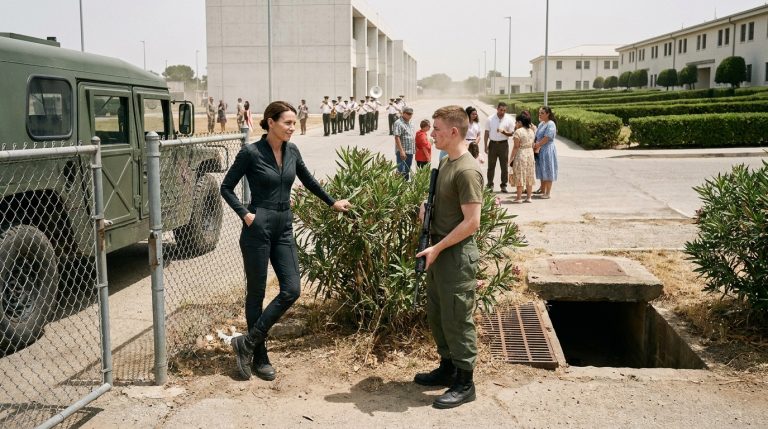
The sun over Camp Hawthorne didn’t just shine; it pressed against the back of the neck like a dull blade. Dust traveled on the heat, fine and chalky, settling into the seams of Emily’s desert utilities and the small of her back. The midday chow line shuffled three inches forward. Boots ground into the hardpack, a rhythmic, scraping irritate that kept everyone’s teeth on edge.
Behind her, the breathing was too close. She didn’t turn around to check the name tapes, but she knew the cadence of the laughs. Infantry. Men who spent their mornings cleaning carbon out of gas tubes and their afternoons wishing for a fight that wasn’t there.
“Hey, Parker,” a voice slid over her shoulder, thick with dry throat and boredom. “You think that butterfly’s going to lift you off the ground when the wind picks up? Or is it just there to keep the clipboards company?”
A dry snort traveled through the three men directly behind her. Emily kept her gaze locked on the rusted corner of the food service container thirty feet ahead. Her fingers didn’t tighten on the edges of her plastic tray; they remained neutral, relaxed, calculating the distance between her boots and the edge of the shadow line. If she shifted two inches to the left, the glare from the aluminum roof wouldn’t hit her eyes. She shifted. The glare vanished.
“Leave her be, man,” another voice muttered, though the chuckle underneath it ruined the charity. “She’s logistics. You break a nail on a supply crate, she’s the one who signs the form for the band-aids.”
She processed the words the way she processed a shipping manifest: weight, origin, destination, irrelevance. Her internal space was a vault of cold data. Every remark was just acoustic interference in a small courtyard. She let her sleeves stay rolled precisely two inches above the wrist bone, exposing the black ink of the wings. They didn’t see the tiny, hair-thin breaks in the lower wing pattern—the five-digit strings that read as shading to the untrained eye but mapped a ridge line in Helmand province. They just saw a decoration out of place on a green uniform.
The line moved. She stepped up, took the ladle of lukewarm eggs without looking the server in the eye, and moved toward the exit.
The heat hit her again at the threshold, a physical wall that smelled of diesel exhaust and burning trash from the perimeter. Before she could clear the walkway, a shadow detached itself from the side of the mess hall. Lieutenant Vance. His uniform was too clean for midday, the silver bar on his chest polished to a high, defensive sheen. Behind him, three platoon sergeants lingered, their hands tucked into their belts, looking for an exercise in authority.
“Private Parker,” Vance said. His voice had the sharp, practiced bark of an officer who hadn’t been outside the wire in six months. “Step out of the lane.”
Emily halted, her boots snapping together on the gravel with a dry clack. The tray remained perfectly level in her hands. “Sir.”
“The motorpool reports your inventory on the incoming small-arms crates is light by two serial numbers,” Vance said, stepping close enough that she could smell the spearmint gum in his mouth. “They tell me you’re quick with the pen, but slow with the grease. Let’s see how much time you spend reading those manuals instead of just filing them.”
He reached behind him, taking an M4 carbine from the nearest sergeant’s shoulder. He didn’t hand it to her; he dropped it onto the rough wooden field table beside the walkway with a heavy, metallic clatter that drew the eyes of forty soldiers leaving the mess hall.
“Disassemble. Inspect. Real-time,” Vance commanded, crossing his arms. “Let’s see if the logistics division knows what a firing pin looks like.”
A low murmur rippled through the gathering crowd. It was an old game—pulling a clerk into the dirt to remind the infantry that the base had a pecking order.
Emily didn’t look at the lieutenant’s face. Her eyes scanned the rifle. M4A1, standard issue, slight wear on the charging handle, the forward assist button carried a speck of dry mud in the groove. She didn’t drop her tray; she set it down on the edge of the wood with a deliberate, silent care that contrasted with the weapon’s rough landing.
Her hand went to her pocket. She didn’t pull out a tool. She pulled out a strip of black utility cloth, six inches wide, folded into a neat square.
Without asking permission, she raised it to her face, wrapping it over her eyes and tying it behind her head with two quick, muscular jerks of her wrists. The world went black, reducing the motorpool to sounds: the dry hiss of the wind, the heavy breathing of Vance to her right, and the distinct, oily metallic scent of the rifle directly in front of her ribs.
“What the hell are you playing at, Parker?” Vance barked.
Emily didn’t answer. Her right hand dropped onto the receiver like a hawk hitting a branch.
Her fingers worked by pure weight and friction. Click. The rear take-down pin yielded to the blunt pressure of her thumb. The upper receiver separated from the lower with a sliding rasp of dry aluminum. Her left hand caught the bolt carrier assembly as it slid free, her thumb already catching the cotter pin.
Clack. Clack. Tink.
The firing pin dropped onto the wood, followed by the bolt, followed by the cam pin. Her movements weren’t fast; they were devoid of error. There was no hesitation between the grip and the pull. To her fingers, the metal parts were large, heavy landmarks in a small terrain. She didn’t need eyes to feel the microscopic lip of wear on the extractor spring.
In ninety-four seconds, the weapon lay in nine distinct pieces across the rough grain of the table, perfectly aligned by size.
Silence took the perimeter. The laughter from the chow line had died somewhere around the forty-second mark, replaced by the heavy, uncomfortable weight of soldiers realizing they were watching an entirely different kind of soldier.
Emily didn’t remove the cloth. She reached down, her bare fingers sweeping the table until they found the cold edge of the upper receiver. She lifted it, her hands moving back into the reassembly loop with the mechanical indifference of an engine. The spring compressed; the bolt locked into the carrier; the pins snapped back into the receiver walls with the force of small hammers.
The final sound was the sharp, metallic snap of the charging handle locking home.
She reached behind her head, untied the cloth with one hand, and let the bright, blinding desert light rush back into her eyes. She didn’t blink. She picked up the M4 by the pistol grip, extended it horizontally toward the lieutenant’s chest with a single, unmoving arm, and let her gaze rest on his collar.
“It’s all in the manual, Sir,” she said softly.
Vance’s hand came up slowly, his fingers wrapping around the handguard to take the weight of the rifle. His face had turned a dull, blotchy red under his tan. He opened his mouth to speak, but the words hung in his throat as his eyes drifted down to her exposed forearm.
Standing three paces behind the lieutenant, an infantry sergeant had stopped mid-stride. His eyes weren’t on her face; they were locked onto the small, precise numbers etched into the lower curve of the butterfly’s wing—numbers that matched the coordinates of a dry valley four hundred miles to the north.
CHAPTER 2: THE UNMAILED LEDGER
“The numbers on the manifest don’t lie, Parker, but the iron might.”
The voice belonged to Staff Sergeant Miller, his shadow stretching long and distorted across the concrete floor of Warehouse 4. The overhead halogen lights hummed a low, irritating B-flat, casting sharp, skeletal edges over the stacks of green wooden weapon crates. It was three hours after the demonstration in the yard, and the air inside the corrugated steel structure had grown thick with the scent of cosmic rust, packing grease, and trapped heat.
Emily didn’t look up from her clipboard. Her pen, a cheap black plastic implement, made a dry, rhythmic scratching sound against the standard-issue logistics log. “The manifest came from the distribution hub at Bagram, Sergeant. If the weight is off, the discrepancy happened before the pallets were wrapped.”
“I’m not talking about the weight,” Miller said. He stepped closer, his heavy combat boots crunching against the fine desert grit that slipped under the warehouse doors. He dropped an iron crowbar onto the top of an unlisted crate with a dull, ringing thud. The sound vibrated through the metal legs of Emily’s desk. “I’m talking about the seal. Look at the stamping on the lead wire.”
Emily set the pen down. The movement was calculated to show no haste, no sudden spike in her pulse, but beneath the desk, her knees aligned into a defensive stance. She stood up, the sharp edges of her uniform trousers brushing against the industrial desk’s lip. The metal surface was cold, absorbing the residual chill of the concrete floor despite the ambient heat.
She walked over to the pallet. The crate in question was smaller than the standard small-arms containers, bound in reinforced steel bands that showed signs of fresh friction—the paint had been scraped down to the bare, silver zinc.
“The seal is standard issue,” Emily said, her voice dropping into a flat, transactional drone.
“The hell it is,” Miller muttered, leaning over the wood. “Look at the forge mark. It’s got an extra digit in the code block. A seven where a zero should be. I’ve broken a thousand of these wire locks since we deployed, and I’ve never seen a seven from the Ohio foundry.”
Emily squinted at the tiny lead disc. Her heart didn’t accelerate, but her mind instantly mapped the anomaly. The “seven” wasn’t a forge error; it was a manual modification, a minute notch carved into the stamping die with a diamond file. It was a recognition marker. The exact same marker used by the logistical contractors who had handled the dead space supply routes in the northern valley five years ago—the same route that had become a slaughterhouse because the telemetry had been leaked from within the network.
“A manufacturing defect,” Emily said, her tone steady as iron. “I’ll log it as a processing variance and have the crate moved to the secure holding bay for secondary inspection.”
“Parker, the lieutenant is still chewing glass about what you did with that M4,” Miller said, his eyes narrowing as he watched her face. Shadows from the overhead rafters cut across his features, making his expression unreadable. “He’s looking for a reason to write you up for insubordination. If I take this up the chain, it shows we’re doing our due diligence. If you bury it in a holding bay, it looks like you’re covering a supply leak.”
“I don’t bury files, Sergeant. I categorize them,” she replied. She reached down, her bare fingers brushing the cold, jagged edge of the broken lead wire. The metal pricked her skin, a sharp, localized sting that anchored her focus. “Leave the crowbar. Go clear the remaining flatbeds from the morning convoy. I’ll handle the intake logging myself.”
Miller hesitated, his hand lingering near his holster. In the guarded silence of the warehouse, the power dynamic shifted slightly—the clerk commanding the infantryman, not by rank, but by an unyielding, psychological mass that he couldn’t quite fathom. He grunted, spat a stream of tobacco juice into a nearby trash bin, and turned on his heel. His silhouette vanished into the bright glare of the open bay doors, leaving Emily alone with the hum of the halogens.
She didn’t waste a second.
The moment Miller’s boots faded from the gravel outside, Emily retrieved a small, blackened steel key from the inner lining of her sports bra. She walked back to her desk, unlocked the bottom drawer, and pulled out a stack of neat, unmailed letters tied with standard-issue green parachute cord. To anyone watching, they were letters to a distant family.
She untied the cord. The letters weren’t correspondence; they were a manual ledger of every unlisted shipment that had cleared Camp Hawthorne over the last ninety days.
She spread the pages across the cold steel desk, the sharp edges of the paper catching the harsh overhead light. Her fingers moved down the columns of numbers, cross-referencing the modified serial numbers from the lead seal with the coordinates she had spent years memorizing.
The telemetry codes matched perfectly. The shipments weren’t disappearing into the local black market; they were being systematically diverted to specific grid coordinates along the border—the same coordinates where her old team’s communication arrays had been jammed before the ambush.
A shadow fell across the ledger.
Emily didn’t freeze. She slid her right hand smoothly over the papers, covering the most sensitive columns, while her left hand drifted toward the heavy iron crowbar Miller had left behind on the crate.
The silhouette in the doorway wasn’t Miller. It was one of the Navy SEAL operators who had arrived with the morning convoy. He was lean, dressed in modified utilities without rank insignia, his face darkened by a week of high-altitude dust and old sweat. He didn’t enter the warehouse; he simply leaned against the steel frame of the door, his arms crossed over his chest, his eyes fixed on the ink exposed on her forearm.
“The wind in the valley always blows from the east this time of year, Parker,” the operator said, his voice low, dry, and jagged as flint. “But your numbers are tracking west.”
The information gap opened instantly. He wasn’t just observing her; he knew the encryption language of the ledger.
Emily didn’t answer. She kept her grip on the desk, the steel cool against her palms, her body coiled to move if the shadow stepped any closer into her space.
CHAPTER 3: THE SHADOW OVER THE YARD
“You’re out of your sector, operator,” Emily said. Her left hand remained a fraction of an inch from the rough iron edge of the crowbar resting on the crate. The metal was cold, sweat-chilled against the stale air of the warehouse.
The SEAL didn’t move from the doorframe. The noon sun cut behind his silhouette, cast into a long, dark spear that split the concrete floor between them. “Sector is a flexible word when a ghost turns up on a manifest distribution sheet. The commander wants to know why an intelligence asset from the 2021 operations block is counting boxes of 5.56 in a dust bowl like Hawthorne.”
“I transfer property. I don’t answer questions from transient personnel,” Emily replied. She gathered the unmailed ledger pages with a cold, steady sweep of her right arm, the paper scraping crisply against the metal desk. She slid them into the central drawer, turned the key, and pocketed the tiny piece of blackened iron. “If your detachment has an issue with the joint training supply allocation, take it to the lieutenant.”
The operator let out a dry, mirthless sound that didn’t reach his eyes. “Vance? The man doesn’t know the difference between an inventory leak and a logistical rounding error. He didn’t see what was hidden in the lower wing of that ink. But we did.” He stepped forward, his boots making no sound against the concrete—a stark contrast to Miller’s heavy, crunching steps. He stopped just at the edge of her desk’s shadow. “The numbers under that butterfly aren’t coordinates for a drop zone, Parker. They’re the telemetry tracking frequencies for the internal logistics leak that put my team into an ambush five years ago.”
Emily’s fingers tightened inside her pockets. The edge of the steel key pressed deep into her thumb, a sharp reminder of the wall she had built around herself. “You’re reading into things that aren’t there.”
“My team died because someone changed the shipping routes on a digital ledger, forcing us into a dead-end gorge,” the operator said, his voice dropping into a low, vibratory rasp that seemed to rattle the corrugated steel walls. “The same modified ledger code that just showed up on that unlisted container outside. The one with the altered lead seal.”
Emily looked at him, her gaze cutting into his with the precision of a scalpel. She recognized the look in his eyes—the tactical exhaustion, the hyper-vigilance, the driving need for a target. He was a mirror of her own internal rot. “If you know the code, then you know it doesn’t stop here. And you know that anyone who kicks the nest before the tracking array is locked down gets everyone killed.”
The operator stared at her, his posture shifting from relaxed observation to a hard, coiled readiness. “So the rumors were light. You aren’t hiding from the past. You’re baiting the line.”
“I am a supply clerk, operator,” Emily said, her tone dropping back into a flat, bureaucratic monotone as she picked up her clipboard. “And your detachment’s flatbeds are currently blocking the secondary fuel line in the yard. Clear them.”
Before the operator could answer, the heavy, metallic screech of a vehicle’s brakes echoed from the main yard outside, followed by the hurried shouting of the guard detail. The air shifted instantly, the distant, rhythmic thrum of heavy diesel engines announcing a new arrival at the camp’s primary checkpoint.
The operator cast one last, lingering look at her forearm before stepping backward into the blinding glare of the courtyard. Emily followed slowly, her clipboard held tight against her chest like a shield, her mind already calculating how the sudden presence of the SEAL detachment would accelerate the timeline she had spent years carefully constructing.
CHAPTER 4: THE FRACTURE OF THE MASK
The perimeter alarm cut through the heat with the jagged scream of a cold circular saw hitting steel.
Emily didn’t run. Her fingers, covered in a thin patina of dry warehouse dust, locked down on the edges of her aluminum clipboard until the metal groaned under the force. Out in the open glare of the main courtyard, the air was dense with the gray plume of burning diesel. The joint training detachment had completely frozen the main thoroughfare, but it wasn’t an attack from the ridges. It was a tactical restructuring from within.
The lead vehicle of the Navy SEAL convoy—a heavily up-armored matte-black truck stripped of all external unit markers—slid into a violent skid, its massive run-flat tires chewing through the hardpack dirt until it halted six inches from the concrete steps of the primary logistics office. The front door swung open with a heavy, ungreased screech.
“Get the lieutenant out here now!” a voice roared from the cab, but the command was instantly swallowed by the presence of the man stepping out of the passenger side.
It was the detachment commander. He carried no rifle, no active gear, only the crushing, immovable gravity of an officer who had survived three decades of classified operations in deep territory. His uniform was stained with the salt-rings of dried sweat, and his jaw was set like a vice. His eyes scanned the chaotic rush of the yard, ignoring the scrambling infantrymen, ignoring Lieutenant Vance who was stumbling down the wooden stairs of the command post while trying to secure his holster.
The commander’s gaze sliced through the glare, passing over the motorpool, over the fuel bladders, and landed directly on the corner of Warehouse 4.
On Emily.
She stood perfectly still in the shadow of the overhang, her sleeves rolled exactly two inches above her wrist bones. The harsh, vertical noon light hit her forearm, illuminating the sharp black ink of the butterfly and the microscopic, notched telemetry rows etched into the shading.
The commander stopped mid-stride. The operators behind him, men who had been moving with the fluid, silent speed of hunting pack animals, instantly halted. The sudden silence that rippled outward from his boots was physical, a wall of absolute pressure that caused the shouting guards at the gate to drop their voices to a whisper.
He didn’t look at Vance, who had finally reached the gravel, out of breath and sweating through his starched collar. The commander walked directly toward the logistics bay, his boots falling with a heavy, rhythmic cadence that sounded exactly like the cyclic rate of a heavy machine gun.
Emily did not retreat into the dark of the warehouse. She stepped forward to meet him at the line where the concrete met the dirt. Her clipboard was pressed flat against her ribs, her heart rate locked down by a lifetime of calculated restraint, though the key in her pocket felt like a brand against her thigh.
Three paces away, the commander stopped. His face was a map of scarred leather and old shrapnel marks, his eyes bloodshot from the mountain wind. He looked down at the tattoo on her arm, his chest rising and falling with a slow, controlled breath.
Without a single word, his right arm snapped up.
It was a crisp, razor-sharp salute, delivered with the absolute precision of a formal dress parade, but weighted with the crushing gravity of a funeral detail. His fingers stayed locked to the brow of his tan cap, his body rigid as iron.
“Sir?” Vance’s voice cut through the silence, thin and high-pitched, completely out of its depth. “Sir, that’s Private Parker. She’s… she’s just an administrative clerk. The small-arms inventory is still being processed—”
“Shut your mouth, Lieutenant,” the commander said, his voice low, vibrating with a quiet rage that made Vance step back a full foot into the gravel. The commander’s eyes never left Emily’s face. “You think she’s a clerk? You think that ink is a joke?”
The entire yard had become a static frame. Soldiers leaving the mess hall stood with their trays half-lifted; the armorers in the motorpool dropped their wrenches against the steel decks; the entire base command structure seemed to tilt on its axis.
“Five years ago, in a valley that doesn’t exist on any map your satellite systems can track,” the commander said, his words cutting through the dry heat like a scalpel, “my entire team was locked into a kill-box. Our comms were jammed, our air support was routed to a false grid, and we were three minutes from being wiped off the ledger. The only reason I am standing on this dirt, the only reason any of my men came back across the wire, is the officer sitting behind that supply desk.”
He pointed a thick, scarred finger at Emily.
“She wasn’t on the ridge with a rifle,” the commander continued, his voice rising until it bounced off the corrugated steel roofs of the barracks. “But she was the one who pulled the tracking array out of the dark. She cracked the internal encryption that had betrayed our position, she rewrote the route code in real-time, and she stayed on the terminal while the extraction bird cleared the ridge. She took the heat so we could take the valley.”
The silence in the yard was absolute now, broken only by the dry hiss of the desert wind through the chain-link fence. The platoon sergeants who had mocked her in the chow line shifted their weight, their eyes dropping to the dirt in a collective, heavy wave of shame. Miller stood near the fuel depot, his mouth slightly open, his hand frozen on the latch of his vehicle.
The commander held the salute. And then, behind him, the lean operator from the warehouse stepped forward, his boots clicking together as his hand snapped up to his brow. One by one, the entire Navy SEAL detachment formed a straight, silent line in the dust, their arms rising in unison.
Vance looked around the courtyard, his face pale, before slowly, awkwardly lifting his own hand to his cover. Then the sergeants. Then every enlisted man standing in the blistering sun.
Emily felt the information gap close around her like a trap. Her low-profile cover was completely shattered, the decoy secret of her administrative status obliterated by the heavy hand of her own legacy. She didn’t smile. She didn’t look vindicated. The psychological weight of the dead team in the valley rushed back into her chest, cold and jagged.
She lifted her right hand, her fingers steady, and returned the salute with a quiet, unyielding discipline that shook them far more than any speech could have. The butterfly ink on her arm was no longer a target for their amusement; it was a banner of survival, and the absolute proof that the war she was fighting was far from over.
CHAPTER 5: THE SILENT SENTINEL
The hands came down. One by one, boots shifted, snapping the spell that had held the courtyard hostage. The SEAL commander lowered his arm, his calloused palm falling to his side with a dry brush against his uniform. The silence that lingered wasn’t the empty quiet of a desert night; it was the heavy, pressurized vacuum that follows a detonated charge.
“You’ve earned more than silence, Parker,” the commander said, his voice dropping into a lower register meant only for the space between them. The heat radiating off his up-armored vehicle felt like a physical wall. “They should know who stands among them. Command needs to pull you out of this dust hole.”
Emily looked down at her clipboard, her eyes scanning the neat lines of black ink. The edges of the aluminum board were sharp, biting into her thumb. “I’m just doing my job, sir.”
“Parker—”
“The flatbeds are cleared, Commander,” she interrupted softly, her voice flat, an absolute barrier constructed from years of isolated discipline. She met his gaze, her eyes cold, calculating, and entirely unmoving. “Your detachment’s fuel manifests are logged. Respectfully, your presence in this sector is disrupting the base’s processing velocity.”
The commander stared at her, his jaw tightening as he read the unspoken data behind her eyes. He knew the protocol. He knew that an asset who refused extraction wasn’t hiding; they were anchoring. His gaze dropped to the butterfly tattoo on her arm one last time, recognizing the absolute finality in her posture. He gave a single, microscopic nod, turned on his heel, and climbed back into the blacked-out vehicle.
The convoy rolled out, leaving a wake of swirling dust that swallowed the yard. Emily didn’t wait for the dust to settle, nor did she look at Lieutenant Vance, who stood frozen on the gravel, paralyzed by the realization of the massive intelligence apparatus operating silently under his nose. She turned and walked back into the stark, shadowed interior of Warehouse 4.
The heavy steel door slid shut behind her with a definitive, echoing clang that locked out the rest of Camp Hawthorne.
She walked back to her desk. The halogens still hummed their monotonous B-flat. She sat down, her movements fluid and entirely devoid of hesitation. She unlocked the bottom drawer, pulled out the unmailed ledger pages, and laid them flat across the cold steel surface.
From the back of the secured terminal beneath her desk, a tiny, dull green light pulsed. Click. A low-frequency audio tone emanated from the encrypted data-link—a signal confirmation.
The public revelation by the commander hadn’t been a victory; it was a variable she had to immediately compensate for. The network leaking the telemetry codes would notice the disturbance. They would look closer at Camp Hawthorne. They would see a exposed clerk, and they would try to cut the line.
She reached down, her thumb tracing the microscopic numbers etched into the ink of her forearm. The numbers weren’t just a memorial to the valley where her team had died. They were the active, master cryptographic keys for the tracking beacon she was currently running through the base’s supply pipeline. Every unlisted crate, every altered lead wire seal, every deviated manifest was a single breadcrumb leading back to the internal mole who had sold out her operators.
She picked up her cheap black plastic pen. Her hand was completely steady. She began writing the next line of data into her ledger, updating the tracking coordinates for the diverted shipments heading toward the northern border.
The infantrymen outside would no longer mock her. They would stand straighter when she passed, their voices lowered in a newfound, unearned respect. But she didn’t want their respect, and she didn’t want their praise. The true conflict wasn’t about vindication in a chow line; it was a silent, tactical game of chess played in the dark against an enemy that didn’t leave footprints.
She adjusted her sleeves, pulling them down precisely two inches above her wrist bones, concealing the butterfly, the numbers, and the scars beneath the sterile, gray fabric of her uniform. The mask was fractured, but the sentinel remained at her post, waiting for the trap to spring.