The Quiet Mechanic Who Kept His Hands Calloused and His Code Unbroken When Washington Came Knocking
CHAPTER 1: THE ROADSIDE TEST
The heat radiating off the asphalt was thick enough to taste.
Ben Carter kept his eyes fixed on the rusted bolt, his knuckles grimy and scraped against the inner fender of the old Ford.
A few feet away, five-year-old Logan hummed a quiet tune from the backseat, his small chin resting against the rolled-down window.
A sharp voice cut through the hum of cicadas.
“Fixing some old farmer’s truck for free, Ben? Your own roof’s still leaking.”
Ben didn’t look up.
He felt the familiar weight of neighbor Dobs standing by the roadside, arms crossed and dripping with condescension.
Ben gave the wrench another firm turn, feeling the metal bite into place.
“Bolts don’t care who turns them, Dobs,” Ben muttered under his breath, wiping a bead of sweat from his forehead with the back of a calloused wrist.
The stranger standing beside the steaming engine didn’t offer empty praise or hollow apologies.
He just watched Ben with a heavy, unblinking gaze that felt entirely out of place for a stranded motorist.
Ben packed his tools back into the canvas bag with deliberate, unhurried motions, ignoring Dobs’ parting sneer.
The engine roared back to life with a deep, steady rumble that settled into an honest idle.
Ben stood up, rolled his aching shoulders, and tapped the fender twice before walking back to his beat-up pickup.
As they drove off down the dusty back highway, the sun dipped lower, casting long golden shadows over a life built entirely on quiet endurance.
He had no way of knowing that the man whose truck he just fixed didn’t drop by coincidence.
The road ahead wasn’t going to offer an easy detour.
CHAPTER 2: MORNING CONVOYS
Three black SUVs idled in an unbroken line along the weed-choked curb.
Their high-gloss black paint absorbed the harsh Georgia morning light, looking entirely out of place against the faded wooden panels and peeling trim of Ben’s house.
A government plate glinted dully from the lead vehicle’s bumper.
Ben stood motionless by the window, the grease-stained dish towel clutched in his fist.
From the doorway of his bedroom, little Logan blinked sleepily, clutching a blue plastic toy truck against his chest.
“Daddy? There’s people outside,” the boy whispered.
Ben didn’t answer right away.
His eyes tracked the lead driver’s door as it swung open with a heavy, weighted thud.
Tall, silver-haired, and moving with the crisp, unyielding posture of a seasoned commander, Lieutenant Colonel Samuel Whitaker stepped onto the patchy grass.
Two other figures emerged behind him, scanning the quiet treeline with quiet, practiced efficiency.
Ben unlatched the rusted screen door, pushing it open with a familiar, high-pitched screech.
He stepped barefoot onto the splintered porch boards, his shoulders squared against the unexpected intrusion.
Whitaker didn’t smile as he mounted the steps, his gaze locking directly onto Ben with absolute focus.
“Mr. Carter,” Whitaker said, opening a worn leather folder to reveal official credentials. “We’re here on behalf of the Veteran Personnel Outreach Division.”
Ben kept his weight evenly distributed, his calloused hands resting flat against the weathered wooden railing.
“You missed the highway by about ten miles, Colonel,” Ben said, his voice flat and steady.
Whitaker didn’t flinch at the dry pushback.
Instead, the rear door of the middle SUV clicked open, and a third figure stepped out into the dust.
General Nathaniel Caldwell.
The man whose truck Ben had fixed on the roadside yesterday walked forward, his gray blazer pressed sharp enough to cut, his eyes carrying the unmistakable weight of a command structure.
“Your neighbors watch a lot, Mr. Carter,” Caldwell said, gesturing vaguely toward the distant roofline where Dobs was undoubtedly peering through the curtains.
“May we come inside?”
Ben looked past the officers toward his son, then back to the men who had tracked him down to a dirt road in Thomas, Georgia.
The front room smelled of instant coffee and burnt toast.
CHAPTER 3: THE KITCHEN TABLE OFFER
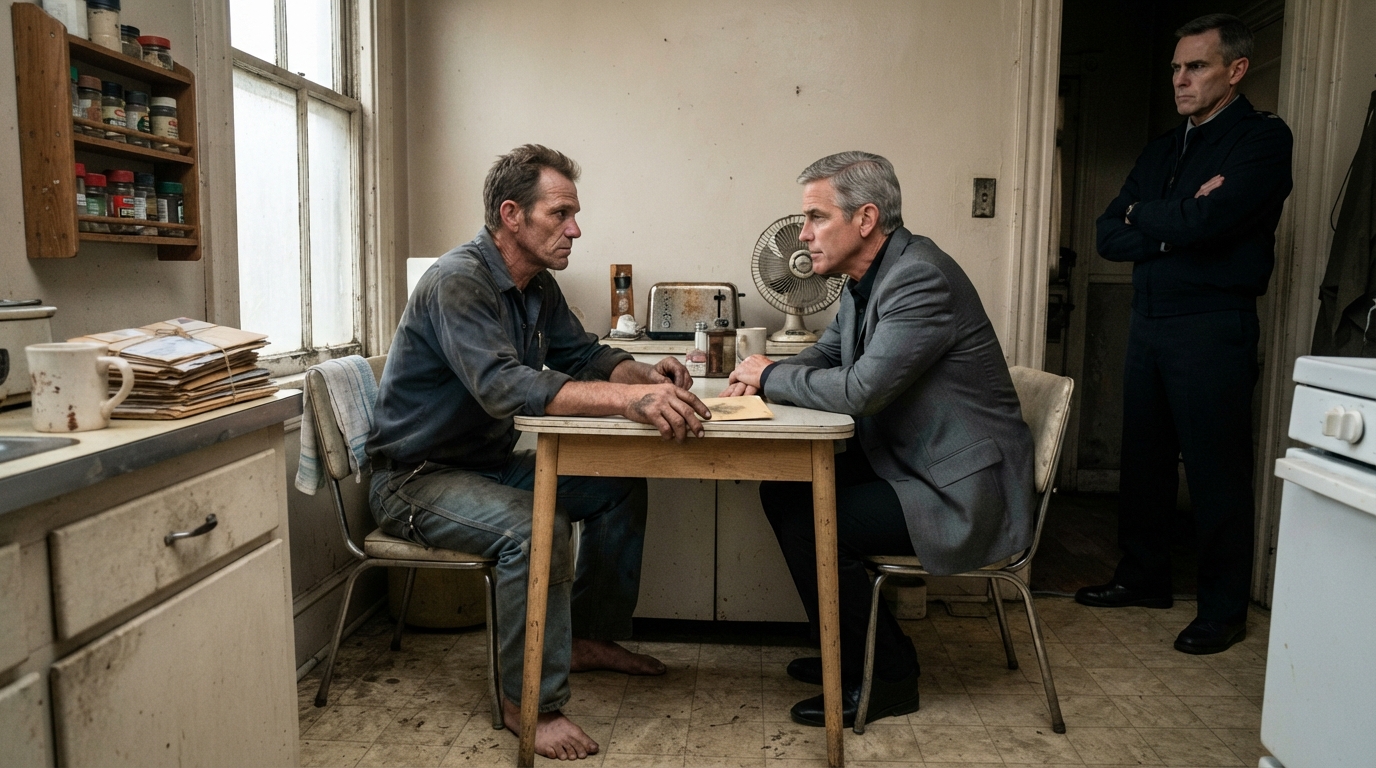
Ben did not reach for the paper.
His calloused fingers remained curled around the edge of the wood, feeling the familiar split in the grain where Melissa had once dropped a heavy cast-iron skillet three summers ago.
General Caldwell pulled out an empty wooden chair, the legs scraping against the linoleum with a harsh, grating sound.
“You’re offering me a job because I turned a wrench on your roadside,” Ben said, keeping his voice level as he watched the silver-haired officer sit.
“I’m offering you a future because you did it without looking for an audience,” Caldwell replied, leaning forward with his forearms planted flat on the table.
From down the hallway, the faint hum of Logan’s toy truck drifted into the room, reminding Ben of the exact math he ran every single night before closing his eyes.
Rent, power bills, daycare, groceries, and the lingering threat of a rusted-out truck breaking down for good on a remote interstate.
The envelope contained a three-fold salary increase, housing security, and a tuition voucher that could give his son a real footing in the world.
Yet the weight of it felt heavy, tied to a system that had quietly forgotten him the moment he handed in his dog tags.
“I don’t need charity, General,” Ben said, his eyes narrowing slightly as he met the steady gaze across the table.
“It isn’t charity,” Whitaker interjected from the doorway, his arms crossed over his chest. “It’s an investment in a man who still knows how to fix things when the entire structure is rotting from the inside out.”
Ben looked down at the corner of the envelope, his thumb tracing a tiny smudge of engine grease left on the white paper.
He had spent three years keeping his head down, taking whatever scraps the county could throw his way, believing that endurance alone was enough to keep the roof over Logan’s head.
The silence stretched thin, broken only by the erratic sputter of the kitchen fan overhead.
Ben slowly slid the envelope across the grain toward himself, his jaw tightening as he finally broke the seal.
CHAPTER 4: THE ATLANTA TRANSITION
Ben stepped across the threshold, his shoulders instinctively tightening against the hum of industrial fluorescent lights overhead.
Rows of heavy diagnostic benches stretched down the hangar-sized floor, surrounded by veterans and former service mechanics whose weathered faces mirrored his own exhaustion.
A younger instructor with a clipboard blocked the aisle, looking down at Ben’s taped-up toolbox with a skeptical squint.
“You’re tracking red clay in from the back roads, Carter,” the instructor noted, tapping his pen against the laminated roster.
“The roads down in Thomas don’t pave themselves,” Ben replied, setting his metal box down with a dull, heavy clatter that made the nearby wiring harnesses rattle.
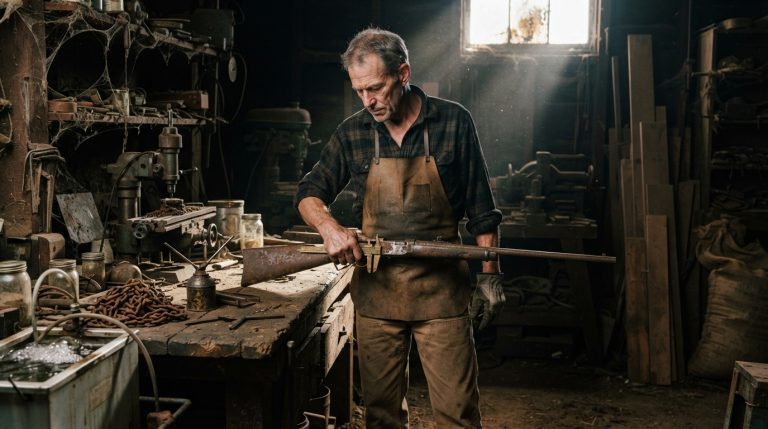
Without waiting for permission, Ben unlatched the rusty lid, pulling out a heavy grease gun and a set of worn wrenches.
Muscle memory took over instantly, bypassing the three years of quiet struggle that had worn the edges off his patience.
Around him, complex hydraulic diagnostic units blinked with unfamiliar fault codes, but the core mechanics remained unchanged.
He didn’t need a textbook to tell him when a pressure valve was choked by carbon buildup or when a seal was rotting under sustained friction.
By midday, the other trainees had stopped whispering, turning their attention instead to the quiet, methodical way Ben tore down a seized transmission housing.
“You’re moving too fast on the torque sequence,” an older navy veteran muttered, pausing by Ben’s station.
“The threading’s stripped from the last field repair,” Ben answered without looking up, his forearm straining against the bolt. “If you force it standard, the whole manifold blows under pressure.”
The veteran watched the adjustment, nodded once in silent agreement, and went back to his own bench.
The work was grueling, stripping away the isolation of his rural life and replacing it with the relentless, synchronized grind of a national motorpool.
Yet for the first time since Melissa’s passing, Ben felt the steady hum of a machine working the way it was designed to.
CHAPTER 5: REBUILDING FOUNDATIONS
Ben drove the stake deep into the red clay, checking the spirit level with a thumb dusted in grit.
The new timber frame sat square against the side of the house, replacing the rotting boards that had plagued him for years.
A shadow fell across the lumber as Dobs stepped up to the property line, hands shoved deep into his canvas pockets with a look of sour disbelief.
” Heard you’re inspecting water lines all over the county now, Ben,” Dobs muttered, kicking a stray pebble into the grass. “Thought you were just fixing old tractors.”
Ben didn’t stop driving the nail, the hammerhead striking true with a sharp, rhythmic ring.
“Infrastructure needs keeping up, Dobs,” Ben said, straightening his back as a dull ache settled into his lower spine.
“Must be nice, getting government trucks rolling down your driveway,” Dobs pressed, his voice tightening with petty resentment. “Some of us have been living on this road twenty years and nobody’s handing out contracts.”
Ben laid the hammer across the top board, his expression neutral as he wiped sweat from his brow.
“Nobody handed me anything, Dobs. I just didn’t walk away when a stranger’s truck stalled out on the shoulder.”
Dobs opened his mouth to retort, but the sudden rumble of a municipal utility van turning down the lane cut him short.
The neighbor grunted, turned on his heel, and stalked back toward his own fence line without another word.
Ben watched him go, then turned his gaze toward the open back door where Logan was laughing over a book at the kitchen table.
The work wasn’t finished, and the roads ahead were still long, but the foundation was finally holding its own weight.
CHAPTER 6: THE CAPITAL BRIEFING
Camera shutters clicked like a swarm of dry cicadas from the back of the packed hall.
Ben stared out over the tier of congressional seats, his fingers lightly brushing the edge of the wooden microphone stand.
A senior senator leaned forward, adjusting his glasses to peer down at the witness table.
“Mr. Carter, your program has expanded across three states, yet you still insist on maintaining your work boots,” the senator noted, his tone tinged with polite curiosity. “Why not stay behind a desk?”
Ben did not hesitate.
“Desks don’t fix broken water lines, Senator,” Ben said, his voice carrying the dry, unpretentious weight of a man used to speaking over the roar of an engine.
“People do. People who show up when nobody else is watching.”
The room fell completely silent, the flashing lights momentarily slowing as the plain truth settled over the legislative floor.
He wasn’t there for medals, and he wasn’t there for the political theater that routinely cycled through the capital.
He was there because every veteran scraping by on a back road deserved someone to remember that character is built in the dirt, not behind a polished title.
When the briefing finally adjourned, reporters pressed forward with notebooks and microphones, but Ben simply turned away, stepping out past the heavy bronze doors into the cool evening air.
He didn’t take a detour.
He caught the late flight back to Georgia, trading the stiff suit back for his favorite flannel jacket before the sun had fully cleared the horizon.
Back home, the morning air was crisp as the old ceiling fan clanked lazily overhead and toast sputtered in the tray.
Out in the yard, Logan was busy stacking wooden blocks near the sandbox, laughing as his small fingers built a structure entirely on his own terms.
Ben knelt on the porch steps, pulling a worn 10mm socket wrench from his pocket to tighten a loose railing screw with a quiet, steady hand.
The roof didn’t leak anymore, the bills were paid, and the road ahead was clear.
Some things never needed changing—just a pair of hands willing to do the work because it was right.