Calloused Hands And Silent Steel: An Old Master Teaches A Bitter Lesson In Respect
CHAPTER 1: THE DISMISSAL
The fluorescent lights overhead hummed a harsh, irritating note against the silence of the shop.
Walter Hensley rested his palms on the scarred wooden edge of the counter, feeling the familiar, cold grain beneath his fingertips.
He did not look at the glowing screen of the phone in the young man’s hand.
He only looked at the thick layer of rust encasing the rifle wrapped in the coarse wool blanket.
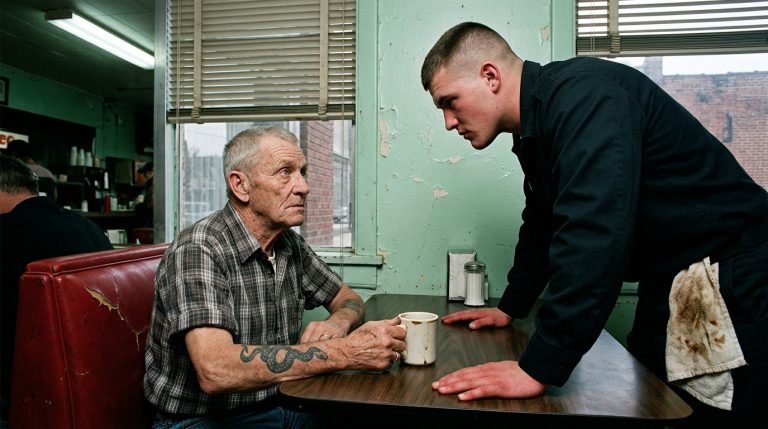
“You’re joking, right?” Tyler Brennan didn’t bother to look up from his device for more than a second, his voice dripping with casual condescension as he pushed the bundle slightly away.
“That thing is completely destroyed. Beyond saving. A waste of your money and my time.”
Walter’s jaw tightened, the skin pulling thin across his weathered cheekbones.
He didn’t raise his voice or let his shoulders slump under the weight of the dismissal.
Instead, his thumb brushed slowly against the scarred brass caliper hidden deep inside his coat pocket, grounding his rising fury into cold, steady silence.
“The surface oxidation is heavy,” Walter said, his tone flat and even, measured like a plumb line. “The underlying steel hasn’t been compromised.”
“Grandpa, I don’t know what YouTube videos you’ve been watching, but that isn’t how metallurgy works.” Tyler finally set his phone down, leaning forward with a smirk that assumed total authority.
“The stock is gone, the internal pins are rusted solid, and restoration work of this caliber is way above your pay grade.”
Walter stared at the young gunsmith, seeing the blind arrogance of a man who had never spent a decade mastering tolerances measured in thousandths of an inch.
Without a word of argument, Walter reached out, gathered the rough wool fabric around the heavy metal mass, and pulled it back toward his chest.
He didn’t blink as he turned on his heel toward the door, leaving the young man to his screen.
The bell above the threshold chimed a hollow, tinny note as he stepped out into the crisp Virginia air, his grip tightening around the hidden brass caliper as a quiet, unshakeable plan took root in his mind.
CHAPTER 2: THE ELECTROLYSIS TANK
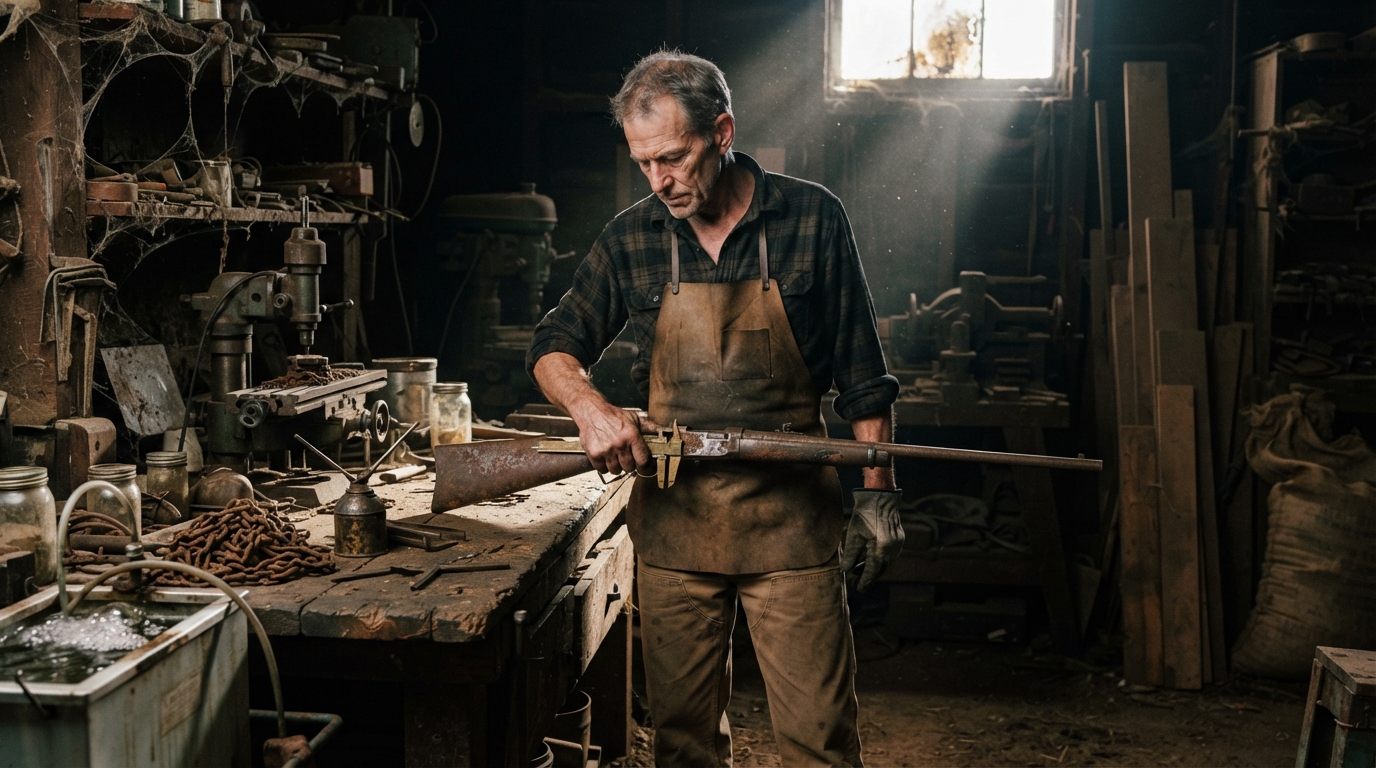
Walter set the blanket-wrapped mass down onto the center of his workbench.
He didn’t rush.
Every movement was calculated, slow, and rhythmic, shaped by decades of discipline that had nothing to do with commercial deadlines.
The air in the barn smelled of dry cedar, cold iron, and dust that had settled undisturbed for fifteen years.
He pulled the canvas covers off the old milling machines, letting a cloud of grey particles drift into the shaft of morning light cutting through the high window.
A single copper wire caught his eye, hanging limp from a shelf beside the wall.
Walter picked it up, running his calloused thumb along its oxidized surface to check for continuity.
The electrolysis tank sat in the corner—a large, heavy-duty plastic vat he had bolted together during the Cold War when precision work meant the difference between a functional sidearm and a catastrophic chamber failure in the field.
He filled the basin with a measured mixture of warm water and washing soda, stirring the solution with a carved wooden paddle until the chemical compound dissolved completely.
The process was simple in theory, but execution required absolute adherence to electrical current parameters.
He submerged the heavily corroded receiver, hooking the negative cathode directly to the unyielding steel mass while clamping the positive lead to sacrificial iron plates hung along the tank’s interior walls.
When he flipped the main DC power supply switch, the system hummed to life with a low, steady drone.
Within minutes, tiny bubbles began to rise to the surface of the cloudy water, carrying a thick plume of orange sediment upward.
Walter pulled a magnifying glass from the drawer and leaned in close to observe the cathode reaction.
A faint, metallic smell—iron oxide separating under direct current—drifted into his workspace, sharp and sulfurous.
He adjusted the amperage dial by a fraction of a volt, keeping the reaction controlled so it wouldn’t pit the base metal underneath.
The rust wasn’t disappearing by magic; it was being chemically stripped down to its core components, molecule by molecule.
He sat back in his wooden chair, listening to the steady, rhythmic hum of the power supply cutting through the silence of the empty barn.
The first layer of the deception—the surface rot that had convinced a twenty-nine-year-old shop clerk that history was worthless—was actively dissolving in the dark water.
CHAPTER 3: THE HARDFORGED STOCK
The steel was clean, but an empty receiver was only a half-truth.
Walter set the polished metal down and pulled a thick, twenty-year-old block of American black walnut from the back rack.
The wood was dark, dense, and seasoned to a perfect dryness that would never warp or split under field stress.
Without outside parts catalogs or modern mail-order suppliers to lean on, every curve had to come straight from raw geometry and muscle memory.
He gripped a heavy steel rasp, its teeth biting into the edge of the timber with a harsh, rhythmic rasping sound that filled the dusty barn.
Wood shavings curled across the bench like dry autumn leaves.
His shoulders burned with a dull, familiar ache, but he didn’t stop to rest.
He worked by touch and caliper measurements, matching the complex compound curves of the military stock down to a fraction of a millimeter.
The inletting required absolute precision—if the barrel channel drifted even a hair off center, the rifle would throw shots wild under recoil.
He tested the fit repeatedly, sliding the cleaned receiver into the half-carved mortise, blackening the high spots with a light coat of lampblack to see where the wood rubbed.
Each tight spot was scraped away with a micro-chisel, stroke by slow stroke, until the metal dropped into the walnut bed with a clean, seamless suction.
The daylight through the high barn window faded into deep evening shadows, leaving only the pool of yellow light from his overhead lamp.
Walter wiped a thin film of sawdust from his forehead, his knuckles stiff and stained with natural oils.
The stock was taking shape under his hands, proving that real work required neither a commercial certificate nor an assembly line.
CHAPTER 4: THE COLD BLUE FINISH
Raw steel was vulnerable to every breath of moisture in the air.
Walter picked up a small cotton swab, dipping it into a jar of period-correct cold bluing solution.
Modern shops dipped entire assemblies into boiling chemical vats for speed, but speed produced an artificial, mirror-bright sheen that belonged on a cheap display piece, not a working military rifle.
He applied the liquid by hand, stroking it evenly across the receiver and barrel.
The dark chemical reaction took hold instantly, turning the bright metal a deep, light-absorbing charcoal black.
He rubbed the surface down with fine steel wool, clearing away the spent oxidation, then applied a second coat.
And then a third.
Fifteen layers of oil on the walnut stock.
Multiple thin applications of bluing on the steel.
His eyes strained under the glare of the lamp, and his lower back gave a dull throb with every bend over the bench.
He didn’t rush a single stroke.
When he finally set the finished barrel assembly into the oiled wooden channel, the weapon looked precisely as it had when it rolled out of the Springfield armory in 1918.
The surface didn’t reflect light; it drank it in, heavy and silent.
He wiped his stained fingers on a rag, knowing the transformation was complete down to the last custom-turned pin.
The decoy scrap was gone, replaced by an artifact of absolute precision.
It was time to take it back into town.
CHAPTER 5: THE RETURN TO TOWN
The bell above the threshold of Precision Arms rang with the exact same tinny note as it had a week ago.
Walter stepped inside, carrying the heavy wool-wrapped package under his arm without a word.
Tyler Brennan was already leaning over his desk, his thumb flicking rapidly across a glass screen while electronic music muttered from a small speaker behind the counter.
“Look, I told you yesterday, parts take two weeks minimum—” Tyler started, not bothering to lift his chin.
Walter set the wrapped bundle on the scarred counter glass.
The cloth fell away with a dry slide, revealing the deep, charcoal-black receiver and the rich grain of the hand-carved walnut stock underneath the fluorescent tubes.
Tyler’s thumb froze mid-swipe.
The phone slipped from his fingers, hitting the linoleum floor with a sharp crack that echoed off the walls.
“That—that’s impossible,” Tyler stammered, his face flushing a bright, angry crimson as he scrambled to back away from the counter edge.
“You didn’t have the manufacturing schematics. You didn’t have a commercial parts account.”
“Precision doesn’t come from an account, son,” Walter said, his voice level as he rested his weathered palm against the edge of the glass.
“It comes from understanding what the metal is trying to tell you.”
Tyler stared down at the flawless checkering on the wrist and the crisp, deep markings on the receiver, his jaw working silently as his entire professional arrogance evaporated into the stale air of the shop.
CHAPTER 6: THE BITTER ADMISSION
The silence in the shop stretched tight, broken only by the hum of the overhead fluorescent tubes.
Tyler swallowed hard, his throat dry as he stared down at the dark, oil-finished walnut stock.
“I thought I knew this craft,” Tyler murmured, his voice cracking slightly as he lowered his eyes from Walter’s weathered face.
“Looking at your work… I realize I don’t know anything at all.”
Walter didn’t gloat or offer a triumphant grin.
He simply reached out, his calloused thumb resting briefly on the cool steel of the receiver before sliding the bolt home with a crisp, perfect click.
“Skill without humility is just noise, son,” Walter said quietly, his gaze steady.
“The moment you think history is junk is the moment you stop learning.”
Tyler nodded, his shoulders dropping as the heavy armor of his pride finally shattered.
He walked slowly around the counter, his hands open and empty, ready to learn the patient ways of the old masters.
The restored rifle rested between them on the glass, a quiet testament to a lifetime of service, endurance, and uncompromising dignity.
Back home, the afternoon sun slanted across the empty workbench in the barn, illuminating a single, polished brass caliper resting in quiet, permanent peace.