The Iron Perimeter: A Legacy Written in Blood and Bureaucracy
CHAPTER 1: THE TRENCHES AT DAWN
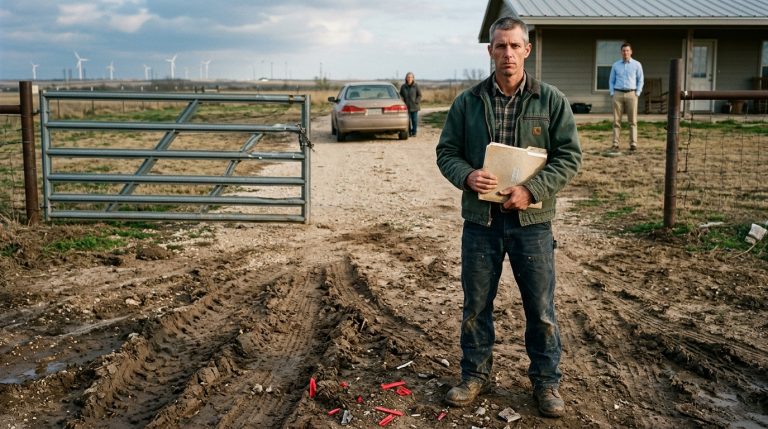
The steel blade of the CAT D8 gouged four feet of topsoil in a single deafening shriek.
Vibrations traveled up through the cedar porch posts, rattling the glass in my storm door. Dirt hit the cedar siding like thrown gravel.
I didn’t reach for a rifle. I reached into my coat pocket, my thumb running over the jagged crack on my grandfather’s brass pocket watch.
Snap. The casing opened. 6:14 AM.
“Stop the engine!” I shouted. The words didn’t cross the twenty feet of diesel exhaust, but the physical movement of my boots stepping off the porch did.
The operator didn’t look at me. He looked past my left shoulder, tracking the white hardhat coming up the dirt lane.
Renee Kesler didn’t wear boots to a demolition. She wore leather pumps that sank two inches into the fresh clay, her clipboard clutched against her chest like a riot shield. Behind her, an idling Ford F-250 blocked the driveway, its roof-mounted dashcam pointed straight at my chest.
“Mr. Nash,” she said. No greeting. No hesitation. “You’re six minutes past the voluntary compliance window.”
“You’re thirty feet over a private property line,” I said.
“This is an authorized access corridor under Covenants-33,” she replied, tapping a printed map on her board. “The board voted at 8:00 PM yesterday. You were served notice via certified drop.”
“I was at my desk at 8:00 PM,” I said. “No one came up the drive.”
“The notice was posted at the gate.” She stepped closer. The smell of cheap lavender perfume mixed with raw earth and hot hydraulic oil. “The valley retreat development is fully capitalized. Five million in site prep starts today.”
I didn’t argue the policy. I pointed a single finger at the trenching blade sitting two inches from my flagstone walkway. “Shut it down, Renee. Or the next operator who touches that throttle leaves in handcuffs.”
A thin, cold smile cracked her lipstick. “Call the sheriff, David. He signed the access clearance himself.”
She leaned in, dropping her voice below the roar of the idling diesel engine. “You have thirty days before the foreclosure lien hits the county registry. You can take the payout now, or you can watch this house get scraped into the ravine for nothing.”
I didn’t answer. I snapped the watch casing shut—clack.
My eyes shifted to a fresh blue spray-paint mark on the corner stone of my porch foundation. It wasn’t an access line. It was a demolition mark.
“You didn’t just route a road,” I said, my voice dropping an octave. “You marked the foundation.”
Renee’s eyes flicked to the paint mark, then back to my face. For a fraction of a second, her fingers tightened on the metal clip of her board until her knuckles turned white.
“The entire plot is being re-cleared,” she said tightly. “Adjustments happen.”
“This isn’t an adjustment.” I took one slow step forward, forcing her to tilt her head back to hold eye contact. “This is a seizure.”
The driver goosed the throttle. A cloud of black exhaust billowed over the porch railing.
CHAPTER 2: PAPERWORK AND POISON
The diesel exhaust hung in my throat like hot zinc.
Renee’s eyes stayed locked on mine for two full beats before she took a calculated step backward out of the churned clay. She didn’t look down at her ruined leather pumps. She just lifted her chin, smoothed the lapel of her tailored blazer, and tapped the top of her clipboard with the tip of a gold Parker pen.
“The survey crew arrives at noon, David,” she said, her voice dropping into that clipped, polished register used for hostile board depositions. “Don’t be on the porch when they set the stakes.”
She turned on her heel and walked back to the idling Ford F-250. The driver didn’t waste time. He threw the heavy truck into reverse, spraying gravel against my wooden gateposts, and backed down the lane with Renee sitting rigid in the passenger seat. The CAT D8 operator cut his engine, climbed down the tread ladder without looking at me, and slung his lunch cooler over his shoulder before disappearing down the access road on foot.
The sudden silence was heavy. The scent of torn roots and diesel oil lingered over the porch steps.
I opened my right hand. The brass watch casing was slick with cold sweat. I snapped it shut—clack—and shoved it deep into my coat pocket.
Ten minutes later, I had the keys to my ’88 F-150 in my hand. I didn’t stop to wash the red mud off my work boots or check the house locks. I cleared the gravel drive, turned left onto Route 9, and kept my foot down until the tachometer hovered just shy of redline.
The County Records Building in Oakridge smelled of floor wax, wet umbrellas, and forty years of decaying ledger glue. It was a squat concrete bunker built during the Carter administration, tucked behind the district court.
I pushed through the heavy glass doors at 7:45 AM. The fluorescent lights overhead hummed a low, flat B-flat. Behind the high oak counter, Martha Vance was already sitting at her desk with a chipped ceramic mug of lukewarm coffee. She had been the senior deeds clerk since my father was in high school.
“David,” she said, squinting over her reading glasses as my mud-crusted boots hit the linoleum. “You look like you wrestled a backhoe.”
“Close enough,” I said, leaning my forearms against the scuffed wooden counter. The wood was cold under my sleeves. “I need the historical plat binder for Sector 4. Specifically the parcel boundary logs for Covenants-33.”
Martha stopped mid-sip. Her eyes flicked toward the small, windowless office behind her desk—the one belonging to the chief land assessor. The door was pulled shut, but the interior light was on.
“Covenants-33?” she asked, her voice dropping an octave. “David, the HOA’s legal counsel was in here at four o’clock yesterday afternoon. They pulled those files for an administrative review.”
“Who signed out the physical volume?”
“Arthur Pendelton,” she said softly.
Pendelton was Renee’s personal real estate attorney.
“Did he take the primary deed vault ledger or the microfiche duplicates?” I asked.
Martha hesitated. She reached under the counter, her liver-spotted fingers pulling up a heavy leather-bound checkout log. She flipped back two pages, running her thumbnail down the columns until she stopped at a line stamped in fresh purple ink.
“He checked out the original land grant file,” she murmured. “And the Municipal Annexation index.”
“Show me the digital archive entry for the 1982 survey,” I said. “Right now, Martha.”
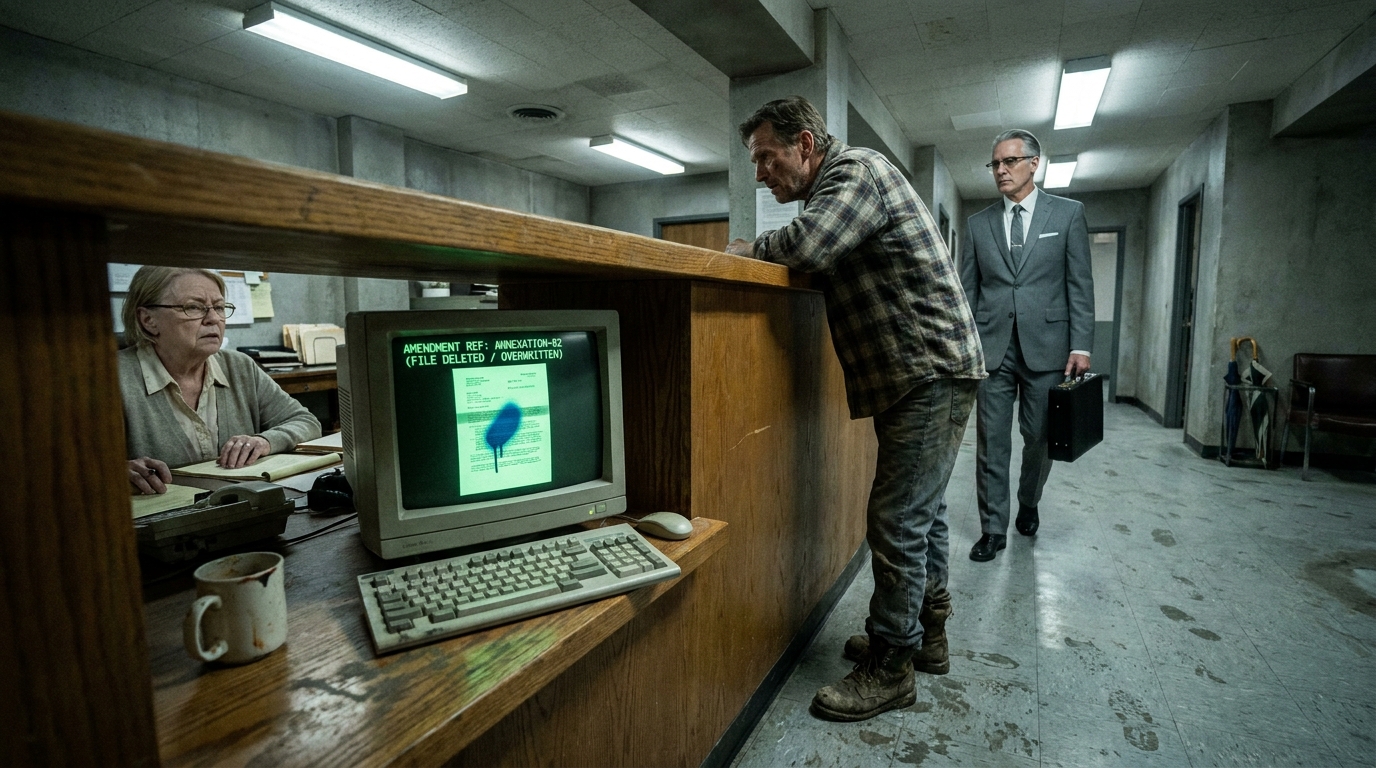
She looked at me for a long moment, reading the line of my jaw, then turned to her desktop monitor. Her fingers clattered over the mechanical keyboard. The green-monochrome terminal screen flickered, rolling through lines of local tax records and property transfers.
I leaned over the partition, watching the text scroll.
I froze. “Read that last line back to me.”
Martha’s glasses slipped down her nose. “That’s… that’s a system flag. It shouldn’t say deleted. It should list a vault box number.”
“Click the amendment reference,” I demanded.
She double-clicked the blue-highlighted text. The screen flashed once, then displayed a low-resolution scan of a land transfer document. At first glance, it looked standard: an administrative overlay shifting 140 acres of the valley basin into the township’s resort development corridor.
I leaned closer, my eyes scanning the signatures at the bottom.
My grandfather’s signature was there—Arthur E. Nash. But the blue ink of the scan showed a microscopic feathering along the baseline. The alignment of the notary seal was rotated three degrees off-grid compared to the official county stamp.
And stamped right in the header of the secondary easement clause, almost invisible under a smudge of digital noise, were three faded letters printed in typewriter font: V-9.
Annexation-82 wasn’t an authentic historical amendment. It was a high-resolution composite forgery uploaded directly into the county’s digital registry to override my family’s foundational deed.
“Martha,” I said, my voice dead calm. “Where are the backup microfiche reels from 1982 kept?”
“In the basement vault,” she whispered, her face draining of color as she realized what she was looking at. “But David… if someone modified the master server index, they had to have local administrative clearance. A clerk couldn’t do that.”
“I know,” I said.
A heavy set of footsteps echoed down the tiled hallway behind me. The heavy double doors swung open, and Arthur Pendelton stepped into the lobby, carrying a black leather briefcase in one hand and a freshly printed stack of legal motions in the other.
He stopped short when he saw me standing at the counter. His slicked-back gray hair was immaculate, but his eyes narrowed behind his rimless glasses as he registered the mud on my clothes and the terminal screen lit up behind Martha.
“Mr. Nash,” Pendelton said, his voice smooth as grease. “You’re early for the filing window.”
“I’m just early enough,” I said, turning slowly to face him. “Tell me, Arthur. When you filed the Annexation-82 update yesterday, did you use Renee’s login, or did the board buy you your own key to the vault?”
CHAPTER 3: THE BRIBE AND THE BLADE
Pendelton didn’t answer. His thumb slid smoothly over the brass latch of his briefcase, locking it with a sharp, dry click.
“You’re making a spectacle of yourself, David,” Pendelton said quietly, taking a half-step back toward the glass entry doors. “The court registry isn’t a forum for conspiracy theories.”
“It’s not a theory when the notary seal on Annexation-82 is sitting three degrees crooked,” I said, stepping past the counter. The heels of my mud-caked boots left dull gray smudges on the clean linoleum. “And it’s certainly not a conspiracy when your client uses an administrative overwrite to dodge a federal easement code.”
Pendelton’s jaw twitched. For a fraction of a second, his eyes cut sideways toward Martha Vance, who was quietly backing away from her desk terminal, her hand hovering near the intercom button.
“Step outside, Mr. Nash,” Pendelton said, his tone shifting into a flat, practiced murmur. “There is a black Suburban idling in the south lot. Mrs. Kesler is waiting. You have five minutes to hear an offer before we file the emergency injunction at nine o’clock.”
“I don’t ride in Renee’s cars,” I said.
“Then you can explain to a bankruptcy judge why you refused a three-point-five million dollar settlement,” Pendelton replied. He turned without waiting for a response, pushing open the heavy glass doors and stepping out into the cold drizzle covering the parking lot.
I stayed motionless for three seconds, counting the steady thrum of my own pulse. My right hand was buried deep in my coat, thumb tracing the cracked glass on my grandfather’s watch. I didn’t have the microfiche reels yet, but I had enough dirt on Pendelton’s shoes to make him pull the trigger early.
I followed him out.
The black Suburban sat near the back fence, its twin exhaust pipes puffing white plumes of diesel vapor into the damp morning air. Pendelton held the rear passenger door open, his umbrella tilted just enough to protect his suit, leaving me in the rain.
I climbed in. The air inside the cabin was suffocatingly warm, thick with the scent of fine Italian leather and Renee Kesler’s sharp, floral perfume.
Renee sat in the far corner of the leather bench seat, a crystal glass of sparkling water resting in the center console’s recessed holder. She was wearing a dark charcoal wool coat today, her hair pulled back into an immaculate knot. On the seat between us lay a thick leather binder stamped with the gold-leaf crest of the valley development trust.
“Close the door, Arthur,” Renee said without looking up from her tablet screen.
The door slammed shut, cutting off the hum of the highway traffic outside. The sudden cabin isolation was absolute.
“Three point five million,” Renee said, tapping the binder with a manicured nail. “Direct wire transfer into an escrow account within two hours of your signature on the Covenants-33 waiver.”
I leaned back against the headrest, feeling the low, rhythmic vibration of the V8 engine beneath the floorboards. “You’re overpaying for a piece of ground you claim you already annexed under Annexation-82.”
Renee finally looked up. Her green eyes were cold, devoid of the theatrical anger she had displayed on my porch three hours ago. This was the corporate predator at work, calculating yield per square foot.
“We are paying for speed, David,” she said flatly. “The resort syndicate opens its institutional funding round on Friday. I don’t intend to let an unwashed heir with an outdated survey slow down a forty-million-dollar land play.”
“The survey isn’t outdated,” I said. I pulled my grandfather’s brass watch from my pocket, letting the heavy chain dangle between my fingers. I didn’t open the casing. I just let the cold metal rest against my knee. “And the Annexation-82 file in the county registry was modified yesterday afternoon at 4:12 PM using an administrative password.”
Renee’s eyes dropped to the brass watch, then flicked back to my face. She didn’t flinch.
“Registry maintenance happens every quarter,” she said smoothly. “If your attorney attempts to challenge the index alignment in court, we will tie the property up in probate litigation for seven years. You’ll be broke by winter, David. Taxes, legal fees, site maintenance—the township will tax that log mansion into foreclosure before you ever see a courtroom.”
“You’re missing a detail, Renee,” I said, my voice dropping into a low, measured rhythm.
She leaned forward, her silver earrings catching the dim gray light filtering through the tinted windows. “I don’t miss details.”
“You missed the header code on the 1982 scan,” I said. “You cleared the private agricultural status, but you forgot to scrub the cross-reference code in the vault ledger. V-9.”
The silence inside the Suburban turned dense.
Renee didn’t speak. She didn’t reach for her water glass. But her thumb, resting against the edge of her glass tablet, gave a tiny, involuntary twitch, pressing against the glass until the screen flickered blue.
“Arthur,” she said softly, her eyes never leaving mine. “Leave us.”
“Renee, the filing window—” Pendelton began from the front passenger seat.
“Get out, Arthur,” she repeated, her tone turning razor-sharp.
The front door opened and shut. Pendelton stepped into the rain, leaving the two of us locked inside the idling vehicle.
Renee reached out, her fingers hovering an inch over the leather binder sitting between us. “You don’t know what that code means, David. You think you’re holding a legal deed. You’re holding a fuse.”
“Then let it burn,” I said. I grabbed the binder off the seat, popped the heavy brass door latch, and stepped out into the pouring rain before she could utter another word.
CHAPTER 4: THE VANGUARD BREACH
The rain hit my face like cold needles the moment the Suburban’s door slammed shut behind me.
I didn’t run. I tucked the heavy leather binder under my oilskin coat, pressed my arm tight against my ribs to keep it dry, and marched straight across the slick asphalt toward my ’88 F-150. Pendelton stood under his umbrella three paces away, his face pale, his rimless glasses fogged with moisture. He opened his mouth as I passed, but no sound came out.
I threw the truck into gear, the rear tires spinning once on the rain-slick pavement before catching asphalt.
The three-mile drive back up the mountain passed in a blur of gray mist and wiper blades dragging across glass. My mind didn’t dwell on Renee’s offer or Pendelton’s forged Annexation-82 file. Layer 1 was broken. They knew I had spotted the crooked notary stamp; they knew the municipal easement was a fragile fiction built to scare me into a quick cash payout. But Renee’s reaction to those three letters—V-9—proved the real war wasn’t being fought in the county court registry.
I turned onto the dirt lane. The CAT D8 sat dead and silent near my property line, its yellow blade resting in the fresh red mud.
I pulled up to the porch, killed the ignition, and grabbed the binder.
Inside the mansion, the air was cold, smelling of old cedar, dry ash, and stone. I locked the front door behind me, threw the bolt, and walked straight into the study at the rear of the floor plan.
My grandfather’s heavy oak desk sat against the north wall, but I didn’t sit down. I dropped Renee’s binder onto the desktop, unzipped my coat, and pulled out my pocket watch.
Snap. 10:42 AM.
I turned toward the chimney stack—four feet of hand-cut river granite rising through the center of the house. For sixty years, the family story was that my grandfather built the stone hearth to support the upper roof beam. But a man doesn’t reinforce a chimney with two-inch steel anchor plates just to hold up cedar rafters.
I dragged the heavy cast-iron log cradle away from the base of the hearth. The floorboards beneath were dark, stained with decades of linseed oil. I got down on my knees, my damp jeans soaking up the chill from the floor.
My fingers traced the gap between the third and fourth cedar planks until they hit a small, circular knot in the wood. I pressed down hard with my right thumb.
A faint mechanical clack echoed inside the floor joists.
A six-foot section of the floorboards dropped a quarter-inch and slid back three inches, revealing a dark subterranean recess cut directly into the mountain’s granite bedrock.
A rush of freezing, metallic air blew up from the cavity. It smelled of ozone, grease, and damp copper.
I pulled a heavy tactical flashlight from my belt, clicked the beam on, and shone it down into the opening. Five steel steps led down to a reinforced steel vault door bolted into the solid stone.
It wasn’t a root cellar. It wasn’t an old bank safe.
Mounted directly above the wheel-lock mechanism was a heavy brass plaque, dull with age but completely free of rust. Stamped into the metal in block lettering were the words:
UNITED STATES DEPARTMENT OF DEFENSE
STRATEGIC MINERAL RESERVE — VAULT DESIGNATION: VANGUARD-9
LEASE AGREEMENT: NASH LAND TRUST (COVENANTS-33)
WARNING: FEDERAL PROPERTY. UNAUTHORIZED ENTRY IS A CLASS 1 FELONY.
My breath hitched in my chest.
Annexation-82 wasn’t just a illegal land grab by Renee’s resort syndicate. It was an attempted cover-up of a federal leasehold. The HOA hadn’t just tried to steal my family’s surface land; they were trying to overwrite the boundary map to seize control of a cold-war federal vault buried forty feet under my floorboards.
I reached out, my fingers touching the cold lead security seal hanging from the vault wheel. Stamped on the lead tag was a date: OCTOBER 14, 1982.
They didn’t want the valley for luxury villas. They wanted the vault. And if the resort syndicate succeeded in executing the foreclosure lien, the federal lease would automatically default to the surface owner.
I gripped the heavy iron wheel of the vault lock, my knuckles turning white against the cold metal.
Behind me, the front porch floorboards groaned under a sudden, heavy weight.
Footsteps. Loud, deliberate, and moving fast toward the front door.
CHAPTER 5: CHECKMATE AT THE CLUBHOUSE
The footsteps on the porch didn’t force a breach.
My knuckles stayed locked around the iron wheel of Vanguard-9, cold metal biting into my palm. Through the floorboards, the heavy thump of boots paused at the heavy oak front door. A folded white envelope slid through the brass mail slot, snapping softly as it hit the rug inside.
I didn’t move until the sound of tires crunching gravel receded down the drive.
I pulled myself up from the stone recess, slid the cedar planking back into place until the floorboards locked with a dull thunk, and kicked the log cradle back over the seam. I picked up the envelope from the entryway.
An emergency summons. Signed by Arthur Pendelton.
SPECIAL SESSION: HOA EXECUTIVE BOARD
LOCATION: VALLEY RETREAT CLUBHOUSE — 1:00 PM
AGENDA: IMMEDIATE CONDEMNATION & EMINENT DOMAIN SEIZURE UNDER ANNEXATION-82
I didn’t call a lawyer. I reached into the desk drawer, pulled out a manila folder containing the certified microfiche transcript Martha Vance had printed for me, and tucked it into my coat next to the pocket watch.
At 1:02 PM, I pushed open the double oak doors of the HOA clubhouse.
The room was packed. Twenty local homeowners sat in folding chairs near the back, their murmurs cutting out the moment my boots hit the carpet. At the head of the long mahogany table sat the executive board. Renee Kesler occupied the center chair, flanked by three silent board members and Pendelton, who was furiously arranging legal briefs across his blotter.
“Mr. Nash,” Renee said, her voice echoing through the vaulted ceiling. She didn’t offer a chair. “You are out of order. This is an executive voting session.”
“You’re using Annexation-82 to force a site seizure,” I said, walking straight down the center aisle until my knuckles rested on the edge of the board table. The mahogany was cold, slick with polish.
“The municipal easement was duly recorded,” Pendelton snapped, rising slightly from his seat. “The board is exercising its statutory authority under Covenants-33 to clear the access corridor for the resort syndicate.”
“Annexation-82 is a forged composite,” I said.
A collective gasp rippled through the residents behind me.
Renee’s eyes narrowed into slits. “Careful, David. Defamation in front of twenty witnesses will cost you whatever equity you have left.”
I pulled the manila folder from my coat and laid it flat on the mahogany table. I didn’t open it. I laid my right hand flat over the cover, my thumb resting on the edge of my grandfather’s brass watch.
“The digital index file in the county registry was modified yesterday at 4:12 PM,” I said, my voice cutting through the hum of the air conditioning. “The notary seal on the scan is off-grid by three degrees. But more importantly, the clerk’s original microfiche reel from October 1982 carries an un-scrubbed cross-reference.”
Pendelton’s hand twitched, knocking his pen off the blotter. It rolled across the polished wood and hit my folder.
“The surface land doesn’t belong to Covenants-33,” I continued, looking directly at Renee. “And it certainly doesn’t belong to your resort syndicate. The entire 140-acre basin is bound by a permanent federal lease agreement established under the Strategic Minerals Act.”
Renee didn’t flinch, but her complexion turned the color of dry ash. Her jaw set hard, her teeth grinding visible under her skin.
“That lease was retired thirty years ago,” she whispered, her voice dropping into a lethal, quiet register.
“It wasn’t retired,” I said. “It was classified. The vault sitting under my hearth is designated Vanguard-9. Any attempt to modify the surface boundaries or execute an unauthorized commercial development over a federal strategic reserve constitutes a Class 1 felony under title 42.”
I leaned in, my face inches from hers. “You didn’t want the land for luxury villas, Renee. You found the 1982 survey, realized the federal lease was buried in the deed history, and tried to forge Annexation-82 so your syndicate could claim default ownership when the lease window expired.”
Silence slammed down on the room like a lead door.
Pendelton looked at Renee, his mouth slightly open, waiting for a counter-argument that didn’t come. The three board members beside her shrank back in their high-backed leather chairs, eyeing the manila folder as if it were an explosive device.
Renee’s hand slowly reached for her water glass. Her fingers shook—just enough to send a tiny ripple across the surface of the liquid.
“This meeting is adjourned,” she said hoarsely.
“No, it isn’t,” I said. “Because the county prosecutor and the regional land office received copies of the Vanguard-9 lease agreement twenty minutes ago.”
CHAPTER 6: THE SILENT PERIMETER
Renee’s glass didn’t reach her lips. Her hand trembled violently, sending a splash of water over the mahogany tabletop and soaking the edge of Pendelton’s brief.
“You’re bluffing,” Pendelton stammered, his voice cracking as he scrambled to mop the spilled water with a handful of paper napkins. “The federal registry doesn’t interface with county land software. You couldn’t have pulled the cross-reference without an authorization key.”
“I didn’t need a key,” I said, my voice dead level. “The key was already under my floorboards. It’s been there since 1982, when my grandfather signed the vault lease under Covenants-33. Every single document your syndicate forged—from Annexation-82 to the site prep permits—is a direct violation of federal land preservation statutes.”
Across the room, two board members stood up so fast their folding chairs screeched against the carpet. Neither spoke to Renee. They didn’t even look at Pendelton. They grabbed their coats from the backs of their chairs and walked briskly toward the side exit, leaving the heavy oak doors swinging behind them.
Renee sat frozen. The sharp, predatory composure she had carried on my porch hours ago was entirely gone. Her jaw worked silently, her chest heaving under her wool coat, but no words came. The cold, mathematical certainty of the trap had sprung, not through violence or empty legal threats, but through the precise, unyielding weight of the records she had tried to erase.
Pendelton stuffed his files into his leather briefcase, his hands shaking so hard he couldn’t align the brass latches. “We… we need to review the filing history,” he muttered to the remaining board members, his eyes darting frantically toward the doors. “There’s been an administrative error.”
“There’s no error, Arthur,” I said, reaching down to take my manila folder back from the table. “The county sheriff is already at the site entrance enforcing the federal hold order. If that CAT D8 turns its key before the federal land office clears the survey, the operator goes to jail—and you go with him.”
Pendelton didn’t answer. He snapped his briefcase shut with a wet, sloppy thud, turned on his heel, and rushed out the rear corridor without looking back.
Renee remained seated alone at the center of the long table. The room was dead silent now, save for the soft hum of the fluorescent lights. She slowly lowered her head, staring at the wet stain spreading across her polished blotter.
“The valley was going to be worth forty million,” she whispered, her voice stripped of every drop of arrogance.
“It’s worth more than that,” I said, sliding the folder under my arm. “And it’s staying exactly as it is.”
I turned and walked out of the clubhouse.
By four o’clock that afternoon, the rain had stopped. A cold, crisp wind blew down from the ridge, carrying the scent of damp pine needles and wet cedar.
I stood on the front porch of the mansion, my boots resting on the top step. Down at the perimeter line, the CAT D8 sat completely abandoned. A heavy steel chain was wrapped through its drive sprockets, secured with a yellow federal padlock. The raw, jagged trench the machine had carved through my wildflowers was already settling, the fresh red clay softening under the dripping trees.
A white utility truck from the County Public Works department pulled up to the driveway entrance. Two workers stepped out in high-vis vests, unloaded a wooden post, and hammered a permanent metal sign into the soil where the HOA’s makeshift access marker had wobbly stood.
The new sign was stark black and white:
PROTECTED FEDERAL BOUNDARY
NO UNAUTHORIZED EXCAVATION OR DEVELOPMENT
ENTRY BY PERMIT ONLY
I pulled my grandfather’s brass pocket watch from my coat. I thumbed the release catch.
Snap. 4:15 PM.
The glass face was still cracked—a fine, jagged line running from the center down to the Roman numeral six. I didn’t replace the crystal. The crack belonged there now, just like the raw earth settling along the perimeter.
I reached into my pocket, pulled out a small brass screwdriver I’d brought from the workbench, and carefully tightened the hinge pin until the cover snapped shut with a crisp, solid sound.
I sat down on the porch steps, resting my forearms against my knees. The mountain valley stretched out below the ridge—silent, green, and completely untouched. The heavy iron perimeter was locked. The land was mine, the vault was secure, and for the first time in thirty days, the air was clear.