The Clockwork Siege: How a Cold-Calculated Defense Dismantled a Suburban Tyrant’s Kingdom of Paper
CHAPTER 1: The Perimeter Breach
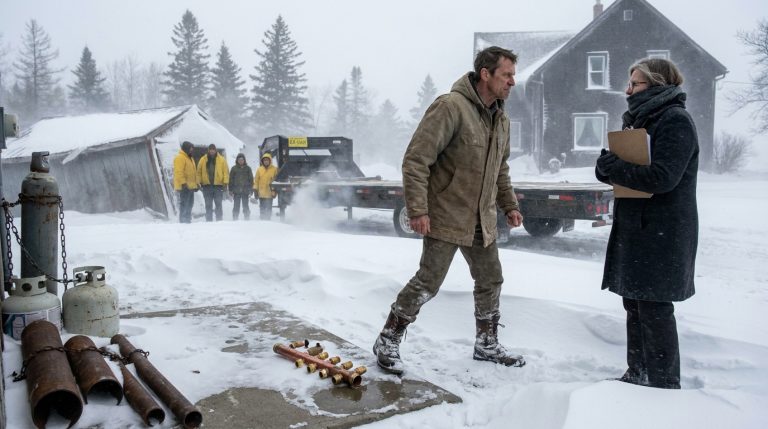
The garage door didn’t just open; it groaned, a metallic protest that hung in the humid afternoon air. I stood at the edge of the driveway, the lukewarm coffee in my mug serving as a pathetic anchor against the rising surge of adrenaline. Karen didn’t look like a thief. She looked like a realtor posing for a listing, her salmon-colored blazer sharp enough to cut glass, her hand gripping a clipboard as if it were a scepter.
Behind her, two men I vaguely recognized from the neighborhood committee hovered with the awkward, stiff-backed energy of people who knew they were committing a felony but were too terrified of her disapproval to stop.
I didn’t yell. I didn’t run. I took a slow, measured sip of the coffee, feeling the heat settle into my chest. In my pocket, my thumb found the edge of the remote trigger for the primary locking system, but I didn’t press it. Not yet. If I stopped her now, she would claim it was a misunderstanding, a civic misinterpretation. I needed her to cross the threshold. I needed her to commit to the theft in a way that left no room for legal theater.
She climbed into the cab of the tractor. The leather seat was custom-fitted to my height, and as she adjusted the mirror, she moved with an unsettling sense of ownership, her fingers tracing the dashboard displays I had built from scratch. She was smiling—not a real smile, but a thin, practiced line of satisfaction.
My phone vibrated against my thigh. A silent alert, crimson on the screen: Property Boundary Violation: 0.2 Meters.
“You’re making a mistake, Karen,” I said, my voice barely carrying over the sound of the wind through the trees.
She turned, her expression dropping into that patronizing, glued-on mask. “It’s a community asset, dear. The board voted. Try to keep up with the progress of your neighbors.”
She didn’t wait for a rebuttal. She didn’t want one. She was the queen of this cul-de-sac, and she was here to claim her prize. She reached for the ignition, and for a split second, I noticed the tremor in her left hand—a quick, nervous flicker that she immediately buried under the bulk of her clipboard. It wasn’t the confidence of a triumphant leader; it was the frantic, brittle focus of someone running out of time.
I watched her thumb the starter. The engine roared, a deep, mechanical growl that resonated in my very teeth. As she jerked the machine into gear and peeled out onto the asphalt, spitting gravel toward the ditch, I realized this wasn’t about flowers or entrance signs.
She wasn’t just stealing my machine. She was desperate. And people who are desperate make patterns that can be tracked. I pulled out my phone and engaged the silent log. The hunt had begun.
CHAPTER 2: The First Calculated Pivot
The sound of the tractor’s engine finally died away, leaving the garage feeling unnaturally cavernous. The smell of gasoline and ozone hung heavy in the air, mixed with the faint, lingering scent of the perfume Karen wore—something expensive and floral that felt like an intrusion on my workspace. I stood frozen for a second, my pulse drumming a rhythm against my eardrums that matched the idling cadence of the machine I had spent months fine-tuning.
My eyes drifted to the concrete floor where the tractor had sat for the better part of a year. The rectangular space was a void now, marked only by a few oil droplets and the dust-free outline of the treads. It was a vacuum, and already, I could feel the cold, logical gears of my mind beginning to grind, shifting from reactive anger to systematic investigation.
I walked to the workbench and swiped my tablet to life. The screen glowed, a harsh blue light that illuminated the clutter of specialized tools, circuit boards, and half-finished projects. I bypassed the main interface and pulled up the diagnostic hub for the tractor. My hand hovered over the screen. A flicker of memory interrupted the workflow: the late nights I’d spent in this very garage, welding the reinforced steel frame and wiring the independent GPS system. I remembered the pride I felt as the circuits clicked into place—a machine built for endurance, built to survive the harsh elements of a work site, not a suburban hijacking. That memory hit me with the force of a physical phantom, a sharp, cold realization that my attachment to this machine wasn’t just about the money. It was about the architecture of my own control. If I couldn’t secure my own property, what exactly was I protecting in this neighborhood?
I tapped the screen. The telemetry data appeared: a crisp, glowing line tracking the tractor’s path across the pavement. It was moving toward the retention ditch at the edge of the subdivision, just as I had anticipated. But it wasn’t the movement that caught my attention. It was the pattern of the stops.
Before Karen had hit the ditch, the tractor had paused twice at the subdivision entrance—not for traffic, but for extended intervals. I zoomed in on the map. The coordinates were precise. The first stop was by the main landscaping sign, the second by the community clubhouse.
Why?
If this were purely a power play or a misguided attempt at “beautification,” she would have gone straight to the flower bed. The pauses were illogical for a thief driven by vanity. They were, however, perfectly logical for someone marking territory or, more suspiciously, verifying a perimeter for a much larger project.
I pulled up the HOA’s public budget logs, which I had archived on my server months ago simply because I liked having the data. I cross-referenced the timestamps of the tractor’s stops with the recent spending reports under “Community Beautification.” The correlation was almost mathematical. Every time Karen had proposed a new project, there was a corresponding, unexplained transfer of funds into private accounts. It was clumsy, shielded only by the sheer laziness of the board members who never bothered to audit her.
I felt a cold tension tighten at the base of my neck. She wasn’t just a tyrant in a blazer. She was a scavenger.
I didn’t feel the urge to run out to the ditch anymore. The urge to confront her right now was a trap—a way to play into her script of a “hot-headed homeowner.” Instead, I sat down on the stool, the cold metal biting into my legs. I needed to be the ghost in her machine. I opened the communications relay I’d embedded in the tractor’s hardware—a failsafe I had built just in case the GPS ever failed. I routed the audio from the tractor’s interior directly to my headphones.
The audio was crisp. I heard the muffled, frantic swearing of the HOA volunteers as they tried to shove the tractor out of the mud. Then, Karen’s voice, sharp and biting, cutting through their incompetence.
“Don’t just stand there! We need the optics right. If the funding doesn’t clear by Monday, the board will start asking questions about the maintenance logs!”
I leaned back, the silence of the garage finally starting to make sense. Funding. The word hung in the air, a jagged piece of a much larger, darker puzzle. She wasn’t building a flower bed; she was building a digital paper trail to mask a shortfall. And she had used my machine as a prop for a performance that was meant to hide her own insolvency.
I didn’t smile. I didn’t feel the thrill of the hunt yet. I felt the weight of the realization. This wasn’t just a neighborly dispute anymore. It was an investigation, and I was holding the key to her entire fraudulent kingdom. My finger hovered over the ‘Record’ button on the tablet. I wasn’t going to just watch her fail; I was going to ensure that when she fell, she had no surface left to land on.
I looked at the map again, tracking her pulse in the mud. She thought she was leading a parade. She had no idea she was already in the middle of a diagnostic test she couldn’t possibly win. I stood up, moved to the tool chest, and pulled out a small, high-gain antenna. If I was going to be the silent observer, I needed a clearer signal. I walked toward the back door of the garage, every step deliberate, every movement measured.
The battle wasn’t happening in the mud. It was happening in the data. And for the first time since the garage door opened, I felt the calm, icy focus of a strategist who knows exactly where the enemy’s foundation is cracked.
CHAPTER 3: The Mirror Stage
I stepped out of the back door of the garage and into the cooling twilight. The air had that sharp, biting edge that precedes a storm, the kind of stillness that makes every rustle of the leaves sound like a whisper. I stood on the threshold, the antenna held firmly in my hand, its cable snaking back toward the tablet on the workbench like a lifeline. I didn’t head for the ditch. Instead, I moved toward the shadows near the property line where the subdivision’s main power junction box sat.
If Karen was orchestrating a massive reallocation of funds, she wouldn’t just be doing it through verbal promises. She was using the neighborhood’s shared infrastructure to hide her tracks. I watched the house through the lens of my peripheral vision. The neighborhood was quiet, unnervingly so, as if the entire street were holding its breath, waiting to see if the status quo would hold or if the friction of the last few hours would finally ignite a fire.
As I reached the junction box, the sound of gravel crunching under tires broke the silence. A silver sedan pulled up to the curb—Karen’s car. She stepped out, her movements frantic, the salmon blazer now stained with a dark, wet patch of mud on the shoulder. She wasn’t holding the clipboard anymore. Her hands were empty, and she kept pressing them against her sides, a rhythmic, nervous motion that looked almost like she was trying to keep herself from shaking apart.
She didn’t see me. I pulled back into the deeper shade of the pine trees, my heart rate steady, my breathing calibrated. The “predator-prey” lens was no longer a metaphor; it was a survival necessity. I watched as she walked toward the clubhouse entrance, pausing to check her phone every few seconds. She looked small, stripped of the performative authority she wore like armor during the daylight hours.
I synced my tablet to the clubhouse’s local network—a simple task for someone who had spent their life writing code and building machines. As I bypassed the firewall, I felt a flicker of doubt. Was I reading too much into this? Was I seeing a criminal mastermind where there was only a petty, entitled woman having a very bad day? I caught myself, bracing my mind against the uncertainty. No. The logs weren’t lying. The pattern of the bank transfers was too precise to be accidental, and her current state of agitation wasn’t the look of someone merely frustrated by a broken project. It was the look of someone whose foundation was shifting.
I tapped the screen, filtering the clubhouse’s internal traffic. A stream of emails and financial reports flooded my dashboard. I ignored the fluff—the meeting minutes, the garden committee discussions—and went straight for the hidden directories labeled ‘Maintenance Assets.’
There it was. An Excel spreadsheet titled Project Resurrect. It wasn’t about landscaping. It was a ledger of expenses that looked more like the frantic balancing of a high-stakes gambling account. My breath hitched. Beneath the veneer of legitimate HOA spending, she had been systematically siphoning money from every maintenance contract in the neighborhood.
I felt a surge of cold, analytical clarity. This wasn’t just embezzlement; it was a desperate, scorched-earth attempt to pay off something massive. The ‘Project Resurrect’ wasn’t the tractor; it was her life. She was using the HOA funds as a revolving door to keep creditors at bay, and the tractor was supposed to be the ultimate shell game—a high-value asset she could “lease” back to the community under a fake service fee to fill the gaps in her accounts.
She reached the clubhouse door and stopped. I watched through the tablet’s remote camera feed as she checked her reflection in the glass. She took a deep, shuddering breath, smoothed her hair, and rearranged the mask of the local tyrant. When she walked inside, the change was instantaneous. The nervous, shivering wreck was gone, replaced by the same polished, icy veneer she’d used to try and intimidate me earlier that day.
I felt a phantom of guilt, quickly suppressed. I wasn’t the one who had created this situation. I was merely the one who had stopped being a victim and started being a witness. I kept the recording running, my thumb hovering over the file-save command. This was the leverage I needed. It was ugly, it was cold, and it was absolutely necessary.
I turned away from the clubhouse, the antenna tucked under my arm, and headed back toward the garage. The darkness of the yard felt less like a threat now and more like a tool. I had the ledger. I had the motive. And for the first time, I could see the endgame clearly. She would try to move again tomorrow—she had to—and when she did, she would find that the ground she was walking on had already been paved over by the very evidence she thought she had buried in the mud.
I reached the garage, the familiar hum of the machinery inside greeting me like a silent partner. I walked to the desk, sat down, and began to assemble the final timeline of her downfall. The clock was ticking, but for the first time in this entire ordeal, I was the one who held the key to the gears.
CHAPTER 4: The Midpoint Decoy
The clubhouse was a cavernous space of laminate flooring and folding chairs, smelling faintly of lemon cleaner and the stale, lingering scent of a thousand community meetings. I stepped inside just as Karen stood at the front of the room, her voice projecting with the practiced, melodic confidence of a woman who had never once doubted her own narrative. She was mid-speech, gesturing toward a PowerPoint slide that featured an artist’s rendering of a lush, manicured flower bed at the subdivision entrance—right where my tractor had sat for months.
I didn’t head for a chair. I stayed in the shadows of the doorway, watching the audience. They looked tired, their expressions vacant, as if they’d already decided that agreeing with her was simply the path of least resistance. She was playing them, banking on their apathy to grant her the ’emergency’ service fee she was pushing for to cover the hole in the maintenance budget.
I caught Dale’s eye. He was standing near the projector, his beige cardigan blending into the wall behind him. For a split second, I expected a nod, a sign that the files I’d sent him had done their work. Instead, he looked through me, his jaw tight, his gaze fixed firmly on the floor. The silence from him was heavy, a sudden, sharp deviation from the alliance we had tacitly agreed upon. Had he been bought? Or had he seen something in those files that terrified him enough to make him retreat?
The shift in the room was palpable. It wasn’t just the mundane boredom of a town hall meeting anymore; it was the suffocating tension of a stage play where the lead actress was beginning to lose her lines.
“This tractor,” Karen said, her voice dropping to a sympathetic, almost maternal register, “is not just a piece of hardware. It is a symbol of our shared sacrifice. And if we, as a community, choose to ignore the opportunity to turn it into a beacon of our beautification project, we are ignoring our collective responsibility.”
A ripple of low-level murmurs passed through the room. She was good. She had framed my personal property as a public utility so convincingly that some of the people sitting there actually looked like they were beginning to believe it.
I stepped forward, the weight of the digital tablet in my hand feeling like a physical weapon. My movement caught the attention of the front row. A few heads turned. The murmurs died out, replaced by a sudden, expectant quiet.
“It’s not a symbol, Karen,” I said, my voice cutting through the stale air with a cold, clipped precision.
The room froze. Karen spun around, the laser pointer in her hand twitching like a conductor’s baton. For a second, the mask slipped—a flash of raw, unfiltered panic that distorted her features into something jagged and unrecognizable. It was gone in a heartbeat, replaced by that thin, patronizing smirk.
“Ah,” she said, her voice dripping with artificial warmth. “I see our resident skeptic has decided to join us. I’m sure you’re here to apologize for the… complications earlier today.”
“I’m here to clarify the equipment maintenance records,” I replied, walking down the center aisle. I kept my gaze locked on hers. I could see the sweat beading along her hairline, the way her grip on the laser pointer had turned her knuckles white. “Especially the ones related to Project Resurrect.”
The name hit the room like an object. Dale, still standing by the projector, visibly winced.
Karen didn’t blink, but her voice dropped an octave. “We are in the middle of a vote, sir. Please take your seat or leave.”
“The vote is based on a lie,” I said, reaching the front of the room. I felt the gaze of every neighbor on me, a heavy, suffocating pressure. I didn’t care. I looked at the screen, then at the ledger data I had synced to the projector. The projection switched. The lush flower bed vanished, replaced by a spreadsheet of siphoned funds, timestamped deposits, and account numbers that didn’t belong to any registered neighborhood vendor.
The room went silent, but it wasn’t the silence of apathy anymore. It was the sharp, jagged silence of an epiphany. I saw the realization dawn on faces in the front row—the treasurer, the board members, the people who had been nodding along with her for years.
Karen lunged for the laptop connected to the projector, but she was too slow. I stepped between her and the hardware, my posture firm, my gaze steady.
“The tractor isn’t part of the community ecosystem, Karen,” I said, my voice low and hard enough to carry to the back of the room. “And neither are these transfers.”
She tried to laugh—a brittle, high-pitched sound that died the moment she looked into the room and saw not supporters, but judges. She looked toward Dale, but he had already turned his back, his shoulders slumped in a gesture of absolute, terrified surrender.
The decoy had been shattered. The embezzlement was exposed, the stolen funds laid bare for all to see. But as I watched her, I saw something else—a flicker of something deeper than just fear of exposure. It was the frantic, trapped look of someone staring into an abyss. This wasn’t just about the money she’d stolen; it was about the life she had been trying to outrun. The embezzlement was just the symptom; the sickness was much, much older.
She stood there, surrounded by the ghosts of her own arrogance, the projector light casting a harsh, clinical glow over her face. She was trapped, the walls of her little kingdom crumbling in real-time, and for the first time, I realized that my victory wasn’t going to be the end of the war. It was the beginning of the collapse.
CHAPTER 5: The Paper Guillotine
The room didn’t just feel different; it felt hostile. The projector’s light, now illuminating the undeniable math of her theft, acted as a spotlight for the neighbors’ collective shift from confusion to cold, hard resentment. Karen stood near the podium, her fingers twitching against the edge of the mahogany wood. A sharp crack of thunder echoed outside, shaking the large clubhouse windows, and for a split second, the lights flickered, casting the room into a deep, jagged shadow.
“It’s a glitch,” Karen hissed, her voice thin and brittle, cracking under the weight of the silence. “The software… it’s been tampered with. He’s been manipulating the logs for weeks to frame me.”
She looked to Dale, expecting her usual leverage to work, but Dale remained glued to his spot, his eyes fixed on the spreadsheet where the missing funds were highlighted in bold red. The storm outside intensified, the rain lashing against the glass like gravel. It felt like the elements were conspiring to strip away the rest of her cover.
I didn’t argue. I didn’t need to. I walked toward the table where the treasurer’s logs were kept, my movements slow, deliberate, and entirely unbothered by her frantic defensive posture. I pulled out my own copy of the bank statements—the ones I’d cross-referenced with the drone footage and the tractor’s GPS.
“Frame you, Karen?” I asked, my voice flat, devoid of the emotion she was trying so desperately to provoke. “The data is timestamped. Every withdrawal, every ghost vendor, every ‘landscaping fee’ that vanished into a personal offshore account. You didn’t just steal the tractor; you used it to create a digital phantom you could charge the neighborhood to maintain.”
“You don’t understand!” she shouted, her composure finally shattering. She took a step toward me, but she stumbled, her heel catching on the edge of the carpet. She landed hard, her hands splayed out across the floor. “I had to! The debt… the interest—”
She stopped, the words hanging in the air, sharp and jagged. The room went deathly still. The embezzlement was the scheme, yes, but the why—the desperate, gnawing need to cover a debt that had spiraled beyond her control—was the actual catalyst. I saw it then: the nervous tic, the obsession with the ‘Project Resurrect,’ the way she’d looked at the clubhouse like a throne room. She wasn’t just a petty tyrant. She was a woman who had gambled her entire existence on a game she didn’t know how to play, and she was currently losing everything.
“The debt?” I repeated, keeping my voice low. “You put this entire neighborhood’s maintenance budget into a betting pool? You thought you could recover what you’d already lost by stealing a piece of machinery from your own neighbor?”
She crawled to her knees, her salmon blazer now stained with dust from the floorboards. She looked around the room, searching for a face, any face, that might offer a shred of empathy. She found only cold, judgmental stares. The neighbors, once her silent subjects, were now watching her with the detached curiosity one gives to a car wreck.
“I can explain,” she gasped, her hands shaking as she clawed at the air. “I just needed more time. If I could have just secured the service fees from the tractor, the auditors wouldn’t have flagged the account before—”
She realized what she’d just said. She froze, her mouth slightly agape, the confession hanging in the room like smog. The rain intensified, drumming a frantic, metallic rhythm on the roof.
I didn’t move to help her up. I didn’t feel the need to gloat. I felt a cold, mechanical satisfaction, the kind that comes when a machine is running perfectly. The sequence of events had played out exactly as the data suggested. Her pride had forced her to make the one mistake she couldn’t recover from: she’d tried to blame the very technology that was recording her crimes.
“Dale,” I said, without taking my eyes off her. “Call the police. Tell them we have the confession and the accounting files. And tell them the stolen property is already accounted for.”
Dale didn’t hesitate. He pulled out his phone, his hand steady for the first time all night. Karen didn’t try to run. She just sat there on the floor, her eyes vacant, staring at the projected numbers on the wall. She looked smaller than she had in the driveway, smaller than she had when she was trapped in the mud, and significantly smaller than the woman who had marched into my garage with a clipboard and a fake sense of destiny.
The storm outside peaked, a blinding flash of lightning followed by a crack of thunder that sounded like the end of a long, drawn-out chapter. I walked toward the door, leaving her amidst the wreckage of her own design. I had one more piece of the puzzle to secure—the final, physical recovery of the tractor—but the fight? The fight was over. She hadn’t been defeated by me, or by the HOA, or by the law. She’d been defeated by her own math.
I pushed open the clubhouse door and stepped out into the rain. It felt cold, clean, and entirely indifferent to the woman shivering on the floor behind me.
CHAPTER 6: The Final Settlement
The rain had tapered to a rhythmic drip from the eaves of the clubhouse, a sound that felt like a heartbeat slowing down. I walked the perimeter of the parking lot, the asphalt slick and reflecting the stark, clinical glow of the streetlights. My truck was parked a few rows back, but I didn’t get in. Instead, I turned toward the retention ditch. The tractor was still there, a hulking, metallic silhouette against the dark, muddy bank, its nose buried in the earth like a dormant animal.
Karen was gone, processed by the arriving patrol cars before the last thunderclap had even faded. The neighborhood was quiet, the kind of absolute stillness that follows a collapse. There were no cheers, no celebrations. Just the heavy, uncomfortable realization among the remaining neighbors that their sense of order had been a fragile, easily manipulated illusion.
I climbed down into the ditch, my boots sinking into the muck. The metal of the tractor’s cab felt cold under my hand, a sharp, familiar edge that grounded me. I didn’t need the remote unlock anymore; the system had reset after the police had secured the scene. I pulled the manual release, and the door swung open with a hiss of pneumatic pressure.
The interior was exactly as I had left it: the faint, lingering scent of my own coffee, the faint hum of the cooling fans, and the digital ghost of the banjo track that had served as the soundtrack to her initial undoing. It felt like a monument to a minor war. I sat in the driver’s seat, the leather molding to my posture, and for the first time in weeks, the tension that had knotted my shoulders began to unspool.
The investigation into the gambling debt—the layer of reality that had driven her to such desperate, public ruin—would likely drag on for months. The auditors had already begun their work, their voices low and professional as they sorted through the digital breadcrumbs I had provided. It was a sordid, human mess, stripped of the grandiosity she had tried to drape it in. She hadn’t been a revolutionary or a tyrant; she had been a person whose pride wouldn’t allow her to admit she was drowning.
I didn’t feel triumph. I felt an exhaustion that went bone-deep.
I reached into my pocket and pulled out the key. It was a simple, machined piece of steel, and as I turned it in the ignition, the tractor roared to life. The vibration traveled up through the chassis and into my hands, a steady, rhythmic pulse of power. I put the machine in gear and began the slow, arduous process of backing it out of the mud. The tires spun once, threw a spray of wet earth against the side of the cab, and then found traction. With a steady, low-end torque, the tractor crested the bank and climbed back onto the gravel of the driveway.
I spent the next hour cleaning the underside, the rhythmic scrape of the shovel against the caked-on clay acting as a form of meditation. I worked until the metal shone again, the surface clean, the mechanics exposed and functional. It was a process of repair—not just of the machine, but of the disruption she had caused.
When I finished, I walked over to the gazebo—the structure that had been moved from her yard to mine, the very symbol of her lost kingdom. It sat near the property line, its white paint peeling, the wood aged and weary. I brought my tools over, set them on the bench, and began to tighten the loose joints and sand down the rough edges. It wasn’t about reclamation; it was about stabilization. I was going to keep this space, not because I wanted to hold onto her legacy, but because I wanted to ensure this ground would remain settled.
A car pulled up at the edge of the driveway. Dale. He climbed out, his beige cardigan looking rumpled, his face showing the strain of the night. He didn’t come right up to me; he stopped at a distance, looking at the gazebo, then at the tractor, then back at me.
“She’s talking to them now,” he said, his voice flat. “Everything’s gone, isn’t it? Even the house.”
“It was never really hers,” I replied, my voice steady as I applied a fresh coat of sealant to the wood. “It was just a place she used to play a part.”
Dale nodded, a slow, hollow movement. “I should have seen it. The numbers were right there.”
“You did see it,” I said, looking up at him. “You just needed the right perspective to verify what you already knew.”
He stood there for a long moment, watching the progress of my work. The silence between us wasn’t strained; it was the quiet of two people who had spent too long looking at the same problem from different sides of the fence. He didn’t apologize, and I didn’t ask him to. We both knew the cost of the intervention.
He eventually turned back to his car, and I went back to the wood, the sealant smoothing over the imperfections. The neighborhood was changing. I could feel it in the air—a shift from the rigid, performative order Karen had imposed to something more fluid, perhaps more honest.
I finished the final joist, the wood now sturdy and firm beneath my hand. The tractor sat a few yards away, its engine cooling, a quiet, solid presence in the moonlight. I realized then that my work wasn’t just about the machine or the gazebo; it was about the boundary. I had set it, I had defended it, and now, it was simply mine to maintain.
I put my tools away, the metallic clatter of the wrenches the only sound in the night. The war was over, the tyrant gone, and the ground was quiet again. I walked toward the porch, the lights of the house welcoming and warm. I stopped at the door, turned, and looked back at the yard—the tractor, the gazebo, the clear line between my life and the rest of the world. It was enough.