The Concrete Kingdom: A Story of Suburban Surveillance, Calculated Law, and the Cold Dismantling of Power
CHAPTER 1: THE FIRST INCISION
The steel blade of a standard-issue Husky box cutter did not slice the plastic; it chewed through it with a low, rhythmic rasp.
Miles stood six inches behind the heavy mesh of his screen door, his weight balanced entirely on his right heel. His left knee was cold, a hollow ache that traveled up from the shrapnel scar on his tibia and settled into his hip like wet cement. Outside, the Arizona dawn was the color of a bruised plum. At 6:47 a.m., the air still held the sharp, synthetic chill of overnight lawn sprinklers, but the heat was already rising from the asphalt, smelling of dry clay and old tar.
Brenda Clearwater didn’t look like a vandal. She wore white designer denim that remained immaculate even as she crouched on the concrete curb, her knees tucked neatly against her chest. Her silver-streaked hair was pulled back into a high, professional ponytail that bobbed slightly each time she brought the knife down.
Zip.
Another section of the bright orange high-vis marker—the heavy-gauge polyurethane strip the federal court had stamped with an official tracking index—toppled into the gravel. It lay there like a severed tongue.
Miles didn’t move. He reached into his right pocket, his fingers closing around the cold, brass casing of his old field compass. The hinge was broken, the glass cracked across the face of the needle, but the dead weight of it stabilized his hand. He counted her breaths through the screen. Three more cuts. She was thorough. She wasn’t just clearing a violation; she was erasing an adaptation.
When she finished the row, Brenda stood up. She didn’t look at his windows. Instead, she turned her back to the house, brushing the gray granite dust from her shins with two swift, rhythmic strokes of her palms. A small, sharp laugh escaped her—flat and dry, the sound of a plastic card snapping in a wallet. She kicked one of the orange remnants into the drainage culvert with the toe of her leather loafer, then stepped toward her white Range Rover. The vanity plate—HOA BOSS—was framed perfectly by the red glare of her brake lights as she unlocked the doors remotely.
The passenger window of the vehicle was down three inches. From inside the garage next door, Dale Pinkerton’s pool pump began its morning cycle, a wet, metallic grinding that filled the silence between them.
Miles shifted his weight. His left foot pins-and-needled, the nerve endings misfiring beneath the heavy scar tissue. He watched Brenda’s reflection in the side mirror of the Rover. She wasn’t driving away. She sat in the idling idling car, the air conditioning immediately blowing a thin plume of condensation against the tint, her thumb moving rapidly across her phone screen.
On the ground near the walkway, right where the concrete met the desert landscaping, a single drop of machine oil from her brand-new box cutter clung to the edge of a shredded orange fragment. It caught the first yellow ray of the sun, glittering like a diamond in the dirt.
Miles opened the screen door. The hinges didn’t whine; he’d greased them with graphite three days ago for this exact silence. He took one step onto the porch, his left leg dragging slightly, the rubber sole of his sneaker making a dry shuck sound against the aggregate.
Brenda’s head snapped up in the mirror. Her expression didn’t change from amusement to fear; it tightened into something hard, small, and infinitely cold. She didn’t roll down the window. She simply engaged the transmission, the heavy tires crunching over the loose gravel she’d kicked onto his driveway as the vehicle glided forward into the street.
Behind him, inside the dark hallway, the floorboards gave a familiar, soft creak. Carmen was awake.
Miles looked down at his feet. The first marker was completely gone, leaving only the two raw zinc anchors screwed into the expansion joint. In the quiet gray morning, the remaining plastic stubs looked less like a path and more like a line of small, clean teeth waiting for a trap to spring.
CHAPTER 2: THE ASSESSMENT OF DAMAGE
The house behind me was still breathing. I could hear the familiar cadence of Carmen’s footsteps—a soft, rhythmic tap-drag on the hardwood that meant she was still moving in a fog of post-shift exhaustion. She was a trauma nurse; her internal clock was permanently set to a war zone rhythm, even here in the sterile, quiet rows of Desert Winds.
I stayed on the porch for a long moment, my left leg stiffening in the morning air. The zinc anchors where the markers had been looked like metal sutures in the concrete. I leaned down, the movement pulling at the taut, angry skin around my knee, and ran a thumb over the jagged plastic left behind. It was sharp—a clean, surgical cut. Brenda hadn’t just torn them out; she had used a blade with precision. It was an act of intent, not rage.
“Miles?”
Carmen’s voice drifted through the screen door. She sounded thin, the way she did after twelve hours of holding people’s lives together. I stood up, favoring my right side, and pulled the screen door open. The metallic click of the latch was a gunshot in the morning silence.
“I’m here,” I said. My voice was raspy, unused. I walked into the hallway, the cool air of the AC hitting the sweat on my neck.
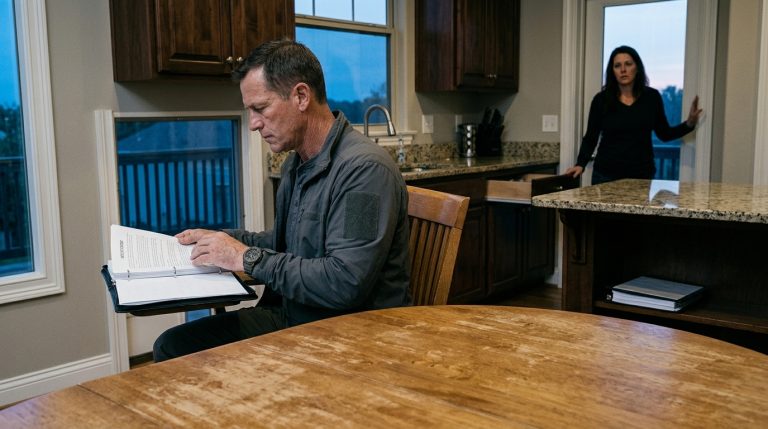
Carmen was standing in the kitchen, a mug of coffee clutched between both hands as if she were trying to draw heat from the ceramic. She looked at me, her eyes tracking the way I moved, the slight list to my walk. She didn’t have to look outside to know what had happened. She saw the familiar tightening of my jaw, the way I kept my right hand curled into a fist in my pocket.
“She was out there,” she stated. It wasn’t a question.
“She was.” I moved past her to the kitchen island, pulling out the small, black-bound ledger I kept hidden in the utility drawer. “She used a box cutter. Took the markers down in under a minute.”
Carmen let out a long, shuddering breath, her shoulders sagging. “The court order, Miles. We have the documentation. We have the photos from the last inspection. Why is she doing this now? She’s not stupid. She knows the federal weight behind those markers.”
I opened the ledger. The paper was crisp, filled with neat, handwritten rows of dates, times, and decibel readings from the neighborhood. I flipped to the back, where I had documented every fine, every “aesthetic” violation notice, and every interaction with Dale Pinkerton. As I looked at the data, the humming of the garage door next door—Dale’s pool pump—seemed to amplify, vibrating through the kitchen floor.
It triggered a sudden, unbidden surge of static in my ears—a ghost sound. I was back in a Humvee in the Arghandab Valley, the radio crackling with a distorted, urgent check-in, the dust tasting like iron and copper. I gripped the edge of the granite counter until my knuckles turned white, forcing the memory back into the dark corner where it belonged. The now was Phoenix. The enemy was an HOA president in designer denim.
“She isn’t just trying to get rid of the markers, Carmen,” I said, my voice dropping to a low, measured tone. “If she were just being petty, she’d have just complained to the board. She’s destroying evidence. She’s cutting the line.”
“Why?”
“Because if I have to sue to replace them again, or if I file a police report for destruction of property, it forces a public investigation into the original zoning accommodation.” I leaned over the ledger, marking the time: 6:52 a.m. “She wants me to look like the aggressor. She wants a trail of ‘neighborhood disputes’ so she can argue in court that we’re the ones creating a hostile environment.”
I walked to the window and looked out at the street. Brenda’s Range Rover was long gone, but the impression of her tires remained in the soft desert dust of the curb. I saw Mrs. Smith walking her poodle two houses down, her gaze darting nervously toward our porch, then away, as if looking at our house was a contagion.
“She’s isolating us,” I said, mostly to myself. “She’s not just enforcing rules. She’s framing the narrative.”
I felt Carmen’s hand on my arm. She didn’t offer empty comfort. She didn’t tell me to let it go. She knew, better than anyone, that letting go wasn’t an option when your foundation was being dismantled piece by piece.
“What’s the next move?” she asked.
I pulled the broken compass from my pocket and set it on the ledger. It was useless for direction, but it was a reminder of dead reckoning—figuring out where you were by knowing exactly where you’d been.
“I’m going to document the remains,” I said, already turning toward the utility closet to grab the digital camera. “And then I’m going to call Agent Walsh. If she wants to play with federal markers, she can explain herself to the people who handle federal violations.”
“She’ll see you out there,” Carmen warned. “She has cameras, Miles. The whole block has them.”
I looked at the window, my reflection ghosted against the glass. “Good. Let her watch. If she’s so obsessed with order, let’s see how she likes being the primary subject of a very thorough, very permanent record.”
I stepped back out onto the porch. The heat was beginning to build, the sharp scent of the shredded plastic still hanging in the air. I kept my movements slow, deliberate, a tactical maneuver in a war fought with cameras and court orders. I wasn’t just fixing a path; I was walking into the crosshairs, and for the first time in years, I felt entirely, terrifyingly awake.
CHAPTER 3: THE COLD WAR MEETING
The sunlight hit the camera lens with a blinding, sterile glare as I stepped down into the driveway. My left knee clicked—a sharp, internal protest—but I ignored it. I walked the length of the walkway, documenting the ruin Brenda had left behind. Every frame of the digital camera shutter clicked like a mechanical promise.
As I rounded the corner of the garage to get a low-angle shot of the shredded markers against the concrete, I saw it. Carmen’s car was pulled fully into the garage, yet there, fluttering slightly in the draft from the door, was a bright yellow slip of cardstock wedged under her wiper blade.
I paused. A laminated HOA violation notice.
I approached it, my pulse thrumming in my fingertips. I didn’t touch it immediately. I pulled out my phone and recorded the position, the angle, the way it had been placed inside a private garage while we slept. It was an intrusion that felt less like a code enforcement issue and more like a calling card.
The text was printed in a crisp, aggressive font: Violation: Unauthorized obstruction of common area sightlines. Fine: $250. Resolution: Immediate removal of all non-conforming aesthetics.
I tucked the notice into a clear evidence bag, my movements practiced and slow. This was the trap. She wasn’t just policing the street; she was claiming the right to penetrate our personal space. She was escalating the friction, testing to see if I would snap, if I would go to her house and raise my voice, if I would hand her the very “hostile interaction” she needed to build her case.
I didn’t head to her house. I walked back inside, the air-conditioned hallway feeling like a bunker.
“They were in the garage, Carmen,” I said, laying the evidence bag on the kitchen table.
She looked up from her nursing charts, her face pale. She didn’t have to look at the bag to understand. “She’s testing the perimeter.”
“She’s daring us to break,” I replied. I sat down, the weight of the day settling into my bones. “She wants a confrontation on her terms. If we respond to the violation, we acknowledge her authority over our garage. If we ignore it, we look like we’re hiding something.”
“So we don’t respond to her,” Carmen said, her eyes narrowing. “We respond to the law.”
The emergency HOA meeting was scheduled for 7:00 p.m. that evening. It was a tactical error on Brenda’s part—calling a meeting on a Friday night, when most residents were looking for a reprieve, was a sign of desperation. She needed the neighborhood’s fear to outweigh their apathy.
When we arrived at the community clubhouse, the room was already filled with the heavy, scentless air of a filtered cooling system. Brenda sat at the head of the long, mahogany table, her cronies—Dale Pinkerton and Judy Whitmore—flanking her like sentries. Dale was busy tapping on a tablet, while Judy was whispering to a cluster of neighbors near the door, her eyes darting toward me the moment I entered.
I found a seat in the back, far from the center of the room. My knee throbbed, a rhythmic reminder of why I needed the markers, but I kept my face neutral, my hands resting flat on the table.
Brenda stood, tapping a glass of water with a silver pen. The room went silent. She didn’t look at me; she looked at the audience, her posture radiating a practiced, rehearsed confidence.
“We have some housekeeping to resolve regarding the structural integrity of our walkway aesthetics,” she began, her voice smooth and modulated. “Some of our newer residents have found it difficult to adapt to the community standards. I want to be clear: Desert Winds is a premium investment. We all pay for that standard, and we will defend it.”
She let that hang, a veiled threat aimed directly at the back of the room. She was shifting the narrative from a disability issue to a financial one—the “investment” of every homeowner in the room was supposedly being threatened by my mere existence.
I didn’t speak. I didn’t interrupt. I just watched Dale. He was avoiding eye contact, his thumb hovering over the ‘refresh’ button on his tablet. He looked tired, his skin sallow under the harsh fluorescent lights.
“Miles,” Brenda said, finally turning to look at me, her smile tight and devoid of warmth. “I see you’ve been doing some… landscaping work today. I trust you’ll be removing the rest of those eyesores by morning?”
The room collectively shifted, a wave of nervous tension rippling through the neighbors. Some looked away, embarrassed; others, the ones who had been whispering with Judy, straightened their backs.
“The markers are there because of a federal court order, Brenda,” I said, my voice steady, stripped of emotion. “You know that. You were served the papers.”
“Papers,” she scoffed, dismissing the comment with a wave of her hand. “Papers don’t protect us from plummeting property values. And frankly, this community is tired of the litigation. Who else feels that the association’s time should be spent on maintenance, not fighting individual whims?”
Several hands went up, prompted by Judy’s encouraging nod.
I leaned back, feeling the cold weight of the evidence bag in my jacket pocket. Brenda was playing a winning hand, or so she thought. She was using the mob to justify the crime. But as I watched Dale’s hand shake while he tapped his screen, I realized something critical. They weren’t fighting for the community. They were rushing to finish something before the fiscal quarter closed.
They were scared. And in a war of attrition, fear is the first thing that breaks.
CHAPTER 4: THE GHOST IN THE WIRE
The clubhouse air was stagnant, recycled through vents that hummed with a low, parasitic drone. I remained seated in the back row, my eyes fixed on Dale Pinkerton. While Brenda held the floor with her practiced charisma, Dale’s focus was entirely on the device in his lap.
He wasn’t checking the minutes. He wasn’t reviewing the budget sheets he had distributed to the board. He was typing with a manic, rhythmic intensity that caught the light of the screen against his glasses, casting a flickering, ghostly blue pallor over his face.
I stood up, the movement causing a sharp jolt of pain in my knee that I carefully masked. The meeting was breaking into small, disjointed clusters of conversation. Brenda was busy mollifying a disgruntled retiree near the front, her voice a soothing, patronizing melody. Judy was moving through the crowd, gathering signatures on a new “Community Standard” petition—a document that looked less like a proposal and more like a loyalty oath.
I navigated the room with the calculated pace of a man walking a minefield. I didn’t head for the door. I headed for the buffet table near the side exit, where Dale had left his briefcase open while he checked his tablet.
As I passed, I “stumbled”—a slight, controlled misstep that caused my shoulder to brush against his chair.
“Apologies,” I murmured.
Dale jumped, his tablet sliding toward the edge of his knees. For a split second, the screen was perfectly illuminated in the dim light of the back corner. It wasn’t the HOA portal. It was a dark-mode, command-line interface, a scrolling cascade of raw data packets that looked more like encrypted tradecraft than community bookkeeping.
His face went white, a sudden, bloodless mask of terror. He shoved the device into his briefcase, his fingers clumsy and shaking. “Watch it, Miles,” he snapped, his voice cracking.
“Hard to watch things when the floor is uneven, Dale,” I replied, keeping my tone flat, devoid of any accusatory spike. I kept my posture relaxed, unthreatening, while my mind processed the glimpse. It wasn’t just embezzlement; it was digital architecture for something far more complex—a system designed to scrub financial traces in real-time.
I walked to the side exit, pushing the heavy glass door open just enough to let in a sliver of the desert night. The temperature drop was instantaneous, a sharp, crisp relief from the stale clubhouse air. I didn’t leave. I pulled out my phone, pretending to check a message, while I activated the recording software I’d pre-programmed.
Arizona’s one-party consent law was my shield, but my intent was the blade. I knew Dale. He was the weak link in their armor—the one who did the technical heavy lifting and lacked the cold, predatory resolve of Brenda Clearwater.
I waited until the room cleared a fraction, then circled back near where he was packing his things.
“You seem tense, Dale,” I said, loud enough for the ambient room noise to mask the specific frequency of my recording equipment. “Brenda’s putting a lot on your shoulders, isn’t she? The landscaping contracts, the accounting, the legal notices… that’s a lot of work for a volunteer.”
Dale paused, his hand gripping the handle of his briefcase so tightly his knuckles were bloodless. “It’s standard procedure, Miles. You’d know that if you weren’t so busy trying to dismantle the neighborhood’s quality of life.”
“Is it?” I stepped closer, closing the distance until I was well within his personal space, watching the rapid, involuntary twitch in his eyelid. “Because I did some digging into those specific landscaping bids. The ones for the irrigation system? Those companies don’t exist in the state registry. Not as vendors, at least.”
The air in the room seemed to go thin. Dale turned, his mouth opening to retort, but he stopped. The color drained from his face again, replaced by a sheen of cold sweat.
“I don’t know what you’re talking about,” he whispered.
“I think you do,” I said, my voice barely rising above the hum of the AC. “I think you’re the one who has to explain where the money went when the federal audit hits. Brenda’s already planning her exit strategy, Dale. Look at her. She’s already building her alibi with this petition. When the walls start closing in, she’s not going to be holding the briefcase.”
I didn’t wait for his answer. I turned and walked toward the exit, my knee aching with every deliberate step. I didn’t look back, but I felt the weight of his gaze burning into my spine. I had planted the seed. The ghost in the wire was now, effectively, a double agent.
I stepped out into the dark parking lot, the desert silence rushing in to meet me. The next phase of the fight wouldn’t be in a courtroom or an HOA meeting. It would be in the digital shadow-space where Brenda and Dale thought they were untouchable. And for the first time, I had a way to pull them into the light.
CHAPTER 5: THE MEDICAL RECORD
The parking lot was a pool of black glass under the halogen streetlights, reflecting the grid of the Desert Winds neighborhood like a map of a city under siege. I didn’t head straight for my truck. I stayed in the shadow of the clubhouse awning, my breathing shallow, the adrenaline from the encounter with Dale still buzzing in my forearms.
My phone vibrated against my thigh—a notification from Carmen.
Shift change. Got something. Get home.
The brevity of the message was a code. I didn’t answer. I pulled my jacket tight against the sudden, sharp drop in temperature. The air smelled of ozone and wet dust, the precursor to one of those violent, unpredictable desert storms that could turn a quiet street into a riverbed in minutes.
The drive home was a slow, mechanical process of keeping my hands steady on the wheel. My left knee was locked in a dull, throbbing protest, the joint reminding me of every mile I’d driven since the IED blast. I parked in the garage, leaving the headlights on just long enough to see the stack of unopened violation notices I’d left on the workbench. They were all there, a mountain of paper designed to bury us.
Inside, the house was dark, save for the blue light of the monitor in the back bedroom. Carmen was sitting in the glow, her nursing scrubs discarded, a pile of thick, yellowed files spread across the desk. She looked exhausted, the lines around her eyes deep, but when I walked into the room, she looked up, and for the first time in weeks, I saw a spark of genuine fire.
“I found the landscaping invoices,” she said, her voice low. She didn’t turn away from the screen. “You were right about the vendors. They don’t exist. But it goes deeper, Miles. Much deeper.”
I moved behind her, leaning over her shoulder. My knee clicked, a sharp, dissonant sound in the quiet room. On the screen was a PDF file—a scanned copy of an HOA financial audit from three years ago.
“The contracts aren’t just fake,” Carmen continued, dragging her mouse over a series of highlighted figures. “They’re cyclical. Every six months, the association pays out a ‘remediation fee’ to a company called Clearwater Holdings. It’s an LLC registered in Nevada, but the mailing address? It’s a UPS store in Phoenix.”
“That’s Brenda,” I said, the realization hitting me with the force of a physical blow. “She’s been paying herself to ‘fix’ the problems she’s creating.”
“It’s not just the landscaping,” Carmen pushed, her voice gaining momentum. “Look at the reserve fund. Four years ago, they had a surplus of over three hundred thousand dollars. After these remediation fees started, it plummeted. There’s barely enough to cover the basic irrigation maintenance now.”
She clicked to a new document—a structural engineering report that had been suppressed. “This was ordered by the previous board before Brenda took over. It says the entire community is sitting on a compromised aquifer. If they don’t do a massive, multimillion-dollar pipe replacement within the next five years, the whole neighborhood is going to have to be condemned.”
I felt the air leave the room. It was the missing piece. The aesthetic violations, the aggressive fines, the campaign against me—it wasn’t just greed. It was a liquidation strategy.
“If the neighborhood is condemned,” I whispered, “the HOA ceases to exist. They can’t be held liable for the maintenance, and the land reverts to a developer.”
“Brenda’s husband is the primary investor in the development group that’s been buying up the surrounding parcels,” Carmen said, her finger tracing a line on the screen. “They aren’t just embezzling, Miles. They’re intentionally bankrupting the association so they can foreclose on the entire neighborhood for pennies on the dollar.”
A sudden, violent crack of thunder shook the house, followed by the sound of rain hammering against the roof—not a gentle shower, but a deluge. The power flickered, the lights dimming for a heart-stopping second before stabilizing.
“If the residents find out they’re not just being managed, but liquidated,” I said, my voice hardening, “the ground under Brenda’s feet is going to disappear.”
“We have to go to the FBI,” Carmen said. “We have enough now. The embezzlement, the wire fraud, the proof of the shell company.”
“Not yet,” I said, my eyes locked on the monitor. “If we go now, she’ll scrub the servers. She’ll burn the paper trail. We need to catch her in the middle of the transfer. We need to catch her making the final move.”
I reached out and placed my hand on the screen, over the name of the shell company. The rain continued to roar, a rhythmic, driving force that matched the steady beat of the anger rising in my chest. We weren’t just fighting for my path markers anymore. We were fighting for the roof over our heads and the safety of eight hundred families.
The scope of the crime was staggering, but for the first time, the target was clear. I was looking at the structure of a lie, and I finally knew where to strike to bring the whole thing down.
CHAPTER 6: THE FEDERAL INJUNCTION
The rain had settled into a steady, rhythmic drumbeat against the roof, a sound that usually lulled me to sleep, but tonight it only served to sharpen the edges of my focus. I watched the progress bar on the monitor. It was 3:00 a.m. The house was cold.
My knee was a dull, persistent thrum of agony, but I didn’t reach for the ice pack. I reached for the burner phone I had purchased in downtown Phoenix two weeks prior. I dialed the number for Agent Walsh—the contact I’d been cultivating through the slow, agonizing process of building this case.
“Walsh,” the voice on the other end was sharp, awake, stripped of any professional pleasantry.
“It’s Miles,” I said. “I have the evidence. The shell company, the fake contracts, the audit reports. It’s all there.”
There was a pause, the kind of silence that suggests a man leaning into a desk, shifting gears. “You have physical copies? Digital signatures? You know how this works, Miles. A claim isn’t evidence.”
“I have a decrypted link to their central ledger,” I said, my voice steady, my gaze fixed on the dancing progress bar as the final data packets downloaded. “And I have a witness who’s ready to turn. Dale Pinkerton. He’s the one who built the architecture. He’s the only one who can explain how they funneled the money before the audit cycle hit.”
“If you move on this,” Walsh said, his tone turning clinical, “there is no going back. If you are wrong, or if the evidence is tainted, you are looking at federal obstruction charges. Brenda won’t just hit you with a fine. She will destroy you.”
“She’s already tried,” I replied, watching a flash of lightning illuminate the empty street through the blinds. “She’s not just a petty HOA president, Walsh. She’s liquidating the entire community. If I don’t move now, there won’t be a Desert Winds left to save.”
“Meet me at the administrative office at 8:00 a.m.,” Walsh said. “I’ll have a judge ready to sign an emergency injunction. But understand this: I can’t protect you if things go sideways during the meeting.”
“I don’t need protection,” I said. “I just need the law.”
The call ended. I sat in the darkness, the screen light casting long, sharp shadows across the room. I felt a strange, terrifying sense of clarity. For eighteen months, I had been the one being hunted, the one watching for violations, the one calculating my next move to stay under the radar. But as I watched the download finish, I realized the landscape had shifted.
I stood up, the pain in my knee grounding me. I moved to the closet and pulled out the gear I hadn’t touched since the valley—my field documents, organized in a heavy, waterproof folio. I sat back down at the desk and began to compile the final package for Walsh.
It wasn’t just a list of crimes. It was a map of a kingdom built on greed, and I was holding the key to the gate.
I walked to the kitchen and made coffee. The smell was bitter, sharp—a jolt to the system. Carmen walked in, her shift over, her eyes heavy. She didn’t ask what I was doing. She saw the folder, the burner phone, the look in my eyes. She simply reached out and took my hand. Her touch was warm, a stark contrast to the cold, analytical reality of the documents before me.
“Are we ready?” she asked.
“As ready as we’ll ever be,” I said.
I looked out at the street again. The storm was passing, the rain slowing to a rhythmic drip. Brenda was sleeping, dreaming of her perfect, liquidated kingdom. She had no idea that at 8:00 a.m., the world she had built on paper would start to burn.
I took a slow, deliberate sip of the coffee. My hand didn’t shake. I was done reacting. From this point forward, every action would be mine, a calculated step toward a finish line that I had been planning since the day she took that box cutter to my life.
CHAPTER 7: THE ANNUAL TRAP
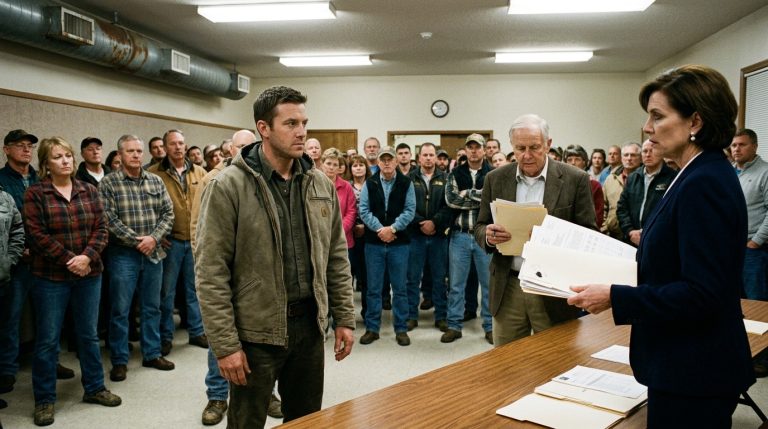
The morning sun cut through the clubhouse windows like a razor, illuminating the dust motes dancing over a room that felt suddenly, unnaturally still. The annual meeting was in full swing, the rows of plastic chairs filled with residents who looked as tired as I felt. Brenda stood at the podium, her back to the wall, her expression one of triumphant, predatory calm.
I stood at the back, the heavy waterproof folio under my arm acting as a shield against the suffocating tension. Carmen was by my side, her hand gripping my bicep—a subtle, grounding weight. My leg was a pillar of fire, the nerves screaming with every beat of my heart, but I didn’t shift my weight. I stayed motionless, a statue in the back of the room.
“We have reached the end of the agenda,” Brenda announced, her voice echoing in the rafters. “Before we adjourn, I would like to move for a vote on the new structural maintenance assessment. As I’ve noted, the community is facing a significant shortfall, and this emergency levy is the only path forward to ensure our property values.”
The murmur of the crowd was a wave of anxiety. I watched them—the families, the retirees, the people who had moved here for peace and were now being bled dry by a woman they thought was their protector.
“I have a counter-proposal,” I said.
My voice didn’t crack. It cut through the room like a blade. Every head turned. Brenda’s smile didn’t falter, but her eyes, cold and sharp as needles, locked onto mine. She hadn’t expected me to show up, let alone speak.
“This is not a recognized item on the agenda, Miles,” she said, her voice dripping with practiced condescension. “The floor is closed.”
“The floor is never closed when theft is on the table,” I stepped forward, the thud-drag of my gait the only sound in the room. I reached the front, the residents parting like water as I walked toward the podium. I felt the weight of the digital evidence in my pocket, the burner phone humming against my hip—the link to Agent Walsh’s team, who were currently waiting in the patrol cars idling at the perimeter of the community.
“I’m sure the community would love to hear about Clearwater Holdings,” I continued, reaching into my folio. “And the phantom landscaping contracts that have funneled over half a million dollars of their savings into your personal accounts.”
Brenda’s composure shattered. It didn’t crack; it evaporated. She slammed her hand onto the podium, the sound ringing out like a gavel. “You are out of your mind. Security!”
Dale Pinkerton stepped out from the side office, his face a mask of sweating, desperate betrayal. He looked at the podium, then at me, then at the tablet in his hand. He went to tap the screen to activate the clubhouse audio, to drown me out with the pre-recorded noise he had prepared for this exact moment.
He tapped. Nothing happened.
He tapped again, his thumb hovering, his face turning an alarming shade of gray. He looked at me, a silent, frantic plea in his eyes. He hadn’t just failed to activate the audio; he had realized, in that second, that I had been monitoring his terminal from the moment I left his office.
“The system is down, Dale,” I said, my voice low, for his ears alone. “I did a little maintenance of my own on your network.”
The room was in a state of chaotic uncertainty. Mrs. Smith stood up, her hand trembling. “What is he talking about, Brenda? What money?”
“It’s a lie!” Brenda shouted, her voice losing its polished veneer and descending into a shrill, frantic pitch. “He’s a disgruntled tenant who’s been harassing the board! He’s trying to destroy our community!”
“I’m trying to save it,” I said. I pulled the folio open, revealing the printed audit reports, the bank transfers, and the structural engineering report that proved the neighborhood was being liquidated. I dropped the stack onto the mahogany table. It hit with a heavy, final sound.
The door to the clubhouse swung open. The sound of rain-slicked tires and the low, authoritative hum of approaching vehicles filled the room. Agent Walsh stepped through the entrance, his dark windbreaker embossed with the bold yellow letters of the federal authorities. Behind him, two officers flanked the exit.
Brenda’s face turned the color of ash. She turned toward the rear exit, but her way was blocked. She looked at the residents—the people she had manipulated, intimidated, and robbed—and saw only a wall of cold, silent realization.
The trap had closed. Brenda didn’t surrender; she spun toward the podium, grabbing her own box cutter—a pathetic, small weapon—but her hands were shaking too violently to even click the blade. She was a predator who had suddenly realized she was the prey.
I stood there, the weight of my leg forgotten, the pain fading into a distant, muted hum. The silence in the room was absolute, a vacuum waiting to be filled with the truth. I had done it. The path was clear.
CHAPTER 8: THE FIVEPILLAR CATHARSIS
The chaos of the arrest played out in slow motion. Federal agents moved with an efficiency that made the room feel suddenly sterile. They didn’t shout; they worked with the quiet, devastating precision of a machine dismantling a threat. I watched from the sidelines as they pulled Brenda toward the exit. She wasn’t fighting anymore. Her posture had collapsed, her shoulders hunched inward as if she were trying to occupy less space in the world. She didn’t look at the residents. She didn’t look at me. She simply stared at the floor, her designer loafers clicking unevenly against the concrete as she was guided out into the rain.
Dale Pinkerton, left behind in the office, was led out in handcuffs. He didn’t even look up at the cameras. The digital ghost he had built had turned into a digital executioner, and he knew it.
I stood in the center of the room, the weight of the folio still in my hand. One by one, the neighbors approached. Not with cheers, but with a quiet, lingering shock. Tom Rodriguez, the retired teacher, stood before me for a long minute, his hands tucked into his pockets. He didn’t speak. He just gave a small, slow nod—a recognition of the cost, the time, and the sheer, brutal endurance the fight had required.
The room cleared out, the sound of the rain outside now a gentle, cleansing rhythm against the windows. Agent Walsh walked over, his expression unreadable. He handed me a folded document—a copy of the emergency stay of execution for the neighborhood, effectively freezing any asset liquidation until the full investigation was complete.
“It’s done,” Walsh said, his voice quiet. “The records are secured. The forensics team is already on-site at the shell company’s office. You won’t have to worry about the HOA president again, Miles.”
I nodded, the words feeling heavy and hollow in my throat. I walked out into the cooling air of the morning. The sky was turning a pale, washed-out blue, the storm having scrubbed the desert air of its heat.
I walked home. The walk was still painful, my knee reminding me of the long climb to this moment, but for the first time in eighteen months, it didn’t feel like a struggle against an invisible weight. I reached the edge of my property. The zinc anchors were still there, glinting in the morning sun, naked and exposed.
I stopped at the edge of the driveway. I didn’t rush to repair them. I simply stood there, listening to the drip of water from the eaves of the house. Carmen came out onto the porch, a mug of coffee in each hand. She walked down the steps, her movements unhurried, and stood beside me. She didn’t say anything about the victory. She didn’t mention the arrests. She just placed a hand on my shoulder, her fingers warm through the fabric of my jacket.
“The silence,” she said, looking out at the rows of houses. “It’s actually quiet.”
I looked down at the concrete. I had a bag of new reflective strips in the truck, ready to be installed, but I left them for later. I knelt, the action slow and careful, and touched the metal anchors. I remembered the feeling of them being shredded by the box cutter, the sudden, sharp vulnerability I had felt standing behind the screen door.
“It’s earned,” I said.
I looked at the house—our house, our home. The anger that had fueled my days, the cold, tactical precision of the last few weeks—it was all drifting away, replaced by a strange, settling peace. I reached into my pocket and pulled out the broken compass. I opened the casing, looking at the cracked glass and the needle that no longer pointed north. I didn’t need it anymore. I knew exactly where I was.
I placed the compass on the corner of the driveway, the metal cold against the stone. It felt like leaving behind a piece of the war.
Carmen shifted, her weight leaning into me, and we watched the sun begin to crest over the horizon, painting the desert in colors of soft, forgiving light. There was no more grand strategy. No more monitoring, no more recording, no more fighting for the ground beneath our feet. Just the house, the neighborhood, and the realization that we hadn’t just survived; we had, in the most quiet, deliberate way possible, reclaimed our peace.
I stood up, the pain in my leg finally feeling like a memory rather than a warning. I took the coffee from Carmen’s hand, the warmth of the ceramic spreading through my palms. We stood there as the neighborhood woke up, the sprinklers turning on one by one in the distance—a rhythmic, clicking sound that signaled the start of a day where, for the first time in a long time, the only thing we had to worry about was the morning.