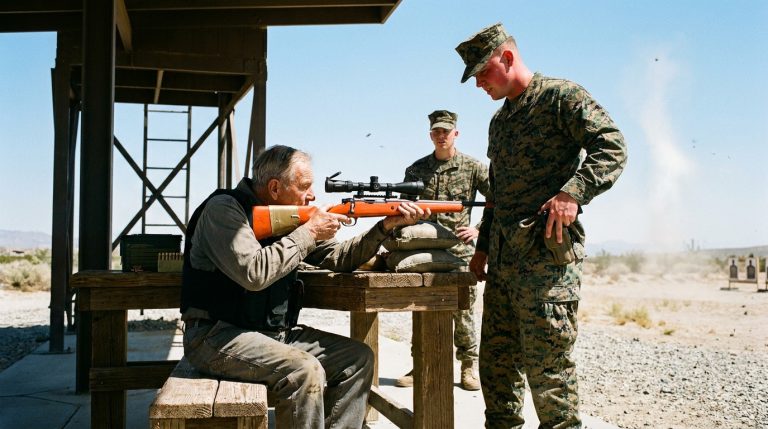
The Whispering Rain over Miramar: A Legend Fading into the Golden Sunset of Remembrance
CHAPTER 1: THE SILENT WEIGHT OF STONE
The rock hit the concrete two inches from Thomas Walker’s boots, leaving a pale streak of powder against the oil-stained gray. Thomas didn’t blink. He didn’t shift the weight of his shoulders against the overpass pillar, where the rough aggregate bit through his faded canvas jacket like a dull wire brush.
“Hey, wake up, you bum,” the boy with the silver chain shouted. His voice had that thin, reedy edge of seventeen-year-old bravado—brittle enough to snap if the wind changed. He was balancing on the curb, another chunk of broken asphalt weighed in his palm. Behind him, four others shifted their sneakers, their laughter sounding like dry leaves scraping across a driveway.
Thomas opened his left eye. The world was desaturated, stained by the amber tint of exhaust smog and the long, low glare of a three o’clock San Diego sun. He looked at the boy—Derek, the others had called him earlier—for three slow beats of a pulse that still timed itself to the rhythm of mechanical distant thrums. He didn’t look at the rock. He looked at the tension in the boy’s right tendon, the slight tremor in the knee that showed he was performing for the gallery behind him. Thomas closed his eye again.
“He’s ignoring you, man,” one of the younger boys muttered, pulling at the strap of his backpack. “Let’s go before the security gate shifts.”
“He ain’t ignoring nothing,” Derek spat. He stepped closer, the smell of cheap energy drinks and hot asphalt moving with him. He brought his arm back, his knuckles whitening around the jagged edge of the asphalt.
Thomas sat up. The movement was not fast, but it had no friction. It was the mechanical unfolding of an old tripod, practiced until the muscles remembered the geometry better than the mind did. His boots, dark leather scuffed to the gray nap but laced with a tight, parallel neatness that no civilian ever quite copied, settled into the dirt. The canvas bag beside him remained tucked against his hip, its strap looped twice around his forearm.
Derek’s arm stayed cocked. The boy’s eyes widened slightly as Thomas grew taller, the frayed hem of his flannel shirt falling away to reveal a neck that looked like cured timber. There was no anger in Thomas’s face—just the cold, flat appraisal of a surveyor measuring a ditch.
“Drop it.”
The voice didn’t come from Thomas. It arrived from twenty feet away, flat and heavy with the authority of starch and polished brass.
Derek spun. Four Marines stood on the gravel shoulder, their olive-drab flight suits unzipped to the waist to reveal dark green undershirts, cardboard coffee cups balanced in their calloused palms. The one in the lead, a staff sergeant with a jaw like a brick and skin burned dark by flight-line sun, didn’t look like he was messing around. His gaze went from Derek’s cocked wrist to the old man sitting against the concrete.
“We were just screwing with him,” Derek stammered, the rock slipping from his fingers to thud harmlessly into the weeds. “He’s just some guy.”
The staff sergeant didn’t answer with words. He walked forward, his boots crunching rhythmically on the gravel until he stood between the boys and the pillar. The shadow of his wide shoulders covered Derek entirely. “Get out of here before I find an MP who wants to write a report your parents have to sign.”
The teenagers didn’t wait for a second invitation. They scattered toward the residential fence line like a covey of quail flushed from the brush, their sneakers slapping the pavement until the sound drowned in the roar of an F-18 lifting off from the runway half a mile away.
The staff sergeant watched them go, then turned back to Thomas. He started to speak, a standard civilian greeting on his tongue, but his eyes dropped to Thomas’s forearms. The old man’s sleeves had ridden up as he sat.
Against the pale, scarred skin of Thomas’s left arm, an old Eagle, Globe, and Anchor was visible—the ink turned a soft, blurred navy blue, the style blocky and thick, the way they did them in the small shops outside Camp Pendleton during the years when the jungle was still burning. Below the elbow, a long, white zipper of jagged tissue ran through a faded skull wearing a frayed bush hat, the words Death from Above barely legible through the silver hair of his arm.
The staff sergeant’s coffee cup tilted slightly. His posture changed, his spine straightening by two inches as his heels clicked into the gravel. “Sir,” he said, the casual tone evaporating instantly. “You served.”
Thomas looked at the young man’s flight suit, at the name Torres stitched in black thread over the breast pocket. He gave a single, dry nod that cost him nothing. “Long time ago,” Thomas said, his voice like two stones grinding together at the bottom of a well. “Different world.”
The youngest Marine in the back, a lance corporal with fresh skin and his cover tucked neatly under his arm, stepped closer. “What was your MOS, sir?” he asked, a small, knowing smirk touching his lips—the look of a young man expecting to hear about logistics or fuel supplies from an old-timer who kept the ink for show.
Thomas looked through him. “0317,” he whispered. “First Recon.”
The smirk on the lance corporal’s face vanished. The staff sergeant didn’t move, but his eyes locked onto the small canvas bag tight against Thomas’s ribs, where the brass corner of an old, cracked pocket compass was just poking through a split in the seam.
CHAPTER 2: THE INK AND THE NAME
“0317,” the staff sergeant repeated, the numbers leaving his mouth not as a question, but as a heavy weight that dropped between them on the oil-stained gravel. The hot liquid from his dropped coffee cup was already soaking into the dry earth, sending up a faint, bitter steam that smelled of stale mornings and scorched plastic. “First Recon. You’re Thomas Walker.”
Thomas didn’t answer immediately. He reached down with slow, deliberate care, his old knuckles cracking like dry twigs under the denim of his trousers. His fingers, calloused and stained with the yellow-gray tint of tobacco and decades of salt air, adjusted the frayed strap of the canvas bag. The texture of the old military-issue web gear was soft now, the heavy cotton fibers worn down to a flannel-like fuzz by forty years of friction against his ribs. He tucked the protruding brass corner of the cracked compass back into the split seam, his thumb lingering over a rough ridge of stitching where the fabric had been crudely repaired with green fishing line.
“Names don’t do much work out here, Sergeant,” Thomas said. His voice carried the gravelly rasp of someone who spent days speaking only to the gulls or the hum of the interstate traffic. He looked at Torres’s chest, where the black embroidery of the name tape was slightly frayed at the edges—a small sign of a long deployment, a texture he recognized without looking. “You ought to be back inside the gate. The afternoon launch cycle doesn’t wait for administrative delays.”
Torres didn’t move. The three younger Marines behind him stood in a silent crescent, their flight suits stiff with salt-crust and jet fuel, their faces frozen in the peculiar, reverent stillness that transitions from youthful arrogance to sudden comprehension. The lance corporal who had smirked looked down at his own polished boots, his throat clicking as he swallowed hard.
“My father was Michael Torres,” the staff sergeant said, his voice dropping into a register that was softer, stripped of the flight-line bark. He took a half-step closer, his boots crunching lightly on the perimeter gravel. “Second Battalion, Twenty-Sixth Marines. He used to talk about a man they called the Reaper Storm. Said he was a ghost that lived in the triple-canopy back in ’69. Said the NVA had a price on his head that could buy a province, but nobody ever collected because nobody ever saw him until the round had already found its mark.”
Thomas looked away, his eyes tracing the long, shimmering line of the Miramar runway where the heat waves made the parked hornets look like gray moths trapped in amber glass. The light was shifting, turning the deep blue of the Southern California sky into a pale, dusty gold that caught the floating particles of exhaust and wild mustard seed. A sudden memory—not of sound, but of the smell of wet earth and elephant grass rotting in the humidity—tried to surface, but he pushed it back down into the dark spaces behind his eyes.
“Your father was a small man,” Thomas murmured, his thumb still tracing the rough fishing-line stitches on his bag. “Carried a picture of a girl with ribbons in her hair inside the sweatband of his M1 helmet. He used to give his C-rations—the pound cake, the sweet stuff—to the kids in the dirt outside Phu Bai. We told him he’d go hungry. He didn’t care.”
Torres’s jaw tightened, a muscle jumping beneath the tanned skin of his cheek. “He told me you stayed in a hole for three days outside the wire at Khe Sanh. Said you didn’t have water, didn’t have radio contact. Just a boltaction rifle and a logbook with thirty-two names in it. He said he lived to come home and have a family because you took the headers off the mortar crews before they could drop the steel on his bunker.”
“The numbers were different,” Thomas said softly, his voice lacking any trace of pride, sounding instead like an old clerk correcting an error in a ledger that had long since been closed. “The logs were just for the command data. The names didn’t matter. Only the grease pencils.”
He shifted his weight, his left knee giving a distinct, wet click that made him wince imperceptibly. The movement pulled the canvas bag tight against his thigh, and through the thin, worn material, the sharp outline of something rectangular and stiff pressed against his leg—not the compass, but a thick bundle of heavy cardstock tucked deep into the inner lining. It was a secret he kept close to his skin, a map whose coordinates didn’t match any standard grid the modern Marines behind him would recognize.
“Sir,” Torres said, stepping forward until he was within arm’s reach of the overpass pillar. He reached into his pocket, his fingers coming out with a small silver coin—a unit challenge comm, its edges worn smooth from years of turning against keys. He didn’t offer it as charity; he held it between his thumb and forefinger like a token of passage. “The base has a transition detachment. There’s a bed at the VFW post down on Rosecrans. My dad… he died five years ago, sir. Cancer from the water or the defoliants, they don’t know. But he always said if I ever found the man who kept him whole through the winter of ’69, I was supposed to give him whatever he needed.”
Thomas looked down at the coin. The silver caught the long glare of the afternoon sun, reflecting a tiny, blinding point of light onto the gray concrete behind him. He didn’t reach for it. Instead, he reached up and slowly pulled his right sleeve down, covering the skull and the faded words Death from Above, burying the old ink back beneath the frayed wool of his cuff.
“I have what I need, Sergeant,” Thomas said, his hand settling back onto his canvas bag, his fingers finding the hidden ridge where the secret map lay cold against his ribs. “Tell your father’s son that the debt was paid when he came home. Now get back to the hangar. You’re losing your light.”
CHAPTER 3: THE UNPOLISHED COMPASS
The scratch on the glass of the casing was exactly three-eighths of an inch long, deep enough to trap a fine crescent of black highway grit. Thomas turned the unpolished brass cylinder between his fingers, feeling the microscopic ridges where sea salt had pitted the metal forty years ago. The needle inside didn’t float with the smooth, liquid grace of modern avionics; it dragged across the faded dial, catching on a hairline fracture before settling sluggishly toward an orientation that was miles away from true north.
“It’s an old Cammenga M-1950,” a voice said, breaking the low hum of the late-afternoon traffic on the overpass above.
Thomas didn’t drop his hands into his lap. He kept his thumbs pressed against the worn brass, his fingers shielding the small, silver-threaded coordinates sewn into the raw edge of the canvas pocket beneath it. He looked up slowly. The staff sergeant, Torres, hadn’t left with the others. He was sitting on a rusted electrical housing box across the gravel ditch, his flight suit unzipped to the ribs, a clean white grease pencil balanced between his knuckles like a cigarette. The sun was dipping below the high concrete retaining walls, throwing long, violet shadows that smelled of dried wild mustard and hot petroleum.
“The damping fluid is gone,” Thomas murmured, his thumb moving over the cracked lens. The texture was cold, smooth, and distinct from the coarse denim of his jeans. “It catches on the pivot. If you want to know where you’re going with one of these, you have to shake it twice to clear the rust.”
“My dad had one just like it,” Torres said. He didn’t move from the housing box, maintaining a distance that felt less like suspicion and more like the cautious spacing of an advance scout entering a narrow draw. “He kept it in a sock in his footlocker. Used to tell me that in the canopy, a compass was the only thing that didn’t lie to you when the cloud cover came down. Said the trees all looked identical until you checked the glass.”
Thomas let his fingers slide down into the gap of the canvas bag, his palm resting against the thick, stiff bundle of cardstock concealed within the lining. The edges of the paper were soft, frayed to the consistency of lint from years of shifting against the heavy web thread. It was a grid map, hand-sketched with purple carbon ink that had begun to bleed into the pulp. The coordinates written along the margins didn’t correspond to any military map available at the Miramar library; they were the locations of old supply caches and shallow, unmarked depressions in the red clay of a valley that had been removed from the official records before Torres was born.
“Your father spent too much time looking down,” Thomas said. He leaned his shoulder back against the concrete pillar, the rough aggregate pressing through his jacket with a familiar, localized ache. “In the brush, if you’re looking at the glass for more than three seconds, someone is already taking the slack out of a trigger behind you. You navigate by the tilt of the ridges. You feel the slope in the back of your calves.”
Torres picked up the grease pencil, rolling it across his knuckles. “He told me you didn’t use maps toward the end, sir. He said by the time the battalion pulled out of the valley, you were just walking out into the high country alone. The lieutenant thought you were hunting. My dad said you were just looking for the pieces we left behind.”
The wind shifted, bringing the sharp, kerosene tang of JP-8 fuel from the flight line across the tarmac. It was a heavy, industrial smell that hung in the back of the throat, identical to the odor that had drifted off the pad at Da Nang when the choppers came in green and went out gray. Thomas closed his eyes for a second, the faded image of a specific treeline—not the sharp pines of California, but the broad, ragged fronds of the banana trees—flickering across his eyelids before the roar of a twin-engine compressor test snapped him back to the gravel.
“We didn’t leave pieces,” Thomas said, his hand tightening around the compass until the brass teeth of the bezel bit into his palm. “We left everything. The people who came home just brought the noise back with them.”
Torres stood up, his boots making a dry, crunching sound as he stepped over the drainage ditch. He stopped five feet away, his shadow extending long and thin across Thomas’s boots, reaching toward the overpass wall. He didn’t offer the silver challenge coin this time. Instead, he pulled a small, yellowed piece of notebook paper from his flight suit pocket, the edges torn unevenly from a standard logbook. A seven-digit number was written across the center in dark blue ink that had long since dried and faded into the grain.
“That’s the direct line to the maintenance desk at the third hangar,” Torres said, his voice dropping below the mechanical whine of the distant jets. “I’m there until midnight most rotations. If the wind comes around from the north, the smoke from the brush fires down in the canyon gets heavy under here. It isn’t good for the lungs, sir.”
Thomas didn’t look at the paper. He kept his eyes on the small, silver-threaded stitch inside the seam of his bag—a minute blemish where three numbers had been embroidered into the canvas with heavy green fishing line. A single coordinate. The entry point to a valley that didn’t exist anymore on any map but his own.
“The smoke stays high,” Thomas said, his fingers sliding the unpolished compass back into the dark depth of the bag until it clicked against the hidden cardstock. “The concrete keeps the heat until three in the morning. It’s better than the mud.”
Torres looked at him for a long beat, his grease pencil disappearing back into his sleeve pocket. He didn’t salute this time; he just reached up, touched the brim of his utilities, and turned back toward the perimeter fence where the yellow guard lights were just beginning to flicker against the gathering dark.
Thomas waited until the sound of the sergeant’s boots had died out completely beneath the rumble of a commercial transport truck overhead. Then, with slow, stiff movements, he pulled the thick bundle of cardstock from the split lining, his thumb tracing the purple lines of a decoy map that everyone believed was his only secret—while beneath his fingernail, the true coordinates remained buried in the thread.
CHAPTER 4: THE FINAL TRANSMISSION
The rain didn’t fall in drops; it drifted under the overpass in a cold, heavy mist that turned the dust on Thomas’s boots into a thick, gray paste. The dampness climbed through the concrete pillars, soaking into the small of his back until every rib felt as though it had been notched by a dull file. Inside his chest, the rattle had grown heavier over the last three months, a wet, persistent scraping that no longer cleared when he shook himself awake at the dawn line.
Thomas tried to slide his thumb into the split seam of the canvas bag, but his fingers were clumsy, stiffened by a deep, hollow chill that had nothing to do with the San Diego coast. The faded cardstock map—the one showing the old decoy caches—lay wet and limp across his lap. In his struggle to sit up, his elbow slipped, striking the concrete with a dull thud. The canvas bag tilted, spilling the unpolished brass compass into the mud at his feet. He reached for it, but his lungs seized, forcing a ragged, breathless cough that brought the taste of copper and cold iron to the back of his tongue. He couldn’t reach the brass. He couldn’t even close his fist around the strap.
The perimeter lights of the air station blinked through the downpour, pale yellow halos suspended in the shifting fog. The roar of the jets had stopped an hour ago, replaced by the low, continuous hiss of water streaming off the bridge deck above his head. Thomas lay against the wet gravel, his view restricted to the underbelly of the steel girders. His hand drifted across the dirt until his knuckles brushed a wet, wrinkled square of notebook paper—the number Torres had left on the housing box weeks ago, its blue ink bleeding into a formless smudge against the pulpy grain.
He didn’t want to pick it up. The active agency that had carried him through forty years of silence resisted the friction of a call, the acknowledgment that the perimeter was closing in. But the breath wouldn’t come. Each inhale felt like pulling dry sand through a narrow straw. He dragged his thumb across the paper, his skin catching on the frayed edge where it had been torn from the logbook.
With a slow, agonizing expenditure of momentum, Thomas pulled a cracked, plastic pay-as-you-go phone from his inner pocket—a cheap, gray box he kept only for emergencies, its screen scratched by the same grit that filled his boots. His fingers shook as he punched the seven digits, the plastic keys clicking loudly in the narrow space between the concrete and the mud. He didn’t hold the phone to his ear; he rested it on his collarbone, staring up at the rust stains on the girder above.
The line clicked once. The background noise on the other end was a chaotic wall of sound—the high-pitched whine of pneumatic impact wrenches, the metallic echo of a hangar bay, and the distant, rhythmic thud of an auxiliary power unit warming up.
“Third Hangar maintenance desk, Staff Sergeant Torres,” the voice barked, sharp and transactional, stripped of everything but the momentum of the shift.
Thomas didn’t speak. He couldn’t find the velocity to push the words past the fluid in his throat. He simply let his breath rattle against the small plastic microphone—a low, rhythmic wheeze that sounded exactly like the dragging of a heavy canvas sack across gravel.
The line went silent on the other end. The background roar of the hangar didn’t change, but Torres’s presence shifted instantly. The mechanical sharpness vanished, replaced by a sudden, heavy stillness.
“Sir?” Torres said, his voice dropping into the mouthpiece until the industrial noise was muffled. “Sir, is that you?”
Thomas closed his eyes, the play of the yellow guard lights fading behind his eyelids into a desaturated gray. He managed a single, dry click from the back of his throat—a sound he used to make in the canopy when a radio transmission had to be acknowledged without a whisper.
“Don’t move,” Torres said, the sound of a metal chair scraping against concrete cutting through the line. “Don’t move, Reaper. I’m clearing the gate now. I’ve got the truck running.”
The line went dead, replaced by the flat, empty hum of an unassigned signal. Thomas let the plastic phone slip from his neck, its small screen face-down in the mud beside the unpolished compass. The decoy map lay ruined and soaked across his knees, its purple ink running into the gray paste of the earth, completely destroyed by the rain. The physical secret of the valley caches was gone, washed away by the storm, leaving only the silver-threaded coordinates sewn into the deepest layer of the canvas bag—and the heavy, unshared burden of the choice that had kept him under the concrete for forty years.
He could hear the distant splash of tires cutting through the standing water on the perimeter road, the headlights of a military vehicle sweeping over the concrete pillars like lanterns in a crypt. Thomas didn’t look toward the road. He turned his face toward the east, his back solid against the stone, waiting for the morning launch that he knew he wouldn’t hear.
CHAPTER 5: THE PERMANENT SALUTE
The first light of dawn did not burst over the airfield; it seeped through the marine fog in a soft, chalky pink that slowly bleached the black asphalt of the perimeter road. The concrete pillar of the overpass, scrubbed clean of its soot by the midnight downpour, cast a long, pale shadow toward the east. For the first time in forty years, the small patch of dirt beneath the bridge deck was empty of its quiet tenant, but the silence he left behind had grown heavier, filling the expanse between the freeway girders like water pooling in a fresh trench.
Staff Sergeant Torres stood at the edge of the gravel shoulder, the cuffs of his service dress alphas slightly damp from the morning mist. His fingers, clad in spotless white gloves, held a small canvas bag that had been recovered from the hospital bedside at 0600. The canvas was dry now, though the fabric remained permanently stained with oil and highway grit, its texture stiff and coarse against the fine linen of his uniform. Inside, the unpolished brass compass lay wrapped in the pieces of the ruined map, but Torres’s hand was resting against the innermost lining, where the crude, green fishing-line stitches had finally been cut away to reveal the true prize.
It wasn’t gold or classified paper that had been tucked away beneath the thread; it was a single, faded black-and-white photograph of three small children sitting on the steps of a thatched hut, their faces blurred by the old camera lens, and an official unclassified document dated August 1969. The paper bore a single paragraph that explained the long silence under the overpass: Operation Reaper Storm suspended due to unauthorized redirection of tactical assets to non-combatant evacuation. The Navy Cross hadn’t been hidden because of what Thomas Walker killed, but because of what he chose to protect when the world demanded blood.
“The colonel’s vehicle just cleared the main gate,” the lance corporal whispered, stepping up to the line. He wore his service dress uniform with a crisp, geometric perfection that seemed entirely different from the boy who had smirked at the old man’s tattoos weeks ago. His white cover was pulled low over his forehead, the bill catching the thin glare of the rising sun.
Behind them, the shoulder of the road was no longer a barren strip of weeds. Dozens of white covers lined the fence line, a quiet procession of Marines from the air station who had left their barracks before the first mess call. They didn’t talk. They didn’t smoke. They just stood in small, orderly files along the gravel, their eyes fixed on the simple granite marker that had been set into the earth beside the concrete pillar overnight. The stone was unpolished, its face rough and gray, etched with a single name and a set of dates that linked the modern base to a jungle three generations away.
“He never wanted the parade, Sarge,” the lance corporal murmured, his voice caught in the low, rhythmic hum of the base generator spinning up across the tarmac.
“He didn’t get a parade,” Torres replied softly, his fingers tightening on the canvas bag. “He got his people.”
A sharp, metallic whistle cut through the morning air from the flight line—the first engine test of the dawn cycle. A pair of F-18s taxied toward the eastern lip of the runway, their dark gray hulls looking like silhouettes cut from cardboard against the pink sky. As the lead jet reached the staging point, its engines roared into a high, cracking whine that vibrated through the soles of Torres’s shoes and echoed off the concrete underbelly of the overpass. It was the same noise that had kept Thomas Walker anchored to this dirt for forty years, the only sound that made the silence in his head bearable.
The staff sergeant stepped forward, his boots crunching in unison with the lance corporal’s as they approached the granite marker. He placed the small canvas bag at the base of the stone, right where the old man’s boots used to rest. Beside it, he laid the silver challenge coin his father had given him, its worn face catching the first direct ray of the sun as it cleared the high hills to the east.
“Detail,” Torres barked, his voice carrying across the gravel shoulder, instantly snapping the loose files along the fence line into a single, rigid line of dark blue and white. “Present… arms.”
In one synchronized motion, forty white-gloved hands rose to the brims of their covers. The salute held as the lead jet released its brakes, its afterburners punching two bright, amber cones of flame into the morning fog as it lifted into the sky, the vibration rattling the granite stone until the dust settled into the clean letters of Walker’s name. They held the salute until the roar faded into the clouds, leaving only the quiet, empty stretch of road that would always bear his shadow.