The Shadow of the Spear: A Tale of Dead Light and Quiet Reckonings
CHAPTER 1: THE TACTICAL SILENCE
The glass did not vibrate until the shadow hit the table. Lieutenant Jax Miller leaned in, his breath carrying the sharp, expensive scent of imported IPA and unearned certainty.
Mark Douglas kept his fingers flat against the wet wood. The grain of the table was scarred, pitted with old cigarette burns and the deep, greasy residue of forty years of spilled lager. To his left, the neon sign for a defunct local brewery buzzed with a rhythmic, insectile click—three shorts, one long. A low-frequency aggregate that most people in the Rusty Anchor tuned out. Mark didn’t. He counted the pulses.
“You hearing me, old-timer? Or is that hearing aid turned off?” Miller’s voice had the distinct, clipped edge of a man who spent his mornings shouting over the turbine whine of a rigid-hull inflatable boat. He was twenty-six, maybe twenty-seven. His jaw line was hard, clean-shaven, and slightly flushed from the high of a successful deployment. Behind him stood four others, a wall of identical high-and-tight haircuts and broad shoulders shifting with the restless energy of an apex predator in a small tank.
Mark didn’t look up. He looked at the amber reflection of his own chin in the cheap blended whiskey. The fabric of his red flannel shirt was thin at the elbows, the canvas of his jacket smelling faintly of hemlock needles and the cold mist that rolled off the salt marshes at four in the morning. His hands were a cartography of spots and stiffening knuckles, but they didn’t shake. They remained perfectly parallel to the coaster.
“I said, are you deaf?” Miller repeated. The volume increased, calibrated to draw the room’s attention. The peripheral noise of the tavern—the pool cues clacking, the low murmur of two shipyard welders in the booth across the aisle—died instantly.
“I am fine right here, son,” Mark said. His vocal cords felt like dry gravel sliding down a chute. Low. Flat. He didn’t offer an anchor for Miller’s anger to hook into.
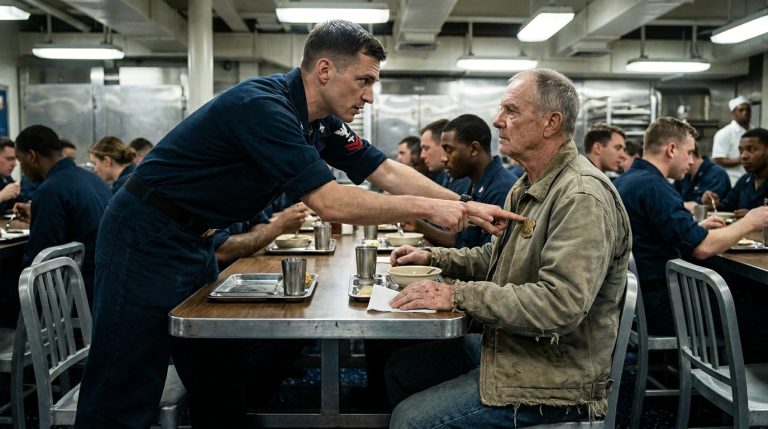
Miller chuckled, a dry snort that looked to his flank for approval. The squad provided it, a synchronized shifting of weight, a collective grin of teeth in the dim amber light. “You don’t get the math here, Grandpa,” Miller said, dropping a palm onto the table. The wood groaned under his rings. “We’re celebrating. We’re the tip of the spear. Active duty only. The VFW has a nice linoleum floor down on Fourth. Grab your cane.”
Mark watched the skin over Miller’s knuckles tighten. He analyzed the distance between the lieutenant’s thumb and the edge of his whiskey glass. Three inches. If the glass broke, the jagged base would find the soft meat under the jaw in point-four seconds. The thought didn’t arrive with anger; it arrived like a line of code on an old monitor. Cold. Green. Automatic.
Instead, Mark reached for his pocket.
The movement was too smooth, a sudden lapse in his geriatric rhythm. Miller’s shoulder twitched backward, his right hand dropping two inches toward his waistband—a clean, instinctive weapon-retrieval reflex. Mark let his fingers emerge slowly, holding nothing but a crumpled, grease-stained ten-dollar bill. He laid it flat on the wood.
“For the drink,” Mark said to the space between them. He began to slide his thighs along the cracked vinyl of the booth, his knees popping with the distinct sound of dry timber snapping in winter.
“Not so fast,” Miller said, his face darkening as he realized his own men had seen him flinch at an old man’s wallet. He stepped laterally, his hip locking against the edge of the table, sealing the exit. “You don’t just shuffle out when an officer is speaking. What’s the matter? No name to give? In the teams, we have call signs. I’m Viper. He’s Sledge.” He pointed a thick thumb backward. “What did they call you when you were counting beans in the supply shed? Private Pile?”
Mark stopped. He looked straight into Miller’s eyes. The gray in Mark’s pupils wasn’t the cloudy film of cataracts; it was the color of deep water under winter ice. For a fraction of a second, the buzzing neon light above them didn’t sound like a transformer. It sounded like the wet, rhythmic slap of a helicopter blade hitting the triple-canopy jungle of the Mekong Delta, forty feet above the mud.
“You don’t want to know,” Mark whispered.
Behind the bar, the heavy wet slap of a rag stopped. Sully, the bartender, was staring at Mark’s exposed right wrist. The sleeve of the canvas jacket had pulled back an inch. On the pale, thin skin above the tendons, there was a perfectly circular, white scar—the distinct, puckered signature of a hot iron brand.
CHAPTER 2: THE RECONSTRUCTION OF BRASS
“I’m going to need you to take three steps back, Lieutenant.”
Sully’s voice didn’t come from behind the taps anymore. It came from the narrow clearing between the jukebox and the low-hanging copper light fixture. The heavy wet rag he’d been using to scrub the laminate bar lay dead on the floorboards like a dropped piece of meat.
Miller didn’t turn his head immediately. He kept his eyes locked on Mark’s face, his chest rising and falling in short, sharp hitches. “Stay out of this, Sully. This is Navy business. We’re just trying to figure out who we’re sharing our air with.”
“You aren’t sharing air with anyone, kid,” Sully said. His hand wasn’t on his apron. It was tucked flat against his thigh, close to the small brass counter-weight he kept beneath the register for when the local shrimpers got too loud. “You’re sucking it out of a room that doesn’t belong to you. Move your hand.”
The air in the Rusty Anchor felt like it was freezing from the corners inward. Mark didn’t move. His shoulder remained exactly where Miller’s hand had impacted it, the canvas of his jacket holding the indentation of the young officer’s fingers like stiff clay. He didn’t look at Sully, and he didn’t look at the four SEALs who had begun to form a semi-circle behind their leader, their faces losing the easy, beer-fueled grins and hardening into something tactical, defensive, and deeply uncomfortable.
“He’s a civilian, Sully,” Davis muttered from the back, his hand hovering over his belt line. “He put his hands on the Lieutenant’s money.”
“That’s a ten-dollar bill, you idiot,” Sully spat. His boots made a dry, rhythmic scraping sound against the sawdust as he shifted into a wider stance. “And that civilian was pulling extraction strings while your grandfathers were still failing high school algebra. Look at his wrist.”
Miller’s gaze flicked down. In the pale, flickering amber of the neon sign, the circular white scar on Mark’s right arm didn’t look like skin. It looked like ancient bone, raised and white, polished by forty years of friction. It was a perfect, seamless O—the brand of the Seventh Special Operations Group, a unit whose personnel rosters were burned in a metal drum outside Saigon before the last bird left the embassy roof.
The young lieutenant’s fingers didn’t drop; they went stiff. “This doesn’t change the posture,” Miller whispered, though the velocity had left his voice. “He refused a lawful inquiry from a commissioned officer.”
“A commissioned officer,” Mark said softly, “doesn’t look for his reflection in a dive bar mirror.”
The front door didn’t swing open; it shattered against the interior drywall with a concussive thud that rattled the empty pilsner glasses on the shelf behind the bar. The wind that followed wasn’t the warm coastal breeze from the harbor; it was cold, sharp, and carried the smell of pressurized fuel and starch.
Two men in dark, unvented charcoal suits stepped through the threshold first. They didn’t look at the bar, and they didn’t look at the squad. They took two steps, cleared the landing, and stood with their hands crossed over their belt buckles, their earpieces casting thin silver glints against the dark plaster.
Then came the brass.
The stars on the collar were four, small and silver, pinned with geometric perfection to an immaculate white dress uniform that seemed to absorb what little light the tavern had left. Admiral Vance didn’t look like a man who had driven three minutes from the base; he looked like he had been carved out of salt and granite specifically for this five-foot section of floorboards.
“Viper,” Vance said. The word wasn’t loud. It had the dry, whistling snap of a wire rope snapping under tension on a carrier deck.
Miller snapped to attention so violent his heels cleared the floor by half an inch. His jaw locked, his eyes staring straight ahead at the salt-and-pepper hair of the base commander. “Admiral on deck,” he barked, his voice cracking on the final syllable.
The four men behind him scrambled into alignment, their heavy boots dragging through the grease and sawdust until they formed a rigid, unblinking wall against the vinyl booths. One of them dropped a bottle; it didn’t shatter, it rolled into the dark under a table, leaking expensive foam against the baseboard.
Vance didn’t look at Miller. He walked past him, the gold braid on his shoulder brushing against the lieutenant’s medals with a faint, metallic hiss. He stopped exactly twenty inches from the corner booth.
Mark remained seated. His gray eyes stayed fixed on the amber liquid in his glass, his fingers still flat on the wet wood, ignoring the four-star admiral the way a man ignores a common sparrow on a fence line.
“David,” Mark said. His voice didn’t rise to meet the uniform.
“Master Chief,” Vance said. The admiral’s hand went up to his visor, his fingers locking into a standard, ninety-degree salute that stayed frozen for three seconds. The two men in the dark suits didn’t blink. The silence in the room became an actual physical weight, pressing the smell of old beer into the floorboards. “We thought you were in the hills behind Coronado.”
“The hills got crowded,” Mark said. He didn’t return the salute with precision; he merely raised two fingers from the table in a short, dismissive arc. “Too many people looking for things that aren’t there.”
Vance lowered his hand, his jaw muscles working beneath his weathered skin. He turned his torso forty-five degrees, his eyes locking onto Miller’s face. The purple hue in the lieutenant’s cheeks had turned to the color of wet river clay.
“Lieutenant Miller,” Vance said.
“Sir.”
“Go to the safe behind the bar,” the admiral ordered, his voice dropping an octave into something completely flat. “Sully will give you the ledger. Open the bottom compartment. There is a gray manila envelope with a red seal from the Department of the Navy, dated August 14th, 1971.”
Miller hesitated, his eyes darting toward his squad before returning to the middle distance. “Sir?”
“Move your feet, Lieutenant, or I will have these two gentlemen carry you out by your ankles,” Vance said.
The sound of Miller’s boots moving toward the bar counter was the only noise left in the world. Sully didn’t say a word; he reached down beneath the register, his heavy keys clinking against the steel of the drop-safe. When he pulled his hand back up, he didn’t hold a bottle. He held a vintage copper Zippo lighter with a filed-down serial number and a thin, yellowed piece of paper folded into a tight square.
He didn’t give it to Miller. He set it on the counter, three inches from the lieutenant’s trembling hand.
“Read the first line,” Vance directed from the center of the floor.
Miller picked up the paper, his fingers catching on the dry, brittle edges of the fifty-year-old stock. His eyes scanned the typewritten text—the standard, cold bureaucratic ink of a bygone Pentagon.
“Dishonorable discharge,” Miller whispered, his voice losing all its air. “Douglas, Mark M. Section 4, conduct unbecoming… signed by the Chief of Naval Personnel, 1971.”
Mark let out a small, dry wheeze that might have been a laugh if his chest weren’t so tired. He didn’t look at the paper. He knew the ink. He knew who had typed it, and he knew the name of the man who had died in a ditch in Cambodia forty-eight hours before that document was filed to make sure the name Douglas never appeared on a federal pension roll again.
“Look at the watermark, Lieutenant,” Vance said, his voice dropping into a register that made the two suits shift their weight toward the exit. “Then look at the man sitting in that booth, and tell me if you think that paper is real.”
Miller didn’t answer. He couldn’t. His eyes flicked from the yellowed document to the old man in the red flannel shirt, who was now systematically using his thumb to erase the condensation ring from the wood, over and over, until the surface was completely dry.
CHAPTER 3: THE STRIPPING OF THE TRIDENT
The paper didn’t rattle until Miller’s thumb joint went completely white. His eyes tracked the blue ink of the official seal, his breathing shortening until it was nothing but a dry wheeze against the crisp collar of his uniform.
“It’s signed by a dead man, Lieutenant,” Vance said. The admiral hadn’t shifted his boots by a single inch. His white dress uniform remained perfectly square, a clinical block of iron against the grimy, oil-filmed backdrop of the bar. “The man who put his name to that clearance died in an unrecorded extraction over the Mekong Delta three weeks before the date stamped on that header. It is a ghost file. Designed to keep people like you from looking too closely at things your clearance cannot afford to see.”
Miller’s gaze remained glued to the parchment. His four men behind him had ceased their shuffling entirely. The restless energy that had carried them into the Rusty Anchor like a wolf pack had turned into a static, heavy dread. They stood frozen, their chins tucked back, eyes fixed rigidly on the blank spaces of the wood paneling across from them.
“Sir,” Miller whispered. The word lacked its earlier precision. It was thin, frayed at the edges. “The database—”
“The database contains what the Department of the Navy permits the public to buy,” Vance cut him off. His voice remained flat, lacking any performance for the room. It was the tone of an executioner explaining the mechanics of a trapdoor. “It is compiled for recruiters and politicians. It does not account for the men who spent three winters in holes that were never dug, executing parameters that were never written down. Hand the paper back to Sully.”
Miller’s fingers uncurled with an audible stiffness. The old parchment fell back onto the zinc counter with a soft, dry flap.
Mark didn’t look at the document. He picked up his glass, his calloused palm registering the exact temperature of the melting ice. The amber fluid was cheap, burning his tongue with the acrid sting of grain alcohol and low-tier oak flavoring. He swallowed it slowly, tracking the heat as it traveled down his throat, past the old scar tissue where a piece of North Vietnamese mortar shell had settled near his collarbone in the winter of ’69.
“You wanted to know his call sign, Lieutenant,” Vance continued, stepping closer until the gold braid on his shoulder was exactly three inches from Miller’s face. The smell of high-grade starch and military polish completely overwhelmed the sour stench of stale draft beer. “You wanted to find out if he was a clerk. If he was counting beans while real men were doing the work. Let me make the calculation simple for your current operational capacity. Every tactical manual you memorized at Coronado—every protocol for silent insertion, every perimeter defense matrix for high-risk extraction—was compiled from the operational logs of the man sitting in that booth.”
Miller’s throat moved as he swallowed. A bead of sweat had formed at the hairline of his temple, running down the clean, sharp edge of his jaw until it hung on the tip of his chin, trembling.
“He didn’t have a team, Lieutenant,” Vance whispered. The silence in the bar was so complete that the hum of the old refrigeration unit in the back office sounded like an incoming mortar launch. “He didn’t have an extraction window. He spent forty-two months behind lines where the United States military officially didn’t exist. The enemy didn’t call him a soldier. They called him the Reaper because he didn’t leave witnesses to sign the reports. And you tried to shove him out of a booth because you wanted a better view of the television.”
Vance reached out. His fingers didn’t move with aggression; they moved with the slow, terrifying authority of a crane lifting cargo. His thumb caught the edge of the fabric unit patch on Miller’s right sleeve—the sharp, black-threaded design that marked his command of the extraction squad.
The sound of the Velcro tearing was short and violent, a sharp rip that seemed to take the remaining air out of the room. Vance didn’t drop the patch. He held it between his two fingers, flat against the white fabric of his own sleeve.
“You are a disgrace to the uniform, Lieutenant,” the admiral said. “You and your men are confined to quarters at the naval station effective immediately. Your deployment rotation to the Western Pacific is canceled. You will report to a formal board of inquiry at nine hundred hours tomorrow morning. I will personally ensure that your trident is stripped and filed under an administrative review that will follow you until the day you leave the service.”
Miller didn’t blink. His eyes had gone glassy, fixed on the brass buttons of Vance’s jacket. “Yes, sir,” he squeaked.
“Get out of my sight,” Vance said. “Before I decide to turn this over to the local police and let them look into the condition of your squad’s blood alcohol content.”
The four men behind Miller didn’t wait for a second command. They moved like a single machine that had been struck by lightning—clumsy, fast, and desperate. Their heavy boots slammed against the threshold as they crowded through the narrow exit, their shoulders clipping the doorframe in their haste to reach the gravel parking lot outside. Miller followed them, his arms locked rigidly at his sides, his head straight, his career reduced to ash in the span of three minutes.
The door swung shut, the old hydraulic closer groaning as the latch clicked into place.
Mark didn’t look at the door. He reached onto the table, picked up the old copper Zippo Sully had left on the counter, and turned it over in his hand. His thumb felt the tiny, rough indentation on the bottom edge where the government serial numbers had been filed away with an emery board fifty years ago.
“They’re young, David,” Mark said. His gravelly voice broke the silence like a boot stepping on dry twigs. “They think the world has a top and a bottom. They haven’t found out about the middle yet.”
Vance turned back toward the booth, his rigid posture loosening by a fraction of an inch. He looked at the old man’s red shirt, at the canvas jacket that had seen better decades, and let out a long, heavy breath that smelled of old tobacco and fatigue.
“The standards are rotting, Mark,” the admiral said, walking over and placing both hands on the edge of the booth. “They think because they have satellite feeds and digital encryption that the dark isn’t dark anymore. They don’t understand the cost of the ground they’re standing on.”
“They don’t need to,” Mark said, sliding his legs out from under the table. His joints made three distinct popping sounds in the quiet room. “That was the point of the exercise, wasn’t it?”
He stood up. At five-foot-nine, he had to look up to meet Vance’s eyes, but his weight was settled perfectly back on his heels, his shoulders balanced in a way that made the canvas jacket look like armor. He reached into his pocket and pulled out his keys—a simple brass ring with three old keys and a tarnished brass tag from a tool locker.
“Thanks for the drink, Sully,” Mark said toward the bar.
Sully didn’t look up from the glass he was wiping, but his large hand came down flat against the counter in a silent, heavy acknowledgment.
Vance watched the old man walk toward the exit. “Mark,” the admiral called out as the canvas jacket reached the shadow of the doorframe. “The house on the ridge. The perimeter checks are still clearing every Tuesday. You need anything from the depot?”
Mark paused with his hand on the brass handle of the door. He didn’t look back. “Just keep the noise down, David. I’ve had enough of it for one lifetime.”
He pushed the door open and stepped out into the cool, salt-rimed air of the coastal night, leaving the brass and the old papers behind him in the dark.
CHAPTER 4: THE MIDNIGHT LEDGER
The gravel driveway didn’t crunch under the tires of Mark’s ancient pickup; it ground down into fine dust. He turned the key, and the engine died with a wet, metallic shudder that rattled the loose steel bolts in the steering column.
Cold air rolled off the ridge, carrying the sharp scent of damp hemlock and pine resin. Mark sat in the dark cab for exactly sixty seconds, his eyes fixed on the rearview mirror. The narrow gravel track behind him was completely black, but his pupils didn’t track the darkness—they tracked the subtle, geometric unnaturalness of a shape hidden two hundred yards back near the tree line. A dark sedan. Headlights extinguished. Engine cooling with an intermittent, high-pitched tick.
They were moving the fence closer.
He climbed out of the cab, his boots striking the frozen earth with a dull, hollow thud. The small house on the ridge was old, its wood siding weathered to a desaturated slate gray that bled into the night. Inside, the kitchen was cold. The linoleum under his feet felt like a slab of river ice through his wool socks. He didn’t turn on the overhead fluorescent bulb; he knew the layout of the room by the number of steps—four to the stove, three to the rusted iron sink, six to the heavy oak table in the corner.
He lit a single burner on the gas stove, the blue ring of fire casting long, sharp-edged shadows across the plaster walls. He reached to the top shelf of the cupboard, behind the tins of cheap coffee and salt, and pulled down a small, heavy iron lockbox. The key was on his ring, a flat piece of unpolished brass that slid into the tumblers with a heavy, dry click.
Inside lay the real ledger.
It wasn’t an official military log. There were no Department symbols, no crisp typewritten headers, no signatures from dead officials. It was a black leather notebook, its edges frayed down to the gray cardboard backing, held together by three wraps of rotten electrical tape. Mark peeled the tape back with his thumb, his calloused skin catching on the sticky adhesive.
The pages were dense with handwritten coordinates, dates, and numbers. No names. Just rows of figures representing weights, fuel allocations, and logistics. It was the accounting mechanism of a ghost—the precise calculation of resources consumed by a man who didn’t exist, traded between agencies that denied each other’s operational data.
A soft, electronic hum cut through the silence of the kitchen.
Mark didn’t flinch. He slowly closed the notebook and turned his head toward the window facing the eastern ridge. In the center of the dark yard, a small, red light was pulsing from the top of an old telephone pole—a secure encryption relay that Vance had installed under the guise of utility maintenance. The signal was overriding his house line, a direct, hardwired intercept that bypassed the regional exchange.
He walked over to the wall-mounted rotary phone next to the refrigerator. The plastic receiver was cold against his ear. He didn’t speak. He listened to the rhythmic, high-pitched digital handshake of the line clearing its encryption protocol.
“They’re executing the audit early, Mark,” Vance’s voice said. The admiral wasn’t speaking from his office at the naval station. The acoustic background carried the low, hollow resonance of a secure underground command post, the faint click of terminal keys shifting in the dark.
Mark held the plastic casing tighter, his knuckles turning white under the blue light of the stove. “The boy at the bar wasn’t an accident, was he?”
A long silence stretched over the wire, punctuated only by the dry hiss of the scrambler. “Miller’s unit was a tracking element,” Vance said softly. His voice lacked the absolute, stone-carved weight it had carried at the Rusty Anchor. It sounded thin, crowded by variables he couldn’t control. “They weren’t supposed to engage you. They were mapping the logistics trail. The Bureau of Naval Personnel is shifting the oversight parameters. The 1971 discharge file—the one in Sully’s safe—is being pulled from the backup servers in Washington tomorrow morning. Once the digital record updates, the legal quarantine around your identity dissolves.”
“Which means the house isn’t mine anymore,” Mark said. His voice remained flat, a calculating machine evaluating a risk matrix.
“The house never was yours, Master Chief,” Vance replied, the words dropping like lead weights into the receiver. “You know the arrangement we made in Panama. Your freedom was contingent on the operational files remaining under a closed administrative seal. If they open the ledger, the international tribunal requirements click into place. They have to account for the personnel numbers from the ’68 incursions. I can’t block the inquiry board from this level anymore. They’ve bypassed my command theater.”
Mark looked down at his right wrist, at the circular puckered scar catching the blue flicker of the gas burner. The white bone-colored tissue seemed to tighten against his tendons. The “freedom” he had lived for thirty years wasn’t an honor; it was a deniable storage parameter. He was a live ordnance shell that Vance had locked in a wooden shed on the edge of town, checked every Tuesday to ensure the casing hadn’t begun to leak.
“The sedan at the gate,” Mark said, his gray eyes tracking the silhouette through the dark windowpane. “They aren’t Navy.”
“They’re federal marshals executing an administrative detainer,” Vance said. “They’re moving in at first light to secure the physical documentation. If the black notebook is on the property when they clear the threshold, the whole architecture goes down. You need to clear out, Mark. Now.”
The line went dead with a sharp, mechanical click. The hum of the encryption relay on the pole outside ceased, leaving the kitchen in absolute, freezing silence.
Mark set the receiver back on its cradle. He didn’t pack a bag. He didn’t look for his passport. He reached into the iron lockbox, took the black leather ledger, and shoved it flat against his ribs beneath the red flannel shirt, buttoning the canvas jacket tight over the bulk.
He walked to the corner closet, reached behind his old fishing waders, and pulled out a heavy, canvas-wrapped parcel. He unwrapped the fabric with deliberate, unhurried motions, revealing the clean, unblinking grey steel of an old Parkerized pump shotgun. He didn’t load it. He slid three green, brass-capped shells into his jacket pocket, his fingers registering the exact weight and cold friction of the metal rims.
As he reached the back door, the gravel outside his kitchen window didn’t crunch. It shifted—a single, soft compression of earth that meant a heavy boot had just stepped off the grass and onto the stone walkway leading to his porch.