The Weight of Salt and Cedar: A Story of Forgotten Anchors and the Fleet That Remembered
CHAPTER 1: THE SPLINTERED EDGE
The morning light over Bayfield Shores didn’t dance anymore; it flattened against the fiberglass hulls of the multi-million-dollar catamarans like glare off a showroom floor. Walter Briggs held the hemp mooring line in his right palm, feeling the coarse fibers bite into the deep, oil-stained creases of his skin. The rope was wet with the low-tide muck that always pooled down by the fuel station—the place where the water smelled like rotting weed and unburnt diesel.
“I have the signed variance from the town council,” Walter said. His voice was low, a dry rattle shaped by forty years of sea salt and command decks, but it didn’t shake. He didn’t lift his eyes to meet Chad Ellison’s sunglasses. Instead, he kept his gaze fixed on the small bronze cleat bolted into the rotting timber of the secondary pier. “The kids from the district school are already off the bus. They’ve got their lunches packed.”
“The variance was for the old municipal slip, Mr. Briggs,” Chad said. He didn’t look at the document Walter offered. His fingers moved across the glass surface of an iPad, his thumb flicking through digital schematics with a rhythmic, wet click. “This is a private asset now. The lifestyle corporation took over the lease at midnight. Look around you. The aesthetic guidelines are clear. No unpainted wood. No exposed ironwork. We have a specific demographic coming in for the regatta at noon.”
Behind Chad, three tourists in white linen shirts paused on the gangway, their leather boat shoes clicking softly against the treated pine. One of them looked at Walter’s boots—the left one held together at the welt by three turns of copper wire—and then looked away, adjusting a camera strap.
Walter reached into his breast pocket. His fingers brushed past the rusted brass compass that sat heavy against his ribs, its needle stuck five degrees off-true since a storm in the Yucatan. He pulled out the small plastic window of his wallet. The military ID was faded to the color of dishwater, the laminate peeling at the corners where his thumb had held it during thirty winters of retirement. The letters CMDMC were nearly gone, just gray shadows under the scratched plastic.
“We don’t serve people like you,” Chad said, louder now. He didn’t look at the card. He tapped the screen once more, hard, as if sealing a transaction. “The harbor has standards. We can’t have heritage projects cluttering the channel when the commercial tenders arrive. You need to clear the slip. Now.”
Across the gravel parking lot, Miss Jennings was leading eight fifth-graders toward the gate. A boy named Marcus, wearing a backpack with a broken zipper held together by a safety pin, stopped walking. His eyes traveled from Walter’s denim shirt down to the dark water between the dock and the hull of the Horizon Bell. The boy’s face fell, the small, sharp anticipation of the sea turning into something cold and quiet.
Walter looked at Marcus. He didn’t look at Chad. He nodded once—a single, heavy drop of his chin—and tucked the wallet back into his shirt.
The wood of the Horizon Bell didn’t creak as he stepped aboard; it gave a low, solid groan that rose from the seasoned mahogany ribs beneath the deck. He took the wooden handle of his boat knife from his belt, its blade thinned by decades of sharpening, and sliced the secondary line with a single, smooth pull. The rope hissed as it dropped into the greasy scum of the harbor, leaving Walter alone on the deck as the current began to carry the cedar hull backward, away from the white concrete and into the gray, open mouth of the bay.
CHAPTER 2: THE DIGITAL RIPPLE
“They’re looking for you, Walter,” Lena said. She had her elbows propped on the scarred laminate table of the harbor’s bait-and-tackle shed, her thumbs flicking across the blue glare of her smartphone. The screen cast cold, sharp shadows over her eyes, illuminating the dark circles of a graduate student who hadn’t slept since Tuesday.
Walter didn’t stop winding. The braided nylon twine was stiff with salt, grease, and the dry scales of old mullet, resisting the rhythmic pull of his thumb as he mended the tear in a secondhand throw net. The shed smelled of damp burlap, rusted anchor chains, and the faint, sweet odor of rotting shrimp under the floorboards—faded textures of a harbor that used to know its own name.
“People are always looking for something on those machines,” Walter said. His voice was flat, rhythmic like the tide hitting the pilings beneath them. Outside the dirt-streaked window, the sun was a pale smudge behind a curtain of low-hanging humidity. “Most times, they forget what it was by sunset.”
“Not this time,” she countered, sliding the phone across the table. The plastic casing caught on a splinter in the wood, stopping short of his calloused hand. On the screen, a video was playing in a loop. It was shaky, recorded through the green-tinted glass of the cafe patio across the way. It showed Walter, his spine rigid as an old pine mast, holding his faded veteran’s ID while Chad Ellison’s mouth moved in silent, arrogant jerks. Beneath the video, a counter was rolling over like the numbers on a broken fuel pump. 2,104,500 views.
Walter looked at it for three seconds. He didn’t see the numbers. He saw Marcus’s small, deflated shoulders standing by the school bus in the background. He saw the way the American flag on the stern of the Horizon Bell had sagged in the dead air when he unmoored.
“The world’s got too many eyes,” Walter murmured, dropping the plastic netting needle into his lap. He reached into his shirt pocket, his fingers grazing the cold, pitted iron of the non-magnetic casing of his old brass compass before pulling out a small iron washer he’d found on the walkway. “None of them see the bottom of the channel.”
“Look at the top comment,” Lena insisted, her voice dropping into a register that made the old master chief look up.
He narrowed his eyes against the screen’s harsh white luminescence. The username was a string of capital letters and numbers, but the profile image was clear—a stiff white collar, the sharp gleam of silver star boards, and a face that looked out from the frame with the level, unblinking focus of an officer who had stood on a bridge through five separate gales.
Location confirmed. Situation noted. Standby.
“Who is that?” Lena whispered. “The account is verified by the Department of the Navy, Walter. People in the forums are saying it’s Thomas Rain. The commander of the Atlantic Fleet’s Third Division. They’re saying he’s redirecting three destroyers from a training block off Mayport.”
Walter’s hand went completely still around the netting needle. The twine bit into his skin, a sharp, familiar pressure. Memories didn’t come to him in flashes; they came like the slow, crushing weight of an anchor chain settling into the locker. 1984. The gray hull of a Coast Guard chopper swinging through the rotor-wash of a category-four hurricane off the flats. A kid—no older than nine, his skin the color of skim milk and his teeth rattling so hard they bled—wrapped in a foil space blanket, clutching a broken piece of plastic molding from a sunken sportfish. Walter had carried that weight through three miles of swamp water after the bird went down.
“He was smaller then,” Walter said softly. He turned his face toward the window, looking past the modern fiberglass yachts lined up in the premium slips like pristine teeth.
“You know him?” Lena leaned forward, the wooden bench beneath her creaking sharply. “Walter, if the Navy is actually coming here—”
“The Navy doesn’t move for old men, Lena,” he cut her off, his voice returning to its hard, transactional edge. He stood up, the joints in his knees popping like dry twigs. The denim of his shirt was thin, the threads at the cuffs fraying into gray lint. “They move for protocols. They move for logistics.”
He walked to the door of the shed, pushing the screen frame outward. It gave a long, rusted shriek that echoed off the concrete seawall. Down at Dock 12, the new platinum members’ nameplate was gleaming under the morning’s pale light. He noticed something he hadn’t seen during the confrontation—a heavy, non-standard silver bolt holding the metal plate to the timber, completely different from the standard brass screws the marina used. It looked out of place, an intentional anchor for something heavier than a simple reservation sign.
Before he could step onto the gravel, his old gray flip phone vibrated in his trousers. The buzz was short, violent, and foreign. He pulled it out with two fingers. The screen showed an encryption code instead of a phone number, followed by four lines of text that read like an automated logistics manifest:
Command Master Chief Briggs. Protocol dignity initiating. Please maintain position. Confirmation unnecessary.
Walter stared at the small screen until the light died, leaving his own weathered reflection in the dark glass. The wind was shifting from the southeast, bringing with it the smell of cold iron and deep, undisturbed water from the shelf thirty miles out. The storm wasn’t in the sky yet, but the air felt heavy enough to sink.
We are entering the middle phase of the narrative layout.
CHAPTER 3: THE SHADOW OF THE HULL
The bilge of the Horizon Bell was a cold, narrow ribs-space that always caught the gray, leaking wash of a southerly tide. Walter knelt on a horsehair cushion that had flattened to the density of wet cardboard, his knuckles wrapped in a piece of oil-darkened flannel. The mahogany planks beneath his fingers felt soft, textured by the thousands of hours they had spent soaking up brine and iron rust. This was the work that never left an old man’s hands: the scraping, the checking, the persistent tracking of where the water met the wood.
A drop of sweat mixed with engine oil ran down the line of his jaw and fell onto the brass housing of the manual bilge pump. It didn’t splash; it rolled into the seam, gray and thick.
“You’re going to scrub the grain right out of her if you keep at it that hard, Walter,” a dry voice carried down from the hatchway.
Walter didn’t look up immediately. He tucked the flannel cloth into his belt and reached for a heavy iron spanner, checking the packing nut on the stuffing box. His shoulders, thick but slightly curved by the weight of seventy-seven winters, didn’t shift. “A boat that sits still collects the rot first, Mitchell. You know that as well as I do.”
Mitchell, the retired harbor mechanic who had run the fuel dock since the oil embargo of ’73, lowered himself down the ladder. His knees gave off a dry, wooden click that sounded exactly like the Horizon Bell’s transom when she took a following sea. His work shirt was the faded blue of an old work shirt washed in well-water, the collar fraying into tiny nests of gray thread. He didn’t look at the bilge; he looked at the water-damaged paper envelope he held between his tobacco-stained fingers.
“Chad’s office clerk dropped this by the pump house before the sun was completely up,” Mitchell said, extending the envelope. The paper was stiff, warped from the dampness of the harbor air, its corner stamped with a purple municipal registry seal that had begun to run into the grain of the stock. “Said it was an official notification of environmental non-compliance. Said your bilges are pushing creosote into the new commercial beds down by the shelf.”
Walter took the envelope with a hand that didn’t tremble. He didn’t tear the paper; he used the blunt edge of his thumb to slide under the glue line. The document inside was clean, too white for a town that smelled of diesel and bait. The signature at the bottom was printed in sharp, computerized ink: Bayfield Shore Restoration Initiative, LLC.
“There isn’t a pint of creosote in this entire valley,” Walter said, his voice dropping into the quiet, rhythmic register he used when the weather was turning foul. He held the report up to the weak, filtering light coming through the hatch. The paper showed a chemical breakdown chart, neat rows of numbers listing parts per million of hydrocarbon contamination. “This boat hasn’t seen coal-tar since we re-caulked the keel back in ninety-six. It’s clean pine and tallow.”
“They don’t care about the tallow, Walter,” Mitchell said softly, his hand resting on the smooth cedar of the engine housing. “They care about the slip. I looked at the registry number on the back of that report before I brought it over. The survey wasn’t done by the county. It was paid for by a private holding firm out of Wilmington. Same group that bought out the old ice plant last November.”
Walter didn’t look at the numbers again. His eyes went back to the corner of the document where a small, handwritten filing code was penciled into the margin: R-84-03. The numbers hit him with the dull, blunt force of a docking line snapping under tension. 1984. The year the Coast Guard cutter went down off the shoals during the Michaelmas gale. The year the local salvage syndicate claimed the hull was unrecoverable to collect the municipal bond, leaving three men under twenty feet of shifting sand until Walter’s unit went in with the heavy chains.
“They’re digging up old dirt to clear the channel,” Walter murmured, folding the white paper until it fit inside his shirt pocket, right next to the non-magnetic brass compass that had guided him through the outer reefs before the digital charts were invented.
“What are you going to do?” Mitchell asked.
“I’m going to clean the strainers,” Walter said, his hand tightening around the spanner. “And then I’m going to stay right where the lines are tied.”
The phone in his pocket gave a single, short vibration against his ribs—a hard, metallic pulse that cut through the low hum of the harbor’s generators. He didn’t pull it out while Mitchell was in the hold. He waited until the old mechanic had climbed back up into the pale light of the pier, his boots dragging heavily across the weathered decking.
When the cabin was quiet again, save for the rhythmic thump-thump of the tide against the mahogany strakes, Walter opened the gray plastic flip phone. The small screen illuminated his calloused palm with a greenish hue. The message was shorter this time, stripped of the logistical markers, leaving only the bare bone of an order:
Vessel tracking locked. Six units currently passing the sea buoy. Do not adjust mooring.
Walter sat back against the bulkhead, the old flannel cloth held loose in his lap. Through the open hatchway, he could see the sky turning from gray to the color of wet lead, the pale textures of the morning hardening into something dark and inevitable. Down at Dock 12, the new silver-capped bolt holding the membership sign gave off a thin, bright reflection as the sun finally broke through the clouds—a tiny, metallic eye watching the open sea.
CHAPTER 4: THE STEEL HORIZON
“Step back from the gunwale, Mr. Briggs,” the wildlife officer said. His voice didn’t carry the corporate polish of Chad Ellison’s; it had the hard, metallic flatly typical of county enforcement. He was standing on the low-slung deck of a fiberglass patrol boat that sat idling three feet from the Horizon Bell’s starboard quarter. The hull-to-hull friction was buffered only by a couple of fraying hemp fenders, the rough weave screaming as the swell squeezed them against the cedar strakes.
Walter didn’t shift his weight from the thick oak tiller. The wood felt cold under his bare palm, damp with the coastal fog that had rolled in over the bar an hour before dawn. “The boat isn’t leaking, officer. I checked the packing box myself before the tide turned. The water in the well is clear enough to drink.”
“The citation doesn’t care about your packing box,” Chad Ellison called out from the pier. He was standing near the new reserved slip, his hands tucked into the pockets of a tailored oilskin jacket. The pale, filtering morning light caught the edge of a fresh white legal placard bolted directly beneath the silver-capped fastener. “The municipal marine registry issued an immediate administrative quarantine based on the runoff logs from Tuesday. Your registry is suspended pending an independent engineering audit by the development board.”
The wildlife officer reached out with a long aluminum boat hook, its rubber-capped tip catching the worn blue paint of Walter’s gunwale. Tied to the shaft of the hook was a bright orange plastic pouch containing a formal seizure notice. The document bore the same corporate watermark Walter had seen in the bait shed—Bayfield Shore Restoration Initiative, LLC—but stamped over the top was an official Coast Guard emergency block number.
Walter looked at the stamp. His knuckles went white against the oak tiller. The code on the seal wasn’t standard environmental code; it was a cold-iron maritime asset freeze, a structural mechanism usually reserved for commercial vessels involved in serious hull-liability disputes. They weren’t trying to clean the harbor; they were locking the boat down legally so it couldn’t leave the basin before the county court signed the permanent eviction order. The decoy secret of the creosote leak had shattered under the weight of this new paperwork, exposing a calculated, legal mechanism designed to bury the vessel entirely.
“You’re making a mistake,” Lena Cho said, her boots slapping against the wet concrete of the pier as she ran down from the public walkway. She held her phone high, the lens tracking the officer’s movements. “The sampling grid they used for that report was drawn three miles south of here, near the commercial shipping lane. This boat hasn’t been within a league of that channel in five years.”
“That’s for the board to sort out at the quarterly hearing, miss,” the officer replied, his hand moving toward the starter toggle on his console. “Right now, the master chief needs to cut his power and step onto the dock. We’re securing the lines.”
Walter didn’t move toward the ignition key. He looked past Chad Ellison’s shoulder, out toward the gray, misty horizon where the bay opened into the Atlantic shelf. The air had changed. The small, choppy waves inside the marina basin were suddenly flattening out, ironed down by a deep, heavy ground swell that didn’t belong to the local weather system. It was the kind of displacement that only came from the mass of deep-draft hulls moving in tight formation through shallow water.
A low, resonant thrumming vibrated through the soles of Walter’s boots, rising up through the mahogany timbers of the Horizon Bell. It wasn’t the high-pitched whine of an outboard or the wet rumble of a commercial tug. It was a rhythmic, sub-audible pulse—the sound of 12,000-ton geared turbines cutting through the brine at standard speed.
“What is that?” Mitchell muttered, stepping out from the pump house door. His hand went to his eyes, shading them against a sun that hadn’t yet broken through the lead-colored mist.
The fog didn’t drift away; it was physically pushed. The silver curtain over the outer bar split apart as the gray prow of a Arleigh Burke-class destroyer sheared through the swell, her raked stem throwing a high, clean wall of white water to either side. Behind her, two more identical silhouettes emerged from the haze, their towering radar lattices and gray missile decks looking like geometric islands rising out of the flat water. They moved in silence, without sirens or horns, their sheer physical weight calming the surface of the bay into a glassy, dark road.
The wildlife officer’s boat hook slipped off the Horizon Bell’s gunwale, clattering against the fiberglass deck of his patrol craft. He didn’t pick it up. His eyes were locked on the lead ship, the USS Sovereign, as she swung her bows inward, her massive screws backing down with a roar that shook the windows of the fusion restaurants along the boardwalk.
Down on the pier, Chad Ellison took two steps backward, his phone slipping from his fingers to bounce softly against the wet hemp matting.
A small, black military launch detached from the flank of the command ship, its hull cutting a straight, white wake toward Dock 12. At the bow stood a figure in white dress uniform, his spine as unyielding as the iron strakes of the destroyer behind him. Even through the salt glare, the silver stars on his shoulderboards gleamed like broken glass under the pale sun.
Walter let go of the wooden tiller. He reached into his shirt pocket, his fingers pressing against the cold, cracked glass of his old brass compass, checking its alignment one last time as the sound of the Navy’s arrival filled the basin.
CHAPTER 5: THE RETURN OF THE COMPASS
The rubber bumper of the naval launch kissed the weathered timber of Dock 12 with a soft, heavy thud that rattled the loose zinc washers on the pilings. There was no screech of fiberglass, no frantic revving of engines. The physical disruption of the harbor had ceased, replaced by a quiet so dense it seemed to hold the salt mist suspended in the air.
Rear Admiral Thomas Rain stepped onto the dock. His boots were immaculate, black leather reflecting the golden rays of a setting sun that was finally tearing through the coastal overcast. As his eyes swept the pier, they bypassed Chad Ellison entirely, treating the harbor manager like a ghost or a misplaced piece of plastic scaffolding. The admiral’s gaze stopped on Walter Briggs.
For a long moment, time dilated. Walter stood by the oak tiller of the Horizon Bell, his hand resting near the old brass compass in his pocket. He didn’t offer a salute first; he simply looked at the boy he had carried out of the swamp in 1984. The small, milk-pale face was gone, replaced by the lined, hardened features of a fleet commander, but the eyes were identical—unblinking and steady.
“Command Master Chief,” Admiral Rain said. His voice wasn’t amplified, yet it echoed off the concrete seawalls, cutting through the murmurs of the gathered crowd. He stopped exactly two paces from the bow of Walter’s wooden boat and snapped a crisp, flawless salute.
Walter raised his right hand, his old, calloused fingers smoothing against the brim of his ballcap in a return gesture that had been drilled into his bones fifty years ago. “Admiral,” he said simply.
Behind Rain, two junior officers stepped forward, carrying a heavy leather document portfolio. One of them handed a sealed folder to Lena Cho, who stood with her phone lowered, her knuckles raw from the damp air.
“The audit is closed, Miss Cho,” the officer said quietly. “The Department of the Navy has assumed jurisdiction over the municipal baseline grid under a federal maritime safety directive. The environmental report issued by the development board has been flagged as a fraudulent intervention. The holding company registered in Wilmington has been dissolved by federal injunction.”
Lena looked up from the papers, her eyes widening as she traced the signature on the internal disclaimer form. “It wasn’t just a marina rebrand,” she whispered, her voice carrying across the narrow gap to Walter. “The parent firm… it was owned by an estate holding under the name of Julian Rain. Your brother, Admiral.”
Thomas Rain didn’t flinch. The shadow of his past, the family rift that had sought to bury the 1984 rescue liability by erasing every record of the old municipal docks, lay exposed on the plain white paper. The decoy secret of the creosote leak had evaporated, revealing the deeper, structural rot of an old family trying to bury its debts by erasing a hero.
“The Navy doesn’t forget its debts, Walter,” Thomas Rain said, his voice dropping into a softer, guarded vulnerability. He stepped closer to the gunwale, looking down at the hand-carved mahogany ribs of the craft. “Even the ones my family tried to write off. This boat has more right to this harbor than anything built of steel or fiberglass.”
Chad Ellison didn’t try to speak. He was already moving toward the back of the crowd, his branded polo looking pale and washed out against the blue uniforms of the shore patrol personnel who had taken positions along the perimeter.
By noon the following day, the change had settled into the very texture of Bayfield Shores. The corporate signage was gone, stripped away by the hand of old Mitchell, who used a crowbar to pry the silver-capped bolts from the wood. In its place, a modest bronze plaque was mounted by the mooring post of Slip One—the most prominent berth in the marina, offered to Walter by a unanimous, quiet vote of the town council.
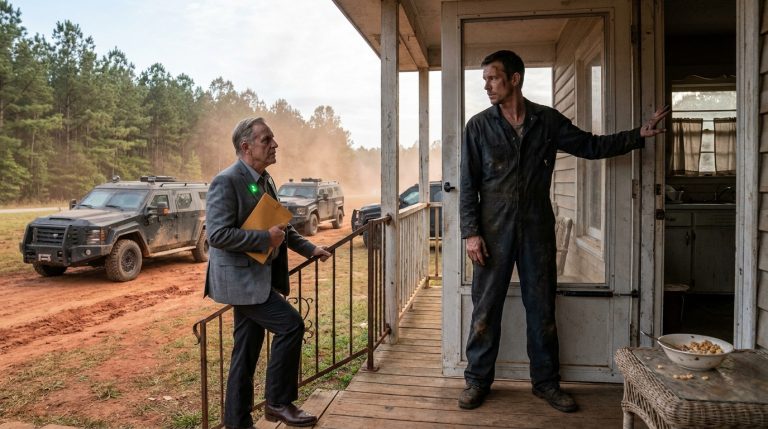
Walter sat on the porch of his whitewashed cottage that evening, the screen door giving off its familiar, dry creak as the offshore breeze caught the frame. Below the curve of the coastline, the Horizon Bell rested securely in her new home, her American flag rippling softly in the warm twilight.
Marcus and three other kids from the school district were down on the pier, their laughter lifting above the sound of the surf as Mitchell showed them how to splice a double-braid nylon line. They didn’t have high-end gear or matching uniforms, but their hands were moving over the coarse ropes with an emerging, quiet pride.
Thomas Rain sat on the porch steps, his dress jacket unbuttoned, a faded porcelain mug of black coffee held between his palms. He looked out over the silver water toward the three destroyers that still anchored near the sea buoy, their riding lights blinking like new stars against the darkening sky.
“The compass still points five degrees off?” Thomas asked, not turning his head.
Walter reached into his pocket and pulled out the old brass instrument, its glass face scratched by thirty years of labor. He laid it on the wooden table between their chairs. The needle wavered, then settled, pointing slightly away from the true grid, stubborn and unyielding.
“It points where it needs to, Tom,” Walter said softly, his rough hand resting on the faded metal casing. “It gets me back to the dock every time.”
The community had begun to remember itself, not through a grand ceremony or loud declarations, but through the small, faded textures of daily life returning to its proper alignment. An old medic down the road had been asked to speak at the high school; a local crabber had his landing fees waived by the municipal board. The town had stopped looking at the photo filters and started looking at the water.
Walter watched the children down on the slip lift the flag for the evening tuck, their small hands working in unison. He didn’t need the medals in his locker, and he didn’t need his name on a monument. As the stars came out over the shelf, reflecting in the dark, clean wood of the Horizon Bell, he knew the anchor had finally holden.