The Repair of All Fraying Edges: A Story of Invisible Scars and the Kintsugi of the Left Behind
CHAPTER 1: THE TEXTURE OF SUNSET AND COLD IRON
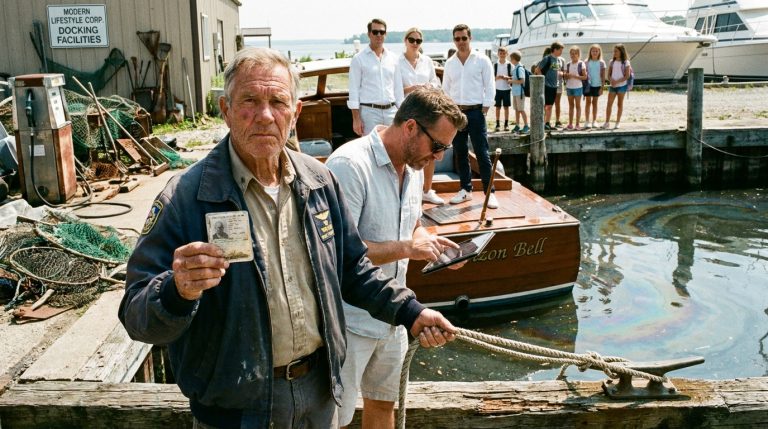
The light in Thomas, Georgia, always died the same way—a long, desaturated bleed of amber that turned the red clay road to the color of dried liver. Ben Carter adjusted his weight on the gravel, the sharp stones biting through the threadbare denim of his knees as he reached into the cavernous, hot shadow of the old Ford’s engine bay. The engine was a mess of dry-rotted vacuum lines and calcified brass fittings, smelling heavily of boiled coolant and ancient, scorched oil. Behind him, inside the cab of his own idling truck, the small silhouette of Logan was visible against the faded vinyl seat, the boy’s plastic juice bottle catching the last orange glint of the sun like a tiny beacon.
“The radiator cap’s about to weld itself to the neck,” Ben said, his voice low, flat, dropping into the dry air without expecting an echo.
The older man standing by the fender didn’t shift his weight. He wore a mud-flecked canvas jacket that looked like it had been through three decades of hard rain, his silver hair cropped close enough to show the pale skin of his scalp. He hadn’t spoken since Ben pulled his truck onto the shoulder forty minutes ago. He didn’t offer a name, nor a handshake, nor the frantic, sweating apologies common to motorists stranded on the state line with five miles of empty pine forest ahead of them. He simply watched Ben’s hands—specifically the jagged, white-rimmed scar across Ben’s left knuckle where an armored personnel carrier’s hatch had dropped during a wet season in Kunar.
“You’re using a metric socket on an imperial nut,” the stranger observed. His voice had the dry, rhythmic rasp of a man who spent his mornings reading logistics logs aloud in rooms with concrete floors.
“It’s a nine-sixteenths,” Ben muttered, his knuckle scraping against the alternator bracket as the wrench slipped three degrees. The metal was pitted, cold despite the engine’s heat. “But the shoulder’s rusted down to about fourteen millimeters. You take what the road gives you.”
From the edge of the drainage ditch, the sudden, rhythmic thud of work boots signaled the approach of Mr. Dobs. Dobs lived three hundred yards down the lane in a brick ranch house with a pristine metal roof and a lawn tractor that never lacked for ethanol-free gasoline. He stopped five feet short of the breakdown, his hands tucked into his pockets, his chin tilted toward Ben’s grease-smeared shoulder.
“Fixing some old farmer’s truck for free, Carter?” Dobs’ voice was thick with the casual sarcasm of a man who checked his credit score twice a week. “Your own roof’s still leaking from that storm last Tuesday. Miss Janine told my wife you were short on the daycare deposit again.”
Ben didn’t flinch. He didn’t drop the wrench. Internal calculation was an old habit; he measured Dobs’ words against the steady hum of Logan’s breathing in the truck behind him, subtracting the noise until only the mechanical work remained. “The terminal’s clear,” Ben told the stranger, completely ignoring the man in the ditch. “Give it a turn now.”
The old man didn’t look at Dobs either. He climbed into the cab with a stiff, practiced movement that spoke of old spinal compression. When the starter engaged, the ancient block groaned, caught a breath of unburned diesel, and then settled into a heavy, trembling idle that rattled the loose gravel under the tires.
Ben stood up, his spine popping twice against the weight of his thirty-six years. He wiped his palms down the sides of his jeans, leaving two dark, permanent slashes of graphite grease against the fabric.
The stranger rolled down the hand-crank window three inches. He looked at Ben, then past him to where Logan’s face was pressed against the truck glass, his small fingers tracing the condensation. In the dimming light, Ben noticed a faint, metallic glint inside the stranger’s glove box—a small, black anodized bracket that didn’t belong on a commercial farm truck, its green diagnostic LED pulsing in a sequence that wasn’t standard civilian telemetry.
“You didn’t ask what I was carrying,” the old man said.
“Didn’t matter,” Ben said, tossing his tool roll into the back of his Ford. “You were stopped.”
The truck pulled away without a puff of smoke, its tail lights disappearing into the dark wall of the Georgia pines, leaving Ben alone in the dust with Dobs and the smell of iron.
CHAPTER 2: THE CRACK IN THE PORCH LIGHT
“Get the boy inside, Carter. Right now,” Mr. Dobs’ voice didn’t carry its usual mocking weight. It was thin, reedy, the sound of a man who had suddenly realized the fence line he spent years patrolling was made of nothing but wet cardboard.
Ben didn’t look up immediately from the kitchen table. The chipped ceramic bowl in front of Logan was half-filled with milk, the tiny floating clusters of grain drifting like debris after a flash flood. The kitchen smelled of burnt toast and the sour metallic tang of the old radiator sputtering in the corner. Through the fraying lace curtains, the morning sun didn’t just rise—it cut across the linoleum floor in long, sharp needles of white glare.
Then came the vibration. It wasn’t a sound at first, but a low-frequency hum that vibrated through the rusted nails of the floorboards, rattling the silver-plated spoons in the drying rack.
Ben stood up slowly, his left hand instinctively dropping onto Logan’s small, flannel-clad shoulder. “Finish your milk, buddy. Keep your eyes on the bowl.”
“Dad?” Logan looked up, a drop of white pooling on his chin. “Is that the big trucks again?”
Ben didn’t answer. He walked to the screen door, his bare feet registering every splinter in the weathered pine threshold. Outside, the red clay dust of the driveway was already swirling into thick, suffocating clouds. Three black SUVs—long, armored chassis with tinted windows that absorbed the morning glare rather than reflecting it—had formed a perfect, seamless wall across his front yard. They didn’t park; they occupied. The engines didn’t idle with the familiar rattle of commercial diesels; they hummed with a synchronized, high-output whine that sounded like an electrical substation under heavy load.
The door of the center vehicle swung open with a heavy, pressurized hiss.
A man stepped down into the dirt. He wasn’t wearing a uniform, but the pressed gray blazer and the polished black leather boots carried the unmistakable architecture of command. It was the same old man from the roadside, but the mud-stained canvas jacket was gone, replaced by an iron-disciplined posture that made the small, sagging porch of Ben’s house look incredibly fragile. On his lapel, a small silver pin flashed in the sun—and within its center, a microscopic green LED pulsed in the exact, irregular sequence Ben had seen inside the truck’s glove box the night before.
Behind him, two younger men in dark tactical civilian attire moved to the flanks of the vehicle, their eyes sweeping the tree line with calculated, unhurried precision.
“Sergeant Carter,” the old man said, his voice cutting through the mechanical hum without requiring volume. He stopped at the bottom step, his hand resting casually on the rusted iron handrail. “The timing on that Ford block is still three degrees advanced. But it held all the way through the ridge.”
Ben kept his right hand flat against the frame of the screen door. The wire mesh was frayed near the bottom, the copper strands poking out like tiny needles. “You’re blocking my mail vehicle, sir. And my neighbor’s nervous about his grass.”
Across the road, Dobs’ curtain twitched, then dropped completely shut.
“Mr. Dobs will survive the morning,” General Nathaniel Caldwell said, stepping onto the first riser. The wood groaned under his weight, a dull, wet sound. “Lieutenant Colonel Whitaker is inside the rear transport. He has your service jacket from the First Armored. The one you tried to leave in the personnel office at Fort Stewart when Melissa’s final state insurance vouchers were denied.”
The mention of the name didn’t cause Ben to move, but his jaw tightened until the old scar along his jawline turned a stark, bloodless white. “That file’s closed, General. I signed the dependency discharge three years ago. I fix tractors now.”
“You fixed a Tier-1 command relay disguised as an auxiliary alternator baseline,” Caldwell said, his voice dropping into a register that didn’t travel past the porch railing. He reached into his blazer and drew out a thick, heavy manila envelope, its corners sealed with tamper-evident red polymer tape. “You didn’t just clear the terminal, Ben. You bypassed a localized encryption lockout using nothing but a jumper wire and an old grounding strap. My engineers in Atlanta have been trying to patch that vulnerability for six months.”
Ben looked at the envelope. The paper was rough, heavy-grain, the kind used for tactical distribution manifests before everything went to digital servers. “It was back-feeding into your distributor. If I hadn’t grounded it, your diagnostic suite would have fried your fuel pump. It wasn’t a tactical decision. It was a fire hazard.”
“The country’s full of fire hazards right now, Sergeant,” Caldwell said softly. He didn’t offer the envelope yet; he held it against his chest like a shield. “The power grid in the valley is dropping two percent efficiency every quarter because the contractors are using third-tier components from offshore suppliers. The water treatment pumps in Thomas are running on legacy software that a high schooler could crack with a standard radio scanner. We are running on the rims, Ben. And the people who know how to balance the wheels are fixing farm trucks for twenty dollars and a box of peaches.”
From inside the kitchen, the clatter of Logan’s spoon against the ceramic bowl stopped. The small footsteps approached the door, hesitant, rhythmic.
Ben didn’t turn around, but his shadow widened to block the boy’s view through the mesh. “I have a routine, sir. I drop him at Miss Janine’s at eight. I have a cylinder head waiting at Henderson’s garage by nine-thirty. If I’m late, he docks the labor rate.”
“There is an infrastructure diagnostic facility forty miles north of Atlanta,” Caldwell said, his gray eyes locking onto Ben’s with an intensity that felt less like an offer and more like a recovery operation. “The salary is guaranteed through the Department of Defense workforce reallocation fund. It includes full family medical baseline coverage. No deductibles. No secondary approvals for pediatric care.”
Ben’s eyes drifted down to the green light pulsing on Caldwell’s lapel. The sequence wasn’t random. It was an old tactical beacon code—Secure Perimeter, Awaiting Transport.
“Why me?” Ben whispered, the grease stains on his fingers suddenly feeling incredibly dark against the clean white paint of the door frame. “There are a thousand mechanics who stayed in the service. Men with clean records who didn’t walk away when the paperwork got heavy.”
“Because you stopped when you didn’t have to,” Caldwell said, and for the first time, a faint, melancholic shadow crossed the old soldier’s face, softening the hard lines around his mouth. “And because when you looked at a broken machine on a dark road, you didn’t ask who was paying for the iron. You just fixed it because it was wrong to leave it broken.”
Caldwell laid the heavy envelope on the small wicker table beside the porch chair, right next to a half-empty jar of dried marigold seeds Melissa had harvested three summers ago. He turned back toward the idling SUVs without waiting for a verbal contract.
“Forty-eight hours, Carter,” the General called over his shoulder as the rear door of the lead transport began to slide open. “Bring your own tools. The state-issued sets don’t have the weight you’re used to.”
Ben watched the dust rise again as the three vehicles reversed down the narrow lane in perfect unison, their tires leaving deep, parallel trenches in the red Georgia clay. He reached out, his hand closing over the cool, stiff cardboard of the envelope, his fingers feeling the unexpected weight of the pages inside.
CHAPTER 3: THE INTELLECT OF CALIBRATED STRESS
The pressure gauge did not lie, but it trembled. Ben held his palms flat against the vibration of the industrial test bench, feeling the rapid, rhythmic pulsing of high-viscosity oil tearing through a faulty seal deep inside the manifold. Around him, the training facility forty miles north of Atlanta did not smell like Henderson’s Auto. It lacked the sweet, heavy scent of damp earth and woodsmoke that drifted into his home garage. Instead, the air here was scrubbed, dry, and cold, reeking faintly of chemical solvents and the ozone sting of twenty high-powered server racks humming behind the drywall.
“The regulator is failing to buffer the secondary stroke, Carter,” an instructor muttered from behind a clip pad. His name was Miller, an old logistics chief whose uniform shirt had been traded for a crisp navy polo that still bore the stiff creases of its factory packaging. “In a municipal water substation, that failure snaps a five-inch cast-iron line in less than twelve seconds. You have forty-five.”
Ben did not answer with words. He adjusted his grip on a heavy, parkerized crescent wrench—not the old vanadium tool he had left on his kitchen table, but a cold, balanced piece of state-issued steel that felt strangely devoid of history. He focused on the rhythm of the machine. Under the [LIGHT ECHO] filter, he did not see a threat; he saw a system trying to tears its own joints apart under an unyielding burden. It was a shared strain, the iron and the oil working against an impossible constraint.
His fingers moved with the muscle memory of five hundred late-night motorpool overhauls. He bypassed the digital control panel entirely, reaching underneath the housing where the manual bleed valve was tucked beneath a coat of fresh, gray enamel. As his knuckles brushed the frame, his eyes caught a small, stamped aluminum plate riveted to the chassis: M-MAN-916-FX.
The breath caught in his throat. The number was identical to the logistics code stamped on the final medical denial form from Fort Stewart—the one that had left Melissa’s hospital accounts unresolved.
“Thirty seconds,” Miller said, his pen hovering.
Ben didn’t look back at the plate. He forced the valve three quarter-turns counterclockwise. The high-pitched scream of the trapped air died instantly, replaced by a low, rhythmic sigh as the fluid found its way back into the return reservoir. The pressure needle dropped smoothly back to the green sector, resting exactly at forty pounds per square inch.
“Clean save,” Miller noted, his tone flattening into professional detachment. “Most of the recruits try to override the software first. They waste twenty seconds waiting for the terminal to reboot.”
“The software doesn’t feel the heat when the seal cracks,” Ben said, his voice quiet as he wiped a smear of clear hydraulic fluid from the wrench with a piece of industrial cotton. His hands were shaking slightly, not from the physical effort, but from the sudden, cold realization that this facility was built out of the remnants of the very administration that had let his family fall through the cracks. “The iron tells you what it needs before the screen does.”
He walked away from the bench, his work boots squeaking against the polished gray epoxy of the floor. The training bay was vast, filled with thirty other weathered men and women, their faces lined with the specific, quiet exhaustion of people who had spent years waiting for a break that never came. They didn’t talk much; they moved between the instructional mock-ups like ghosts in civilian denim, testing valves, splicing fiber-optic cables, and rebuilding high-output alternators that looked suspiciously like the one Ben had fixed on the side of the road.
At the end of the line, sitting on an overturned shipping crate, a woman with a faded sleeve tattoo was staring at a disassembled communication array. Her fingers were trembling as she tried to seat a high-density ribbon cable into a slot that had been bent out of alignment.
Ben stopped beside her. He didn’t offer a lecture. He simply reached down, his calloused thumb gently pressing the edge of the aluminum housing to relieve the tension on the bracket. “It’s cross-threaded from the factory,” he said softly. “They don’t leave enough clearance for the ground wire. Slide it in from the left side first.”
The woman looked up, her eyes carrying the sharp, defensive guard of someone who expected to be reprimanded. She looked at Ben’s grease-stained shirt, then down at his hands. “It’s a closed system,” she whispered. “The manual says if we breach the seal, we lose the certification credit for the week.”
“The manual was written by someone sitting in a room with air conditioning,” Ben said, his voice dropping as he guided her fingers toward the hidden notch. “The wire wants to fit. You just have to give it the room to find its own center.”
The cable clicked into place with a small, definitive snap. The red fault light on the module flickered twice, then died, replaced by the steady, unblinking green glow that Ben had grown to recognize.
“Thanks,” she muttered, pulling her hands back into the sleeves of her oversized jacket. “I’m Sarah. Formerly Fourth Infantry. I was driving a delivery van in Macon before the General’s people came through.”
“Ben,” he said.
“I know,” Sarah said, looking around the cavernous bay before leaning closer. “We all know who you are, Carter. You’re the one who didn’t ask for a receipt.”
Before Ben could ask what she meant, the heavy double doors at the front of the bay swung open with a dull thud. Lieutenant Colonel Whitaker stood in the frame, his dark suit perfectly tailored, holding an industrial tablet that cast a pale blue light across his face. His eyes scanned the room until they locked onto Ben.
“Carter,” Whitaker called out, his voice sharp enough to draw the attention of every mechanic in the line. “Step away from the equipment. The General is in the main office. We’ve found a discrepancy in the diagnostic logs from your vehicle’s synchronized scan.”
Ben felt the cold steel of the wrench still heavy in his back pocket. He didn’t look back at Sarah, nor at the rivet plate under the test bench. He moved toward the door, every step revealing the deep, structural cracks in the security he thought he had just bought for his son.
CHAPTER 4: THE DECOY INTERCEPT
The glass panel of the server cabinet was cold, coated in a fine layer of gray dust that vibrated with the heavy pulse of the regional transit mainframe. Ben pressed his fingers against the seam of the locked metal frame, the heavy steel-toed boots he’d been issued three months ago scraping uncomfortably against the concrete floor. The room smelled of hot circuit boards and old, decaying damp paper—the specific texture of an institutional archive left to rot behind a facade of digital efficiency.
“You shouldn’t have the diagnostic keys for this terminal, Carter,” Whitaker said, his voice coming from the darkened doorway behind Ben. The Lieutenant Colonel didn’t move into the room; his silhouette remained framed by the fluorescent yellow wash of the corridor, steady and sharp. “The technical core is authorized for infrastructure maintenance, not system data recovery.”
Ben didn’t turn around. He kept his diagnostic scanner hooked directly into the auxiliary data loop—the exact same interface sequence he had accidentally triggered on General Caldwell’s truck alternator four months ago. On the small, cracked LCD screen of his handheld terminal, rows of encrypted data packets were scrolling in a frantic, unyielding cascade.
“The alternator on the General’s truck wasn’t a standard build,” Ben said, his voice dropping into the quiet, dead air of the server room. “It wasn’t just stabilizing the voltage. It was tracking a localized distribution network across four counties. And the same encryption signature is running through this local municipal water grid.”
“We are rebuilding the infrastructure, Ben. Rebuilding means synchronizing the monitoring protocols,” Whitaker replied. His posture remained rigid, but the sound of his leather soles shifting on the concrete carried a faint, defensive friction. “The General gave you an assignment. He took you off a dirt road and gave your boy a future. Don’t look under hoods you haven’t been ordered to fix.”
“I looked at the distribution log for the regional veterans’ housing assistance program,” Ben muttered, his thumb pressing the manual override button on his scanner. The metal casing of the handheld unit was peeling at the corner, the thin plastic overlay frayed from weeks of hard labor in the field. “The system isn’t just flagging names for work placement. It’s routing specific logistical equipment—high-grade communications gear and advanced telemetry modules—directly to veterans who are currently classified as unhoused or disabled. And half of those shipments are being redirected through a private defense contractor called Vanguard Logistics.”
The scrolling text on the screen suddenly stopped. The interface flickered, then flashed a stark, amber notification: LAYER 1 OVERRIDE COMPLETED. DECOY EXPOSED.
Ben froze. The data didn’t show a government initiative to rebuild a broken nation. According to the screen, the entire Veteran Technical Corps was a massive, off-the-books tracking program designed to harvest mechanical talent and deploy undocumented military hardware into civilian zones under the guise of municipal repair work. The system was treating the veterans like cheap, untraceable field mechanics for an experimental private network.
“It’s a shadow logistics operation,” Ben said softly, the weight of the realization pressing down on his chest like a dropped engine block. He turned around slowly to face Whitaker, his calloused hands dropping to his sides. “The General didn’t create a pilot program to save us. He created a private pipeline for Vanguard. He used my name, he used my face before Congress, just to build a screen for a corporate hardware rollout.”
Whitaker didn’t flinch. The silver light from the hallway caught the edge of his jaw, rendering his expression completely flat, devoid of anger or remorse. “You think you understand the architecture of this world because you know how to balance a crankshaft, Sergeant? You were drowning in debt. Your house was falling apart. The system didn’t care about your service record until we put a suit on you.”
“Melissa’s name is on this manifest,” Ben whispered, his voice cracking slightly against the sterile hum of the cooling fans. He pointed a scarred finger toward the amber screen. “Three years ago, her medical vouchers were flagged by the exact same logistical routing node. This isn’t an infrastructure corps, Whitaker. It’s a harvesting operation. You found the people who were too broken to fight back and you turned them into an undocumented workforce.”
“You found a decoy file, Ben,” a new voice said from the dark depths of the corridor.
General Caldwell stepped into the room, his gray blazer immaculate, though the old soldier looked smaller under the harsh, unshielded fluorescent bulbs of the server vault. His eyes didn’t carry the authority of the porch in Thomas, Georgia; they carried a deep, faded exhaustion that looked remarkably like Ben’s own inner shadow.
“You’ve gone exactly as far as the program allowed you to go,” Caldwell said, stopping three feet from Ben. He didn’t look at the scanner. He looked at Ben’s knuckles, where the white white-rimmed scar from Kunar was red and raw from a slipped wrench earlier that afternoon. “You think Vanguard is running this network? You think I would let a private contractor touch the men and women who bled in the valley?”
“The data is right here,” Ben said, slamming his hand against the glass cabinet. The frame rattled, a sharp, metallic ring that died instantly against the acoustic insulation. “You lied to me. You lied to the committee.”
“If the corporate sector believes they are buying a cheap, off-the-books workforce, they don’t look at the true distribution nodes,” Caldwell said, his voice dropping into a harsh, protective whisper that made Whitaker step back toward the door. “If the bureaucracy thinks it’s an economic development program, they leave the funding line untouched. You found the bottom of the first tray, Sergeant. But the absolute truth of what we are building here is still completely locked inside this system, and if you walk out that door right now, you aren’t saving your son—you’re just letting the fire reach the house.”
Before Ben could pull the terminal connector from the wall, a sudden, high-intensity alarm began to wail through the ceiling griles. The amber lights on the server racks turned a violent, flashing crimson, and the heavy electronic locks on the emergency doors slammed shut with a definitive, pressurized thud that cut off the air from the main hallway.
CHAPTER 5: THE TEXTURE OF UNBROKEN LEVEE
The brass of the microphone head was pitted close up, scarred by tiny intersecting scratches from decades of nervous breath and official transcripts. Ben adjusted the collar of his suit jacket, the coarse, unfamiliar wool rubbing against the raw patch on his neck where his grease-stained work shirt usually sat. The hearing room was structured like an amphitheater of cold marble and dark mahogany, a massive dome of filtered light where the soft murmur of legislative aides sounded like dry leaves scraping over a frozen pond. Behind him, on the hard oak benches reserved for spectators, Logan sat perfectly still in his best Sunday shoes, his small fingers tracing the worn edge of a silver-plated spoon he had insisted on carrying from home.
“Mr. Carter,” the committee chairman said, his voice echoing flatly through the overhead PA system, stripped of warmth by the acoustic dampening of the room. “The record shows your rapid advancement through the technical training center in Atlanta. It also notes several unauthorized diagnostics performed on regional transit infrastructure. We have a brief prepared by Vanguard Logistics suggesting your actions exceeded your civilian mandate.”
Ben looked down at the typed statement Caldwell’s staff had laid out on the podium before him. The crisp white paper looked blinding under the direct glare of the spotlight. He could see the strategic phrases highlighted in yellow ink—reallocation of technical assets, municipal oversight, standardized system restoration. It was a perfect, beautifully polished shield designed to cover the true reality he had pulled out of the terminal vault forty-eight hours ago.
Beside the podium, General Caldwell sat in a low leather chair, his silver hair catching the edge of the light. He wasn’t looking at the committee; his eyes were fixed on the rough, dark crescent of grease embedded under Ben’s thumbnail—a mark that three different industrial hand-cleaners in the Washington hotel room hadn’t been able to completely erase. It was the same silent, waiting look the old man had carried on the side of the road in Thomas, Georgia. He wasn’t waiting for a defense. He was waiting to see if the weld would hold under maximum stress.
Ben reached out and slowly slid the prepared statement to the side, leaving the dark polished wood of the podium completely bare.
“I don’t know much about the Vanguard contract protocols, sir,” Ben said, his voice flat and low, dropping into the room with the unhurried rhythm of a mechanic explaining a cracked block to a farmer. “But I know how iron behaves when it’s left to rust in the dark.”
A sharp rustle of papers rippled through the row of congressional aides. Whitaker, sitting three rows back in a pristine charcoal suit, closed his eyes once and did not open them again.
“Six months ago, I was kneeling in the red dirt off Highway 19, trying to clear a corroded terminal on a truck that shouldn’t have been running,” Ben continued, his fingers resting lightly on the edge of the mahogany rail. Under his palm, the texture of the wood was smooth, too smooth, lacquered so deeply that the true grain of the timber was buried beneath three layers of chemical varnish. “I didn’t ask for the driver’s discharge papers. I didn’t check to see if the state insurance vouchers had been cleared through the regional office. I just knew that the man was stranded, and the sun was going down, and my boy was watching me from the front seat to see what a father does when someone is running on empty.”
He looked directly up at the high tier of benches where the lawmakers sat behind their nameplates.
“When General Caldwell built this technical corps, he didn’t build it to fix broken pipes or patch the software on a municipal water pump,” Ben said, the subtext of the true network—the invisible shield protecting five hundred broken down soldiers from the corporate harvesting line—pulsing behind his words like the green LED on the General’s lapel. “He built it because the people who know how to keep this country from rattling apart are currently invisible. They are living in houses with leaking roofs, working three separate delivery jobs just to pay a daycare deposit, and waiting for someone to notice that their character still matters after the uniform is put away.”
The chamber was entirely silent now. The high-pitched whine of the television cameras on the perimeter seemed to drop an octave, absorbing the low vibration of his voice.
“You can spend billions on new components from third-tier contractors,” Ben said, his hand dropping into his suit pocket, his thumb catching the smooth, familiar curve of the silver spoon. “You can write manuals that tell us how to re-encrypt a server line or monitor a regional transit grid from an office in Atlanta. But if you don’t trust the hands holding the wrench, the system is going to fail anyway. I didn’t fix that truck to get a certificate or a suit that doesn’t fit my shoulders. I fixed it because it was the right thing to do when the world stopped watching. And every person in that training bay right now is just looking for the same thing—a chance to keep the levee from breaking before the next storm comes down.”
Ben stepped back from the microphone, the small squeak of his new leather soles sounding remarkably loud against the marble floor. He didn’t wait for the chairman to rap his gavel, nor for the reporters in the press gallery to finish scribbling into their pads. He turned toward the spectator benches, extending his scarred hand toward Logan, who immediately stood up and slid his small, warm palm into his father’s grip.
As they walked down the center aisle toward the heavy oak exit doors, General Caldwell stood up from his chair. He didn’t offer a salute, and he didn’t make a speech. He simply gave Ben a single, slow nod—the soldier’s handshake given across a distance, firm and wordless, recognizing that the kintsugi was complete, and the broken pieces had finally been bound together with gold.