The Measured Grace of Ghosts: The Long Return of Captain Aaron Mitchell
CHAPTER 1: THE YELLOW LINE
The bristles of the push broom made a dry, scraping sound against the concrete, a rhythm that Aaron Mitchell had used to anchor himself to the earth for forty years. The desert air at dawn smelled of cold dust, spilled diesel, and the faint, sweet scent of sagebrush blowing in from the Nevada flats. Light was just beginning to bleed across the sky—a pale, translucent gray that turned the chain-link fence of Fort Lincoln into a wall of silver wire.
Aaron didn’t look up when the boots approached. He knew the cadence of military footwear better than the beating of his own heart. Two pairs. Stiff leather. Heavy soles. They stopped precisely three inches from the yellow security line painted onto the asphalt.
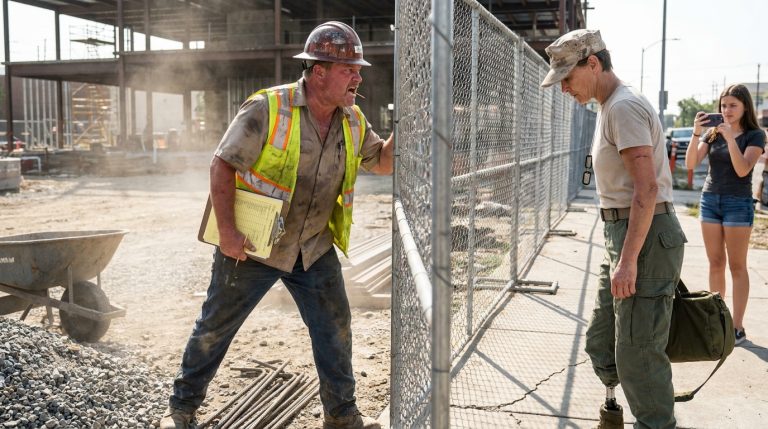
“Sir, I’m going to have to ask you to step away from the fence,” the younger MP said. His voice had the rehearsed, metallic edge of someone repeating a directive whispered into his earpiece five minutes prior. “New base regulations. No civilian presence within ten feet of the perimeter.”
Aaron paused, his palms resting against the smooth, splintered wood of the broom handle. The wood was dark, seasoned by the oils of his skin over decades of morning frost and noon heat. He let his gaze lift slowly, tracking the line of the young man’s pressed trousers up to the polished brass of his name tag. Rodriguez. A boy. No older than the boys Aaron had left in the mud near the red river branch in seventy-seven.
“I’ve cleared this curb since the tarmac was gravel, son,” Aaron said. His voice was small, dry, like two stones rubbing together at the bottom of a well.
“Orders are orders, sir,” Rodriguez replied, though his stance shifted slightly, losing a fraction of its rigidity. Behind him, standing near the guard shack, Private First Class Jason Miller watched with a coffee cup held between both hands, the steam rising into the chill air like a tiny, gray signal fire.
Aaron didn’t argue. Argument required an investment in the present that he simply did not possess. He nodded once—a brief, microscopic dip of his chin—and leaned the broom against the galvanized steel fence. He reached down to the concrete bench where his canvas satchel lay, its olive-drab fabric frayed into gray whiskers at the corners.
The zipper was old, its teeth clogged with years of desert sand. When Aaron pulled it, the metal tab caught on a loose thread of his jacket. He yanked it—not with anger, but with the clumsy force of fingers stiffened by the morning cold.
The bag rolled.
A small, rectangular ammunition box slipped through the gap, hitting the concrete with a loud, metallic ring that seemed to shatter the silence of the valley. The latch, worn thin by time, popped open.
The items did not scatter; they slid out in a neat, heavy pile onto the gray stone.
Jason Miller dropped his coffee. The dark liquid spread across the pavement, but neither MP looked at it. Their eyes were locked on the silver star that lay face-up in the dust, its ribbon faded from brilliant gallantry to a dull, ghostly pink. Beside it lay a shoulder patch—Special Recon—its edges blackened by an old fire, and a single, creased photograph of eight young men whose smiles had been preserved beneath a layer of yellowed scotch tape.
Aaron remained on one knee, his hand hovering an inch above the metal box. For the first time in forty years, the silence around him felt heavy, dangerous, and completely broken.
CHAPTER 2: THE ARCHIVE SEARCH
The air in the basement tier of the base library smelled of desiccant packets, disintegrating glue, and the cold, static hum of a dehumidifier that had been rattling in the corner since the mid-nineties. Jason Miller shifted his weight on the metal folding chair, the iron legs scraping a sharp, protesting note against the unpainted concrete floor. Under the low-wattage glare of a goose-neck lamp, the shadow of his fingers looked long and skeletal across the yellowed cardstock of the folder.
He had bypassed the digital terminal entirely. Modern databases were clean, scrubbed by algorithms that smoothed out the jagged edges of the late twentieth century into neat, unclassified summaries. If Captain Aaron Mitchell existed anywhere in Fort Lincoln’s memory, it would be here, buried in the physical dead-letter office where the old paper records went to molder.
Jason flattened the palm of his hand against the cardboard cover of the file labeled Operation Thunderline: After-Action Repositories (Restricted Access). The texture was rough, furred with dust that left a dark smudge across his thumb. His heart knocked a steady, anxious rhythm against his ribs. He wasn’t supposed to have this file; the clerk at the desk had left for a smoke break, leaving the cage keys dangling from a magnetic hook. It was a tactical risk, a calculated breach of protocol that felt entirely unnatural to a second-generation soldier raised on a strict diet of chain-of-command. But every time he closed his eyes, he saw the old man kneeling in the dirt, the pink ribbon of the Silver Star catching the pale Nevada sun.
He opened the folder.
The first layer was mostly logistical waste—requisition forms for jungle rot ointment, fuel consumption logs for Huey helicopters, and carbon-copied rosters with names stamped over in purple ink: REDACTED. Jason turned the pages carefully, his fingernails catching on the brittle edges of the water-damaged paper. The documents painted a picture of a disaster that had been systematically disassembled by bureaucratic hands until it looked like nothing more than an accounting error.
Then he reached the mid-mission telemetry summaries from April 1977.
The prose in the logs was dry, written in the clipped, unfeeling shorthand of military dispatchers. Unit encountered heavy perimeter resistance at Grid Zulu-Four. Air extraction compromised. Transport aircraft Three-Zero-Two sustained catastrophic rotor failure via RPG. Commander Mitchell went down with the tail section.
Jason leaned closer, the heat of the incandescent bulb baking the skin of his forehead. He pulled out his field notebook, the spine cracked and loose, and laid it beside the file. The names matched the faded photograph from Mitchell’s ammunition box. He could see the structural logic of the official narrative—it was a clean, tragic ending designed to be filed away and forgotten.
But something didn’t fit the weight of what he had seen at the gate.
He reached into his pocket and pulled out the small, notched brass key he had swept off the asphalt when the old man’s satchel popped open. Aaron hadn’t noticed him pocketing it, or perhaps the old captain had been too consumed by the sudden exposure of his ghosts to care. Jason turned the key over in his fingers. The metal was dull, the teeth worn smooth by years of friction against leather or skin. It didn’t belong to a standard military locker. It looked like a key to a personal lockbox, the kind people used to keep their life insurance policies or land deeds safe from fire.
Jason turned back to the file, his eyes tracking a line of text at the bottom of the final page that had been partially obscured by a rusted paperclip. The metal had oxidized, leaving a deep brown stain that ate through the paper.
Subject Mitchell, A. – Discrepancy Note.
The handwriting was different here—not the neat type of a logistics clerk, but the hurried, heavy slant of an field doctor or an investigator. John Doe admission at Sector 4 VA Hospital matches dental indicators for Captain Mitchell. However, service records indicate separate termination of duty under secondary identification.
Jason’s breath hitched in his throat. He used the tip of his thumb to scrape away a flake of rust from the paperclip. Beneath it was a cross-referenced serial number that pointed to a closed file in the 1979 archives.
He didn’t hear the footsteps until the shadow broke the yellow pool of light from the lamp.
“You’re tracking a ghost that doesn’t want to be found, Miller,” a voice said from the darkness beyond the stack.
Jason stiffened, his fingers locking around the edge of the folder as he instinctively shifted his body to block the view of the restricted document. His boots found purchase on the concrete, ready to push him into a standing position, his muscles tight with the reflexive adrenaline of a soldier caught out of bounds.
Sergeant Taller stepped into the light, his uniform shirt unbuttoned at the collar, a cold cup of chicory coffee held loosely in his right hand. His eyes weren’t angry; they were tired, reflecting the dim yellow glow with a heavy, protective dullness.
“Get the file back in the bin, Private,” Taller said softly, his voice carrying the weight of someone who had spent twenty years learning exactly which rules to break and which ones to die for. “The old man isn’t a secret. He’s a warning.”
Jason didn’t move. He kept his hand flat over the rust-stained paper. “The records say he died in the ravine, Sergeant. But he’s standing outside our gate with a broom. That’s not a warning. That’s a mistake.”
“The military doesn’t make mistakes that last forty years, Miller,” Taller replied, stepping closer until the smell of stale tobacco and cold grease reached Jason’s nose. “They make decisions. And right now, you’re looking at a decision that was signed, sealed, and buried before your father even took his oath. Put it back.”
Jason looked down at the notched brass key resting on his notebook. The metal seemed to catch the light, a single bright point against the faded textures of the past. He didn’t know what the key unlocked, but the logic of the file was beginning to crack, and he knew he couldn’t stop digging until he found the mechanism that held the old captain’s life in the dark.
CHAPTER 3: THE GATHERING STORM
The base didn’t wake up all at once; it bled into awareness. By mid-afternoon, the low, vibrating hum of the administrative offices had curdled into a tight, defensive quiet. Jason Miller stood at the corner of the motor pool washing dock, his fingers stained with the bitter tang of industrial solvent, watching the asphalt outside the main gates. The sky had turned the color of a bruised plum, holding the dry heat of the high desert flat against the earth until every breath felt like inhaling fine sand.
Rumors traveled through Fort Lincoln like electricity through rusted wire. No official announcement had broken the radio chatter, but the MPs weren’t joking anymore. Their posture had changed—shoulders pinned back, eyes tracking the perimeter fences not out of boredom, but with the sudden, sharp focus of men who realized the ground beneath their boots had history buried in it.
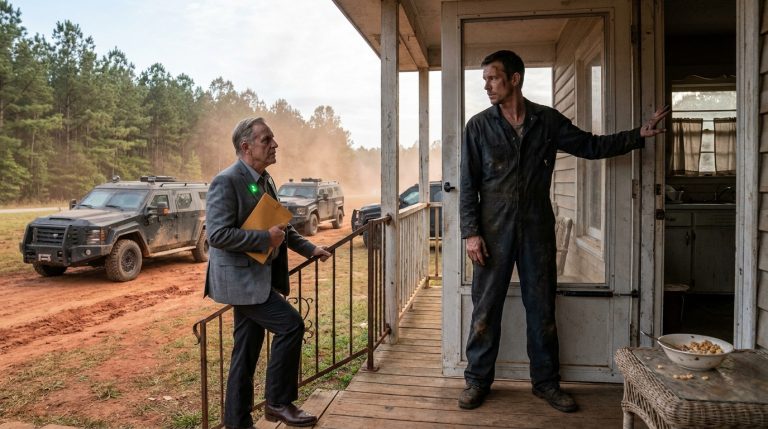
Then the black sedan arrived.
It didn’t have flags or an escort. It didn’t need them. The vehicle moved through the eastern checkpoint with a slow, heavy momentum that made the gravel beneath its tires grind to dust. When the rear door swung open, the silence that fell over the courtyard was absolute.
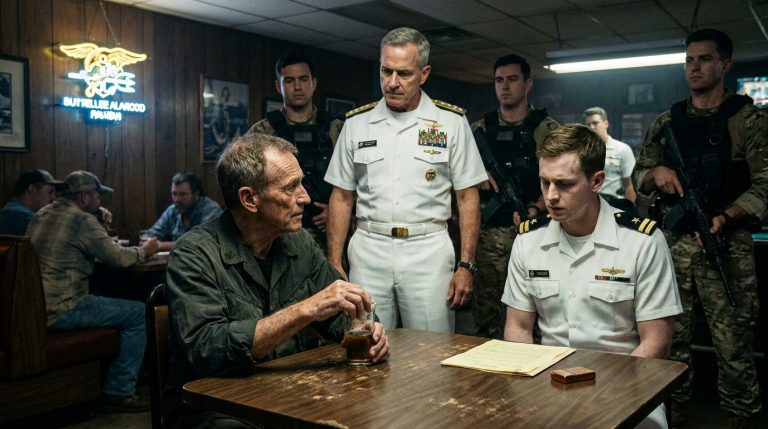
General Richard Hawthorne stepped out into the dry heat. His right leg dragged slightly, a heavy, mechanical hitch that disrupted the crisp alignment of his green dress uniform. The rows of medals on his chest clinked softly—a small, metallic language of silver and gold that caught the dimming sun. He didn’t look at the base commander who stood waiting on the top step of headquarters. His gaze cut straight across the tarmac, past the guard shacks, until it landed on the lone concrete bench by the yellow line.
Aaron Mitchell was still there. He hadn’t touched the broom since the MPs had moved it. He sat with his hands resting flat on his knees, his faded canvas jacket zipped to the throat despite the stagnant warmth of the afternoon. He looked smaller now, his gray beard catching the grit blowing off the flats, but his spine remained perfectly straight—a line of stubborn wood that refused to rot.
Jason moved closer, his boots clicking softly on the pavement as he slipped into the shadow of the logistics truck. He could feel the cold weight of the brass key in his pocket pressing against his thigh.
Hawthorne stopped three paces from the bench. His broad shoulders remained squared, but his jaw was tight, the skin around his eyes pulling into deep, deep lines that hadn’t come from age alone. For a long, agonizing moment, neither man spoke. The wind caught the edge of the frayed photograph still resting in Aaron’s half-open box, making the paper flutter like a trapped moth.
“You saved my life, Captain,” Hawthorne said. His voice wasn’t the booming command Jason had heard on training tapes; it cracked on the first syllable, thin and dry, carrying the raw texture of a thirty-year-old memory suddenly brought into the light. “I saw the tail section go down. We looked for three days before the extraction window closed. I thought you died with the rest.”
Aaron didn’t look at the medals. He didn’t look at the stars on Hawthorne’s shoulders. He looked at the slight drag of the general’s right leg, his old eyes softening with a quiet, devastating empathy.
“The helicopter was too heavy, Richie,” Aaron murmured. The use of the informal name made the base commander behind them stiffen, but Hawthorne only flinched as if he’d been struck by a physical blow. “If I hadn’t stayed to clear the ridge, the second bird wouldn’t have cleared the trees. You know that.”
“So you just let us leave your name on the wall?” Hawthorne’s voice rose slightly, a sudden flare of pain cutting through his military discipline. “Forty years, Aaron. Forty years of saluting a stone plaque while you’re out here sweeping the gravel outside our gates?”
Aaron reached down, his fingers slowly closing the lid of the ammunition box. The latch clicked shut with an unyielding finality. “Not all of us made it out of that jungle, Richie. Some of us left pieces of our minds in the mud. When I finally came around in the VA hospital, they called me John Doe. And when I looked in the mirror, I couldn’t find a reason to call them liars.”
Jason took a step out from the shadow of the truck, his focus shifting as Sergeant Taller approached the rear of the general’s sedan. Taller wasn’t looking at the reunion; his eyes were on a heavy, tarnished footlocker strapped into the trunk of the vehicle, secured by a mismatched, modern security chain that looked entirely out of place against the general’s official gear.
Before Jason could process the discrepancy, Hawthorne reached into his coat pocket and pulled out a faded, water-damaged manila envelope. He dropped it onto the bench beside the ammunition box. Through the worn paper, the bold stamp of the Department of the Army was visible, but beneath it, written in sharp red ink, was a notation that made Jason’s stomach drop: DISCHARGE BY REASON OF DESERTION – 1979.
“They found this in the secondary registry two hours ago, Aaron,” Hawthorne said, his voice dropping to a dangerous whisper. “The Pentagon didn’t just lose your file. According to the record, you walked away from the service two years after the crash under a different name. They think you ran.”
Aaron stared at the red ink, his expression entirely unchanging. He didn’t deny it. He didn’t defend himself. He simply reached out and placed his weathered palm over the document, obscuring the word Desertion beneath his scarred skin.
Jason watched the old captain’s face, realizing with a sudden, chilling certainty that the file in the library hadn’t been an accident of bureaucracy. The decoy secret was out—the system had branded the old man a coward to close the books—but the true reality of why Aaron Mitchell had accepted that shame remained locked behind a wall of silence that even a general couldn’t breach.
CHAPTER 4: THE SHARED BURDEN
“The ink doesn’t bleed, Richie,” Aaron said softly, his thumb tracing the brittle, yellowed edge of the manila envelope. “That means it’s spent a long time sitting in a dark drawer, away from the sun. Just like me.”
General Hawthorne didn’t sit down. His shadow stretched long and heavy across the weathered wood of the bench, completely obscuring the pale evening light that filtered over the Fort Lincoln fence line. The metallic rattle of his medals had stilled, but the tension in his broad shoulders remained unyielding. “You don’t understand the systemic leverage at play here, Aaron. If that file is validated by the oversight committee, you’re not a hero coming home. You’re a liability they have to contain. They will strip the pensions of the men who made it out on those choppers if they prove the mission log was compromised by an unmapped retreat.”
Jason Miller stepped closer, his boots pressing silently against the soft dirt flanking the concrete pathway. He felt the cold edge of the small brass key inside his pocket, a silent anchor amidst the shifting fragments of truth. He wasn’t looking at the general’s polished brass buttons anymore; he was watching the way Aaron’s weathered hands held the envelope. The paper was worn thin, showing the ghosted fibers of old cotton stock used only by the administrative branches before the shift to digital records.
“Let them look,” Aaron whispered. His gaze remained anchored on the far western horizon, where the mountain ranges were dissolving into a dull indigo smear. “A man who’s spent two years counting the cracks in a bamboo floor doesn’t worry much about the ledger books at the Pentagon. I didn’t come to this gate to ask for an audit.”
“But I have to live with the ledger, Captain,” Hawthorne countered, his voice cracking slightly as he leaned forward, placing his heavy palms flat on the back of the bench. The wood groaned under the sudden, physical weight. “Every advancement I received, every command assignment since seventy-seven, came because the record said I brought my people home under fire. If the record says my commander walked out of a field hospital two years later and vanished into the desert under a John Doe intake, they don’t look at the jungle. They look at the gaps in my testimony.”
The subtext hung thick in the cooling desert air—a heavy, suffocating layer of institutional self-preservation that felt entirely foreign to Jason’s pristine ideas of military honor. He could see the structural logic of the failure now. The decoy secret—the forgery accusing Aaron of desertion—wasn’t just a random bureaucratic mistake; it was a protective barrier erected to shield the survival of the unit itself. But it was a false bottom, a fragile screen hiding a darker compromise.
Jason pulled the small brass key from his pocket and stepped into the small circle of yellow incandescent light cast by the overhead security lamp. “This fits the footlocker in your trunk, doesn’t it, General?”
Hawthorne didn’t flinch. He turned his head slowly, his eyes narrowing into cold, gray slits that felt like a formal reprimand before a single word left his mouth. “You’re out of your depth, Private. This is a closed operational review between officers.”
“The file in the basement has a cross-referenced intake signature from seventy-nine,” Jason said, his voice steady despite the rapid drumming of his pulse against his throat. He held the key out between his fingers, the dull metal catching the amber flash of a nearby utility truck. “It was signed by an administrator named Miller. My grandfather. He was the chief clerk at the Sector Four facility before the building was condemned. He didn’t process desertions, General. He handled the deep-tier medical isolations that the Department of Defense wanted kept off the primary books.”
Aaron looked up then, his weathered face catching the low light. The lines around his eyes didn’t tighten with anger; they softened into a profound, crushing sorrow that seemed to age him ten years in a single second. “Your grandfather was a quiet man, son. He used to bring me three soft blankets every November because the dampness in the concrete floors made my legs stop working. He told me the world outside wasn’t ready for the names we left behind.”
“He kept you dead on paper,” Jason realized, the words tasting like cold iron in his mouth. He looked from the key to the manila folder. The realization shattered the remaining structure of the decoy—the desertion charge wasn’t an act of cowardice or an accusation by an enemy. It was a shield. But before he could speak the truth aloud, the sharp chirp of an MP radio broke the silence, the voice on the other end urgent and clipped.
“Command to Gate One, we have a breach of security protocols at the administrative annex. Secure all unverified personal assets immediately.”
Hawthorne’s jaw tightened. He reached down, his heavy fingers locking around the manila envelope and snatching it from Aaron’s knee before Jason could read the secondary serial codes stamped on the inner lining. “The window is closing, Aaron. If you don’t accept the formal retirement package by sunrise, the oversight committee will release the 1979 filing to the press. They will call you a runaway, and I won’t have the authority to stop them.”
The general turned on his heel, his dragging leg making a harsh, dragging sound against the gravel as he strode back toward the idling black sedan. The heavy doors closed with a dull, pneumatic thud, leaving Jason standing by the bench with his hand still open, the brass key resting uselessly against his palm while the old captain sat in the gathering dark, completely unmoving.
CHAPTER 5: THE FINAL WATCH
The taillights of the general’s sedan cut two bleeding streaks through the gathering desert dusk before disappearing into the concrete throat of the main boulevard. Jason Miller stayed beside the bench, his fingers tightly pressed against the notched brass key until the metal bit into his skin. The silence that rushed back into the courtyard wasn’t empty; it carried the vibrating, metallic echo of forty years of institutional secrets settling into the sand.
He turned to look down at Aaron Mitchell. The old man hadn’t moved to collect the fallen paperwork or to inspect the ammunition box. His gaze remained tracking the slow, rhythmic ascent of the evening shadows crawling up the white-painted staff of the base flagpole.
“My grandfather didn’t write that file to hide a coward, Captain,” Jason said, his voice dropping into the quiet space between them. He knelt, his boots pressing into the dry gravel, and laid the notched key flat on the weathered wood of the bench. “He wrote it because the system was going to classify your physical trauma as an operational failure. He gave you a phantom name so you could heal without a target on your back.”
Aaron’s hand moved slowly, his palm catching the soft glow of the amber security lights as he reached down to touch the key. His skin was cross-hatched with old scars, deep lines that looked like unmapped trails across a desaturated landscape. He didn’t speak immediately. In the silence, the distant, brassy note of a bugle echoed from the barracks—the final call of the day dissolving into the cold Nevada wind.
“The world wants a ledger to balance, son,” Aaron murmured, his thumb finding the worn notch in the brass. “They want the medals to weigh exactly as much as the blood we left in the grass. But your grandfather knew that some debts can’t be settled with a line item. Sometimes, the only thing left to do is to stand watch over the people who didn’t get to grow old.”
The morning came not with fireworks or the polished roar of an dress parade, but with a thin, silver line of frost that coated the handles of the push broom and the edges of the heavy cotton flag resting in the arms of the base honor guard. The ceremony wasn’t held in front of the television cameras or the visiting dignitaries from the Pentagon; it took place at exactly 0600 hours, when the air was still sharp enough to catch a man’s breath and turn it into a ghost.
Jason stood at the head of the morning watch formation, his uniform immaculate, his spine locked into a straight line that felt earned rather than ordered. Across the gravel square, near the base of the massive copper flagpole, Aaron Mitchell stood in his faded canvas jacket. His back was unbent, his head lifted toward the dark peak of the staff where the halyard lines clinked softly against the metal.
General Hawthorne was there too, standing a step behind the old captain, his dress uniform covered in a light dusting of frost, his right hand resting flat against his chest over the scar tissue of an injury that had healed but never truly left him. There were no speeches. The base commander didn’t read from a typed citation. The true victory wasn’t the clearing of a file cabinet or the reinstatement of back pay; it was the quiet, undeniable presence of a man who had refused to let his survival be turned into a secret.
When the bugler raised the instrument to his lips, the first note broke across the valley like a drop of water hitting an iron skillet.
Aaron reached down, his hands catching the thick, braided hemp of the halyard. He didn’t pull with the hurried force of a recruit; he moved with a slow, measured grace, his palms sliding over the fiber with a rhythm that matched the scraping of his broom against the concrete. With every stroke of his arms, the heavy stars and stripes rose into the pale amber light, the fabric snapping once, twice, as it caught the high wind coming off the flats.
Time seemed to dilate, stretching out into a long, slow-motion cascade of sensory weight. Jason watched the frayed edges of the blue field catch the first ray of the sun, turning the indigo weave into a deep, burning violet. He looked at the base of the pole, where decades of Aaron’s solitary footsteps had worn a smooth, circular track into the concrete—a permanent mark of devotion that would remain long after the paint on the yellow security line had peeled away into dust.
One by one, across the square, the hands of the young soldiers rose in a silent, unbroken salute. Privates and corporals, mechanics with oil beneath their fingernails and officers with polished leather holsters—they all faced the eastern gate, their eyes locked not on the medals that Hawthorne had left in the ammunition box, but on the steady, unyielding hands of the captain who had stayed behind so they could stand here today.
Aaron didn’t look down to see them. He fastened the line to the copper cleat with a final, precise knot, then stepped back into the shadow of the pole. His right hand rose to his brow, his fingers shaking slightly against the silver grain of his hair as he returned the gesture—a ghost finally checking in from a mission that had lasted a lifetime.
The flag flew high above Fort Lincoln, its shadow sweeping across the pristine walkways and the weathered benches, covering the entire base in a quiet, shared memory that would never fade with the turning of the pages.