The Quiet Pilot Everyone Mocked Just Saved Their Lives Without Saying A Single Word
CHAPTER 1: THE CANVAS MOCKERY
The canvas flaps of the tactical tent rattled as a hot desert gust slapped the flight line. Inside, the air smelled of burnt grease, stale coffee, and dry dry-erase ink.
Captain Mara Cole sat on the edge of a bent metal folding chair in the second row. She kept her knees aligned and her heels planted flat on the gravel-dusted plywood floor. On her lap, a worn paper notebook lay open to a blank page.
Her thumb rhythmically rolled the barrel of a lead mechanical pencil—click, roll, click.
At the front of the room, Captain Ror stood before a flickering projector screen. He held a red laser pointer, tapping the glowing dot against a satellite map of the northern ridge line.
“Standard insertion for Package Two,” Ror announced, his voice booming with the practiced ease of a man used to taking up space. “We run the low gap through the notch. Quick in, quick out. No messing around.”
A junior pilot in the front row leaned back, lacing his fingers behind his head. “That notch gets pretty greasy with crosswinds this time of day, Cap.”
“Then hold the stick tighter, son,” Ror snapped, sparking a wave of dry chuckles across the front two rows. “We aren’t flying transport vans out here.”
Mara stared at the red dot dancing on the screen. She didn’t laugh. She didn’t join the easy banter bouncing between the men.
Instead, she clicked the lead pencil once. The tiny graphite tip extended with a soft metallic snap. She drew a single, precise line across her notebook page, marking the altitude gradient of the notch.
“Something on your mind back there, transferred?”
The room went quiet. The shift in energy was instantaneous—the heavy, suffocating silence that occurs when a predator locks onto a target for the room’s entertainment.
Mara lifted her gaze slowly. Ror was staring directly at her, the laser pointer hovering near her boots.
“The notch channels thermal drafts off the eastern floor between fourteen-hundred and sixteen-hundred hours,” Mara said. Her voice was flat, level, and entirely devoid of heat. “If you push Package Two through the gap at that speed, the turbulence will shear your entry angle. You’ll waste thirty seconds correcting and burn forty pounds of fuel.”
A beat of absolute stillness held the tent.
Then Ror let out a short, nasal snort. He looked over at his wingman, who grinned back on cue.
“Appreciate the classroom lecture, Captain,” Ror said, dragging out her title with a subtle twist of irony. “Where’d you pull those wind figures from? A video game?”
A low ripple of laughter rolled through the folding chairs. Someone in the back row let out a theatrical cough.
Mara didn’t flinch. She didn’t flush red, nor did she shift her weight in the creaking chair. She simply lowered her eyes back to the notebook page, pressed the graphite tip down, and wrote: Thermal drift: 14 knots west.
“Let’s stick to real-world flight ops, folks,” Ror said, turning his back on her to slap the projector board. “If we ride higher over the ridge and drop late, we bypass the ground clutter entirely. That’s how we do it here.”
The planner at the map nodded with sudden, energetic approval. “Good catch, Ror. Rider over the ridge. Exactly the kind of aggressive adjustment we need.”
Mara’s pen didn’t pause. She watched the red dot move across the screen, calculating the extra exposed horizon time the new route created. She said nothing more.
She didn’t mention that she had flown that exact ridge four years ago when the rocks were still named in grid codes. She didn’t mention her name wasn’t in the active squadron registry because the paper trail had been stripped clean.
She just clicked the pencil, retracted the lead, and slid the notebook into her thigh pocket as the briefing broke apart.
CHAPTER 2: SILENCE OVER SAND
The noon sun baked the tarmac until the heat shimmered like liquid glass off the metal bellies of the aircraft. Dust swept through the flight line in low, blinding sheets, clinging to sweat and settling into every seam of Mara’s suit.
She stood beside her assigned jet with a grease rag in one hand and her lead pencil tucked behind her ear.
Ten feet away, two maintainers were hauling a heavy tool crate across the crushed gravel. Behind them, Captain Ror strolled out from the operations tent, his flight helmet swung casually by its strap like a trophy.
“Look at that,” Ror said to his wingman, loud enough to cut straight through the whine of a spooled generator. “They gave the transfer the scrap-heap jet. Figures. Probably spent her whole career flying desk chairs.”
His wingman let out a short, nasal bark of agreement, kicking a pebble against Mara’s landing gear.
Mara didn’t look up. She kept her fingers moving over the intake panel, feeling for loose rivets by touch.
Click.
She pulled the mechanical pencil from behind her ear, marked a hairline stress fracture near the seam with a small lead cross, and tucked the pencil back in place.
She didn’t need a pristine flight log or a chest full of ribbons to know an intake housing was three thermal cycles away from failing. She didn’t have her official service history on file here—it didn’t exist in their system, stripped clean to keep her old squad’s ghost out of the press—so as far as Ror was concerned, she was a ghost with zero hours.
That was fine by her. Pride burned fuel; common sense kept engines running.
Ror stopped right at the nose of her jet, blocking the dry breeze. “Hey, Cole. You actually know what you’re looking at, or are you just admiring the paint?”
“Intake seam is stressed,” Mara said, her voice completely even, flat as the desert horizon. “Needs a torque check on the third flange before Package Two spins up.”
Ror let out another dry laugh, shaking his head at his wingman. “Did you hear that? First day on the line and she’s trying to tell the crew chiefs how to turn a wrench.”
He stepped closer, his shadow falling over her shoulder. “Listen to me, Captain. Out here, we don’t hold up sorties for imaginary metal fatigue because someone got nervous in a briefing. You want to survive this deployment? Stop looking for excuses to stay on the ground.”
Mara adjusted her collar against the biting wind. For half a second, the faded fabric rolled outward, revealing the pale, unstitched threads hidden in the inner lining where her actual combat assignment badge used to sit.
She rolled the collar back down before he could notice.
“The torque check takes ninety seconds, Captain Ror,” she said quietly, picking up her kneeboard from the boarding ladder. “A compressor stall over the ridge takes the whole plane.”
Ror’s smile tightened into a thin, ugly line. The easy arrogance slipped for a fraction of a second, replaced by the sharp, defensive annoyance of a man whose authority had been quietly questioned without a raised voice.
“The plane is fine,” Ror snapped, turning on his heel. “Worry about keeping up on the ridge line. Assuming you don’t get lost in the notch.”
Mara watched him walk away toward the fueling trucks. She didn’t argue. She didn’t reach for credentials or demand the respect her rank usually carried.
She simply turned to the ground chief who was standing nearby with a torque wrench in his hand, his eyes shifting nervously between her and Ror.
“Third flange,” Mara said softly, pointing a single finger at the marked rivet. “Check it anyway.”
The chief hesitated for a beat, looked at the small graphite mark, and then nodded once, stepping up to the intake with his wrench.
Mara picked up her helmet from the crate, checked the seal on the visor, and looked out toward the dark, jagged line of the northern ridge. The wind was picking up, carrying the faint, low rumble of thunder—or artillery—far off in the dry valley.
CHAPTER 3: THE FRACTURED GRID
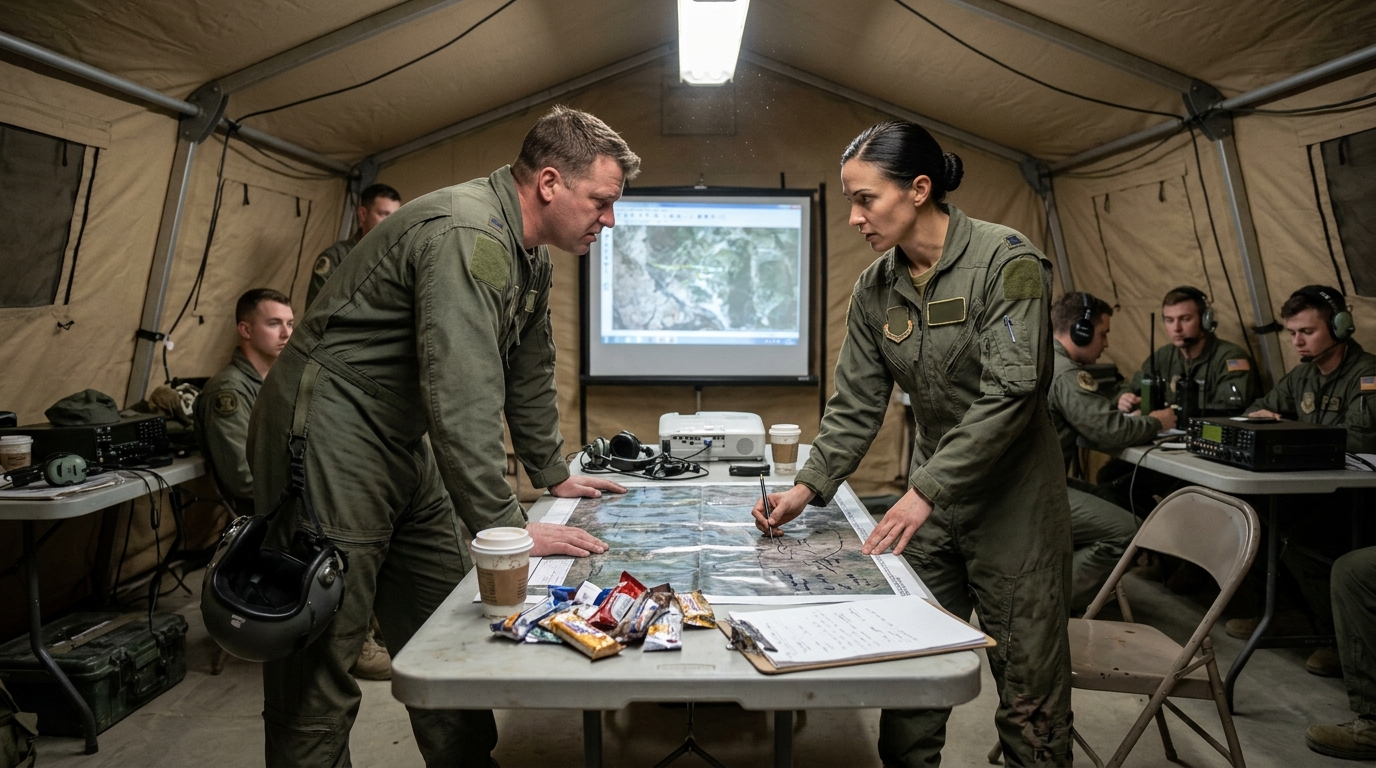
Inside the tent, the air turned instantly thin. Static roared through the ceiling speakers, bleeding through three separate radio frequencies at once.
“Contact! Taking heavy fire—grid standby—”
The mission planner slammed both hands onto the tactical table. “Get those coordinates locked down! Where is Package One?”
Mara stepped through the canvas flap, wiping grease off her knuckles with her rag. She didn’t hurry her steps, but her eyes locked directly onto the flickering projector map.
Captain Ror was already there, leaning over the JTAC operator’s shoulder. “Send Package One along the notch! They can be over the grid in four minutes!”
“Hold,” the JTAC muttered, wiping a sheen of sweat from his forehead. His headset buzzed with overlapping shouting. “I’ve got grid seven-six-five, three-two-one… wait, negative! I’m copying seven-five-six, three-two-one, break, nine-four-two!”
“It doesn’t matter, pick one and launch!” Ror snapped, pointing a thick finger at the map. “They’re pinned down in the open! We don’t have time to play accountant with the numbers!”
Mara walked right past Ror. She pulled the mechanical pencil from her pocket, clicked the lead out twice, and tapped the graphite tip directly onto the satellite map.
“Seven-five-six puts them on a sheer vertical cliff face,” Mara said quietly.
Ror spun around, his mouth opening in frustration. “Not you again—”
“—And seven-six-five places them in a dry riverbed three miles east,” Mara continued, her voice cutting through the radio noise like a cold blade. “If the patrol reported moving north along cover, the northing and easting digits were transposed in the broadcast.”
“You’re making assumptions!” Ror barked, stepping into her space to block her view of the board. “The ground team gave the grid! We trust the ground team, not a transfer’s hunch!”
“I’m not assuming,” Mara said. She didn’t step back. She didn’t look at Ror’s face; she kept her eyes fixed on the map terrain features. “Flip the last two digits. Look at the saddle gap on the ridge. The dry creek is the only natural cover within two miles.”
The JTAC operator froze. His hand hovered over the radio console. He looked from Mara’s calm, unblinking eyes down to the pencil point resting firmly on the dry riverbed coordinate.
“Razer Two,” the JTAC called into his mic, overriding Ror’s voice completely. “Divert to alternate grid… check the dry riverbed east of the ridge.”
“What are you doing?” Ror yelled, turning on the JTAC. “You’re sending our air cover to empty sand based on her guesswork!”
Mara didn’t offer a defense. She didn’t remind Ror that she had spent three years mapping these exact elevation profiles when his unit was still in training. Without her official credentials, she had no authority to order a strike—only the absolute, unshakeable math in front of her.
The radio crackled, dead silence holding the tent for five agonizing seconds.
Then a new voice broke through the static, crisp and close. “Razer Two on scene at alternate grid… visual on friendlies. They’re in filade along the riverbed, taking fire from the treeline. Engaging now.”
The tension in the room didn’t break; it shifted instantly into a heavy, suffocating weight.
Ror stood frozen, his hand still raised toward the map board, his face turning a mottled, silent red under the fluorescent lights.
Mara retracted her pencil lead with a soft click and slid it back into her flight suit.
“Intake flange is torqued,” she said softly to the room, turning toward the exit flap. “My jet is ready for standby.”
CHAPTER 4: INTO THE CANYON
The engine roared to life under her boots, sending a sharp vibration through her heels and up her spine.
Mara pulled the canopy down, sealing out the howl of the desert wind. Inside the cockpit, the amber glow of the multi-function displays reflected off her clear visor.
She keyed her mic twice—no words, just two steady pulses on the carrier wave.
“Razer Standby, you are cleared for immediate departure,” the JTAC’s voice crackled through her headset. “Ground element is still taking sporadic fire from the ridge line. Crosswinds through the notch are gusting forty knots.”
“Copy,” Mara said flatly.
She pushed the throttle forward. The jet surged into the black sky, leaving the faint lights of the forward base behind.
Within three minutes, the smooth air shattered. The mountain range loomed beneath her as a jagged shadow against the dark horizon, and the draft hit the fuselage like a sledgehammer. The right wing dipped sharply as thermal currents roared out of the valley floor—the exact wind channel Ror had dismissed during the morning briefing.
The control stick fought her palm, jerking with brutal kinetic strain.
Mara didn’t fight the turbulence with sudden, panicky inputs. She let her shoulder relax, riding the violent oscillations, using the natural weight of the aircraft to settle the glide path.
“Razer Standby, friendly unit reports heavy automatic weapons fire pinned near the dry riverbed,” the radio cut in. “We need a visual sweep, but visibility in the notch is zero.”
Mara pulled her mechanical pencil from her knee pocket with her free hand, holding it against the edge of her kneeboard map to double-check her approach angle by touch.
She couldn’t rely on a command authority override or an official record to prove she belonged in this sky. She had no official deployment orders logged in the local network—only her own hands on the stick and her memory of the terrain.
“I’m bypassing the notch entry,” Mara reported, her voice as smooth as if she were sitting in a quiet office. “Climbing fifty angels above the ridge wall. Dropping in behind the wind shadow.”
She pulled the nose up, banking hard away from the funneling canyon.
The jet sheared through the top layer of cloud, bursting into clear, starlit air above the ridge. Below her, through a gap in the dust layer, orange flashes flickered along the dark floor like tiny match heads striking in the dark.
She inverted the aircraft, nose dipping sharply into a steep dive right down the lee side of the mountain peak. The wind turbulence instantly vanished as the massive stone wall blocked the gale, dropping her jet into a pocket of dead-silent, stable air directly behind the enemy positions.
Her thumb rested on the weapon release button.
“Razer Standby, in hot,” she murmured.
CHAPTER 5: THE UNSPOKEN RECKONING
The canopy hissed open, letting the thick, hot smell of cooling jet fuel and desert dust hit Mara’s face.
She unclipped her harness with quick, practiced flicks of her fingers, slung her helmet under her left arm, and climbed down the aluminum ladder onto the gravel.
Inside the operations tent, the air had gone stale and quiet. The tactical board was still lit up with red track lines, but the shouting had stopped.
Captain Ror stood near the center table, holding a plastic water bottle so tightly the middle was buckled inward. When Mara stepped through the tent flap, his head snapped toward her, his jaw clenching hard enough to bulge the muscle below his ear.
“You broke formation parameters on the dive,” Ror said instantly, his voice rising to fill the room before anyone else could speak. He took a heavy step toward her, using his height to throw a long shadow across her boots. “You ignored standard ingress protocol over the notch! If you’d stalled that intake, you would have dropped two million dollars of government property into the canyon!”
The ground chief standing near the doorway shifted his feet, looking down at his boots. The JTAC operator kept his headset on, but his eyes stayed glued to the two of them.
Mara didn’t drop her gaze. She didn’t raise her hands or raise her voice to match his volume.
She reached into her thigh pocket, pulled out the worn mechanical pencil, and set it flat on the wooden map table between them.
“The notch wind was forty-two knots, Captain Ror,” Mara said, her tone steady enough to balance a glass of water on. “The intake held because the chief torqued the third flange before takeoff. The ground team is on the transport trucks right now.”
Ror’s face flushed a deep, ugly red. “Don’t talk to me about ground teams! You think because you got lucky on one pass, you get to write your own rules here? You’re an unverified transfer with no record! I could have you grounded by morning for flight discipline violations!”
He reached down, slapping his open palm against the table right next to her pencil, waiting for her to flinch, waiting for her to scramble for an excuse or bring up past credentials she didn’t have.
Mara simply looked at his hand on the table, then lifted her eyes to meet his.
“Then file the report, Captain,” she said softly.
Ror opened his mouth, the veins in his neck straining as he prepared to launch into another tirade, but the tent flap lifted behind him.
The visiting squadron commander stepped inside, his boots crunching on the loose gravel floor. He didn’t look at the tactical board, nor did he look at Ror’s outstretched hand. His eyes locked directly onto Mara’s face, stopping dead in his tracks.
Ror turned quickly, pulling himself up straight. “Sir! I was just briefing Captain Cole on her procedural overreach during the intervention—”
“Quiet, Ror,” the commander said. His voice wasn’t loud, but it carried the dense weight of twenty-five years on active flight lines.
Ror froze, his mouth snapping shut mid-sentence.
The commander walked slowly up to the table, staring at Mara’s faded suit collar. For a brief second, his eyes lingered on the tiny, pale square of unstitched thread hidden inside the folded fabric.
“I wondered where you ended up after the northern theater,” the commander murmured quietly.
Ror blinked, looking between the two of them, his defensive posture cracking at the edges. “Sir? You… you know her record?”
“There is no official record on file, Ror,” the commander replied, never taking his eyes off Mara. “Because four years ago, when her wingman went down in classified airspace, someone had to stay in the canyon for three hours to keep the rescue corridor open. And when the politics got ugly afterward, someone had to take the administrative wipe so the kid’s family got his full pension.”
Silence slammed down on the tent like a iron hatch.
Ror’s face went completely pale. He looked at Mara, then at the small mechanical pencil sitting on the map, then back at her plain gray helmet. His lips moved slightly, but no sound came out.
Mara picked up her pencil from the table, slid it into her pocket, and adjusted her collar back over the faded stitching.
“Request permission to pre-flight Package Three for tomorrow’s dawn cycle, sir,” Mara said.
The commander looked at her for a long moment, then gave a single, tight nod. “Permission granted, Captain Cole.”
Ror stood pinned to the spot, his unearned authority completely dismantled, forced to endure the quiet, heavy shame of his own noise as Mara turned her back on him and walked out into the cool desert night.
CHAPTER 6: DUST ON THE WINGS
The sky was changing from bruised purple to a pale, clear gold over the eastern mountains. Ground power units hummed in steady, low rhythms across the dirt tarmac.
Footsteps approached on the gravel, heavy and uneven.
Ror stopped five feet away from her wingtip. He wore his full flight suit, but his helmet hung low in his hand, the strap dangling near his boot. His jaw was tight, his eyes bloodshot from a night spent staring at tactical logs.
“I tried to lodge a formal protest with the commander,” Ror said. His voice was rough, defensive, trying to claw back a sliver of leverage. “I told him we can’t have unverified personnel taking lead on high-threat sorties. I told him rules are rules.”
Mara didn’t stop wiping the aluminum skin of the flap. “And what did he say?”
Ror swallowed hard, a muscle twitching near his temple. “He told me if I had a problem with your record, I could hand over my own flight keys and take the next transport back stateside.”
He took a step closer, staring at her plain gray helmet resting on the crate. “You let everyone think you were a rookie. You let me stand up there in front of the whole squadron making a fool of myself. You could have pulled rank the first day you walked in.”
Mara stopped the rag. She stood up straight, setting her palm flat against the cool metal of the wing root.
“I didn’t come here to measure rank, Captain Ror,” Mara said, her voice quiet, carrying the simple weight of total truth. “I came here to fly the jet. The ground crew doesn’t care what patches are on your chest when they’re pinned in a riverbed. They just need the air cover to show up.”
Ror stared at her, his mouth opening as if to launch one last desperate counter-argument, but the absolute lack of malice in her eyes left him with nothing to fight.
There was no grand confession, no dramatic apology. Just the cold, undeniable reality that his arrogance had been entirely self-inflicted. He turned slowly and walked away toward the mess tent, his boots dragging in the dust, completely diminished.
Mara pulled her mechanical pencil from her knee pocket. She clicked the lead out once, noted the fuel load level on her kneeboard, and retracted the tip with a soft snap.
She reached up, tucked her flight suit collar securely into place over the hidden, faded threads, and climbed up the boarding ladder into the cockpit.
The sun broke over the ridge line, bathing the aircraft in warm, golden light.