Shattered Glass and Hidden Receipts: How One Woman Dismantled a Web of Deceit to Reclaim Her Truth
CHAPTER 1: THE COLD KITCHEN
The hospital room smelled of sterile bleach and damp carpet.
I stared at the ceiling tiles until my eyes stung, refusing to give the fluorescent lights the satisfaction of blinding me.
Gareth sat in the vinyl corner chair, his thumb swiping across his phone screen with rhythmic indifference.
He hadn’t asked how I felt since the doctor delivered the quiet verdict.
When the nurse handed over my clear plastic discharge bag, my fingers brushed against the smooth plastic of my phone.
A tiny red dot blinked near the top edge.
I didn’t remember leaving the voice memo app running, but my thumb moved on instinct.
I pressed play, keeping the volume low enough that only the hum of the IV drip kept it company.
“How can one really verify if a pregnancy is real?” Gareth’s recorded voice slipped out, smooth and sickeningly calm. “Some women exaggerate, you know, for attention, for leverage.”
The words didn’t burn. They hardened like wet cement drying in winter.
He hadn’t just doubted me; he had auditioned for my destruction weeks before I even felt the first kick.
I slipped the phone into my bag, stood up before Gareth could reach for his keys, and called my own ride.
The cab window stayed rolled down all the way back to Chapel Hill, letting the sharp spring wind scour the hospital smell from my hair.
Once inside the house, the silence felt heavy, but it wasn’t empty anymore.
It was full of coordinates.
I walked straight to my office, knelt by the locked bottom file drawer, and pulled out a yellowed receipt from a novelty medical site.
Item code 409-B: Fake ultrasound kits.
He had laughed it off as a Halloween prank months ago, but the tracking number matched the financial statement I downloaded from our joint account three weeks back.
He didn’t stumble into doubt; he manufactured it.
I laid the receipt flat on the wooden desk, weighting it down with a heavy brass paperweight.
My fingers traced the grain of the wood as I opened a blank digital document.
I wasn’t writing a diary entry or a plea for understanding.
I was building a ledger, and every single entry had a timestamp.
CHAPTER 2: DIGITAL SHADOWS
The morning light cut across the desk in pale, unyielding stripes.
I scrolled through the cloud storage folders, my fingers steady over the trackpad.
Gareth’s old financial export files sat zipped in a directory he thought he had purged.
I didn’t need to guess where he bought the novelty kit; the transaction ID on the receipt matched an online distributor registered under an LLC he managed for a side project.
The purchase date fell three days before I mentioned my fatigue to him last autumn.
He hadn’t been listening to my symptoms as a partner; he was cataloging them as ammunition.
A sudden knock at the front door rattled the glass pane in the hallway.
I didn’t answer it.
Instead, I listened to the hollow rap of knuckles against wood, followed by the muffled slide of an envelope crossing the threshold.
When the footsteps retreated down the porch steps, I walked out to the entryway.
A cream-colored card lay on the coir mat, bearing my sister’s neat, slanted handwriting.
“Don’t make this harder on yourself, Ro,” the note read inside. “Family is everything.”
I tossed the card straight into the recycling bin beside the door without opening it further.
Sentimental blackmail didn’t work when you could trace the ink back to a coordinated script.
I sat back down at my desk, exported the entire ledger into a secure, encrypted PDF, and backed it up to an off-site drive.
They wanted a dramatic breakdown, something they could frame as instability for a jury or a family intervention.
What they were getting instead was an audit trail they couldn’t delete.
CHAPTER 3: THE PUBLIC ARENA
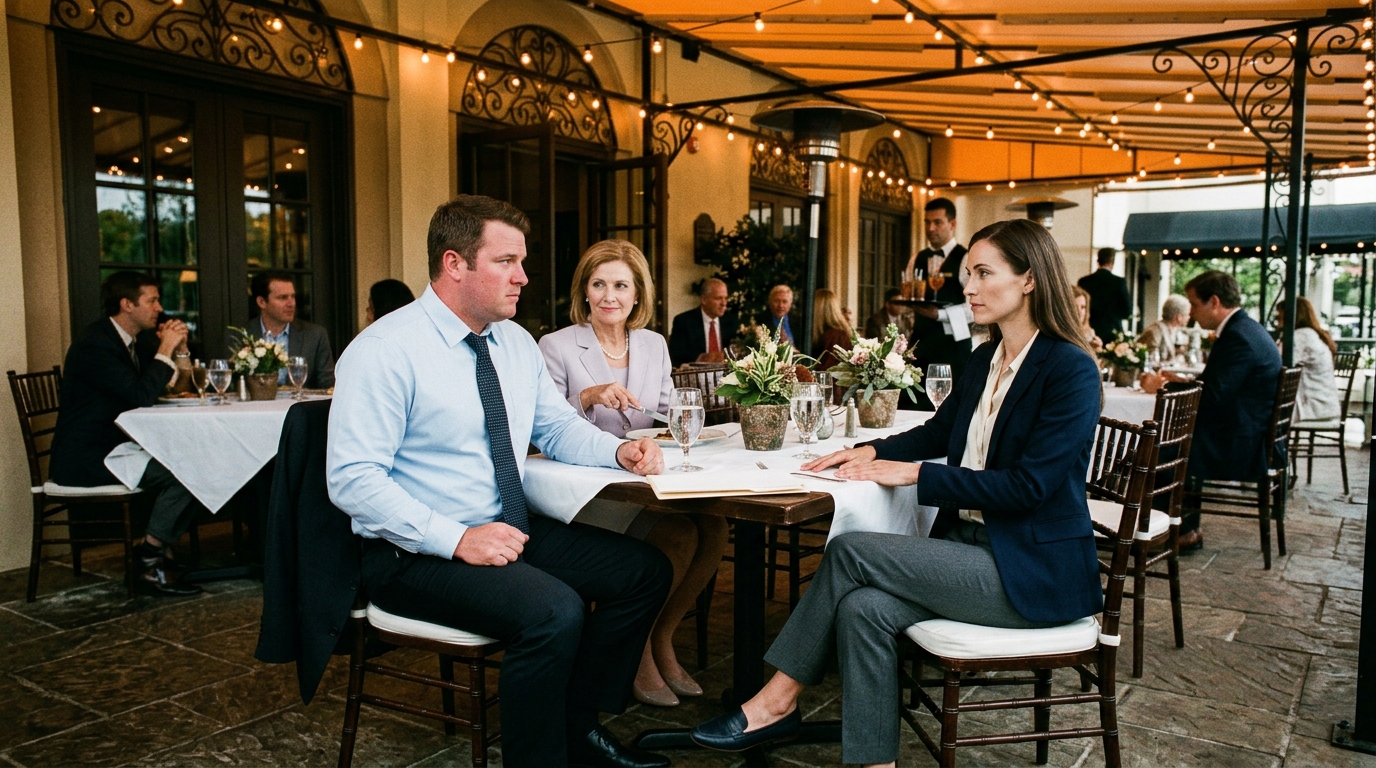
The patio string lights hummed softly above the wrought-iron tables, casting amber shadows across the country club terrace.
Gareth’s mother waved us over before we even cleared the iron garden gate, her expression a masterclass in practiced hospitality.
“We are just trying to clear the air, Rowena,” she said, sliding a crystal glass of sparkling water across the linen tablecloth toward me.
I didn’t touch the glass.
Instead, I kept my hands resting flat on the cold wood, feeling the rigid grain beneath my palms.
Gareth shifted in his seat beside me, his collar a fraction too tight against his thick neck.
“There’s nothing to clear if everyone just stops looking for ghosts,” Gareth muttered, staring down at his bread plate.
“Ghosts leave paper trails, Gareth,” I said, my voice cutting cleanly through the ambient chatter of the surrounding tables.
His mother’s smile froze, the silver butter knife hovering an inch above her roll.
“What on earth is that supposed to mean?” she asked, her voice dropping into an icy register.
I reached into my structured leather handbag, my fingers brushing past the lining to wrap securely around a heavy plastic folder.
I didn’t yell. I didn’t lean forward for effect.
I simply slid the unsealed manila folder across the linen, letting it stop right beside Gareth’s unused water goblet.
CHAPTER 4: DROPPING THE LEDGER
The manila folder remained closed against the white linen, but the mere weight of it shifted the atmosphere at the table.
Gareth’s father leaned forward, his knuckles pressing into the wood as he tried to regain control of the room.
“Rowena, this is entirely uncalled for,” his father began, his voice carrying that familiar tone of manufactured authority.
“Read page four before you talk about what’s called for,” I replied, my tone flat and unyielding.
Gareth snatched the folder, his fingers tearing the corner of the envelope as he yanked out the printed pages.
His eyes scanned the top line, and the healthy color drained entirely from his face, leaving his skin a sickly gray under the patio lights.
“You hacked this,” Gareth hissed, his voice cracking slightly as he dropped the papers back onto the plates.
“It’s a public corporate filing and a legally bound purchase order, Gareth,” I said, leaning back into my chair with deliberate slowness. “Not a secret.”
His mother reached out to touch his arm, her expression shifting from defensive annoyance to sudden, genuine panic.
“What is he talking about, Gareth?” she demanded, her voice rising above the soft jazz playing from the hidden speakers.
Gareth didn’t answer her; he just stared at me across the table like he was seeing a stranger for the very first time.
CHAPTER 5: THE WITNESS STEPS UP
Ivy stepped into the amber glow of the patio lights, her hands clutched tightly around the strap of her leather purse.
She wasn’t dressed for a country club dinner, wearing only a faded cardigan that looked entirely out of place among the pressed silk and linen.
“I saw it,” Ivy said, her voice trembling slightly but cutting cleanly through the ambient noise of the club.
Gareth’s head snapped up, his eyes narrowing as he recognized the quiet neighbor from across the street.
“You don’t belong here,” Gareth snapped, half-rising from his chair with his palms flat against the tablecloth.
“I saw what you did on the landing,” Ivy continued, ignoring his outburst entirely as she took another step forward. “I was bringing in my trash bins when you pushed her down those stairs. You waited until her back was turned.”
Silence fell over the table, heavy and absolute, broken only by the hum of the overhead string lights.
Gareth’s mother dropped her napkin onto her plate, her face turning pale as the web of excuses finally frayed beyond repair.
“She’s lying,” Gareth shouted, his voice cracking with sudden, desperate panic as he looked around the table for an ally. “She’s just a neighbor meddling in family business!”
I didn’t yell, and I didn’t flinch.
I simply reached out, picked up my bag, and placed a signed, notarized copy of Ivy’s statement right on top of the corporate filings.
CHAPTER 6: FINAL CLOSING
The oak double doors of the courtroom swung shut with a heavy, muffled thud that echoed against the high plaster ceilings.
Gareth stood by the opposing counsel’s table, his tie slightly crooked, his eyes darting frantically toward his lawyer as the final judge’s signature dried on the decree.
He didn’t look at me. He couldn’t.
His entire fabricated narrative had evaporated under the weight of three timestamps, a purchase receipt, and an honest neighbor’s voice.
“We’re done here, Rowena,” my attorney murmured, sliding the final certified copy across the mahogany surface into my open folder.
I took the pen, capped it with a sharp, metallic click, and slipped the folder into my bag.
No fanfare. No dramatic speeches across the aisle.
Just the quiet, irreversible friction of a life reclaimed from people who never earned a single inch of it.
Back at home, the afternoon sunlight stretched in clean, unbroken lines across the living room floorboards.
I walked from the kitchen to the quiet office, picking up the last remaining framed photograph of our wedding day from the hallway shelf.
I didn’t hesitate, and I didn’t look twice at the smiling faces frozen behind the glass.
I dropped the frame straight into the recycling bin by the back door, right on top of the torn pieces of my sister’s empty notes.
The house was completely still, save for the hum of the refrigerator and the steady breeze coming through the cracked window.
I sat down at the wooden table with a half-cup of warm tea, my hands steady around the ceramic mug.
There was no grand performance left to stage, no invisible audience to convince, and no footsteps waiting in the hallway.
Just the quiet, solid weight of my own life, entirely back in my own hands.