The Ledger of Blood and Ink: A Weary Daughter’s Cold Reckoning with Golden Child Entitlement
CHAPTER 1: STERILE SILENCE
The white glare of the fluorescent ceiling grid burned straight into my retinas every time I tried to blink away the haze. My mouth tasted like dry sandbox dirt, the skin of my lips cracking as I pulled a breath through teeth that felt foreign and coated in chalk. To the right, the green cardiac line on the monitor monitor screen jumped in small, rhythmic hills, the only rhythmic thing in the room besides the dull thudding at the base of my skull.
I shifted my weight, and a sharp, white-hot wire sliced straight up my spine, pinning me flat against the stiff hospital cotton. The sheets smelled aggressively of industrial bleach and sour starch, rubbing against the back of my neck like coarse sand. In the corner, the green vinyl visitor’s chair sat tucked deep beneath the shadow of a dead television screen, its cushion perfectly flat, untouched by the weight of anyone who cared whether I woke up from the blade or stayed under.
A young nurse stepped through the half-drawn privacy curtain, the rubber soles of her shoes squeaking against the polished linoleum with a sound that set my teeth on edge. She held a black plastic clipboard against her chest like armor, her eyes darting to the IV bag before she offered a quick, practiced smile that didn’t alter the tight lines around her mouth.
—You’re finally clear of the anesthesia fog, Kalin—she said, her fingers snapping a fresh pair of latex gloves into place with a sharp pop.—The surgeon said the alignment went well, but you’ll need to stay flat until the morning shift checks the drainage.
My throat clicked, raw and scraped from the breathing tube, before I could force the words past my tongue.
—My mother—I rasped, the sound like dry leaves scraping across concrete.—Did she leave a note?
The nurse didn’t look up from the monitor screen, her fingers tapping three quick entries into the terminal with a light, hollow click.
—They stayed through the first forty-five minutes of the recovery window—she replied, her voice dropping into that rhythmic, detached tone reserved for patients whose families have already checked out.—A older woman and a younger girl in a wool coat. They said they had an appointment across town but would try to call the floor desk after the weekend.
She pulled the blood pressure cuff from the wall hook, the Velcro ripping open with a sound like a small explosion in the quiet room. I didn’t answer, my thumb merely finding the rough, chipped edge of the plastic water pitcher on the tray table, tracing the jagged split in the handle over and over until the sharp plastic bit into the meat of my skin.
By five o’clock that evening, the pale winter light had died completely against the windowpane, leaving only the reflection of the room’s silver fixtures frozen in the glass. A sharp knock rattled the door frame, too rhythmic to be a orderly delivering the evening broth. A man in gray slacks and a blue lanyard stepped inside, a rugged tablet clamped under his forearm like an accountant’s ledger.
—Miss Thorne—he began, stepping into the gray circle of light by the foot of the bed.—I’m Miller from patient financial services. We have a small administrative loop to close on the intake insurance verification before the morning discharge paperwork processes.
He extended a single sheet of thermal paper, the print fresh and smelling faintly of hot ink.
—We just need you to verify the supplemental credit authorization that went through for the six thousand five hundred and eighteen dollar deductible clearance at six-thirty this morning—he said, pointing a plastic stylus toward the signature block at the bottom.
I held the paper against the light of the bed lamp, my thumb still tracing that chipped plastic handle on the tray table for balance. The name Kalin Thorne was written across the line in dark gray digital ink, the letters upright and steady.
But the first letter—the capital K—didn’t close at the spine like my hand had done since grade school. It swooped backward, an open, lazy loop shaped like a backwards fish hook that caught the ink and dragged it down into the next stroke. It was the exact cursive my mother used when she signed the back of my report cards, the same loopy, hurried hand that had managed my mail for three long years.
—I didn’t sign this—I said, the dry skin of my throat tightening as the cold from the floor seemed to rise straight through the metal frame of the bed.
Miller reached for the tablet, his eyebrows drawing together as he tapped the screen once, twice, the glass reflecting the small, green hills of the heart monitor behind me.
—The system logged it through the joint medical portal linked to the old Hamilton County address—he said, his voice losing its professional warmth.—The security log shows it was authorized via a verified secondary user account using the original master application profile from 2021.
I stared at the fish-hook loop on the paper until the white edges blurred into the sheet. The silence in the room wasn’t the quiet of a hospital after hours; it was the heavy, calculated weight of a room where the door had been locked from the outside while I was still asleep.
CHAPTER 2: THE SIXTY FIVE THOUSAND DOLLAR GHOST
A single drop of dark blood swelled at my cuticle, smudging the gray thermal paper right against the loops of that forged signature. Miller shifted his weight, his rubber-soled shoes giving a short, impatient squeak against the hospital linoleum. He looked at the smudge, then back up at the cervical brace pinning my jaw tight.
—If there’s an issue with the primary billing address, Miss Thorne, we can update the file—Miller said, his thumb hovering over the tablet’s plastic bezel.—But the payment itself cleared the automated clearinghouse processing window at dawn. The line is active.
—The line was closed fourteen months ago—I said, each syllable scraping against the raw lining of my throat like dry gravel.—My mother had supplemental access for a shared emergency fund during my first apartment lease. That card should be melted down in a landfill.
Miller didn’t blink. He simply turned the tablet around, displaying a digital ledger grid filled with green approval codes.
—Reactivated yesterday at 4:11 p.m. via the medical hardship provision—he stated, his voice flat, completely stripped of any human curiosity.—The application utilized your verified Social Security number, your historical credit file, and an attached electronic signature authorization form. The system doesn’t flag a mismatch on the secondary user if the master data match is absolute.
I closed my eyes, the pale green light of the heart monitor pulsing through my eyelids. 4:11 p.m. yesterday. I was three hours deep into a general anesthesia cocktail, a titanium plate being screwed into my lower vertebrae while my financial footprint was being walked through a digital back door.
—Give me the full transaction history for the master line—I said, my fingers tightening around the edge of the stiff hospital mattress until the cheap cotton fabric groaned.—Not just the deductible. Everything attached to that specific application reference number.
Miller hesitated, his pen tapping once against the plastic casing of his device before the clinical reality of an unpaid hospital balance won out over corporate privacy policies. He swiped across the glass, his face catching the blue reflection of a newly generated PDF document. The man’s routine professional smile vanished, his mouth flattening into a hard, narrow line as his eyes skimmed down the columns of numbers.
—There’s a secondary authorization attached to the same credit union routing group—he muttered, his tone dropping from administrative boredom to a low, cautious rumble.—A capital expenditure draft issued three days before your admission.
He turned the screen again. The numbers weren’t gray thermal ink; they were bold, black, and definitive. A vehicle loan draft for exactly $64,900, issued to a local dealership in the Northside district, structured under a joint owner transfer signature.
My thumb pressed down on the pitcher handle until the plastic split widened, the sharp pain the only thing keeping the white room from spinning into a blur. Dollar for dollar. The luxury silver Tesla Kalista had spent three weeks flaunting on her private feed wasn’t a reward for her sudden real estate breakthrough. It was a debt anchored straight into my marrow, signed away while I was prepped for the steel table.
—Do you want to flag the entry as unauthorized, Miss Thorne?—Miller asked, his finger already poised over the red litigation toggle at the corner of the interface.—If you claim identity misrepresentation, the hospital will automatically freeze the current billing profile and forward the electronic routing logs to the Hamilton County prosecutor’s office within forty-eight hours.
The room fell into an absolute, freezing silence. The hum of the overpass traffic outside the glass felt miles away, buried under the heavy weight of the choice sitting on the blanket. If I pressed that digital button, the paper trail would leave the clean walls of the ward and land straight on the desks of the local police precinct.
—Leave the hospital freeze off for twenty-four hours—I said, my teeth clicking together against the chill of the IV fluids.—Process the discharge paperwork through my personal, single-signature debit account for the current stay. I want the physical copies of every form that backward fish-hook touched.
Miller looked at me for three long seconds, his fingers executing the commands with a rapid, dry clicking before he pulled the clipboard back against his ribs. He didn’t offer the standard recovery wishes. He just handed me a black legal envelope containing the printed duplicates, turned on his heel, and let the privacy curtain snap shut behind him.
I reached for my phone on the plastic tray table, my fingers leaving a faint, rusty fingerprint on the glass screen as I bypassed the messaging apps and pulled up the public social media feed. The top post was exactly four hours old. Kalista was sitting in the cream-colored leather driver’s seat, her manicured fingers resting casually over the steering wheel emblem while the winter sun lit the custom metallic trim of the dashboard.
The caption was short, clean, and written for five thousand people to read: Grateful for the family who stays through the storm. Hard work always leaves a clean track.
I pulled my thumb back, looking at the dark red line splitting the skin of my cuticle. The family group text beneath the notification shade remained completely dark, a dead gray box without a single word of inquiry about my drainage tubes or my spine. I didn’t type a response. I didn’t leave a comment under the gleaming hood of her new prize. I simply slid the black legal envelope deep into my duffel bag, my jaw locking against the pain as I forced my legs to swing over the metal edge of the bed frame, the cold linoleum waiting for my bare feet.
CHAPTER 3: THE BROKEN BACKSPLASH
The metallic silver paint on the vehicle’s hood gleamed with a spotless, fresh-waxed perfection under the overcast Ohio sky. My fingers, still carrying the lingering scent of hospital antiseptic, pressed hard into the black envelope I held against my thigh to stop the visible trembling in my right leg. The exhaust from the departing rideshare vehicle hung heavy in the damp February air, leaving me standing at the edge of the asphalt lot I had spent five years co-signing to protect.
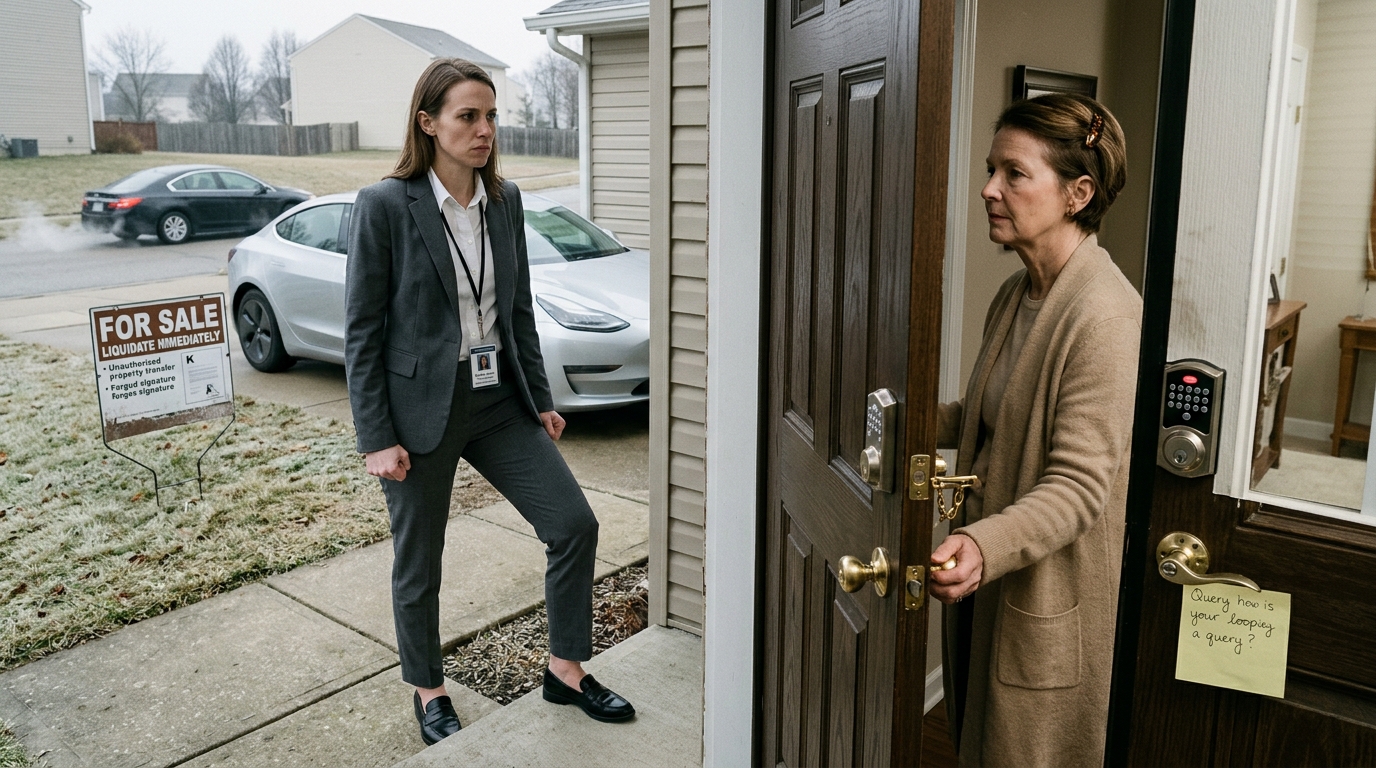
A loud, decorative wooden sign pinned into the frozen turf of the front lawn caught the wind, its red-and-white face spinning slightly. For Sale: Liquidate Immediately. Beneath the master brokerage logo, a smaller sticker read: Seller: V. Thorne.
My keys didn’t slide into the deadbolt because the lock cylinder had already been swapped for a electronic keypad, the status light glowing a steady, defensive crimson. I reached out, my fingernail scraping the edge of a yellow sticky note tucked behind the aluminum screen door frame.
The loopy cursive was unmistakable, the ink bleeding slightly into the cheap paper fiber: Stay with a friend. We’re a little full here. You’ll figure it out. A small, hurried ink heart anchored the final line.
The deadbolt clicked from the inside before I could pull my hand back from the mesh. The heavy oak door swung open exactly four inches, held fast by a thick brass security chain that rattled against the frame. Vera stood in the gap, her hair pinned back in an immaculate tortoiseshell clip, her left hand casually adjusting the collar of an expensive beige wool cardigan.
—Kalin, you always twist these logistical family matters into a personal crisis—Vera said, her voice dropping into the quiet, rhythmic cadence she used when correcting a difficult child.—The condo listing is a mutual liquidation strategy. You simply don’t possess the financial bandwidth to manage property overhead right now after this medical emergency.
—My name is the primary entry on the deed, Vera—I said, my voice flat, anchored by the cold stone step beneath my sneakers.—I’ve cut the monthly assessment check to the association for sixty consecutive months. Who authorized the broker code?
Vera’s right eyelid gave a tiny, involuntary twitch, her fingers dropping to trace the gold latch of the safety chain.
—Names change, and so do responsibilities—she replied, her eyes narrowing as she looked past my shoulder at the silver vehicle parked in the center of the driveway.—We had to adjust the asset allocation to protect the family footprint. Kalista is establishing her professional network now. She requires an entirely different presentation than someone who refuses to plan ahead.
Through the narrow four-inch gap in the door, my eyes locked onto the small hallway console table behind her. Resting right beside the mail tray sat a fresh, uncreased copy of a Hamilton County Zillow listing agreement, the signature page facing upward. Even from four feet away, the signature at the bottom was clearly visible—a dark blue digital stamp with a capital K that failed to close at the spine, swooping backward into an open fish-hook tail.
The realization hit with the clean, cold weight of a lead weight dropping into a pool. She hadn’t just lifted my credit profile for the vehicle loan at the credit union; she had scanned the physical intake forms from the surgical wing to execute a full property transfer while the nurses were still monitoring my post-op vitals.
—You’re always too sensitive about the details—Vera whispered, her hand moving to close the inner oak slab as the chain began to rattle against the trim.—Go rest at Becca’s place. We have clients coming to view the kitchen backsplash this evening.
The door slammed shut with a heavy, pressurized thud that vibrated straight through the soles of my shoes, the deadbolt firing into the frame with a final, mechanical snap.
CHAPTER 4: THE PILATES CLASS LEDGER
The yellow manila folder sat flat on the scuffed linoleum table, its tab stamped in faded red type: Cordell, L. – 2018 Closed. Desmond pulled a long silver pen from his breast pocket, using the metal tip to pin down the document’s corner before the overhead ventilation fan could scatter the loose carbon sheets.
—Your sister didn’t build this blueprint overnight, Kalin—Desmond said, his voice a low rumble that barely carried across the partition wall.—Look at the micro-line signatures on the 2018 gym membership authorization.
I bent lower, my lower back locking as the surgical sutures pulled tight against my skin. The page was a standard corporate indemnity release, but the primary billing block carried a digital transaction code registered to a master credit application. The ink line was steady, but the name Lacy Cordell was underlined by a secondary authorization stamp—and right next to it, the witness acknowledgment was signed with that exact same backward fish-hook loop on the letter K.
—She used Lacy’s credit file to secure the initial lease on the East Side training studio—Desmond explained, his finger tracing a column of past-due collection entries.—When the collection agency finally flagged the signature mismatch, the entire account profile was closed out for lack of physical tracking data. Lacy simply walked away because the balance was too low to justify court fees.
—Lista told the family that Lacy had moved to Chicago on a corporate retainer—I whispered, my thumb tracing the chipped edge of my ceramic coffee mug to steady my focus.—She spent that entire Thanksgiving telling everyone how her business partner had mismanaged the accounts.
Desmond leaned back, his chair giving a dry, rhythmic creak against the concrete floor.
—They weaponized the social silence, Kalin—he said, his voice dropping into a flat, clinical drone.—They counted on the fact that people would rather lose a small deposit than engage in a public dispute with a mother and daughter who control the neighborhood image. If you don’t file the civil declaration by Friday noon, the county assessor will clear the condo transfer automatically under the standard medical abandonment provision.
A sharp chime cut through the basement silence. The screen of my phone lit up on the table, displaying a private messaging notification from a name I hadn’t seen since undergrad. Tina – Pilates Class.
The text block was dense, short paragraphs formatted for quick reading: Kalin, everyone in the morning session just saw Kalista’s live feed. She said you’re trying to liquidate the family studio because of personal envy. Is it true the vehicle is registered under your old tax profile?
I didn’t type a reply. I simply picked up the silver pen from Desmond’s folder, drawing a thick, black circle directly around the 2018 fish-hook signature on the archival copy. The pattern was entire, clinical, and completely documented; the golden child’s entitlement didn’t rely on master criminal strategy, but on the absolute certainty that the quiet one would keep swallowing the bill to preserve the peace.
—Draft the formal multi-party complaint under the third-party identity misrepresentation statute—I said, pushing the manila folder back across the table into Desmond’s hands.—Include Lacy’s archival file, the hospital intake log, and the credit union auto loan verification.
Desmond looked at the black circle on the paper, his mouth tightening as he closed the drawer with a final, heavy metal thud.
—They won’t settle this behind closed doors, Kalin—he muttered, his eyes locking onto my brace.—When the summons hits the front porch, Vera will turn the entire neighborhood network against you before the clerk can even stamp the date.
—Let them check the registration—I said, my fingers closing around the black envelope as I stood up from the iron table.—The court date is the only room where the cursive has to match the deed.
CHAPTER 5: THE CHECKMATE AT HAMILTON COUNTY
The polished walnut benches inside the courtroom gallery were mostly empty, leaving the rhythmic hum of the central heating unit to dominate the silence. At the defense table to the right, Vera sat with her fingers interlaced tightly around her leather clutch, the gold bands on her knuckles catching the harsh fluorescent light. Kalista sat directly beside her, her chin tilted upward as she scrolled through her phone with a sharp, frantic thumb stroke.
Desmond dropped his heavy leather briefcase onto our table with a hollow thud that made the wooden surface vibrate. He didn’t look across the aisle; he merely opened the brass clasps and pulled out a three-inch stack of notarized bank logs, placing them directly under the lamp.
—The defense table has already filed a motion to dismiss based on implied familial authorization—Desmond muttered, his voice dropping below the gallery noise as he smoothed a thumb over the top document.—They’re still counting on the lack of third-party tracking.
The heavy wooden side door rattled as the bailiff stepped into the well, his uniform crisp.
—All rise for the Civil Division of Hamilton County—he announced, his hand resting casually over his leather holster.
Vera stood up instantly, her spine perfectly erect, her face masking the panic with an expression of aggrieved maternal dignity. She adjusted the pearl strand at her collar, her eyes scanning the room until they landed directly on me, narrowing into a warning that had worked for thirty years. Kalista didn’t pocket her phone until the judge’s robes rustled against the high-backed leather chair behind the bench.
Judge Vance didn’t look at the gallery; his fingers flipped through the master case file with a dry, paper friction.
—We are here on the matter of Thorne versus Thorne, identity misrepresentation and property conversion—he stated, his voice flat, exhausted by decades of domestic avarice.—Plaintiff may present the foundation for the forensic motion.
Desmond stepped toward the presentation podium, his fingers anchoring a single enlarged document against the wood.
—Your Honor, we submit the electronic transaction log from the Northside automotive group dated February 14th—Desmond said, his voice filling the room without the need for a microphone.—The defense claims the vehicle loan was a joint family asset authorized by the plaintiff during a pre-op consultation. We have the certified hospital intake log showing the plaintiff was fully sedated under general anesthesia at the exact millisecond the digital signature was executed.
He pulled a secondary sheet from the stack, sliding it forward under the digital scanner.
—Furthermore, we present the archival signature profile from the 2018 Cordell matter—Desmond continued, the paper rustling against the glass.—The digital signature on the Zillow property listing agreement features the exact same backwards fish-hook loop on the capital K that appears on the fraudulent auto loan application. This is not a signature mismatch; it is a physical template lifted from the plaintiff’s historical records and deployed from the defense’s home network routing address.
Vera’s knuckles went completely white around her leather clutch, her mouth twisting into a hard, defensive sneer as she leaned across her attorney’s shoulder.
—This is an absolute fabrication born out of pure jealousy!—Vera hissed, her voice cracking as she hijacked the silence, her right hand slamming flat against the defense table table trim.—Kalin has been unstable since college! We have managed her accounts out of necessity to keep her from ruining her own future!
The judge didn’t look up from the scanner screen, his pen executing a heavy, definitive stroke across the defense motion.
—Mrs. Thorne, you will maintain professional decorum or your counsel will escort you to the corridor—Judge Vance said, his voice dropping an octave into absolute ice.—The digital routing tags on the electronic filing indicate the property transfer document originated from your residential wireless network while the plaintiff was in the post-operative recovery wing. Your counsel has three minutes to produce a physical master document bearing a standard, ink-witnessed authorization that closes the spine of that letter K.
Kalista’s thumb finally froze against her phone screen, her eyes darting from her mother’s face to the stack of paper sitting under the scanner lamp. The silence that followed was absolute, heavy, and locked by the cold reality of a paper trail that common sense had finally brought into the light.
CHAPTER 6: THE CHIPPED CERAMIC NORMAL
The single sheet of paper from the Hamilton County Civil Division sat beneath the window lock, the black ink of the court judgment crisp under the bright July sun. Seventy-four thousand dollars, ordered to be repaid in full via immediate wage garnishment and asset liquidation.
Vera’s desperate, final counter-move—a tearful public broadside posted to the neighborhood forum alleging elder exploitation—had collapsed the moment a skeptical neighbor linked the public court docket directly into the comment section. The entitlement that had driven them to clone my life had left them completely exposed under the clinical light of a public record.
A fresh notification chimed on my phone, the screen displaying an internal email notification from Desmond’s firm. The title block was brief: File Closed – Settlement Finalized.
I didn’t open the attachment. I simply picked up the chip-handled ceramic mug, taking a slow sip of black coffee as the afternoon traffic droned three floors below the balcony window. The electronic keypad on my front door remained dark, its secret entry code known exclusively to the person standing inside the room.
The space was smaller than the condo, the walls painted a clean, unvarnished white that carried no memories of forced family dinners or loopy handwriting hidden behind screens. There were no hand-me-down lamps or borrowed furniture items resting in the corners to remind me of what it cost to keep the peace.
I reached out, sliding the court decree deep into a plain manila folder marked with today’s date, locking it inside the desk drawer with a single, firm turn of the iron key. The air in the room was warm, still, and completely mine.