The Cold Threshold of Whispering Pines: A Sovereign Record of Survival and Retribution
CHAPTER 1: THE ZEROPOINT FROST
Eight degrees Fahrenheit. The brass threads on the primary regulator coupling were sheared raw, leaving bright, silver metal exposed against the rusted iron pipe.
I didn’t need to look at the pressure gauge to know the main line was dead. The silence inside the basement was absolute—no click from the igniter, no hiss of pressurized vapor pushing through the line. Just the steady, low groan of floorboards contracting as the house began to bleed its last pocket of heat into the blizzard outside.
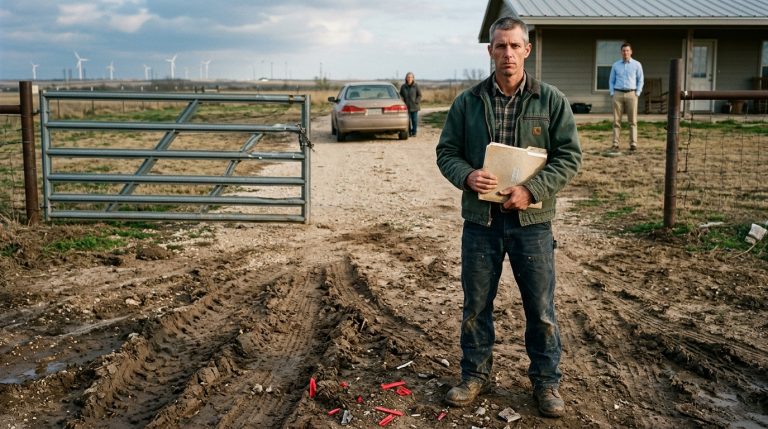
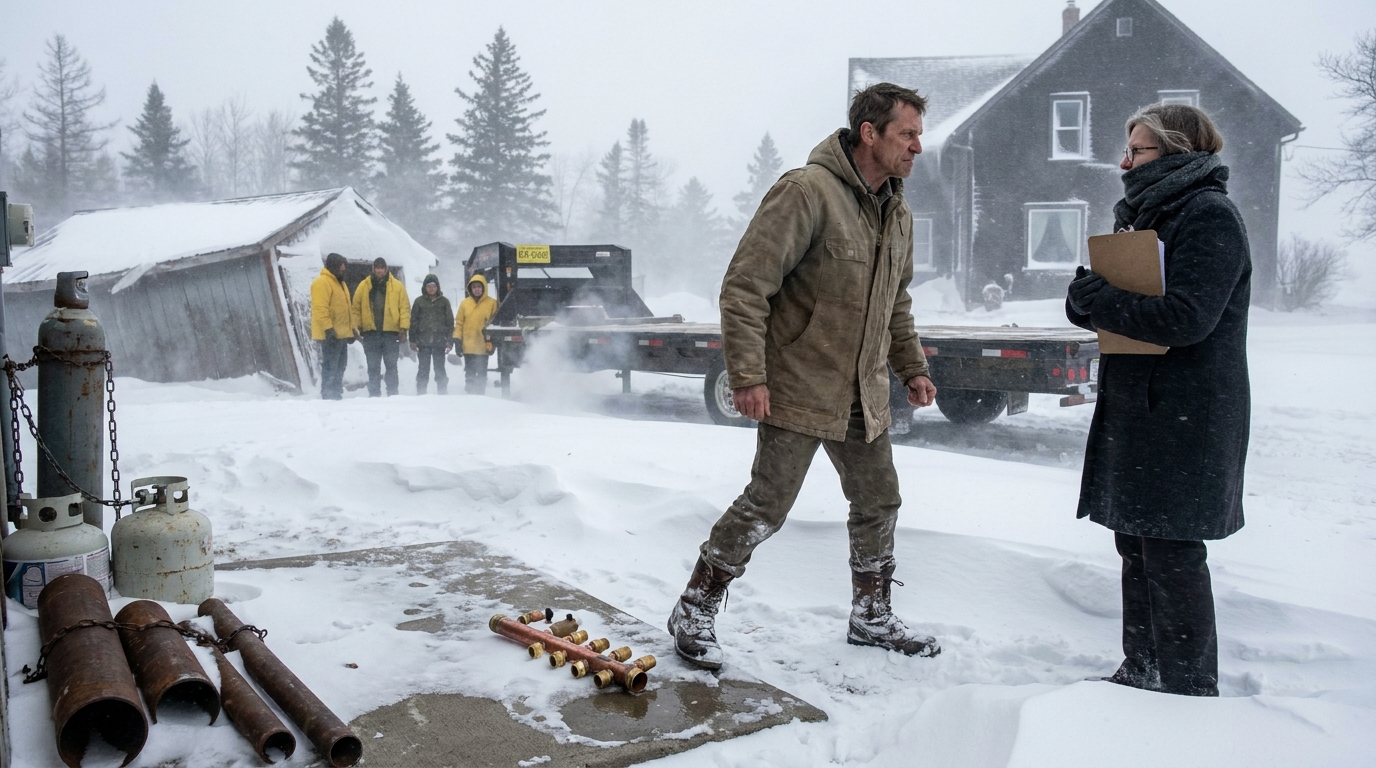
I stepped up to the living room glass. The snow was blowing sideways across the yard, cutting through the pine trees in white sheets. Four yellow jackets stood waist-deep in the drift behind my shed. Muscle for hire. In the center of them, clutching a laminated clipboard in a gloved hand, stood Helen Thompson.
She wasn’t looking at the storm. She was looking right at my window.
I pulled on my heavy canvas coat, jammed my feet into unlaced work boots, and hit the back door latch.
The cold hit my lungs like ground glass. A foot of fresh powder packed around my shins with every stride, but I kept my weight forward, eyes locked on the flatbed trailer idling at the edge of my driveway. Four of my eight three-hundred-gallon tanks were already chained to the deck.
“Drop the winches,” I called out. My voice didn’t carry. The wind tore the words away before they reached the fence line.
I closed the distance until I could smell the diesel exhaust idling in the frozen air. One of the hired hands—a kid in a grease-stained parka—avoided my eye, tightening a ratchet strap until the steel webbing whined under the tension.
Helen didn’t step back. She raised the clipboard, adjusting the heavy woolen scarf wrapped around her throat.
“Mr. Walker,” she said. Her breath didn’t even plume; she spoke in short, clipped exhalations that vanished into the whiteout. “You’re blocking the access corridor.”
“Those tanks hold two thousand gallons of commercial propane,” I said. My thumb pressed hard against the brass cap I’d pulled off the severed manifold, feeling the sharp, jagged burr where her crew had forced the threads. “I refilled the entire bank six days ago. That’s my heat.”
“These units violate Section 4-B of the Whispering Pines Land Use Covenant,” she replied. She tapped the page with a plastic pen. “Unapproved bulk fuel storage exceeding five hundred gallons. They are an unflagged hazard to the development.”
“It’s eight degrees outside, Helen. The grid is down across the county.”
“The covenant doesn’t pause for weather, Walker.” She turned her shoulder to me, gesturing toward the fifth tank resting near the pad. “Get the winch hook on the lifting lug. Move it.”
“Touch that last valve,” I said, stepping into the space between her and the pad, “and we stop talking about HOA guidelines.”
Helen’s eyes narrowed behind her wire-rimmed glasses. She didn’t flinch, didn’t check her phone, didn’t look at her crew for backup. She held the clipboard like a shield stamped by divine authority.
“Consider this your formal notice of seizure,” she said, her voice dropping into a flat, practiced monotone. “Any interference with authorized board contractors will incur an immediate five-hundred-dollar daily assessment. The removal fees will be attached as a super-priority lien against your deed.”
“You cut my line,” I said. “You used a pipe wrench on a live copper flex-coupling.”
“We abated a violation.” She turned toward the flatbed, her boots crunching sharply into the ice. “You have twenty-four hours to bring the exterior structure into compliance, Mr. Walker. Have a good evening.”
The engine roared as the flatbed driver pulled into gear, the heavy steel chains slapping against the wooden deck as the truck backed down the lane.
I stood in the snow until the red taillights vanished into the blur. My hands were stiff inside my gloves. I reached down, picked up a discarded brass fitting lying in the crushed snow near the concrete pad, and pressed it into my pocket alongside the sheared cap.
Inside, the house was already down to forty degrees. The silence had a physical weight to it—the sound of an empty shell waiting to freeze from the inside out.
CHAPTER 2: THE TACTICAL AUDIT
The flashlight beam flickered, its battery dying in the thirty-five-degree air of the basement. I held the sheared brass coupling against the severed copper flex-line, the edges refusing to seat. The metal wasn’t just cut; the threads on the house side had been stripped clean with a smooth, deliberate back-turn. It wasn’t an emergency disconnect executed by a hurried crew. It was a mechanical kill-shot designed to prevent any quick bypass.
My breath plumed in the blue light as I traced the line toward the floor joists. The floorboards above creaked as the wood settled under the dropping temperature. In the corner, the disconnected electric baseboard heaters sat like iron corpses, their wiring stripped out by the previous owner a decade ago. Helen knew that. When she walked the property during the spring compliance pass, she’d noted the lack of redundant electrical draw on the neighborhood transformer. She knew there was no backup switch to throw.
I reached into my pocket, my fingers numb against the cold brass cap, and pulled out my phone. The battery meter dropped two percentage points the moment the cold screen lit up. Zero bars on the cellular network—the storm had taken down the primary repeater on the ridge—but the hardline copper landline near the workbench still carried a faint dial tone.
I dialed Ethan Blackwell’s direct line from memory.
The connection clicked three times before his voice came through, thin and clipped over the landline’s analog wire. “Walker. Tell me you’re not sitting in the dark.”
“Helen brought a flatbed and four hired hands forty minutes ago,” I said. My thumb rubbed the rough edge of the sheared fitting, feeling the small, deep notch stamped into the hex collar—a tiny, stylized A enclosed in a circle. “She took all eight tanks. She didn’t just lock the shutoff valves, Ethan. They put a pipe wrench on the manifold and ripped the copper out of the foundation.”
A brief pause on the line, punctuated by the rhythmic static of a line struggling against the wind. “She used a formal abatement warrant?”
“She had a clipboard and four kids in high-vis vests,” I replied, my voice flat. “She cited Section 4-B. The bulk storage limits.”
“Section 4-B doesn’t apply to pre-existing secondary tanks installed prior to the 2018 covenant revision,” Ethan said instantly. The sound of papers shifting came over the receiver. “I helped draft the regional safety exemptions for that district when I was still consulting for the state board. She’s pulling leverage out of thin air.”
“She’s not just pulling leverage,” I said. I held the flashlight closer to the stamped A on the brass collar. “The crew she brought didn’t look like local contractors. They had fresh straps, unmarked trucks, and they knew exactly which line to cut to bleed the manifold without setting off the low-pressure alarm on the street regulator. Who uses a stamped A inside a circle for industrial manifold seals in this county?”
Ethan went silent for two full seconds. “Apex Capital Receiverships. They aren’t a service vendor, Walker. They’re a court-appointed liquidation outfit out of Cheyenne. They handle asset recovery for distressed commercial properties.”
“This isn’t a commercial property. It’s my house.”
“Then she’s masking the seizure under an external work order,” Ethan said, his tone dropping an octave into cold, clinical analysis. “If Apex is hauling those tanks, they aren’t going to a county impound yard. They’re being logged as surplus inventory to offset a receiver debt. Does the HOA have an open credit line with them?”
“I don’t know,” I said. “But my living room is thirty-eight degrees, Emily is stuck on the wrong side of the pass in Denver with no cell service, and the house will freeze solid before the storm clears on Thursday.”
“Listen to me,” Ethan said sharply. “Do not try to splice a flexible propane line with hardware store fittings in this cold. If those copper leads are frozen, you’ll crack the seat and blow the foundation if the pressure spikes. I’m calling Carol at Armstrong Propane right now on my office trunk. She handles the regional logistics dispatch. If Helen logged those tanks under a fraudulent violation code, Armstrong’s central registry will flag the serial numbers the moment they hit a refill dock.”
“Helen won’t take them to Armstrong,” I said. “She’s smarter than that.”
“She doesn’t have a choice if she wants to move two thousand gallons of commercial fuel,” Ethan countered. “There are only three certified bulk terminals within fifty miles that can legally process unsealed pressure vessels. Every single one of them operates under the state fuel registry. If I flag those serials as stolen structural assets, no legitimate driver will touch them without a sheriff’s release.”
“Make the call,” I said. “I’m going to take a walk down the lane.”
“Walker. Keep your hands in your pockets. Don’t give her a reason to call the county deputies for trespassing.”
“I’m not going to her house,” I said, setting the dead flashlight on the workbench. “I’m checking Mike’s place.”
I hung up the receiver, pulled my collar high over my neck, and grabbed a heavy steel crowbar from the pegboard—not as a weapon, but as a walking staff against the foot-deep drifts covering the driveway.
Outside, the wind had picked up, sweeping across the open road in violent gusts that erased my footmarks from less than an hour ago. The neighborhood was dead dark. Most houses were dark shells, their occupants having fled into town before the pass closed or huddling around wood stoves in the older cabins near the creek.
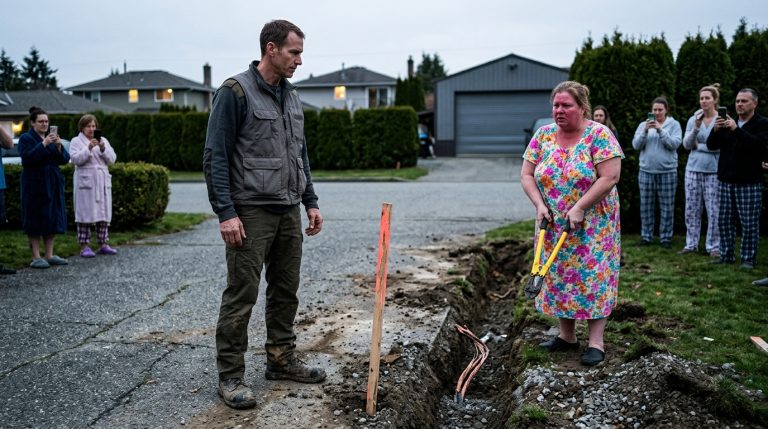
Three doors down, Mike’s driveway was unplowed. I pushed through the snow toward his rear patio. The sliding glass door was dark, but the tracks in the snow near his outdoor kitchen were fresh—half-filled divots where heavy rubber legs had rested until recently. His high-end cast-iron smoker and the stainless-steel patio heater he’d bought last summer were gone. In their place sat a small, laminated yellow card pinned to a wooden deck post with a single staple.
I bent down, brushing the frost off the card.
PROPERTY SEIZED PURSUANT TO HOUSING DEVELOPMENT CODE 12-A. NON-COMPLIANT EXTERIOR STORAGE. REMOVAL EXECUTED BY APEX RECEIVERSHIPS. FOR ESCROW ACCOUNT 409 INQUIRIES, CONTACT BOARD ADMINISTRATION.
There it was. The same stamp. The same cold, bureaucratic language used to strip a man’s yard while the snow buried his tracks.
I pulled the card off the post, my gloved fingers stiffening as the wind whipped around the corner of the house. Helen wasn’t just enforcing rules. She was harvesting the street, piece by piece, using the storm as cover to clear out high-value physical assets before anyone could cross the pass to file an injunction.
A pair of headlights cut through the whiteout at the end of the cul-de-sac.
A heavy 4×4 pickup, idling slowly without its high beams on, crept along the curb. On the driver’s door, barely visible through the swirling snow, was a magnetic stencil: Apex Capital — Asset Recovery Division.
I stepped back into the shadow of Mike’s roof overhang, my hand tightening around the cold iron of the crowbar, and watched the truck slow to a stop right in front of my driveway.
CHAPTER 3: THE COLD TRADE
The diesel clatter of the idling 4×4 echoed off the frozen embankment. I held my breath, the cold iron of the crowbar digging into my palm through the worn leather of my glove. The truck’s driver-side spotlight cut through the falling snow, its beam sweeping across my dark porch before pinning the severed copper manifold behind my shed in a circle of white light.
A man got out of the passenger side. He didn’t wear an HOA vest. He wore a heavy canvas work jacket with an unbadged high-visibility harness, a clip-on radio bouncing against his chest. He walked straight to the concrete pad, stepped over the sheared copper tubing, and shined a tactical flashlight onto the foundation wall where the manifold had been torn free.
He wasn’t checking for leaks. He was taking photographs.
The digital click of his camera shutter sounded three times against the wind. He reached down, swept his gloved hand across the snow to verify no secondary auxiliary line remained, then tapped his radio twice.
“Pad clear at 114,” he said, his voice flat, gravelly, carried over the gusting wind. “Owner’s off-site or dark. No auxiliary line detected. Log it for the morning auction manifest.”
He turned back to the truck, his boots crunching hard into the icy crust. The 4×4 shifted into reverse, its tires spinning briefly on the untreated asphalt before catching traction and backing slowly down the cul-de-sac toward the main gate.
I waited until the tail lights vanished behind the treeline before stepping out from beneath the porch overhang. My boots broke through the frozen crust of the drift, each step requiring a deliberate push of my weight.
I reached my driveway and knelt by the concrete pad. Where the third tank had rested, the snow was melted down to the bare aggregate from the heat of the truck’s winch motor. Lying in the slush was a yellow plastic tag—a broken breakaway seal used on high-pressure transport valves.
I picked it up. Stamped into the hard polypropylene was a seven-digit ledger number: ACR-00409.
The middle digits matched the escrow account printed on the notice I’d stripped from Mike’s post.
I pushed back into the house, closing the heavy oak door against the howling gale. The air inside had dropped another two degrees. The frost on the inside of the living room windows was forming intricate, jagged leaves across the glass.
I walked to the kitchen, set the broken yellow seal on the oak table, and picked up the copper landline receiver. It hummed with a thick, low-frequency hum before the dial tone cut through. I punched in the local number for the Natrona County Sheriff’s sub-station.
“Sheriff’s Office, Dispatcher Miller.”
“This is Marcus Walker at 114 Whispering Pines Lane,” I said. My jaw was stiff from the cold, the words coming out tight and measured. “I need an officer dispatched for a commercial theft in progress.”
“Mr. Walker, the pass is currently closed due to whiteout conditions,” Miller replied. His voice was distant, muffled by heavy static. “County plows are grounded until zero-hundred hours. Unless it’s a medical emergency or active fire, deputies are restricted to emergency calls only.”
“The HOA president and an private recovery crew just removed two thousand gallons of commercial fuel from my property,” I said, tapping the yellow plastic seal against the table. “They sheared the secondary supply line to the house. The temperature inside my residence is currently thirty-six degrees.”
Silence hung on the line for three long seconds. The static crackled, then a second voice cut in—sharper, crisper.
“Walker? This is Officer Park.”
“Park,” I said. “You handled the property line dispute on the east fence last fall.”
“I did,” she said. “Did you say they cut a live line?”
“They used a pipe wrench on a flex-coupling,” I said. “They left a yellow asset tag from Apex Capital Receiverships stamped with an Escrow Account number 409. They’re moving the tanks off-site right now.”
“Apex doesn’t have a municipal transport permit for Whispering Pines,” Park said, the sound of a keyboard clacking coming through the receiver. “The county receiver’s office hasn’t issued a court-ordered seizure warrant for that development in eighteen months. Who authorized the truck?”
“Helen Thompson,” I said. “She’s citing internal covenant 4-B.”
“An HOA covenant isn’t a judicial order,” Park said sharply. “She can issue administrative fines, but she can’t seize pressurized utilities without a sheriff’s civil deputy present. Where are they taking the haul?”
“There are only three certified terminals within fifty miles that can process bulk fuel,” I said, repeating what Ethan had told me. “The nearest one is the Armstrong staging yard off Highway 20.”
“Hold tight, Walker,” Park said. “I’m in an all-wheel-drive unit near the lower intersection. The roads are brutal, but if they’re hauling heavy pressure vessels on flatbeds, they aren’t going more than fifteen miles an hour in this storm. I’m rolling toward the Highway 20 terminal now.”
“I’m coming down,” I said.
“Negative,” Park cut in instantly. “You stay in the shelter. If your house loses all residual heat, you freeze. Do not get on the road.”
“My house is already freezing,” I said. “And the flatbed that took my fuel is the only thing moving in this valley. I’ll meet you at the gate.”
I didn’t wait for her response. I hung up the receiver, grabbed my heavy canvas coat, and jammed a spare pair of wool socks into my pockets.
Before leaving, I picked up the landline one last time and dialed Ethan’s office trunk.
“Ethan,” I said when he picked up. “The haul tag is marked ACR-00409. It’s logged to an escrow account.”
“Hold on,” Ethan said. The sound of rapid typing came through the line. “I’m looking at the regional bulk registry database right now. Account 409 isn’t an HOA operating fund, Marcus. It’s an unlisted holding account registered under The Iron-Gate Protocol—a corporate shell company filed in Cheyenne three months ago.”
I paused, my hand tightening on the receiver. “Who signed the incorporation charter?”
“The filing agent is concealed,” Ethan said, his voice dropping into a cold whisper. “But the corporate address matches the primary tax office for Helen Thompson’s legal counsel.”
The pieces didn’t just fit; they locked together like iron teeth.
“She’s not just clearing yard clutter,” I said. “She’s manufacturing defaults.”
“If she cuts the heat during a zero-degree storm, the pipes burst within twelve hours,” Ethan said. “The structural damage triggers a mandatory uninhabitable notice from the county health inspector. And under the Whispering Pines master deed, any property declared structurally abandoned for more than thirty days reverts to the board’s preferred lender for expedited foreclosure.”
“The Iron-Gate Protocol,” I repeated.
“It’s an asset engine,” Ethan said. “She starves you out, ruins the structure, and buys the deed at fifty cents on the dollar through the escrow account.”
I slammed the receiver back onto the cradle, grabbed my truck keys from the peg, and walked out into the blinding white.
CHAPTER 4: THE PRESSURE CHECK
The cold inside the cab bit through my canvas coat before the engine block even began to throw lukewarm air through the vents. The steering wheel felt like a ring of frozen iron under my gloves. I shoved the transfer case into four-wheel low, the gears grinding once with a dull, heavy thud, and let the tires dig into the foot of unplowed drift blocking the end of my driveway.
The storm had completely swallowed Whispering Pines Lane. Snow piled against the fences in five-foot banks, shaped by the wind into sharp, windward ridges. I kept my speed under fifteen miles an hour, the truck’s high beams bouncing off a wall of blinding white.
At the main gate, a silver sedan sat angled across the exit lane, its hazard lights blinking in slow, amber pulses.
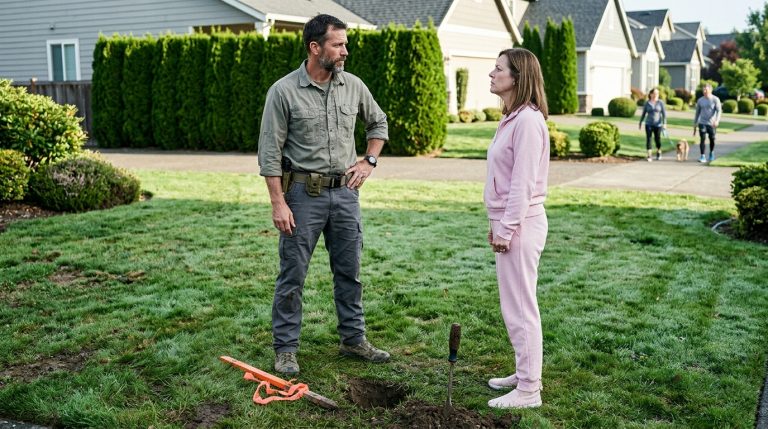
Helen Thompson stood on the snow-slick pavement beside the driver-side door, wrapped in a long wool coat, holding a heavy halogen spotlight. Beside her sat Robert Chen, the HOA vice president, his hands jammed deep into his parka pockets, his face pale and tight as he watched my bumper approach.
I didn’t stop until my front tow hooks were six inches from her driver-side quarter panel.
I cut the engine, stepped out into the knee-deep powder, and let the driver’s door slam shut with a hard metallic crack.
Helen didn’t move. She raised the halogen beam, pinning my eyes in white glare, but her hand was trembling—a tiny, involuntary micro-shake that rattled the plastic casing against her gloves.
“Turn off the high beam, Helen,” I said. My voice came out gravelly, rough from the sub-zero air.
She lowered the light three inches, resting the heavy casing against her hip. “The main gate is closed by board resolution until county highway crews clear the access road, Marcus. You need to return to your residence.”
“You have an unmarked recovery flatbed hauling two thousand gallons of stolen fuel toward Highway 20,” I said, taking two deliberate steps forward. My boots crunched into the ice, stopping just outside her personal space. “It’s signed under Apex Capital. Account 409.”
Robert Chen shifted his weight, his eyes darting toward the dark road behind my truck. “Helen… you said the county receiver issued the order for the non-compliant tanks.”
“Quiet, Robert,” Helen snapped, her tone sharp as a razor, though she never broke eye contact with me. “Mr. Walker is in direct violation of Section 4-B. The board exercised its statutory right of abatement to protect the development’s fire safety classification.”
“There is no fire safety classification issue, Helen,” I said. I pulled the yellow polypropylene seal out of my coat pocket and tossed it onto the hood of her sedan. It landed with a dull plastic click against the ice-crusted paint. “And there is no county receiver order. That seal belongs to a liquidation shell registered under The Iron-Gate Protocol.”
Robert Chen frowned, reaching out a gloved hand to pick up the yellow tag. “What is he talking about? The Iron-Gate Protocol? Helen, you said the funds from the asset removals were going into the master maintenance reserve to cover the emergency plow contract.”
Helen’s left jaw muscle clenched hard, her teeth grinding behind closed lips before she forced a calm, condescending smile. “Marcus is throwing around legal jargon he doesn’t understand because he’s upset about a routine enforcement action. The board’s legal counsel manages the escrow accounts.”
“Your legal counsel filed the incorporation papers for Iron-Gate three months ago,” I said, stepping closer until I could smell the stale coffee on her breath. “You cut my lines during a zero-degree blizzard. You knew the electrical baseboards were stripped out. You knew the house would drop past freezing in under six hours.”
“If your property becomes structurally compromised due to inadequate winterization, that is a homeowner liability,” she said, her voice dropping into a flat, venomous register. “The covenant explicitly grants the board emergency authority to declare a severe structural hazard. If a house is condemned by health officials, the HOA assumes primary lien position to prevent neighborhood blight.”
“That’s the game,” I said quietly. The wind howled through the pine branches above us, but between the two of us, the air felt suffocatingly still. “You freeze the owner out. You trigger a health department condemnation order. You use Account 409 to buy the paper at foreclosure for pennies, then list the parcel through your shell.”
Robert Chen dropped the yellow seal like it had burned his palm. “Helen… is that where Mike’s equipment went? The patio furniture? The RV from lot twelve?”
“I said stay quiet, Robert!” Helen turned on him with a snarl, her composure cracking for a fraction of a second, revealing the raw, panicked fury underneath. “I have managed this community’s valuation for six years! Without my oversight, half these properties would be in tax default!”
“You’re not managing valuations,” I said. I reached into my coat, pulled out my landline notepad where I’d written down the dispatch confirmation, and held it in front of her spotlight. “Officer Park is already at the Highway 20 terminal with a county deputy. The flatbed driver was flagged at the scale.”
Helen’s breath hitched in her throat. Her eyes scanned the paper, then flashed up to mine. The arrogance didn’t vanish—it turned into something desperate and predatory.
“A municipal deputy can’t invalidate a board covenant action without a circuit court injunction,” she said, her voice rising against the wind. “I will file an immediate emergency lien against your title for six thousand dollars in administrative fees before the courthouse opens on Friday! You’ll be locked in litigation for two years, Walker! You won’t have heat, you won’t have a clean title, and you won’t have a home!”
“I don’t need two years,” I said, stepping past her to the driver’s door of my truck. “I have the rest of tonight.”
I shifted the truck back into drive, cleared the edge of her silver sedan by an inch, and accelerated out onto the black ice of Highway 20.
CHAPTER 5: THE CHECKMATE MEETING
The highway terminal gate sat open, its heavy steel chain dragging across a patch of packed slush. Inside the staging yard, the flatbed truck lay idling under two sodium floodlights. Beside the rear axle, a county cruiser sat angled with its lightbar strobing against the falling snow, casting rhythmic red and blue pulses across six white propane tanks chained to the deck.
I pulled my truck alongside Officer Park’s patrol unit, cut the ignition, and stepped out into the freeze.
Park stood near the flatbed’s driver-side door, her radio mic unclipped and resting against her shoulder. Beside her, the flatbed driver was holding a clipboard, his face pale under the sodium light, his gloved fingers nervous as he flipped through laminated transport manifests.
“Walker,” Park said, her eyes shifting to me as my boots crunched on the gravel. “He’s carrying a receiver transit permit signed by Apex Capital Receiverships. It logs six pressure vessels for liquidation under court docket 202-B.”
“Docket 202-B was closed four years ago,” I said, stepping up to the flatbed’s deck. I pointed at the brass collars on my tanks. The stamped A inside the circle caught the red strobe light. “Those serials belong to my secondary residence installation. There is no active judicial lien.”
“The driver claims he was dispatched by an escrow agent,” Park said, turning her flashlight onto the ledger sheet clipped to the board. “Account 409. The destination isn’t a county impound. It’s an unlisted holding dock three miles south.”
“It’s registered under The Iron-Gate Protocol,” I said, looking the driver straight in the eyes. “Check the destination tax ID.”
The driver swallowed hard, his thumb rubbing a grease stain on the edge of the clipboard. “I just drive the rig, officer. The dispatcher handed me the paperwork at eight o’clock. Said it was an emergency clearance for non-compliant fuel storage.”
“Your dispatcher took a fraudulent abatement order,” Park said cold. She pulled a pen from her breast pocket, marked a heavy red line through the manifest, and snapped her notebook shut. “Turn the ignition off. This vehicle and its cargo are impounded as evidence in an active grand larceny and reckless endangerment investigation.”
“Wait a minute—” the driver started.
“Off,” Park commanded. Her hand rested flat against her utility belt.
The driver reached into the cab and killed the diesel motor. The sudden silence in the staging yard was absolute, broken only by the whine of the wind against the chain-link fence.
“I called Deputy Sheriff Meyers,” Park said, turning back to me. Her breath rose in a steady white plume. “He’s pulling the filing records from Cheyenne right now on the courthouse terminal. The county prosecutor accepted the initial affidavit. We’re executing a physical search on the HOA administrative office before the storm clears.”
“She’s at the clubhouse,” I said. “She called an emergency board session to vote on an administrative assessment against my title.”
Park’s jaw set hard. “Get in your truck. We’re going back.”
The Whispering Pines clubhouse was lit up like a beacon against the storm. Four snowmobiles and six all-wheel-drive crossovers filled the unplowed parking lot. Inside, the main hall was packed—forty homeowners huddled around folding tables, their heavy winter coats draped over the chairs, the air thick with the smell of wet wool and woodsmoke from the stone fireplace.
Helen Thompson stood behind the main podium, her hands resting flat on a stack of printed ledger sheets. Beside her sat Robert Chen and two junior board members, their expressions tense, eyes fixed on the floorboards.
“Under Section 12-A of the master covenant,” Helen’s voice echoed across the hall through the small PA system, “the board maintains absolute authority to assess remedial costs for hazardous conditions. The four-thousand-dollar levy against Lot 114 is non-negotiable due to the severity of the violation—”
The heavy rear double doors banged open against the drywall.
The crowd turned as one. I walked down the center aisle, my boots leaving wet, muddy tracks across the carpet. Behind me, Officer Park and Detective Meyers moved in silent sync, their leather gear creaking under their heavy coats.
Helen’s voice cut out instantly. Her hand tightened on the podium’s edge until her knuckles turned white.
“Marcus,” she said, her tone attempting a sharp, authoritative snap that failed to cover the sudden hitch in her throat. “This is an executive board session. Non-board members are not permitted on the floor without invitation.”
“The session is over, Helen,” I said. I stopped at the front table, pulled the yellow polypropylene asset seal from my pocket, and set it squarely in the middle of her ledger sheets.
Beside it, I laid down the paper copy of the state corporate registry Ethan had faxed to the landline an hour ago.
“What is this?” Robert Chen asked, leaning forward to read the top line of the printout.
“That’s the charter for The Iron-Gate Protocol,” I said, my voice carrying clearly across the silent room. “Incorporated three months ago under escrow account 409. It’s not an HOA reserve account. It’s a private holding company set up to purchase foreclosed properties in this valley after their utilities are cut.”
A low murmur rippled through the room. Neighbors stood up from their chairs—Mike from three doors down, Sharon from the corner lot.
“That’s a lie,” Helen snapped, her voice rising an octave. She swept a hand over the paper, trying to pull it toward her, but Detective Meyers stepped forward and laid a heavy, gloved palm directly over the document.
“Patricia Helen Thompson?” Meyers asked. His voice was low, flat, devoid of emotion.
“I am the president of this association,” she said, her chest heaving as she pulled herself upright. “I am executing covenant enforcement under statutory—”
“You are under arrest,” Meyers interrupted. “Natrona County warrant for felony grand larceny, scheme to defraud, and criminal reckless endangerment.”
Helen froze. The color drained from her face, leaving her skin a sallow, papery gray under the fluorescent lights. “This is an internal civil dispute. You have no jurisdiction over board administrative actions!”
“You seized pressurized fuel lines during a sub-zero storm without a judicial warrant,” Officer Park said, stepping around the podium and unsnapping a pair of steel cuffs from her belt. “You redirected private residential assets into an unlisted holding account. Turn around and put your hands behind your back.”
“Robert! Call the legal team!” Helen shrieked, her hands flying up to clutch her wool scarf as Park pulled her right wrist down. “Tell them it’s a procedural breach! Tell them—”
“Robert isn’t calling anyone,” I said quietly, looking her in the eye as the steel cuff clicked tight over her wrist. “The state fuel board blacklisted your name from every terminal in Wyoming twenty minutes ago. You couldn’t buy a gallon of propane in this state if you brought cash.”
The room erupted into a deafening roar of voices—neighbors shouting questions, board members backing away from the table, chairs scraping hard against the floor.
Helen didn’t speak again. As Park led her down the center aisle, her head remained high, her eyes fixed straight ahead, refusing to look at the people whose homes she had spent six years trying to harvest.
CHAPTER 6: THE UNBOUND ACRE
Robert Chen picked up the top sheet from the podium, his gloved fingers trembling as he traced the figures printed in the column under Escrow Account 409.
“Sixteen properties,” he whispered, his breath rising in a thin gray mist toward the high timber rafters of the hall. “Over three years. Every time a homeowner fell behind on an assessment, she didn’t send a notice. She attached the lien straight to Apex Capital Receiverships before the board even voted.”
“She didn’t want the assessment money, Robert,” I said, leaning my hands against the smooth oak edge of the podium. “She wanted the title. The Iron-Gate Protocol was set up to hold the equity until the sheriff’s sale cleared. Once the property was condemned for winter utility failure, the covenant let her buy the paper for thirty percent of market value.”
Robert looked toward the open double doors, where the last snowmobile engines were sputtering to life in the parking lot. The storm outside had broken; through the high glass gables, a pale, cold sliver of moonlight cut through the parting clouds over the ridge.
“The board is done,” Robert said, setting the papers back down on the felt blotter. His shoulders slumped, years of quiet compliance falling away in a single heavy exhale. “I’m calling an extraordinary meeting for Saturday morning. We’re dissolving the covenants. Every single restriction—from the fuel storage caps to the land-use liens. It’s over.”
I didn’t answer. I reached out, picked up the yellow plastic seal I’d thrown down an hour ago, and shoved it deep into my coat pocket alongside the sheared brass cap from my basement.
By three in the afternoon the next day, the sun was bright against a cloudless, crystalline blue sky. The temperature had climbed to twenty-two degrees—still freezing, but the wind had died completely, leaving the valley wrapped in a heavy, motionless quiet.
At the foot of my driveway, the yellow Armstrong Propane boom truck sat idling, its hydraulic arms extended over my rear fence line.
Ethan Blackwell stood by the open flatbed deck, a pair of heavy iron pipe wrenches tucked under his arm. Beside him, Carol’s senior field driver was guiding the fourth steel tank back onto its concrete pad with a heavy steel winch cable.
“All eight serials checked out against the original delivery invoice,” Ethan said, stepping through the knee-deep powder to meet me at the pad. He handed me a fresh, unmarred brass regulator coupling—its threads gleaming bright yellow under the winter sun. “Apex’s holding dock was locked up by the county sheriff at dawn. They recovered Mike’s smoker and three other sets of equipment from the secondary bay.”
I took the brass coupling. The metal was cold, but the precision-machined threads sat square against my palm.
“How long until the line holds pressure?” I asked.
“Ten minutes,” Ethan said, nodding toward the foundation where the driver was already flaring the end of a fresh copper supply pipe. “Carol signed off on the secondary inspection personally. State fuel registry cleared the tank bank under your primary agricultural exemption. Nobody touches these valves again without a court summons signed by a federal judge.”
I knelt in the snow beside the foundation wall, set my crowbar against the sill plate, and guided the new copper tubing into the brass receiver. The fitting seated with a clean, solid click. I took the iron wrench from Ethan and pulled the collar tight, feeling the threads grip and seal until the joint was completely air-tight.
Inside the basement ten minutes later, the low, steady click of the automatic igniter sounded three times through the floorboards.
Click. Click. Snap.
A soft, deep rumble rose from the burner floor as the primary line pressurized. Warm air began to push through the floor vents in the living room, faint at first, then steady and dry, carrying the scent of dust heating on metal coils.
I sat at the heavy oak kitchen table, the sun pouring through the south-facing glass, illuminating the fine frost melting into clear beads along the window frame. On the table sat my pocket knife, the sheared brass cap from the first night, and a clean sheet of paper from my landline notepad.
The landline rang once. I picked up the heavy black receiver.
“Marcus?” Emily’s voice came through clear and sharp, the line interference completely gone now that the county crews had restored the primary trunk on the pass. “The highway department just opened the lower gate. I’m thirty minutes out from the valley floor. Is the house cold?”
I looked down at the floor vent near my boots, feeling the warm air rising against my denim jeans.
“No,” I said, my voice steady, my hand resting flat on the clean oak table. “The house is warm.”
I set the receiver back on its cradle, picked up the old, sheared brass cap, and tossed it into the iron scrap bucket beside the stove. It landed with a dull, heavy clatter that faded quickly into the quiet warmth of the room.