A Geometry of Retribution: How One Man Dismantled a Suburban Empire through Cold, Measured Precision
CHAPTER 1: THE MORNING OF THE BUTCHERY
The air smelled of acrid two-stroke exhaust and raw, wounded wood. It was a sterile, violent odor that didn’t belong in the cathedral of my front yard. I counted them again, a reflexive habit born of twenty-five years of military discipline: four stumps. Four voids in the canopy that had provided the only shade Sarah and I had ever cared to keep.
Karen Bishop stopped ten feet from the property line, her hands tucked neatly over her stomach. She looked at the raw, cream-colored wood of the stumps with the detached satisfaction of a tax auditor.
“They were a menace, John,” she said, her voice dripping with that artificial, saccharine concern she reserved for board-approved newsletters. “I did you a favor. The property looks clean, finally.”
My hands were balled into fists, the fingernails biting into my palms with a pressure that bordered on the painful. Every beat of my heart felt like a hammer blow against the inside of my ribcage, a frantic, red-hot pulse of rage. A younger, less disciplined man might have bridged the gap between us in two strides. He might have forced her to taste the same metallic bitterness that now filled the air.
I didn’t move. I forced the rage down, pushing it into a deep, icy vault behind my sternum. I locked the vault shut. My jaw loosened. My facial muscles, conditioned by decades of briefing officers who didn’t want to hear the truth, settled into a mask of polite, terrifying neutrality.
“You did this?” I asked. My voice was a low-frequency hum, devoid of the tremor that threatened to betray me.
She puffed her chest, the fabric of her mumu stretching over the movement. “As president, I’m authorized under bylaw 7.4. Nuisance vegetation. Those trees were a hazard to the street, John. We have standards here.”
Hazard. She called a hundred years of biology a hazard because a walnut might deflect a tire. She was a zealot of the beige, a woman whose entire existence was defined by the alignment of lawns and the regulation of trash can aesthetics. She hadn’t just destroyed the trees; she had desecrated the one living thing Sarah had touched, the one piece of the property that held the ghost of our future.
The silence that followed was a physical entity, heavy and suffocating. I watched a bead of sweat trickle down her temple, a sudden, tiny failure in her armor of entitlement. She was waiting for me to break. She wanted the shout, the outburst, the irrational display that would justify her calling the sheriff to have the “unhinged veteran” escorted from his own home.
I tilted my head, looking past her toward the road. I noticed a stray wood chip snagged in the hem of her sandal. It was a small, sharp detail—a piece of the crime scene literally clinging to her.
“I see,” I said, my tone as flat as an executioner’s gavel.
She turned, her smirk faltering as the lack of a scene registered. She was expecting a bonfire of emotion; I was offering her the cold, surgical silence of a map room. She didn’t know it, but the war she thought she had won with a chainsaw had just transitioned to a battlefield where she was hopelessly outgunned.
“You’re going to regret this, Karen,” I said, the words barely rising above the rustle of the remaining leaves. “You have no idea what you’ve just done.”
She didn’t answer. She turned, her walk rhythmic and smug, and headed back toward her immaculate McMansion. I stood on the porch, my pulse finally stabilizing, and felt the first cold, sharp edge of a plan begin to form in my mind.
CHAPTER 2: THE FORENSIC SURVEY
The silence of the cul-de-sac was not a natural quiet. It was the heavy, suffocating weight of neighbors peeking through blinds, the collective holding of breath as the “veteran at the end of the street” stood in the middle of a war zone. I didn’t acknowledge them. I didn’t look at the houses that suddenly seemed too close, their beige facades mocking me with their uniform, sanitized perfection.
My attention was singular. I stepped off the porch. The ground beneath my boots felt wrong—soft, churned, and violated. The heavy equipment used during the night had compressed the earth into a muddy mess, effectively burying the history of this soil.
I knelt by the nearest stump. It was a black walnut, or it had been. Now, it was a raw, pale wound in the earth, the rings showing a century of resilience that had been severed in a matter of minutes. I pulled a small trowel from my garage kit and began to dig. I wasn’t looking for the roots themselves, but for the story they told.
As I scraped away the top layer of sawdust and churned dirt, I found it: a section of the primary lateral root, severed with brutal, jagged precision. It wasn’t just cut; it was ripped. This hadn’t been a surgical removal by someone who cared for the landscape. It was a scorched-earth operation. And then, I saw the discrepancy.
Beneath the root, wedged deep into the clay, was a fragment of a metal housing—a piece of a heavy-duty hydraulic jack, sheared off during the lift. It was brand new, gleaming with a factory-fresh synthetic lubricant. Most importantly, it was engraved with a serial number.
My pulse, which had been a steady, icy metronome, skipped a beat. A professional crew, a real one, would have had their equipment inspected. This was a piece of cheap, high-stress gear that had snapped under the load of a titan. Whoever Karen had hired wasn’t just a nuisance; they were amateurs, or at the very least, they were cutting corners on their own safety to keep the operation silent and swift.
I pulled out my phone and switched to the camera. I didn’t just take a photo; I recorded the position of the debris, the angle of the cut, and the proximity to the property line. I spent the next hour moving from stump to stump, cataloging every deviation from a standard removal. The sawdust wasn’t just scattered; it had been kicked over the lawn in a frantic attempt to hide the gouges from the heavy tracks.
The grief that had been a burning coal in my gut was being rapidly displaced by a cold, sharp-edged clarity. This was tactical. I wasn’t just a widower looking at a ruined yard; I was a man surveying a breach in my perimeter.
I stood up, my knees popping, and surveyed the street. A delivery truck rumbled past, its driver slowing down to stare at the carnage. I didn’t flinch. I let him look. Let them all look. The more witnesses who saw the scale of this, the better.
I walked back to the garage and retrieved my logbook. It was a black, leather-bound notebook that had traveled with me from Iraq to the Pentagon and finally to this quiet North Carolina suburb. I opened to a fresh page and began to write.
7:15 AM: Site survey initiated.
7:45 AM: Fragment of heavy-duty hydraulic gear (Serial # BPS-9921) recovered from beneath stump #1.
8:00 AM: Site documented. 200+ photographs.
I put the pen down and looked toward Karen’s house. She was likely inside, drinking her morning coffee, feeling smug about the “clean” property line. She was already calculating the next move, convinced that the shock of the morning had rendered me inert.
She was wrong. She hadn’t just removed four trees. She had provided me with a motive, a cause, and, most importantly, a paper trail. The gear fragment was the first link in a chain. If I could tie that piece of equipment to a company that shouldn’t have been operating in this neighborhood—or worse, a company that didn’t exist on paper—I wouldn’t just be fighting an HOA bylaw. I would be exposing an enterprise.
I walked to the trunk of my car and pulled out the small, sealed evidence bags I kept for my own DIY repairs. I placed the metal fragment into a bag, labeled it, and dated it. Then, I headed to the house. I had a phone call to make, but it wasn’t to the sheriff. It was to Marcus Thorne. If I was going to turn this into a war of attrition, I needed the best JAG officer I knew to show me where the ground was weakest.
My home felt different now—larger, emptier, and suddenly focused. I sat at my desk, the quiet of the house pressing in on me. I didn’t reach for the phone immediately. I let the silence settle. I needed to ensure my voice was perfectly steady, perfectly professional. I was not a victim. I was a strategist.
I looked at the photos on my laptop screen, zooming in on the raw wood grain of the walnut. It was beautiful, even in death. I would not let this go to waste. Every ring in those trees, every year of growth, would be converted into a unit of leverage. I dialed the number.
“Gunny?” Marcus’s voice on the other end was a comfort—sharp, alert, and entirely devoid of the suburban pretense that suffocated Oakidge Estates.
“I have the site surveyed, Marcus,” I said, my voice as hard as the gravel in my driveway. “And I have more than just a bylaw violation. I have the hardware that did the job. I think it’s time we started asking where the money for this massacre actually came from.”
CHAPTER 3: THE INITIAL CONSULT
I held the phone a moment longer than necessary, listening to the soft clicks of the connection stabilizing. My study was a room of ghosts—Sarah’s collection of gardening books, the framed photograph of our daughter’s graduation, the heavy velvet drapes that kept out the afternoon sun. I looked at the desk, cluttered with the evidence bags and the printouts of the HOA covenants, and felt a strange, cold detachment. The room belonged to a man who had lived in the past. The man who had hung up that phone belonged to the future.
I didn’t pack a bag. I grabbed my keys, the weight of the metal familiar and heavy in my palm, and walked to the garage. The smell of cedar and machine oil was a grounding force. I backed my truck out, the tires crunching against the scattered debris—the only remains of the century-old giants that had anchored my property. I didn’t try to clean it up. I left it there. It would be my witness.
The drive to Raleigh was a study in controlled momentum. I didn’t speed, but I didn’t hesitate. Every turn, every red light, every merging vehicle was an opportunity to rehearse the narrative I would present to Marcus. I didn’t need to embellish. The facts, as they stood, were damning enough; it was the presentation of those facts that would win this, or lose it.
Marcus Thorne’s office was located in a glass-and-steel monolith that reflected the skyline like a shield. It was a sterile, high-altitude environment—the kind of place where decisions were made that could ruin lives. I checked in at the lobby, my face composed into that same mask of neutral discipline I had worn when facing Karen. When the elevator doors opened on the twentieth floor, I felt a familiar hum of energy. This was a place of tactical operation.
Marcus was waiting in the lobby. He looked the same as he had ten years ago, perhaps a few more lines around his eyes, but the posture was unmistakable: the coiled, predatory patience of a JAG captain who had spent his career dissecting the flaws in other people’s logic.
“Gunny,” he said, his voice a low, welcoming rumble. He gestured toward a glass-walled conference room. “You look like you’ve been through a fire.”
“A bush fire,” I corrected him as we walked inside. The room was soundproofed, the silence immediate and heavy, like the inside of a vacuum. “Four black walnuts. Eighty feet tall. Cut down at 3:00 AM without notice, without a board vote, and clearly without respect for the property line.”
He sat down at the mahogany table, his briefcase resting like a weapon beside his chair. He didn’t ask for pleasantries. He opened a notepad and clicked a silver pen. “Give me the specifics. Start with the bylaw she cited.”
I laid out the timeline. I detailed the “sole discretion” clause of 7.4, the lack of written notice, and the absolute absence of an emergency board meeting. As I spoke, I watched Marcus. He was a machine of assimilation; he cataloged the violations, the procedural failures, and the administrative arrogance with a terrifying speed. When I mentioned the fragment of the hydraulic housing—the Serial number—his pen stopped moving.
“That’s interesting,” he murmured, his gaze lifting to meet mine. “If she used a crew that wasn’t licensed or bonded, or if that equipment wasn’t up to code, we aren’t looking at a simple civil dispute. We’re looking at a code violation that triggers an entirely different set of state regulations. You didn’t just have trees cut down, John. You had a prohibited industrial operation conducted in a residential zone.”
“She didn’t know,” I said. “She was so busy trying to assert her authority that she skipped the due diligence.”
“That’s exactly what I want to hear,” Marcus said, a slow, predatory grin spreading across his face. “If she cut corners on the law to satisfy her ego, she’s practically doing the work for us.”
He began to outline the plan. We wouldn’t file a lawsuit today. We wouldn’t even send a formal demand letter yet. First, we had to force her into the open. We needed to let her think she was in control, to let her believe that the “official notice” she would eventually send would be the end of it. We would document her attempts to gaslight the neighborhood, collect the affidavits from the other victims, and build a dossier that would make it impossible for her to claim ignorance or “good faith.”
As he spoke, a memory surfaced, unbidden and sharp: Sarah, standing in the garden, her hand resting against the rough, fissured bark of the largest walnut. ‘They make the house feel permanent, John,’ she had said. ‘Like we’ve always been here and we always will be.’
I blinked, forcing the image away. The trees weren’t permanent. They were gone. And the house didn’t need to feel permanent anymore—it needed to be a fortress. The emotional weight of the past was the fuel for the fire I was building, but I couldn’t afford to burn myself in the process.
“The money matters less than the record,” I said, interrupting his train of thought. “I want her to know, when this is over, that the rule of law isn’t a tool for her to wield—it’s the hammer that broke her.”
Marcus leaned forward, the glass walls of the conference room reflecting his serious, focused expression. “That’s a heavy target to shoot for, John. Total reputational collapse isn’t easy to engineer.”
“She didn’t make it easy,” I replied, my voice cold. “She made it inevitable.”
We spent the next two hours mapping out the next phase. I left the office with a stack of legal forms and a clear set of instructions: engage the neighbors, collect the stories, but above all, do not react. I was to be the quiet, aggrieved neighbor—the man who was simply asking for fairness. It was a role I could play perfectly.
As I walked back to the elevators, I looked out over the Raleigh skyline. It was a vast, sprawling grid of lives and livelihoods, all governed by the same flawed systems of rules and power. Karen Bishop thought she was the queen of her little cul-de-sac, but she was just one more person who had forgotten that the world is run by those who understand the process. And I had the best architect in the state on my side.
I felt the weight of the phone in my pocket. The war had begun, and for the first time in years, the house back at Oakidge Estates didn’t feel like a monument to what I had lost. It felt like a base of operations.
CHAPTER 4: THE RECONNAISSANCE
I didn’t head straight to my own front door. Instead, I pulled the truck to a slow crawl, letting the engine idle as I scanned the street. Oakidge Estates was a masterclass in architectural uniformity. Every mailbox was the same shade of slate gray, every house sat at the same distance from the curb, and every lawn was trimmed to the exact same quarter-inch height. For years, I had walked this pavement believing it was a neighborhood of quiet, happy families. Now, seen through the lens of a mission, it looked like a staging ground.
I turned into the Miller family’s driveway. Tom Miller was in his garage, his tools arranged on a pegboard with the same obsessive precision I applied to my own gear. He looked up as I approached, his face tightening almost imperceptibly before he smoothed it back into a neighborly mask.
“John,” he said, setting down a sanding block. “I saw the tree service truck earlier today. I’m… I’m sorry. Those were beautiful trees.”
“They were,” I said, my voice steady, stripped of the raw grief that had defined the morning. I kept my hands out of my pockets, visible and relaxed. “But it’s done, Tom. I’m focusing on the process now. I understand you had some trouble with the board over your daughter’s swing set?”
Tom’s posture shifted. He glanced back toward the house, where the blinds were drawn. “That was two years ago. We moved on. It’s not worth the fight, John. Karen—the board—they have all the leverage. If you push, they just find a new rule you’re breaking.”
“Did you receive written notice?” I asked.
“An email. And a follow-up letter that wasn’t even certified.”
I nodded, committing the detail to memory. “Did you ever see the meeting minutes where they voted to dismantle it? Or were you just told it was a ‘board decision’?”
Tom sighed, a ragged, weary sound. “Just told. She said it was a violation of the aesthetic code. I asked to see the minutes, and she told me they were ‘internal.’ I didn’t want to make Lily a target.”
I watched him. He was a good man, a craftsman who understood the value of structure, but he had been systematically dismantled by the threat of arbitrary fines. He wasn’t a coward; he was a parent who had been forced to prioritize his family’s peace over justice. I needed to shift that focus.
“I’m not looking for an apology, Tom,” I said, lowering my voice. “I’m looking for a pattern. If I can prove that Karen isn’t following her own governing documents, the leverage shifts back to the homeowners. But I need evidence. I need dates, emails, and any record of those ‘board decisions.’”
Tom hesitated, his eyes flickering toward his workbench. He knew the risks. If he helped me, he risked becoming a target again. But he also looked at the empty patch of grass where his daughter’s swing had stood, and I saw a flash of something hard and bitter beneath the surface.
“I have a folder,” he said finally, his voice barely a whisper. “I kept everything. I didn’t think it would ever matter, but… I kept it.”
“Give it to me,” I said. “And keep your mouth shut about it. The less Karen knows about what I’m gathering, the more mistakes she’s going to make.”
I spent the next two hours walking the neighborhood, not as a resident, but as a ghost in the machine. I stopped at Mrs. Gable’s house, where the gnomes stood in silent, ceramic defiance. She didn’t have records, but she had memory—a sharp, detailed recall of every time she had been accosted, every fine she had paid, and every conversation that had left her feeling humiliated in her own home.
As I moved from driveway to driveway, the “unreliable perception” hit me like a physical blow. I had lived here for twenty-five years, yet I had never really seen the neighborhood. I had been living in my own bubble of privacy, assuming that as long as I followed the rules, the neighborhood would remain a sanctuary. I had been wrong. The sanctuary was a cage, and the silence I had attributed to respect was actually the sound of people bracing for the next arbitrary enforcement.
By the time I reached my own home, the sun was beginning to dip below the roofline, casting long, sharp shadows across the lawn. The stumps remained—pale, jagged, and accusing. I stood on the porch, looking at the house next door. Karen’s house was dark, but a single light in the upstairs office flickered. She was working. Probably refining the next newsletter, or drafting another “note on community responsibility.”
I went inside, my mind a matrix of dates, names, and procedural failures. I had enough for Marcus to begin the legal scaffolding, but I needed something more. I needed the smoking gun that connected the “sole discretion” to the “financial gain.”
I opened the garage door and checked the security camera I had mounted on the back wall, facing the street. I had installed it years ago for peace of mind, thinking it would only catch the occasional neighborhood dog. I sat down at my computer, plugging in the SD card and scrubbing through the last forty-eight hours of footage.
There, at 3:14 AM, the heavy equipment truck had rolled into the cul-de-sac. It wasn’t marked with any company logo. I watched as the crew moved with practiced, brutal efficiency. They weren’t just clearing trees; they were staging a demolition. And then, at 3:45 AM, a car pulled up—a silver sedan.
I zoomed in. The driver’s side door opened, and Karen Bishop stepped out. She wasn’t dressed for a midnight stroll. She was wearing a heavy coat, her hair pulled back, and she was holding a clipboard. She didn’t look like an HOA president conducting a nuisance removal; she looked like a project manager overseeing a site. She walked over to the crew, handed them a piece of paper, and waited while they loaded the wood into a trailer.
She stood there, watching the destruction with a terrifying, calm satisfaction, checking items off her list.
I didn’t look away. I watched every second, memorizing the way she leaned against the trailer, the way she pointed at the remaining stumps, the way she didn’t show a single ounce of hesitation. I felt no rage, only a chilling, mechanical clarity. She hadn’t just made a mistake; she had staged a crime, and she had left the most damning evidence of all on my own server.
I copied the file to a secure drive and tucked it away. The recon was over. The trap was no longer theoretical—it was armed.
CHAPTER 5: THE PAPER TRAP
The storm hit Oakidge Estates with a sudden, violent intensity, the kind of summer squall that turned the gutters into raging rivers and lashed the remaining foliage against the houses. I sat in my study, the screen of my computer casting a flickering blue light over the documents spread across my desk. I wasn’t just waiting; I was calculating.
The email blast had gone out an hour ago—an “emergency” board meeting to be held tomorrow. Karen’s prose was, as always, a masterpiece of manipulative urgency. She claimed that “unforeseen legal threats” necessitated immediate bylaw amendments to protect the community’s integrity. She was framing herself as the shield against a nameless, faceless menace. She was, of course, talking about me.
My phone chimed—a text from David Chen. “She’s pulling the trigger on the 7.4 amendment. If she gets this through, she’s basically granting herself the power to clear-cut the entire neighborhood without a vote. She’s frantic, John. She’s burning every bridge she has to shore up this power grab.”
I typed back a simple response: Let her.
I turned my chair and looked out the window. The rain hammered against the glass, blurring the silhouette of Karen’s house. She was moving with the desperate, jagged rhythm of a gambler who had lost the house and was now trying to bet the deed. She didn’t realize that in her rush to “clarify” the bylaws, she was creating a legal record of retrospective justification. That was her fatal flaw. You can’t rewrite history to cover a crime if you’ve already created a digital, photographic, and testimonial trail that proves you were breaking the rules in the first place.
I stood up and walked to the kitchen, the hardwood floor cool beneath my bare feet. I wasn’t hungry, but the routine was necessary. I poured a glass of water, watching the rain streaking the sliding glass door. I thought about the trees again—not with the hot, blinding rage of the first morning, but with a cold, detached assessment of the value lost. Each ring of those trees represented a year of Sarah’s life, a year of our shared history. And Karen had traded that history for a piece of property management software and a brother-in-law’s stump-grinding vanity project.
The intensity of the storm intensified, a crack of thunder vibrating through the floorboards. I checked the weather app. It was going to be a miserable, claustrophobic night for anyone forced to commute. Tomorrow night’s meeting at the clubhouse would be a disaster for anyone trying to maintain an air of calm authority. The room was small, it was prone to humidity, and now it would be packed with anxious, storm-rattled homeowners.
I walked back to the study and opened the folder Marcus had sent over. It contained the draft for the letter we would send to the insurance carrier the moment the meeting concluded. We had the evidence of the original violation, the timeline of the “emergency” board meeting, and the recordings of her past threats. All we needed was the official confirmation that she had indeed attempted to change the rules after the incident.
I went to the cabinet and took out the hard drive containing the security footage. I backed it up again, then placed the drive in a fireproof safe. It was the keystone of the entire operation.
I didn’t sleep much that night. I sat in the dark, watching the storm move through the neighborhood, listening to the wind howl through the eaves. I thought about the neighbors. I thought about Tom and Jenna, and the way they had looked at me when I told them I was going after the HOA. They had been afraid, but they had also been hungry for someone to stand up. I wasn’t just doing this for the trees. I was doing it because the system of silence, the quiet, suburban complicity that allowed people like Karen to thrive, had to be broken.
At 7:00 AM, the rain had subsided, leaving the neighborhood drenched and glistening. I made coffee and sat on the porch, watching the morning commute. The HOA newsletter was already in my mailbox—a crisp, white envelope that looked like every other piece of junk mail, yet contained the justification for a campaign of harassment. I picked it up, turned it over, and didn’t even open it. I knew exactly what it said. It was a template for control.
I looked at my watch. The meeting was in twelve hours. Karen would spend the day practicing her speech, smoothing out her arguments, and reinforcing her alliance with Gary and Brenda. She would convince herself that this was just another administrative hurdle to be cleared. She would be so focused on the “how” of her defense that she wouldn’t see the “why” of her collapse.
I set the newsletter down on the table beside me, leaving it untouched. It was a relic of a past that was already being erased. I didn’t need to read it. I had already written the conclusion to this chapter, and unlike Karen, I wasn’t relying on bluster or rule-bending. I was relying on the weight of the truth, documented, verified, and prepared to be dropped at the exact moment she reached for her own salvation.
The storm clouds began to break, revealing a thin, pale slice of sunlight. It was going to be a long day, but for the first time since the trees had fallen, I wasn’t waiting for justice. I was orchestrating it.
CHAPTER 6: THE LITIGATION HOLD
The house was perfectly still, save for the hum of the hard drive and the distant, rhythmic ticking of the wall clock in the hallway. I didn’t rush. I spent ten minutes verifying the attachment headers, ensuring that the security footage of Karen at the 3:00 AM demolition was perfectly synchronized with the timestamps on the HOA financial ledgers David Chen had provided. Every document was numbered, indexed, and cross-referenced. It was a digital dossier of malfeasance.
I looked at the ‘Send’ button. This was the moment Marcus had called the “legal bazooka.” Once this left my outbox, the HOA’s insurance carrier would be forced to open a formal investigation. They wouldn’t have a choice. The liability I was exposing—potential fraud, unauthorized expenditures, and direct evidence of a board president acting in bad faith—was the kind of thing that turned insurance executives into predators.
I clicked. The progress bar loaded with a quiet, efficient flicker, and then the screen flashed: Message Sent.
I sat back, the chair groaning under the shift in my weight. I was suddenly, vividly aware of the silence in the house. For twenty-five years, the house had been filled with the echoes of Sarah’s laughter, the soft clatter of dishes, the simple, mundane sounds of a life being lived. Now, the silence was sharp, a weapon I had been honing for weeks. I realized then that I wasn’t just fighting for the trees anymore; I was fighting to reclaim the space I lived in from the sterile, beige rot Karen had tried to impose.
I walked to the kitchen and poured a glass of water, my movements measured, precise. I didn’t feel the adrenaline I expected. Instead, I felt a strange, hollowed-out calm. This was the discipline of the Corps—the moment the objective was identified, the resources deployed, and the fire mission confirmed. There was nothing left to do but observe the impact.
The phone on the counter buzzed. It was Marcus.
“It’s in their inbox,” I said, not even waiting for a greeting.
“Good,” Marcus replied, his voice devoid of its usual warmth, replaced by a razor-sharp focus. “I’ve just received a call from the insurance firm’s legal council. They’ve seen the news blog that the Miller girl put up. The investigator is already in the air. He’ll be at the clubhouse tomorrow morning. They’re not just investigating the trees anymore, John. They’re investigating the entire presidency. You’ve successfully escalated this from a neighborhood dispute to a corporate forensic audit.”
“How is Karen reacting?” I asked.
“She doesn’t know about the insurance inquiry yet. She’s still in the ‘public relations’ phase. She’s out there right now, hand-delivering copies of her ‘corrected’ newsletter to the residents, trying to control the narrative before the board meeting tomorrow night. She thinks she’s winning because she hasn’t heard a shout of dissent yet.”
“She’s about to find out the difference between silence and agreement,” I said.
I looked out the kitchen window toward her house. The porch light was on, casting a harsh, yellow glare across her pristine driveway. She was out there, moving from house to house, a small, bustling figure in the dim, street-lit evening. She looked ridiculous—a petty dictator trying to prop up a crumbling empire with scraps of paper.
I didn’t watch for long. I knew what she was doing; I knew the script she was reading. It didn’t matter. The narrative she was weaving had already been shredded by the evidence currently sitting in the insurance company’s legal department.
I went back to my study and began preparing my own notes for tomorrow night’s clubhouse meeting. I didn’t need to write a speech; I just needed to organize the visual aids. I laid out the enlarged photos of the stumps, the highlighted sections of the CC&Rs, and the invoices from Bishop Property Services. I had them stacked in the order of the presentation, a sequence designed to dismantle her authority piece by piece.
As I worked, I noticed a flicker of light from the street. A car was idling in front of my driveway. I walked to the front window and pulled the curtain back just a fraction. It was Karen. She was standing at the end of my walk, a stack of newsletters in her hand. She stared at my house for a long moment, her face illuminated by the streetlamp. She wasn’t looking at the front door; she was looking at the stumps. She stood there, frozen, her hands gripping the papers until the edges crumpled.
She knew. She didn’t know what I had done, but she felt the shift in the air. She felt the sudden, terrifying lack of control.
She turned and walked slowly back to her car, her shoulders hunched. The arrogance was still there, but it was thinner now, brittle. The trap was closing, and she was beginning to hear the gears grind. I watched her drive away, the taillights fading into the dark, and I felt nothing but the cold, hard satisfaction of a target being acquired. Tomorrow, the mask would come off.
CHAPTER 7: THE CLUBHOUSE WATERLOO
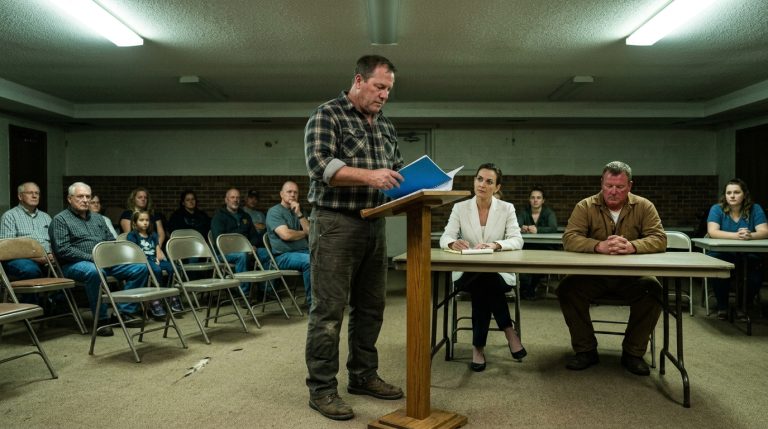
The community clubhouse was a windowless, beige rectangle that always smelled faintly of stale coffee and industrial-strength floor wax. Tonight, the air was thicker, charged with the nervous electricity of nearly every household in the estate. I entered through the double doors, my stride even, my eyes fixed forward. The room fell silent the moment I stepped inside. It was a visceral reaction—a collective realization that I wasn’t here to play by the rules of the previous regime.
Karen was seated at the head table, her face taut, a thin sheen of perspiration glistening on her upper lip. Gary, the retired car salesman, sat to her right, repeatedly clearing his throat into a handkerchief. Brenda, the board secretary, stared resolutely at the tabletop. They looked less like leaders and more like hostages of their own bad decisions.
I didn’t take a seat. I walked toward the front of the room, carrying the foam boards I had prepared. I felt every eye in the house on my back. My pulse was a steady, rhythmic thrum of intent. This was the theater of the war, the moment where the abstract documents I had gathered with Marcus would be translated into a crushing, undeniable reality.
Karen stood up, her hand trembling slightly as she tapped the microphone. “This meeting is to address… community integrity,” she began, her voice cracking before she regained control. “There have been… misunderstandings regarding the board’s recent actions. We are here to clarify—”
“Point of order, Madam President.” David Chen stood up from the second row, his voice slicing through her preamble like a surgical blade. “The agenda states this meeting is for a vote of no confidence. You are currently out of order.”
Karen’s eyes widened, her composure fraying at the edges. “David, please. Let’s not turn this into a circus. We are here for the good of the neighborhood.”
I didn’t wait for her to continue. I moved the first foam board onto the easel. It was the photo of my yard as it was—vibrant, alive, and shadowed by the canopy of the black walnuts. I followed it immediately with the second board: the raw, weeping stumps. I let the visual contrast do the work. The collective gasp in the room was a low, undulating sound, like a wave crashing against a shore.
“This,” I said, my voice projecting clearly to the back of the room, “is not a matter of ‘integrity.’ This is a matter of unauthorized, unlawful destruction of private property. President Bishop claims this was a nuisance removal under bylaw 7.4. But I have proof that this was a private, unapproved operation—staged in the dead of night, utilizing family-owned equipment to funnel community funds into a shell company.”
The room erupted. It wasn’t a roar; it was a confused, indignant murmur that quickly spiked into sharp shouts of disbelief. Karen’s face turned an ugly, mottled red. She leaned over the table, her hands flat against the laminate. “You don’t have the right! You are a resident, not a judge! Everything I did was for the benefit of these property values!”
“You mean your brother-in-law’s property management business,” I countered, sliding the copies of the invoices onto the head table. They skidded across the surface, coming to a stop in front of Gary, who recoiled as if they were venomous. “I have the banking records, Karen. I have the security footage of you supervising the demolition at 3:00 AM. And I have the insurance firm’s investigators on their way here tomorrow morning to discuss the potential for fraud.”
The word fraud hung in the air, absolute and unforgiving.
Karen looked around the room, searching for an ally, a friendly face, a scrap of support. She found none. The neighbors who had once been afraid to question her were now staring at her with a look of collective betrayal. Mrs. Gable sat in the front row, her hands folded over a small garden gnome she had brought as a symbol of her protest.
“I move for a vote of no confidence,” Tom Miller shouted from the back. “Now!”
“Seconded!” came a chorus of voices from the middle rows.
Karen grasped at the microphone, her knuckles white. “You can’t do this! The board—”
“The board is no longer with you, Karen,” Brenda whispered, her voice barely audible but amplified by the microphone’s proximity. She slowly pushed her chair back, distancing herself from the head table. Gary followed suit, his face pale and sweating.
I stepped back, allowing the momentum to take over. I didn’t need to speak again. The power dynamics had shifted irrevocably. The community was no longer a collection of isolated individuals; it was a unified force, and the object of their anger was trapped behind a table of laminate and cold, damning paper. Karen looked from me to the sea of hostile faces, then back to the empty chair where her authority had once resided. She knew it was over. The game, the rules, the control—all of it had been dismantled by the very evidence she had carelessly left in her wake.
CHAPTER 8: THE FINAL EVICTION
The final act of the Oakidge Estates drama did not involve a grand speech or a climactic confrontation. It played out in the quiet, methodical exhaustion of a Tuesday morning. Karen’s home, once the pride of the neighborhood’s aesthetic code, looked neglected. The lawn, usually trimmed to the millimeter, was beginning to show the ragged unevenness of a week’s missed maintenance. A moving truck was parked askew in the driveway, its engine idling with a rhythmic, mechanical growl that sounded like a funeral dirge for her tenure.
I stood on my porch, holding a mug of coffee that had long since gone cold. I watched as men in heavy-duty overalls moved her life out in cardboard boxes. There was no grand spectacle. Just the mundane, heavy thud of furniture against the truck’s metal floor and the sharp, snapping sound of packing tape being torn from a dispenser. Each sound marked another piece of the past being disconnected.
The settlement had been signed three days prior. It was a document of complete, humiliating surrender. Karen was personally liable for the massive deficit left over after the HOA’s insurance policy was tapped, and the court-ordered payout had left her with no choice but to liquidate. She was leaving behind the house, the neighborhood, and the fragile, artificial identity she had cultivated.
As I watched, she emerged from the front door. She looked smaller than I remembered, her shoulders slumped, her movements heavy. She wasn’t wearing her usual pristine HOA attire; she was in worn, stained sweats. She held a single, small wooden crate—the last of her personal effects. She paused at the threshold, her eyes scanning the street one last time. When her gaze drifted toward my house, I didn’t hide. I didn’t look away. I simply watched her, my posture relaxed, my expression neutral.
She didn’t storm over to curse me. She didn’t offer a final, venomous justification. She just looked at the four young walnut saplings I had planted in the memorial grove, their slender, green leaves fluttering in the breeze. She looked at them for a long time, the realization clearly dawning on her that the very thing she had tried to erase had already been replaced—stronger, permanent, and entirely outside her control.
She got into her car, a modest sedan that replaced her usual SUV, and started the ignition. She didn’t look back at the moving truck. She didn’t look at the neighbors who were watching from their windows. She simply pulled away, turning the corner and vanishing from the cul-de-sac. The silence that followed was absolute.
I turned back to the memorial grove. The four saplings needed water. I walked down the stone path, the weight of the last year finally dissipating. The victory wasn’t just in her departure; it was in the restoration of the rhythm of the neighborhood. The fear that had kept people behind their curtains was gone, replaced by the quiet, mundane activity of people living their lives without the threat of a notice of violation.
I reached the center of the grove, where the bronze plaque was embedded in a block of local fieldstone. I traced the inscription with my thumb: The Sarah Davis Memorial Grove. May this be a place of peace and community.
Tom Miller walked up behind me, carrying a toolbox. He didn’t say anything, but he nodded toward the playground equipment in the common area, where his daughter, Lily, was finally able to use the adaptive swing they had installed as part of the settlement fund. The sight of her—laughing, mobile, and unburdened—was the true payoff. The justice wasn’t just the money; it was the return of the simple, human joys that Karen had tried to choke out of the community.
“Everything looks solid,” Tom said, his voice soft. “The irrigation for the saplings is set for 6:00 AM.”
“Thanks, Tom,” I said. “For everything.”
He walked away, leaving me alone in the grove. I knelt by the base of the largest sapling and loosened the soil around the roots, my hands familiar with the work of nurturing something that had been violated. The cold, analytical mindset I had used to dismantle Karen’s power had served its purpose. Now, it was time to let it go. The house, the neighborhood, and the memories were no longer a battleground. They were a home.
I looked up at the sky. The afternoon light was golden and warm, casting long shadows across the grass. Sarah would have liked this, I realized. She would have liked the park, the trees, and the fact that the neighborhood had finally found its own, unscripted peace.
I stood up, wiping the earth from my palms. The mission was complete. I walked back toward my house, the front door standing open in the cooling air. I wasn’t the same man who had stood on this porch a year ago, but as I stepped inside and heard the quiet, rhythmic ticking of the hallway clock, I knew I had arrived exactly where I was meant to be. The war was over, the debt was paid, and for the first time in a long, long time, the future didn’t feel like a threat. It felt like a garden, waiting to grow.