The Architect of Order: How One Man Dismantled a Suburban Empire of Petty Tyranny
CHAPTER 1: THE DRIVEWAY CALCULUS
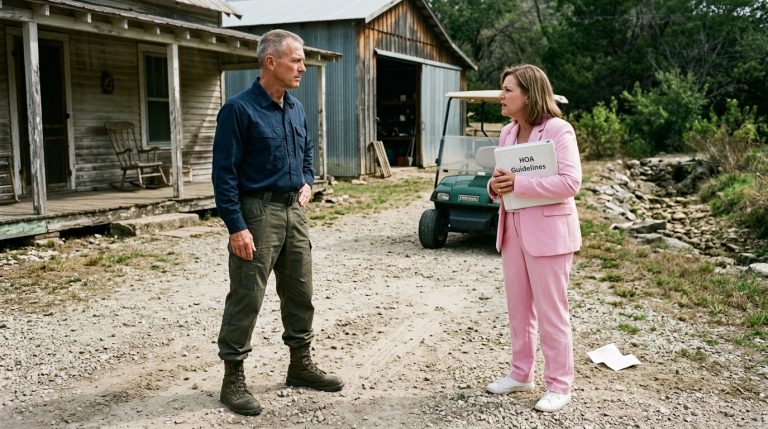
The perfume was the first thing that reached me—a synthetic, cloying sweetness that had no business being out here among the oaks and the damp, cooling breath of the spring. It was a cheap, floral assault designed to command territory. Karen didn’t walk; she occupied. She stood at the threshold of my property line, her floral mumu hanging like a bright, predatory banner against the muted greens of the lawn.
“I don’t care what your little geologist says, Mr. Caldwell,” she said, her voice a serrated blade slicing through the humid afternoon. “That is an unapproved man-made water feature. Fill it with dirt by Friday, or I’ll have it done for you—and I’ll bill you for the privilege.”
She tapped her clipboard. It was a sturdy, plastic thing, stark white against her sausage-thick fingers. Behind her, the mid-afternoon sun caught the windshield of her Lexus, turning the glass into a blinding, featureless eye.
I kept my hand on the porch railing. The wood was weathered, rough against my palm, a stark contrast to the sterile, polished arrogance emanating from the driveway. My internal clock clicked into a familiar rhythm. Twenty years in the Army Corps of Engineers hadn’t just taught me how to move earth; it had taught me how to read the landscape for weaknesses. Karen wasn’t looking for compliance. She was looking for an echo—a vibration of fear that would signal she had found a submissive subject.
“It’s a natural spring, Karen,” I said, keeping my tone level. I didn’t raise it. I didn’t match her pitch. I watched the way her mouth twitched, the slight dilation of her eyes as she searched for a crack in my composure. “The property survey is explicit. It’s an aquifer window.”
“It’s a hole,” she snapped, and for a split second, the mask slipped—a flash of pure, frantic indignation that told me this wasn’t about the water. It was about the fact that I had dared to exist outside of her line of sight. “And you are in violation of Articles Four, Seven, and Nine. You are an insurance liability.”
I didn’t argue. Arguing was an emotional expenditure I couldn’t afford. Instead, I analyzed the geometry of her stance. She was leaning forward, her weight on the balls of her feet, ready to retreat if I stepped toward her, but rooted enough to hold the line of her own authority. She was a tactical disaster waiting to happen.
“I’ll review the covenants,” I said, my voice as neutral as a stone.
She stared at me, frustrated by the lack of friction. She wanted a brawl; I gave her a delay. She adjusted her grip on the clipboard, her knuckles white. She looked past me, toward the distant, hidden glint of the water in the thicket of willows. Her gaze lingered there with a strange, possessive intensity, as if she were mentally tallying the dirt it would take to erase it.
“Friday, Mr. Caldwell,” she repeated, turning on her heel. The movement was practiced, a military-grade pivot that screamed of hours spent in front of a mirror, perfecting the posture of command.
As she marched back to the Lexus, the smell of that cheap perfume lingered, a ghostly residue on the breeze. I watched her slide into the driver’s seat. She didn’t speed off. She sat there for a moment, her silhouette framed against the windshield, staring at the front of my house.
I looked down at the rotted porch board I had been replacing. I picked up the hammer, the weight of the steel familiar and grounding in my grip. The silence of the afternoon was now replaced by the rhythmic, calculated thud of nails into wood. I didn’t know the exact nature of the architecture she was protecting, but I knew one thing for certain: every structure, no matter how imposing, had a structural failure point.
And I was going to find hers.
CHAPTER 2: THE ANATOMY OF A BINDER
The final nail went in with a clean, biting snap. I didn’t reach for another immediately. I stood up, the heat of the afternoon pressing against the small of my back, and wiped the sweat from my brow with the back of my hand. The porch was solid now. It felt anchored, purposeful. A small, structural victory.
I looked down the long, sun-drenched stretch of my driveway. The Lexus was gone. It had left behind nothing but a pair of heat-shimmering tire tracks on the asphalt and the lingering, nauseating scent of that synthetic perfume. It was a sensory stain, a reminder that the perimeter of my life had been breached.
I didn’t head for the kitchen or the cooling shade of the living room. I walked straight into the house, my boots echoing on the hardwood floors, and went directly to the home office. This was the command center. It was a small, utilitarian space, but it was where I would process the noise of the outside world into actionable intelligence.
I pulled the three-ring binder from the corner of my desk. It was heavy, industrial, and utterly devoid of personality—exactly what I needed. I opened the clear plastic sleeve on the front and slid in a fresh sheet of white paper. With a fine-tipped black marker, I wrote in block letters: OPERATION SPRING FREEDOM.
The title looked stark against the paper. It was, perhaps, a bit grandiose, but in the sterile, beige landscape of Harmony Creek, grandiosity was a survival mechanism. It turned a petty nuisance into a campaign.
I opened the binder to the first tab, labeled Inbound/Outbound. I took the violation notice Karen had handed me earlier—that heavy, cream-colored card stock—and placed it into a protective sleeve. The ink was still sharp, the eagle-and-laurel-wreath logo staring back at me with its vaguely fascistic posture. I ran my thumb over the text. It wasn’t just a letter; it was a move.
I needed to calculate my counter-move.
I sat down, the chair creaking under my weight, and opened my laptop. The screen flickered to life, the blue light washing over the room. I didn’t want to send an angry email. Angry emails were the tools of the desperate; they provided the enemy with the exact satisfaction they were looking for. No, this required the cold, bureaucratic precision of the Corps.
I began drafting.
Dear Board of Directors, I started. I intentionally bypassed Karen. Addressing the board was a deliberate structural shift, designed to strip her of the illusion that she was the board.
I systematically refuted every claim. To the unauthorized excavation: I pulled up the high-resolution scan of our property survey. I highlighted the surveyor’s original notations in a brilliant, piercing yellow. Natural artesian spring. I saved the file and hit print. The laser printer whirred, a mechanical hum that sounded like a heartbeat.
To the liability issue: I opened the file containing our homeowner’s insurance policy. I navigated to the riders and endorsements. There it was—a specific inclusion for the spring, a clause that had cost us an extra thirty dollars a year but was now worth its weight in gold.
I spent two hours building the document. It was a masterpiece of deadpan legalism. I didn’t use emotional language. I didn’t mention the smell of her perfume or the way her finger had wagged at me like an accusatory sausage. I dealt only in facts, in timestamps, in definitions.
By the time I finished, the sun had begun to dip behind the line of oaks at the edge of the preserve, casting long, sharp-edged shadows across the yard. The house felt quiet, but it was a different kind of quiet—it was the silence of a structure that was being reinforced from the inside out.
I gathered the pages, organized them with surgical precision, and slipped them into the second tab of the binder. I clipped a fresh return receipt card to the outside of the envelope and sealed it. It felt like an ammunition crate.
As I walked toward the front door to place the envelope in the mailbox, I looked out toward the back of the property. The spring was tucked away in the thicket, a hidden, dark-blue pulse of life that Karen was currently trying to bury under bureaucratic nonsense.
I wasn’t just defending a hole in the ground. I was defending the principle that what was mine stayed mine.
I opened the front door. The evening air was cooler, the heat of the day retreating, but the humidity still clung to the skin. I walked down the steps and stopped at the mailbox. I lifted the flag, the red metal snapping into place with a sharp, metallic sound that seemed to ring out across the empty street.
The envelope sat inside, a small white block of defiance.
I turned back to the house. As I did, I noticed something. The welcome mat. It was slightly askew, moved perhaps an inch from where it had been that morning. I looked at the ground, at the small patch of concrete where the Lexus had been idling earlier.
There, near the edge of the driveway, was a small, faint scuff mark in the dirt—the distinct impression of a heel. She hadn’t just stood at the property line. She had stepped onto my property, closer to the front door than she had ever let on.
A cold, thin sliver of realization slid down my spine. This wasn’t just a casual drive-by. She had been scouting the front entry.
I looked at the house again, seeing it not as a home, but as a site to be secured. The game wasn’t going to be played in the open. It was going to be played in the margins, in the small, unobserved moments, in the inch-by-inch encroachment of her shadow.
I went back inside and locked the door, the click of the deadbolt sounding final in the gathering dark. The binder was ready. The move was made. And I knew, with the cold clarity of a man who had seen this before, that tomorrow wouldn’t bring peace. It would bring a response.
CHAPTER 3: THE TERRAIN OF THE AQUIFER
The quiet of the house was no longer a comfort; it was an interrogation. I stood in the dark for a long moment, listening to the house settle. Outside, the crickets maintained their steady, rhythmic chant, oblivious to the fact that my front porch had just become a contact point in a low-intensity war.
I walked back into the office. The glow of the monitor felt like a spotlight. I didn’t turn on the overhead light. I didn’t want to silhouette myself against the window, not now, not when I knew she had been close enough to touch the siding of the house.
My mind was already dissecting the layout. The driveway was the primary vector. It was where she had stood, where she had left her mark. I opened the file for the neighborhood covenants again. I didn’t care about the lawn height or the fence color anymore. I was looking for the geography of the power structure. I needed to see how the rules were anchored to the physical world.
I opened a new tab on my browser. Florida Aquifer System. Karst topography.
The more I read, the more the local context shifted. I had bought this land thinking of it as a ranch, a piece of suburban stability. But the documents I was pulling up now—geological surveys, state water management data—revealed that my backyard wasn’t just a yard. It was a window. A karst window.
The spring wasn’t a static feature; it was a breathing, moving part of the Floridian crust. It connected to a vast, complex network of underground rivers that spanned the entire region. The legal implications for interfering with such a system were not just HOA-level warnings; they were state-mandated felonies.
I printed the state statutes. The paper felt heavy, the ink sharp and black against the stark white of the page. Shall not impede, divert, or obstruct. The language was cold, absolute, and devoid of the pettiness that characterized Karen’s mandates. It was the language of law, and it was a weapon I hadn’t yet pointed in her direction.
As the printer finished, I noticed a discrepancy in the local records. I had been cross-referencing my own property survey with the county’s master map. They didn’t align.
My pulse quickened. I sat forward, the metal legs of my chair scraping against the hardwood. I zoomed in on the satellite imagery. The county map labeled the entire thicket at the back of the property as “non-regulated green space,” while my own private surveyor had marked the spring head as a protected geological feature.
It was a setup.
The county map had been updated only two months before we moved in. It was a digital erasure. If someone—say, an HOA board member with connections to the local zoning office—wanted to clear the way for “redevelopment” or “landscaping improvements,” the first thing they would do is scrub the geological significance of the land from the public record.
I stared at the screen, the blue light reflecting in my pupils. It wasn’t just power she wanted. She was trying to build a narrative reality where my spring didn’t exist, where it was just a liability that needed to be filled with dirt.
I stood up and walked to the window. The backyard was a void of darkness, save for the pale sliver of moonlight catching the edges of the willows. The spring was out there, bubbling up, indifferent to the lies being encoded into the county database.
I needed to see it.
I grabbed a high-lumen tactical flashlight from the desk drawer—a habit from the Corps that had never quite left me—and headed for the back door. The screen door creaked, a sound that seemed loud enough to wake the entire neighborhood. I stepped out onto the damp grass.
The air was thick, heavy with the scent of pine needles and wet earth. I didn’t point the light toward the house. I kept it directed at the ground, a narrow beam of focus.
The flagstone path I had laid felt uneven under my boots. I reached the deck we had built, the wood cool and solid. I knelt down at the edge, where the bank sloped down to the spring’s mouth.
I clicked the light on, just for a second. The beam hit the water, and the reflection was blindingly clear. The spring was churning, a slow, hypnotic boil of crystal-clear water rising from the deep limestone. It was beautiful, but as I looked at the surrounding brush, I realized that someone had been here.
There were branches snapped. Not by wind, not by animals. They were clean, surgical cuts. Someone had been clearing the perimeter of the spring, trimming the growth to make it easier to access. Easier to fill.
My hand tightened around the flashlight. The discovery wasn’t just a breach of privacy; it was an active preparation for the crime she had threatened.
I stood up, the anger boiling beneath my skin like the water in the spring. I didn’t want to scream; I wanted to map it. I started walking the perimeter, counting my paces, measuring the distance from the property line to the water’s edge. Every step was a tactical note being recorded in my head.
If she wanted a war, she had started it on the wrong terrain. I knew how to defend a position, but I was currently realizing that to win, I had to understand the scope of her offensive.
I went back to the house, but I didn’t go to sleep. I spent the rest of the night creating a new folder in the binder, titled Geological Intelligence. I added the maps, the statute printouts, and my own hand-drawn diagrams of the property lines.
The binder was no longer just a log of our conflict; it was becoming a comprehensive dossier on her corruption. She thought she was fighting a homeowner. She was actually dealing with an engineer who was currently building a bunker out of evidence.
As the first gray light of dawn began to bleed into the sky, I closed the binder and took a long, slow breath. The house was silent, but my mind was screaming with the potential of what I had found. I looked at the phone on my desk. It was time to find out if anyone else in this neighborhood had felt the cold hand of her “community standards.”
I had the map. Now, I needed to find the allies who had been erased by her bureaucracy.
CHAPTER 4: THE ARCHITECTURE OF RESENTMENT
The sidewalk was a strip of poured concrete that felt like a DMZ. As I walked, I kept my hands in my pockets, the binder tucked under my arm like a silent companion. The neighborhood was quiet, the kind of suburban stillness that felt manufactured. Behind closed doors and manicured hedges, people were waking up to the same regime I was fighting. I just had to be the one to give that resentment a name.
I reached Mrs. Gable’s house first. The gnomes were out in force, a small, colorful army standing guard over a patch of dying marigolds. They looked ridiculous, yes, but they also looked like an act of defiance. I tapped on her gate. The metal hinge groaned, a high-pitched, rusted protest.
When she opened the door, her face was a map of exhaustion. She had a watering can in her hand, the plastic handle worn smooth by years of use. Her eyes darted toward the street, scanning for the telltale white Lexus.
“Mr. Caldwell,” she whispered. Her voice was like dry leaves. “You shouldn’t be here. She’s… she’s very thorough.”
“I know,” I said, keeping my posture relaxed, unthreatening. “That’s exactly why I’m here. I’ve been looking at the property records, Mrs. Gable. It’s not just your gnomes. It’s a systemic reach.”
I didn’t lead with the legal statutes or the aquifer maps. I let her talk. She spent the next twenty minutes telling me about the fines—the $400 for ‘unapproved ornamentation,’ the certified letters that arrived on Tuesdays, the way the board meetings felt more like forced confessions than community gatherings. She didn’t have a plan; she had a fear that had calcified into a daily weight.
As she spoke, I felt a sudden, sharp memory of a base housing inspector back in Okinawa. He had been a thin, spindly man who would run a white-gloved finger over the light switches, looking for dust. He wasn’t looking for cleanliness; he was looking for control. Karen was the same brand of predator, just wearing a floral mumu instead of an olive-drab uniform. The similarity made the hair on the back of my neck stand up. It was a phantom, a ghost of an old adversary that reminded me that the scale of the threat didn’t matter as much as the nature of the authority.
“She’s not just enforcing rules, Mrs. Gable,” I said, my voice steady. “She’s building a tax base. A private one.”
I saw the Martinez family next. They lived four houses down, in a ranch with a basketball hoop that was currently tilted at an awkward, defeated angle. They were younger, but the exhaustion was the same. When they opened the door, they looked at me with the eyes of people who had already decided to lose.
“We’re moving,” Mr. Martinez said before I could even get the greeting out. “We put the house on the market yesterday. It’s not worth it. The fines, the meetings, the feeling of always being watched. We just want out.”
“Don’t move,” I said. It wasn’t a request; it was a tactical intervention. “If you move, she wins. She expands the tax base. She gets to fill the gap you leave with someone who’ll be easier to squeeze.”
I didn’t show them the binder yet. I wasn’t ready to pull the trigger. Instead, I listened. I took notes in my head, logging the dates, the amounts, the specific clauses they were cited for. I was building a database of their collective hurt.
The walk back to my house felt different. The neighborhood didn’t look like a collection of homes anymore; it looked like a cluster of defensive positions. I saw the peeling paint on a fence, the way a gate was chained shut, the nervous way a neighbor pulled their blinds as I passed. This was a place being slowly hollowed out from the inside.
I arrived back at my driveway and stopped. I stood there, looking at the house. I had come here to plant roots, to dig into the soil and find peace. Instead, I had found a bureaucracy that was actively mining the ground beneath us.
I realized then that the binder wasn’t enough. Documentation was for the courts. But I wasn’t fighting this in a courtroom. I was fighting this on the street, in the living rooms of people who were terrified of their own neighbors.
I went into the kitchen and poured a glass of water. It was cool, clean, and tasted of the limestone deep underground. It was the only honest thing in the neighborhood.
I sat at the table and opened the binder to the Geological Intelligence section. I looked at the maps, the discrepancies in the county records. The evidence was clear: there was an active, coordinated effort to reclassify the land. And I was the only one who had the survey to prove it.
I wasn’t just a neighbor anymore. I was an outlier, a node of resistance in a system that relied on absolute conformity.
I picked up the phone. I didn’t call Frank yet. I called a contact I had kept from my Corps days, a man who worked in private land surveying. I needed a verified, independent audit of the property lines, one that would hold up under the harshest scrutiny.
“I need an assessment,” I said when he picked up. “Not just for a plot. For an aquifer head.”
There was a pause on the line. “Mark? That’s a heavy request. That kind of survey triggers automatic flags in the state system.”
“I know,” I said, looking out the window at the morning light hitting the willows. “That’s the point.”
I hung up and stood in the kitchen, the silence of the house once again feeling like a fortress. I had made the move. The resistance was no longer just a collection of grievances; it was becoming a legal and geological fact. And somewhere, perhaps behind a window just like mine, the queen of Harmony Creek was waiting for the dirt to arrive.
She was going to be disappointed.
CHAPTER 5: THE SPREAD OF THE KILLBOX
I didn’t wait for the survey to be completed. I had the foundation. That evening, I sat in the office with the binder open to the Legal and Statutes section, the pages filled with the stark, unyielding text of state law. Beside me, the phone felt like a detonator. I called Frank Peterson.
“Mr. Caldwell,” his gravelly baritone cut through the silence of the office. “I assume you’re calling because you’ve found something that makes our initial letter look like a polite suggestion.”
“I have,” I said, keeping my voice low. “The county records have been scrubbed. The spring head isn’t just a point of contention—it’s been reclassified as ‘non-regulated space.’ And I have evidence that the reclassification happened on the watch of the current HOA board.”
There was a silence on the other end, the kind of stillness that precedes a seismic event. “That’s a sophisticated play, Mark. That’s not just a petty tyrant. That’s someone who understands how to weaponize the system.”
“She’s using the maintenance budget to pay for a private company—Creative Community Solutions. I’m betting it’s a shell.”
Frank exhaled, a long, raspy sound. “If you’re right, you’ve moved from defending your property to conducting a criminal investigation. That changes the stakes. You can’t just defend; you have to box her in. If she realizes you’ve found the trail, she’ll try to burn it. We need to move the killbox into place before she sees it coming.”
The plan we formulated was a hammer. We would deliver a cease-and-desist letter that wasn’t just a lawyer’s bluff; it was a formal notice of impending state-level action. It was designed to force a reaction, to make her act in haste—and in that haste, she would surely stumble.
I spent the rest of the night printing, organizing, and tabbing. Every page in that binder was a structural member of the trap.
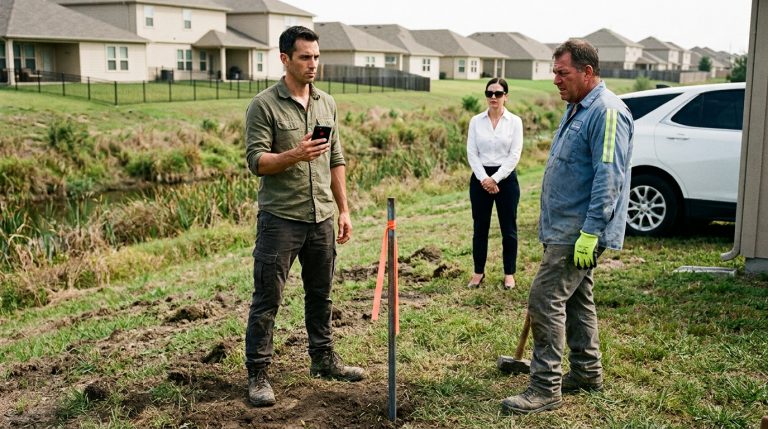
The next morning, the neighborhood was disrupted by an unexpected event. A county utility truck—a bright, unavoidable yellow—pulled into the Harmony Creek cul-de-sac. It wasn’t there for my street, but the arrival of a heavy vehicle in a neighborhood where even a delivery truck was scrutinized was like a pebble dropped in a still pond. I watched from the window as a worker began marking lines on the pavement.
It was a local infrastructure audit—a routine mapping of the underground lines. I knew, with the cold certainty of an engineer, that their maps would show the aquifer runoff, the very lines Karen had been trying to erase from the zoning records. It was a chaotic, unplanned collision between the bureaucratic reality she had fabricated and the physical reality of the earth itself.
I grabbed my jacket and stepped out. The morning air was sharp, smelling of diesel and freshly turned earth. I walked toward the utility truck, my eyes tracking the movement. A few doors down, I saw the Lexus. It was parked, stationary, its windows tinted to a dark, impenetrable black. She was watching.
The worker was looking at a set of blueprints, shaking his head. I approached him, keeping my distance, professional.
“Underground lines?” I asked.
He looked up, wiping his forehead with a sleeve. “Yeah, they want to map the drainage for the new phase of the preserve expansion. Apparently, someone flagged a discrepancy in the water table readings.”
My heart hammered against my ribs. “Someone flagged it?”
“Yeah, anonymous report. Filed through the county clerk last week.”
I looked toward the Lexus. Karen wasn’t just losing control; she was being bypassed by the very systems she had tried to manipulate. The audit was the butterfly effect I had set in motion, and it was now tearing through the neighborhood like a localized storm.
As I walked back to my house, the neighborhood felt different. The tension wasn’t just in the air; it was in the pavement, in the sound of the utility truck’s engine, in the way the neighbors were peeking through their curtains. The bubble of her manufactured reality was beginning to lose pressure.
I went back inside and grabbed the binder. I wasn’t waiting for the mail. I was going to Frank’s office. I had the data, and now, the county had the audit. The killbox was closing.
I left the house, not looking at the Lexus, but knowing she was watching every move. I drove out of Harmony Creek, the tires of my truck gripping the road with a new sense of purpose. The final phase of the fight hadn’t just arrived; it was being played out on a board that was getting smaller and smaller every second.
The war of the HOA wasn’t just about a spring anymore. It was about the inevitable moment when the truth of the earth met the lies of the boardroom. And as I merged onto the highway, I knew one thing: I wouldn’t be the one to blink first.
CHAPTER 6: THE KANGAROO COURT
The clubhouse was a beige, windowless box that smelled of stale coffee and the damp, cloying scent of floor wax. The fluorescent lights hummed—a steady, maddening frequency that seemed designed to strip away nuance and leave only the raw nerves of the room exposed. I stood in the entryway for a heartbeat, my hand resting on the heavy, metal-rimmed handle of the door, and took a breath. My binder was tucked firmly under my left arm, a solid, squared-off weight.
I pushed the door open.
The room was already full. It wasn’t the kind of crowd that gathered for a community update; it was a theater of anticipation. The folding chairs were arranged in rigid, concentric rows that all faced a long, utilitarian table at the front. And there she sat, enthroned in the center of the dais, draped in a blazer of aggressive, unforgiving purple. Karen didn’t look at me when I entered. She was staring at a point in the middle distance, her posture so rigid it looked painful.
The silence as I walked toward the front was total. It wasn’t the respectful silence of a lecture hall; it was the suffocating quiet of a pressure cooker. I found the single chair placed directly in front of the table—the defendant’s chair. It was positioned to force me to look up at them, a physical manifestation of their assumed superiority.
I sat down and placed the binder on the floor. The snap of the three-ring lock was the loudest sound in the room.
“This special hearing of the Harmony Creek Estates Board of Directors is now in session,” Karen announced. Her voice didn’t waver, but I noticed the slight tremor in her hands as she picked up the small, wooden gavel. It looked like a child’s toy in her grip. “We are here to address the ongoing violations at Lot 72, the property of Mr. Mark Caldwell.”
She launched into the script. It was a masterpiece of selective narrative. She detailed the “unauthorized water feature” and the “illegal landscaping,” her voice dripping with the righteous indignation of a martyr. She spoke of “community standards” and “liability risks” as if she were reciting a holy text.
I watched her, looking for the tell. I didn’t focus on the words; I focused on the way she rhythmically pressed her thumb against the edge of the dais. Click. Click. Click. It was the nervous habit of someone who knew the ground was shifting beneath them but refused to look down.
Behind her, Barry, the treasurer, wouldn’t meet my eyes. He stared at his own notepad, his face a pale, sweating mask of panic. Janice, the secretary, was scribbling so furiously the tip of her pen squeaked against the paper. They were the engine of this kangaroo court, but they were already trying to detach themselves from the driver.
“Mr. Caldwell,” Karen snapped, her eyes finally finding mine. The look was sharp, cold, and utterly devoid of humanity. “This is your final opportunity to agree to comply. Will you commit here and now to draining and filling the unapproved pool and removing the associated structures? Or shall we proceed with the immediate imposition of the full fine and the filing of a lien against your title?”
The room leaned in. The air felt thin, recycled, and metallic.
I stood up slowly, deliberately. I didn’t look at Karen. I turned, my body rotating to face the rest of the room. The people sitting in those folding chairs—Mrs. Gable, the Martinez family—they were the jury. They just didn’t know it yet.
“My name is Mark Caldwell,” I said, my voice projecting toward the back of the room, avoiding the artificial acoustics of the microphone. “My family and I moved here four months ago. We wanted a home. We didn’t want a war.”
“Stick to the agenda, Mr. Caldwell!” Karen barked, her gavel hitting the table with a sharp, hollow thwack.
I ignored her. “To answer your question, President Karen: No. I will not be filling the natural, state-protected artesian spring on my property. To do so would not just be a violation of HOA bylaws. It would be a crime under Florida state law.”
A murmur rippled through the room. It was the sound of a collective turning point.
“That is a baseless assertion!” Karen shrieked, her mask finally fracturing. “This is about community rules! You are in violation of Articles Four, Seven, and Nine!”
I reached down and picked up the binder. I didn’t open it. I just held it, the weight of it a physical counter-argument to everything she had just said.
“I have the statutes here,” I said, my voice dropping to a conversational, deadly level. “I have the case number from the Department of Environmental Protection, where a formal file has been opened regarding this property. And I have the copies of your letters—the ones where you demanded, in writing, that I impede a protected waterway.”
Barry’s pen stopped. He looked up, his eyes wide and terrified. Janice sat perfectly still, her mouth slightly agape.
“I am not here to negotiate a violation, Karen,” I said, looking her directly in the eye, watching the panic finally eclipse the arrogance in her expression. “I am here to inform you that the investigation into the Harmony Creek Homeowners Association has already begun.”
The clubhouse felt like it had suddenly shrunk, the walls closing in on the dais. The hum of the fluorescent lights suddenly seemed to intensify, a high-pitched drone that mirrored the rising, chaotic buzz of the room behind me. She had wanted a show trial, a final display of her absolute authority.
Instead, she had just handed me the stage.
I turned back to the room, to the neighbors who were watching the collapse of the only power they had ever known. The trap wasn’t just set; it had been sprung. And as I saw the way Karen’s hand gripped the gavel, her knuckles white and straining, I knew the game had finally, irrevocably shifted.
CHAPTER 7: THE GROUNDED REVOLT
The parking lot was a pool of darkness, illuminated only by the flicker of distant streetlights. The air felt thin, sharp, and charged with the metallic tang of an incoming storm. I moved toward my truck, my keys already in my hand, when the heavy, rhythmic thrum of a diesel engine rolled through the neighborhood.
It wasn’t a civilian vehicle. It was the low, grinding growl of a commercial flatbed.
I stopped. I didn’t reach for my phone; I reached for the tactical flashlight in my jacket. The light was a heavy, cold cylinder in my grip. I turned off the parking lot’s perimeter lamp with a quick, practiced flick of the switch near the clubhouse entrance, plunging the immediate area into shadow.
A mud-splattered flatbed truck rounded the corner, its headlights cutting through the night like twin, searching eyes. On the side, the logo read ACME Landscaping and Excavation. They weren’t turning toward the clubhouse. They were heading straight for my property.
I moved. I didn’t run—running was a mistake, an expenditure of energy that could be better used elsewhere. I kept to the shadows, my boots silent on the asphalt, tracking the truck as it lumbered toward the entrance of Harmony Creek.
The driver was local. He knew the route. He turned onto my street, his headlights sweeping across the houses—the Martinez’s basketball hoop, the Gables’ garden gnomes—the light catching the quiet, frightened faces in the windows. He slowed as he approached my driveway.
I was already there. I stood at the edge of the property line, right where the driveway met the street, a solid, unmoving object in the path of the machine. I didn’t hide. I stood in the center of the beam, the light washing over me.
The truck slowed to a crawl, the air brakes hissing with a sound like a giant, angry snake. The foreman, a burly man with a sunburned neck, leaned out of the driver’s side window.
“Mr. Caldwell?” he called out, his voice heavy with the fatigue of a late-night job. “We got a work order. HOA president. Urgent site clearance. You need to move, or we’re going to have to involve the Sheriff.”
I didn’t move. I reached into my jacket and pulled out the cease-and-desist letter Frank had drafted. The paper was crisp, the signature at the bottom an iron-clad legal barrier.
“Read it,” I said, my voice cutting through the idling rumble of the truck. “You are an agent of an entity that is currently under state-level investigation for embezzlement and environmental crimes. If you put one bucket of dirt into that spring, you aren’t just moving earth. You’re facilitating a felony.”
The foreman hesitated. He looked at the paperwork in my hand, then at the dark, silent house behind me, and finally at the shadows of the neighborhood where he could sense the eyes of the residents.
“She said—” he started, his bravado wavering.
“She lied,” I interrupted, stepping forward until I was only a few feet from the massive front grille. “She’s using you to clean up her mess. She’s not paying you from the HOA funds; she’s paying you from an account that is already being audited by the state.”
The foreman turned to his passenger, a younger guy who was looking increasingly nervous. They whispered, their voices lost under the idling diesel.
I hit the record button on my phone, which was already tucked securely into my chest pocket. I didn’t need to brandish it. I just needed it to catch the dialogue.
“We’re just contractors, man,” the foreman said, his voice dropping. “We don’t want no trouble.”
“Then leave,” I said. “Before the authorities arrive.”
He sat there for a long, agonizing moment, the engine shuddering beneath him. I thought of the inspector in Okinawa, the way he would search for dust. Karen was exactly like that. She was looking for a flaw in my perimeter, a crack she could exploit. She had sent this truck not to clean the spring, but to force me into a physical confrontation, a moment of weakness she could use to paint me as the aggressor.
She was playing for the optics. I was playing for the terrain.
“Forget it,” the foreman muttered to his partner. He shifted the truck into gear. The transmission groaned, the metal complaining under the strain, and he began a slow, heavy U-turn.
I stayed where I was, my eyes fixed on the rear of the truck until its taillights faded into the dark. Only when they were gone did I finally let my shoulders drop.
I looked up toward the street. The white Lexus was parked two houses down, idling, a silent, predatory ghost in the dark.
I didn’t run toward her. I didn’t shout. I just walked back to my porch, my movements slow, deliberate, and entirely unbothered. I knew she was watching. I wanted her to see that I wasn’t just standing my ground—I was winning.
I stepped onto the deck, the wood solid under my feet, and looked out over the spring. The water was dark, deep, and utterly indifferent to the petty power struggles of the surface.
I realized then that the fight wasn’t about the water. It was about the fact that she couldn’t stand the existence of something she couldn’t regulate. She needed to feel like a gatekeeper, a savior of the suburban status quo, and the idea that I could simply have something natural, something wild, was a psychological trauma she couldn’t handle.
I went inside and sat down in the office. The binder sat on the desk. I turned to the final tab: The Tribunal.
Tomorrow was the recall meeting. The coup was ready. The evidence of the Creative Community Solutions embezzlement was already in the hands of the reporter, Jessica Vale. The state auditors were on notice.
The trap wasn’t just sprung—it was snapping shut. And as I sat in the dark, the quiet pulse of the spring outside my window seemed to harmonize with the rhythmic, steady beating of my own heart. I was ready.
CHAPTER 8: THE HARMONY OF TRUTH
I walked out of the clubhouse and into the night. The parking lot was cooling, the heat of the day bleeding out into the asphalt. My footsteps were the only sound, rhythmic and steady. Behind me, the clubhouse lights flickered, a dying star of authority. The news van had already pulled away, its orange strobe fading into the distance, but the quiet that remained was heavier, more substantial.
I didn’t head for my truck immediately. I stood in the middle of the empty lot, feeling the weight of the binder in my hands. It wasn’t just paper anymore. It was the physical record of a system being dismantled, piece by documented piece. I looked toward the row of houses, the silhouettes of Harmony Creek dark against the velvet sky. For the first time in four months, the neighborhood didn’t feel like a collection of tactical positions. It felt like a neighborhood.
I drove home slowly. The streets were deserted. When I pulled into my driveway, I didn’t rush inside. I walked toward the thicket of willows, the flashlight in my hand dark. I didn’t need it. I knew the terrain now by heart. I reached the deck, the wood cool beneath my fingers, and looked down at the spring.
The water was black, perfectly still, a mirror for the stars above. It was a karst window, a connection to something ancient and uncontrollable. I touched the surface. It was cold—sharp, clean, and vital.
The embezzlement—the invoices for “beautification”—had been her decoy, the Layer 1 defense meant to distract from her true hunger. But standing there, I realized the core truth of Karen’s crusade. It was never about the money, and it was never about the gnomes or the paint. It was about the terrifying, fragile realization that she was an ordinary person in a world that didn’t revolve around her. She had built the HOA as a stage, a place where she could force the world to acknowledge her as the absolute, unquestioned arbiter of reality. When the spring proved that nature had its own laws—laws that she couldn’t sign, amend, or fine—it didn’t just annoy her. It threatened the very scaffolding of her identity.
She had fought so hard because she believed that if the spring remained, her world would simply cease to function. She wasn’t saving the community; she was trying to stabilize her own fractured perception.
I walked back to the house. The interior felt different—lighter, somehow. I went into the office and placed the binder on the desk. I didn’t open it. The work was done. The recall vote had been decisive, a landslide of ‘I’s’ that had washed away her influence in a single, unified breath. Barry and Janice had already issued their apologies, distancing themselves from the ‘misguided leadership’ as if they hadn’t been the ones rubber-stamping every invoice for three years.
I sat down and looked at the repair I had made to the porch earlier that week. The board I had replaced was solid, the nails flush with the wood. It was a small thing, but it was mine. I had fixed it with my own hands, with the precision of someone who knew that order wasn’t something you imposed on the world; it was something you maintained through honest labor.
The phone rang. It was Frank.
“The state attorney’s office has the files, Mark. The forensic audit will be public by Monday. You’re done. You can put the binder away.”
“I know, Frank,” I said, looking out at the dark silhouette of the oaks. “I just wanted to make sure the spring was safe.”
“It’s a protected resource now, by order of the state. She can’t touch it. Nobody can.”
I hung up and stood on the porch. The air was clear, the humidity of the summer afternoon finally breaking. I heard a distant, rhythmic sound—the Martinez’s basketball bouncing on the driveway, a sound that had been absent for months. It was a simple, mundane noise, but in the quiet of the night, it sounded like a victory.
I looked at my hands. They were calloused, worn by the work of the last few months—the building, the documenting, the fighting. I went into the tool shed and retrieved the board I had left over from the porch repair. I had meant to throw it away, but I kept it. I found a piece of sandpaper and began to smooth out the rough, jagged edge of the wood, the rhythmic shhh-shhh of the paper a grounding, meditative sound.
The denouement of the war was quiet. There would be no dramatic exit for Karen, just the slow, grinding reality of legal proceedings and the inevitable realization that she had lost the only thing she had ever really valued: the appearance of control.
I finished the wood, the surface now perfectly smooth, a clean texture in a world that had been jagged for far too long. I placed the board back on the rack. The shed was clean, every tool in its place.
I walked out to the edge of the lawn and looked at the spring one last time. A dragonfly with wings like spun glass skittered across the surface, a tiny, vibrant spark of life. I breathed in, the air filling my lungs, cold and clean. The weight of the last four months—the hyper-vigilance, the tactical planning, the constant, low-level hum of conflict—finally lifted, leaving behind a profound, grounded stillness.
I went inside and turned off the lights. The house was mine. The land was mine. And the peace that settled over Harmony Creek wasn’t the forced, artificial order of a covenant; it was the quiet, resilient harmony of people who had finally learned to look after their own.