The Paper Trail: A Silent War for a Strip of Land, Won by the Unblinking Eye
CHAPTER 1: THE FIRST INCURSION
The landscape of my backyard was quiet, save for the rhythmic, metallic thwack of the foreman’s sledgehammer hitting the steel stake. It was a sound that didn’t belong here. My land followed the natural curve of the canal, a narrow stretch of grass that had been mine since before the subdivision sprouted its manicured, beige boxes across the field next door.
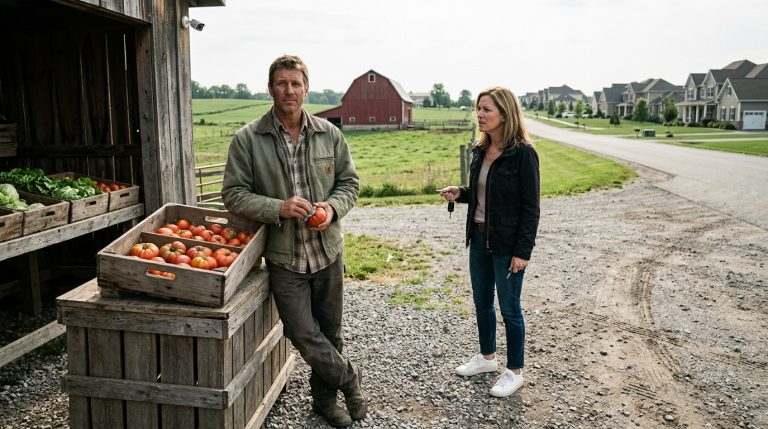
I walked down the slope. My boots didn’t crunch on gravel; they sank into the soft, neglected soil. I kept my distance, waiting until the foreman wiped sweat from his forehead with the back of a neon-yellow glove. He saw me then, his hand freezing mid-air. He looked toward the curb, where Karen Whitlock stood beside a white SUV, her posture rigid, her sunglasses masking whatever she was thinking.
“Gentlemen,” I said. My voice was low, devoid of any jagged edges. I wanted it flat—a recording of a fact, not an outburst of emotion. “You are on private property. The boundary line is six feet behind where you are standing.”
The foreman didn’t look at me immediately. He glanced toward Karen, then back to the packet in his hand, clutching it like a shield. “HOA authorized this, sir. We’ve got the corridor plan.”
“The HOA doesn’t have an easement,” I said, my gaze shifting from him to the surveyor flags I’d had placed three days prior. They were still there—bright, defiant orange against the green. “Who hired you?”
“The Association.” He sounded defensive now, the confidence in his voice wavering as he realized I wasn’t going to raise my voice. I wasn’t going to play the role of the angry neighbor he’d been prepped to handle.
Karen walked over, her heels sinking into the grass. She wore a smile that felt like a surgical incision—precise and cold. “We’re doing this for the community, for the families who need a safe way to walk,” she said, her tone dripping with practiced, patronizing warmth. “It’s a minor adjustment for a larger cause. Surely you can see the necessity of cooperation?”
I didn’t answer her. I didn’t acknowledge the ‘we.’ Instead, I pulled my phone from my pocket and unlocked it. I brought up the screen recorder. The red recording light pulsed, a small, blinking heartbeat of accountability.
“You are being recorded,” I said, my voice steady. “Stop work. Leave the property.”
The foreman looked at Karen. Her face tightened, the smile slipping just enough for me to see the raw, frantic irritation underneath. She reached out to touch the foreman’s arm, her fingers brushing the reflective strip on his vest. “Ignore him,” she murmured, though her voice carried perfectly across the canal. “He’s just being difficult. The paperwork is finalized.”
I stepped closer, ignoring the spike of adrenaline in my chest. I focused instead on the way her hand trembled, just a fraction of a millimeter. It was a detail I hadn’t expected. I looked at the foreman, who refused to meet my eyes, focusing intently on a loose thread on his glove.
“If you continue,” I said, addressing the foreman directly, “you are doing so without a recorded easement and against a direct warning. Are you sure that’s worth your contractor’s license?”
The foreman went silent. He looked at the stake, then at the orange flags, and finally, he looked back at the curb. For a heartbeat, the air felt heavy, charged with a strange, unspoken tension—as if he wanted to tell me something, some truth trapped behind his teeth.
“Karen,” the foreman began, his voice dropping, “the survey markers…”
“Just do your job,” she commanded, and the sharpness in her tone shattered the moment.
As they turned back to the stakes, I looked down at my phone. The timestamp was locked. The file was already uploading to the cloud. I turned and walked back toward the house, but as I reached the edge of my patio, I glanced back. The foreman was looking at me, not with anger, but with a sudden, dawning recognition of a trap. He knew something about the paperwork he was holding, and for the first time, he looked afraid of what he was being forced to build.
CHAPTER 2: THE DIGITAL SIEGE
The air-conditioning in my home office was set to a brisk, dry chill, a sharp contrast to the humid, over-saturated heat clinging to the canal bank outside. I sat at my desk, the only light coming from the dual monitors that bathed the room in a sterile, electric blue. I wasn’t relaxing. I was working, the kind of work that felt more like a slow, deliberate excavation of a collapse.
I plugged the phone into the workstation and let the data dump. I watched the progress bar crawl across the screen, a digital tide washing in evidence. Metadata. Timestamps. The GPS coordinates of the stakes. I opened the file containing the HOA domain headers from Karen’s initial email—the one that started this. It was a PDF, supposedly a standard brochure, but the properties pane told a different story. Created at 2:00 a.m. on a Tuesday. Modified four hours later.
I leaned back, the leather of my chair creaking—the only sound in the house. My mind looped back to the foreman. That look on his face when he’d nearly blurted out the truth. He wasn’t just a laborer; he was a man holding a packet he didn’t trust.
I opened the municipal GIS overlay on the second monitor. I zoomed into the canal corridor, comparing the parcel lines to the photos I’d taken that morning. The discrepancy was blatant. Karen’s “walkway” didn’t just drift onto my land; it cut through a municipal buffer zone—a protected area that required a specialized permit. A permit she clearly didn’t have.
My phone chimed on the desk—a notification from the title monitoring service. My pulse quickened, a spike of cold discipline that I forced into a rhythmic, steady beat. A new document had been recorded against my parcel. I clicked the link, my finger hovering over the mouse. Another Notice of Claim. Another signature from Karen Whitlock.
I felt a sudden, sharp pang in my chest—not of fear, but of a disorienting, phantom recognition. I stared at the signature on the screen, that decorative, flowery cursive. It was elegant, almost fragile. For a fraction of a second, I imagined the hand that held the pen. I imagined the weight of the HOA presidency, the meetings, the pressure to deliver a “community corridor” in an aging subdivision that was slowly tearing itself apart.
I shook the thought away. No. My mind snapped back to the Predator-Prey lens. Sympathy was an anchor that would drag me under. Karen was playing a game of attrition, assuming I would tire of the filings, the certified letters, the endless administrative noise. She was counting on my exhaustion. She was betting that I would prioritize my peace over my property rights.
I reached for my coffee, but the mug was empty, cold to the touch. I didn’t get up. I pulled up the contact information for the county environmental inspector I’d researched the night before. I needed to document the disturbance near the canal. I began to draft the email, my typing rhythmic and sharp, each keystroke a tactical move. I didn’t use emotive language. I didn’t mention my anger or the disruption to my morning. I provided facts: the date, the location, the specific nature of the disturbance, and the lack of visible permits on-site.
I attached the timestamped photos. As I reviewed the images, I saw the foreman in the background of one frame, looking not at the construction, but at the white SUV where Karen stood. He was waiting for her to look away. He was waiting for a signal.
Why?
The question sat in the back of my throat. If this was just about a walkway, why was the tension between the contractor and the client so brittle? Why did the foreman look like a man trying to survive a storm rather than a man doing a job?
I saved the draft, but I didn’t hit send. I stared at the screen, the blue light reflecting in my eyes. I was winning the paper war, but I was beginning to realize that the paper was only the surface. There was something buried underneath the HOA’s frantic, aggressive expansion. Something that made Karen move with a terrifying, singular focus, and something that made her workers terrified to deviate from her scripts.
I opened a new folder on my hard drive, labeled HOA_Deep_Dive. I moved the recorded incident, the surveyor’s map, and the suspicious PDF properties into it. I needed to move to the next front: the financial trail. If they were filing claims against my property, they had to be accounting for those costs somewhere.
I looked at the clock. 11:42 p.m. My eyes were burning, but the clarity of the task ahead kept the fatigue at bay. I was an architect of my own defense, and the foundation was solid. But as I watched the cursor blink, I felt the phantom weight of the situation—the realization that by forcing them to stop, I was also forcing them to reveal the deeper, darker mechanics of their operations.
I hit send on the email to the inspector. The whoosh of the outgoing message sounded unnaturally loud in the quiet house. I was committed now. There was no path back to the quiet, simple mornings before the string lines and the stakes. There was only the trail, the documentation, and the inevitable collision waiting at the end of it.
CHAPTER 3: THE FORGERY
I didn’t turn the lights on. I didn’t need to. The monitor’s glow provided enough illumination to see the signature on the document I’d just printed. It was the “Temporary Easement Agreement,” the one Karen had emailed the night before. I held it under the light, comparing it to the digital file I’d extracted from the HOA’s management server.
The document claimed I had granted them a temporary pedestrian easement. My name was typed in a decorative, slanted cursive—a pathetic, digital approximation of a human signature. But that wasn’t what held my attention. My eyes were drawn to the bottom of the page, to the footer.
Property of Whitlock Consulting, LLC.
I leaned closer, my breath hitching in my throat. I hadn’t noticed that line in the PDF. It was small, nearly invisible against the gray shading of the document’s template. I pulled up the HOA’s public records on my second screen. Whitlock Consulting wasn’t an HOA vendor; it was a private entity, registered to a post office box in a neighboring town.
The room felt suddenly colder. I stood up, my chair scraping against the hardwood with a sound like a blade on stone, and paced the small office. The narrative Karen had sold—the “community corridor”—wasn’t just a project for the families. It was a private infrastructure project run through a shadow company, piggybacking on the HOA’s authority to bypass municipal oversight.
I sat back down and opened the management company’s portal, the one I’d gained access to through my formal records request. I searched for “landscaping” and “walkway.” Hundreds of invoices appeared, most of them mundane—mulch, irrigation repairs, seasonal planting. But then, I saw it.
Invoice 44471.
It wasn’t for pavers or stone. It was categorized under Consulting Fees, but the attached file was the work order the foreman had showed me on the canal bank. The amount was staggering—nearly three times the standard rate for such a project. And the payer wasn’t the HOA general fund. It was a transfer from an account listed as Capital Improvements – Restricted Use.
My mind began to race, clicking pieces into place. If the HOA was paying for the walkway, but the “consulting” fees were going to Whitlock Consulting, LLC, someone was skimming off the top of a project that, legally, shouldn’t even exist.
I reached for my phone to call my attorney, but stopped. My thumb hovered over the screen. If I moved too fast, if I made the wrong inquiry, I would tip my hand before I had the full picture. I needed more. I needed to know who was signing off on these transfers.
I went back to the ledger, tracing the approval chain. The initials at the bottom of each requisition were not Karen’s. They belonged to a board member I recognized from the “canal walk preview”—the one in the polo shirt who had tried to talk like a mediator.
I realized then that this wasn’t just a story about a neighbor who wouldn’t listen. It was a systemic rot. They were using the subdivision’s resources to fund a private scheme, and they were using me as the sacrificial lamb to justify the legal costs.
I felt a cold, hard resolve settle in my gut. This was no longer about property lines. It was about exposing the architecture of their lie. I began to print everything. The ledgers, the invoices, the email headers, the metadata of the fake agreement. Each page was a weight, a piece of ammunition that would hold up in a court of law.
As the printer worked, I walked over to the window. Outside, the neighborhood was dark, the beige houses silent and still. Somewhere, a few hundred feet away, Karen was likely sleeping, believing her decorative signature had bought her the control she craved. She didn’t know that every stroke of that pen was a step closer to the end.
I looked at the forged agreement again. I noticed a slight misalignment in the text—a single character slightly bolder than the rest, a glitch in the software she’d used to create it. It was so small, so subtle, that anyone glancing at it would miss it. But I wasn’t just glancing. I was looking for the flaw.
I picked up my pen and, with surgical precision, marked the discrepancies on a sticky note and attached it to the document. Then, I took a photo of the marked-up sheet. I saved it to the cloud. My phone buzzed—a reminder from my title monitoring service.
Notice of Claim recorded: Instrument #88294.
They were still moving. They were still trying to cloud my title, still trying to force my hand through administrative weight. They had no idea that I had stopped playing defense.
I sat there for a long time, watching the cursor blink on my screen. I was tired, my eyes gritty, my body humming with the adrenaline of the hunt. I thought about the foreman, the way his hands shook on that canal bank. He knew. He had to know. He was a piece of the machine, but he was a piece that didn’t fit.
I had enough now to secure a restraining order, but that would only stop the construction. It wouldn’t expose the money. I needed to find the board member—the one in the polo shirt—and see what he was really hiding. He was the weak link.
I picked up the file and locked it in my desk drawer. The metallic click of the lock sounded final. I turned off the monitors, the room plunging into darkness. For the first time, I felt the true weight of the conflict. It wasn’t just a neighborly dispute. It was a test of endurance, and I was going to see it to the very last page.
CHAPTER 4: THE SHADOW LEDGER
The sky didn’t just darken; it bruised, turning a deep, sickly shade of violet before the rain began. It started as a thin, biting mist, then intensified into a relentless downpour that hammered against my windshield as I pulled into the visitor parking near the HOA board member’s office complex. This wasn’t the subdivision; this was a separate, commercial space—a sterile brick building that looked like it had been designed to discourage visitors.
I kept my engine running, the wipers slapping in a frantic, uneven rhythm. I watched the entrance, waiting for the man in the polo shirt. His name was Miller. I’d spent the last hour tracing his digital footprint through property tax records and business registrations. He was the treasurer, the gatekeeper. And according to the ledger I’d decrypted earlier, he was the one who had signed off on the transfer to Whitlock Consulting.
I reached into the passenger seat and pulled up my hood. The rain was cold, a sharp, metallic sting against my face as I stepped out of the car. My objective was simple: observe, document, and look for the connection that tied Miller to Karen’s shadow company. I wasn’t there to confront him. I was there to confirm what the ledgers suggested.
As I made my way toward the back of the building, the storm intensified, turning the gravel lot into a series of shallow, dark pools. I hugged the shadows of a heavy, rusted dumpster, the smell of damp refuse and wet iron thick in the air.
Then, a side door clicked open. Miller stepped out. He wasn’t wearing his usual golf attire. He wore a dark, oversized jacket, and he was clutching a heavy, weathered briefcase to his chest as if it contained his own heart. He didn’t head for his car. He walked toward a nondescript landscaping van idling at the far end of the lot—the same van I’d seen on the canal bank, the one with the foreman’s crew.
I crouched lower, the rain soaking through my jeans, turning the fabric into a cold, heavy shroud. I pulled out my camera, the lens shielded by my palm. I needed a clear shot of the handoff.
The foreman stepped out of the van. The two men met in the driving rain. There was no greeting, no handshake. Miller shoved the briefcase toward the foreman, and the foreman handed him a thick, stapled folder in return.
I fired the shutter. Click. Click. Click. The sound was lost in the roar of the rain, but the visual was sharp. I caught the way Miller’s face looked in the light from the van—pale, sweat-beaded, and visibly terrified. This wasn’t a business transaction. This was a shakedown.
My heart hammered against my ribs, a dull, physical ache. If Miller was being blackmailed by the foreman, then the “consulting fees” weren’t just a way for Karen to skim money—they were hush money. The entire walkway project was a diversionary tactic, a way to move large sums of capital around to satisfy the foreman’s extortion. Karen was the public face, but the foreman held the leash.
The realization hit me with the force of a physical blow. The mystery wasn’t just a fraud; it was a layered disaster. Karen was the architect, but she was sinking, and the foreman was the one keeping her head underwater while he drained the accounts.
Miller turned, his eyes scanning the lot. I pulled back, pressing my shoulder hard against the rusted steel of the dumpster. My breath came in shallow, sharp gasps.
“You make sure the board stays quiet,” the foreman’s voice drifted over the sound of the rain, coarse and low. “Karen’s losing it anyway. She doesn’t even remember half the invoices she signs.”
Karen’s losing it.
The words hung in the air, a devastating, sudden clarity. The “consulting” company, the erratic management, the sudden, sharp shifts in tone—it wasn’t just personality. It was a breakdown.
I waited until the van pulled away, the taillights bleeding red into the dark, rain-slicked asphalt. Then I waited until Miller’s car vanished down the main road. Only then did I move.
I walked out into the middle of the lot where they had stood. The rain had washed away their footprints, but the lingering smell of damp tobacco and grease remained. I looked down at my hands. They were trembling, not from the cold, but from the weight of the truth.
I had the proof of the blackmail. I had the link between the board and the shadow company. But I also had a target on my back. By uncovering the foreman’s hold on Miller, I had entered a space where the rules were no longer civil or procedural. I was in the middle of a collapsing empire, and the people running it were desperate.
I climbed back into my car, the interior dark and smelling of wet wool. I didn’t drive away immediately. I watched the empty parking lot, the rain still hammering against the glass, blurring the world outside into a gray, featureless smear. I reached for my phone, my fingers fumbling as I opened the encryption app.
I saved the photos. I uploaded them to the secure drive. I had the lever I needed to crack the board, but I knew now that the board wasn’t the final boss. I had to get to the foreman. I had to break the connection that was keeping Karen’s “architectural” nightmare alive.
The storm was moving on, but the pressure in the air remained—a heavy, static charge that promised a strike. I turned the ignition, the engine growling to life, and drove back toward the dark, silent streets of the neighborhood, knowing that tomorrow, the war would no longer be fought with paper. It would be fought with the truth, and the truth was going to be anything but quiet.
CHAPTER 5: THE FINAL AFFIDAVIT
I didn’t go home. I drove straight to my attorney’s office, the city around me beginning to wake in the pre-dawn light. My office was a sanctuary of files and order, but his was a fortress. The hallway smelled of floor wax and stale coffee, a stark, antiseptic environment that suited the mood of the documents I was carrying.
He was waiting for me in the conference room. He was a man of few words, a lawyer who viewed human conflict as a series of equations to be solved with the right leverage. He didn’t ask me why I’d been driving through a thunderstorm at midnight; he simply gestured to the empty chair at the head of the mahogany table.
“Tell me,” he said, tapping a pen against the legal pad.
I laid it all out. The invoices, the ledger, the photos of the handoff between Miller and the foreman, and finally, the realization that Karen was not just a villain, but a woman lost in a cognitive fog that the board was using as a weapon. I spoke for twenty minutes, my voice steady, my thoughts mapped out with the precision of a blueprint.
He didn’t interrupt. He listened, his gaze fixed on the photos I had taken in the parking lot. When I finished, he sat back, the chair groaning under his weight.
“You’ve done the work,” he said, his voice flat. “But this is messy. If we present this, the board will pivot. They’ll throw Karen to the wolves to save themselves. They’ll claim they were misled, and the foreman will disappear before he can testify.”
“I don’t care if they pivot,” I said, my voice cutting through the silence. “I want the record corrected. I want the encroachment stopped. And I want the blackmail uncovered. If they want to throw Karen to the wolves, that’s their prerogative. But I’m not letting them bury the truth.”
He looked at me, a hint of curiosity in his eyes. “You’ve spent weeks turning your life into a forensic file. What happens when the file is closed? You still live next to these people.”
“I don’t live next to people,” I said. “I live on my property. And I intend to keep it that way.”
He nodded, a slow, deliberate movement. He reached for his phone and made a call, his tone professional, brisk, and entirely devoid of the tension I had carried with me for days. Within an hour, we had a plan. We weren’t going to file a complaint; we were going to file a motion to compel discovery, using the evidence of the blackmail as the foundation. It was the “nuclear option”—it would force the HOA into a public investigation, the one thing they couldn’t afford.
As the morning sun began to bleed through the window blinds, turning the room into a series of sharp, golden stripes, I watched him draft the motion. I realized then that my obsession—my rigid, cold adherence to the timeline—had worked. I had become the system I despised, matching them move for move, cold for cold.
But as I looked at the draft of the final affidavit, a strange, creeping doubt took hold. The document included a request for a medical inquiry into Karen’s capacity. It was standard legal procedure, a way to invalidate the fraudulent agreements she had “executed.” But seeing it on the page, written in plain, clinical language, made my stomach turn.
I was weaponizing her collapse.
I looked at the document, then back at my attorney. He was focused on the phrasing of the discovery motion, oblivious to the shift in my perspective. I had wanted justice, but this felt like something else. I was dismantling a human life to protect a strip of land.
Is this what winning looks like?
The question was a ghost in the room, an intrusive thought that I couldn’t brush aside. I thought about Karen’s face at the canal bank—the tremor in her hand, the frantic look in her eyes when the foreman didn’t follow the script. I had read it as a sign of her malice. Now, I wondered if it had been the sign of a woman already drowning.
“Something wrong?” my attorney asked, not looking up.
“No,” I said. “Just finish it.”
I stood up and walked to the window, watching the city traffic begin to clog the arteries below. I was right about the fraud. I was right about the blackmail. The logic was sound, the evidence was ironclad, and the path to victory was clear. But as I traced the shadow of the window frame on the wall, I realized that I had spent so long looking for the flaw in the HOA’s files that I had ignored the people behind them.
I would proceed. I would file the motion. I would force the investigation. But I knew now that when the dust settled, there would be no victory party, no sense of triumph. There would only be the quiet, restored silence of my shoreline, and the knowledge that I had used the very same methods that had threatened to destroy it.
The office door opened, and a clerk entered with a stack of papers—the final version of the motion. I turned back to the table, my expression a mask of professional resolve. I was the protagonist of this process, and the process had to be completed. I picked up the pen, the weight of it familiar and cold in my hand, and signed my name. The ink was dark, permanent, and final.
The siege was over. The counter-attack was launched.
CHAPTER 6: THE QUIET VERDICT
The courtroom was not the dramatic stage I had anticipated. It was small, paneled in dark wood that smelled of lemon polish and long-forgotten arguments. The air was thin, filtered by the rhythmic hum of a ventilation system that seemed to emphasize the silence. I sat at the petitioner’s table, my attorney beside me, a motionless pillar of focus.
Across the aisle, Karen Whitlock sat with her husband and her counsel. She didn’t look like a vengeful HOA president. She looked diminished, her posture fragile, her eyes darting toward the judge’s bench with a kind of rhythmic, hollow intensity. Beside her, her husband kept a hand firmly on her arm, his knuckles white, his gaze fixed on the floor. The board members were absent; they had already distanced themselves, the “consulting” fees and the forged easements now conveniently categorized as “unauthorized administrative errors.”
The judge entered, the sharp clack of her heels sounding like gunfire in the quiet room. She looked over the stack of filings—the ledgers, the metadata-stamped forgeries, the photographic evidence of the blackmailed board member. She didn’t look at any of us. She read.
Minutes stretched into an eternity. I watched the dust motes dance in the sliver of sunlight cutting across the desk. I thought of my shoreline, the way the grass had been torn up by the stakes, and the way the native plants were now slowly, painstakingly reclaiming the disturbed soil. The legal battle had been a machine of cold, sharp edges, but the resolution was surprisingly, almost uncomfortably, quiet.
“Ms. Whitlock,” the judge said, her voice dry and steady. “The court has reviewed the evidence of the unauthorized filings and the misrepresentation of agency. You testified earlier that you believed you had consent. The audit trail provided by the county and the metadata from the HOA servers show that you personally generated these documents after being served with a cease and desist.”
Karen’s husband moved to speak, but the judge raised a hand. “I am addressing Ms. Whitlock.”
Karen blinked, a slow, vacant expression crossing her face. She looked at the judge, then at me. For a moment, the mask of the iron-willed president flickered and vanished. There was no defiance, no rehearsed argument. Just a confused, exhausted woman who had been running on a momentum she no longer understood.
“The board,” she whispered, her voice barely audible. “They said it was for the community. The corridor… the walkway… it was for them.”
“The board is not on trial for the forgery,” the judge replied, her tone softening with a professional, clinical pity. “You are. The court finds no evidence of authorization. More importantly, the court finds evidence of systemic deception.”
The judgment was swift. The injunction was made permanent. The HOA was ordered to withdraw every recorded notice against my property. My attorney’s fees, the restoration costs for the shoreline, and the survey fees—all of it was to be paid, not by the HOA’s reserve, but by the personal and professional insurance funds of the parties involved in the forgery. The judge then turned to the matter of the “consulting” fees. She didn’t call it blackmail; she called it “gross fiduciary negligence,” a clinical, polite term for the rot I had exposed.
As the gavel fell, the sound was not a triumph. It was a period at the end of a long, exhausting sentence.
The aftermath in the hallway was a blur of hurried departures. The contractor foreman, who had been subpoenaed but never called, hovered near the exit, his eyes downcast. He didn’t look at Karen. He didn’t look at me. He just walked out, the man who had been the architect of the physical destruction simply melting into the gray, rainy afternoon.
I stayed behind, waiting for the room to clear. My attorney packed his bag, his movements efficient and indifferent.
“Case closed,” he said, offering a small, tight nod. “You have your title, and your record is clean.”
“Thank you,” I said.
I walked out of the courthouse, the fresh, cool air of the evening hitting me. My car was in the lot, the same one I’d driven through the storm. I walked to the edge of the parking structure and looked out over the city. It felt distant, disconnected from the precision of the paper world I had lived in for the last several weeks.
That weekend, I finally felt the shift. I walked down to the canal. The shoreline was quiet. The native vegetation I’d planted had taken root, the stems thin and fragile but holding against the slow, steady current of the water. I spent the afternoon repairing the small section of fencing that had been damaged when the stakes were first driven in. My hands moved with a familiar rhythm, the wood, the nails, the steady, physical labor a relief after the digital complexity of the trial.
One of my neighbors, the one who had brought burgers to the small, quiet cookout, walked over. He didn’t ask about the court or the money. He just looked at the water. “It’s nice to have it back,” he said.
“It is,” I agreed.
I looked at the water, the way it mirrored the darkening sky. I wasn’t the same person who had bought this parcel. I had learned the language of the machine—the ledgers, the timestamps, the quiet power of the documented word. But I had also learned the cost of that knowledge.
I turned back to the house, the porch light glowing a warm, steady yellow in the twilight. I didn’t feel the triumph of a victor. I felt the profound, quiet relief of a man who had successfully defended his sanctuary, and for the first time in months, I stopped checking the timestamps. I simply watched the light settle on the grass, and in the deepening stillness of the evening, I finally let go of the war.