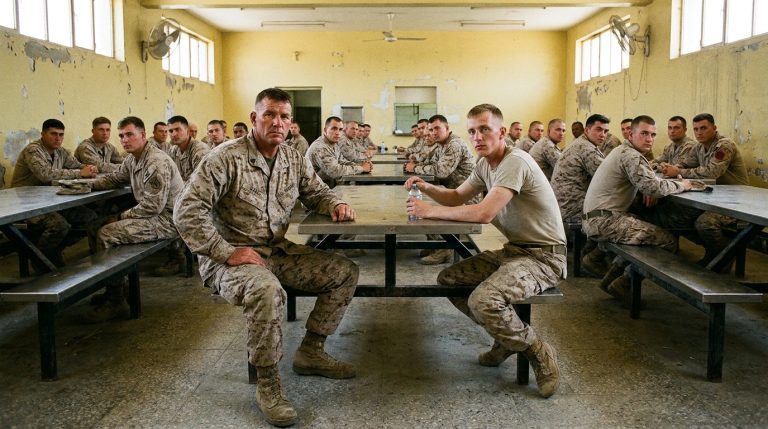
The Surgeon’s Shadow: A Quiet Reclamation of Purpose Within the Sterile Halls of Fort Bragg
CHAPTER 1: The Geometry of Silence
The hallway of the surgical wing at 4:00 a.m. smelled of chemical lemon and the stagnant, heavy air of a building that never slept. Victor Kaine moved with the deliberate, ghost-like grace of a man who had spent three years ensuring no one saw him. His mop pushed a trail of grey, soapy water across the white tile, a metronome for his own breathing.
He kept his pace steady. He kept his head down.
Then, the rhythm of the hospital changed.
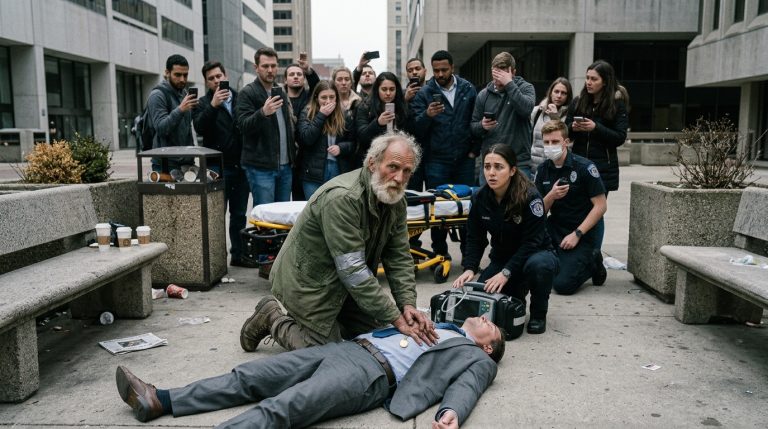
It wasn’t a loud noise, but a sudden, frantic discordance. A gurney rattled against the doorframe of the emergency department. Voices—young, high-pitched with panic—cut through the hum of the ventilation.
“Get me the crash cart! Start compressions!”
Victor’s hand tightened around the handle of his mop. He knew that sequence. He knew the precise, staccato rhythm of the CPR that followed—but as he drifted closer, his internal clock failed to sync with the sound. The compressions were too fast, too shallow. They were hitting the ribs, not the heart.
He reached the threshold of the room. The air inside was freezing, dominated by the sharp, metallic tang of an impending death. Private Luke Brennan lay pale, his skin already beginning to take on the translucent, blue-grey tint of a fading candle. Dr. Rebecca Hartley stood over him, her hands trembling so violently that the rhythmic pressure she applied did more to bruise the soldier than to save him.
Victor looked at his own hands. They were calloused, dry, and stained by years of industrial cleaner. He thought of the watch in his pocket—the one that still ticked with a heart he had long ago deemed silent.
He stepped into the room.
“Get me gloves now,” he said. His voice wasn’t loud, but it carried the absolute, iron-clad authority of a man who had pulled men from the fire in places the map had forgotten.
Dr. Hartley spun around, her face a mask of shock and flickering rage. “Excuse me? Who are you?”
Victor didn’t look at her. He watched the monitor. The flatline was a thin, steady razor blade cutting through his resolve. He saw the way the respiratory therapist’s hands hovered, uncertain.
“I said, gloves,” Victor repeated, stepping over the threshold. He looked at Dr. Hartley, his eyes cold and ancient, revealing nothing of his past, only the terrifying necessity of the present. “You have sixty seconds before his brain turns to jelly. Do you want to be the one who signed his death warrant, or do you want to hand me the gloves?”
The room went completely still. A nurse, driven by a primal recognition of command, reached into the supply bin and held out a pair of sterile latex gloves.
Victor snapped them on. The sound was like a gunshot in the sterile quiet. As he placed his hands over the soldier’s chest, he felt the familiar, terrifying weight of a life balancing on the edge of a blade. He leaned in, the watch in his pocket ticking against his hip.
But as he looked down at the boy’s face, he didn’t see the soldier. He saw the face of someone else—someone he had lost in a cold hospital bed three years ago. The realization hit him like a physical blow: he had been hiding from the pain of losing a life, only to find himself standing in the center of the very thing he had run from.
He pressed down. The resistance was real, the anatomy familiar. He was back. But as he looked up, he noticed something that shouldn’t have been there: tucked into the side of the crash cart, someone had taped a strange, coded photograph of a patient record—one that didn’t match the boy on the table.
CHAPTER 2: The Ghost in the Files
The silence in the operating room had become a physical weight, thick with the smell of ozone and the sharp, chemical tang of the antiseptic Victor had spent three years scrubbing into these very floors. The soldier on the table, Luke Brennan, was breathing now—a ragged, shallow hitch that signaled life had returned to the machine. But Victor’s gaze remained fixed on the crumpled piece of paper he had pulled from the crash cart’s side pocket.
It wasn’t a medical chart. It was a requisition manifest for a series of high-end trauma kits—the kind usually reserved for specialized, off-book surgical units—marked with a stamp that shouldn’t have been in a public-access hospital: Project Nightshade.
“Dr. Kaine?”
The voice was shaky, tethered to the reality of the room. It was Dr. Rebecca Hartley. She was standing by the monitors, her hands still trembling, though now it was from the adrenaline crash. She had witnessed something that defied the laws of the hospital’s rigid hierarchy—a janitor, a man she had looked through a thousand times, performing a procedure that she had only read about in textbooks.
Victor didn’t turn. He tucked the paper into the hidden interior pocket of his blue janitorial smock. “The rhythm is stable, Doctor. He needs to be moved to ICU. Now.”
“Who are you?” Hartley pressed, stepping closer. The fluorescent lights hummed above them, a low-frequency buzz that felt like needles against Victor’s skin.
As the light flickered, the sterile white walls for a split second seemed to dissolve. He wasn’t in the surgical wing of Fort Bragg anymore. He was in a dimly lit hospice room, the air stagnant with the smell of wilting lilies and the metallic taste of his wife’s medication. Eleanor’s hand, thin and translucent, had rested in his, her pulse a failing bird beneath his fingers. He had been a man of science, a man of cold, hard solutions, and he had failed to fix the only thing that mattered.
He blinked, and the image shattered. The hospital room returned, sharp and unforgiving. The phantom weight of Eleanor’s hand was replaced by the cold, biting edges of the surgical tray.
“I’m a janitor, Doctor,” Victor said, his voice flat, stripped of the authority he had wielded moments ago. He picked up his mop from the doorway, his movements once again slow and deliberate. “And your patient is going to wake up. That is all that matters.”
He turned and pushed his cart out into the corridor. The floor he had been cleaning was still wet, a gleaming ribbon of grey. He walked past the nurses’ station, where heads turned and whispers trailed him like static. He ignored them. His mind was racing, not with the surgical precision of the last five minutes, but with the impossibility of the document in his pocket. Project Nightshade at Fort Bragg? He knew this hospital inside and out; he knew every vent, every storage locker, every illicit stash of supplies. There was no such project here.
Someone was using this facility as a shell.
He reached the janitorial closet at the far end of the wing, the door latch clicking with a familiar, rusted protest. Inside, the shelves were organized with a precision that bordered on the obsessive. He set the mop down and pulled the manifest from his pocket. The ink was cheap, smeared by the humidity of the floor cleaner, but the stamp was real.
He looked at his own reflection in the small, cracked mirror hanging on the back of the door. The face staring back was weathered, the skin around his eyes mapped by years of fatigue and exposure to the brutal, unforgiving sun of the combat zones. He had wanted invisibility. He had wanted the silence of the night shift to act as a shroud for the things he had seen and the things he had failed to save.
But silence, he realized, was a lie.
He heard the heavy, rhythmic thud of boots in the hallway—military issue. They were moving with purpose, bypassing the regular wards and heading directly for the restricted files in the administration office. Victor knew those footsteps. He had heard them for three decades. They belonged to the Provost Marshal’s office, the hospital’s internal security.
He didn’t move. He stood in the dim light of the closet, the smell of ammonia stinging his nostrils, and waited. If they were already tracking the requisition manifests, then the janitor who had just performed an unauthorized procedure in OR-4 was about to become the most interesting ghost in the building. He took the watch from his pocket and pressed it into his palm, feeling the steady, uneven heartbeat of the gears.
He wouldn’t run. If he ran, he confirmed he was hiding something. Instead, he reached for his cleaning bucket and began to mix a new, fresh batch of solution, his movements calm, his heart rate low. He would play the role of the invisible man until the moment it was no longer possible to remain in the shadows.
There was a sharp rap on the closet door.
“Victor Kaine?”
The voice was crisp, professional, and entirely devoid of warmth. Victor didn’t look up from his work. He slowly dipped his mop into the bucket, the water swirling with a dark, grey reflection.
“Yes?” he replied, his voice the soft, muted tone of a man who knew his place.
“Colonel Frost wants to see you. Now.”
Victor squeezed the mop, the water dripping back into the bucket in a steady, rhythmic cadence. He looked at the door, then at the stolen document concealed beneath his pile of clean rags. He had spent three years trying to forget the world of command and consequence, but the world had a habit of finding you, regardless of how thin a layer of blue uniform you wore.
“I’ll be right there,” he said. He stepped out of the closet, the mop handle heavy in his hand, a weapon disguised as a tool, and began the long, silent walk toward the center of the storm.
CHAPTER 3: The Weight of the Scrub
The walk to Colonel Frost’s office was a study in the geometry of power. Victor moved through the corridors he had cleaned for three years, feeling the eyes of nurses and technicians following the blue fabric of his uniform. The mop handle felt like an extension of his own arm—heavy, honest, and entirely out of place in the polished, high-traffic arterial of the administration wing. He didn’t rush. He counted his steps, his internal clock clicking in unison with the rhythmic ticking of the watch in his pocket. Each stride was a negotiation between the man he had been and the ghost he had become.
When he reached the mahogany-trimmed doors of the command suite, he stopped. He leaned the mop carefully against the wall. It looked absurd there, a tool of labor against the backdrop of institutional gold leaf. He took a breath, the air here filtered, devoid of the antiseptic sharpness of the surgical wing, smelling instead of paper, aging ink, and the nervous sweat of subordinates.
He pushed the door open.
Colonel Diana Frost was standing by the window, her back to the door. She was watching the morning light slant across the base grounds. She didn’t turn around immediately, and the silence in the room stretched, deliberate and heavy.
“The surgical team is still talking about you, Victor,” she said, her voice dropping into the quiet of the room. She turned then, her expression a careful architecture of professional neutrality. “They aren’t just talking about the technique. They’re talking about the eyes.”
Victor stood by the door, his hands clasped behind his back. He let his shoulders slump just enough to appear diminished, a trick of posture he had perfected to slide beneath the radar of those who only saw what they expected to see. “I was just doing the job, Colonel.”
“A job,” she echoed, gesturing to the chair across from her desk. “Dr. Hartley is convinced you’re a ghost, or perhaps a hallucination brought on by sleep deprivation. She’s documented everything. Every move, every sequence. She’s terrified, and she’s fascinated.”
Victor sat, the upholstery of the chair sinking beneath him. It was soft, too soft compared to the hard benches of the breakroom. He felt the manifest from Project Nightshade pressing against his ribs, a secret weight that made every movement feel like a potential mistake.
“I’m a janitor, ma’am. I know the anatomy of a crash cart because I clean them. I know how to handle a patient because I’ve spent forty years watching how people fall apart.”
Frost sat down, leaning forward. The light caught the silver of her insignia. “I ran your name, Victor. Before the morning meeting. I didn’t find a janitor. I found a combat surgeon who vanished three years ago after the loss of his wife.”
The mention of Eleanor hit him like a physical tremor. He kept his face blank, a wall of stone, but his hand involuntarily tightened inside his pocket, pressing against the worn casing of his watch. The silence that followed wasn’t just about his secret; it was a test. She was waiting for him to break, waiting for the trauma to surface and dismantle the mask of the humble worker.
“My wife’s death wasn’t a tactical failure, Colonel,” Victor said softly, the words measured and cold. “It was the only war I ever lost.”
Frost softened, just a fraction, the sharp line of her jaw relaxing. She leaned back, tapping a pen against the edge of the desk. It was the same rhythm he had used to calm soldiers in the field. She was a tactician, and she was maneuvering him.
“This hospital is a machine, Victor. It operates on protocols, insurance liabilities, and the fear of litigation. You broke the seal. You acted outside of the approved scope, and you saved a life. By doing so, you’ve put a target on your back.” She pulled a file from the side of her desk and slid it toward him. It was thin, the edges frayed. “Risk Management is already drafting a report. They want you removed from the surgical wing. They want you back in the basement, where you can’t disrupt the status quo.”
Victor looked at the file, but he didn’t reach for it. He was thinking about the requisition manifest. Project Nightshade. If they wanted him buried in the basement, it wasn’t just about insurance liability. It was about containment.
“If I go back to the basement, I won’t be able to hear the rhythm of the floor anymore,” Victor said, a strange, dark note of humor in his voice. “Is that what the hospital needs? A janitor who can’t see the dirt?”
Frost looked at him, her eyes searching his face for the man she had read about in the service records—the legend who had operated in the dust and fire of a dozen different conflicts. “I need someone who can see the truth, Victor. The staff here has become too accustomed to the screens, the diagnostics, the distance between the doctor and the dying. They’ve forgotten how to feel the pulse of a human being with their own hands.”
She reached out and tapped the desk. “I’m going to make you an offer. I can block the Risk Management report, but it will cost you. You’ll be watched. Every move you make, every word you say, will be scrutinized by people who don’t care about the lives you save. They only care about the lines on the charts.”
Victor finally reached out and took the file. He didn’t open it. He could feel the pulse of the hospital outside the window—the sirens, the frantic footsteps, the hum of the cooling units—and he knew he was already deeper in than he intended.
“Why me?” he asked.
“Because,” Frost said, her gaze steady, “you’re the only person in this building who isn’t afraid of the blood. And because I think you’re looking for something that got lost three years ago.”
She stood up, signaling the end of the conversation. Victor rose, his knees aching slightly from the long hours on the cold floors. As he walked toward the door, he stopped with his hand on the handle.
“The crash cart in OR-4,” he said, his voice barely a whisper. “The requisition manifest taped to the side. Who is authorized to use it?”
Frost’s eyes flickered—a momentary lapse in her composure that she recovered in a heartbeat. “That’s a specialized supply list, Victor. It shouldn’t have been in a public area. Why do you ask?”
“I don’t like messes,” he said, and he left the office, leaving the Colonel in the silent, suffocating air of the command suite, his mind already calculating the next shift.
CHAPTER 4: The Shadow of the Scrub
Victor’s exit from the command suite felt less like a departure and more like a tactical retreat under fire. He had the file in his hand, its edges rough against his calloused palm, but his focus was not on the paper. It was on the silence that had followed his question about the requisition manifest. Colonel Frost, a woman whose entire career was built on the precision of information, had faltered. That flicker of hesitation was a crack in the foundation—a signal that the institution he worked for was not just flawed; it was compromised.
He kept his pace steady as he walked back toward the surgical wing, but his senses were dialed to an unnatural sharpness. The hospital felt different now. The hum of the equipment seemed less like a life-saving symphony and more like a drone of concealment. Every orderly he passed, every doctor rushing with a chart, seemed like a potential sentry.
He reached the surgical hallway just as the lights flickered. A deep, resonant thrum vibrated through the floorboards—a power surge. For three seconds, the corridor plunged into absolute, suffocating darkness.
The sound of the hospital changed instantly. The constant beep of telemetry monitors died, replaced by the chaotic, urgent shouts of nurses and the scraping of metal gurneys against tile. Victor stood perfectly still in the dark, his back against the wall, his breathing slowed to a surgeon’s calm. He didn’t move. He listened.
Above the din of the panic, he heard it: a specific, rhythmic metallic click—not the sound of a falling tool, but the precise locking of a heavy steel drawer in the supply closet.
Someone was in the surgical wing, and they weren’t trying to save a patient.
Victor moved. He didn’t use the emergency lighting. He knew the geography of this wing by the texture of the floor beneath his boots—the smooth, high-grade finish near the ORs, the rougher patch near the biohazard disposal. He navigated the darkness like a predator, his fingers brushing the wall until he reached the handle of the supply closet.
The door was locked. He waited, his ear pressed to the cold steel.
“The timeline is compressed,” a voice whispered from inside, muffled and sharp. It was a man, his voice tight with the frantic edge of someone who knew they were running out of time. “If the janitor stays, the variable is too high. We need to initiate the bypass tonight.”
“The janitor is a ghost,” a second voice replied—a woman’s, calm and eerily familiar. “He’s a relic of a dead era. He’ll be back to scrubbing floors by morning. The file is already being scrubbed from the digital server. By the time he realizes what he’s holding, he’ll be a liability we can manage.”
Victor felt a chill crawl up his spine that had nothing to do with the air-conditioning. He recognized that second voice. It was Dr. Jennifer Marx, the head of Risk Management—the very person who had been petitioning for his termination since he arrived.
His grip tightened on the mop handle he had left propped nearby. He was a veteran of the long, slow, grinding wars where victory was measured in survival, not conquest. He knew how to move in the dark. He knew how to wait.
He didn’t confront them. He didn’t make a sound. Instead, he pulled a small, heavy container of industrial floor stripper from his belt—a chemical so caustic it could melt the finish off the floor in seconds—and quietly, with agonizing slowness, he began to pour a thin, precise line of it under the door of the supply closet.
He didn’t need to fight them. He needed to create a distraction that would force them into the light.
As the acid hissed against the tiled floor inside, the smell of volatile, stinging chemicals began to billow out. A coughing fit erupted inside the closet. The door handle rattled, the lock clicking open as the inhabitants panicked at the sudden, sharp chemical burn in their lungs.
Victor turned and moved back into the shadows of the alcove near the emergency department. He watched as the door swung open, and Marx and the man—a technician he didn’t recognize—stumbled out, clutching their eyes and coughing violently.
They were exposed.
Marx wasn’t looking at the patient wards. She was looking at the discarded file folder that lay on the floor near the command suite. She was panicking, her movements erratic and uncoordinated.
Victor watched them from the darkness of the alcove, his pulse slow and methodical. He could have intervened. He could have confronted them with the manifest he carried, but that would have ended the game too early. He saw the way Marx reached for her phone, her fingers trembling as she dialed. She wasn’t calling security. She was calling someone outside the hospital.
Layer 1 was crumbling, but it was just a shell.
He understood then. The hospital wasn’t just hiding a project; they were using the medical chaos—the mass casualty events, the emergency surgeries—as a staging ground for a much larger, more illicit operation. The Project Nightshade files weren’t just about medicine. They were about control.
He turned and slipped away into the service stairwell just as the main power grid sputtered back to life. The overhead lights hummed to a blinding, harsh white. The nurses were calling for assistance, the alarms were blaring, and the hospital was waking up from its three-second nightmare.
Victor began to descend the stairs, his boots hitting the concrete with a hollow, rhythmic sound. His heart wasn’t racing. He felt a strange, chilling clarity. He had spent his life trying to fix bodies, but for the first time, he realized that some things couldn’t be fixed—they had to be surgically excised.
He reached the basement level, the air stale and quiet. He pulled the manifest from his pocket, the paper damp with his own sweat. He looked at the list of names under the project header—names of soldiers who had gone missing in the field, soldiers he had treated, soldiers he had thought had gone home.
The realization wasn’t just a discovery; it was an accusation. He had been so focused on his own grief that he hadn’t seen the truth happening right beneath his mop. He wasn’t just fighting for his dignity. He was fighting for the soldiers they were discarding like biohazard waste.
He stepped into the basement locker room, his shadow stretching out long and jagged against the concrete wall. He was no longer a ghost. He was the one thing they didn’t anticipate: a man who had nothing left to lose and everything to remember.
He took his watch from his pocket, opened the back casing, and removed the small, micro-etched lens he used to inspect surgical instruments. He set it against the light of the basement bulb, turning it until the beam caught the hidden code printed on the manifest.
The numbers aligned, revealing not a supply list, but a manifest of names.
He wasn’t going back to the surgical wing as a janitor. He was going back as the surgeon who was going to take the hospital apart, piece by piece, until the truth was on the table.
CHAPTER 5: The Surgical Excision
The basement stairwell was a throat of raw concrete, cold and unyielding. Victor’s footsteps were ghosts against the hard surface, each one carefully measured to avoid the vibration of the metal landings. His fingers were white-knuckled around the manifest. The names on the page weren’t just lists; they were legacies he had once been responsible for protecting.
He didn’t need to check his watch to know that he had been gone for too long. If Marx had alerted her handlers, the security protocols in the basement would already be shifting from routine maintenance to active lockdown.
He reached the heavy steel door that separated the stairwell from the hospital’s sub-basement—a utility labyrinth that housed the primary power arrays and the data cooling racks for the facility. He pushed the door open just an inch. The smell hit him first: hot plastic, ozone, and a thin, chemical layer of something that didn’t belong in a hospital—the smell of industrial-grade incinerator waste.
This was the core of Project Nightshade.
He slipped inside. The sub-basement was a cathedral of blinking lights and humming servers, vast and sprawling. He navigated the shadows, his eyes scanning for the specific configuration of the security terminals he had serviced as a janitor. He knew where the vulnerabilities were; he had spent three years fixing the systems that were now being used to bury the truth.
He reached the main terminal, his hands moving with the muscle memory of an old combat surgeon. He didn’t hack the system; he bypassed it. He knew the master reset for the hospital’s internal server was tucked behind the cooling fan array—a legacy quirk from when the building was first commissioned.
As he knelt, the hum of the cooling fans changed pitch. A strobe light bloomed in the distance—the silent alarm. They knew he was here.
“You should have stayed in the dark, Victor,” a voice echoed through the vast, industrial space.
It was Marx. She emerged from behind the rows of server racks, flanked by two men in tactical gear. They didn’t look like hospital security; they moved with the professional, detached fluidity of private contractors.
Victor stood slowly, his hands held away from his sides. The manifest was tucked securely in his waistband.
“I was a surgeon,” Victor said, his voice steady despite the adrenaline spiking in his veins. “I’ve spent my life fixing messes. This mess has your signature all over it.”
“You’re a janitor,” Marx corrected, her eyes scanning the terminal behind him. She was moving toward him, her hand hovering near a concealed sidearm. “And janitors are meant to clean up the dirt, not question where it comes from. You saved that boy, and you think that makes you a hero? You’re just a variable that needs to be removed.”
“The soldiers on that list,” Victor said, his eyes locking onto hers. “They didn’t just disappear. You used them for the trials. You traded their lives for the metrics of this hospital’s success.”
Marx stopped, her expression hardening. She didn’t deny it. “Efficiency is the only metric that matters in a war-torn world, Victor. We aren’t failing them. We’re giving them a purpose beyond their expiration date.”
“That isn’t purpose,” Victor said, and in that moment, he felt the weight of every loss he had endured in his career. “That’s theft.”
He lunged. Not toward her, but toward the fire suppression control panel directly above the server racks. He didn’t need a weapon. He needed to trigger the Halon gas dump.
One of the contractors lunged for him, but Victor moved with the surprising, kinetic force of a man who had spent his life operating in the chaos of a field tent. He ducked under the man’s reach, grabbed the fire-pull, and slammed it down.
The sound was instantaneous—a deep, cavernous roar of rushing gas. The sub-basement erupted in a blinding, white-out fog of suppression chemicals.
Marx screamed for her men to secure the terminal, but the fog was absolute. Victor didn’t try to fight them. He moved to the secondary maintenance hatch—a narrow crawlspace he had used to hide from his own grief for three years. He crawled inside, the metal scraping against his ribs, and pulled the hatch shut behind him.
He was in the dark again, but it was a different kind of dark. He had the manifest. He had the truth. And now, he had the leverage.
He crawled through the labyrinth of ducting, the air thick with the metallic tang of the suppression gas. He was heading for the communications relay on the rooftop. It was the only place left in the hospital where the signal couldn’t be scrubbed by the internal servers.
He moved with the exhaustion of a man who was nearing the end of his tether, but his mind was clear, a surgical blade carving through the confusion. He wasn’t just exposing them; he was dismantling the system.
As he reached the final access panel, his fingers brushed against the cold, familiar texture of the hospital’s main wiring harness. He began to strip the wires, his movements precise and uncaring of the sparks that showered his skin. He had three minutes before the backup power cycled, and he intended to use every second to broadcast the manifest to the one place Marx couldn’t hide it—the public record.
He wasn’t a janitor. He was the only thing standing between the truth and the abyss.
He completed the final connection, and the signal hummed to life, a steady, bright pulse in the dark.
CHAPTER 6: The Final Stitch
The wind on the roof was sharp, smelling of ozone and the coming rain. Victor stood by the relay, his hands trembling—not from fear, but from the sudden, profound release of tension. The signal was out. The manifest, the names, the evidence of the shadow trials—it was all broadcasting now, pulsing into the digital ether.
He didn’t have to wait long. From the doorway leading to the roof, footsteps crunched on the gravel. He didn’t turn. He knew who it was.
General Diana Frost walked toward him, her uniform sharp against the grey sky. She stopped ten feet away. Behind her, the tactical teams were waiting, their weapons holstered, their faces masks of professional uncertainty. They weren’t here to kill him; they were here because the order had changed. The signal had hit the Pentagon, the press, and the board.
“You did it, Victor,” she said, her voice stripped of its command authority. It was quiet, human.
“I did what I had to,” Victor replied, turning finally. His blue janitor’s uniform was stained with dust and chemicals, his hands raw. He looked older than he ever had, but his eyes were clear, the fog of the last three years finally burned away.
“Marx is in custody,” Frost continued, looking out over the city. “The board is convening. You’ve brought the system down, but you’ve left a vacuum. People will be looking for someone to blame for the survival of the program, even if you just exposed it.”
“Let them look,” Victor said. He reached into his pocket and pulled out the old, worn watch. He opened the case, the rhythmic ticking echoing in the silence.
The Payoff arrived ten minutes later. As the sun began to break through the clouds, lighting up the hospital grounds below, a line of black sedans pulled into the main entrance. Men in suits—not the contractors, but federal investigators—poured out, their presence signaling the absolute, systemic collapse of the Nightshade initiative. He watched as they moved through the lobby, arresting the department heads, seizing the hard drives. It was cold, clinical, and perfect.
The Poetic Justice took a quieter form. He watched from the roof as Dr. Sinclair, the man who had once mocked him, walked out the front door, his career in ruins, stripped of his badge and his title. He wasn’t escorted out in handcuffs, but he walked with the slumped, defeated posture of a man who realized that all his institutional power had been a hollow shell. He had been so focused on his status that he’d missed the rot at the core, and now, he had to live with the silence of his own obsolescence.
The Cool Down set in as the chaos on the ground subsided. Victor walked back into the hospital, through the corridors he had scrubbed for a thousand days. The staff didn’t whisper anymore. They watched him with a strange, heavy reverence. He reached the janitorial closet, the familiar space where he had hidden his grief and his purpose.
He looked at the mops, the buckets, the cleaning supplies. He picked up his own, the handle smoothed by his grip. He walked to the supply sink and, with slow, steady movements, he began to clean it. He scrubbed away the grime of the last three years, the chemical stains, the dust of his own isolation. It was a rhythmic, meditative act. He was putting the world back in order, one square inch at a time.
Then came the Symbolic Closure. He reached into his pocket and took out the watch—the one that belonged to his life before, the one that had ticked away his grief. He looked at the cracked glass, the frayed leather strap. He thought of the soldiers who had sent him letters, the lives he had repaired with his hands. He took the watch and, with a finality that felt like a healing, he placed it on the shelf, leaving it behind. It was a relic of a ghost. He was no longer that man.
The Character Arc settled in the quiet of the room as a figure appeared in the doorway. It was the young nurse from the first night, the one who had handed him the gloves when no one else would. She didn’t say anything. She just stood there, watching him work.
“You’re not leaving, are you?” she asked.
Victor looked up. He thought of the consulting role, the international travel, the acclaim—and he thought of the quiet, honest work of healing.
“I have some training to finish,” he said, his voice soft. “And I think there’s a lot of work left to do.”
He stepped out of the closet, leaving the janitor’s uniform hanging on the hook one last time. He felt the weight of the scalpel in his mind—the muscle memory returning, the clarity of a diagnosis, the simple, beautiful imperative of doing the work.
He walked down the hall, toward the surgical wing, not as a ghost, but as a man who had finally earned the right to heal. The world was messy, and the system would always be flawed, but he knew the truth now: as long as there were hands to do the work and a heart to care for the outcome, the dignity would hold.
He walked into the OR, the doors swinging open with a soft, decisive click, and the light hit him—warm, bright, and waiting.