The Iron Boundary: A Master Sergeant’s Calculated Dismantling of a Suburban Empire Built on Fraud
CHAPTER 1: THE FIRST SHOT
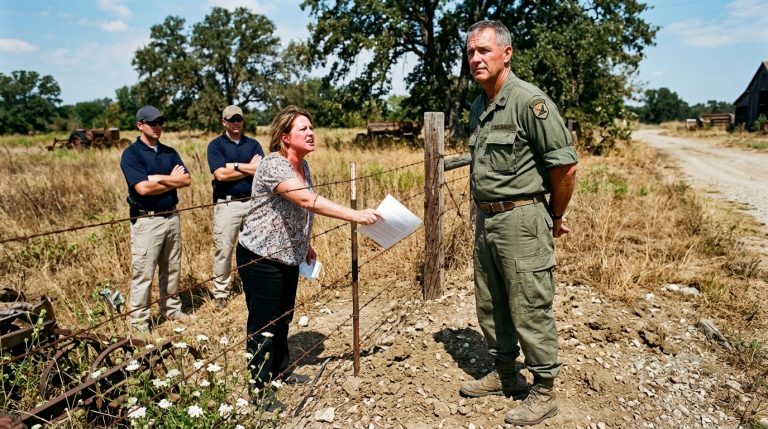
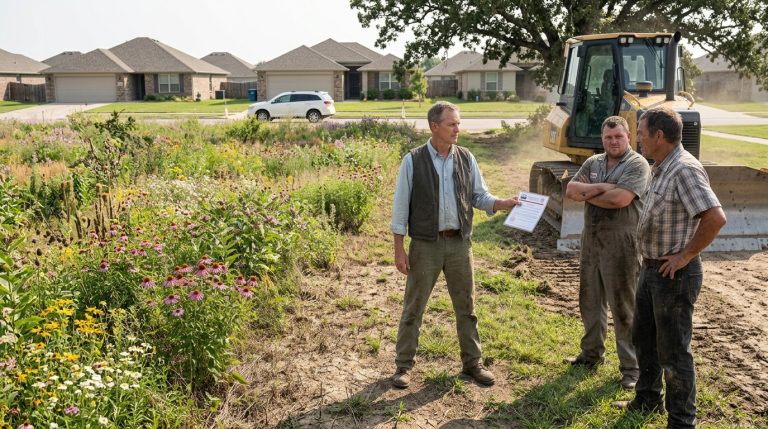
The clipboard hit the gate, and with it, the quiet hum of my retirement shattered. Karen stood there, a pastel-pink anchor in the middle of my driveway, clutching her HOA binder as if it contained the constitution of the entire county. She wasn’t just a woman in a pantsuit; she was the physical manifestation of a suburban infection, and she had just stepped across the property line I had spent twenty years of my life and a Marine Corps pension to secure.
I didn’t blink. I didn’t shout. I stood on the porch of the farmhouse my grandfather built, my boots planted firmly on the weathered wood, watching the way her gaze flicked over my workshop—that pole barn I’d raised by hand—with the predatory disgust of someone calculating a tax deduction.
“Mr. Thorne,” she began, the name sharp and transactional on her tongue. “The beautification committee has noted your refusal to comply with article 7. The creek is no longer under your jurisdiction. It is a community water feature.”
I walked down the steps. The gravel under my boots sounded like a drumbeat, steady and rhythmic. I didn’t look at her face; I looked at her hands. They were pale, trembling slightly with the arrogance of someone who had never been told ‘no’ in a way that actually stuck. She was holding the citation out to me, a crisp, white paper that looked like a flag of truce but tasted like an ultimatum.
I didn’t take the paper immediately. I stopped a foot away, letting the weight of the moment expand between us. I thought about the deserts of Iraq, about reading topography maps in the pitch-black of a moonless night, identifying where the enemy had dug in based on the slight, unnatural dip in the sand. Karen thought she was playing a game of lawn maintenance, but she had just stepped into a kill box she didn’t know existed.
“Karen,” I said. My voice was low, devoid of heat. It was the voice I used when a junior enlisted soldier made a mistake that could cost lives. It was the sound of a closing door. “You’re standing on private property. You have exactly ten seconds to turn that golf cart around and exit my land before I have the sheriff escort you off for criminal trespass.”
Her eyes went wide, the smug certainty flickering into a confused, indignant rage. She tried to puff out her chest, to rely on the badge of authority pinned to her lapel, but the look in my eyes stopped her. She realized, for the first time, that she wasn’t talking to a simple farmer. She was talking to a man who had spent his career dismantling threats twice as complex as her petty committees.
She recoiled, stumbling back toward her cart. “This is an HOA matter! We have lawyers!”
“Then you’d better go talk to them,” I replied, my gaze locked on the specific discrepancy I’d noticed the moment she arrived: the missing boundary marker near the creek edge, which she’d likely had her own crew pull to ‘clean’ the site. “Because you just walked into a legal nightmare you aren’t prepared to survive.”
She scrambled into the cart and peeled away, but she left the paper on the gate. I didn’t touch it. I turned and walked toward my office. My grandfather’s deed was waiting on the desk, and I had a war to document.
CHAPTER 2: THE RECONNAISSANCE
The farmhouse didn’t breathe with its usual comfort tonight. The walls, lined with the history of three generations of men who held their ground, felt like they were leaning in, waiting for the first move. I didn’t sit at the dining table. I went straight to the small room at the back, the one that smelled of old tobacco and the dry, metallic tang of an M-16 cleaning kit. My office.
I sat down, the chair’s wood creaking under the weight of my anticipation. I didn’t turn on the overhead light. I snapped on the desk lamp, a single, harsh beam of yellow that turned the mahogany desk into an island of illumination. I reached into my shirt pocket and pulled out the citation Karen had jammed into my gate. It was a flimsy, digital-printed sheet of paper—the kind of corporate nonsense that thinks a bold-faced font can rewrite the laws of property. I smoothed it out on the desk, not with care, but with the flat of my palm, as if I were pressing a bug against the surface to examine its wings.
My mind drifted—a dangerous, involuntary slide—back to the flat, bleached plains of the desert, where a shift in the shadow of a ridge could be the difference between a secure perimeter and a catastrophic breach. I could almost smell the cordite and the dust of the valley floor, the phantom pressure of a radio handset in my palm. It wasn’t nostalgia; it was a calibration. I was looking for the same things here: the lines of sight, the enemy’s hidden intent, the logistical flaws in their aggressive posture.
Karen had identified the creek as a community feature. That was the decoy. That was the psychological hook they were using to draw me into a brawl, hoping I’d scream, hoping I’d overreact so they could frame me as the aggressor. But a developer like Harris didn’t care about a “community feature.” Harris cared about density. He cared about the acreage required for a drainage buffer—a state-mandated environmental requirement that Whispering Pines had likely failed to meet during the zoning phase.
I reached for the accordion file, my movements measured, stripped of the excess energy that usually defines a nervous man. I didn’t feel nervous. I felt the slow, steady rise of a tactical surge. I pulled out the original 1952 deed. It was heavy, the parchment brittle and yellowed, smelling of time and ownership. My grandfather’s signature was there, a dark, forceful ink-stain that had withstood seventy years of storms, wars, and bureaucratic shifts.
I opened the modern topographical survey I’d commissioned in 2015. I laid it over the deed, the laser-measured precision of the modern map aligning perfectly with the metes and bounds of the old. There was no ambiguity. The creek was, and had always been, 200 feet deep inside my territory.
The strategy clicked. Harris hadn’t made a mistake. He’d made a bet. He was gambling that I wouldn’t have the stomach for a war of attrition, or that my documents would be just old enough to be “legally debatable.” He was counting on the HOA’s constant, low-level harassment to make the cost of defending my land higher than the land was worth. It was a classic pincer movement: bureaucratic pressure from the county to squeeze the permits, and social pressure from the HOA to force a surrender.
I pulled out my phone and dialed the number for the county register of deeds, my eyes tracking the path of the creek on the map. I was going to find out exactly what they had filed, the specific lie they had submitted to the planning commission to bypass the environmental buffer mandates.
The house was quiet, save for the rhythmic tick of the grandfather clock in the hall. My wife, Sarah, appeared in the doorway, her silhouette cast against the soft light of the hallway. She didn’t speak. She knew that look—the one where the lines around my eyes tightened and my shoulders shifted into a defensive posture. She just looked at the stack of papers, the war of the maps, and nodded. She trusted the precision. She trusted the history.
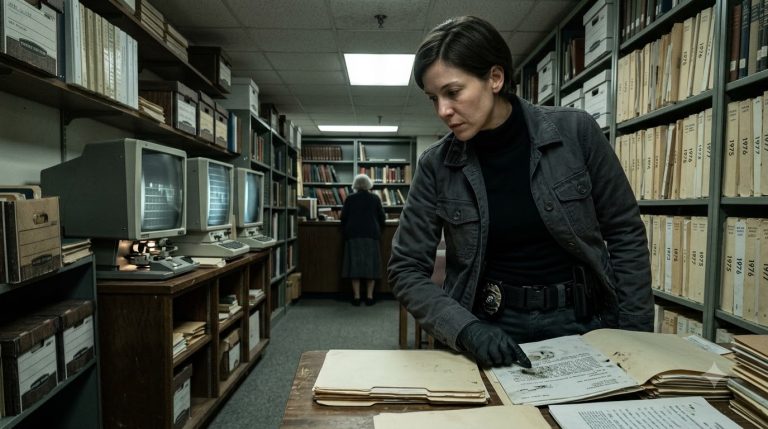
I started taking notes, my pen scratching against the paper like the sound of dry leaves. Reconnaissance. Identification. Neutralization. I wasn’t just defending a creek anymore. I was dismantling an infection. And the first step wasn’t a shout. It was a visit to the dusty, windowless records room where the truth was kept, buried under layers of official, deceitful ink.
CHAPTER 3: THE COUNTERINTELLIGENCE
The ink was still wet on the legal pad when I pushed the chair back. My eyes were burning, the yellow light of the desk lamp having etched a glowing, circular ghost onto my retinas. I stood up, the floorboards of the study groaning under the weight of my shift, and moved to the bookshelf where the old property logs were kept. These weren’t just books; they were the physical memories of the land.
I pulled out a leather-bound volume, the cover worn smooth by my father’s hands. I didn’t open it immediately. I let my fingers trace the spine, the texture of the grain telling me exactly where the 1985 survey notes were tucked away. If Harris and his HOA were going to play the game of bureaucratic erasure, I would counter with a depth of record they couldn’t possibly account for. They had the corporate team, the fancy lawyers, and the pastel-pink enforcer, but they were working off a plat map that was barely five years old. They had no idea what lived in the archives of this farm.
I took the volume to the desk and opened it. The pages were thick, smelling of dust and dried cedar. My father had been a stickler for detail—a trait I’d inherited and, in the Marines, weaponized. He’d recorded every seasonal shift of the creek, every storm that changed its flow, and every survey marker that had been verified since the day we acquired the acreage.
There, on a page dated August 1985, was a hand-drawn diagram. It was simple, precise, and devastating. It showed the original iron pins driven into the bedrock at the 200-foot offset. I looked from that drawing to the fraudulent map Harris had filed with the county. The difference was small, a mere thirty-foot drift in the boundary line at the northern bend, but in the world of zoning and buffer zones, that drift was the difference between a compliant development and a permit-violating disaster.
That was the “why.” Harris didn’t just want my land for the prestige of a creek-side walking path. He needed that specific thirty-foot stretch of topography to satisfy the state’s environmental requirements for storm-water runoff. Without it, the density of his beige mushrooms—those identical houses he was planting—was illegal. The entire development was perched on a knife-edge of permit fraud.
My pulse, which had been steady for hours, shifted. It wasn’t adrenaline—I’d left that back in the sandbox—it was the cold, focused clarity of a combat engineer finding the fault line in a fortification. I picked up my phone. It was 2:00 AM, but I didn’t care about the hour. I navigated to the contact I’d saved from my research into local zoning law: an investigator named Elias Thorne, a man who had made a career out of exposing the shell games played by developers in the state capital.
I didn’t call him yet. Instead, I began to draft the email. I kept it clinical, transactional, and devoid of the righteous indignation that the HOA expected. I attached high-resolution photos of my father’s 1985 diagram, the 1952 deed, and the blatant, fraudulent jogs in the Harris plat map. I laid out the discrepancy as if I were submitting a structural report to a commanding officer.
I needed eyes on this—expert eyes. If I was right, the county hadn’t just been deceived; they had been complicit, or at the very least, negligent in their vetting.
I paused, the pen hovering over the desk. The farmhouse settled around me, the wind outside tapping a branch against the siding. It was a rhythmic, insistent sound, like someone knocking on a door that was already locked. I thought of Karen, of her pastel suit and her jewel-encrusted fingers pointing at my workshop. She was the decoy, the noise meant to keep me looking at the fence line while the real theft happened in the zoning department.
She was a fool, but she was a persistent one. She’d be back. She wouldn’t be able to help herself. The violation notices were her way of asserting dominance, a way of proving she could manipulate the physical environment of my world. Let her try. Every time she stepped over that line, every time she sent a contractor, every time she put a piece of paper on my gate, she was leaving a trail of evidence that I was collecting, piece by piece, into a narrative of systematic harassment.
I closed the ledger. The plan was shifting from a defensive perimeter to an offensive maneuver. I wasn’t going to fight them on their terms. I was going to pull the pins out of their entire project. I set the phone down and looked toward the window, toward the dark, unseen line of the woods where the creek flowed, deep and undisturbed. They thought they were the architects of this future, but they were just building on sand. I had the bedrock, and I had the documents to prove it.
The silence of the house felt different now. It wasn’t the silence of a retreat. It was the silent, steady breath of a trap, set and waiting for the pressure to be applied.
CHAPTER 4: THE ESCALATION
I didn’t move toward the front door. Instead, I bypassed the living room and stepped into the kitchen, my movements fluid, habitual, born of years spent operating in environments where sound was a luxury. I reached for the heavy iron lantern hanging by the mudroom—a tool as solid and pragmatic as the land I was defending—and clicked it on. The beam was narrow, surgical, cutting a path through the gloom of the house.
I wasn’t just reacting; I was conducting a sweep. If Karen or the developer had someone watching the property—and given the audacity of their claims, I had to assume they were doing exactly that—they wouldn’t be expecting me to come out this way. They were expecting the predictable anger, the impulsive confrontation at the front gate. They were waiting for me to be the “enraged farmer.” I was going to be the engineer instead.
I eased the mudroom door open, the hinges silent, greased by my own hand months ago. The night air was biting, carrying the sharp, iron scent of Miller’s Creek. I didn’t head for the road. I moved toward the timberline, staying in the shadows of the old barn. The ground here was uneven, littered with the detritus of seventy years of logging, but I navigated it with a memory written into my feet.
As I reached the edge of the woods, I stopped. My senses, long honed to the static and chaos of combat, shifted to the rhythm of the forest. There was a difference in the air, a minute shift in the way the wind moved through the rhododendrons. It was the feeling of being watched, a prickly sensation at the base of my neck that defied logic. I stood motionless, blending into the dark geometry of a pine trunk, waiting for the forest to reveal its secrets.
Minutes passed. The silence was absolute, yet layered. Then, I heard it: the faint, rhythmic ‘clack-clack’ of a high-end golf cart battery engaging—a sound too distinct for any local wildlife. It was moving along the perimeter path they had carved out on their side of the creek. They weren’t just monitoring the boundary; they were patrolling it, looking for any sign that I was moving to block their upcoming “remediation” action.
My pulse didn’t spike. It leveled out. This was a tactical error on their part, a blatant overreach that I could now document. I didn’t reach for my phone; I reached for the small, low-light binoculars kept in my coat pocket. I pressed them to my eyes, scanning the tree line. The moonlight was thin, filtered through the thick canopy, but it was enough to catch the glint of a polished metal emblem on the front of the cart: the logo of Whispering Pines.
They were doing more than watching. I watched through the lenses as a man—not Karen, but someone in a corporate windbreaker—stepped out of the cart and began measuring the distance from the creek bed to a tree I knew to be on my side of the line. He wasn’t surveying; he was staging. They were marking the ground for the landscaping crew, ensuring their heavy machinery had a clear path to tear up my buffer zone come Monday.
He dropped a marker, a bright, reflective stake that caught the moonlight like a beacon. The sheer, unadulterated arrogance of it left me cold. He thought the darkness was his shield. He didn’t know that I had already spent hours memorizing the topography of this stretch of land, and that every square inch of it was currently being recorded by my internal map.
I didn’t confront him. To step out would have been to play into their hand, to give them the “hostile landowner” incident they needed to call the local police. Instead, I watched, recording the position of the marker in my mind, noting the time, and identifying the man’s features as best I could. I was gathering the intelligence for the counter-strike.
As they moved on, the cart whirring softly into the darkness, I didn’t retreat to the house. I stayed. I moved along the line, parallel to their patrol, until I reached the spot where they had placed their marker. I didn’t pull it. I didn’t destroy it. That would be a reactive move. Instead, I carefully, almost surgically, relocated it three feet to the left—straight into the middle of a thick, rotted stump that was impossible to clear without specialized equipment. It was a subtle, invisible shift, but when their crew showed up on Monday, they would hit that stump, break a chain on their saw, and stall in the exact location where I needed them to be to trigger a formal complaint.
It was a small, precise sabotage, the kind that created friction without violence. My hands were steady as I moved back through the trees, the cold air filling my lungs. I felt a grim, dark satisfaction. They were playing a game of intimidation, but they were playing it with someone who understood the logistics of chaos. Every step they took, every move they made to “clean” my land, was just another layer of evidence proving their intent to trespass.
I returned to the farmhouse and locked the mudroom door behind me. I didn’t go to bed. I went back to the office, the leather-bound survey logs waiting, and began to map out the exact sequence of events for my meeting with Abernathy. I had the timing, the location, and the evidence of their preemptive trespass. The trap wasn’t just set; I was now baiting the line, ensuring that when they stepped forward, they wouldn’t just be entering my property—they would be stumbling into the very evidence that would strip them of their permits for good.
The house was still, but the air felt charged. I picked up the phone, and this time, I made the call to Elias Thorne. It was time to pull the strings on the puppet.
CHAPTER 5: THE TACTICAL DEPLOYMENT
I stepped away from the desk, the phone still warm in my hand, and moved toward the mudroom. The rhythm of the house was different now—tight, coiled, expectant. The idling engine outside wasn’t a random arrival; it was a calibrated move, a check on their territory. I clicked the lantern off, plunging the hallway into a deep, impenetrable gray, and moved to the window overlooking the gravel drive.
The vehicle was parked halfway up the path, its headlights extinguished, but the interior glow illuminated the silhouette of a man leaning over a set of plans. It was a county-marked truck, yes, but the placement was entirely off-protocol for a standard inspection. They were scouting the secondary access to the barn—the one I used to maintain the forestry equipment.
I didn’t wait. I stepped out the side door, my boots hitting the soft mulch instead of the gravel, keeping my body low, shadowed by the dense row of pines that bordered the workshop. The cold air felt like a physical weight, sharpening my focus. I moved with the silent, practiced economy of a man navigating a known landscape, closing the distance to the truck from the blind side.
As I reached the rear bumper, the door swung open. A man stepped out, a reflective vest over a polo shirt—the standard uniform of the county zoning department. But he didn’t move toward the house. He moved toward the boundary flags I had set. He had a flashlight in one hand and a surveyor’s laser in the other. He wasn’t there to inspect; he was there to verify the layout for the crew they planned to send on Monday.
The “Butterfly Detour” hit when he stumbled. His foot caught on the edge of the stump where I’d relocated their marker. The heavy thud of his flashlight hitting the dirt was followed by a sharp, jagged curse. He shone his light on the stump, his frustration palpable, then began to pace the area, his laser dancing over the grass.
I didn’t call out. I waited, observing the discrepancy. He was looking for the marker they had placed, but the relocation had thrown his readings off by precisely the three feet I’d intended. He moved his device, recalibrated, paced again, and then swore louder. His frustration was a tactical victory; he was struggling to force reality to align with the fraudulent plat map Harris had submitted.
“Dammit,” he muttered, loud enough for me to hear over the low gurgle of the creek. He pulled out a radio. “Yeah, I’m at the north bend. The markers are all over the place. I can’t get a lock on the easement baseline. It’s… it’s not matching the county file.”
The radio crackled back with a harsh, impatient voice—the developer’s voice, I recognized it from the zoning hearing tapes I’d studied. “Just mark it for the crew, Jim. We need that buffer zone cleared by Monday morning. If the line is off, adjust it to the creek bank. We have approval for the corridor.”
Adjustment to the creek bank. The confession was plain, casual, and utterly illegal. They were knowingly overriding the plat map in real-time, relying on the “flexibility” of the crew to just take what they wanted. I had him. I had the confirmation that the encroachment wasn’t a mistake—it was a mandated instruction.
I pulled out my phone, set the sensitivity to low light, and began recording. I didn’t need to be close; the audio was crisp in the still night air. I captured the inspector’s frustration, the developer’s instruction, and the visual proof of them violating their own submitted plans.
But then, the unexpected shift occurred. The inspector, sensing something—the way the wind changed or perhaps the subtle sound of my breathing—froze. He swung his flashlight beam in a wide, sweeping arc. I shifted behind the trunk of a massive oak, the bark cold and rough against my cheek. The light cut through the air, inches from where I stood, illuminating the exact spot I’d been seconds before.
He moved toward the woods, his step tentative now. The playfulness of the “inspection” had evaporated, replaced by a nervous, twitchy energy. He didn’t want to be here. He knew he was walking into a place he didn’t own, on land that was currently being disputed. He reached the edge of the treeline, his beam probing the deep, black throat of the woods.
My hand tightened on the handle of my multi-tool, the only thing I’d brought with me. I wasn’t going to engage, but the proximity, the sudden violation of my sanctuary, triggered a surge of cold, defensive resolve. I was the sovereign of this patch of earth.
He lingered for another thirty seconds, the light wavering, then turned back, his movements hurried, desperate to get back to the safety of his truck. He didn’t finish the marking. He scrambled back to the driver’s side, started the engine, and backed down the gravel drive with enough speed to kick up a shower of stones.
I watched him go, the taillights fading into the distance. I stayed in the dark for a long time, the silence of the woods returning, but it wasn’t the same. The boundary had been breached, the enemy had scouted my position, and the clock was now running at a sprint. They were coming on Monday, and they were going to come with force.
I walked back to the house, the recording saved and encrypted on my phone. The “escalation” hadn’t just arrived; I had invited it, and I had recorded its arrival. The trap was no longer just for Karen; it was for the entire machine. I entered the kitchen and saw Sarah standing by the island, her face pale. She’d heard the truck, heard the engine.
“They’re not coming to talk, are they?” she asked.
“No,” I said, my voice steady, the cold fire of the resolution finally burning through the last of the fatigue. “They’re coming to finish it. And I’m going to make sure that when they get here, they find exactly what they deserve.”
CHAPTER 6: THE FINANCIAL GRENADE
The sun didn’t bring warmth; it brought clarity. By 8:00 AM, the farmhouse was silent, but the air inside was pressurized, the kind of quiet that follows a structural collapse. I stood in the kitchen, a cup of coffee untouched in my hand, staring out toward the gate. The road was empty, but I knew the cadence of the approaching storm. By noon, Harris would have been served. By now, his phone would be lighting up with calls from his investors, his banks, and his panicked project managers.
I didn’t wait for them to come to me. I went back to the office, my movements precise, stripping away any lingering impulse to react. I needed to be ready for the moment the “Lis Pendens” hit. It was a financial explosive, a document that effectively froze the legal title of every unsold property in Whispering Pines. It meant no closings, no refinances, no operating capital. It was the absolute, final severing of the developer’s arterial line.
The phone rang at 10:15 AM. It wasn’t Harris. It was Abernathy. His voice was calm, resonant, the voice of a man who enjoyed the mechanics of a well-executed maneuver.
“It’s served, Mark,” he said, not even bothering with a greeting. “Harris’s lead counsel didn’t even try to hide the shock. They knew we were prepping a case, but they clearly underestimated the speed of our filing. The county recorder has already logged it. The title is officially clouded.”
“And the developer?” I asked, my voice steady, reflecting the same professional detachment.
“He’s currently in a conference room with his lawyers, trying to figure out how to explain a fifty-million-dollar development project that can’t move a single deed. He’s going to come at you, Mark. Not legally—not yet. He’s going to use the leverage he has left. I expect a call, or a visit, from his project director. They’ll try to bully you, offer you a ‘settlement’ that is nothing more than a bribe to get you to lift the hold.”
“Let them come,” I replied.
I hung up, the silence returning with a sharper edge. I stepped out onto the porch, my eyes scanning the treeline. The psychological phantom hit me then—a sudden, sharp recollection of a bridge-blocking operation in a village outside of Fallujah. We had held the high ground, the enemy forced into a narrow corridor, their movements dictated by our positioning. It was the same geometry. Harris had overextended, built his entire foundation on a lie, and now he was caught in the choke point. He had no room to maneuver, and that made him dangerous.
I walked down to the fence line, the bright pink flags fluttering in the morning breeze. They were markers of my territory, but more than that, they were the front line of the psychological war. I knew they were watching. I could feel the invisible pressure from the development, the way the houses sat there—silent, beige, and expectant. They were waiting for me to break.
The sound of an engine broke the morning peace—a different sound than the inspector’s truck. A high-end, heavy-duty sedan, its tires crunching the gravel slowly. It pulled to a stop at the gate, idling with a low, expensive hum. It wasn’t the project director. It was Harris himself.
He didn’t get out of the car. He sat there, his silhouette visible through the tinted window, watching me. I didn’t approach. I stood by the first of the fence posts I’d driven into the ground, my hands in my pockets, my posture relaxed but alert. I was the master of this geography, and he was a trespasser in his own mind.
He eventually opened the door and stepped out. He was dressed in a suit that cost more than my first truck, his tan faded slightly, his hair carefully composed. He walked to the gate, stopping exactly where Karen had stood three days before. He didn’t have a clipboard. He didn’t have a citation. He had the look of a man who had realized he’d been playing a game with a professional and had only just noticed the barrel of the gun pointed at his head.
“Mr. Thorne,” he said, his voice smooth, but the edges were frayed. “I think we’ve reached a point where we can have a productive conversation. This… this legal maneuver you’ve initiated is going to destroy more than just my company. It’s going to ruin the equity of every family who bought into this development.”
He was using the families as a human shield—a classic, desperate tactic. He didn’t care about the families; he cared about the capital they represented.
“You’re mistaken, Harris,” I said, my voice cutting through his tone. “The only thing destroying your development is the fraud you committed when you filed that map. If the families are ruined, it’s because you sold them a dream built on stolen ground. That’s not my doing. That’s your signature on the bottom of the page.”
He took a step toward the gate, his face tightening. “We can settle this. I’ll make an offer that will make you very comfortable. Lift the Lis Pendens, sign an easement for the creek, and this all goes away.”
“The creek isn’t for sale,” I replied, the finality of the statement hanging in the air, heavy and absolute.
He looked at me, and for a second, the mask slipped. The anger, the fear, the desperation of a man who had staked his entire existence on a bluff, flashed in his eyes. He realized then that he couldn’t bully me, he couldn’t buy me, and he couldn’t wait me out. I had the high ground, the documentation, and the tactical advantage.
“You think you’ve won,” he said, his voice a low, hard rasp. “But you have no idea what you’re dealing with. There are ways to handle people like you, Thorne. You’re not the first veteran who thought he could stand in the way of progress.”
He turned and got back into the car, slamming the door. The sedan pulled away, the gravel flying, a pathetic, impotent display of aggression. I didn’t move. I stood by the fence, my hand resting on the smooth, cold surface of the aluminum. He’d made his threat, but all he’d done was confirm his desperation. The financial grenade had gone off, and he was already bleeding.
I reached for my phone and sent a short text to Abernathy: Harris visited. Attempted extortion. Proceed to the settlement phase. The game was entering its final, violent stage of attrition.
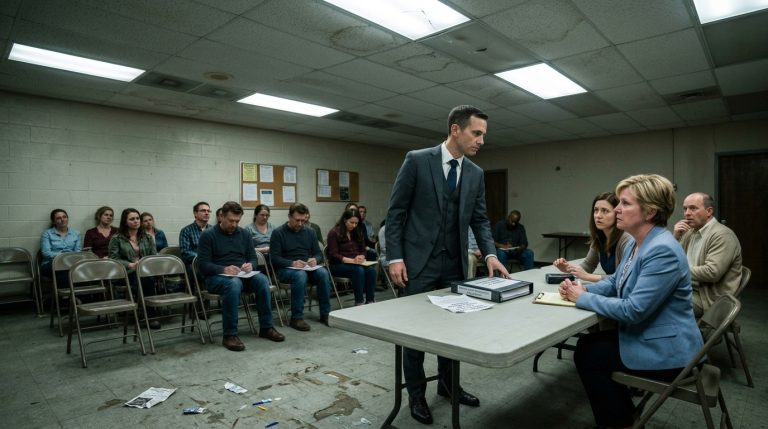
CHAPTER 7: THE SETTLEMENT CONFERENCE
The community clubhouse was a temple of artificial perfection. Polished oak floors, vaulted ceilings, and an air of climate-controlled, corporate serenity that felt alien to the raw, rugged hills outside. I stepped across the threshold, the air smelling of floor wax and the faint, chemical scent of a printer’s ozone.
Abernathy was already there, looking like he’d been carved from the same oak as the furniture. He stood at the far end of the long conference table, his briefcase open, a collection of stark, black-and-white documents laid out like a deck of cards. He didn’t look up as I entered; he didn’t need to. He knew the gait, the rhythm of a man who had walked through the fire and was coming out on the other side.
“They’re coming, Mark,” he said, his voice a low, resonant rumble. “Harris has been on the phone with his board for two hours. He’s panicked. He knows the Lis Pendens is the first of many nails. He’s going to come in here and try to turn this room into a negotiation. He’s going to offer you money. He’s going to offer you the world. Do not take it.”
“I’m not here for a check, Arthur,” I said, pulling out a chair and sitting down. “I’m here for the permit.”
“Good.”
The doors opened at 11:00 AM sharp. Harris entered first, flanked by two lawyers in suits so expensive they seemed to absorb the light in the room. Behind them, Karen followed, a shadow of her former self, her movements robotic, her face drawn. She looked like someone who had been hollowed out from the inside, her power—the very thing she’d built her entire identity around—stripped away by the sheer, unyielding reality of the legal paperwork.
They didn’t look at me. They sat at the opposite end of the table, their movements choreographed to project a confidence that was visibly crumbling. The room felt tight, the air heavy with the friction of two opposing, incompatible worlds colliding.
The lead attorney, a man whose skin looked like dry parchment, started the dance. “Mr. Thorne, we are here to discuss a resolution to what has been an unfortunate series of misunderstandings. My client is prepared to offer a substantial sum to resolve this matter, provided we can clear the title on the Whispering Pines development.”
I didn’t answer. I leaned back, my posture relaxed, and let the silence grow. Abernathy didn’t speak either. He simply tapped a single piece of paper—the surveyor’s sworn affidavit—and pushed it across the table.
“Before we discuss money,” Abernathy said, his voice calm, polite, and lethal, “we need to discuss the permit. We have the developer’s own surveyor on record, stating that he was instructed to forge the boundary maps to meet the DEEQ’s buffer requirements. We have a recording of the developer’s project director confirming this instruction. We have the inspector’s own admission of the encroachment.”
Harris’s face went white. The two lawyers froze, their collective gaze snapping toward their client. Harris sat there, his mouth slightly open, the arrogance of his sedan-side threat completely evaporated. He’d thought I was bluffing. He’d thought the “veteran on a farm” was a trope he could handle with a few well-placed phone calls and a fat check.
“This is not a negotiation,” I said, my voice cutting through the silence like a blade. I didn’t raise it. I didn’t need to. “This is a reckoning. You built this on a lie, and you used the HOA to enforce it. You aren’t going to buy your way out of this. You’re going to withdraw the plat map, you’re going to issue the public apology, and you’re going to face the commission. If you don’t, I will personally ensure that every agency in this state knows exactly what you did.”
Karen made a sound then—a small, broken whimper. She was staring at Harris, the realization of her own betrayal finally hitting home. She had been the sword he used to strike at me, and now that the sword was broken, he was ready to discard her.
“We need a moment,” one of the lawyers muttered, his voice strained.
“Take all the time you need,” Abernathy replied, his smile thin and devoid of warmth. “But understand this: the clock is already ticking on the Lis Pendens. Every hour you spend in that corner is an hour of lost revenue. Every hour you spend trying to save face is an hour of mounting interest.”
I sat in the chair, watching them. The dynamic had shifted. The power, which had been theirs for months, had been siphoned away by the weight of the evidence. I wasn’t the trespasser; they were. I wasn’t the one being squeezed; I was the one applying the pressure. It was a tactical standoff, and I held the only card that mattered: the truth.
The room smelled of sweat and expensive cologne. It was the scent of a machine breaking down, the gears grinding and locking up. I looked at the table—the documents, the maps, the life’s work of my family represented in ink and parchment. The boundary was holding.
“We accept,” Harris whispered, his voice barely audible. “We accept the terms.”
“Put it in writing,” Abernathy said. “Now.”
As they began to draft the agreement, the frantic, shaky motions of the lawyers a sharp contrast to our calm, I caught a glimpse of Karen through the clubhouse window. She was walking toward her car, not looking back, her pink jacket a smudge of fading color against the harsh, bright morning. She wasn’t just losing a battle; she was losing the only thing that had ever made her feel important.
I felt no pity. I only felt the quiet, steady pull of the land, the knowledge that by the time the sun set, the creek would be mine again, shielded by law and iron, and the nightmare of the past few months would finally be silenced.
CHAPTER 8: THE FORTIFIED LEGACY
The pen dropped onto the polished oak surface with a soft, final thud. It was the only sound in the room. Harris sat slumped in his chair, his expensive suit now hanging on his frame like a shroud. He didn’t look at me. He didn’t look at the document that had just effectively dismantled his career and his company’s future. He was staring at his hands, the hands that had signed the forged plat maps, the hands that had orchestrated the systematic bullying of his own neighbors.
I didn’t gloat. Gloating was for the inexperienced, for the ones who had never seen what happens when a structure built on a lie finally hits the ground. I simply reached across the table and folded the signed agreement into my breast pocket. It was heavy, a physical weight that pressed against my heart, but it was the weight of permanence.
Abernathy stood up, his face impassive. “The copies will be filed with the county clerk within the hour, Mr. Harris. I suggest you have your council ready the withdrawal of the plat map before the afternoon session.”
Harris didn’t respond. He didn’t have to. The man who had walked into this room with the arrogance of a conqueror was now a broken relic of his own hubris. I turned and walked out of the clubhouse, the heavy glass doors swinging shut behind me with a clinical, final click.
Outside, the air was crisp, the sky a vast, indifferent blue that stretched over the hills and the timber. I walked back toward the gate. The black aluminum fence stood as a silhouette against the verdant green of the woods, its presence quiet, steadfast, and absolute. It was the physical manifestation of the victory, but as I reached it, I realized that the fence wasn’t what I’d really fought for. I’d fought for the right to exist without being erased by a binder of rules and a committee of bureaucrats.
I reached out and laid my hand on the fence post, the metal cold and hard beneath my palm. The creek was still gurgling on the other side, its song the same as it had been for centuries. I thought of my grandfather, of the strength it took to carve a life out of this rugged, untamed soil, and of my father, who had staked his legacy here with nothing more than a compass and an unwavering sense of justice. They hadn’t fought for maps or deeds; they’d fought for the bedrock. And tonight, for the first time in months, I knew the bedrock was safe.
The cool down was immediate and profound. I walked the line all the way to the old workshop, my movements slow, rhythmic. The tension that had lived in my shoulders, the constant, jagged hum of a man preparing for a breach, drained away into the dark, damp earth. I reached the barn and saw my own tools—the hammer I’d used to drive the original survey pins, the heavy-duty gear I’d kept maintained and ready for a conflict I had hoped would never come.
I took the hammer and spent an hour carefully inspecting each iron pin, ensuring they were deep, settled, and immovable. It was a symbolic act of closure. I wasn’t just checking a boundary; I was anchoring my own sense of peace back into the land. Each tap of the hammer was a heartbeat, a steady, measured pulse of life returning to its natural state.
That evening, Sarah and I sat on the porch. The sun was dipping behind the ridge, painting the sky in colors that were as bold and honest as the land itself. We didn’t talk about Harris, or Karen, or the lawsuit. We didn’t have to. We watched the kids playing down by the edge of the creek, their laughter echoing through the pines, vibrant and uncontained.
I reached into my pocket and pulled out the small, worn compass my father had given me the day he’d restaked the property line. I held it for a moment, the needle pointing true, north, north, north. It was the simplest, most honest instrument I owned.
“It’s done, isn’t it?” Sarah asked, her voice a soft, steady hum beside me.
“Yes,” I said, my gaze sweeping across the timber, the boundary, the creek. “The line is held.”
I stood up and walked to the edge of the porch, where a loose railing had been bothering me since the conflict began—a small, tangible damage done by the stress of the house itself. I spent the next hour carefully repairing it, my hands moving with a practiced, quiet focus. It was the symbolic closure of the struggle; I was mending the house, repairing the damage, and settling the world back into the order that belonged to us.
When I finally finished, the house felt solid, centered, and quiet. There was no more fight, no more tactical preparation, no more war. Just the steady, enduring, and unyielding life of the woods. I sat back down beside Sarah, the repair complete, the night deepening around us, and felt, for the first time in twenty years, a profound and absolute sense of home. The land was safe, the future was clear, and the legacy was, once and for all, ours to keep.