The Iron Weight of Silence: A Chronicle of the Rusty Anchor and the Shadows of the Mekong
CHAPTER 1: THE WEIGHT OF THE GLASS
The neon sign for the Rusty Anchor buzzed with the low, rhythmic click of a dying insect, casting a desaturated pink glow over the scarred surface of the corner booth. Mark Douglas didn’t look up from his whiskey. The glass was cheap, thick-rimmed, and coated in a thin film of grease from the kitchen, but his fingers held it with absolute stillness. At seventy-two, the skin across his knuckles was the texture of dry parchment, mapped with the gray friction of time, but the bone beneath remained solid.
“We need this booth,” Lieutenant Miller said. He leaned down, his shadow blotting out the faint reflection of the neon in Mark’s drink. Miller smelled of expensive iron-filtered lager and the sharp, metallic tang of fresh adrenaline. Behind him, four young men stood in a rigid, grinning wall, their freshly pressed utility uniforms crisp against the grimy wood of the tavern. “It’s for active duty. VFW is down the street, grandpa.”
Mark didn’t flinch. He let the silence stretch, calculating the distance between the edge of the scarred table and Miller’s left collarbone. It was an old habit, a mechanical rhythm that his mind executed before his logic could stop it. The air in the bar felt heavy, thick with the smell of damp sawdust and the sulfur of struck matches. He took a slow, deliberate sip of the whiskey, letting the fire of it coat his throat before setting the glass back down with a dull, hollow clink.
“I am fine right here, son,” Mark said. His voice was the sound of dry river stones scraping together.
Miller laughed, a short, sharp sound that carried no heat, only the performance of authority for the men behind him. He placed a heavy palm on the table, the leather of his watch strap creaking under the strain. “You don’t get it. We just finished the extraction detail. We’re the tip of the spear. You’re just taking up space. So unless you’ve got a trident hidden under that flannel, grab your cane.”
Across the room, behind the cracked laminate of the bar, Sully stopped wiping a pint glass. His thick fingers tightened around the gray cloth. He wasn’t looking at Miller’s arrogant posture; his eyes were locked on Mark’s right wrist, where the sleeve of the faded canvas jacket had slipped back exactly one inch.
There, scarred into the weathered skin, was a perfect, hairless circle—the edges raised and white, the center dark like old iron.
Mark reached into his pocket, his hand moving with a sudden, fluid economy that made Miller’s fingers twitch automatically toward his empty waistband. It was a micro-second of survival instinct that shamed the younger man instantly. Mark pulled out a crumpled ten-dollar bill and slid it onto the wet wood.
“For the drink,” Mark whispered, sliding his weight toward the edge of the vinyl bench. The material groaned under him, the old springs clicking in the dark.
Miller stepped into the gap, his boots grinding into the sawdust. “Not so fast. In the teams, we have names earned in the mud. Call signs. I’m Viper. He’s Sledge.” He pointed a thick thumb at the man behind him. “What’s yours, old man? Or did you just count beans while real men did the work?”
The room went dead. Mark looked up, and for a fraction of a second, the neon light didn’t look like pink gas; it looked like the silver sliver of a monsoon moon cutting through triple-canopy jungle. The smell of floor wax vanished, replaced by the suffocating stench of rotting vegetation and wet copper. He could feel the weight of a heavy blade in his palm, the cold mud sliding down his cheeks like oil. We have no assets in the area, Reaper. You are on your own.
“You don’t want to know,” Mark said softly, his gray eyes fixing on Miller with the absolute neutrality of a stone wall.
Sully dropped the rag behind the bar, his face turning the color of dry ash. He turned toward the back office door, his boots moving without a sound.
CHAPTER 2: THE SCRAPING OF THE IRON KEY
The hinge of the office door didn’t scream; it gave a low, rusted protest that was swallowed completely by the heavy silence hanging in the main room. Sully stepped across the threshold, his boots dragging through the fine layer of dry grit that always managed to settle near the baseboards. The air inside the small back room smelled of old paper, stagnant moisture, and the bitter tang of gun oil from the disassembled Remington on his desk. His hands, usually as steady as the anchor bolted to the concrete outside, were vibrating with a small, persistent twitch.
He didn’t turn on the overhead fluorescent bulb. The pinkish glare from the bar’s neon sign bled through the frosted glass of the door, throwing long, jagged shadows across the room. Sully reached into his pocket, his fingers scraping against the sharp edges of a heavy iron key. It was cold, pitted with corrosion, and weighted with the knowledge of things he had spent twenty years trying to unlearn.
He didn’t look at the phone yet. Instead, his eyes dropped to the floorboards beneath the heavy metal safe.
The wood there was different—darker, weathered by a different kind of dampness. He knelt, his knees popping with a sound like dry twigs snapping, and used the edge of a flat-head screwdriver to pry up the loose tongue-and-groove plank. The friction of metal against old pine released a sharp puff of dry dust that tasted like iron on the back of his tongue. Beneath it lay a ledger, bound in moldering leather that had begun to split along the spine, shedding tiny flakes of brown debris onto the concrete below.
This was the unauthorized registry. He hadn’t opened it since the night the old admiral handed him the keys to the building, but the memory of the faded ink inside remained burned into his mind. He flipped the cover back with a calloused thumb. The pages were yellowed, the edges frayed into thin threads that clung to his skin like cobwebs.
The list was short. Every name from the 1968 deployment in the Mekong Delta was crossed out with a single, heavy stroke of black ink. Next to each line, the word DECEASED was stamped in a purple dye that had faded over the decades into a ghostly gray. But at the absolute bottom of the page, beneath the official column headers, there was no name. There was only a hand-drawn symbol—a perfect, dark circle, identical to the hairless scar currently resting on the old man’s wrist in the corner booth. Next to it, the ledger didn’t say DECEASED. It didn’t say MISSING. It was blank, save for a single, small coordinate that mapped directly to the coordinates of the base commander’s private quarters.
A cold sweat broke along the back of Sully’s neck, the dampness sticking his shirt to his spine. The piece of paper wasn’t just a record; it was a tracking anchor. The realization ground against his ribs like a broken bone. The old man wasn’t hiding from the past; he was the center of a grid that had been waiting for someone to trip the wire.
Outside, the heavy thud of a fist striking wood vibrated through the floorboards. The noise was dull, but the impact traveled up through the joists into Sully’s knees. Miller was pushing. The arrogant kid was going to try to force a ghost into a corner, completely unaware of the structural collapse he was about to trigger.
Sully dropped the ledger back into the dark recess, slamming the floorboard down with the heel of his palm. He reached for the heavy black rotary phone on the desk, his fingers slick with sweat as he dialed the emergency number taped inside the safe. Each rotation of the dial felt agonisingly slow, the mechanical click-click-click dragging at his nerves.
“Hello,” the voice answered on the second ring. It wasn’t the voice of a man who had been sleeping. It was the voice of a man who had been sitting by the receiver, waiting for the line to go live.
“This is Sully at the Rusty Anchor,” he whispered, his throat dry, the words catching on the grit in his breath. “I think… I think he is here.”
“Who is here?” The response was flat, devoid of color, but the sudden absence of background noise on the other end told Sully everything he needed to know.
“The Reaper,” Sully said, his eyes locked on the frosted glass where Miller’s silhouette was currently expanding. “The man with the circle brand. He’s sitting in the corner booth, and there’s a group of young frogs trying to push him out of his seat. It’s about to get ugly, Admiral.”
The silence that followed was so absolute that Sully thought the copper wires had snapped somewhere under the street. Then the voice returned, colder than the frost on a meat locker door. “Do not let them touch him. Do not let them disrespect him. I am three minutes away. Keep the peace, Sully, or God help us all.”
The line went dead with a sharp, metallic pop. Sully set the receiver back on its cradle, his breath rattling in his chest. He stood up, his hand automatically reaching for the heavy iron key in his pocket, turning it over and over until the metal began to warm against his skin. The decoy was already falling apart; the old ledger had given him a glimpse of a different truth, a layer of authority that went far deeper than a simple retired veteran buying a cheap drink. Mark Douglas wasn’t an accidental relic in a dive bar. He was a beacon.
He pushed the office door open, stepping back out into the pink-hued gloom of the main room just as Miller’s hand made solid contact with the old man’s canvas shoulder.
CHAPTER 3: THE BREACHING POINT
The fabric of Mark’s canvas jacket didn’t just bunch under Lieutenant Miller’s fingers; it resisted with a heavy, dead-weight density. The friction of the young officer’s palm against the worn cloth made a sharp, dry rasping sound that seemed to draw all the remaining air out of the room. Mark didn’t pull back. He remained seated, his shoulders squaring slightly as his joints gave a faint, audible pop like dry kindling snapping underfoot. He looked down at the hand on his shoulder, then up into Miller’s eyes, his own gaze as flat and unyielding as a sheet of rusted iron left out in the rain.
“That was a mistake,” Mark whispered. His voice didn’t rise, but the low-frequency gravel of it caused the glass in his hand to hum faintly against the scarred wood of the table.
Sully came lunging through the small opening behind the bar, his heavy work boots slamming against the floorboards with a series of dull thuds that scattered the dry sawdust. “Lieutenant, stand down,” he roared, thrusting his large bulk between the booth and the wall of active-duty operators. “That is a direct order from the owner of this establishment. Stand the hell down.”
Miller didn’t break his stare from Mark, though his jaw muscles clenched until the skin grew white around his cheekbones. “Shut up, Sully. This civilian put his hands on my team’s space first. We’re tracking a protocol here.”
“He is not a civilian, you idiot,” Sully spat, his breath coming in short, ragged gasps as his fingers twitched near his apron. His left hand remained buried in his pocket, clamped tightly around the heavy iron key he had retrieved from the back office. The metal was burning hot against his palm now, a physical reminder of the ledger hidden beneath the floorboards.
Miller shoved Sully aside with a hard, transactional strike to the chest—not to injure, but to clear his line of sight. He turned back to Mark, his fist tightening until the leather strap of his watch strained against his wrist. “I am going to teach you a lesson in respect, old man. You don’t get to sit at the table we bleed for.”
He raised his hand, reaching down to grab Mark by the rough collar of his red flannel shirt, intending to drag the seventy-two-year-old body straight out onto the gravel parking lot. The young SEAL’s movement was precise, driven by thousands of hours of repetitive tactical drilling. He expected a struggle, a defensive flinch, or the frail resistance of a body worn down by seven decades of ordinary life.
Instead, the heavy oak front door of the Rusty Anchor exploded inward.
The impact wasn’t a casual kick. It was a massive wave of kinetic force that tore the brass latch completely out of the frame, sending a shower of splintered wood and rusted screws skipping across the floorboards. The door slammed against the interior wall with a rhythmic, metallic crash that sounded exactly like the opening salvo of a mortar group. Every man in the room spun toward the breach, their hands automatically dropping toward their hips in a synchronized survival reflex.
Standing in the shattered frame was a single silhouette, framed by the cold, desaturated glare of the streetlights outside. The figure didn’t step; he marched. The rhythmic clicking of high-gloss leather dress shoes on the grit-covered floor was the only sound left in the building. As the man stepped into the pink glow of the neon sign, the rows of silver stars on his shoulder straps caught the light, gleaming like polished teeth.
It was Admiral Vance. Behind him, two men in dark, unblinking suits filled the threshold, their earpieces casting thin shadows against their necks, their bodies completely still but radiating an immediate, lethal capability.
The transformation in the room was instantaneous. The laughter from the active-duty squad died instantly in their throats, replaced by a cold, suffocating vacuum. Miller froze, his fingers stopping mere inches from Mark’s collar. His chest hitched, his spine locking into a rigid, vertical line so fast that his uniform shirt snapped against his skin.
“Admiral on deck,” Miller shouted, his voice cracking slightly on the final syllable as a heavy drop of sweat broke from his hairline and tracked down his temple.
The other four SEALs scrambled into a straight line, their boots clearing the sawdust as they stood at rigid attention, their eyes locked forward onto the wall. The expensive beer bottles they had been clutching sat abandoned on the adjacent tables, small rings of condensation already pooling on the dry wood.
Admiral Vance didn’t look at them. He didn’t acknowledge the salute, nor did his eyes drift toward the broken door frame. He walked directly past Miller, his shoulder brushing the lieutenant’s sleeve with enough force to twist the younger man’s torso an inch out of alignment. Vance stopped exactly three feet from the corner booth.
The admiral’s face was a mask of deeply lined stone, weathered by decades of salt and command, but his eyes were wide, tracking the small details of the old man’s face—the gray stubble, the steady hands, the absolute lack of movement. Slowly, with a mechanical precision that seemed to carry the weight of forty years of institutional memory, Vance brought his right hand up to his brow.
He held the salute. One second. Two seconds. Three seconds. The silence stretched until the hum of the neon sign felt loud enough to split the wood.
Mark Douglas looked up from his empty glass. A small, dry crease appeared at the corner of his mouth—not a smile, but an acknowledgment of a shared debt. He slowly raised his right hand, his creaking elbow joint making a faint scraping noise against the vinyl, and returned the gesture with a casual, muscle-memory grace that had never truly faded.
“At ease, David,” Mark said softly.
Admiral Vance dropped his hand, a long, heavy exhalation escaping his chest as if he had been holding his breath since 1968. “It has been a long time, Master Chief,” Vance said, his voice thick with a granular roughness. “The registry said you were gone. We lost the signal after Panama.”
“I like being gone,” Mark replied, his fingers drifting down to touch a small, notched piece of silver metal that had been wedged into the torn vinyl of the seat beside him—an old tag that didn’t belong to any civilian deployment. “It’s quieter.”
Vance turned slowly, the warmth completely draining from his features, leaving only the hard, unyielding geometry of a commander about to excise a cancer. He fixed his gaze on Miller, whose face had transitioned from flushed adrenaline to the color of dry ash.
“Lieutenant,” Vance said, his voice low, vibrating with a danger that made the previous tension look like a schoolyard game. “Do you have any idea whose air you are breathing?”
CHAPTER 4: THE RESIDUE OF IRON
Lieutenant Miller did not answer. His mouth clicked open, then closed, his tongue catching against the dry roof of his mouth like a dry leather valve missing its seal. The arrogance that had inflated his uniform only minutes prior evaporated into a fine, invisible mist, leaving his frame appearing suddenly hollowed out and fragile under the neon glow.
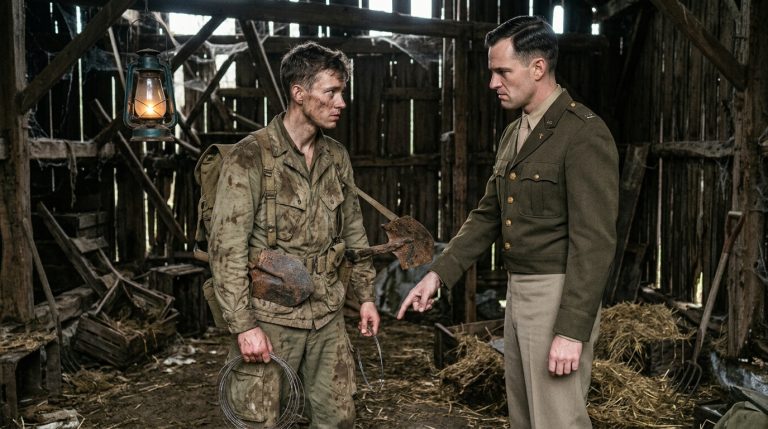
“His file is black,” Vance said, his voice dropping into a low register that traveled through the floorboards like an engine tremor. “It has been black since 1968. When I was a brand new Ensign in the Mekong Delta, my patrol boat took fire from three sides of the treeline. We were sinking into the riverbed. Command denied extraction. Air support was weathered out. We were dead men, Lieutenant.”
The admiral stepped closer to Miller, the high-gloss surface of his uniform shoes grinding a tiny stray piece of grit into the floor with a sharp, dry crunch. “One man came out of that canopy. No fire support. No squad. Just a blade and a rifle. He cleared three machine-gun nests in under four minutes. He dragged me and six of my crew through three miles of mangrove swamp with an enemy slug buried in his calf. When we asked for his call sign, he didn’t say a word. He vanished back into the mist. The enemy called him the Reaper. Because when he arrived, existence simply stopped for anyone in his way.”
The silence in the tavern was absolute, save for the low, industrial buzz of the dying fluorescent bulb near the back office. The active-duty operators behind Miller stood so still they resembled cement molds, their eyes fixed firmly on the stained plaster wall ahead.
“This man has more confirmed terminations with a blade than you have spent days in the service,” Vance continued, his hand coming down onto Miller’s shoulder, not in a shove, but with the crushing, static mass of an absolute authority. “He wrote the tactical doctrines your instructors fail to fully grasp. And you attempted to throw him out of a tavern because you thought your trident made you a god.”
With a sudden, violent tearing sound that caused every man in the line to squeeze their eyes shut, Vance ripped the unit patch directly from Miller’s left sleeve. The Velcro backing separated with a sharp rasp, leaving a frayed, dark gray rectangle on the fabric where the insignia had been.
“You are a disgrace to the uniform,” Vance whispered, the lack of volume carrying more weight than a shout. “You and your detail are confined to quarters effective immediately. You will face a board of inquiry at zero-eight-hundred tomorrow. I will personally oversee the strip of your command. Get out of my sight before I forget my office.”
Miller didn’t salute. He turned on a heel that slipped slightly in the sawdust, his movements stiff and uncoordinated as he stumbled toward the broken entrance. The four operators trailed him in a frantic, silent rush, their boots clattering over the threshold and out into the cool night air. The heavy oak door swung on its single remaining hinge, coming to rest with a dull thud against the frame.
The air inside the Rusty Anchor slowly settled, the dust motes spinning lazily in the pink light. Vance turned back toward the corner booth, his stiff military bearing giving way to a slight, heavy sag in the shoulders. He looked down at Mark, whose fingers were still turning over the notched silver tag on the vinyl.
“I apologize, Master Chief,” Vance said, his voice rough with old smoke and older exhaustion. “The standards are slipping out here.”
Mark let out a dry, gravelly chuckle, sliding the silver tag into the pocket of his canvas jacket next to the heavy iron key. “They’re young, David. Full of fire and vinegar. They just haven’t been burned down to the carbon yet. Don’t be too hard on them. They just need to learn that the ocean is deep, and the floor is full of things that don’t sleep.”
Vance nodded slowly, looking at the empty shot glass sitting precisely in the center of the table. “Can I buy you a fresh round, Reaper? For the delta?”
Mark shook his head as he stood up, his knee joints popping with a clear, dry snap that echoed in the quiet room. He buttoned the canvas jacket, pulling the collar tight against his throat. “No. I think I’ve had enough noise for one evening. I just wanted a quiet drink.”
He walked past the admiral, his body looking small again, slightly bent under the weight of his age as he moved toward the exit. The remaining patrons—the bikers, the local mechanics, the off-duty harbor workers—moved aside without a sound, parting like a curtain to create a wide, jagged lane of absolute clearance. No one spoke. One man began a slow, heavy clap, but the sound died instantly when he realized the silence was the actual honor due to the phantom passing through.
Mark pushed the broken door aside and stepped out into the damp night, the cool air smelling of sea salt, diesel exhaust, and dry earth. Behind him, Vance walked over to the table, picked up the empty shot glass, and turned to the remaining crowd.
“You saw nothing here tonight,” the admiral commanded softly. “Leave this table empty.”
A week later, after the base had processed the quiet reassignment of a certain lieutenant to a tracking station in the frozen interior of Alaska, a small wooden crate arrived at the bar for Sully. Inside, nestled in dry straw, sat a bottle of very old, dark amber whiskey. Taped to the glass was a small scrap of cardboard with a message written in a shaky, unhurried cursive: Keep the table open.
Mark Douglas never returned to the Rusty Anchor. He didn’t need to. Far out on the edge of the county line, where the trees grew thick and the ground stayed dry, an old man sat on a wooden porch, watching the first amber light of dawn hit the treeline. His hands were perfectly steady as he held his coffee cup. To the postman, he was just Mark. But to the registry under the floorboards, he remained the anchor holding the entire grid in place.