The Weight of the Soil: A Veteran’s Quiet Siege Against the Encroachment of Petty Suburban Tyranny
CHAPTER 1: THE INVISIBLE LINE
The wind didn’t just rustle the oak leaves; it scraped them against the chain-link, a dry, rasping sound that set my teeth on edge. I stood with my hands jammed deep into the pockets of my canvas jacket, feeling the familiar, grounding weight of the hunting knife against my hip. Across the invisible divide—the line where the groomed, soul-crushing beige of Oak Ridge Estates met the stubborn, untamed reality of the Miller homestead—Karen Thorne stood like a sentinel of suburban boredom.
Her golf cart was a silent, white blister on the landscape. She held a binder as if it were a weapon, her fingers white-knuckled against the plastic, her blonde hair a helmet that didn’t move, even when the October breeze whipped around her.
“Your grandfather’s legacy is a public nuisance, Mr. Miller,” she said. Her voice was thin, sharp, and perfectly articulated, the kind of sound designed to be heard in a courtroom or a board meeting, never in the woods. “I will see it dismantled piece by piece if I have to.”
I didn’t answer. I looked past her, at the hundred acres of field and timber that stretched behind my house—a jagged, beautiful mess of history. My great-grandfather had pulled these stones from the soil with a mule. My grandfather had planted the pines as a windbreak against the world. To her, this wasn’t land. It was a failure of zoning.
“The bow hunters,” she pressed, stepping closer to the perimeter, her boots sinking just a fraction of an inch into the dust. “It ends. This is a residential zone, and the proximity of weapons—”
“This land isn’t in your HOA, Karen,” I said, my voice quiet, landing in the space between us like a lead weight.
“The impact on property value is universal,” she countered, flipping a page in her binder with a snap that echoed like a breaking bone. She looked at the woods with a disgusted tremor in her lip.
I felt the old, cold clarity wash over me—the same feeling I had when staring through a scope in the desert, when the world narrowed down to the movement of a single target. She was looking for a reaction. She wanted the shout, the tantrum, the lack of control that would justify her bylaws.
Instead, I watched a hawk circle high above the treeline, catching the golden afternoon light.
“You’re standing on the border of a ghost,” I said, finally meeting her eyes. They were pale, hard, and utterly vacant of any understanding of what this ground had cost.
“I am standing on the side of order,” she snapped.
She turned and climbed back into the cart, the electric motor whining like a trapped insect as she spun it around. She hadn’t even looked at the trees. She had only looked at the fence, at the boundary, at the idea of me that she had cultivated in her own head.
As she drove away, a single piece of paper fluttered out of her binder—a map, marked with bright red highlighter, overlaying my land with a grid that didn’t exist. I walked over and picked it up. The paper was crisp, expensive, and utterly wrong.
I looked back at the hunting cabin. The porch was listing slightly to the left, the wood aged to a deep, iron-grey. It was quiet here, but it wasn’t the quiet of peace anymore. It was the absolute, focused silence of a battlefield in the seconds before the first shell leaves the chamber. Karen had declared her war, and she had provided the first piece of intelligence.
I tapped the paper against my palm. She thought she was building a kingdom. She had no idea she was just clearing the ground for a collapse.
CHAPTER 2: THE PAPER SIEGE
The envelope was cream-colored, thick, and embossed with the kind of gold-leaf lettering that usually preceded a funeral or a wedding. I turned it over in my hands, feeling the sharp, crisp edges of the cardstock. It wasn’t a neighborly invitation to a block party; it was an eviction notice for my way of life, sent by a woman who didn’t even know the proper name of the creek that bordered my north pasture.
I didn’t open it on the porch. I walked inside, the floorboards of the old house groaning under my boots in that familiar, rhythmic way that had served as the soundtrack to my life. I dropped the envelope onto the dining table. My grandfather’s table. The wood was scarred, stained by decades of coffee mugs, rifle oil, and hard work. It was a solid, honest thing, unlike the flimsy, pretentious correspondence currently sitting in the center of it.
I pulled out a kitchen knife—my grandfather’s old fixed-blade—and slid it through the seal. The paper tore with a sound like dry skin snapping.
Inside was the notice of covenant violation. It was cold, clinical, and dripping with the kind of bureaucratic arrogance that only exists in people who have never had to dig a ditch or fix a fence in the driving rain. They were fining me five hundred dollars, with a recurring daily penalty that felt like a joke if it hadn’t been so calculated. They had assigned me a property ID number, treating my hundred acres of ancestral heritage like a unit in a poorly managed apartment complex.
My pulse didn’t race; it slowed. I felt the familiar, rhythmic cadence of my breathing, the one I had refined during long hours in the desert, watching a horizon for movement.
I walked over to the window. From here, I could see the edge of the Oak Ridge subdivision. The houses looked like they had been extruded from a mold—all the same beige, all the same roof pitch, all the same desperate, clinging need to be identical. They were safe houses for people who were afraid of the messy, unpredictable truth of the living world. They saw my woods as an eyesore, a gap in their manicured perfection.
The violation notice sat on the table, a paper anchor tethering me to a fight I hadn’t wanted but was now entirely prepared to win.
I went to the hallway closet and pulled out a heavy manila folder. I opened it and wrote in thick, black marker on the tab: Project Nightingale.
The name felt right. In the military, a nightingale was a code, a trigger, a sign of something that looked one way but behaved another. Karen Thorne thought she was the beautiful voice of her community, the defender of their sterile peace. She had no idea she was about to sing a song that would dismantle everything she had built.
I sat back down at the table and poured a cup of coffee. The grounds were dark, bitter, and strong—the kind of fuel that cut through the haze of a long morning. I pulled out my phone and dialed the number for the county records office.
“Marge,” I said, when she answered, her voice a warm, familiar rasp. “It’s Jack Miller.”
“Jack,” she said, her tone brightening. “I haven’t seen you since the spring. How’s the back pasture?”
“The pasture is fine, Marge. It’s the neighbors I’m worried about.” I kept my voice steady, peeling back the layers of the threat. “I need some information. I’m doing some… structural analysis on the Oak Ridge Estates development.”
“Structural analysis, huh?” She chuckled, the sound like dry leaves skittering over pavement. “Sounds like you’re doing more than checking fence lines. What do you need?”
“I need everything, Marge. Their original plat map, the articles of incorporation, and the full covenants and restrictions. Especially the ones regarding the park that borders my land.”
“You’re going for the whole enchilada, aren’t you?”
“I’m just drawing the map, Marge,” I replied, staring at the violation notice. “Someone needs to show them where they stand.”
I hung up, the silence of the house returning, but it was no longer empty. It was charged, a physical pressure in the room. I stood up and walked to the door, stepping out onto the porch. The air was cooling, the smell of damp earth and rotting leaves telling me that winter was waiting just over the ridge.
I looked at the fence line again. It was just a line of wire and wood, rusted and weathered by a century of seasons. It wasn’t just a barrier; it was a record. Every post was a commitment, every strand of barbed wire a promise that this space belonged to us, not to a binder of rules.
I went to my truck and grabbed the heavy leather tool belt I kept behind the seat. If I was going to war, I needed to ensure my perimeter was secure. I walked out to the edge of the property, my boots sinking into the soft, yielding soil. I touched the wire. It was cold, biting, and solid.
Karen Thorne wanted a fight on her terms, in her sterile clubhouse, with her manufactured rules. She didn’t understand the physics of the land. She didn’t understand that for every action, there is a reaction—a consequence that is as inevitable as the changing of the seasons.
As I tightened a bolt on the corner post, the metal screaming in protest under the wrench, I realized something. This wasn’t about the hunting lease. That was just the decoy, the first stone she had thrown to see if I would flinch. And I hadn’t. I had taken the stone, felt its weight, and started building a wall.
The war wasn’t going to be fought with guns or shouting matches. It was going to be fought with documents, history, and the absolute, unyielding truth of what this land was. I was the architect of my own defense, and I had a long, cold night ahead of me to draft the plans.
CHAPTER 3: THE ARCHIVE
The drive to the county seat was a descent into a landscape of deteriorating industry and forgotten paperwork. My truck, a weathered beast that had seen more gravel roads than paved highways, groaned as it climbed the winding incline toward the courthouse. The morning air was thin and sharp, carrying the scent of dried corn husks and the metallic tang of the coming frost. I kept my hands at ten and two, watching the rearview mirror, checking for the phantom presence of a beige golf cart, though I knew Karen Thorne wouldn’t be caught dead in this part of the county.
The county records office was located in the basement of the courthouse, a place where time didn’t just stand still; it accumulated in layers of dust and yellowed ink. It was a temple to ownership, a library of titles that smelled of ancient paper and the faint, ozone-heavy hum of microfilm machines. I pushed the heavy oak door open, the brass hardware cold and pitted under my touch, and stepped into the dim, fluorescent-lit silence.
Marge was at her desk, her glasses resting precariously on the tip of her nose. She looked up, her expression a mix of professional routine and genuine curiosity.
“You’re back, Jack,” she noted, her voice a low rustle that didn’t disturb the dust motes dancing in the light.
“I’m back, Marge. I need to see the original patent for the Miller homestead, and everything you have on the Oak Ridge subdivision—the articles of incorporation, the whole filing.”
She didn’t ask why. She simply stood, her joints popping in the quiet room, and led me toward the deep, shadowed aisles where the bound volumes were stacked like fortress walls. The air grew cooler here, the light softer. I traced my fingers along the spines of the ledgers. They were leather, cracked and scarred, representing a century of claims, trades, and hard-won rights. This was the foundation of the world—not the manicured lawns and plastic siding of the new developments, but the ink and paper that dictated who actually held the ground.
“You’re looking for the fault lines,” Marge observed, stopping before a particularly heavy volume.
“I’m looking for the truth, Marge. People have a habit of forgetting that the land doesn’t care about their bylaws.”
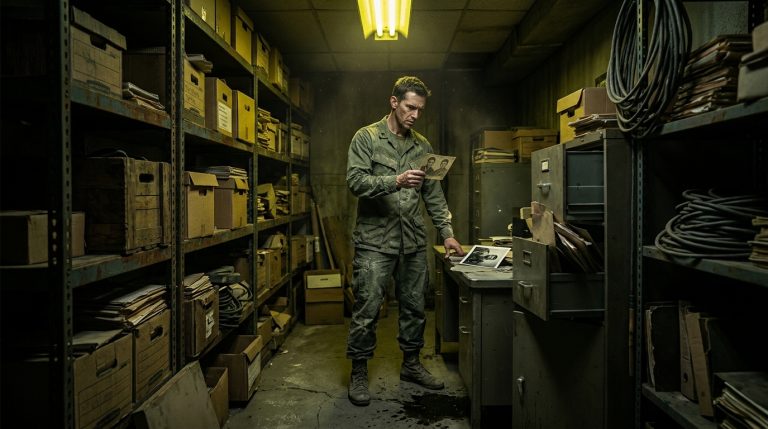
I spent the next four hours buried in the records. I unrolled the plat maps, their edges crinkling like dry autumn leaves. I saw the deliberate geometry of Oak Ridge Estates, a grid of convenience forced onto the landscape. And then, I saw the exclusion. There it was—Parcel 4A, the Miller homestead, marked by a thick, hand-drawn ink line that set it definitively outside the HOA’s reach. It was as clear as a soldier’s order: Excluded from jurisdiction.
But as I delved deeper, the atmosphere in the room shifted. My mind wandered to the training I’d received back in the Corps, the way we had to analyze terrain for hidden weaknesses before even considering the strategy. I found myself thinking of the architecture of the archives themselves—the way the floors were laid, the heavy, load-bearing pillars that held the weight of the county’s history. It felt like walking through the internals of a machine. My thoughts were interrupted by a fleeting, sharp phantom memory: the way my grandfather had stood in this very spot, his hand resting on a map, his voice telling me that paper could be manipulated, but the physical record—the deed—was the only absolute truth.
I turned my attention to the HOA’s documents. The articles of incorporation were a masterpiece of legalese, designed to intimidate any common landowner. They spent pages defining “community property,” claiming everything from the entrance signs to the retention ponds. And there, tucked into an addendum, was the mention of Founders Green.
The name had always bothered me. It was a sterile, branding-heavy term. I pulled the deeds for the 5-acre plot that bordered the subdivision. My grandfather’s signature was there, sharp and resolute, dated twenty years ago. He hadn’t just given the land; he had attached strings.
I read the text once, then again. My lungs felt suddenly constricted.
Conditions of use: In perpetuity as a public park, open to all residents of Madison County.
It was a beautiful, lethal trap. He had known. He had anticipated that a group like Karen Thorne’s would eventually try to monopolize the natural space, and he had built a back-door mechanism into the law—a reversionary clause. If they excluded anyone, if they turned a public park into a private club, the land wouldn’t stay with the county. It would come back to his heirs.
To me.
I stood up, the chair scraping sharply against the concrete floor. The sound was like a gunshot in the tomb-like quiet. I looked at the document, the ink seemingly glowing under the harsh overhead lights. I wasn’t just a man fighting for his hunting lease; I was the legal heir to the heart of their development.
I took a breath, forcing myself to steady my pulse. The realization didn’t make me want to shout; it made me cold. I had the lever now. I had the fulcrum. I just needed to make sure I had the right partner to help me apply the pressure. I thought of Sarah Jenkins, the lawyer I’d met at the hardware store. She was smart, she was frustrated with the system, and she had the kind of sharp, strategic mind that could turn a legal document into a weapon.
I gathered the files, my movements deliberate and silent. I wouldn’t leave a trace of my visit; I would simply disappear into the afternoon, leaving the archives to their dust. As I walked toward the exit, I passed Marge, who gave me a knowing nod.
“Find what you needed, Jack?”
“I think I found everything, Marge,” I said, my voice steady, feeling the weight of the manila folder in my hand—a weight that felt like the heavy, iron-cold promise of a coming reckoning.
The walk back to my truck was a blur of calculated motion. I drove out of the county seat, the horizon darkening as the clouds gathered, and for the first time since this whole war began, I felt the shift in the air. The terrain was no longer alien to me. I had mapped the enemy’s foundation, and I knew exactly where to strike.
CHAPTER 4: THE SILENT ALLIANCE
The cafe was a neutral territory, a place of mismatched chairs and the constant, rhythmic hiss of an espresso machine that filled the lulls in our conversation. Outside, the world was grey, the sky pressing down on the town with the heavy, saturated weight of an impending downpour. I sat in a booth at the back, my back to the wall, watching the door. The folder, containing the blueprints to the HOA’s undoing, lay flat between us.
Sarah Jenkins didn’t reach for it immediately. She sat with her hands wrapped around a ceramic mug, her gaze shifting from the steam rising from the coffee to the thick, manila-covered documents. She was younger than I expected, with eyes that caught the flickering fluorescent light and reflected it back with a sharp, analytical hunger. She had moved into Oak Ridge Estates a year ago—an insider who had quickly realized the ecosystem was designed for exclusion, not community.
“Mr. Miller,” she began, her voice low, calibrated for privacy. “You didn’t call me for a routine property dispute. You called because you’ve been digging.”
I didn’t answer right away. I took a slow sip of the coffee, its bitterness grounding me. I looked at her, searching for the crack in the facade, the point where her legal professionality ended and her personal frustration with the neighborhood began. She wasn’t just a lawyer; she was a resident who had been paying dues for the privilege of being told where to plant her geraniums.
I slid the folder toward her. “I’m not looking for a cease-and-desist letter, Sarah. I’m looking for a tactical assessment.”
She opened the folder. The first thing she saw was the plat map, the heavy lines of my property drawn in bold, defiant ink, explicitly excluding the HOA’s jurisdiction. Then, she pulled out the deed to Parcel 5B—Founders Green.
As she read, the flicker of the cafe’s overhead light seemed to distort her expression. For a split second, she looked like a shadow, a silhouette against the rainy window. I found myself wondering if I was handing a weapon to someone who would use it to burn the whole forest down, or just clear a path for herself. It was a momentary, paranoiac flicker—a habit from years spent in environments where loyalty was a luxury you couldn’t afford. I pushed the thought down. I needed the logic, the legal precision she offered.
“The reversionary clause,” she murmured, her thumb tracing the legal text. “Your grandfather was incredibly specific. If the land is restricted… if they claim exclusivity…”
“They already have,” I said, my voice barely audible over the hum of the machine. “The sign, the rules, the way they chased out Arthur Henderson’s grandchildren. They’ve been acting as if they own it for years.”
Sarah looked up. The predatory gleam in her eyes wasn’t aimed at me; it was aimed at the document. “This isn’t just a defense, Jack. This is the end of the current board’s power. If we leverage this, they lose the park. They lose the crown jewel of their precious development.”
“What happens if they call our bluff?” I asked.
“They won’t,” she replied, a faint, confident smile touching her lips. “Because you have the deed. And I have the record of their breaches. They think they’re fighting a lone farmer. They have no idea they’re fighting the law itself.”
She started to outline the approach, not as a legal battle, but as a series of strategic maneuvers. We wouldn’t go to the press—that was too chaotic. We wouldn’t storm the next board meeting—that was too emotional. We would draft an “informational notice.” We would provide them with the facts, a clear, insurmountable reality that they couldn’t ignore or spin.
As she talked, the environment around us faded—the clatter of the espresso cups, the muffled sound of the rain against the glass, the murmur of the other patrons. Everything narrowed down to the strategy. She was methodical, her points organized like a defensive line, each one designed to block a potential counter-move from Karen Thorne.
But beneath the legal brilliance, I caught the undertone: she was hungry for this. She wanted the collapse of the structure as much as I wanted to protect the land. She was an insider looking for a way to break the system from within, and I was the key that unlocked the gate.
“They’re going to harass you,” she warned, looking at me directly. “Once they realize the scope of what you have, they’ll throw every petty grievance they can find at you. Fences, animals, noise complaints. They’ll try to bury you in the noise so you stop looking at the truth.”
“Let them,” I said. “I’ve spent years learning how to work in the mud. They’re just building my evidence folder for me.”
She laughed, a short, sharp sound. She closed the folder, the snap of the paper echoing in the small booth. “I like your resolve, Jack. Most people just want to settle. You want to make them acknowledge the ground they’re standing on.”
“I want them to respect the history of it,” I corrected.
“We’ll start with the letter,” she said, pulling a tablet from her bag. “It’ll be polite. It’ll be professional. And it will be the most terrifying thing they have ever read.”
I stood up, leaving the money on the table for the coffee. The rain outside had intensified, a steady, relentless drumming against the roof of the truck. As I walked out, the air felt cleaner, the path ahead marked by the cold, clear logic of our plan. We were no longer reacting. We were the ones dictating the movement of the battlefield. The trap was set, and for the first time, I felt the heavy, satisfying weight of anticipation.
CHAPTER 5: THE CALM BEFORE
The rain didn’t start with a warning; it arrived as a wall of grey water that swallowed the horizon, turning the fields into a landscape of shifting mud and blurred silhouettes. I was already at the edge of the property line, checking the fence again, when the sky opened up. The water hit the rusted wire with a frantic, rhythmic tapping, and within seconds, my heavy canvas jacket was soaked through, the weight of the water dragging at my shoulders.
I wasn’t alone in this downpour. Two days after the meeting with Sarah, the HOA’s tactical response had shifted from silent observation to overt, grinding attrition. I stood in the mud, staring at the property line, where a crew hired by the subdivision was currently installing a series of high-intensity floodlights along their boundary. They weren’t angled for the safety of the residents; they were angled specifically to cut across my fields, turning my sanctuary into a lit-up stage every time the motion sensors tripped.
It was a classic move: a disruption of the environment, a violation of the quiet, and a clear signal of intent.
I didn’t move. I watched as the workers hammered the posts into the ground, their movements slick and clumsy in the mud. I felt the cold creeping into my boots, a sharp, numbing ache that reminded me of winters spent in the field, waiting for a target that never appeared. But this target was constant. It was the HOA, it was the board, it was the systematic attempt to push me off my own soil by making it impossible to exist in peace.
My phone vibrated in my pocket. A text from Sarah: Don’t engage. Document.
I didn’t need the reminder, but it helped to know there was a second set of eyes on this war. I held my phone up, framing the floodlight installation against the backdrop of my grandfather’s pines. The shutter clicked—a tiny, digital spark in the gloom.
Just as I tucked the phone away, I heard the whine of the electric motor. It wasn’t the subdivision maintenance cart this time. It was hers. Karen Thorne.
The cart splashed through the water, tires throwing up rooster tails of mud, and ground to a halt twenty feet away. She was bundled in a yellow raincoat that looked like a synthetic barrier against the very earth she sought to control. Her hair was tucked under a matching hat, but the sharp, bloodless line of her mouth was exposed, twisted into a expression of grim, damp triumph.
“You’re trespassing on a construction zone, Mr. Miller,” she called out over the drumming of the rain.
I looked at the mud between us, then up at the floodlights, then back to her. I didn’t say a word. I didn’t reach for my phone. I simply stood there, an anchor in the storm, refusing to validate her authority with a response. The silence between us grew, thick and pressurized, as the rain poured off the brim of my hat and into the furrows of the dirt.
She stepped out of the cart, her feet sinking into the sludge. She was used to people reacting, to people apologizing, to people cowering behind their own deeds. She wasn’t used to a man who understood that silence was a tactic, not a sign of defeat.
“This is the first step of our community’s security improvement,” she continued, her voice rising, losing its polished edge to the frustration of the elements. “If you don’t like the light, you can always sell. We’ve had offers from developers who would love to turn this blight into something… productive.”
The mention of the developers was the key—the reveal of the true motivation. It wasn’t about aesthetics; it was about the asset. They wanted the land cleared, the legacy dismantled, and the ground smoothed out for concrete and profit. She had overplayed her hand, revealing the underlying greed behind the veneer of community standards.
“You’re making a mistake, Karen,” I said, my voice low, cutting through the sound of the rain with a sudden, sharp clarity.
“I’m following the law,” she spat back, though her confidence flickered like a candle in a draft.
“You’re following a rulebook you don’t understand,” I replied. “And you’re standing on ground that’s going to shift beneath your feet.”
I turned my back on her, the mud sucking at my boots as I walked toward the cabin. I didn’t look back to see if she followed. I knew she wouldn’t. She needed the facade of control, the comfort of her clubhouse, and the validation of her board. I needed the cabin, the coffee on the stove, and the long, slow work of gathering the final threads of evidence.
The storm intensified, the wind picking up and whipping the pines into a frenzy. It was a chaotic, beautiful mess, a reminder that the land couldn’t be tamed, only inhabited. As I reached the porch, I felt the cold, hard reality of the conflict. The harassment was getting heavier, the moves more desperate. They were trying to break my spirit before the letter arrived, trying to make me fold before I even had a chance to show them the deed.
Inside the cabin, the air was warm, smelling of pine needles and damp wool. I took off my jacket, the weight of the water hitting the floor with a wet thud. I moved to the table and opened the Project Nightingale folder. I laid out the photos of the new lights, the timestamps, and the record of the crew.
Every act of harassment was a brick I was placing in the foundation of my case. Every time she reached for power, she was exposing the weakness of her hold on it. I picked up a pen and began to note the time of her arrival, the content of her words, and the exact placement of the floodlights.
The rain continued to hammer the roof, a persistent, relentless beat. But inside, I felt nothing but a cool, detached sense of momentum. They had chosen the war, and they had chosen the battlefield. Now, all I had to do was hold the line until the final move was ready to be made.
CHAPTER 6: THE KILL ZONE
The clubhouse was a cavern of beige walls and fluorescent hum, smelling faintly of artificial cleaner and the stale, nervous energy of fifty people who didn’t want to be there but couldn’t look away. The folding chairs were arranged in rows, facing a small, elevated podium. It was a space designed for order, for the ratification of budgets and the discussion of mailbox paint codes. Tonight, it felt like a bunker.
Karen Thorne was at the front, standing behind the lectern with the practiced posture of a queen presiding over a court. Her blonde hair was pulled back so tight it made her eyes look like two points of sharpened glass. She watched the door, her gaze flicking across the room, cataloging every face. When she saw me, her lips pulled back into a thin, bloodless line—a silent signal to the room that the threat had arrived.
I didn’t acknowledge her. I moved to the back, to a small table where Sarah had already set up the projector. The laptop hummed, a small, mechanical heart in the center of the mounting silence.
I glanced around the room. I recognized the faces. Some were the neighbors who usually nodded at me at the fence line; others were the ones who had filed the complaints about my “unapproved” fence. They were a collective body, a mass of anxiety and resentment that Karen had molded into a weapon. They didn’t see a man standing on his own land; they saw an obstacle to their property values.
My eyes caught a subtle, jarring detail: the seating arrangement was skewed. The board members were clustered together in the front row, but the treasurer—a quiet, mousy man I’d seen around town—had deliberately pulled his chair away from the group, leaving a small, isolated gap. A betrayal, or perhaps just a defensive reflex? It didn’t matter. It was a point of weakness, a crack in the armor that I hadn’t expected.
“Mr. Miller,” Karen’s voice boomed through the microphone, echoing off the low ceiling. It wasn’t a greeting; it was an accusation. “You are not a member of this community. This is a closed meeting for Oak Ridge residents.”
I stood up, my boots making a slow, deliberate sound against the thin industrial carpet. “I am a party of interest in a matter concerning the public park that sits on my boundary line, Mrs. Thorne. And as the law states, that park is public property. Which makes this a public matter.”
The room erupted. Shouts of “He’s the one!” and “Get him out!” filled the space, the noise jagged and uncoordinated. Karen stood back, allowing the mob to do the work for her. She had manufactured this chaos, betting that I would be intimidated by the raw, unfocused fury of the crowd.
I didn’t yell back. I didn’t reach for the microphone. I simply waited. I let the silence of the room, when it eventually faltered, do the work for me.
“I have the documents,” I said, my voice carrying into the brief, stunned quiet that followed the shouting. “I have the deed, and I have the survey.”
“Lies!” someone shouted from the middle of the room.
“Facts,” I countered, and I pressed the button on the remote.
The wall behind the podium lit up. The first image was the sign—the one that said Private Park for Residents of Oak Ridge Estates. It looked large, garish, and undeniably illegal when blown up to eight feet wide. The projector light washed out the room, turning the beige walls into a screen for a reality they had been ignoring for a decade.
Karen spun around, her face illuminated by the bright, white light. She looked smaller, suddenly—a person stripped of her context. She tried to move to block the screen, but the light hit her, casting a distorted, elongated shadow that loomed over the board members.
“This is not a matter for this room!” she shrieked, but her voice was swallowed by the hum of the projector.
“It is the only matter for this room,” Sarah said, her voice cutting through the panic like a razor. She had moved to the podium, her hand resting on the wood, her posture radiating a calm, professional authority that made Karen look like a frantic child. “The board has been misled. We have the proof.”
I clicked the remote. The next slide: the deed of gift, with the reversionary clause highlighted in a bold, impossible-to-ignore yellow. The room went dead silent. The faces that had been twisted with anger shifted into expressions of confusion, then, as they read the words on the wall, into a cold, dawning dread. They weren’t just homeowners anymore; they were stakeholders in a failing enterprise, and the truth was written in ink that had been drying for twenty years.
Karen was gasping, her breath hitching in the dry, conditioned air. She looked out at her neighbors, her constituency, her base of power, and for the first time, she saw them as they were: people who were now terrified that they had been lied to. She opened her mouth to speak, but the lie was no longer enough. The truth was on the wall, bright and immutable.
I watched her, feeling the cold, hard weight of the moment. We weren’t just winning an argument. We were dismantling a regime. Every second she stood there, struggling to find a defense, the foundation of her little kingdom crumbled a little more. The meeting was no longer hers. It belonged to the facts.
CHAPTER 7: THE COLLAPSE
The silence was absolute. It was the kind of heavy, pressurized quiet that precedes a landslide. On the wall, the reversionary clause remained, its yellow highlights burning into the retina of every person in the clubhouse. Fifty pairs of eyes, previously filled with Karen’s manufactured indignation, were now fixed on the document, processing the terrifying math of their own collective ruin.
Karen stood at the lectern, her hands gripping the wood so hard that her knuckles were white, bloodless knots. The triumph had vanished, replaced by a frantic, darting gaze as she scanned the room for a lifeline, an ally, a loophole. But there were no allies left. The faces of her neighbors had turned into a wall of stone.
“Karen,” the treasurer’s voice cut through the air. It was thin, reedy, and trembling with a quiet, dangerous fury. He hadn’t just been asking a question; he was acknowledging the end of an era. “Did the board know about this deed? Did you hide the fact that we were building our park on a ticking time bomb?”
She didn’t look at him. She looked at me. For a split second, the mask of the community leader slipped, revealing the raw, exposed fear of a woman who had gambled the stability of an entire neighborhood on her own ego. She had built her kingdom on a foundation of lies, and now, the ground was not just shifting—it was liquefying.
“Our legal counsel… they assured me the covenant was… obsolete,” she stammered, the words sounding like glass shattering.
A laugh rippled through the room—not a sound of amusement, but a sharp, jagged bark of derision. It was the sound of a hundred frustrated grievances finally finding a target.
“Counsel?” someone shouted from the back. “Which counsel? Did you even show them the original deed, or just the one you drafted for the sign?”
The chaos that followed was not the chaotic shouting match she had intended. This was a systematic dismemberment. Neighbors stood up, not to attack me, but to challenge her. They demanded answers about the budgets, about the maintenance fees, about the secretiveness that had defined her tenure. It was as if a pressure valve had been ripped off, and years of pent-up resentment were flooding the room.
I stood by the projector, the remote cold in my hand. I didn’t need to say another word. I had laid the map; the community was doing the digging. I watched as the board members, one by one, physically pulled their chairs away from her, creating a widening arc of empty space around the podium. She was being quarantined, isolated by the very people she had tried to control.
“I resign,” she said, her voice small, a fragile whisper that barely made it past the microphone.
The room went still again. But it wasn’t the silence of confusion; it was the silence of a verdict being delivered. She didn’t wait for a response. She turned, her movements jerky and uncoordinated, and fled the podium. She didn’t look at the crowd, at the board, or at me. She shoved her way through the rows of folding chairs, the sound of her frantic, hurried footfalls the only noise in the clubhouse.
She disappeared out the door, the heavy metal frame clanging shut behind her with a final, resonant thud.
The treasurer walked up to the podium, his face pale, his hands shaking as he adjusted the microphone. “We will… we will take a recess,” he said, his voice gaining a slight, tentative strength. “The board needs to confer. We will issue a public statement within twenty-four hours.”
The meeting ended not with a vote, but with a disintegration. People began to leave in small, whispering groups, their shoulders slumped, their faces turned toward the floor. The anger was gone, replaced by the hollow, weary realization of what had been lost and what had been risked.
Sarah leaned against the table, a faint, satisfied smile on her face. “You didn’t have to say a thing, Jack. You just let them see the truth.”
“The truth is a heavy thing to carry, Sarah,” I replied, watching the last of the residents file out.
The room felt cold, the fluorescent lights humming in the emptiness. The projection on the wall was still there—the reversionary clause, a permanent scar on the room’s history. My work here was done, but the fallout was only beginning. Outside, the rain had stopped, leaving behind a silence that felt different than the one I had known in the woods. It was the silence of a house after a fire, where the walls still stood, but the interior had been hollowed out.
I walked to the door, my boots feeling heavy against the floorboards. I had come here to protect a legacy, and I had succeeded. But looking at the wreckage of the community meeting, I realized the cost. We had cleared the path, but the ground was still scarred, and the work of rebuilding was a task that would take more than a single legal victory to resolve. I stepped out into the night, the cool air biting at my skin, and looked up at the stars. The war was over, but the land—the living, breathing reality of the soil—remained. And for now, that was enough.
CHAPTER 8: THE SETTLEMENT
The drive home was a slow, deliberate transit through the dark. The roads were slick with the remnants of the storm, reflecting the occasional flicker of headlights like patches of black oil. I didn’t rush. The urgency that had fueled the past few weeks—the frantic gathering of deeds, the strategic meetings with Sarah, the high-wire tension of the board meeting—had bled away, leaving behind a profound, hollow stillness.
When I pulled up to the house, the old structure sat silent under the canopy of pines. It looked smaller tonight, more fragile against the expanse of the dark sky. I killed the engine and sat for a moment, listening to the tick of the cooling metal. The war was over. The paperwork was filed. The park was public. The HOA, stripped of its figurehead and its fraudulent claims, was busy tearing itself apart in internal audits and investigations.
I stepped out of the truck, the mud of the driveway still clinging to my boots. I walked toward the hunting cabin, my footsteps rhythmic on the gravel. This was the place where it had started—the cabin my grandfather and I had built, a monument to the labor that actually earned a man his place in the world.
I stepped onto the porch. The railing, weathered to a deep, iron-grey, felt solid under my palm. I sat on the bench, leaning back, letting the quiet of the woods settle over me. The smell of pine, of damp, dark earth, of the encroaching winter—it was a smell that had been here for a century, indifferent to the beige subdivisions and the petty tyrants in golf carts.
I reached into my pocket and pulled out a small, worn piece of hardware: the bolt from the fence corner that I had tightened the day the harassment began. I had taken it off when the fence needed a final adjustment, and somehow, I had kept it in my pocket. I held the cold metal, feeling the bite of the threads against my skin. It was a small thing—a piece of utility that had served its purpose.
The irony of the last few weeks wasn’t lost on me. Karen Thorne had threatened to dismantle my grandfather’s legacy piece by piece, believing that if she pushed hard enough, the structure would buckle. She didn’t realize that a legacy isn’t a fragile thing made of bylaws and paper; it’s rooted. My grandfather hadn’t just given me land; he had given me the understanding that you don’t fight for a place by shouting; you fight for it by knowing it better than the person trying to take it.
I placed the bolt on the railing. It wouldn’t hold the fence forever—metal rusts, wood rots—but it had held when it mattered.
The front door of the house creaked open, and Bunker, my old Labrador, trotted out to greet me. His nails clicked against the porch, a familiar, steady sound in the darkness. He rested his chin on my knee, his breathing deep and slow. I ran my hand over his ears, feeling the warmth of him, the simple, honest presence of a life that didn’t care about deeds or boundary lines.
Tomorrow, the sun would rise over the pines. The new sign at the park would be there—the one that read John A. Miller Memorial Park. People would walk their dogs, kids would play on the grass, and the developers who had been eyeing the parcel would find the door firmly, legally locked. The subdivision would remain, a collection of beige houses filled with people trying to keep their own versions of order, but the wall—the invisible, suffocating wall Karen had tried to build around my life—was gone.
I stood up and moved to the edge of the porch, looking out toward the distant lights of Oak Ridge. They weren’t a threat anymore; they were just lights, marking the homes of people who were now, perhaps, a little more aware of their own fragility.
I walked back into the house, my movements easy, the tension that had tightened my shoulders for weeks finally dissolving. I went to the dining table and picked up the Project Nightingale folder. I didn’t need it anymore. I took the documents out, the deed, the surveys, the photos, and I walked to the fireplace. I lit a match and watched the flame catch, the orange glow filling the room with a brief, flickering warmth.
I watched the history of the struggle turn to ash. It wasn’t a loss; it was a release. The truth was secure. The deed was recorded, the law was clear, and my grandfather’s promise was kept.
I sat in the armchair, the fire casting long, dancing shadows on the walls, and closed my eyes. The silence of the house was no longer the silence of a battlefield; it was the quiet, steady hum of a home that had endured. The war was over. The ground remained. And as the fire settled into embers, I knew that for the first time in a long time, everything was exactly where it was supposed to be.