The Gravel Line: A Calculated Siege Against the Architects of Suburban Conformity and Petty Tyranny
CHAPTER 1: THE IDLE ENGINE
The air in Oakwood Estates had a manufactured quality, a sterile, pressurized scent of cut Bermuda grass and chemically treated silence. It was a lie, of course. Beneath the surface, the earth was still raw, still untamed, and perfectly content to be ignored.
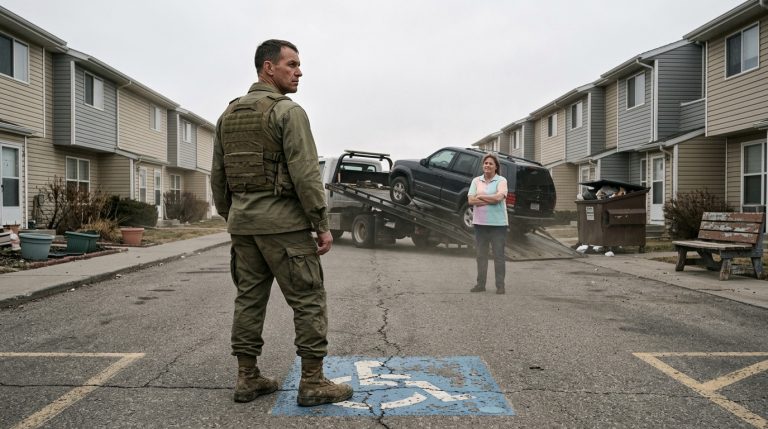
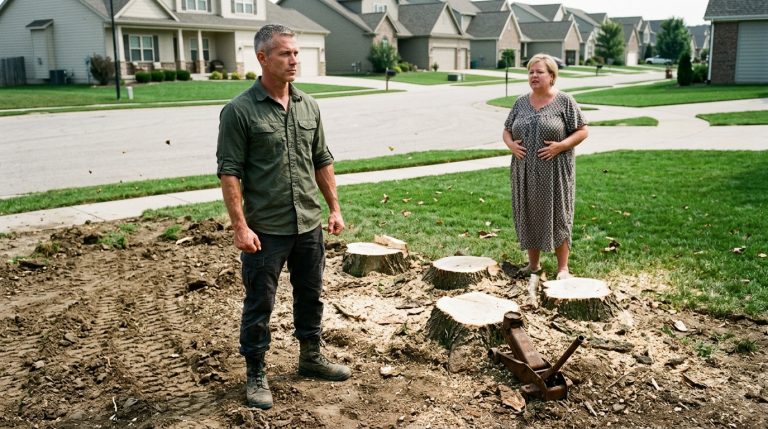
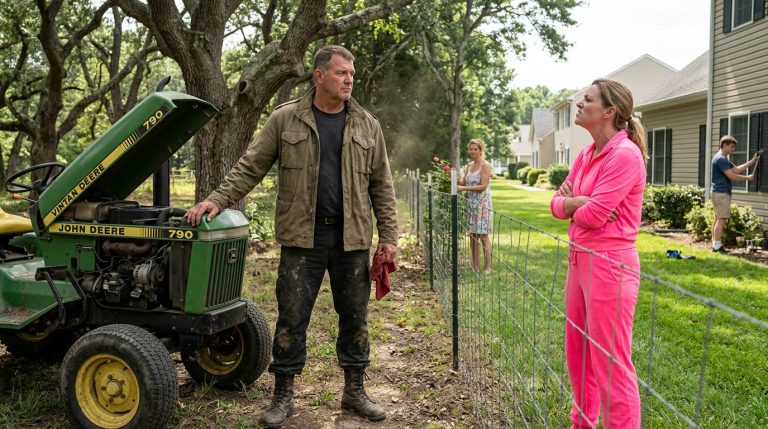
Karen stood at the edge of my gravel drive, her floral-print mumu billowing in the stagnant July heat like a warning flag. She was the epicenter of this neighborhood’s anxiety, a woman whose life’s work was the enforcement of beige uniformity. She held a stack of documents, the edges curled by the humidity, and behind her, the bulldozer hummed—a rhythmic, predatory vibration that traveled up through the soles of my work boots and settled deep into my marrow.
The operator, a man with skin the color of cracked leather, sat in the cab, his gaze flicking between us. He wanted to be elsewhere. I didn’t blame him. I stepped off my porch, the wood groaning slightly under my weight, and moved toward the boundary line. I didn’t walk with the hurried gait of a man under fire; I walked with the measured, rhythmic stride of an engineer who had spent twenty-five years assessing structural integrity.
“This access easement is a blight, Mr. Reynolds,” Karen called out, her voice sharpened by the artificial authority of the HOA board. “A direct violation of Covenant 17B. The board has voted. The road goes today.”
I stopped ten feet from the blade. It was caked in dried mud from a dozen other demolition sites, a jagged, rusted grin hovering just inches above my crushed stone. I looked past her, focusing on the bulldozer’s tread marks. They were jagged, chaotic, tearing into the perfectly graded slope I’d spent a decade maintaining. She thought this was about aesthetics. She thought this was about property values. She hadn’t even begun to understand the mechanics of the wall she was trying to climb.
I felt the weight of the folder in my pocket, the sharp corner pressing against my ribs. It held the truth about the subdivision’s main entrance—a truth the developer had buried in the fine print of the original plat, a truth that made the HOA’s current push for “compliance” not just illegal, but physically impossible.
“Covenant 17B, Karen,” I said, my voice cutting through the thrum of the engine. “You might want to check the baseline survey before that blade touches the first stone.”
She smirked, a tight, thin expression of triumph. “The survey is irrelevant. The community has spoken.”
As she moved to hand me the papers, I noticed something odd. A thin, metallic cable was dangling loose from the bulldozer’s hydraulic assembly, vibrating violently in the heat. It was a minor detail, a maintenance oversight, but it told me everything I needed to know about the quality of the company she’d hired. They were sloppy. And in a war of attrition, sloppiness was a fatal flaw.
The engine revved, a sharp, metallic spike in the air, and for a heartbeat, I realized the operator was looking at the loose cable, not at me. He was worried about his machine, not his mission. The fear was already there, hidden in the mechanical failure. The engine sputtered, then caught, then stalled, leaving a hollow, agonizing silence in its wake.
Karen’s smile didn’t just falter; it vanished. She spun toward the operator, her mouth opening to deliver a sharp retort, but as she did, her shoe caught on an uneven lip of asphalt at the edge of my property line. She stumbled, and for the first time in two years, the absolute, rigid posture of the HOA president shattered, replaced by a momentary, frantic scramble for balance.
It was the smallest sign of failure, but it was enough. I knew then that she wouldn’t leave this drive with the victory she expected.
CHAPTER 2: THE PAPER WAR
The silence was absolute, save for the ticking of the bulldozer’s cooling manifold—a metallic, rhythmic contraction that sounded like a countdown. Karen didn’t move. She stood on the edge of the gravel, her hands still gripping the folder of “official” notices, her knuckles white. She looked like a general whose army had vanished into the mist, leaving her alone on the battlefield with nothing but a worthless scepter.
“It’s just a loose connection,” the operator muttered, his voice cracking. He didn’t look at her; he was staring at the loose cable, his fingers twitching toward the tool kit behind his seat.
“Fix it,” Karen snapped, but the command lacked the jagged edge of her earlier certainty. It was thin, brittle.
I didn’t wait for him to reach for the wrench. I moved closer, my boots crunching rhythmically on the stone. The sound was amplified by the unnatural quiet of the neighborhood—a quiet that felt like the world holding its breath, waiting for the crack in the facade to widen.
“A structural failure, Karen,” I said, my voice steady, stripped of the condescension she’d used on me for years. “In my line of work, we call that a ‘predictable systemic collapse.’ You chose the cheapest contractor in the county. You relied on intimidation instead of infrastructure. Now, you’re standing in the middle of a broken system, and you’re the only one who doesn’t realize the power has already shifted.”
A sharp, intrusive memory flared in my mind—the collapse of a temporary bridge in a remote sector of the Bagram valley, the way the steel groaned before the entire structure folded into the river. I’d warned the command then, just as I’d warned the HOA board now. History, I’d found, rarely changed; only the players and the geography shifted. Karen was just another bureaucrat ignoring the physics of the situation.
She finally looked at me, and for a fleeting second, the mask slipped. I saw the raw, pulsing vein in her temple, the sheer, frantic desperation of someone who had invested too much of her identity in a lie.
“You think you’re so smart,” she hissed, taking a step back toward her Lexus. “You think you can hide behind your deeds and your little folders. The community wants this road gone. They don’t care about your ‘facts.’ They care about order.”
“They care about their own convenience, Karen,” I countered. I reached into my breast pocket and pulled out the first document—not a threat, but a simple, clear piece of leverage: the survey overlay highlighting the main subdivision entrance’s failure to meet fire-code turn radii. It was a document I’d pulled from the county archives months ago, a quiet anchor I’d been waiting to drop.
I didn’t hand it to her. I let the wind catch the edge of the paper, making it snap like a whip. “If you try to block this easement, you aren’t just violating my property rights. You’re highlighting the fact that your HOA board intentionally ignored county fire safety standards to squeeze in those extra corner lots. That’s not a covenant violation, Karen. That’s a liability that will bankrupt the HOA and everyone sitting on that board.”
The operator had finally pulled the cable free. He held it up, a frayed, pathetic mess of wire. “The harness is shot, ma’am. I can’t restart it here. We’ll need a flatbed.”
The word hung in the air: flatbed. The admission of total defeat.
Karen looked at the dead machine, then at me. The air was thick with the scent of unburned diesel and the impending thunderstorm, but for the first time, I felt the cool, clear sense of tactical superiority. I wasn’t just defending my land; I was dissecting her kingdom.
“You aren’t going to pull me over the coals,” she said, her voice dropping to a dangerous, low tremor. “I have the vote. The board has the authority.”
“The board has a piece of paper,” I said, stepping past her toward the bulldozer. I stood in the shadow of the massive, inactive blade. It looked less like a weapon now and more like a heavy, useless hunk of iron. “I have the county fire marshal’s direct line and a transcript of your board meeting where you specifically discussed ‘mitigating’ the fire-code issues by removing my road as a potential bypass for emergency vehicles. That’s not just a breach of fiduciary duty, Karen. That’s criminal negligence.”
The color drained from her face, leaving her features looking like wax under the harsh July sun. She was a petty tyrant, yes, but she was also a person who had spent her life terrified of being exposed. She didn’t fear me; she feared the consequences of her own ambition.
“Get off my property,” I said, my voice quiet, final.
She opened her mouth to argue, to launch another volley of bureaucratic rhetoric, but the silence from the houses surrounding us was deafening. The neighbors were watching. Behind the curtains of the beige houses, I could feel the collective weight of their gaze, the silent shifting of loyalties. The spell of her absolute authority was dissolving in real-time.
She turned and marched to her Lexus, the gravel spitting beneath her heels. As she pulled away, the tires didn’t screech; they spun, struggling for purchase on the very road she’d tried to erase. I watched her go, not with triumph, but with the cold, detached satisfaction of an architect watching a faulty foundation finally give way.
The operator looked at me, his shoulders slumped. “Sorry about the mess, sir. Just doing what I was told.”
“I know,” I said. “But you’re the one who has to get that pile of metal out of here. And I’d suggest you do it quietly. I’d hate to see what happens to your company’s reputation if a reporter shows up to photograph a bulldozer blocking an emergency fire-access route.”
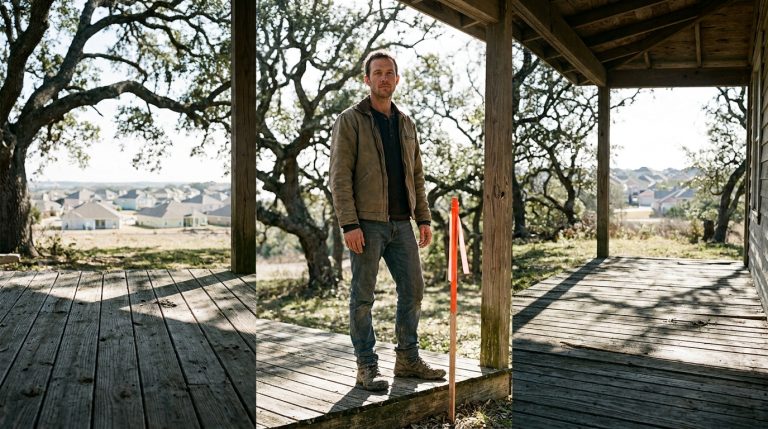
He paled, nodded, and began packing his tools. I turned and walked back toward my house. My porch felt solid beneath my feet, the wood seasoned and true. But as I reached for the handle of the screen door, I noticed a detail I’d missed earlier: a small, dark red ribbon tied to the base of my fence post. It hadn’t been there when I left for the driveway.
It was a small, almost invisible marker. A warning? Or a message from someone else in the neighborhood who was watching the war unfold from the shadows? I looked toward the Miller’s house two doors down. The curtains moved, just a fraction, then settled back into place.
The war wasn’t over. It had only just escalated to a level where the players were no longer just the ones standing in the light.
CHAPTER 3: THE SOCIAL SIEGE
I didn’t immediately retreat inside. I stood on the threshold of my porch, watching the operator climb into the cab of a support truck that had arrived to drag the dead machine away. He didn’t look at me. He was focused on the winch cables, his movements hurried, almost panicked. The subdivision felt like a stage set after the play had been canceled mid-performance—the actors were still in place, but they didn’t know their lines anymore.
I walked along my fence line, my boots leaving deep indentations in the soft earth. The red ribbon caught the light—a splash of violent color against the muted, dusty tones of the oak trees. I reached out and touched it, expecting it to be tied with a knot, but it was just looped over a splintered piece of cedar. It was a signal, one I wasn’t meant to misunderstand.
A few houses down, Bob was standing in his driveway. His lawn was perfect, as always, a verdant carpet of chemical-fed Bermuda grass, but his posture was wrong. He was clutching a garden hose, his knuckles white, staring not at his manicured edges, but at the empty space where the bulldozer had been. He looked like a man who had backed the wrong horse and was currently watching it collapse on the track.
When he saw me looking, he didn’t puff out his chest or start his usual tirade about “community standards.” He didn’t even glare. He simply looked away, his gaze snapping to his own front door with a sharp, jerky motion. It was an admission of retreat.
I turned back to my house. The interior was cool, smelling of old paper and the sharp, clean scent of the high-quality coffee Sarah was brewing. She was in the kitchen, her back to the door, staring out the window toward the cul-de-sac.
“They’re watching,” she said, her voice low.
“Let them,” I replied, setting my folder on the drafting table. I didn’t open it yet. I wanted to sit with the feeling of the silence, to analyze the shifting vectors of the neighborhood.
“Karen is on the phone,” she continued, not turning around. “She’s been on it for twenty minutes. Standing in her window, pacing back and forth. She looks like she’s trying to sell a lie that nobody wants to buy anymore.”
I walked to the window and looked out. Karen’s house was a monolith of beige siding and perfectly spaced windows. She was indeed there, a silhouette against the sheer curtains, the phone pressed hard against her ear. She was moving with that same frenetic, mechanical energy I’d seen in the bulldozer operator. She was losing her grip, and the friction was starting to show.
I went to my desk and opened the files. I needed to solidify the ground beneath me before the next wave of intimidation arrived. If she was still fighting, she was likely looking for a new tactical angle. She wouldn’t just give up; people like Karen required a total systemic failure before they could accept reality.
I pulled out the plat map again. I’d spent hours studying it, but I’d been looking at the roads, the easements, the utility lines. Now, I looked at the names. The original parcel owners. The history of the land itself.
There, near the northern boundary, was a handwritten annotation from 1974. A secondary easement. A legacy clause. It was faint, the ink faded by decades of exposure to the humid valley air, but the legal phrasing was unmistakable. The entire northern sector—the sector the HOA claimed as its own—was legally tethered to the original Hemlock farm parcel for the purpose of “utility and emergency access.” It wasn’t just my road that mattered; it was the whole orientation of the subdivision.
If they tried to pave over my history, they’d be dismantling their own foundation.
I felt a cold, sharp thrill of clarity. She wasn’t just bullying a neighbor; she was attempting to sever the land from its own legal context. She couldn’t do it, not without a total, catastrophic collapse of the neighborhood’s legal standing.
“She’s going to escalate, isn’t she?” Sarah asked, turning around.
“She has no choice,” I said. “If she stops now, she’s just an embarrassing HOA president. If she keeps going, she’s a criminal liability.”
I left the study and stepped back out onto the porch. The sun was beginning to dip below the tree line, casting long, jagged shadows across the gravel. The red ribbon was still there, but now, a second one had appeared on the fence post a few feet away. This one was blue.
A silent tally? A warning of two different factions? Or perhaps the first tentative signals from a neighborhood that was finally realizing its own house was built on a legal sinkhole.
I stood there, a solitary figure on the edge of the encroaching subdivision, listening to the muffled, frantic sounds of a community slowly losing its artificial peace. I had the documents. I had the logic. And for the first time, I could feel the neighborhood—not as a monolith of opposition, but as a collection of individuals, each one currently weighing the cost of their own silence.
The siege hadn’t really begun. We were just at the stage of positioning the pieces.
CHAPTER 4: THE CLUBHOUSE TRAP
The clubhouse smelled of chlorinated pool water and the aggressive, synthetic lemon of industrial-strength floor cleaner. It was a space designed to suppress humanity, all beige walls and stiff, folding chairs arranged in perfect, soul-crushing rows. Thirty residents sat there, their faces illuminated by the harsh, overhead fluorescent lights. They looked like they were waiting for a funeral, or perhaps a verdict.
Karen sat at the front, centered at a folding table, a glass of water untouched before her. She was wearing a structured navy blazer that made her look like she was preparing for a board meeting rather than a neighborhood squabble. When the door clicked shut behind me, thirty pairs of eyes swiveled in unison. The room went dead silent.
I didn’t move toward the front. I stood by the back wall, my hands resting lightly on the folder tucked under my arm. I felt the weight of the documents—the fire marshal’s letter, the utility schematics—anchoring me. I wasn’t here to play by Karen’s rules of order; I was here to rewrite the architecture of the conversation.
“Mr. Reynolds,” Karen said. Her voice didn’t waver, but I noticed the way her fingers tapped a frantic, irregular rhythm against the laminate tabletop. “This is a closed board session. You have no standing here.”
“This meeting is about my property, Karen,” I said, my voice cutting through the hum of the air conditioning. “And it’s about the safety of every single family sitting in these chairs.”
A murmur rippled through the room. Bob, sitting in the second row, shifted uncomfortably, his eyes darting to the floor. The Miller family, huddled near the exit, watched me with a mix of anticipation and fear. They were waiting to see if I would fold.
Karen stood up, her shadow stretching long and thin across the linoleum. “You are an agitator. You have spent the last two years harassing this association with your refusal to conform. This meeting is to finalize the budget for the removal of your encroachment. It is a matter of record, not a matter for debate.”
She signaled to a man sitting at the end of the table—a private security guard she’d clearly hired for the occasion. He was a thick-set man in a black polo, his arms crossed over his chest. He looked like he’d rather be anywhere else, but he was currently part of the architecture of intimidation.
“The board,” Karen continued, her voice gaining the shrill, righteous pitch of a martyr, “has determined that your gravel road is an eyesore and a liability. We have a unanimous vote to fund the demolition. Henderson Construction is ready to begin at first light.”
I took a step forward, the sound of my boots on the polished floor echoing like gunshots in the small room. I didn’t yell. I didn’t need to. “A liability, Karen? Or is it a cover-up?”
I stopped at the edge of the first row. The air between us was charged, thick with the anticipation of the crowd. I pulled the fire marshal’s letter from the folder. The paper was crisp, the ink dark and authoritative.
“I spoke with the fire marshal this morning,” I said, my voice projecting to the back of the room. “He didn’t just mention the turning radius of Oakwood Lane. He provided a written assessment that states your subdivision’s main entrance is in direct violation of county emergency code. The tight corners you insisted on for the sake of ‘aesthetic harmony’ mean the large ladder trucks can’t turn onto your main road in an emergency.”
The silence in the room shifted. It wasn’t the silence of intimidation anymore; it was the sharp, jagged silence of realization. People started to turn to one another, whispers bubbling up like gas from a swamp.
Karen’s face hardened. “That’s a fabrication. Our developer ensured full compliance.”
“Did he?” I asked. I laid the schematic on the table, right next to her glass of water. It was a photocopy of the county-approved plan, with the critical error circled in red ink—a detail hidden in plain sight, a monument to greed over safety. “Check the dates. This was filed after the initial build. You didn’t just ignore the code; you attempted to bypass it by claiming my private road was an ‘auxiliary access.’ If you destroy that road, you’re not removing an encroachment. You’re trapping yourselves in a subdivision that doesn’t meet the most basic safety requirements of the county.”
The security guard shifted his weight, his eyes darting to the paper on the table. He leaned in, just a fraction, curious despite his orders.
“You’re lying,” Karen said, but her voice was a thin, high-wire act of desperation. She reached for the paper, but I moved faster, my hand slamming down on the document.
“Ask the board,” I said, turning to the four other members seated beside her. They looked like deer in the headlights, their eyes wide, their faces pale. They hadn’t known. Karen had kept the truth from them, using their collective anxiety to push her own agenda.
“Is this true?” a woman in the third row shouted, her voice shaking. “Is our subdivision not up to code?”
The room exploded. People stood up, chairs clattering against the floor. The sterile, beige walls suddenly felt like they were closing in on Karen. She stood there, frozen, the veneer of her authority cracking under the weight of the reality I’d just introduced.
I didn’t need to say another word. I had planted the seed of doubt, and now, the room was doing the work for me. Karen looked at the crowd, then at the board, her mouth opening and closing as she searched for a narrative that could hold the chaos back. But the truth, cold and hard as the gravel on my drive, had already taken root.
I stepped back, watching the collapse. The security guard retreated, realizing that this wasn’t a security situation; it was a riot of logic. Karen’s house of cards was falling, and I had simply provided the breeze.
CHAPTER 5: THE LOGISTICAL STRIKE
I walked out of the clubhouse not as a victor, but as a man who knew the hardest part of the war was the aftermath. The sky, which had been threatening all evening, finally broke. A jagged fork of lightning illuminated the parking lot for a split second, turning the sea of beige siding and manicured lawns into a high-contrast negative. Rain began to fall—heavy, rhythmic drops that slapped against the asphalt like small arms fire.
I reached my truck just as the downpour turned into a deluge. I didn’t get in immediately. I stood there, letting the cold water soak through my shirt, feeling the grit of the gravel beneath my boots. It was a grounding sensation. The truth I’d dropped in that room would ripple outward, but it was just the beginning. Karen wouldn’t go quietly; the cornered animal usually fights the hardest.
My phone vibrated in my pocket. A text from Frank, the route supervisor at Allied Waste. Check your email, Jack. The board sent a legal rep. They’re trying to pressure us to blacklist your road regardless of the safety findings. They claim ‘private easement interference.’
I wiped the rain from my eyes. So, she was going for the supply lines. If she couldn’t win on the law, she’d try to create an operational impasse, starving my access by weaponizing the utility contract. It was a predictable, clumsy move.
I turned back to the clubhouse. The lights inside were still blazing, but the shadows moving behind the glass were agitated. I watched through the window as Karen stood by the folding table, her blazer discarded, her hair coming loose from its stiff, calculated arrangement. She was gesturing wildly, talking to a man in an expensive gray suit—the HOA’s legal shark. They were huddled over the same documents I’d brought to the floor.
I needed to see what they were doing. I moved to the side of the building, toward the service entrance. The rain was drumming against the corrugated metal roof, a deafening, white-noise wall that gave me the cover I needed to reach the back window. The glass was cool against my skin.
“—if the easement is tied to the original parcel,” the lawyer was saying, his voice barely audible over the roar of the rain, “then the entire legal standing of the Phase III annexation is moot. You don’t just have a road problem, Karen. You have a title problem. If this man can prove the Hemlock covenant still holds sway over the collective deed, he isn’t just a neighbor. He’s a shareholder in the very land you think you own.”
Karen’s response was a sharp, unintelligible retort, but her posture had changed. She wasn’t just angry; she was terrified. She was looking at the lawyer not as an employee, but as a lifeline.
I felt a chill that had nothing to do with the storm. My property was an island, yes, but the legal reality was a web. If the Hemlock covenant was as old and as foundational as I suspected, then my land wasn’t an exception to the HOA—it was the anchor. Without it, the subdivision didn’t have legal egress.
The weight of the realization hit me with the force of a physical blow. I wasn’t just defending a gravel road; I was holding the leash for the entire subdivision.
A bolt of lightning struck somewhere close—a deafening, bone-shaking crack that vibrated through the foundation of the clubhouse. The lights flickered and died. The building plunged into total darkness, save for the occasional, stuttering flash of blue-white light from the storm.
I backed away from the window, my heart hammering against my ribs. I needed to get back to my office. I needed the original deed, the one Hemlock had handed to me a decade ago. There were signatures on the back, faded and ignored, that I had never truly scrutinized.
I turned to run toward my truck, but a figure blocked my path.
It was Bob. He was standing in the downpour, his expensive raincoat slick with water, his face twisted in a mask of uncertainty and hidden rage. He wasn’t holding a hose this time. He was holding a flashlight, the beam cutting through the rain, blinding me.
“You really messed it up, didn’t you, Jack?” he yelled over the wind. “Everything was perfect. The value, the rules, the look of the place. We had it all planned out, and you came in with your gravel and your attitude, and you’re tearing the whole thing down because you couldn’t be bothered to be a neighbor.”
“I was a neighbor, Bob,” I said, my voice low, steady. I kept my hands visible, the rain plastering my hair to my forehead. “Until you decided that my property was something to be managed. You’re not mad at me. You’re mad because you’re realizing that your investment is a house of cards.”
“It’s not just an investment,” he screamed, taking a step closer. “It’s my life! And you’re destroying it.”
He lunged. It wasn’t a calculated move; it was a desperate, emotional strike. He swung the heavy flashlight, an arc of steel and glass intended to connect with my head. I didn’t think; I reacted. The training, the years of muscle memory in the field, kicked in. I ducked, the flashlight whistling through the air where my temple had been a fraction of a second before. I stepped inside his reach, my forearm catching his wrist, redirecting his momentum.
He stumbled, the wet asphalt beneath his feet offering no purchase. He went down hard, the flashlight skittering across the driveway and into the darkness.
I stood over him, my chest heaving, the rain washing the mud from my hands. He scrambled backward, his face a mess of panic and rain.
“Stay down, Bob,” I warned, my voice cold. “The only one destroying your life is you.”
I turned and walked to my truck. I didn’t look back. The storm was reaching its peak, the wind howling through the oak trees, tearing leaves and branches down around us. The subdivision was changing, the veneer of civilization dissolving in the mud. I had the knowledge now, and I had the proof. The war was no longer about a road. It was about the very foundation of the land itself.
I climbed into the cab and started the engine. The heater hummed, a small, artificial comfort in the middle of a collapsing world. I looked at the rearview mirror once. Bob was still on the ground, a dark, lonely shape in the rain.
The truth was coming, and it was going to be heavier than any road they could build.
CHAPTER 6: THE MEDIA BLITZ
The office was a tomb of paper. I moved directly to the desk, the rain still dripping from my jacket onto the hardwood floor, a steady, rhythmic tap that measured the urgency of the moment. I didn’t turn on the overhead lights; the single, focused beam of my desk lamp was enough to cut through the oppressive darkness of the room. It cast long, jagged shadows against the wall, making the stacks of reports and schematics look like miniature, jagged mountain ranges.
I pulled out the original deed. My hands were still cold, the adrenaline from the encounter with Bob receding to leave a hollow, metallic taste in my mouth. I laid the paper flat, the edges brittle and prone to tearing. I reached for a magnifying glass—an old tool from my days in the Corps—and adjusted the light.
The annotations on the back were written in fountain pen, the ink a deep, sepia tone that seemed to vibrate under the lens. It wasn’t just a survey note. It was a restrictive covenant, drafted by Hemlock and his counsel, stipulating that the maintenance of the northern ingress was the prerequisite for the legal validity of any subsequent subdivision.
It was the “Original Anchor.” If I could get this into the hands of someone who understood the weight of it—someone like Maria Sanchez—the entire Oakwood Estates legal structure would undergo a forced, immediate liquidation. They were currently fighting me on a “nuisance” claim, but this? This was a “title” claim. This invalidated the very charter that allowed the HOA to exist as a governing body.
My phone screen flared again. Another message, this one from Maria. The story is gaining traction. I have residents from Phase II calling me about unexplained ‘assessments’ that don’t match the budget. They’re scared, Jack. Karen’s legal team is sending cease-and-desist orders to the local news desk. She’s trying to kill the signal.
I didn’t reply. I started typing. I didn’t just summarize; I indexed every violation, every piece of evidence of their fraudulent fire-code bypass, and added the scans of the deed. I was creating a dossier that was too large to bury and too volatile to ignore.
The room felt smaller, the walls pressing in. My mind kept jumping back to the flashlight, the arc of glass in the dark, the look in Bob’s eyes. He wasn’t just a neighbor; he was a symptom. The HOA had created a culture where conformity was the only survival strategy, and now that the strategy was failing, the residents were turning on each other.
I heard a sound from the porch. Not the wind, not the rain. A footfall. A distinct, heavy crunch of gravel.
I froze. I extinguished the desk lamp, plunging the room into absolute darkness. My hand found the edge of the desk, fingers mapping the familiar surface. I moved to the window, keeping low.
Through the rain-streaked glass, I saw a figure standing on my porch. The silhouette was unmistakable: Karen. She wasn’t carrying a folder. She was standing perfectly still, looking at the door, her face tilted upward toward the porch light. She stayed there for a long time, the rain soaking through her clothes, her posture rigid, unnatural.
She wasn’t there to argue. She wasn’t there to deliver a notice.
She reached into her coat pocket and pulled out a small, metallic object. A key. Not the key to the clubhouse, not the key to her house. It was a master key, the kind used by the management company for common area access—and, if the legends in the neighborhood were to be believed, it was also the key they used to access the utility boxes that controlled the perimeter of the estates.
She stepped off the porch and walked toward the utility shed near the edge of my property line, where the primary junction for the subdivision’s electrical feed was housed. The shed was on my land—a technicality they’d been trying to litigate for months.
If she cut the power, she wouldn’t just be plunging me into darkness. She’d be triggering a system-wide fault in the subdivision’s automated security and access grid. She was looking for a total, chaotic reset. She wanted the system to fail so she could blame the ensuing security breach on me—a final, desperate play to frame me as a public danger.
I didn’t wait for her to open the lock. I stood up, the chair scraping sharply against the floor. I didn’t reach for a weapon; I reached for the one thing that held more power than a master key: the truth I’d just verified.
I grabbed the dossier, stepped out the back door, and began to run into the teeth of the storm.
CHAPTER 7: THE BOARD ROOM COLLAPSE
The utility shed was a claustrophobic box of humming transformers and tangled copper, smelling of ozone and wet cedar. I ducked inside, the rain still lashing at my back, and slammed the door shut, cutting off the howl of the storm. The darkness was absolute for a heartbeat, until I clicked on my flashlight. The beam cut through the dust, revealing a scene of organized neglect—shelves stacked with spare parts, rolls of conduit, and a desk that looked like it hadn’t been touched in a decade.
Karen wasn’t there. I spun, the beam sweeping across the narrow space, but the shed was empty. Had I misjudged her? Or was she already ahead of me, pulling strings I hadn’t even mapped? I stepped toward the desk, my boots leaving muddy tracks on the concrete floor. That was when I saw it: the blueprints. They were tucked beneath a stack of old maintenance manuals, their edges worn and stained with damp.
I unfurled them under the harsh light. These weren’t the sanitized plans I’d seen in the clubhouse; these were the original “as-built” documents. They showed the truth in agonizing detail. The fire-code violations weren’t an oversight—they were a deliberate architectural choice, a way to maximize density at the expense of safety. And there, in the margins, were Karen’s own initials, dated from the earliest phase of the development.
She hadn’t just moved into the subdivision; she had helped curate its flaws. She was an architect of this disaster from day one.
The shed door creaked. I whipped around, the flashlight beam hitting the opening. Karen stood in the doorway, drenched, her hair matted against her skull, her clothes clinging to her frame like a second skin. She looked less like a president and more like a ghost, her face pale and drawn. She held the master key in her hand, the metal reflecting the light with a dull, matte shimmer.
“You shouldn’t have come in here, Jack,” she said. Her voice was flat, devoid of the performance she’d been putting on for the last two years. “You have no idea what you’re looking at. This isn’t just about a road. It’s about the very concept of community.”
“It’s about fraud,” I said, my voice steady, my heart pounding against my ribs. “It’s about sacrificing safety for scale, and then using a homeowners association as a legal shield to bury the bodies.”
She laughed, a short, sharp sound that didn’t reach her eyes. “Bodies? You’re so dramatic. This is real estate. It’s compromise. Everyone who bought a house here signed a contract. They traded their autonomy for a certain kind of life—a clean, predictable, safe life. I just made sure they got what they paid for.”
“By threatening anyone who didn’t fit the mold?” I gestured to the plans. “By trying to bulldoze a man’s home because it didn’t align with your vision of perfection?”
“You were the only one who didn’t understand the assignment,” she hissed, stepping into the shed, the door banging shut behind her. “You could have been an asset. We could have worked together. But you insisted on being a variable in an equation I’d already solved.”
I took a step toward her, the dossier in my left hand feeling like a block of lead. “The equation is broken, Karen. Look at the plans. Look at the dates. When the fire marshal gets his hands on these, your tenure, your reputation, and your legal immunity are going to evaporate.”
She looked at the blueprints, then back at me. “The fire marshal? The media? You think they care? They want a story. I can give them a story. I can tell them you’re a paranoid ex-military officer who’s been terrorizing the neighborhood, and that you’ve been falsifying documents to settle a vendetta. Who are they going to believe? The president of the HOA, or the man who’s been fighting the community for a decade?”
She was a master of the pivot, shifting the narrative as easily as she’d shifted the blame. But she was wrong about one thing: she assumed I was playing the same game.
“I’m not playing the story, Karen,” I said, moving past her toward the exit. “I’m playing the law.”
She reached out, grabbing my sleeve, her fingers digging into the wet fabric. “You can’t walk out with those.”
“Watch me,” I said. I pulled my arm away, the movement effortless.
I pushed the door open and stepped out into the rain. The storm had reached a fever pitch, the world a chaos of wind and water. I ran toward my truck, the dossier tucked tight against my chest, the blueprints heavy in my pocket. I reached the driver’s side and climbed in, the engine roaring to life with a desperate, metallic urgency.
As I pulled out of the driveway, I saw her standing in the doorway of the shed, a lone figure in the deluge. She wasn’t chasing me. She was just standing there, watching. She knew. The game was up.
I headed for the main road. I had the documents. I had the proof. And I had the absolute certainty that when the sun rose tomorrow, the Oakwood Estates Homeowners Association would no longer be a governing body, but a crime scene.
CHAPTER 8: THE QUIET RESTORATION
The drive back from the subdivision was an exercise in pure, cold mechanics. I parked in front of my house, the truck’s headlights carving two bright, unwavering tunnels through the receding mist of the storm. I didn’t get out immediately. I sat with my hands on the wheel, my muscles vibrating with the residual energy of the night, feeling the heavy, wet weight of the dossier on the passenger seat.
I walked to the house, the gravel crunching beneath my boots with a sound that felt deliberate—a confirmation that the road was still there, still mine. Inside, the house was dark, but the air felt breathable again, free from the stale, oppressive pressure that had been building for two years.
I sat at the drafting table and began the final phase. I didn’t need to shout, or hold rallies, or bang gavels. I simply opened my laptop and sent the digital packets: one to Maria Sanchez, one to the county fire marshal, and a final, certified copy to the HOA’s management company, CC’ing the legal counsel I had finally retained the week before.
The reveal of the Hemlock covenant was the anchor. It didn’t just expose the fraud; it rendered the HOA’s jurisdiction over my land legally impossible from the date of the subdivision’s inception. The “annexation” was a phantom, a bureaucratic fiction that held no power once the truth of the original deed was pulled into the light.
By mid-morning, the chaos began. I watched it from my porch, sipping a cup of coffee that tasted like victory. The management company representatives arrived in a black sedan, their expressions grim and business-like. They didn’t go to the clubhouse; they went to Karen’s house.
I didn’t see her come out, but I saw the bags. I saw the realtor’s sign being pulled from the yard—the same sign that had stood as a monument to her failure. By noon, she was gone. No dramatic exit, no final standoff; just a slow, grinding realization that the system she had curated was now optimized to exclude her.
The payoff was not a singular, triumphant explosion, but a series of quiet, restorative shifts.
The fire marshal and his team arrived at two in the afternoon. They didn’t come to demolish; they came to inspect. They spent hours measuring, testing, and confirming the very violations I had laid out in my dossier. The main entrance was formally shuttered for emergency access within the hour, deemed a public safety hazard. The “auxiliary” access—my road—was officially designated the primary artery for emergency services until the subdivision could be brought into compliance.
Poetic justice, I realized, was rarely spectacular. It was structural. Karen had tried to erase my road, and in doing so, she had ensured it would be the only thing keeping her community functioning.
As the sun began to set, the neighborhood began to settle. The atmosphere was different—less sterile, less governed. People were out, but they weren’t checking their mailbox heights or measuring their grass. They were talking. I saw the Millers walking down the center of the street, their kids riding bikes on the asphalt without the frantic, nervous supervision that had become the norm.
I walked out to the edge of the drive, where the gravel met the pavement. I knelt, my fingers finding the edge of the crushed stone, the grit firm and unyielding under my touch. I reached into my pocket and pulled out a small, bent garden stake—one that had been pulled from the ground during the height of the harassment—and driven it back into the earth. It was a small act of maintenance, a tiny restoration of the order that existed before the fever dream of Oakwood Estates took hold.
Sarah came out onto the porch, a soft shawl wrapped around her shoulders. She stood beside me, not saying a word, just watching the sky turn that deep, bruised purple that signaled the end of a long, punishing heatwave.
“It’s quiet,” she said finally.
“It’s home,” I replied.
The struggle hadn’t left me unchanged. I was tired, with a deep, marrow-level exhaustion that I knew would take months to shed. But as I stood there, looking out over the rolling pasture that had once been the Hemlock farm, I felt a profound, settled peace. The antagonist wasn’t a person; it was the obsession with control, and that had been dismantled by the simple, stubborn reality of the ground itself.
The covenant held. The land remained. The road was safe. I stood up, brushing the dirt from my knees, and turned back toward the house. The windows were warm with light, and for the first time in ten years, I wasn’t just existing on the periphery of a community. I was a part of a landscape that was finally, truly, resting.
The war was over. The maintenance of the peace could finally begin.