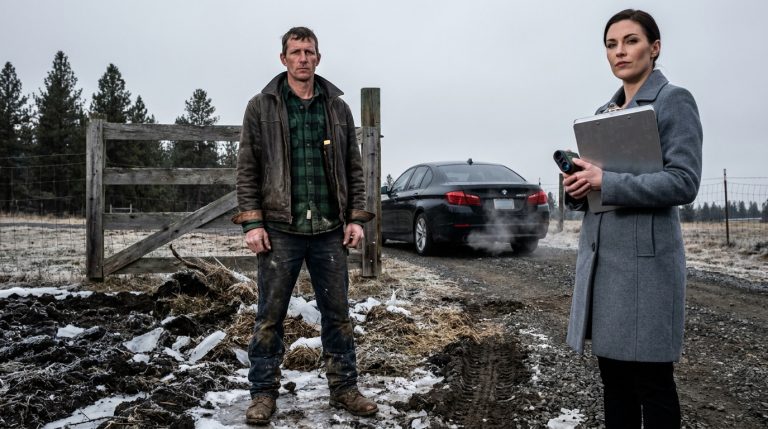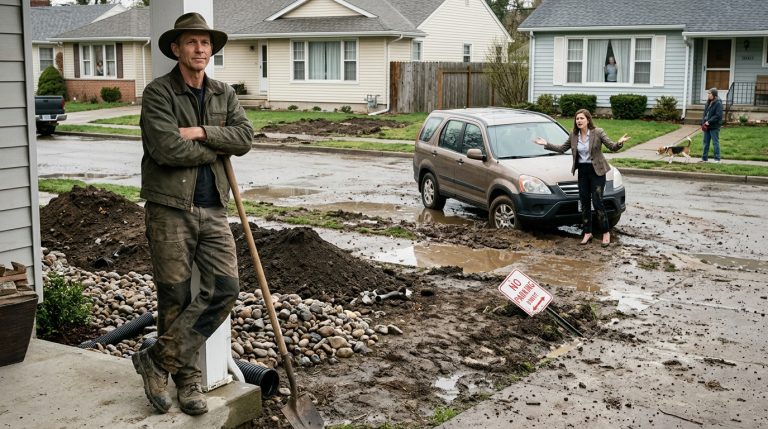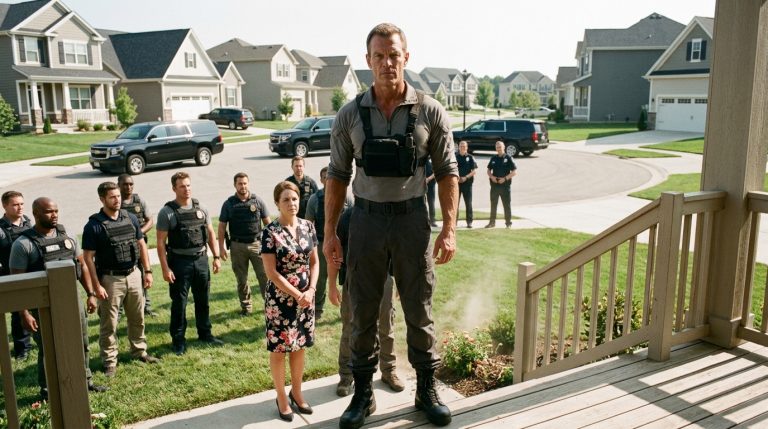
The Blueprint of Retribution: How One Man Dismantled a Suburban Tyrant Through Calculated Systemic Warfare
CHAPTER 1: The Breach
The voice on the other end of the line was thin, frayed at the edges. Sarah Miller was trying, but the sound of her child wailing in the background made the attempt at composure impossible.
“She gave us thirty days, Mark,” she whispered, the words hitching in her throat. “Thirty days before she sends the sheriff to clear us out.”
I leaned back in my leather chair, the leather creaking in the silence of my office. Outside, the evening light was dying, casting long, bruised shadows across my desk. I didn’t look at the HVAC schematics anymore. I looked at the dark window, watching my own reflection. I was Major Mark Thorne, Retired. I spent twenty-five years mapping the logistics of survival in hostile environments, and I knew the sound of a predator closing in on a target.
“Sarah,” I said, my voice dropping to a low, steady frequency—the same tone I used when briefing a unit before a push. “Take a breath. No one is evicting you. You have a lease, you have rights, and you have me. Do not open the door if she comes back. Do not sign anything. Do you hear me?”
“But she said the sandbox… she said the shade of green was a breach of contract.”
I felt the familiar cold burn in my gut. It wasn’t heat; it was the sharp, crystalline clarity of a mission objective. It wasn’t about the green plastic turtle. It was about the exercise of control. It was about the thrill of watching someone smaller crumble.
“I am going to handle this,” I said, my voice leaving no room for doubt. “Stay inside. Lock the doors. I’ll be there in the morning to document the perimeter.”
I ended the call and let the silence reclaim the room. I reached into my pocket and touched the cold, jagged teeth of the brass key I’d carried since my final tour. The room felt suddenly too small. I looked down at the HOA covenants I’d filed away—documents I’d analyzed with the clinical detachment of an engineer.
I turned my computer monitor back on, the blue light washing over my face. I opened a new file, typing a single word in the subject line: Karen.
I didn’t just need to stop an eviction. I needed to identify every structural weakness in her little kingdom, map her reach, and find the point where her arrogance was most vulnerable. She thought she was holding the law over the heads of civilians. She had no idea she had just declared war on a man who had spent his life dismantling hostile structures, piece by agonizing piece.
I looked at the photos of the property on my screen. The sandbox sat in the corner of the yard like a plastic casualty of war. The phone buzzed again, an automated alert from the HOA’s public portal. A fresh notice of violation. I didn’t read it. I didn’t need to. I already knew the architecture of her next move.
CHAPTER 2: The Architecture of the Audit
I didn’t turn on the office lights. The glow from the dual monitors was sufficient, carving the room into patches of harsh blue light and deep, ink-black shadow. On the screen, the HOA covenants of Oakmont Creek laid themselves out like a complex, flawed piece of engineering. They were sloppy—a patchwork of borrowed legalese and personal vendettas, written by people who valued the appearance of order over the reality of it.
I pulled a physical notepad toward me, the paper crisp and expensive. I began to map the document’s logic.
There were four primary pillars of authority: Article 4, which covered the vague “aesthetic integrity” that Karen weaponized; the Architectural Review Committee (ARC) mandates; the fining protocols; and the enforcement chain of command. I drew them as nodes. My pen moved with a rhythmic, sharp efficiency, tracing lines between them.
The violation she had sent was based on an aesthetic clause. I circled Article 4, Section 2 with a heavy, deliberate stroke of red ink. It was the “catch-all”—the clause that gave the board arbitrary power to enforce anything they deemed “unharmonious.” It was a classic, amateur trap. By keeping it vague, they thought they had more power, but they had actually created a massive liability. Law relies on specificity; without clear, objective definitions of what constituted a violation, her actions were technically arbitrary. And in a court of law, arbitrary is just another word for unenforceable.
I leaned back, the leather of my chair groaning. My hand drifted to my pocket, finding the cold, rusted brass key. It was a sensory anchor, a reminder of a different life where the stakes weren’t plastic turtles and lawn ordinances, but troop movements and logistical integrity. Back then, if a structure was hostile, we identified the supply lines, cut off the resources, and waited for the internal pressure to cause a collapse.
Karen’s supply line wasn’t ammunition or fuel; it was the psychological submission of her neighbors. She needed them to fear the fine. She needed them to look at their own backyards and see a list of potential infractions rather than a home.
I began to list the potential vulnerabilities. If she wanted to enforce the rules, she had to follow the chain of command, which meant the board, the committee, and the official notification process. I needed to see if she was cutting corners. If she was bypassing the ARC to issue fines directly—which the bylaws strongly implied she was—then she was operating outside the charter.
The silence of the house was absolute, save for the hum of the hard drive. My mind was a machine, parsing the data. I didn’t hate her. Hate was a waste of caloric energy, a messy emotion that obscured the tactical view. I viewed Karen with the same clinical, detached evaluation I would have given a failing bridge support. She was a stress point. She was a component under too much pressure.
I opened the HOA’s public financial summary, the one posted on their website. It was thin, a few pages of rounded numbers and vague categories. I scanned the “Community Improvement” line item. It had jumped forty percent in the last three years. I compared it to the photos of the neighborhood I’d taken during my last visit—the cracked asphalt, the faded community pool, the rusted light posts.
The math didn’t align. The physical reality of the neighborhood contradicted the expenditures.
A thought flared in the back of my mind—a V-2 phantom. For a second, the office smelled of diesel and hot, dry desert air. I saw the faces of the soldiers who had trusted me to build their housing units, who relied on me to ensure the contracts were honest. The anger returned, not as a flash, but as a cold, dense mass in my chest.
She wasn’t just a tyrant. She was a parasite.
I started a new document, labeling it Logistics. I would need to contact the county clerk to get the full incorporation papers of the Oakmont Creek HOA. I needed to know the legal definition of the board’s powers and whether they had actually filed the amendments required to authorize these fine levels.
My phone buzzed again. Another email from the HOA portal. I ignored it, focused instead on the red ink on my pad. The structure was beginning to reveal itself. I was no longer an observer. I was the architect of her obsolescence. I stood up, the chair pushing back with a sharp, percussive sound against the floorboards. I walked to the window. Outside, the night was still, but to my eyes, it was already a theater of operations. I knew exactly where I was going to push, and I knew exactly when the first crack would appear.
The plan was solid. I felt the weight of the key in my pocket, the sharp edges pressing into my palm. It was time to start making calls.
CHAPTER 3: The First Contact
I didn’t wait for the sun to rise. By 7:00 AM, the temperature was already climbing, and the air held that stagnant, thick quality of a humid summer morning in the suburbs. I parked my truck three houses down from the rental property, ensuring my field of vision was clear. The neighborhood was quiet, waking up in segments—the sound of an automatic sprinkler ticking, the muffled start of a commuter’s engine.
I walked the perimeter of the Miller house, my footsteps measured. I wasn’t just looking at the house; I was looking for the intrusion. And there it was, sitting in the backyard, partially obscured by the fence: the green plastic turtle. It was exactly as Sarah had described—a harmless, faded piece of molded plastic that Karen had deemed a threat to the community’s aesthetic integrity.
I didn’t touch it. I pulled out my phone and began to document. I took photos from the sidewalk, from the driveway, and finally, I walked to the edge of the property line to capture it from the exact angle a passerby would see if they were walking their dog. It was barely visible. You had to intentionally stop, lean over, and squint through a specific gap in the horizontal slats of the fence to even notice it.
It was a pretext. A farce.
I heard the sound of a heavy sliding door behind me. I turned to see Sarah stepping onto the back porch, clutching a mug of coffee. Her eyes were red-rimmed, searching my face for a sense of direction. I didn’t smile; I maintained the neutral, professional mask that had served me well for two decades.
“Mark?” she asked, her voice tight. “Did you see it? Did she—”
“I see it,” I interrupted, keeping my voice low and steady. “And I have the evidence I need. She isn’t just wrong, Sarah. She’s overstepping. She has no authority to demand the removal of non-permanent recreational items, especially when they aren’t visible from the public thoroughfare.”
Sarah took a shaky sip of her coffee, leaning against the railing. “She pounded on the door yesterday. She wasn’t ringing the bell, she was… she was hammering on the wood like she was breaking in. My kids were terrified.”
I recorded the detail, locking it away in the mental file I’d titled Karen. “She won’t be back. I’m going to make the call to her office this morning. I’m not going to argue the sandbox. I’m going to argue the bylaws.”
I left Sarah with the reassurance that her sanctuary remained intact and drove toward the Oakmont Creek clubhouse, which doubled as the HOA’s administrative center. I didn’t expect to find Karen there, but the building held the files.
As I pulled into the parking lot, I saw a woman stepping out of a silver sedan. Her posture was unmistakable—a rigid, sharp-edged rigidity that telegraphed a need for absolute dominance. It was Karen. Her hair was cut into a severe, chin-length bob that didn’t move as she turned her head. She was carrying a stack of files, her expression one of permanent, deep-seated disapproval.
I exited my truck. I didn’t rush. I walked at a pace that suggested I had all the time in the world.
She saw me halfway across the lot. She stopped, her shoulders tensing. She recognized the truck, and then she recognized the man. For a second, her composure flickered—a brief, unmasked shadow of surprise—before it was replaced by a familiar, defensive sneer.
“Mr. Thorne,” she said, her voice carrying a practiced, thin sharpness. “I believe I made my position very clear in the notice I sent.”
“You did,” I replied, closing the distance until I was standing well within her personal space. I didn’t raise my voice; I let the silence do the work. “But I think you might have skipped a page in your own manual. Article 4, Section 2 is a broad-strokes clause. It requires interpretation, not executive mandate. You don’t have the authority to act as judge, jury, and executioner for my tenants.”
She stiffened, her knuckles turning white around the file folders. “I have the authority to maintain the standards of this community. If you are incapable of supervising your property, I am perfectly happy to do it for you.”
“You’re going to be very unhappy then,” I said, my voice dropping an octave, slipping into the cadence I’d used to command subordinates in the field. “Because I’ve reviewed the charter. I’ve reviewed the ARC requirements. And I know exactly what you are and are not authorized to do. If you approach that property again—if you knock on that door, if you leave another notice, or if you attempt to intimidate my tenants—I will consider it harassment. And I will treat it accordingly.”
She scoffed, a brittle, grating sound. “You’re threatening me? In my own neighborhood?”
“I’m informing you of the consequences of your next move,” I said. “Send me the official violation, Karen. Do it by the book. Cite the specific bylaw, the specific date of the review, and the specific board resolution that authorized this fine. If you can’t, then we have nothing left to discuss.”
I turned, leaving her standing alone in the middle of the empty lot. I didn’t look back. I heard her call out something—a sharp, indignant protest—but I let it dissolve into the morning air.
As I drove away, I felt the internal pressure shifting. I had engaged. The line was drawn. She would react, and her reaction would be predictable, emotional, and flawed. She was moving exactly where I needed her to be.
CHAPTER 4: The Gathering
I drove through the Oakmont Creek exit, the tires humming against the hot asphalt. The neighborhood looked idyllic from the driver’s seat—manicured lawns, quiet streets, the architecture of suburban peace. But I saw it differently now. I saw the fault lines. Every house was a potential victim, every fence a potential site of conflict.
My phone rang through the truck’s speakers. It was George. I pressed the answer button on the steering wheel, keeping my eyes locked on the road.
“You’re making waves, Mark,” George’s voice was dry, seasoned by years of observing the petty theater of this neighborhood. “Karen’s been on the phone with three different neighbors since you left the clubhouse. She’s calling it ‘harassment.'”
“Let her,” I said. “Fear is the only currency she has left. If she’s spending it, she’s losing her leverage.”
“Maybe. But she’s not alone. She’s got a couple of board members who are basically her mouthpieces. They’re scared of her, and they’re scared of the fines she threatens them with. If we’re going to challenge this, we need more than just one angry landlord. We need the people who have been paying those fines.”
“I have a list,” I said. “I’m going to need you to help me connect with them. I want to organize a meeting, somewhere neutral—off-site. We need to create a space where people can talk without looking over their shoulders to see if Karen is watching.”
“The library in the next town over,” George suggested. “It’s got a community room. Nobody from here goes there unless they have to. It’s a ghost town on Tuesday nights.”
I made a mental note of the location, the tactical advantage clear. “Tuesday. Eight PM. Can you get the word out to the Garcías? And whoever else has a story?”
“I can try. But be careful, Mark. She knows the neighborhood better than you do. She knows who’s vulnerable. She won’t stop at calling names; she’ll start looking for dirt.”
“Let her look,” I said, a grim smile touching my lips. “The cleaner the record, the harder it is to find a flaw.”
I spent the next three hours in my home office, moving beyond the public portal. I didn’t just want the bylaws anymore. I wanted the history. I went through the county records, looking for property disputes in Oakmont Creek over the last five years. The data was buried in public access files—a tedious, mind-numbing process of cross-referencing names, case numbers, and timestamps.
It was V-1 territory. The official HOA record books were polished and professional, but the county court records told a different story: a recurring pattern of “discretionary” fines, administrative warnings issued on the same day, and a disproportionate number of cases that ended in quiet settlements—usually after the homeowner moved out.
It wasn’t a pattern of community enforcement. It was a pattern of systematic extraction.
I found the Garcías’ file. It was sitting right there, digitized and filed away under a routine zoning complaint. I opened it. It was a mess of handwritten notes from an inspector, citing “improper garden structures.” The pictures included were grainy and taken from an elevated angle—the neighbor’s side of the fence. Karen’s house.
I stared at the screen, the blue light reflecting in my glasses. The sheer petty, calculated malice required to document tomato plants and garden hoses as a legal threat was staggering. She wasn’t just enforcing rules; she was curating a hostile environment, using the city’s own infrastructure to validate her personal vendetta.
I didn’t feel rage. I felt a cold, surgical curiosity. If she was willing to go this far for tomatoes, what was she capable of when the stakes were real?
I opened the financial data again. I began to look for the “in-and-out” transactions—the ones that didn’t align with the maintenance schedule. I tracked the legal fees again. There was a spike in payments to a firm that didn’t exist in the state registry.
I leaned forward, my fingers drumming against the mahogany desk. I was starting to see the architecture of the fraud. It wasn’t just about the sandbox. The sandbox was a distraction, a bright, shiny object designed to draw the eye while the real damage was being done in the ledger.
I heard the front door open downstairs. My wife was home. I saved the files, hid the window, and stood up, the chair pushing back. The tactical shift from the mission back to the domestic sphere was jarring, a necessary exercise in compartmentalization. I walked to the door, the brass key still in my pocket, feeling the weight of the coming confrontation. The gathering was set. The information was locked. By Tuesday, we wouldn’t just be neighbors complaining about a lawn ornament. We would be a collective, armed with the evidence of a reign that was finally, inevitably, reaching its breaking point.
CHAPTER 5: The Paper Trail
I sat at the dining room table, the documents spread out in a way that mimicked the battlefield maps of my previous life. The HOA’s legal response was a masterpiece of arrogant, defensive posturing. It was printed on letterhead that looked slightly off-center, the logo a faded, ink-smeared rendition of the neighborhood’s crest. It didn’t just dismiss our grievances; it insulted them, labeling our request for mediation as “frivolous, burdensome, and indicative of a coordinated effort to harass the Association leadership.”
I reread the final paragraph for the third time. The Board considers these matters closed and sees no value in mediation as its decisions were made in accordance with the bylaws and are final.
I reached for the phone and dialed Ben Carter. He picked up on the first ring, his voice clipped and precise.
“I have the letter, Ben,” I said. “She’s not just digging in. She’s giving us everything we need.”
“I see it, Mark,” Ben replied. “By refusing formal mediation—a process explicitly codified in Article 11—they’ve basically admitted to bad faith. It’s a procedural suicide note. They think they’re signaling strength, but they’re actually signaling total incompetence.”
“What’s the next move?”
“We don’t go to court yet,” Ben cautioned. “That’s her territory. She wants a fight she can fund with community dues. We go to the state oversight bureau. We file a formal complaint regarding the violation of mandatory mediation and the lack of transparency in the financial disclosures. We hit her with the bureaucracy. We make her explain to a state auditor why she’s ignoring her own charter.”
I looked at the highlighted copy of the bylaws. Red for Karen’s powers, green for homeowner rights, blue for procedure. The blue was currently winning. “She’s going to panic. When she realizes we’re going over her head to the state, she’ll lash out.”
“Let her,” Ben said. “Every letter she sends, every fine she tries to levy while this is pending, adds another layer to our case. Keep the logs tight. Keep the receipts. I’ll draft the filing for the state bureau.”
I hung up, the silence in the room pressing in. I knew the next phase wasn’t just going to be paperwork. Karen was a creature of immediate, personal power. Losing the ability to intimidate via the mail would force her to escalate. She would want a physical confrontation, a moment to reassert control where she could see the fear in someone’s eyes.
I stood up and walked to the window. The neighborhood was quiet, but I felt a tension in the air, a low-frequency hum of impending conflict. I pulled my laptop toward me and opened the shared folder. I began to write a summary for the others—a clear, concise document explaining that we weren’t just “fighting back,” we were navigating a legal channel that would effectively strip the board of its ability to act unilaterally.
I was finishing the draft when my phone alerted me. A message from Mrs. Albright. She’s at my house. She’s claiming my siding is the wrong color. She’s threatening to call the city code enforcement if I don’t schedule an immediate inspection.
My jaw tightened. I grabbed my jacket. The V-3 variance—the shift from a legal strategy to a direct, ground-level intervention—wasn’t a choice; it was forced by her inability to stay in her own lane.
The drive to Mrs. Albright’s home was short, but the friction in my chest was growing. Karen was testing the perimeter. She was looking for the weak link, the person who wouldn’t be able to handle the pressure. She had chosen someone who was already working two jobs, a single mother doing her best to maintain a home. It was a calculated, cowardly selection.
When I pulled up to the curb, I saw them. Mrs. Albright was standing on her porch, her posture braced, while Karen stood in the middle of the yard, pointing at the trim of the house with a manic intensity. She had a camera, the lens focused on the wood.
I stepped out of the truck, the sound of the door closing echoing sharply in the street. I didn’t say a word. I walked toward them, my presence a deliberate, heavy shift in the atmosphere. Karen looked up, her smug expression wavering for a fraction of a second when she saw me.
She wasn’t going to get her victory today. I didn’t care about the siding. I cared about the fact that she was here, stepping onto a property she had no right to be on, trying to crush someone who had already sacrificed enough.
“Mrs. Albright,” I said, my voice cutting through the humid morning air. “Please go inside.”
Karen turned, her face flushing, the mask of the president momentarily slipping to reveal the raw, desperate spite beneath. “You have no business here, Thorne. This is an official inspection.”
“This is private property,” I corrected, closing the final few feet. “And you are not a city inspector. You are a neighbor with a camera and a grudge. Walk away, Karen. Walk away now, or I will ensure the next ‘inspection’ you conduct is under the scrutiny of the state bureau I’m currently filing with.”
She stared at me, her chest heaving. For a second, I thought she might actually strike. The air was thick, the silence between us charged with the kind of kinetic energy that only comes right before a collapse. She didn’t walk away immediately; she held her ground, clutching that camera like a talisman of her fading authority. But then, she saw the look in my eyes—a look that had seen genuine, life-and-death consequences, a look that rendered her petty threats into nothing more than noise.
She turned on her heel, her movements sharp and jerky, and marched toward her car. She didn’t look back. She didn’t have to. I knew the war had just accelerated.
CHAPTER 6: The Annual Meeting
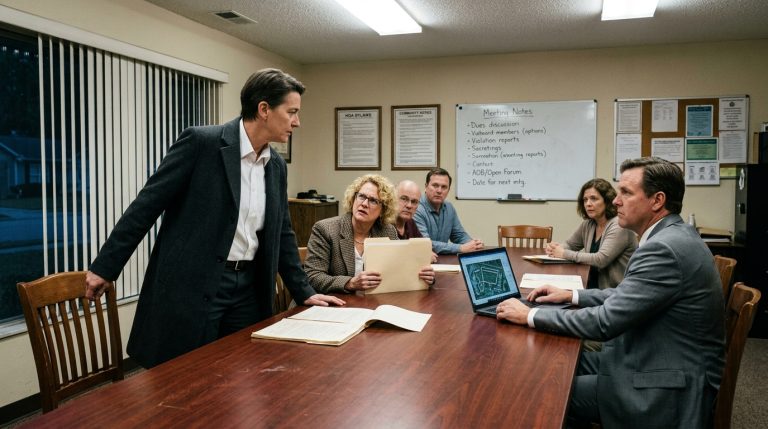
The clubhouse was a space designed for banality—beige walls, linoleum floors that clicked under hard soles, and the lingering, stale scent of industrial cleaning agents. Tonight, however, the room felt electrified. Nearly every seat was filled, a dense sea of neighbors who usually avoided one another, now united by a singular, simmering agitation.
I stood in the back, leaning against the far wall. The dossier in my hand felt heavy, a brick of documentation that was about to be weaponized. Beside me, George shifted, his face set in a mask of determined calm. He was our candidate, the antithesis of the current regime: quiet, fair, and deeply rooted in the history of the place.
Karen sat at the front table, flanked by two board members who looked like they were sitting on hot coals. She hadn’t seen me yet. She was busy fussing with a portable microphone that screeched with a high-pitched, feedback-laced whine every time she adjusted the stand. When she finally brought it to her lips, her voice sounded tinny and hollow, bouncing off the ceiling.
“Welcome,” she said, her tone an affectation of forced cheer. “We have a full agenda, and I’d appreciate it if we kept all commentary until the open forum.”
She plowed through the report with a practiced, aggressive efficiency. She spoke of “fiscal responsibility” and “preserving the aesthetic character of our community,” all while carefully avoiding eye contact with the crowd. She glossed over the budget items, her hand waving vaguely at a projector screen displaying pie charts that seemed to have been designed to obscure rather than inform.
I watched her hands. They moved with a nervous, staccato energy—flicking through notes, adjusting the gavel, clutching the edge of the table. She was trying to project the image of a leader, but the posture was all wrong. She was a defensive player, constantly checking the room for dissent.
“Are there any questions regarding the budget?” she asked, her gaze sweeping the room with a practiced, chilly authority.
The room was silent for a second, a beat of hesitation that felt like the intake of breath before a dive. Then, George stood. The wood of the chair scraped against the floor, a sharp sound that drew every eye to him.
“I have a question about the ‘Community Improvement’ line item,” George said, his voice steady. “Specifically, the twenty-thousand-dollar allocation for the lake fountain repairs, dated last November. The fountain hasn’t functioned since the winter of ’23. I’d like to see the invoice and the service report for that repair.”
The air in the room underwent a sudden, violent change. Karen’s posture snapped into a rigid, defensive lock.
“The fountain is a complex piece of equipment, George,” she said, her voice dripping with condescension. “Service reports are handled by the management company. They aren’t something the board distributes at will.”
“The bylaws state that all expenditures over five thousand dollars must be accompanied by a publicly available invoice,” I said, stepping away from the wall. My voice carried easily, cutting through the murmurs that had begun to ripple through the crowd.
Every head turned. Karen froze. Her eyes locked onto mine, and for the first time, I saw the flicker of something that wasn’t just spite. It was genuine, cold-blooded fear.
“Mr. Thorne,” she said, her voice hardening. “You are out of order. This meeting is for the board to present to the residents, not for a private dispute regarding your own violation.”
“This isn’t a private dispute, Karen,” I said, walking toward the center of the room, my footsteps deliberate. “This is a public accounting.”
I opened the dossier. The pages were marked with colored tabs—a roadmap of her negligence, her intimidation, and her greed. “I’m not here to talk about my sandbox. I’m here to talk about the fact that this board has systematically ignored the bylaws, bypassed the architectural committee, and spent community funds without transparency or authorization.”
The room erupted. It wasn’t the loud, angry roar of a riot, but the sharp, jagged chatter of realization. Neighbors began to talk to one another, sharing notes, pointing at the handouts we’d distributed. Karen stood up, her face a blotchy, uneven red. She hammered the gavel down, the wood striking the table with a sound like a gunshot.
“Order! I call for order! This man is hijacking the meeting!”
She looked at her fellow board members for support, but they were looking at the floor, their faces pale. They knew. They had seen the same evidence.
“I move for a vote of no confidence in the board,” George said, his voice ringing out, clear and uncompromising.
The sound of the second was immediate, coming from a dozen different voices in the crowd. Karen was still holding the gavel, but she was no longer the one running the room. She was just a woman standing behind a table, her world collapsing in the face of a truth she had spent years trying to suppress. She looked at me, her eyes frantic, and for a moment, I saw the entire structure of her power—the threats, the fines, the petty tyranny—simply dissolve. She was cornered. And she had no idea that the worst was yet to come.
CHAPTER 7: The Final Card
The aftermath of the vote didn’t feel like a celebration. It felt like a decompression. The clubhouse cleared out slowly, neighbors murmuring in small, shocked knots, their expressions hovering between relief and the dawning realization of just how far the rot had gone. Karen was gone, having vanished through the side door the moment the gavel struck, but she wasn’t truly finished.
I waited until the room was mostly empty before stepping out into the cool night air. The parking lot was dark, save for the hum of the streetlights. I knew where she would go. The Crafty Corner was open late on Thursdays for inventory, and she was a creature of habit.
I drove the short distance to the plaza in silence. The brass key in my pocket felt warm, a constant, grounding weight against my thigh. I didn’t rush. I parked, checked the perimeter, and walked toward the storefront. Through the large glass display, I could see her. She was behind the counter, her movements frantic, tearing through a stack of invoices with a manic intensity. Her face was pale, caught in the harsh fluorescent glare, and she was talking to herself—a jagged, rhythmic mumbling that I could hear as I pushed open the glass door.
The bell chimed. The sound was jarring, a cheerful, mundane ring that snapped her head up.
She froze. The invoice in her hand crumpled as her grip tightened. For a second, the office-manager persona tried to assert itself, but it was hollow, a paper-thin mask over a face consumed by raw, unadulterated panic.
“You,” she spat, though the venom lacked its usual bite. “I don’t know how you did it. I don’t know what you told them, but you’re a dead man, Thorne.”
I didn’t answer. I walked to the counter, my boots heavy and rhythmic on the tile. I reached into my briefcase and placed a single, stapled document on the counter. It wasn’t a threat. It was a forensic summary of the HOA’s financial records—the one I’d paid a professional to compile, the one that tracked the “Community Improvement” funds directly to personal expenditures.
She didn’t look at it. She looked at me, her chest heaving. “I don’t know what that is.”
“It’s a paper trail, Karen,” I said, my voice steady, stripped of all aggression. “You thought you were playing at being a queen. You thought you were protecting the neighborhood’s ‘aesthetic.’ But while you were measuring the trim on people’s houses and policing children’s toys, you were also skimming. You used the HOA as a slush fund. Twenty thousand dollars for a fountain that never worked? A cruise to the Caribbean? We found the receipts.”
The color drained from her face, leaving it the shade of old parchment. She leaned back against the shelves of yarn, her hands trembling so violently that the spools rattled behind her.
“You can’t prove that,” she whispered.
“I don’t have to,” I said. “David Chen, your regional manager, is waiting in his car in the back lot. I’ve already sent him a copy of this. And the police? They’re getting the digital copies tonight. You didn’t just harass my tenants. You embezzled from the very people you claimed to be protecting.”
She looked around the store, her eyes wide and unfocused, as if realizing for the first time that the walls of her little kingdom were not just transparent, but gone. “I did it for the community,” she suddenly blurted out, her voice rising to a shrill, hysterical pitch. “They were lazy! They didn’t appreciate what I did for them! I kept the standards up!”
“You kept your own pockets full,” I countered. “You weren’t protecting a neighborhood. You were protecting your own ego, and you were willing to destroy anyone who stood in your way.”
She reached out, grabbing the edge of the counter, her knuckles white. “You think you’re so righteous? You’re just like me. You spent weeks obsessing over this. You used your resources, your lawyers, your connections. You destroyed me because I insulted you.”
“I destroyed you because you were a threat to people who couldn’t defend themselves,” I said. “And the difference, Karen, is that I played by the rules. You were the one who broke them.”
I didn’t wait for her next outburst. I turned and walked toward the door. As I reached for the handle, I heard the sound of her collapsing—a soft, wet thud against the floorboards. She wasn’t fighting back anymore. The weight of the truth had finally settled, and it was far heavier than any bylaw she had ever invented.
I stepped out into the night. David Chen was standing by his car, his silhouette framed by the streetlights. He saw me, nodded once, and started walking toward the store. The loop was closed. The system had functioned exactly as it was designed to.
CHAPTER 8: The Cool Down
The hum of the police scanner in the distance was the only sound left in the plaza. David Chen stood by my side, his hands stuffed into his pockets, staring at the darkened storefront. The cardboard box Karen had been packing was still sitting on the counter, a pathetic monument to her professional existence.
“It’s over,” David said quietly. “The corporate audit will confirm what you found. It’s more than just sloppy accounting, Mark. It’s theft on a scale that’s going to keep her in court for years.”
“She chose this,” I replied, feeling the brass key in my pocket. “She could have walked away weeks ago. She could have honored the bylaws and treated the homeowners with the respect they were owed. Instead, she chose to build a house of cards.”
We walked to the edge of the parking lot. The air was cool, the humidity of the evening having finally broken. The Crafty Corner stood shuttered and dark, a stark contrast to the buzzing activity of the neighborhood just a few miles away. The cycle of the neighborhood was already beginning to correct itself.
The next morning, the restoration began in earnest. I met George at the Oakmont Creek clubhouse. The new interim board was already tearing down the restrictive signage and the absurd, hand-painted “aesthetic warning” notices that Karen had peppered throughout the common areas. There was a sense of liberation in the room—a genuine, physical lightening of the atmosphere.
I spent the afternoon with Sergeant Miller, who had finally returned home. We sat on the back patio of the rental property, the green plastic sandbox sitting undisturbed in the corner of the yard. It looked smaller than I remembered, just a piece of plastic. Miller was a man of few words, but the look he gave me—a look of profound, quiet gratitude—said more than any speech could.
“I appreciate you holding the line, Mark,” he said, his voice steady. “My wife was terrified. You did more than just deal with a bad neighbor. You gave my family their home back.”
“I just applied the rules,” I said, though the words felt inadequate. “People like Karen thrive on the assumption that everyone else is too busy or too scared to hold them accountable. Once you show them that the system works when you apply it with precision, they have nowhere to hide.”
I took a moment to look at the house. It was a sturdy, well-maintained structure. I reached into my bag and pulled out a small repair kit. One of the wooden slats on the back deck had been damaged during Karen’s “inspections”—a splintered mess that had been bothering me since the first day I’d visited. I spent the next hour working, my movements focused and precise. Measuring, cutting, hammering. The physical act of repairing the wood was grounding, a way to signal that the period of destruction was definitively over.
As the sun began to set, the light bathed the backyard in a soft, golden glow. The neighborhood was quiet, the way a community is supposed to be. There were no cameras, no inspectors, no shouting matches over the color of paint. Just the sound of a distant lawnmower and the laughter of the Miller kids playing in the grass.
I realized then that this was the victory. Not the handcuffs, not the termination, not the forensic audit. It was the return of the mundane. The return of the quiet, unremarkable peace that Karen had tried so hard to poison.
I finished the repair, wiped the sawdust from my hands, and stood up. I looked at the house one last time. It was strong, it was lasting, and it was secure. I walked to my truck, the brass key feeling light in my pocket now. The mission was complete. I had dismantled the hostile structure, and in the space left behind, the neighborhood had simply, quietly, started to breathe again.