A Precise Siege: How One Man’s Tactical Persistence Toppled a Suburban Tyrant’s Corrupt Empire
CHAPTER 1: THE VIOLATION
The Texas sun was a physical weight, pressing down on the shoulders of my shirt, but it was the icy sharpness of Karen Vance’s tone that truly bit. She stood in the center of my lawn, a garish floral pantsuit clashing violently with the manicured green of the grass. She wasn’t looking at me. She was looking at the VSAT dish mounted to the side of my eaves, her eyes narrowing into two thin, judgmental slits that seemed to measure the world and find it lacking.
“It is a blight, Mr. Garrison,” she said, not as a woman offering an opinion, but as a monarch issuing a decree. “The covenant is clear. You have seven days. After that, the fines begin. Five hundred dollars a day.”
I didn’t answer immediately. My pulse was steady, a low-thrumming engine that had carried me through two decades of signal analysis and combat communication. When I looked at her, I didn’t see a neighbor. I saw a system failure. I saw a variable that needed to be calculated, isolated, and neutralized.
“It’s an internet connection, Karen,” I said, my voice intentionally flat, devoid of the irritation she expected to provoke. “It’s barely visible from the street. It complies with every reasonable interpretation of the bylaws.”
She offered a smile that didn’t reach those predatory eyes. It was a practiced, hollow expression designed to signal that the conversation was over. “Reasonable is not the standard here. Compliance is. Remove it.”
She turned and began walking back toward her oversized white SUV, her posture rigid with the self-importance of someone who had never been told ‘no’ in a way that mattered. As she walked, my gaze drifted past her to the community entrance. The guard shack was visible from here, a small, modern structure equipped with cameras and security logs. It was a fragile, high-tech hub, and its entire digital heartbeat was currently traveling through the wire attached to the dish she wanted dismantled.
The irony was not just thick; it was a tactical oversight of monumental proportions.
I didn’t feel the heat of the day anymore. A cold, surgical focus had taken root in my gut. I thought of Sarah, my wife, inside the house, currently streaming a show, unaware that our life here was about to be put through a stress test. I thought of the military manuals I’d practically memorized—the ones that taught you that if you want to break a resistance, you don’t use a hammer. You cut the power.
I watched her pull away, the gravel crunching beneath her tires in a rhythmic, dismissive sound. She thought this was a petty dispute over property aesthetics. She thought she was disciplining a homeowner who had overstepped his bounds.
I leaned back against the porch railing, the wood rough and hot against my palms. I needed to see the fine print of the HOA charter again, but as I looked down at the spot where she had been standing, I noticed something else. A small, discarded piece of plastic—part of a landscaping marker—lay half-buried in the dirt. It was cracked, jagged, and entirely out of place. It was a sign of neglect, a tiny, rotting detail in a neighborhood she claimed to keep perfect.
I walked over and picked it up, turning the sharp plastic over in my hand. Karen was sloppy. That was her flaw. And in the world of high-stakes logistics, a single sloppy detail was all the leverage I needed to bring the whole structure down.
My phone chimed—a notification for an incoming email from the HOA’s automated portal. I didn’t open it. I already knew what it was: a formal, digitized copy of her threat. I walked inside, the cool air of the kitchen washing over me, and looked at the granite countertop.
My reflection stared back from the polished stone, and for a split second, I didn’t recognize the man looking at me. He looked like the soldier I used to be, ready for a mission that required no armor, only a pen and a target.
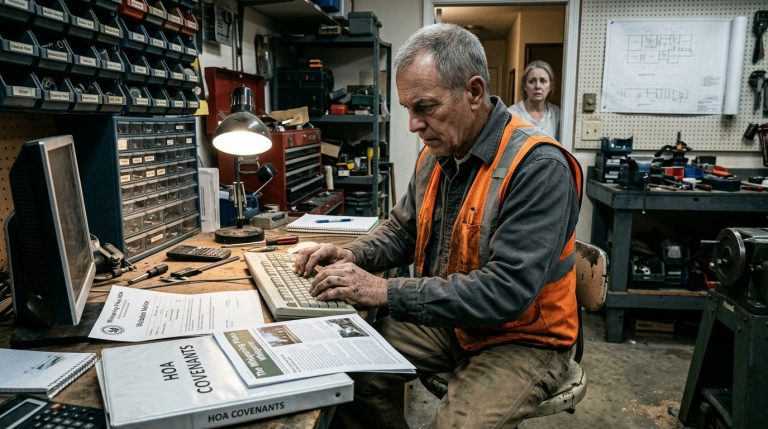
I walked over to the kitchen drawer and pulled out the thick binder of CC&Rs I hadn’t touched since we moved in. I set it on the table with a heavy, final thud.
“Jack?” Sarah’s voice floated from the living room, soft and questioning. “Was that the board president?”
“Yes,” I said, my fingers already tracing the index. “It was. And you’re not going to believe the mistake she just made.”
CHAPTER 2: THE ANATOMY OF A BYLAW
The kitchen remained suffocatingly still. The only sound was the soft, rhythmic hum of the refrigerator, a sharp contrast to the chaotic, judgmental energy Karen Vance had left in her wake. Sarah stood by the doorway, her silhouette framed by the fading amber light of the Texas sunset. She wasn’t moving, her hand still hovering near the doorframe, a physical manifestation of the uncertainty she felt.
I ignored the instinct to comfort her. Instead, I pulled the chair out, the legs dragging against the hardwood with a screech that set my teeth on edge. I sat down and opened the binder. The pages were thick, high-gloss stock that felt cold and sterile under my fingertips. My hands, which had once calibrated sensitive transmission arrays in the heat of a desert night, didn’t shake. They traced the index with a familiarity that felt alien and comforting all at once.
“It’s a set of rules, Jack,” Sarah said, her voice barely above a whisper. She moved closer, the soft scent of her perfume cutting through the faint, metallic smell of the house. “Not a deployment order. You don’t have to treat it like a sabotage mission.”
“Every system has a vulnerability, Sarah,” I replied, my eyes scanning the dense, legalistic jargon of Article IV, Section 2. “The people who write these rules are the ones who usually break them. They think they’re the only ones who can read the manual. That’s their first mistake.”
I felt it then—the familiar, phantom itch of a mission. The way the lines of text began to organize themselves, identifying hierarchies of authority and procedural requirements. In the Signal Corps, we’d learned that information is only as good as the infrastructure that carries it. Here, the infrastructure was paper, bureaucratic signatures, and the assumption that no one would take the time to check the math.
I pulled out a yellow highlighter, the color a jarring, neon slash against the white page. I began to mark clauses. ‘The Architectural Review Committee shall provide written response within thirty days…’ I tapped the timestamp on my computer screen, where the confirmation of my submission sat like a silent witness. My application had been submitted forty-two days ago. By the board’s own ironclad language, the lack of a response wasn’t just a silence—it was an endorsement.
A sudden, sharp memory flared—a static-filled transmission in the dark, the desperate need for a clear signal before the feed cut out. I blinked, and the image vanished, replaced by the grain of the dining room table. I was sweating, a fine sheen of cold moisture on my upper lip. The control I was exerting over the situation was tight, perhaps too tight, but it was the only way to keep the surrounding chaos at bay.
“They haven’t just forgotten to answer,” I muttered, more to myself than to Sarah. “They’ve established a pattern of non-compliance that invalidates every fine they’ve ever issued under that clause. She’s overextended. She’s relying on intimidation because the actual mechanism of enforcement is broken.”
“And if she notices?” Sarah asked. She pulled out the chair opposite me, the wood creaking softly. Her expression was a mix of concern and, beneath that, a flicker of something sharper—a realization that she was watching me retreat into the person I was before we bought this house.
“She won’t,” I said, my voice dropping to a low, rhythmic cadence. “People like Karen don’t look at the details. They look at the power they hold. They assume the machine works because they’re the ones pulling the lever. She’s never had to look at the wiring.”
I continued to read, my mind moving through the pages like a search algorithm, weeding out the filler and isolating the pivot points. I found a clause about the ‘hearing process’—a mandatory step involving the full board that was required before any fine could be levied. Her letter had bypassed that entirely, moving straight to a threat of a lien. It was a procedural shortcut. A shortcut that meant she had technically violated the very bylaws she was using to attack me.
The realization brought a strange, detached satisfaction. It wasn’t the relief of a husband protecting his wife from a nuisance; it was the precision of a technician finding the exact cable to sever.
I looked up at Sarah. The room seemed darker now, the shadows stretching across the floor. “She’s not just a tyrant, Sarah. She’s a criminal. She’s using a shell game to enforce compliance that doesn’t exist.”
“Jack, please,” she whispered, her hand reaching out to touch the binder, her skin contrasting with the harsh, cold plastic of the cover. “Let’s just take it to the next meeting. Let’s not make this a war.”
I looked at her hand, then back at the pages. The war had already been declared when she set foot on my lawn and looked at my home as something to be dismantled. I closed the binder. The sound was definitive, a sharp slap of leather against wood that echoed in the quiet kitchen.
“I’m not starting a war, Sarah,” I said, my voice steady, my internal compass locked onto a target I couldn’t yet name. “I’m finishing an inspection.”
I stood up, the chair pushing back with a quiet, controlled motion. I needed to see the front gate again. I needed to see the logic of the infrastructure she was so desperate to protect. My pulse settled into the steady, methodical beat of a man who knew exactly what the next move would be. The trap was already being set, and for the first time in months, I felt perfectly, dangerously aligned.
CHAPTER 3: THE FRAGILITY OF ROSES
The sun was higher now, the heat radiating off the asphalt in shimmering, ghost-like waves that distorted the horizon. I walked down the street, my stride rhythmic, matching the internal tempo I had set back in the kitchen. To anyone watching, I was just a man taking an evening stroll, but my eyes were operating at a different frequency. I was scanning for patterns—the slant of a lawn, the specific, aggressive pruning of a hedge, the way a mailbox stood a fraction of an inch off-center.
I reached the Millers’ residence. The house was older than mine, a classic ranch-style structure that looked like it had been held together by sheer willpower and decades of care. But the yard was a battlefield. Along the perimeter, where a row of rose bushes had once stood as a vibrant, crimson anchor, there were only raw, jagged stumps of wood protruding from the disturbed earth.
Eleanor Miller was on the porch, her back to the street, a small trowel in her hand. She was working the dirt around a patch of petunias, her shoulders hunched with a weariness that looked deep enough to settle into her bones.
I didn’t call out. I walked up the driveway, the crunch of gravel beneath my shoes sounding like breaking glass in the stillness of the afternoon.
“The soil is too dry for those, Eleanor,” I said, my voice soft but steady.
She jumped, the trowel slipping from her grip and clattering against the concrete. She turned, her eyes wide, the lines around them etched with an exhaustion that made my throat tighten. When she saw it was me, the tension in her neck subsided just enough for her to let out a long, shuddering breath.
“Jack,” she whispered, her hand rising to touch her throat. “You startled me. I—I didn’t hear you coming.”
“I’m sorry,” I said, stepping onto the porch. I looked at the patch of dirt where the roses had been. “I heard what happened. I saw the notice posted on the community board.”
She followed my gaze, her jaw setting. “She called them a safety hazard. Said the thorns were a liability and the bees were too aggressive.” Her voice trembled, not with fear, but with a sharp, piercing injustice. “Arthur has tended those bushes for twenty years. They were the first thing we planted when we moved in.”
I looked at the garden. It wasn’t about the bees or the thorns. It was about the fact that the Millers had a piece of the world they nurtured and controlled, a piece that Karen hadn’t been able to dictate. It was a failure of the system to homogenize, and therefore, it had to be pruned away.
“How much were the fines?” I asked, my voice devoid of emotion.
“Two hundred dollars,” Arthur Miller said, his voice emerging from the gloom of the open doorway. He walked out, his frame thinner than I remembered, his hand resting on the doorframe for support. “Plus the cost of the ‘professional’ contractor she sent to dig them up. It came to nearly four hundred in total.”
“And you paid it?”
“We didn’t have a choice, Jack,” Arthur said, his eyes meeting mine. There was no shame in his gaze, only a heavy, crushing resignation. “She threatened to put a lien on the house. We’re on a fixed income. We can’t fight the board.”
I felt the familiar, cold shift in my gut. This wasn’t just a neighborly dispute; it was a targeted campaign of extraction. Karen wasn’t just enforcing rules; she was bleeding the residents dry, one petty infraction at a time. The system wasn’t broken—it was performing exactly as intended by the person holding the keys.
“You aren’t alone in this, Arthur,” I said, my voice firm. I didn’t make a promise of safety; I wasn’t a hero, and I wasn’t going to lie to them. But I knew what I was looking at. “I’ve been reviewing the bylaws. There’s a clause regarding the Architectural Review Committee’s response time. It’s explicit.”
“It doesn’t matter,” Eleanor said, wiping her hands on her apron. “She has the lawyer. She has the board. She has the power.”
“Power is an illusion of maintenance,” I replied, the words feeling sharp and precise in the warm, stagnant air. “It only exists as long as the system is allowed to remain closed. If you open it, if you look at the underlying processes, it doesn’t hold up to scrutiny.”
I sat down on the edge of their porch, the wood splintering slightly under my weight. I began to talk, not about the roses, but about the structure of the HOA. I explained the requirement for a formal hearing, the necessity of a board vote, and the fact that Karen had bypassed every single one of those steps. I watched their faces. At first, they were skeptical, wrapped in the protective layer of their own defeat. But as I pulled apart the mechanism of her tyranny, piece by piece, I saw the skepticism peel away, revealing a raw, jagged hope.
It felt like calibrating a sensor—tuning out the static and focusing on the clear, underlying signal. I wasn’t just talking to them; I was testing the frequency, measuring the strength of the resentment that had been building here for years.
“I need to know something, Arthur,” I said, my tone shifting, becoming more transactional. “Are there others? Who else has been targeted in the last six months?”
Arthur hesitated, looking toward the street. The light was fading, the shadows of the oaks stretching long and skeletal across the lawns. “The Rodriguezes. Down on the corner. Their son’s basketball hoop. They were fined for ‘improper storage’ even though they keep it in the garage.”
“And the Chens?” I pressed.
“They’ve been fighting over their mailbox color for weeks,” Eleanor added, her voice gaining a bit of strength. “Karen insists it’s the wrong shade of ‘eggshell’.”
I nodded, committing the names to memory. The pieces were beginning to align. It wasn’t a scattershot attack; it was a focused, systematic operation.
“I have a plan,” I said, standing up. My shadow stretched toward the street, long and dark, merging with the growing gloom. “But it requires you to stop paying. No more fines. No more ‘contractor’ fees. From this point on, everything goes through a paper trail. I’ll show you how to document the next notice. I’ll show you how to force the board to act, and when they refuse to answer, we’ll use their own silence against them.”
Arthur looked at Eleanor. There was a long, heavy silence—a moment where the fear of the future clashed with the bitterness of the past.
“Why are you doing this, Jack?” Arthur asked. “It’s not just about the satellite dish, is it?”
I looked at the jagged stumps in the garden. I thought about the military, the precise, ordered world where everything had a function and every error had a consequence. I thought about the emptiness of the days since I’d retired, the lack of a target, the lack of a mission.
“I don’t like it when systems stop working, Arthur,” I said, and for a moment, the coldness in my voice was so pronounced it made the evening air feel sudden and sharp. “And I don’t like it when people abuse the mechanisms of order to create chaos.”
I turned and walked back toward the street. My pace was faster now, my mind already calculating the next set of variables. I had three more households to contact, three more pockets of resentment to map. The neighborhood was quiet, the houses looming like silent sentinels, but I knew what lay beneath the veneer of suburban peace. It was a circuit board, and I was just starting to find the breaks in the path.
I reached my own driveway and looked up. The VSAT dish was still there, a small, dark shape against the darkening sky. It was a target, a decoy, and the most effective piece of hardware I’d ever deployed. Karen Vance was out there somewhere, thinking she had won the day with a few rose bushes, but she had no idea that the signal had already been rerouted.
I stepped into my garage, the light from the automatic opener bathing me in a harsh, clinical yellow glow. I walked over to the workbench, where my laptop and the binder of HOA documents were waiting. The air was cool, smelling of oil and dust. I sat down and opened the laptop. The screen flickered to life, the blue light reflecting in my eyes, and I felt the cold, familiar thrill of the hunt. It was time to start digging into the financials. It was time to find the leak.
CHAPTER 4: THE DIGITAL PAPER TRAIL
The hum of the cooling fan in my laptop was the only sound in the garage, a steady, rhythmic breathing that felt like a pulse. Outside, the neighborhood was dark, the streetlights casting long, spindly shadows that seemed to claw at the edges of my garage door. I didn’t care about the night. My world had shrunk to the eighteen-inch rectangle of the screen, where columns of data were beginning to reveal the true anatomy of Oakidge Estates.
I had been scraping the HOA’s legacy website for six hours, cycling through archives that were never intended to be scrutinized. It was sloppy, amateurish work—a digital graveyard of meeting minutes and financial summaries that spoke of a board that assumed its constituents were illiterate.
My eyes burned, but I didn’t blink. I was looking for the variance, the decimal point that didn’t fit. I found it in an invoice labeled simply General Repairs: Q3. The amount was $2,490. I scrolled back. The next month, another invoice, this one Grounds Maintenance: Q4. $2,485.
The threshold for a full board vote, according to the bylaws I’d memorized, was $2,500.
It was a blatant, lazy bypass. Every single payment to ‘Vance Services’ sat just beneath the trigger line for oversight. I pulled up the state business registry on a secondary tab, my fingers dancing across the keys with a frantic, cold precision. When the results popped up, I didn’t feel a rush of adrenaline. I felt a hollow, sinking clarity. The proprietor of Vance Services was Harold Vance. Karen’s husband.
I stared at the name, the cold blue light reflecting in my irises. My phone buzzed on the workbench, a sharp, jarring vibration that cut through the silence. It was George, the treasurer.
I hesitated. My internal tactical monitor registered the call as a potential security breach, a risk to my current operation. Was he calling because he knew? Or was he calling to gauge how much I had found?
I picked it up, my voice steady, stripped of any inflection. “Yes, George.”
“Jack,” his voice was hushed, the sound of someone standing in a closet or a dark room. “I saw your request. The one for the invoices. Karen… she’s tearing the office apart. She’s demanding the attorney block it. She thinks you’re just a disgruntled homeowner who’s pissed off about a dish.”
“And what do you think, George?” I asked, watching the cursor blink on the screen, a tiny, rhythmic reminder of the time.
“I think you’re dangerous,” he said. He didn’t sound angry. He sounded relieved. “You’re looking at the wrong things, Jack. You’re looking for bylaws, but you should be looking for the invoices for the common area maintenance. Especially the ones from Vance Services.”
My breath hitched. The information was being handed to me, a tactical gift wrapped in fear. But I couldn’t trust it. In the field, an asset who gives you everything you ask for is usually the one leading you into an ambush.
“Vance Services,” I repeated, letting the name hang in the air. “I’ll look into it.”
“She’s been doing it for years,” George continued, his voice dropping even lower. “She uses the fines to cover the deficit whenever the ‘general maintenance’ costs get too high. It’s a closed loop. She’s not just a president, she’s a—”
The line cut out with a sharp click.
I stared at the dead phone. Paranoia, cold and sharp as a razor, crept into the space where the conversation had been. Was George a whistle-blower, or was he playing a deeper game, trying to get me to commit to a specific line of attack so they could discredit me for slander? The realization that I was now viewing my neighbor through the lens of a counter-intelligence officer wasn’t a choice; it was a reflex. My control over the environment was absolute here in the garage, but out there, in the dark, I was being watched.
I looked back at the screen. The invoices were just text, but they were the keys to the kingdom. I started exporting the data, creating a clean, immutable record that couldn’t be deleted or corrupted. I was no longer just protecting my home; I was documenting the corruption of a community.
I stood up and walked to the garage door, peering out through the small, frosted window. The street was empty, but the feeling of being exposed, of being an outlier in a system that demanded conformity, was visceral.
I thought about Sarah. She was sleeping in the house, a few feet of drywall and insulation separating her from the work I was doing. She wanted peace. She wanted the life we had planned—the gardening, the quiet evenings, the slow drift into the comfort of a settled life. I realized, with a sudden, jarring pang of guilt, that I had already burned that life to the ground. I wasn’t fighting for peace anymore. I was fighting because this was the only mission I had left, and without it, I was just a ghost haunting a suburban house.
The monitor flickered, a sudden surge in the power line causing the light to dip. For a split second, the screen went black, and I saw my own face in the reflection—gaunt, focused, and profoundly isolated.
I sat back down and grabbed my notebook. I had the invoices. I had the registration. Now, I needed to know what ‘Vance Services’ actually did. I started mapping out the maintenance schedule, cross-referencing the invoices with the dates of the reported ‘repairs’. If the gate mechanism was repaired in January, there should be a corresponding service call. If the clubhouse was power-washed in March, there should be water utility records.
It was a massive undertaking, but as I organized the data into a spreadsheet, I felt a sense of calm return. It wasn’t the peace of a garden; it was the peace of a firing range. I knew how to find the discrepancy. I knew how to map the lie.
I hit save, the file name glowing in the dark: Project_OAKIDGE_Audit.xlsx.
I wasn’t just a homeowner anymore. I was an auditor, and the audit was going to be merciless.
CHAPTER 5: THE BLIZZARD OF PAPER
The printer let out a mechanical groan, a sound like grinding teeth, before the status light on the console bled from a steady green to a frantic, strobing red. I sat in the dim light of the garage, the air thick with the smell of ozone and hot toner, my hands hovering over the control panel. Paper was jammed somewhere deep in the gut of the machine—a minor, infuriating failure in an otherwise flawless sequence.
I didn’t swear. I didn’t rush. I simply opened the chassis, the plastic housing clicking as it released. I found the snag: a single sheet of cardstock, crumpled near the feed roller. It was a violation notice. The very same heavy, creamy paper Karen Vance used to convey her bureaucratic authority. It was a fitting metaphor, I thought, pulling the mangled page from the rollers. The system was eating its own tail.
I cleared the jam and reloaded the tray with a fresh ream of standard bond paper. The printer cycled, a low, demanding whine that filled the quiet garage. I was three days into the blizzard. My dining room table had been abandoned in favor of this space, where the concrete floor and the smell of gasoline kept me grounded. Beside me, the folder I had titled The Case Against Oakidge was fat, bursting with the documents I had painstakingly harvested over the last seventy-two hours.
It was no longer just about the satellite dish. The dish was a relic now, a static marker in a landscape that had shifted entirely. I had the invoices from Vance Services—dozens of them, a chronological map of the embezzlement. I had the state business registry. I had the timestamped photos of the ‘selectively enforced’ violations I’d collected during my morning walks. I had the testimonies, transcribed in a neat, clinical font that made the petty tyrannies of the HOA read like a deposition in a war crimes tribunal.
My phone, resting on the workbench, buzzed. A text from Sarah. Are you coming in for dinner? It’s almost ten.
I looked at the clock on the wall. Ten o’clock. I hadn’t eaten since noon, but the hunger was a distant, secondary signal. I was operating on a different fuel now. I typed back: Almost done with the final assembly. Don’t wait.
I didn’t mention that the ‘assembly’ was a thirty-page document designed to be sent to every single resident in the neighborhood, and simultaneously, to a contact I’d developed through my old signal corps network—a local journalist who specialized in municipal rot.
The printer finished its work, the pages sliding into the tray with a rhythmic, satisfied thwack. I picked up the stack, the weight of it surprising me. It felt like evidence. It felt like a verdict.
I stepped to the workbench and began the collation. I wasn’t just paper-clipping documents; I was structuring a narrative. I laid out the opening statement—a polite, professional inquiry regarding the lack of transparency in the board’s financial management. Then, the exhibits. The Vance Services invoices, highlighted in neon yellow. The comparison photos of the ‘aesthetic violations’ that Karen had ignored vs. the ones she had punished.
The paranoia that had stalked me during the initial investigation had vanished, replaced by a cold, unwavering focus. I was no longer afraid of being watched; I was the one doing the watching. I had mapped the terrain, identified the weak points, and now, I was ready to force the engagement.
A movement outside the frosted garage window caught my eye. A figure, silhouetted by the streetlamp, was walking slowly down the center of the road. I froze, my hand dropping to the edge of the workbench, my posture shifting into a defensive crouch. The figure paused in front of my driveway, their head turning. It was Karen.
I didn’t move. I watched through the narrow gap in the window, my breath held in my chest, my heart rate steadying into the rhythmic, disciplined pulse of a scout in the field. She stood there for a long moment, staring at the closed garage door, her presence a dark, jagged smudge on the night. She looked different—not like the queen of the estate, but like someone who had sensed a shift in the air, a drop in pressure before a storm.
She didn’t knock. She didn’t approach. She simply turned and continued down the street, her silhouette fading into the darkness of the neighboring houses.
I waited until she was gone, counting the seconds in my head. Had she seen the light in the garage? Had she heard the printer? It didn’t matter. The encounter had confirmed something I’d only suspected: the system was feeling the strain. She was vulnerable, and for the first time, she knew it.
I turned back to the workbench and finished the last staple. The dossier was complete. It was a heavy, dense block of paper—the physical manifestation of my resolve. I felt a strange, detached sensation in my chest, a hollowness where the anxiety used to be. I had spent twenty years in the Signal Corps learning how to maintain communication lines under the most impossible conditions. Now, I was using that same skill to destroy a line that had never been open in the first place.
I walked to the door and pulled it open, the night air hitting me like a physical blow. The neighborhood was silent, a sleeping machine that had no idea its operating system was about to be overwritten. I looked at the dark street, at the house where Karen Vance was likely sitting in her own, private war room, and I felt nothing but a cool, detached indifference.
The storm was ready. I just had to hit ‘send’ on the digital version and drop the hard copies in the mailboxes of the most influential residents by dawn. I walked back into the garage and reached for the envelope. My hand was steady, my grip firm. The mission was entering its final phase. I didn’t care about the cost, or the fallout, or the life Sarah wanted. All I cared about was the silence. And after tonight, I was going to ensure that the silence was finally, permanently broken.
CHAPTER 6: THE TRIGGER MECHANISM
The silence of the garage at 10:00 a.m. was not the peaceful stillness of a quiet morning; it was the pressurized vacuum of a detonator waiting for the switch to close. I stood by the workbench, my eyes fixed on the small, high-definition monitor that pulled the live feed from the camera mounted in the upstairs window. It was aimed directly at the west side of the house, where the VSAT dish sat, an innocuous white plate against the siding.
To anyone else, it was just a piece of telecommunications hardware. To me, it was the bait.
My pulse was rhythmic, a low-frequency hum in my ears. I felt a fleeting, intrusive memory—a dusty room in a forward operating base, the smell of burnt copper as a radio array failed under fire, the frantic, mechanical necessity of re-establishing a link before the position was compromised. The memory was sharp, vivid, a sudden spike of adrenaline that made my hands twitch toward the edge of the workbench. I forced my breathing to even out, the tactical discipline taking over. I was not in the field. I was in a suburban garage. And I was the one who had rigged the ambush.
At 10:03 a.m., the white utility van appeared on the monitor. It was an unmarked, nondescript vehicle, the kind that blended into the background of an exurban development so perfectly it was almost invisible. It slowed, pulled toward the curb in front of my house, and idled. The engine note changed—a low, mechanical growl—before the driver’s side door opened.
A man emerged. He didn’t look like a professional technician. He wore greasy, oversized overalls and carried himself with the heavy, unhurried gait of someone who had been paid just enough to do a job, but not enough to care why. He walked to the back of the van, opened the double doors, and pulled out a ladder.
I watched him on the screen, my eyes tracing his movements. He was the variable I hadn’t accounted for in the simulations—the human element. He hesitated, looking up at the roofline, his expression masked by the glare of the morning sun. He was looking for the dish. He was looking for the target.
I reached for my phone. The digital dossier, the one that would ignite the neighborhood, sat ready to send. My finger hovered over the screen, but I didn’t engage. Not yet. I had to wait for the severance.
The man set the ladder against the side of the house. The metal-on-siding sound was faint, a dry, grating screech that I could hear even through the insulated garage wall. He began to climb, his boots heavy on the rungs.
My heart hammered against my ribs—a mechanical, persistent beat. My hand reached for the headset, the one I had rigged to monitor the gate’s network signal. As the man reached the level of the dish, I saw him pause. He pulled a pair of heavy-duty cable cutters from a holster on his belt. The sunlight caught the steel, a bright, dangerous flash that made me wince.
He positioned the blades around the thick, black coaxial cable—the umbilical cord of the entire Oakidge security infrastructure.
I took a deep, steadying breath. This was it. The moment of irreversible structural collapse.
The blades closed. A distinct, sharp snap vibrated through the air—a sound so clean, so precise, it felt like the firing of a weapon. On the monitor, the cable fell away, dangling against the siding like a severed nerve.
I didn’t wait.
The second the cable hit the siding, I tapped the screen on my phone. The email, addressed to the entire community distribution list, fired into the digital ether. At the same moment, I hit the alert button for the network monitor.
The effect was instantaneous, a domino collapse that I had mapped in my head a thousand times. Within five seconds, the monitor on my workbench, which was piped into the guard shack’s internal status log, flickered from green to red.
Connection Lost.
System Offline.
Security Protocol: Failure.
I could almost hear the panic from here. The guards, the automated gates, the visitor logs—all of it had just gone dark. The system had been running on the signal that was now dangling, broken, from the side of my house.
I walked out of the garage and into the blinding light of the morning, my posture relaxed, my expression neutral. The contractor was still on the ladder, unbolting the dish from the mount. He looked down, saw me standing there, and froze.
“You the owner?” he called out, his voice tinged with the confusion of a man who had expected a fight and found none.
“I am,” I said, my voice steady, carrying clearly across the lawn. I didn’t look at him. I looked toward the gate, toward the chaos that was inevitably unfolding as the cars started to pile up. “Finish the job. You were hired to remove it, weren’t you?”
He hesitated, then shrugged and went back to his work.
I turned and walked toward my front door. I could hear the first distant honks of a horn from the entrance of the estate. The trap had been sprung, and the predator had just walked straight into it. I stepped inside the cool, silent house, closing the door behind me. I went to the kitchen, poured myself a glass of water, and listened.
The sound of the neighborhood—a peaceful, curated silence—was beginning to fray. The sirens, the honking, the frantic, digital pulse of three hundred people realizing their gate had locked them in. It was a chaotic, discordant symphony, and it was playing exactly according to the script I had written. I sat down at the table and watched the clock. The recall petition was already moving. By this time tomorrow, the only thing left of Karen Vance’s kingdom would be the wreckage.
CHAPTER 7: THE TRIBUNAL OF PUBLIC OPINION
The air inside the middle school auditorium was dense, recycled, and humid with the collective respiration of four hundred people. It was a space designed for school plays and PTA meetings, not for a revolution. The fluorescent lights overhead buzzed with a low, irregular frequency that made my temples throb. I walked toward the front, the wooden floorboards groaning under my boots, each step sounding like a hammer strike in the hush that had fallen over the room.
On the stage, behind a long, skirted table that looked like an altar to bureaucracy, sat Karen Vance and her two remaining board members. She was dressed in black—severe, unyielding, an aesthetic choice intended to convey a mourning for the order she believed she represented. But as I passed within ten feet of her, I saw the tremor in her hands. She was gripping a fountain pen so tightly her knuckles had turned white, the skin translucent and fragile.
I took my position at the podium. It was cold, the metal surface radiating a sterile, unforgiving chill. I checked my notes. They were organized with the same clinical precision I had used to calibrate radio arrays a decade ago. I didn’t look at the crowd; I looked at the back wall, keeping my vision wide, my peripheral awareness tuned to the slightest shift in the room’s energy.
“The evidence is straightforward,” I said, my voice cutting through the stale air. I didn’t reach for theatrics. I didn’t need them. I tapped the microphone, the feedback whine forcing the audience to sharpen their attention.
I began with the satellite dish. It was the entry point, the simple, relatable grievance that had opened the door. I traced the timeline: the architectural submission, the silent approval, the sudden, retaliatory fine. Then, I pivoted. I didn’t use emotive language. I simply projected the Vance Services invoices onto the screen above the stage.
The room went silent. It was a vacuum-sealed silence, the kind that precedes an explosion.
I saw Karen’s eyes flicker toward the screen, then back to me. Her face was a mask of rigid denial, but the foundation was cracking. I didn’t offer an opinion on the invoices; I simply read the math. The recurring amounts—always under twenty-five hundred dollars. The vague, meaningless descriptors of the labor provided. The registry listing Harold Vance as the owner. I connected the dots with the surgical efficiency of a field report.
“This is not a matter of aesthetics,” I concluded, my hand resting on the stack of papers. “This is a matter of fiduciary duty and the systemic misappropriation of community resources.”
When I looked out at the audience, I didn’t see neighbors. I saw a force. I saw the Millers, sitting in the front row, Arthur’s jaw set with a hard, uncompromising grimace. I saw the Rodriguezes, their faces reflecting a mix of disbelief and burgeoning rage.
The floor was opened for questions, and for the next hour, the meeting descended into the systematic dismantling of a regime. Speaker after speaker stood up, each one adding a new layer to the narrative of abuse. A young mother spoke of being bullied for her child’s chalk drawings on the sidewalk; a retired professional detailed how he’d been intimidated into withdrawing a legitimate landscaping bid.
Karen tried to speak. She rose from her seat, her face a blotchy, uneven red, her voice cracking as she attempted to paint me as the architect of a smear campaign. “He’s a troublemaker!” she shouted, pointing at me with the same hand that had held the pen. “He came into this community and decided that the rules didn’t apply to him! This is slander! This is a personal vendetta!”
But the room wasn’t listening. The dynamic had shifted. The audience was no longer reacting to her authority; they were reacting to the numbers on the screen. The reality of the theft had stripped away the power of her position. She wasn’t a president anymore; she was a thief caught in the act.
I stood by the podium, my hands at my sides, my expression unchanging. I felt a strange, cold distance from the scene. I was the one who had brought them here, but the anger belonged to them now. It was a runaway process, a chain reaction that no longer required my input. I watched the moderator, a neutral attorney I’d vetted, move to take control of the voting process.
The ballots were distributed—slips of white paper that looked like scraps of debris in the aftermath of a wreck. I leaned back against the podium, the cool metal biting into my palms. My mind drifted back to the garage, to the solitary, quiet work of assembling the dossier. Was this what I had wanted? To lead a mob, to orchestrate the public shaming of a woman who had, in the end, only been as small and petty as the world she had built?
The answer didn’t come, and I didn’t reach for it. I focused on the count.
As the attorney tallied the votes, the auditorium felt impossibly hot. I could hear the rhythmic thud of the ballot box being opened, a sound like a heartbeat. My attention drifted to Karen. She had sat back down, but her posture had collapsed. She looked smaller, her black blazer hanging loosely on her frame. She was staring at her own hands, the hands that had signed the invoices, the hands that had wielded the power, now resting in her lap, completely still.
She was losing. She was being erased.
I looked at my own hands, resting on the podium. They were steady. They had been the tools of a professional, the hands of someone who could dismantle a system without ever feeling the need to touch the person behind it. But as the crowd began to murmur, the sound rising like the tide, I realized I didn’t feel like a savior. I felt like an operator, someone who had completed the mission and was now standing on the empty, desolate plain that remained when the smoke cleared.
“The votes are conclusive,” the attorney announced, his voice flat, devoid of emotion. “The motion to recall has carried. The board is vacated, effective immediately.”
The reaction was instantaneous. A roar of sound—half-cheer, half-release—shook the room. People were standing up, the chairs screeching against the floor, the energy in the space becoming kinetic, explosive. I remained where I was, a silent observer in the center of the storm. Karen was already moving toward the side exit, her husband appearing from the shadows of the wings to usher her out, shielding her from the gaze of the people she had governed for so long.
She didn’t look back. And as I watched them disappear into the hallway, I felt the mission go cold, the objective achieved, leaving me standing in the center of a victory that felt, in every possible way, like a final, permanent departure from the life I had once imagined.
CHAPTER 8: THE WEIGHT OF THE STILLNESS
The exit door hissed shut behind me, severing the cacophony of the auditorium. Outside, the parking lot was bathed in the harsh, sodium-orange glow of the security lights, the air crisp and biting compared to the humid, suffocating atmosphere I had just left. I walked toward my car, my boots clicking rhythmically against the asphalt. Behind me, the muffled cheers of the crowd continued, but they sounded distant, disconnected, as if coming from a frequency I was no longer tuned to.
I reached the car and leaned against the hood, the metal still radiating a faint, residual warmth from the drive. I was alone. Sarah had stayed inside, caught up in the relief of the neighbors, but I had needed the space. I stared at the dark expanse of the lot, feeling the lingering vibration of the last two weeks in my muscles—the tension of the investigation, the precise, lethal calibration of the trap, and finally, the explosive, messy release of the recall.
My hands, which had been steady through the entire operation, were finally starting to shake.
The adrenaline was bleeding out, leaving behind a profound, crystalline exhaustion. I realized then that for the last six months, I had been operating in the same mode I’d used back in the Corps: identify the threat, assess the vector, neutralize the opposition. I had treated the HOA like an insurgency, Karen like a hostile combatant, and my own home like a forward operating base.
I looked at the house keys in my hand. They were just pieces of metal, but they felt heavier than they had two weeks ago.
I heard footsteps approaching from the exit—Arthur Miller. He walked with a newfound lightness, his shoulders back, his face bright with an energy that looked like it had been held in reserve for a decade. He stopped when he saw me, a genuine, wide smile breaking across his features.
“We did it, Jack,” he said, his voice brimming with a quiet, powerful pride. “It’s over. We have the special meeting scheduled, the interim board is ready, and we’re already drafting the restoration plan for the gate.”
I looked at him, trying to mirror his relief, but all I felt was the hollow click of a gear locking into place. “It is over,” I echoed.
“You should come back inside,” he urged, his hand resting on my shoulder. “Eleanor wants to thank you. Everyone does. You’re the reason this community still has a heart.”
I shook my head, a small, tired movement. “I think I’ve done enough, Arthur. I just need to get home.”
He looked at me, a flicker of something—perhaps concern, perhaps understanding—passing through his eyes. He didn’t push. He simply nodded and turned back toward the doors.
I drove home in silence. The roads were empty, the houses tucked into the dark like ships at anchor. When I pulled into my driveway, the VSAT dish on the side of the house caught the moonlight. It was still there, the ugly, white plate that had started it all. I walked over to it, the grass damp beneath my feet, and ran my hand along the mounting bracket. The bolts were loose—the handyman had never tightened them back down properly.
I took the toolkit from the garage and spent twenty minutes carefully re-tightening every bolt, leveling the dish, and securing the wiring with fresh zip ties. It was a small, mindless task, but it felt necessary. It was the repair of the object that had signaled the beginning of the chaos, a symbolic closing of the loop. When I was finished, the dish was rock-solid, a silent, efficient piece of technology performing exactly as designed.
I walked inside. Sarah was sitting in the living room, a book in her lap, but she wasn’t reading. She was waiting. As I entered, she looked up, and for the first time in months, the lines of anxiety around her eyes seemed to have softened.
“Is it done?” she asked.
“It is,” I said. I walked over to her and sat on the arm of the chair. I looked around the room. It was just a house. A nice house, in a quiet neighborhood, filled with the things we had bought to build a life. But as I looked at the walls, I realized I didn’t see the ‘mission’ anymore. I saw the place where I was supposed to exist.
“Are you all right?” she asked, her voice soft, her hand finding mine.
I thought about the last six months—the binder, the spreadsheets, the late-night sessions in the garage, the cold, calculating way I had dismantled Karen Vance’s world. I thought about the ghost I had been, and the soldier I had tried to resurrect.
“I think I’m just tired,” I said. And for the first time in my life, the word didn’t feel like a tactical deficit. It felt like a boundary.
I leaned back, closing my eyes, and listened to the silence of the house. It wasn’t the silence of a combat zone, or the silence of a trap being set. It was just quiet. And for the first time since I’d left the service, I knew exactly where I was. I was home. And that, I realized, was the only objective that mattered.