The Weight of the Deed: A Quiet Reclamation of Land, Legacy, and Unyielding Moral Ground
CHAPTER 1: The Morning Audit
The sun hadn’t yet cleared the treeline of Willow Creek, leaving the neighborhood in that bruised, violet light where secrets usually hide. I stood in the threshold of my own front door, the coffee in my mug still hot enough to sting my palm, staring at the woman on my porch. She looked like she’d been carved out of cold marble—sharp lines, expensive silk, and eyes that didn’t bother to acknowledge I was a living person. She didn’t apologize for the early hour; she didn’t even look at me. She just turned, her heels clicking a rhythmic, dismissive cadence against the porch boards, leaving the white envelope taped to the wood.
I reached for it, the paper heavy, the red stamp on the front screaming a warning that felt more like a tantrum than a legal notice.
“You forgot something,” I called out, my voice rough from a night of restless sleep.
She didn’t stop. She reached the door of her SUV, the luxury vehicle idling with a low, predatory hum. She turned back just enough for the light to catch the edge of her oversized sunglasses. “That’s exactly where it belongs.”
I pulled the envelope free. The adhesive tore away with a dry, ripping sound that seemed too loud in the morning air. I opened it right there, not bothering to step inside. The numbers swam into focus: 350,000 dollars. It was a line item, a fee, a death sentence for a bank account I’d spent three weeks trying to settle into. I read the header again: Willow Creek Estates Homeowners Association.
The absurdity of it hit me in the gut. I laughed—a short, dry sound that had no humor in it.
I looked down at the gravel drive. My truck sat there, the blue paint flaked away to show the honest, rusted iron beneath. It was a relic of a different life, a tool that had built everything I currently held dear, including the roof over my nine-year-old daughter’s head. To the HOA, it was a violation. To me, it was a ledger of years spent in the heat, measuring, cutting, and enduring.
As I stood there, I noticed something that hadn’t been there yesterday. At the very edge of the property, where the old wooden fence met the neighbor’s manicured lawn, the metal stake marking the survey boundary was missing. There was only a jagged hole in the dry earth.
A shadow moved in the doorway behind me. Lily, her hair a bird’s nest of sleep, leaned against the frame. “Dad? Who is that?”
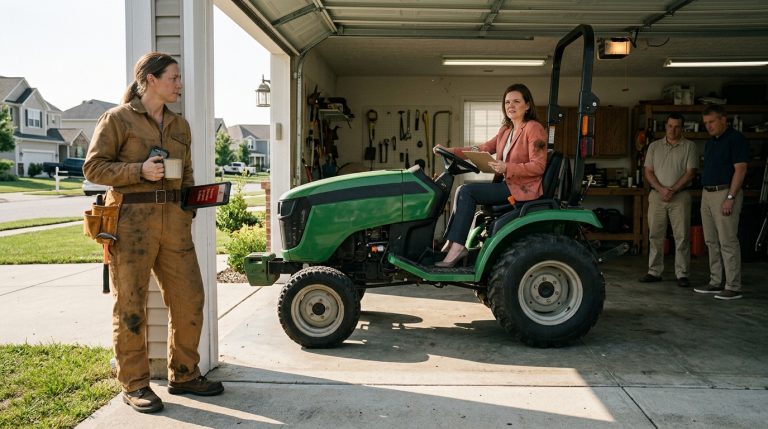
The woman was walking back now, clipboard tucked under her arm like a weapon. “I’m the president of the HOA,” she said, her voice dropping into a register of practiced, brittle authority. “And trust me, I’ve removed people from this neighborhood before.”
I felt Lily’s small hand bunching the back of my shirt. The tension in the air was no longer just about a fee; it was the specific, biting static of a fight that had been brewing long before I’d turned the key in this lock. And for the first time in years, I didn’t feel the need to argue. I just looked at the empty space where the boundary marker used to be, and I felt the cold, hard weight of the deed tucked in my desk drawer.
“You have ten days,” she said, her smile not reaching her eyes.
“We’ll see,” I replied, but this time, the words felt like iron.
CHAPTER 2: The Paper Trail
The silence after the SUV pulled away was heavy, a suffocating layer of dust settling over the driveway. I stood there, the envelope still feeling oddly light in my hand, staring at the empty gap in the soil where the survey stake had been. It was a petty act of erasure, the kind of thing someone does when they want to assert dominance over a space they don’t truly understand. I walked over to the spot and knelt, pressing my palm against the dry, parched earth.
Lily walked up behind me, her small, bare feet silent on the gravel. “Dad, are we really moving?”
I stood up, dusting the soil from my knees. “No, Lily. We’re not moving. We’re just doing some research.”
I didn’t explain the deed. It wasn’t the time. Instead, I retreated to the barn—a structure that most people in Willow Creek saw as a code violation, but which I saw as a fortress. It was cool inside, smelling of pine sawdust and the sharp, metallic tang of old tools. I moved to the workbench, pushed aside a box of rusted nails, and cleared a space for the envelope. I pulled the violation notice out and laid it flat against the worn wood.
The list of “unauthorized” infractions was typed in a font that screamed corporate neutrality, yet the red ink felt violent. I pulled my laptop from the bottom drawer of a metal filing cabinet. I’d spent months preparing for this move, gathering digital copies of county records, cross-referencing maps, and tracing the genealogy of the land back to the homestead era.
The HOA expected me to be a guy who would panic, who would see the 350,000-dollar figure and start looking for an apartment in a cheaper part of town. They relied on that fear. They banked on it.
I logged into the county assessor’s database. The screen glowed, a harsh contrast to the dim, amber light filtering through the gaps in the barn’s wooden walls. I began to input the parcel numbers, pulling up the financial filings the HOA was legally required to submit. My fingers moved with the practiced rhythm of a man who’d spent enough years reading blueprints to spot a structural flaw from a mile away.
The first few pages were standard: landscaping fees, lighting maintenance, administrative costs. But then, I hit a snag. The system flagged the last three quarters of data as “pending review.” I clicked deeper, navigating through the labyrinthine interface of the county’s archaic digital records.
My phone buzzed against the wood. It was an email notification from the land records clerk I’d been in touch with. File unavailable due to server maintenance.
I leaned back, the wooden chair creaking under my weight. It wasn’t a coincidence. Not here. Not now. I looked back at the violation notice. If they were hiding the financials, it wasn’t just because they were being inefficient. It was because the books didn’t just have errors; they had holes.
I stood up and paced the small space, the grit under my boots grinding into the concrete floor. The morning air was already beginning to heat up, promising a brutal afternoon, but my mind was elsewhere. I needed to see the physical archives. The digital trail had been scrubbed, but the paper trail—the original land grants, the signatures, the hand-drawn maps—that was harder to wipe clean.
I walked to the corner of the barn and grabbed a heavy canvas bag. I packed a flashlight, a notebook, and the original deed—the document that was the anchor for my entire plan. As I zipped the bag, I looked toward the house. Lily was sitting on the back porch steps, drawing something with her chalk, completely oblivious to the gravity of the morning.
I stepped out into the light, shielding my eyes. The neighborhood looked serene, the kind of manicured, curated peace that felt manufactured. I knew, with the cold clarity of a man who’d seen enough construction sites collapse, that the ground beneath these perfectly trimmed lawns was far less stable than it appeared.
The walk to the truck was short, but every step was a calculation. I didn’t want to alert anyone, yet I knew the moment I started the engine, I’d be announcing my presence. I gripped the door handle, the cold metal biting into my skin, and pulled.
The truck turned over with that familiar, grinding roar—a sound that, to the HOA, was a middle finger, but to me, was a call to work. I drove out of the driveway, deliberately avoiding the main gate. I took the back road, the one that wound through the old timber stands, keeping my speed low. I wasn’t just going to the county office; I was going to unearth the history they’d tried to bury.
As I hit the main road, my phone buzzed again. A text from an unknown number: Your truck is being watched. Stay in your lane.
I didn’t answer. I didn’t even slow down. I simply pressed the accelerator, feeling the engine surge beneath me. They were playing with fear, and they were very good at it. But they had forgotten one fundamental truth about the people they decided to push: if you back someone into a corner, make sure you don’t leave them with the keys to the house.
I pulled into the county archives parking lot, but the gates were locked, a handwritten sign taped to the chain-link: Closed for emergency structural assessment.
I pulled to a stop, the engine idling, the vibration humming through the steering wheel. I looked at the sign, then at the empty, silent building. They were moving faster than I’d anticipated. They were locking the doors before I could even turn the key. I sat there for a long moment, the heat of the day beginning to bake the interior of the cab, and realized that the fight had just shifted from a matter of paperwork to a race against the very people who thought they owned the ground I stood on.
I put the truck in reverse. There was always another entrance, always another way to get to the truth. I just had to be willing to look where they thought no one would go.
CHAPTER 3: The First Fracture
The lock on the archive gate was a simple, rusted padlock, the kind that had been exposed to enough rain and salt air to make the tumblers sluggish. I didn’t reach for a tool. Instead, I climbed out of the truck, the gravel crunching loudly under my boots—a sound that felt like a challenge in the quiet of the morning. I walked to the chain-link fence, my hands tracing the rough, corroded wire. The “emergency assessment” sign hung askew, flapping softly in the rising breeze. It was a lie, and a lazy one at that.
I took a deep breath, the air smelling of wet asphalt and drying grass, and focused on the lock. It wasn’t about breaking in; it was about acknowledging that the rules governing the neighborhood, and by extension this archive, were being bent by someone with a vested interest in keeping things hidden. I didn’t need to pick the lock. I reached into my truck bed and pulled out a heavy-duty bolt cutter—the same tool I’d used to dismantle the old fence lines during my first week in the house. The steel of the cutters felt cold and reassuringly heavy.
One clean, sharp snap. The sound echoed through the parking lot, startling a crow from the roof of the building. The chain fell away with a clatter, hitting the ground like a spent casing. I didn’t rush. I moved with the slow, deliberate pace of a man who knew exactly where the weak points in the system were. I drove the truck through the gap, parked it behind the cover of a large dumpster, and walked toward the side entrance of the archive.
This was where the “Context Zone” really began. I wasn’t just fighting a person anymore; I was fighting the inertia of a bureaucracy designed to protect the status quo.
The side door was unlocked—a sign that the “assessment” was a facade, a bureaucratic barrier meant to deter the curious rather than stop the determined. I stepped into the dim, climate-controlled hallway, the sudden drop in temperature raising gooseflesh on my arms. The archive was a labyrinth of steel shelves and cardboard boxes, smelling of ancient paper and treated dust.
I didn’t go for the digital kiosks. I went straight for the physical files: the basement vault labeled Subdivision Grants & Historical Titles.
The lights in the vault were off, but I had my flashlight. I swept the beam across the rows, the light catching the dust motes dancing in the air. I found the label: Willow Creek Estates – 1970s Establishment Records. My heart rate remained steady, a rhythmic, calm beat that I had trained myself to maintain through years of high-pressure job sites. I pulled the box from the shelf and set it on the table.
The papers inside were yellowed, brittle, and held together by rusted paperclips that left orange stains on the margins. I started at the bottom, working my way up. It didn’t take long to find the first fracture. Tucked between a routine maintenance agreement and an early HOA charter was a ledger of property taxes—unpaid, deferred, and eventually settled by a shell company I didn’t recognize. The company, WCE Holdings, appeared again and again, appearing to act as a guarantor for the neighborhood’s debt whenever the HOA hit a shortfall.
And then, I saw the signature on the authorization line for a large, recurring “administrative transfer.” It wasn’t a bank. It was the HOA president’s personal legal representative.
I sat there, the silence of the vault ringing in my ears. The embezzlement wasn’t a grand, cinematic heist; it was a slow, systematic draining of the neighborhood’s resources, justified by “infrastructure improvements” that never actually happened. They were inflating the costs of maintaining the land to keep the residents in a perpetual state of debt, which gave the HOA board absolute control over the properties.
But there was something else—a document stapled to the back of the ledger. It was a land survey map from 1954, long before the subdivision existed. The red ink outlines on the map corresponded to the coordinates of my house, my barn, and the entire strip of land along the western edge of the development. The signature on the bottom was my grandfather’s.
My hand trembled, just for a second, before I steadied it. The land wasn’t just “nearby” or “adjacent.” It was the core. The HOA had built their polished little kingdom on a foundation they didn’t actually have the rights to operate on, based on a title transfer that had been legally contested—but never resolved—decades ago.
I heard a sound in the hallway. A faint, rhythmic clicking of heels against the concrete floor.
I didn’t panic. I didn’t hide the files. I simply closed the box, tucked the specific map into my jacket, and stood up, extinguishing the flashlight just as the light from the hallway spilled across the threshold. I stood in the darkness, the weight of the map pressed against my ribs, listening to the approach of someone who, just like me, had come to make sure their secret stayed buried. The clicking stopped right outside the vault.
“I know someone is in there,” a voice called out—cool, familiar, and utterly devoid of doubt.
I didn’t say a word. I shifted my weight, feeling the cold steel of the shelves behind me, waiting for the door to push open. The confrontation wasn’t coming in ten days; it was happening right now.
CHAPTER 4: The Pressure Cooker
I didn’t move. I let the darkness be my armor. Outside the vault, the clicking of heels slowed, then stopped. The person—I was certain it was the HOA president—was right on the other side of that thin, steel-reinforced door. The air in the vault felt stagnant, heavy with the scent of aging parchment and the metallic tang of the metal shelving.
“I know someone is in there,” she repeated, her voice tighter now, lacking the practiced, melodic arrogance she’d shown on my porch. She sounded human, which meant she was dangerous.
I slid the 1954 land survey map deeper into my jacket, my hand finding the rough texture of the paper. I needed an exit, but the only way out was the door she was blocking. I looked toward the back of the vault. There was a small, high ventilation grate, clogged with years of debris. It was a long shot, but in my line of work, the long shot was usually the only one that mattered.
I climbed up the bottom shelf, my boots finding purchase on the cold metal. As I reached up to touch the grate, my fingers brushed against a small, recessed key hidden on a ledge near the duct—an old, skeleton key, out of place in this modern, climate-controlled facility. I didn’t have time to ponder why it was there; I shoved it into my pocket and focused on the grate. With a sharp, controlled pull, I dislodged the screws. The metal groaned, a high-pitched protest in the silence of the vault, but I didn’t flinch.
Outside, the door handle turned.
I scrambled up, squeezing my shoulders through the gap just as the heavy vault door swung open. A sliver of hallway light cut across the darkness, illuminating the spot where I had been standing just seconds before. She was there, framed by the light, holding a mobile phone in one hand and a set of keys in the other. She wasn’t alone; a security guard hovered behind her, his uniform crisp and his expression one of weary annoyance.
I didn’t wait to see if she looked up. I pushed through the narrow vent, dropping into the cramped, dark crawlspace behind the wall. The dust was thick, choking, and coated my tongue. I crawled forward, the metal vibrating beneath my knees, until I reached the outer brick facade of the building. I managed to push out a loose brick, creating a small, jagged window to the outside.
I looked down. I was directly above the dumpster where I’d left my truck. I dropped, hitting the asphalt with a controlled roll that absorbed the impact. I didn’t look back. I climbed into the cab and started the engine, the roar of the diesel motor cutting through the eerie silence of the parking lot.
As I drove toward the gate, I saw her—the HOA president—walking out of the archive building, her face white with rage, pointing toward the exit. She was talking into her phone, her movements sharp, frantic. She knew I had something. She didn’t know what, but she knew the foundation of her tidy little neighborhood was starting to crack.
I reached my house twenty minutes later. The neighborhood was quiet, the sprinklers hissing in the morning sun, coating the lawns in a synthetic, shimmering dew. It was a pristine, perfect display, designed to distract anyone who looked too closely. But as I pulled into my driveway, I saw the HOA’s “violation” sign—a bright, neon-orange warning—taped directly over my front door.
I got out of the truck, the weight of the map still heavy in my jacket. Lily was inside; I could see her silhouette against the kitchen window. I walked up to the door and tore the sign down. As I did, I noticed a sleek, black car idling down the street. It hadn’t been there earlier.
The pressure cooker was reaching the boiling point. They weren’t just monitoring me anymore; they were watching the house. I went inside and locked the door, the click of the deadbolt echoing in the quiet hallway. I walked into the kitchen, the map still in my hand. It was time to stop researching and start constructing the evidence.
I laid the map out on the kitchen table. It was more than just lines and borders. It was a blueprint of their deception. I began to mark the areas where the “infrastructure improvements” they had charged the neighborhood for were supposed to have taken place—areas that, according to this map, were protected wetlands that no developer could legally touch.
If they were charging for work in wetlands, they were either violating federal environmental laws or they were committing fraud on a scale that would make the IRS sit up and take notice. And suddenly, the $350,000 fine didn’t seem like a penalty for an old truck and a leaning fence. It was a desperate attempt to drive me out before I started looking at the maps.
I stood there, staring at the table, the map, and the simple, brutal reality of the fraud. I wasn’t just a homeowner fighting an HOA; I was a man holding the one piece of paper that could dismantle their entire world. I grabbed my phone and dialed the number for the legal advocacy group I’d been quietly vetting for weeks.
“This is the property owner at 22C,” I said, my voice low and steady. “I have something that needs a serious set of eyes.”
The reply was immediate, professional, and cold. “Send the documents. And be careful. If what you’re saying is true, you’ve just become the most expensive person in the county.”
I hung up, looking toward the window. The black car was still there, a dark, motionless anchor in the middle of the street. I was no longer an observer. I was in the crosshairs, and for the first time in a long time, I felt the sharp, exhilarating focus of a man who knew exactly what his next move was.
CHAPTER 5: The Silent Audit
The interior of the house felt smaller than it had an hour ago. Every shadow cast by the afternoon sun seemed to stretch toward the table where the land survey map lay, a stark, ink-stained testament to a history they thought they had erased. I watched the black sedan through the slats of the blinds. It hadn’t moved. It was a patient, predatory presence, waiting for me to make the next mistake.
I looked at the notes I’d scrawled on the yellow legal pad. The embezzlement was clear—a trail of inflated maintenance fees, phantom construction projects, and “emergency” administrative levies that had funneled over two million dollars into WCE Holdings over the last five years. It was enough to sink the board, but it wasn’t enough to secure the land. For that, I needed to show the residents not that the board was greedy, but that they were effectively holding the neighborhood’s legal stability hostage for their own personal gain.
I picked up the phone again. I didn’t call the lawyers; I called the one person on the board I knew was just as tired of the status quo as I was: Marcus, the retired architect who lived three doors down. He’d been the one to briefly nod at me during the last HOA meeting, a subtle acknowledgment of the fraying edges of our community.
“Marcus,” I said, keeping my voice low. “It’s the guy with the blue truck. I have something you need to see. Not later. Now.”
There was a long silence on the other end, the kind of hesitation that spoke of fear. “You have no idea what you’re dealing with,” he finally whispered.
“I have the survey maps,” I replied, my voice hard. “The originals. They didn’t just overcharge for the landscaping; they built on land they don’t own. And they’ve been leveraging that instability to keep us paying for phantom repairs. I’m going to the board office tonight. Are you in, or are you going to keep paying for a ghost?”
He didn’t answer immediately. I watched the black car. A man stepped out, stretched, and lit a cigarette, his gaze fixed directly on my front porch. My skin crawled. The paranoia was starting to settle in—I wondered if my own phone was compromised, if my movements were being fed back to the HOA president in real-time. I looked at the map, then at the kitchen knife sitting on the counter, and forced myself to breathe. Focus.
“Meet me at the back entrance of the community center in twenty minutes,” Marcus said, his voice barely audible. “And for God’s sake, don’t take the truck.”
I hung up. I pulled a hooded jacket from the closet, grabbed the canvas bag, and slipped out the back door. I moved through the shadows of the tall, overgrown hedges that lined the edge of the property. The neighborhood felt like a stage set—beautiful, rigid, and entirely fake. As I skirted the edge of the wetlands, I noticed a series of yellow stakes in the ground, marking where the board intended to expand the “green space”—an expansion that would require leveling the very barn that anchored my property’s history.
They weren’t just watching me; they were ready to move on the land itself.
The community center was a fortress of glass and steel, designed to project an image of open, communal living, but behind the scenes, it was a ghost town. I found Marcus standing in the shadow of the delivery bay, his face pale, his hands trembling. He looked like a man who was seeing his own life’s work being dismantled.
“Show me,” he demanded, his voice thin.
I spread the map on the hood of a delivery van. I showed him the discrepancies, the tax filings, and the blatant overlap between the proposed expansion and the original homestead boundaries. He traced the lines with his finger, his breath hitching.
“If this gets out,” he said, “the entire incorporation of the neighborhood is void. The houses, the loans… everything.”
“That’s exactly the point,” I said. “They are gambling with our titles to hide their own bankruptcy. They aren’t the guardians of this place. They’re the liquidators.”
Just then, the glare of headlights hit the alleyway. A heavy SUV pulled in, blocking our exit. The door opened, and the HOA president stepped out, her expression wiped clean of its usual smugness, replaced by a cold, calculating intensity. She wasn’t holding a clipboard this time. She was holding a thick, manila folder that looked identical to the one I’d left in the archive vault.
“You really should have left it in the box,” she said, her voice carrying through the cool night air like glass shattering.
She walked toward us, her steps measured, confident. The power dynamic shifted instantly; she wasn’t just a bureaucrat anymore. She was a woman fighting for her survival, and she looked ready to burn the neighborhood down to keep her secret buried. I stepped in front of Marcus, the map clutched in my hand, feeling the grit of the alleyway beneath my boots.
The audit was over. The confrontation had begun.
CHAPTER 6: The Unraveling
The HOA president stepped closer, the heels of her shoes clicking rhythmically against the asphalt of the alleyway. She was close enough that I could see the fine lines around her eyes—a map of stress and calculated ambition. She held the folder loosely, but her knuckles were white.
“You’re trespassing, Marcus,” she said, her voice dripping with a practiced, synthetic concern. She didn’t even look at me, as if I were merely a piece of debris in her way. “And you, Mr. Property Owner, are in deep violation of several community bylaws. I suggest you hand over that map, and perhaps we can discuss a quiet exit from the neighborhood.”
Marcus stood beside me, his breathing shallow. He looked at the woman who had presided over our lives for years, and for a moment, he seemed to shrink. I took a half-step forward, placing myself between them. The map in my pocket felt like lead—heavy, substantial, and dangerous.
“The bylaws don’t apply to a ghost, do they?” I said, my voice steady, cutting through the damp night air. “You’ve spent years running this community like a corporation, but you forgot one thing: you need a legal foundation to incorporate. You don’t have one.”
She stopped. A flicker of genuine uncertainty crossed her face, gone as quickly as a shadow in the moonlight. “You’re delusional. You think some old paper and a few scribbled notes give you the right to overturn this board? You’re just a man with a truck and a grudge.”
“I’m a man with the title,” I corrected.
She laughed, but there was no mirth in it. It was a sharp, serrated sound. “The title is buried under thirty years of development agreements. You’ll be bankrupt before you even find the right judge to hear your case. Give it to me.”
She gestured to the folder in her hand. “I have the eviction order signed and dated for tomorrow morning. Your truck will be crushed, your house will be reclaimed, and your daughter will be finding a new place to sleep by tomorrow night.”
The mention of Lily hit me like a physical blow. The memory of her sitting on the porch steps, drawing with chalk, surged through me—not just as a memory, but as a visceral reminder of what I was protecting. My grandfather’s old work shed, a place I hadn’t thought about in years, suddenly appeared in my mind—the scent of pine needles, the way he would square a joint until it was perfect, his insistence that if you built it right, it stayed. This land was not just a plot of earth; it was the foundation he had built for his future, and someone had tried to steal that future with ink and malice.
“You think you’re protecting this place,” I said, my voice dropping. “But you’re just the final infection. You didn’t build this. You just managed the decline.”
I saw the guard behind her stiffen. I knew, based on the way he looked at the folder in her hand, that he didn’t know the full extent of what she was hiding—the embezzlement, the falsified records, the environmental fraud. He thought he was protecting a neighbor; he didn’t realize he was shielding a crime.
“Marcus,” I said, not taking my eyes off her. “The records we found. Do you have them?”
Marcus hesitated, then pulled a thumb drive from his pocket. He had duplicated the vault files.
The HOA president’s eyes darted to the drive. The facade of control finally shattered. She dropped the folder, her hand reaching for her phone, but she was too late. I had already signaled the group on my phone—the legal advocates, the local press, the county board representative. The information was already moving.
“You did it,” she whispered, her voice failing. “You think this helps anyone? You’ll ruin the property values for everyone. You’ll destroy this neighborhood.”
“I’m clearing it,” I said.
She turned, her face a mask of frantic realization. She saw the lights of a patrol car turning into the alleyway at the far end—not for me, but for the report I’d filed regarding the fraudulent land seizure. She scrambled toward the SUV, but the guard, sensing the shift in the wind, stepped back, distancing himself from her.
She was alone. She had managed the board, the neighbors, and the rules, but she had failed to account for a man who knew the difference between a house and a home. She drove off, her tires squealing against the wet pavement, leaving behind the folder of fake violations—a pile of paper that suddenly meant nothing.
The patrol car pulled up. I didn’t run. I reached into my bag and handed the officer the survey map. The process had begun, and while it wouldn’t be over tonight, the threat of immediate eviction—the leverage they had used to hold the neighborhood hostage—was gone.
Marcus let out a long, ragged breath, leaning against the van. “It’s really over,” he said.
“No,” I replied, watching the red lights fade into the distance. “It’s just starting. But the house is ours.”
I walked back toward my house, the night air cooler, the tension in my chest beginning to ease. The black car was gone. The street was silent. I climbed the porch steps, the wood solid and familiar beneath my boots, and for the first time since I’d moved in, the place felt like it was finally, truly mine.
CHAPTER 7: The Final Leverage
The house was too quiet. I stood in the kitchen, the map still spread out on the table, the edges curled where I had pressed down on them in my frustration. Outside, the neighborhood was deceptive in its stillness. The streetlights flickered in a rhythmic, mechanical cadence, casting long, angular shadows across the lawns. I knew the HOA president hadn’t just driven away to lick her wounds; she was likely in some high-rise office, surrounded by the kind of attorneys who could turn a plain fact into a six-month delay.
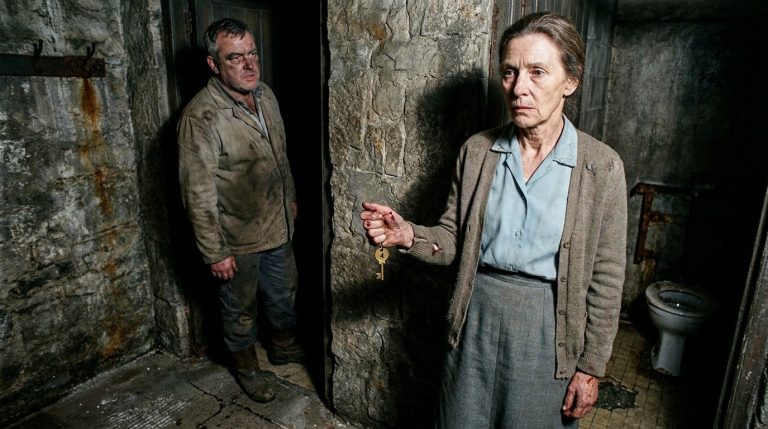
I pulled the rusted key I’d found in the archive from my pocket. I had been carrying it for days, rubbing its smooth, cool surface between my thumb and forefinger without really looking at it. Now, under the harsh light of the kitchen, I saw the inscription worn into the metal: 22-C.
It wasn’t just a random key. It was a key to the original land office—a small, stone shed that sat at the very back of my property, hidden by decades of overgrown ivy and the weathered barn. I’d thought it was just storage. I hadn’t even checked the lock.
I walked out the back door, my boots hitting the soft, damp grass. The air was cool, smelling of night-blooming jasmine and the damp earth of the wetlands. I navigated toward the back of the lot, my flashlight beam cutting through the darkness, illuminating the gnarled, twisting vines that choked the stone structure.
I reached the shed. The ivy was thick, like a natural barricade. I pulled it away, piece by piece, the brittle stems snapping in my hands. The stone door was heavy, solid, and held closed by an iron lock that had clearly not been turned in fifty years. I didn’t hesitate. I slid the old key into the mechanism, the metal grating with a deep, grinding protest as I forced it to turn.
The door creaked open, revealing a space that smelled of dry, stagnant air and history. Inside, there were no tools, no farm equipment. There was a single, heavy steel cabinet bolted to the floor. I opened it. Inside sat a stack of deeds, original surveyor’s notes, and a series of letters—correspondence between the original homesteaders and the county representatives from the 1920s.
My heart hammered against my ribs as I sifted through them. It wasn’t just the land title. It was proof that the entire Willow Creek development had been built on a series of forged signatures and stolen easements. The “fraud” I’d discovered earlier was only the surface; this was the foundational corruption that rendered the entire subdivision’s incorporation legally nonexistent.
I grabbed the papers, my hands trembling as I realized the magnitude of what I was holding. This wasn’t just leverage—it was an anchor. I could dismantle the entire HOA, not just the current board.
Suddenly, a bright, searing light flooded the yard. I spun around, blinded, dropping the papers.
“Step away from the structure!” a voice barked.
I shielded my eyes. A vehicle had pulled up behind the barn, its headlights cutting through the darkness like twin blades. It wasn’t a patrol car. It was an unmarked SUV, the same model the HOA president drove. Two men stepped out—not police, but private security, dressed in tactical gear that looked out of place in our manicured suburb.
They weren’t here to arrest me. They were here to retrieve the cabinet.
“Give us the contents of that box, and you’ll walk away,” one of them said, his hand resting on his belt. “We have the sheriff on call, and we have the legal standing to declare this a private salvage operation. You’re trespassing on corporate land, Property Owner.”
I looked at the documents, then at the men. My mind raced, calculating the distance to the house, the possibility of a phone call, the likelihood that the legal advocacy group I’d contacted would get there in time. I realized then that the “legal counter-strike” wasn’t coming at dawn. It was here, and it was using private force to finalize the erasure.
“This land is my foundation,” I said, my voice low and steady, as I stepped in front of the stone shed, my hand finding the heavy iron bolt I’d used to secure the door. “And it’s time this neighborhood finally saw what it was built on.”
I didn’t back down. I held my ground, the cold weight of the rusted key still in my pocket, and for the first time, I felt the full, crushing reality of the legacy I was defending. The fight wasn’t just about a deed anymore; it was about the truth, and I was going to make sure it was heard, no matter what they brought to the door.
CHAPTER 8: The Denouement
The men in tactical gear hesitated, their boots shifting in the gravel. They were paid to be bullies, not to act as accomplices to a felony being broadcast to the county attorney. I held the ledger open, the flashlight in my other hand illuminating the forged signatures—the physical proof that the foundation of the entire neighborhood was built on a lie.
“You want to call the sheriff?” I asked, my voice cutting through the hum of the SUV’s engine. “Go ahead. Tell them you’re here to recover a ‘salvage operation’ on land that, according to these records, was never legally yours to develop. Tell them you’re here to assist in the theft of primary historical documents.”
The lead guard looked at his partner, then at the stone door of the shed. The authority they had projected moments ago evaporated, replaced by the instinctual self-preservation of men who knew when a situation had turned radioactive. Without a word, he turned, signaled his partner, and they retreated to their SUV. The engine roared to life, and they backed out of the yard, leaving me alone in the sudden, jarring silence of the night.
I didn’t celebrate. I walked back to the house, the weight of the documents feeling like a physical burden I had finally been permitted to set down.
The next three days were a blur of lawyers, county officials, and the slow, grinding machinery of legal reality catching up to the HOA. The embezzlement was exposed, the construction projects halted, and the board—including the president who had tried so hard to intimidate me—was dissolved by a court order. The neighborhood didn’t collapse into chaos; instead, it began to breathe. For the first time in weeks, the streetlights didn’t feel like surveillance; they felt like utilities.
I spent the final afternoon in the backyard, standing by the barn. I took a wire brush and a can of penetrating oil to the old gate hinges. They had been rusted, screaming every time I opened or closed them, a grating sound that mirrored the friction I’d been living in. I worked until my hands were black with grease and the metal was clean, silver, and silent.
Symbolic closure. The gate swung open with a soft, effortless glide.
I walked to the front porch. Lily was there, working on a new chalk drawing—a sprawling, messy, beautiful map of the neighborhood, showing the trees, the pond, and our house right in the center. She looked up as I approached, her face smeared with blue dust.
“Is everything okay now, Dad?”
I sat down on the steps, the wood solid beneath me. I thought about the man I’d been when I moved in—defensive, wary, convinced that the world was just a series of traps laid by people who wanted to take what was yours. I thought about the grandfather who had built this foundation, the long trail of legal battles, and the quiet dignity of reclaiming what had been stolen.
“Yeah,” I said, watching her work. “Everything is exactly where it’s supposed to be.”
I picked up the envelope I’d left on the porch, the one that had started this entire sequence of events. It was empty now, a piece of paper that had once carried a threat of three hundred and fifty thousand dollars. I folded it once, twice, and tucked it into my pocket—not as a trophy, but as a reminder.
The HOA was gone, replaced by a resident-led trust that focused on genuine maintenance rather than manufactured debt. The barn stayed. The truck stayed. And the land—my land—was finally, quietly secure.
The sun began to dip below the horizon, painting the sky in soft, bruised colors of orange and violet. The neighborhood was quiet, not with the forced, synthetic silence of the past, but with the peaceful, easy stillness of a place that was finally being treated with care. I leaned back against the porch railing, closed my eyes, and for the first time since I’d arrived at Willow Creek, I simply breathed. The weight was gone. The truth was out. And the future, for the first time in a long time, felt like something I could actually build.