A Calculus of Soil and Scorn: Reclaiming the Legacy of Puit Farm from the Teeth of Corruption
CHAPTER 1: THE SHORELINE BREACH
The air smelled of damp earth and coming heat, the kind of morning that usually promised a good day’s work. Instead, it felt like standing on a fault line. My father’s truck sat idling behind me, the engine a low, steady thrum against the backdrop of the waking lake.
Bev and Trish stopped ten feet away. They were walking in perfect synchronization, their posture stiff, their movements rehearsed. Bev held her folio like a weapon.
“Mr. Harrove,” Bev said, her voice clipped, professional, and entirely devoid of warmth. “This is a managed community shoreline. You don’t have authorization to be standing here.”
I felt the heat rise in my skin, a slow, familiar burn that usually signaled the start of a long fight. I looked at the water. It was the same lake I’d spent every summer of my life staring at, the same muddy bank where my grandfather had taught me how to read the clouds.
“This is my land,” I said, my voice steady, though my pulse was hammering against my ribs.
Trish stepped forward, checking a laminated sheet in her hand. “The community access protocols are very specific, Clint. If you haven’t received a lake use badge, you are effectively trespassing on common area assets. We’ve already logged this. We’ll have to report the unauthorized presence to the board.”
I looked at the notice she held. It wasn’t just a flyer; it was an official-looking document, complete with a seal that meant nothing. The arrogance of it was breathtaking. They weren’t just asking me to leave; they were redefining the reality of the property line in real-time, rewriting history with ink and bad intent.
“I’m not leaving,” I said, leaning back against the truck door. I didn’t raise my voice; I just looked at them until they started to fidget. “And you aren’t going to report anything, because you don’t know what you’re talking about.”
“We know what the records say,” Bev countered, her chin lifting. “And the records say this access is private.”
I reached into my pocket and felt the corner of the envelope I’d found on the kitchen counter—the notice about the mailbox post, the one that referenced amenity access. It was the missing piece of a puzzle I hadn’t realized was being built around me.
“The records,” I repeated, letting the word hang between us like a threat. “You keep using that word, but I don’t think you’ve actually looked at the deed. You’ve been busy playing house, haven’t you? Selling badges for water that hasn’t been yours for forty years.”
The color drained from Trish’s face so quickly it was like a ghost passing through her. She blinked, her gaze flickering to Bev. The silence stretched, thin and brittle. It wasn’t the silence of someone caught in a lie; it was the silence of someone realizing the foundation they were standing on had just turned to water.
Then, behind them, a motion-activated light on the clubhouse porch flickered on, despite the broad daylight—a short, frantic stutter of electricity that shouldn’t have been happening. I watched the bulb die with a sharp, final pop.
“You’re not reporting me,” I said, stepping toward them. “You’re going to go back to the office and explain why your records don’t match the county register.”
I didn’t wait for an answer. I turned back to the truck, the weight of the moment pressing into my shoulders. Something was buried under the surface of this development, something darker and deeper than a few HOA violations. And as I reached for the door handle, I realized the note in my pocket was vibrating—or maybe it was just my hand. Everything had changed, and the true cost of this war was only just beginning to reveal itself.
CHAPTER 2: PAPERWORK AND POISON
The drive back to the house was a study in controlled rage. My knuckles were white against the steering wheel, my grip so tight I could feel the vibration of the road buzzing up through the bones of my arms. Behind me, the lake sat like a placid, uncaring eye, hiding the rot that Bev and Trish had just tried to enforce. Every mile back toward the farmhouse felt like a retreat, but my mind was already moving forward, calculating the distance between the lies they told and the reality I held in my pocket.
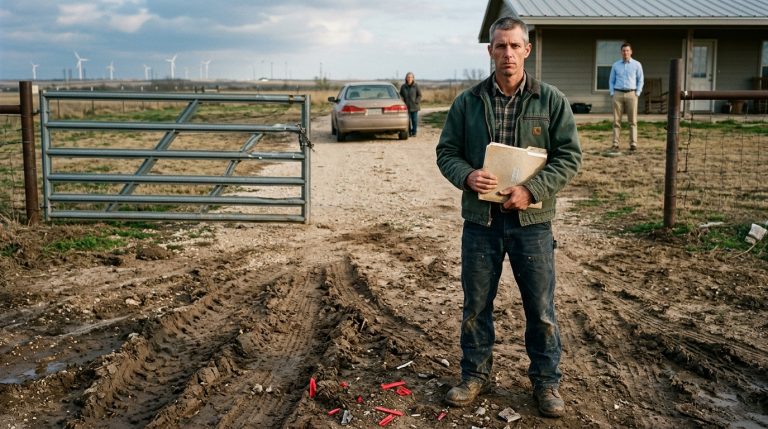
When I pulled up to the house, the gravel crunching beneath the truck tires sounded like breaking glass. I didn’t go inside immediately. I sat there in the cab, letting the engine die, watching the smokehouse stand solid and stubborn in the morning light. My grandfather had built that place to last, brick by brick, in a time when a man’s word was worth more than a laminate badge. I remembered the rhythm of his work—the way he’d pull the hickory boards tight, the sound of the hammer hitting the nail, a cadence that spoke of permanence. It was a complete contrast to the frantic, bureaucratic chaos Darla Fitch and her committee were trying to impose. That was the ghost in the machine: the realization that while I was grieving, they had been treating my family’s life as a line item in a ledger.
I stepped out of the truck and walked to the porch, the air feeling heavy, charged with the static of an impending storm. Inside, the kitchen was quiet, the coffee pot still warm. I pulled the envelope from my pocket and spread the notices across the table. They were pristine, perfectly printed, filled with the kind of legalese designed to make a man feel small. But as I lined them up—the mailbox complaint, the amenity access notice, the subtle, shifting language they’d used over the last eleven years—the pattern became clear.
It wasn’t just harassment. It was a siege.
I reached for my phone and dialed Constance Waverly. She answered on the first ring, her voice calm, a sharp contrast to the adrenaline still burning through my veins.
“Clint,” she said. “I assume the morning went well?”
“They’re getting bold, Constance,” I said, my voice hitting that low, flat note that signaled I was done playing. “They approached me at the water’s edge. Used the ‘managed community’ line. They think they own the shoreline.”
I heard the shift in her breathing on the other end. She didn’t react with shock; she reacted with the predatory focus of an attorney who had just been given the green light to go for the throat. “If they are moving onto the shoreline, they are operating under the assumption that the easement is valid. They’re overreaching. They’ve finally provided us the leverage to verify exactly how deep this goes.”
“What do you need?”
“Records,” she said, her voice turning crisp. “Everything your grandfather kept. The original county filings, the land survey from ’81, and any correspondence your father kept from the board in the last two years. If they’re monetizing that lake, they had to register the fees somewhere. They’re greedy, Clint, but they’re also lazy. They’ll have hidden the income in the official books, mislabeling it to avoid transparency. We need to find the specific instrument they used to claim that water.”
I hung up and headed to the basement. It was a cool, dim space, filled with the smell of old paper and dust—the repository of a life’s work. I started digging. I pulled open boxes that hadn’t been touched in years, unfolding yellowed permits and hand-drawn maps of the property. Every document was a piece of the wall they were trying to tear down.
My hands moved with precision. I didn’t look for emotions; I looked for contradictions. I laid the papers out on the old workbench, the same one my father had used to clean his tools every Sunday. Beside a faded survey of the lakefront, I placed the latest HOA notice. The contradiction was there, buried in the fine print. They were citing a 2018 amendment to the community bylaws that claimed stewardship of the lakefront, a document that had no basis in the original county survey. It was a forgery of intent, a sleight of hand.
I felt a cold, jagged calm settle over me. Darla Fitch wanted compliance? She wanted standards? I was going to give her a reality check that would dismantle her little kingdom stone by stone. I pulled a fresh notebook from my bag and started writing down the dates, the names of the board members I remembered, and the gaps in their logic.
This wasn’t just about the lake anymore. It was about the fact that they had been lying to the entire neighborhood, selling them a fantasy of control while pocketing the proceeds of their own deception. I stood there in the quiet of the basement, the lightbulb swinging slightly overhead, and realized that for the first time since my father’s funeral, I wasn’t just mourning. I was hunting.
CHAPTER 3: THE HIDDEN LEDGER
The light in the basement was thin, filtered through small, grime-streaked windows that barely cleared the surface of the ground outside. I stood at the workbench, my hands resting on the rough-hewn pine. The air was thick with the scent of cedar and old, damp paper—a sharp contrast to the sterile, manicured atmosphere that Darla Fitch cultivated in her board meetings. My phone buzzed on the concrete floor, the vibration rattling against the silence.
I picked it up. A text from Gene, one of the board members I’d met briefly at a neighborhood barbecue years ago. He was the one who had apologized to my father, the one who’d looked like he’d been swallowing acid whenever Darla started one of her tirades.
I have copies. Meet me at the trailhead, off the south end of the lake. 4:00 PM. Come alone.
I looked at my watch. 3:15 PM. The lake was a twenty-minute drive through the winding backroads of the county. I didn’t hesitate. I dropped the documents into a heavy leather satchel, threw on my jacket, and headed back up the basement stairs. The house felt like a pressurized chamber; every floorboard creak sounded like a declaration of war.
The drive was quiet. I kept my eyes on the road, my mind working through the implications of Gene’s contact. If he had records, he had been keeping them for a reason. Fear, perhaps. Or guilt. It didn’t matter which. What mattered was that the cracks in the HOA’s foundation were widening, and I was holding the sledgehammer.
The trailhead was tucked away behind a dense thicket of pine and scrub oak, the gravel path leading down toward the water. I parked the truck, the engine ticking as it cooled in the damp afternoon air. Gene was already there, pacing near a cluster of birch trees. He looked older than I remembered, his shoulders hunched, his eyes darting toward the treeline. He wasn’t the type to handle a confrontation. He was the type to keep his head down until the weight of someone else’s sins became too heavy to carry.
“Clint,” he said, his voice barely a whisper. He didn’t offer a handshake. He held a manila envelope, his knuckles white against the paper. “I shouldn’t be doing this. If Darla finds out, she’ll make sure I’m fined out of my house.”
“She won’t find out,” I said, my voice steady, projecting the kind of authority that made him straighten up, if only slightly. “And she won’t be able to fine anyone once we’re through with this.”
He handed over the envelope. I opened it right there, shielded from the road by the trees. Inside were copies of financial summaries—the ones the board was supposed to present at the annual meetings but never did. My eyes scanned the lines of numbers. There, in black and white, were the ‘amenity access’ fees. Thousands of dollars, listed under ‘miscellaneous maintenance’ and ’emergency infrastructure.’
I stopped at one entry. July 2023. A deposit for ‘shoreline stabilization equipment’ that totaled eight thousand dollars. I knew every inch of that shoreline; I had walked it, fished it, and maintained it my entire life. There had been no equipment, no stabilization, no work of any kind.
The discrepancy wasn’t just a mistake. It was a thumbprint.
“This money,” I said, pointing to the entry, my finger pressing into the paper, “where did it go? If there was no equipment, there was a paper trail for the expenditure.”
Gene swallowed hard, his Adam’s apple bobbing. “It’s routed to a third-party contractor. A landscape firm called ‘Greenway Solutions.’ It’s the same group Darla’s brother-in-law runs. They submit invoices for work that never happens, the board approves the payment, and the HOA gets a kickback in the form of a ‘consulting fee’ that the board members split.”
He looked away, his gaze fixed on the shimmering water. “I didn’t take any of it, Clint. I just… I stayed quiet. I thought if I just did my job, it would eventually stop. But it’s not stopping. It’s getting worse. They’re talking about seizing the parcel rights to the old pier next. They think they can just take it.”
The anger I’d felt earlier sharpened into something colder, more tactical. This was the decoy. This was the scheme they thought was their golden ticket—a simple, greedy embezzlement ring. They believed they were smart because they had a paper trail that looked official. They hadn’t realized that the trail also led directly to their own destruction.
“You did the right thing, Gene,” I said, sliding the envelope into my satchel. “But you need to be ready. When this hits the light, they aren’t going to go quietly. They’re going to try to burn everything down to cover their tracks.”
“What are you going to do?” he asked, his voice trembling.
“I’m going to make sure they’re the ones holding the matches when the roof collapses,” I replied.
I turned and walked back to the truck. The wind shifted, carrying the scent of the lake—damp, cool, and ancient. I could see the silhouette of the farm in the distance, a small, stubborn mark on the landscape. They thought they were the architects of a new world, building their little gated heaven on the bones of someone else’s history. They were about to learn that you can’t build anything of value on a foundation of theft.
I started the truck, the engine roaring to life, a low, powerful sound that seemed to chase the silence away. I wasn’t just holding records anymore; I was holding their future. And as I turned the truck around, I realized the game had moved from defense to something much more dangerous.
CHAPTER 4: SUBVERTING THE NARRATIVE
The drive back from the lake was shadowed by a bruising sky. Clouds the color of hammered lead rolled over the ridge, turning the afternoon light into a premature, nervous dusk. I had Gene’s envelope on the passenger seat—a bundle of paper that felt heavier than its actual weight. Every time the truck hit a rut in the gravel road, the envelope shifted, a rhythmic reminder of the information that was about to shatter the neighborhood’s manufactured peace.
I pulled into the farmhouse driveway just as the first heavy, singular drops of rain began to crater the dry dust. I didn’t head inside to the comfort of the kitchen; I went straight to the smokehouse. It was my sanctuary, a place of cinder block and hard work that hadn’t changed in forty years. The interior smelled of hickory and wood smoke, the scent familiar and anchoring. I cleared a space on the old workbench, brushed aside a collection of rusted iron hinges, and laid out the financial summaries Gene had provided.
The plan was simple: the neighborhood’s online group was a closed circuit, a digital echo chamber where Darla Fitch held court. They expected a new round of complaints about the smokehouse, a fresh volley of aesthetic critiques. Instead, I was going to give them a mirror.
I booted up my laptop, the screen’s blue glow cutting through the dimness of the shed. The rain began to hammer against the tin roof, a chaotic, drumming sound that filled the space and muffled the world outside. I started drafting the post. I didn’t write it as a screed or an angry diatribe. I wrote it as a balance sheet. I took the “shoreline stabilization” invoice, scanned it with crisp clarity, and placed it alongside a photo of the actual, overgrown, wild-edged bank of the lake.
Transparency, I typed. The lifeblood of a community.
My fingers moved with a surgeon’s detachment. I wasn’t feeling anger anymore; I was feeling the cold, hard logic of exposure. Each document I uploaded was a nail in the coffin of Darla’s authority. I cross-referenced the HOA’s stated bylaws—the ones about community standards and compliance—with the actual, unauthorized agreements they had signed with Greenway Solutions.
Midway through the process, the power in the shed flickered, a sudden, sharp dip that made the screen stutter. Outside, the storm had turned violent; lightning tore through the dark, and the resulting thunder rattled the cinder block walls. I didn’t stop. I worked by the light of the laptop, the screen reflecting in my eyes, my focus entirely on the digital interface.
This was the “Butterfly Detour”—the unexpected storm, the sudden shift in the environment—forcing me to work faster, to anticipate the moment the power might fail entirely. If the internet went down before I hit ‘post,’ the window of opportunity would slam shut. I didn’t have time to second-guess the strategy. I moved the final documents into the upload queue, ensuring the file names were clear, objective, and damning.
I glanced at the window. The rain was a gray curtain now, obscuring the view of the development’s manicured lawns on the hill. It was perfect. The weather would keep people inside, glued to their devices, waiting for an update from the HOA about the storm—the perfect time for a revelation that would dominate their screens.
I hit ‘publish.’
The progress bar crawled across the screen, a thin line of green against the black background. I watched it, my breath held in my chest. The upload finished just as the lights in the shed blinked once and died completely. The darkness that rushed in was absolute, save for the faint, flickering glow of the laptop battery.
I sat back, the cool air of the storm creeping through the gaps in the cinder blocks. The silence that followed the drop of the post was deafening. Somewhere out there, across the fields and into the tidy, suburban streets of Stonebridge Meadows, phones were buzzing. People were opening the documents. They were seeing the numbers, the signatures, the blatant, ugly reality of the money their HOA had been pocketing in their names.
I didn’t need to see their faces. I could imagine the shock, the quick-dawning realization that the person they’d trusted with their property values was nothing more than a common thief. The narrative wasn’t just being challenged; it was being erased.
I left the laptop on the workbench and walked to the smokehouse door. The rain had slowed to a steady, rhythmic pour, the kind that promised to wash the dust away. I stood in the threshold, the cool dampness settling on my skin. The storm was doing exactly what I needed—it was isolating them, trapping them behind their doors with nothing to do but read the truth I’d just delivered.
The first notification chimed on my phone in my pocket. Then another. Then a rapid, frantic series of alerts, like the clicking of a machine gun. I didn’t check them. I didn’t need to. The work was done. The truth was out, and there was no way to walk it back. I watched the rain drip from the eaves of the smokehouse, a steady, measured pulse, as the little world on the hill began to unravel.
CHAPTER 5: THE CALM BEFORE THE STORM
The silence that followed the digital publication wasn’t empty; it was pressurized. I sat in the farmhouse kitchen, the laptop screen dimmed, waiting for the reaction. The rain had ceased, leaving the world outside washed clean and unsettlingly still. Then, the first notification hit—not a chime, but a persistent, frantic vibration against the wooden tabletop.
It wasn’t a message from the neighborhood. It was a call from an unknown number. I watched it pulse for a moment before I picked up.
“Mr. Harrove.” The voice was thin, sharp, and unmistakably Darla Fitch. She didn’t bother with pleasantries. “You have no idea what you’ve done. That post is a direct violation of our community standards. I’m contacting my attorney, and I suggest you remove it before the legal consequences become permanent.”
I looked at the window. The hill leading up to the Stonebridge Meadows entrance was dark, but I could see the flickers of motion—porch lights turning on, cars pulling out of driveways. The community was waking up to the fire I’d started.
“Permanent sounds like a big word, Darla,” I said, keeping my voice intentionally flat, devoid of the satisfaction I actually felt. “Especially coming from someone who’s been forging financial instruments for the better part of a decade. Are you calling to negotiate, or are you calling to practice your defense for when the state investigators get here?”
The line went silent. I could hear her breathing—a jagged, uneven sound. For a second, a strange, vertigo-like sensation washed over me; the kitchen walls seemed to lean in, and for a heartbeat, I questioned if I was actually speaking to her or if the exhaustion of the last week was finally fracturing my perception of reality. I blinked, grounding myself in the solid, unyielding texture of the table beneath my hands. The reality held. She was there, and she was desperate.
“You’re a small, petty man, Harrove,” she spat, the mask of the professional HOA president finally shredding to reveal the raw, trembling rage underneath. “You think you’ve won? You’ve only made yourself a target. Every person on that board is going to fight to save their reputation. You’ve just declared war on a dozen families who have nothing to lose.”
“They have plenty to lose,” I countered. “They have their integrity. Or what’s left of it. I’m not at war with the families, Darla. I’m at war with the rot you introduced to them.”
I ended the call before she could offer a rebuttal. I didn’t want to hear her justifications. I wanted to see the aftermath.
I walked out onto the porch. The air was cool, smelling of wet pine and distant ozone. Below, near the edge of the property line, I saw headlights sweeping across the field. Someone was driving down from the development. They weren’t moving with the typical, cautious speed of a neighbor; they were coming fast, the tires kicking up mud.
I didn’t retreat inside. I stepped down onto the path, my boots sinking into the softened earth. I was the architect of this moment, and I wasn’t going to hide from the debris. The vehicle—a black SUV, dark enough to blend into the shadows—skidded to a halt at the edge of the drive. The door swung open, and two figures stepped out. One was a man I recognized from the board, his face obscured by the low brim of a ballcap; the other was a man in a sharp, expensive-looking suit—the kind of outfit that didn’t belong on a dirt road in Caldwell County.
“Harrove!” the man in the suit called out. His voice was loud, echoing against the quiet of the night. “We need to talk about the misinformation you’ve spread.”
I stood my ground, my hands in my pockets, feeling the solid weight of my phone. I didn’t move toward them, and I didn’t back away. I waited, letting the tension coil between us. The man in the suit began to walk toward me, his pace measured, his body language an exercise in intimidation. He was trying to assert dominance in an environment he didn’t understand.
“The records aren’t misinformation,” I said, my voice cutting through the heavy, humid air. “They’re math. And math is notoriously difficult to argue with.”
“Math can be interpreted,” the man replied, stopping a few feet away. His suit was damp with the mist, his eyes cold and devoid of anything resembling a human connection. “We’re prepared to offer a settlement. A quiet retirement of the claims, a modest compensation for the ‘inconvenience’ you’ve suffered, and we go back to being neighbors.”
He was trying to buy the truth. The irony was almost sharp enough to draw blood. They didn’t understand that for me, this was never about the money. It was about the fact that they thought my family’s history, my grandfather’s sweat, and the very water of the lake were commodities that could be bartered.
“I’m not interested in your settlement,” I said, looking past him to the board member, who was standing back by the SUV, his hands shoved deep into his pockets, eyes averted. “I’m interested in the truth. And the truth is, you’re not here to settle. You’re here to find out what else I have in the binder.”
The man in the suit paused, his facade of composed corporate dominance flickering. For a brief second, he looked genuinely uncertain. That was the moment I realized they weren’t as united as they wanted me to think. They were scared. They knew the paper trail didn’t just end with them; it led to the deeper, darker truth of how they had manipulated the land rights to begin with.
The air was thick with the scent of damp earth and the metallic tang of the coming fight. The confrontation wasn’t going to be settled with words, and it certainly wasn’t going to be settled with money. It was going to be settled by who could hold their ground when the structure finally gave way. I wasn’t going anywhere.
CHAPTER 6: THE MEETING
The man in the suit didn’t flinch. He didn’t even blink. He just stood there, the damp night air clinging to his expensive fabric, while the board member in the SUV remained huddled in the shadows, a silent witness to a gambit already failing.
“You’re making a tactical error, Harrove,” the man said, his voice dropping an octave, losing its veneer of neighborly concern. “People in this community value stability. They value the order Darla has maintained. They don’t value the disruption you’re causing over… what? A bit of shoreline access and some misinterpreted accounting?”
I didn’t step back. I looked at the SUV, then back at him. “Accounting isn’t ‘misinterpreted,’ it’s either accurate or it’s fraud. And given the signatures I’ve seen on the ‘Greenway Solutions’ invoices, I’d say it’s the latter.”
I watched him closely. At the mention of the invoices, a micro-expression crossed his face—a momentary tightening of the jaw, a flicker of genuine alarm. He hadn’t expected me to have the signatures. They were the key, the physical proof that this wasn’t just a difference of opinion; it was a criminal enterprise. I knew the treasurer’s signature because my father had kept a decades-old property tax filing the man had signed back when he was just a local accountant. The loop was tight, and it was closing.
“I think you should leave,” I said, my voice steady, the coldness in my chest radiating outward. “Before I call the county sheriff and ask him why there’s a representative of the HOA standing on my private land after dark, threatening me.”
The man in the suit held my gaze for a long, uncomfortable moment. He was calculating the cost of this encounter—weighing the value of the silence he had come to buy against the potential fallout of a public, legal spectacle. He turned slowly, his shoes crunching on the wet gravel, and walked back to the SUV. He didn’t say another word. He just climbed into the passenger seat, and the SUV reversed, its headlights sweeping across the smokehouse before it tore out of the drive, leaving behind the heavy scent of tire rubber and exhaust.
I stood there in the dark until the red taillights vanished around the bend of the road. My hands were shaking, a delayed reaction to the adrenaline that had been surging through me for the last hour. I felt the weight of the phone in my pocket—the recording I’d started the moment they pulled up. It was all there. The offer, the threat, the admission of their desperation.
I walked back to the house, the silence returning with a vengeance. I didn’t turn on the porch light; I sat in the darkness of the kitchen, looking at the layout of the annual meeting notice I had printed earlier. It was scheduled for tomorrow night. The clubhouse, the fluorescent lights, the folding chairs—the perfect stage.
The board members were scrambling. They were making mistakes, showing up at my door, trying to bribe me with money that didn’t belong to them. They were acting like predators who had suddenly realized they were the ones being tracked. I picked up the pen on the counter and marked the final item on my list: the treasury report.
I knew the treasurer’s signature on the ‘shoreline stabilization’ invoice was a clumsy, rushed imitation—a desperate attempt to authorize funds that the board never voted on. It was a physical discrepancy, a flaw in their armor that was too obvious to ignore. Tomorrow, I wasn’t just going to show the neighborhood that they’d been lied to; I was going to show them exactly how the lie was constructed, signature by signature.
I went to the basement one last time. I opened the safe that had belonged to my grandfather and pulled out the original 1981 deed, the paper crisp and smelling of long-forgotten summers. It was the bedrock, the document that proved everything. My grandfather had known that property was a responsibility, a trust to be maintained. Darla and her board had seen it as an asset to be liquidated.
The weight of it hit me then—not the anger, but a profound, heavy clarity. This was the end of their version of the story. Tomorrow night, the truth wasn’t just going to be spoken; it was going to be documented, verified, and placed on the table where it could no longer be dismissed. I turned off the basement light, the darkness settling in like a blanket, and for the first time in weeks, the future didn’t feel like a threat. It felt like a calculation reaching its inevitable, logical conclusion.
CHAPTER 7: THE FALLOUT
The air inside the clubhouse was stagnant, recirculated and smelling faintly of industrial floor wax and nervous sweat. I stood near the back, my hand resting on the heavy black binder I’d brought. Every seat in the room was filled. The hum of conversation was brittle, a frantic, high-pitched static that underscored the fragility of the neighborhood’s current reality. At the front of the room, Darla Fitch stood behind a podium, her face set in a mask of rigid, fragile composure. She looked like a woman trying to hold back a flood with a piece of notebook paper.
When I walked down the center aisle, the room didn’t go silent; it went still. It was the stillness of a pond before a heavy rock hits the surface. I saw the faces of the neighbors—some angry, some confused, some just plain scared. They had spent the last twenty-four hours digesting the documents I’d leaked, and the weight of the deception was visible in the way they shifted in their chairs.
“The meeting is called to order,” Darla said, her voice sounding thinner than I’d ever heard it. She gripped the sides of the podium, her knuckles white. “We have a packed agenda. I request that we keep the focus on the actual business of the Stonebridge Meadows association, and not on… outside disruptions.”
I reached the front row and stopped. Constance was a few steps behind me, her presence a silent, immovable anchor. I didn’t wait for a formal invitation. I stepped into the aisle, my voice cutting through the ambient noise like a blade.
“The business of this association has been a lie, Darla,” I said. My voice was calm, which only seemed to make the room more tense. “The records speak for themselves. You haven’t been managing this community; you’ve been monetizing it.”
“You are out of order, Mr. Harrove,” she snapped, though her eyes flickered toward the back of the room, where a local reporter was setting up a camera. “I have the authority to remove you if you continue this—”
“You lost your authority the moment you forged the treasury report for the lake stabilization,” I interrupted, setting the binder down on the edge of the front table. The sound it made—a heavy, decisive thud—reverberated through the room.
The reaction was instantaneous. A ripple of gasps and muttered questions broke out. One man near the front stood up. “Darla, is it true? Did you sign those invoices?”
“This is a smear campaign!” she shouted, the thin veneer of her professional persona shattering completely. “It’s a fabrication by a man who’s been obsessed with tearing down our neighborhood since the day his father’s farm started causing problems!”
It was the moment of the cornered beast. She wasn’t fighting for the community anymore; she was fighting for herself, and the desperate, frantic energy of her accusation only served to confirm the truth. I opened the binder, pulled out the copy of the forged signature, and held it up.
“Look at it,” I said, addressing the room, not her. “Look at the treasurer’s signature on the invoice for the lake, and look at the signature on the association’s official filings. They don’t match because the treasurer didn’t sign them. Darla did. She needed the money to flow to her family’s firm, and she did it by signing names that weren’t hers.”
The room erupted. It wasn’t the polite dissent of a board meeting; it was the raw, ugly, and entirely justified fury of people who realized they’d been played for fools. I watched as the board members—the ones who hadn’t defected—began to exchange looks of pure, unadulterated panic. The treasurer, sitting at the long table in the front, turned a shade of gray that suggested he was about to lose his dinner.
I didn’t need to say another word. The truth was doing the work for me. Constance stepped forward, her voice low and precise, beginning to outline the legal implications—the fraud, the misappropriation of funds, the violation of the state-mandated oversight rules. Every word was a hammer blow to the foundation Darla had built.
I looked at Darla. She was slumped against the podium, the color entirely gone from her face, her eyes searching the room for an ally who was no longer there. The people in the room weren’t looking at her as their president anymore. They were looking at her as a stranger.
The, quote, “No Confidence” vote wasn’t even a debate. It was a roar.
As the room turned into a chaos of shouting and slamming chairs, I stepped back into the shadows of the doorway. I felt a strange, hollow sensation in my chest—a echo of my grandfather’s presence, the memory of his quiet, steady patience. He had understood that you didn’t have to shout to be heard; you just had to be immovable.
The door to the clubhouse swung open, and I walked out into the cool, night air. The storm had passed, leaving the stars bright and cold in the wake of the rain. I stood on the porch, listening to the cacophony behind me. The reign of the laminated folio was over, and as I looked up at the quiet, dark hills in the distance, I knew the farm was going to be just fine.
CHAPTER 8: THE SMOKEHOUSE SILENCE
The drive back from the clubhouse was a blur of exhaustion and sudden, jarring peace. My truck felt like a capsule moving through a world that had been tilted on its axis. The neighborhood lights on the hill, once symbols of an encroaching, artificial order, now flickered like dying embers in the rear-view mirror. When I pulled into the gravel drive of the Puit Farm, the silence of the land hit me with the weight of an physical embrace. It wasn’t the anxious silence of the last few weeks; it was the deep, resonant stillness of a place that had finally exhaled.
I stepped out of the truck and walked toward the smokehouse. My legs were heavy, but my mind was perfectly, chillingly clear. I pushed open the heavy wooden door, the scent of hickory smoke still clinging to the rafters—a ghost of my grandfather’s work. In the center of the room, on the workbench, lay the binder that had effectively dismantled the HOA’s side business in one night. It looked mundane now, just a collection of paper and ink, its power spent.
The morning was beginning to bleed into the sky, a soft, bruised purple creeping over the treeline. I leaned against the cinder block wall, the rough surface cool beneath my palms. I thought about Darla Fitch, about the way she had looked when the realization finally dawned that her leverage was gone, and that the “standards” she held were nothing more than a shroud for a simple, ugly greed. She hadn’t just been stealing money; she had been trying to build a world where she was the final arbiter of truth. But truth, as it turned out, didn’t care about lamination or folios.
I didn’t have to wait long for the first signs of the restoration. By mid-morning, trucks from the neighborhood started coming down the road—not with complaints or inspectors, but with apologies and curiosity. Neighbors I hadn’t spoken to in years stood by the fence line, looking at the smokehouse with a kind of reverence that hadn’t existed before. They weren’t coming as a board or as a committee; they were coming as people who had been lied to, and who were finally seeing the land for what it actually was.
I met them there, the binder long since put away. We talked about the smokehouse, about the history of the soil, about the way the wind moved across the lake. I told them the stories my grandfather had told me—the ones about stewardship, about the difference between holding land and owning it. They listened, and for the first time, the “Agricultural Operation” wasn’t a nuisance or a violation of a code; it was a connection to the place they lived.
Three days later, the official notices arrived. They weren’t from the HOA demanding compliance; they were from the state, confirming the dissolution of the fraudulent easements and the formal apology of the Stonebridge Meadows association. The scholarship fund—the one we’d seeded with the recovered money—was already processing its first set of applicants: local kids looking to study surveying, agriculture, and land management. It was a small thing, but it felt like a beginning.
The final piece of the closure came on a Tuesday, when I found the old, wooden gate to the dock—the one Darla’s crew had tried to lock with a rusted chain and a cheap, plastic padlock—hanging open. I walked down to the water. The air was crisp, and the lake was clear, reflecting the morning sun like a polished mirror. I took a heavy pair of bolt cutters from the back of my truck and snapped the chain that had been binding the gate to the post. It fell into the mud with a dull, final thud.
I spent the afternoon working on the fence line, repairing a section of the wire that had been cut during the height of the harassment. It was hard, physical work, the kind of labor that required me to pay attention to the tension of the wire and the depth of the post. As I hammered the final staple into the cedar post, I felt a deep, profound release. The repair was small, but it was mine. It was a physical act of restoration, a way to close the loop on the months of chaotic, forced change.
That evening, I sat on the porch of the farmhouse, a cup of coffee in my hand, watching the shadows stretch across the yard. The smokehouse chimney was beginning to breathe a thin, gray ribbon of hickory smoke into the twilight—a signal that, no matter what had happened, the work continued. My father would have understood the silence that now filled the house. He would have known that the most important thing wasn’t the victory itself, but the fact that we had been able to remain who we were throughout the struggle.
I looked out at the lake one last time before the light failed entirely. The water was still, the surface unbroken, and for the first time, it didn’t belong to a corporation or an HOA or a committee. It just belonged to the land, and the land belonged to the work. It was enough.