Shadows Over the Cul-de-Sac: A Veteran’s Silent War Against the Neighborhood Syndicate
CHAPTER 1: THE LAWN CONFRONTATION
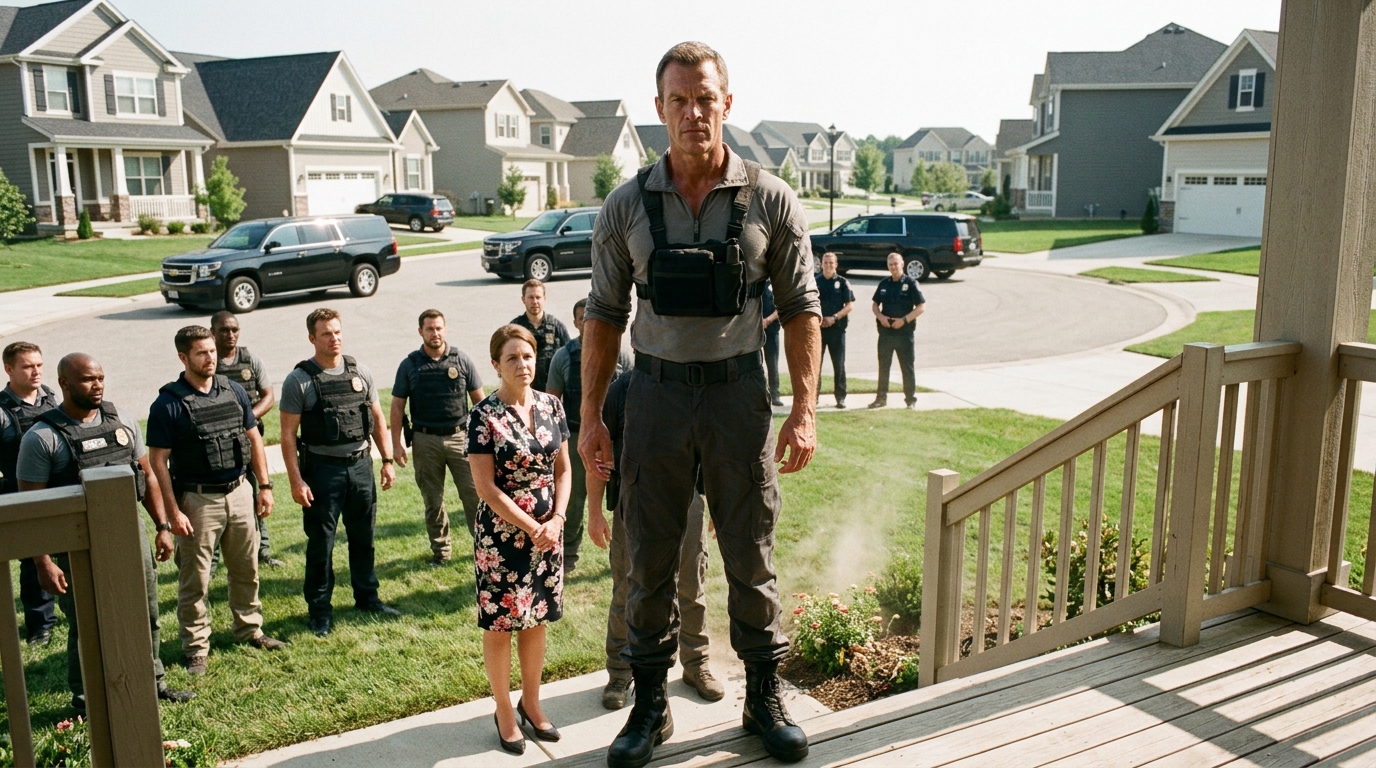
The sun hung heavy and oppressive over the cul-de-sac, but the heat wasn’t what made my skin prickle. It was the woman standing in the center of my lawn, her frame rigid, her eyes fixed on my son with a predatory gleam. She looked like the manifestation of every petty, small-minded rule ever written, but the men standing behind her—the ones in the tactical vests—that was the variable I hadn’t calculated for.
“Your boy is breaking HOA rules. I’ve already called the cops,” she shouted. Her voice was thin, sharpened by a lifetime of unchallenged authority.
I stepped out onto the porch, my boots making no sound on the wood. My son, taller than he was a year ago but still carrying the weight of being fifteen in a hostile environment, stood frozen. Behind him, three men sat on the porch steps. They weren’t just friends; they were ghosts from my past, men who had navigated the darkest corners of the globe with me. They didn’t look up, but their stillness was absolute.
I ignored the woman for a second, my eyes scanning the street. Three black SUVs sat idling at the curb, their tinted windows reflecting the afternoon glare like obsidian eyes. The uniforms of the men behind the woman were wrong. No badges, no jurisdictional patches, just heavy-duty gear designed to project power where none existed.
“You’re trespassing,” I said, my voice low and steady.
She turned, her face twisting into a smirk that didn’t reach her eyes. “I’m the HOA president. I own this neighborhood, and that kid is a liability. I’m having these thugs removed.”
I moved down the steps, closing the distance. She reached into her bag and shoved a laminated paper toward me. It was a fake notice, a poorly printed threat. My hand moved instinctively, not to take the paper, but to check the line of sight for the men behind her. One of them shifted his stance, his hand drifting toward his waist.
Weaponized silence, I reminded myself.
“Step aside,” I said, my gaze locking onto the lead fake inspector. He had the eyes of a man who dealt in fear, not law. “You’re in the wrong zip code if you think you can play soldier here.”
The woman laughed, a brittle, manic sound. “What are you going to do, ‘soldier’? Call for backup? The police are already on their way, and they aren’t here for me.”
As if on cue, the wail of sirens cut through the quiet neighborhood, growing louder, closer. The men in the vests spread out, forming a semi-circle. My son took a step back, his knuckles white. I looked at the lead inspector, seeing the subtle tremor in his jaw. He wasn’t a cop, and he knew it. He was a professional playing a part, and he was beginning to realize the script had changed.
The air grew heavy with the smell of scorched asphalt and impending violence, but beneath that, I caught the metallic tang of something else: the realization that someone else was watching the house. I glanced at the porch, where one of my friends was subtly adjusting his position, his eyes fixed not on the woman, but on the third SUV in the line.
“Dad,” my son whispered, his voice cracking. “What if they’re real?”
I didn’t answer. I kept my eyes on the lead inspector, watching the way his shadow stretched across the grass. He wasn’t just here for the lawn. He was here to ensure we didn’t leave the house.
CHAPTER 2: THE VIGILANCE OF GHOSTS
The smirk on the lead inspector’s face didn’t vanish; it curdled. It was the look of a man who had practiced his intimidation routine in front of a mirror until he believed he was untouchable. He stood on the manicured grass of my lawn, his posture shifting from bureaucratic menace to something more grounded, more aggressive.
I didn’t blink. I didn’t reach for a weapon, because in this setting, the absence of movement was more terrifying than the presence of a threat. My hand remained at my side, fingers slightly curled, measuring the distance to his carotid. Beside me, my son’s breathing was shallow, hitched in his throat. The instinct to pull him behind me was overwhelming, but I forced myself to remain a wall. If he saw me retreat, he would believe he was unsafe.
“You’re a long way from a warrant,” I said, my voice barely above a whisper, carrying the grit of a desert floor.
The inspector stepped forward, his boots crushing the edges of a garden bed. “We don’t need a warrant to enforce community standards,” he spat. The words were a script, recited with the hollow confidence of someone who had never seen the cost of real enforcement.
Suddenly, the scent of the neighborhood—freshly cut grass, expensive fertilizer, the lingering ozone of the humid air—triggered a sharp, unbidden memory. I wasn’t on a suburban lawn in Ohio; I was in a crawlspace in a city that didn’t exist on maps, watching a shadow move across a threshold. That shadow had been a soldier’s, and this man, standing in his cheap tactical vest, moved with that same tell-tale twitch of the shoulder before a strike. He’s trained, I thought. Or he’s terrified.
The inspector reached for his belt, his fingers hovering over a heavy plastic casing. I didn’t wait. I closed the distance, not with a rush, but with the deliberate, heavy motion of a closing gate. I stopped inches from his chest. The smell of his cheap cologne, cloying and artificial, hit me.
“Identify your unit and jurisdiction,” I repeated, my voice dropping an octave, the tone shifting from homeowner to field commander.
The inspector stiffened. His men, spread out in a ragged semi-circle, hesitated. The regular police officers, standing near the curb, had their hands hovering near their own holsters, their faces pale. They were clearly out of their depth, caught between a local dispute and the sudden, atmospheric shift of a professional confrontation.
“We don’t answer to you,” the inspector blustered, though his eyes darted to the three men on my porch. My friends hadn’t moved. They were sitting, calm and lethal, watching the scene with the bored detachment of predators who had already determined the outcome.
My son tugged at my sleeve. “Dad, don’t,” he whispered, his voice trembling.
I didn’t look at him, but I let my presence shift to envelop him, a shield of calm. “They’re not cops, son,” I said, loud enough for the inspector to hear. “They’re just people who haven’t realized that the rules they’re hiding behind don’t exist here.”
The lead inspector’s bravado finally fractured. He looked at me—really looked at me—and saw the scar near my temple, the way I stood, the lack of fear. He saw that he was standing in the yard of a man who had forgotten more about combat than he would ever know. His hand retreated from his belt.
“This isn’t over,” he muttered, the smirk replaced by a thin, bitter line of fear. He signaled to his men, a sharp downward flick of the hand.
They turned, retreating toward the SUVs in a loose, uncoordinated formation. I didn’t turn my back on them until the doors slammed shut and the engines roared to life, kicking up dust that settled over the manicured grass. The regular officers remained, standing awkwardly in the silence that followed, unsure if they should pursue or retreat.
I turned back to my son. His face was pale, his eyes wide, still clinging to the remnants of his fear. I placed a steadying hand on his shoulder. Under the fabric of his shirt, I could feel his muscles knotted with tension.
“They’ll be back,” I said, more to the porch than to him.
“Why?” he asked.
“Because they have a quota to fill,” I replied, looking toward the street where the SUVs had disappeared. “And because they haven’t realized yet that they’ve chosen the wrong house.”
The silence of the afternoon returned, but it wasn’t the same. It was a pressurized quiet, the kind that precedes a landslide. I walked back toward the house, my friends rising in unison, their movements fluid and silent. We entered the living room, the cool air inside offering no comfort. The front window, which overlooked the street, felt like a target.
I moved to the hallway and pulled a small, unassuming floorboard near the closet. Beneath it lay a collection of analog tools—a radio, a hand-drawn map of the neighborhood, and a notebook filled with records of every HOA meeting I’d attended over the last six months.
“We start the prep now,” I said. My son followed me, watching as I laid the items out. The mystery wasn’t just about Karen. It was about the way the neighborhood had changed, the way the streetlights had been replaced with surveillance cameras, and the way the property lines seemed to shift whenever someone fell behind on their dues.
We were no longer just living in our home. We were holding the line.
CHAPTER 3: THE LEDGER OF LIES
The living room had transformed. It was no longer just a space for my son to do his homework or for us to watch the evening news; it had become an operations center, defined by the low, steady hum of the refrigerator and the sharper, more rhythmic ticking of the wall clock. My three guests—men I had trusted with my life in places where trust was the only currency—moved through the kitchen with a practiced efficiency. They weren’t looking for comfort; they were checking the perimeter, their eyes scanning the windows for the red flicker of a laser or the tell-tale silhouette of a sniper.
I knelt on the rug, the ledger spread out before me. My son sat on the floor, his back against the sofa, watching me with an intensity that made my chest tighten. He was growing up in the span of an hour.
“Dad,” he whispered, gesturing toward the papers. “What are we actually looking at?”
“The anatomy of a shakedown,” I replied, pointing to a series of dates and figures.
I flipped through the pages, my finger tracing the columns. The HOA records were a masterpiece of bureaucratic obfuscation. Fines for overgrown grass, penalties for unapproved paint colors, and “administrative fees” that seemed to inflate whenever a property owner missed a payment by even a single day. But there was a pattern. The fines weren’t random. They were concentrated on the houses nearing the end of their mortgage terms, specifically those owned by the elderly or those who had been in the neighborhood the longest.
“Look,” I said, sliding the ledger toward him. “The ‘improvement fees.’ They’re charging three times the market rate for basic landscaping, and when the homeowners can’t pay, they slap them with a lien. It’s not just a fine. It’s an acquisition strategy.”
One of the seals, a man named Miller, walked over. He didn’t speak, but he looked down at the ledger, his eyes narrowing. He pulled a small, high-intensity penlight from his pocket and swept it over the edges of the pages. He pointed to a faint, embossed mark near the binding of the HOA binder—a stylized geometric shape that didn’t belong to any homeowners association I had ever heard of.
“That’s not a local mark,” Miller murmured, his voice a gravelly rasp. “I’ve seen that before. It’s a holding company out of Chicago. They buy distressed debt, clear the board, and then flip the land to commercial developers. They don’t want the houses, kid. They want the dirt.”
The realization hit me with the force of a physical blow. Karen wasn’t the architect; she was the demolition crew. She was the one sent in to agitate, to provoke, to create the “untenable” environment that allowed the syndicate to legally seize the property.
“They’re using the HOA as a cudgel,” I said, my voice cold, the fury rising in my gut like bile. “They provoke a confrontation, escalate it with fake inspectors to drive the victims into a state of panic, and when the homeowner reacts—like I did today—they use the record of that reaction to initiate a forced sale or a foreclosure.”
I looked up at the window. Outside, the street was unnaturally dark. The motion-sensor lights on our neighbors’ porches had all been deactivated. The quiet was absolute, devoid of the crickets or the distant hum of traffic. It was the silence of a vacuum, waiting to be filled.
“They’re watching,” I said.
My son stood up, his posture mirroring my own. “What do we do?”
“We don’t wait for them to breach,” I said, standing and moving toward the kitchen counter where I’d left my comms gear. “If they want to play by the rules of this neighborhood, we’ll show them exactly what those rules are worth.”
I dialed a number, a direct line that hadn’t rung in years. It was a risk, a massive one, but the moment the phone connected, I knew we were committed. The voice on the other end was clipped, efficient, and entirely devoid of emotion.
“The perimeter is soft,” I said. “I need eyes on the target’s logistics chain. Follow the money from the inspector’s SUV lease back to the holding company.”
“Copy,” the voice replied.
I hung up and looked at my son. “They’re going to hit the house tonight, probably around 0200. They’ll try to make it look like a civil dispute gone wrong. But we’re going to be recording everything. Every illegal entry, every moment of harassment, every word spoken. When the federal authorities see the link between the ‘HOA inspectors’ and the Chicago firm, this entire shell game collapses.”
“You’re using us as bait,” he said, not as an accusation, but as a realization.
“I’m using us as the pivot,” I corrected. I walked to the front door, checking the heavy iron bolts I’d installed years ago. They were solid, reassuring. “If they come, they come to a place that knows how to defend itself. And once they do, the game they’ve been playing for years ends. Not with a shout, but with a jail cell.”
The air in the house grew tighter. I could hear the subtle shifting of the seals in the back of the house, the quiet click of safeties being disengaged, the soft rhythm of people preparing for an inevitability. We were the only house on the street with the lights on, a beacon in the darkness.
I looked down at the ledger one last time. The figures in the margin weren’t just numbers. They were the names of my neighbors, the lives of people who had been systematically dismantled by a group of people who thought they were too small to matter.
“They think this is just a neighborhood,” I whispered, reaching for my radio. “They don’t realize it’s a fortress.”
The lights in the house flickered, once, twice, and then went out. The darkness was instant, complete, and heavy. The power had been cut from the outside.
“Here we go,” Miller said from the shadows of the hallway.
I felt my son’s hand find mine in the dark. It wasn’t shaking.
CHAPTER 4: THE MIDNIGHT AMBUSH
The house felt smaller in the dark. Every settling timber, every whisper of wind against the siding, sounded amplified. I stayed low, my hand tracing the familiar grain of the hallway wall until I felt Miller’s sleeve. He was a shadow among shadows, his breathing so shallow it was almost non-existent. My son was tucked into the alcove behind the kitchen pantry, his pulse a rapid, stuttering rhythm I could feel even from three feet away.
“They’re taking their time,” Miller whispered, the sound barely a vibration in the air.
He was right. The intruders were patient. They weren’t kicking the door in like the amateur thugs Karen had hired earlier. These men were moving with the systematic, measured caution of people who expected resistance. I could hear the faint, metallic scrape of tools—something harder than a pry bar against the deadbolt. They were bypassing the physical security with a professional’s focus.
V-4: The Unreliable Perception. In the pitch black, my mind played tricks. I kept seeing movement in the corners of my eyes, fleeting ghosts of shapes that weren’t there. I had to focus on the physics: the weight of the floorboards, the tension in the air, the cold draft beginning to curl around the edges of the front door. I checked my watch—the luminous hands showing 02:14. They were four minutes past their projected arrival time. A tactical delay. They were checking the perimeter for sensors.
“They’re at the jamb,” Miller breathed.
A sharp crack echoed through the house—the sound of wood splintering under concentrated pressure. It wasn’t a violent breach, but a surgical one. The door gave way, not falling open, but swaying inward just enough for a single silhouette to slide through the gap.
I didn’t move. I wanted them inside. I wanted them committed to the threshold.
The first man stepped over the line, his frame tall, encased in dark tactical gear that absorbed what little ambient light bled in from the street. He moved with a heavy, confident stride, his weapon tucked into a low-ready position. Behind him, a second figure followed, his movements more cautious, scanning the living room with a thermal or night-vision optic that gave his eyes a faint, ghostly luminescence.
They were equipped for war, not for a neighborhood dispute.
I let them move five paces into the living room—the kill zone I had mapped out during the hours of daylight. I felt the familiar, cold clarity settle over me. The fear was gone, replaced by the precise, rhythmic calculation of a defensive operation.
“Now,” I whispered.
The command was a trigger. From the shadows of the kitchen, one of my friends slammed a heavy mag-light onto the floorboards, creating a sudden, blinding strobe of white that sliced through the darkness. The intruders didn’t just stumble; they recoiled, their night-vision optics whiting out instantly.
Miller and the other two veterans moved with the terrifying speed of men who had spent their lives training for this exact second. There was no shouting, no cinematic posturing. Just the sound of bodies hitting the floor and the sharp, controlled impact of tactical takedowns. The first intruder went down before he could even raise his weapon, his knee buckling under a strike that was as precise as it was brutal.
The second man tried to pivot toward the kitchen, but he found himself staring into the cold, unwavering barrel of a weapon held by someone who hadn’t made a sound in hours.
“Drop it,” the voice was calm, devoid of malice, yet it carried the absolute finality of a judge.
The man froze. His hands shook, his weapon clattering to the floor as if it had suddenly become too heavy to hold. The fight had drained out of them as quickly as the light had been introduced. They had come expecting an easy entry into a soft target; they had walked into a buzzsaw.
I stepped out of the hallway, my flashlight beam steady as I centered it on their faces. They were young—younger than I expected—with the hardened, hollow expressions of men who had traded their integrity for a paycheck. They weren’t local. They were imported muscle, hired to do the dirty work of a company that didn’t even know their names.
“Who sent you?” I asked.
The lead man, the one who had entered first, spat blood onto the rug. He looked up at me, his eyes flickering with a mix of fear and defiance. “You’re dead, man. You think you’re fighting the HOA? You’re fighting the city. You’re fighting the money. You’re already a ghost, you just don’t know it yet.”
I ignored the bravado. I looked at the gear they were carrying—the heavy-duty cases, the specialized tools, the tactical vests with no insignias. It matched the intelligence I had gathered from the ledger. They weren’t here to threaten; they were here to seize the house, to clear it out, and to leave behind a scene that looked like a robbery gone wrong.
I knelt beside him, keeping my light fixed on his eyes. “Tell me about the Chicago firm. Tell me about the land titles.”
The man’s bravado shattered. A flicker of genuine terror passed across his face—not at me, but at the name. He knew exactly what he was involved in, and he knew exactly what would happen to him if he talked.
“I can’t,” he choked out. “They’ll kill me.”
“And if you don’t talk,” I replied, my voice steady, “you’re going to spend the next twenty years in a box. You pick the ending, soldier.”
I turned to Miller. “Secure the perimeter. I want the local police, not the dispatch. Use the direct line to the precinct commander. We have them dead to rights on breaking and entering, and if we’re lucky, we have a lead on the entire syndicate.”
My son appeared in the doorway, his face pale but his eyes fixed on the men on the floor. He didn’t look away. He looked at the intruders with a cold, analytical appraisal that was almost identical to my own.
“They’re not going to stop,” my son said, his voice quiet in the room.
“No,” I agreed, looking out the broken front door toward the line of SUVs waiting in the street, their engines idling in the dark. “They aren’t. And that means we’re done playing by their rules.”
The night was far from over. Outside, I heard the heavy, rhythmic slamming of car doors. More vehicles were pulling up. The first wave had been a test. The second wave was the response.
CHAPTER 5: THE SIEGE OF SILENCE
The house shuddered, not from a blow, but from the sudden, synchronized movement outside. I felt it in the soles of my boots—a vibration of coordinated intent. The first group had been the scouts, the ones meant to test the resolve of the homeowner; the second group was the wrecking ball.
“They’re bypassing the front now,” Miller said, his voice a ghost of a sound near my ear. “They’re not going to knock. They’re going to peel the siding off the back addition.”
I didn’t answer. I signaled to the men to move, a series of hand gestures learned in another life, another country. My son didn’t wait for instructions. He slipped into the shadows, heading toward the secondary position in the hallway—the place we had rehearsed hours ago, when the sunlight still felt like a protection rather than a surveillance tool.
Outside, the first heavy thud against the rear exterior wall rattled the glassware in the kitchen cabinets. It was a rhythmic, industrial sound—a battering ram meeting wood, then retreating. Thud. Thud. Thud. They were looking for the studs. They were going to open the house like a tin can.
I moved to the hallway, my hand brushing the wall to keep my balance in the complete absence of light. I knew this house. I knew the way the floorboards sighed underfoot and the specific angle of the hallway that led to the utility closet. I didn’t need vision; I needed the weight of the air, the friction of the moving parts, the geometry of the assault.
Suddenly, the kitchen window—a reinforced pane we had installed years ago—shattered. It wasn’t the sound of breaking glass; it was the roar of an explosion, followed by a rush of cold, humid air that swirled through the house like a warning. A strobe of white light flared, disorienting and blinding, reflecting off the walls. They were using flash-bangs. They were bringing the war into the living room.
“Get down!” I barked, a split second before the sound wave hit.
The concussion knocked the breath out of me, a physical weight that hammered against my chest. My ears rang with a high-pitched, insistent whine. I felt a hand—Miller’s—grab my shoulder and yank me behind the heavy oak table in the center of the room just as a volley of rounds punched through the drywall, wood chips and plaster dust raining down like snow.
They weren’t aiming to intimidate anymore. They were aiming to clear.
V-3: Environmental Shift. The house was no longer a home; it was a contested territory. The structural integrity of the walls was failing, the air thick with the metallic taste of gunpowder and the ozone of the flash-bang. The environment itself had turned against us. I looked across the room and saw the shadow of my son, his silhouette hunched, perfectly still, his hands steady as he gripped the handle of the interior security door.
“They’re inside!” Miller shouted over the din.
I rose, my knees pressing into the debris-strewn floor. My vision was swimming, but I centered my breathing—four seconds in, four seconds out. I wasn’t the homeowner anymore; I was a tactical asset, and I was exactly where I needed to be.
I fired a warning shot, not to hit, but to force a retreat, the muzzle flash illuminating the room in a jagged, violent strobe. The silhouettes at the back entrance froze, their optics struggling with the rapid change in light. They had been prepared for a residential standoff, not a disciplined, high-intensity response.
“Check fire! Check fire!” I roared, the command cutting through the chaos.
The intruders hesitated. They were trained to follow the momentum, to flow into the breach, but the breach was stalled. They were caught in the bottleneck, their numbers working against them in the confined space of the hallway. They began to shout, a cacophony of panicked, high-pitched voices that lacked the cool efficiency of the first team.
I moved, my boots silent on the carpet, closing the distance to the kitchen entrance. The lead man was trying to pull his partner back, his hands fumbling with his belt. He was desperate, and desperation is the only variable that cannot be predicted.
“Out! Get out, it’s a trap!” one of them screamed, his voice cracking.
I didn’t let them retreat. I took the initiative, a calculated, aggressive push that forced them back out the hole they had created. I moved with the cold, unyielding pressure of a flood, my presence an absolute barrier. They backed away, their weapons drooping, their confidence pulverized by the sheer refusal of the environment to surrender.
They scrambled back into the darkness of the yard, their heavy boots kicking up dirt and debris. They didn’t stop at the porch. They didn’t stop at the sidewalk. They ran, a disorganized blur of tactical vests and panicked energy that spilled into the street.
I stood in the doorway, the frame shattered, the siding hanging in jagged, splintered strips. The silence that rushed back into the room was heavier than the violence had been. It was the silence of a structure that had held.
Miller walked up behind me, his weapon lowered, his breathing steady. “They’re gone. For now.”
“They’ll be back with a different tactic,” I said, my gaze fixed on the darkness of the street. “They aren’t just trying to seize a property anymore. They’re trying to bury a problem.”
My son joined us, his face illuminated by the flickering light of the street lamp that shone through the jagged hole in the wall. He looked at the wreckage—the shattered glass, the pockmarked walls, the ruined cabinets.
“Dad,” he said, his voice stronger than it had been a few hours ago. “We need to leave.”
I looked at him, then back to the ledger, which was still resting on the floor, untouched by the chaos. “We don’t leave. We finish this. If we run, we’re just another statistic in their files. If we stay, we force them to play their hand.”
The street outside was alive again. The sound of more engines—heavier, deeper—began to rumble from the end of the cul-de-sac. They were bringing in the heavy equipment. They were going to try to flatten the house.
I looked at Miller. “Get the recording device out of the utility closet. We have everything we need to bury the Chicago firm. We just need to survive the next ten minutes.”
The rumble increased, a low, tectonic hum that vibrated the floorboards. The final phase of the siege was beginning.
CHAPTER 6: THE FEDERAL PIVOT
The sound was not just a rumble; it was a physical displacement of air. My kitchen walls bowed inward as the heavy machinery shifted into position just beyond our front yard. They weren’t coming for a negotiation. They were coming for the property, and they were using the cover of night to ensure that, by dawn, there would be nothing left of the house—or the evidence inside—to testify against them.
“They’re moving in with heavy armor,” Miller said, his voice clipped and devoid of hesitation. He pulled a sleek, encrypted satellite phone from his tactical vest, his thumb dancing across the screen. “We’ve got exactly three minutes before they attempt a structural breach of the foundation.”
I felt the floor tremble. They were using a hydraulic ram, likely mounted to the chassis of a truck, to tear the joists from their mounts. The house was being systematically dismantled while we were still inside. This wasn’t a tactical raid; it was a demolition.
V-2: The Psychological Phantom. In the chaos, I caught myself staring at a family photograph on the mantel—a moment of peace from years ago. For a fleeting second, the image didn’t look like a memory; it looked like an indictment. If we failed here, that image would be the only thing left of us, buried under the debris of a corporate land grab. The realization hit me with more force than the blast in the previous room: we weren’t just defending a house. We were the last obstacle standing between this syndicate and the total erasure of our community’s history. The scale of their ambition was terrifying. They hadn’t just targeted us; they had targeted the entire neighborhood’s future, and we were the only ones who had finally looked behind the curtain.
“Miller,” I said, my voice cutting through the impending collapse. “Route the footage. Now.”
“It’s already uploading,” he replied, not looking up. “The direct feed to the regional FBI field office is active. We’re streaming the entire event—the breach, the uniforms, the equipment, everything.”
The wall behind the dining area buckled. A piece of heavy construction machinery—the serrated claw of a demolition excavator—tore through the siding, ripping wood and insulation away like paper. It was a giant, mechanical hand, cold and unfeeling, clawing its way into the sanctuary of our home. My son, tucked safely in the rear utility room, didn’t scream. He watched, his posture rigid and focused, his hand gripped around the receiver of the recording device we had hidden.
“We have to get out,” I said, checking the perimeter one last time. “The house is compromised. The evidence is secured. We move to the secondary extraction point.”
“We can’t just leave them the house,” Miller said, eyeing the excavator claw as it pulled a section of the roof truss toward the street.
“We aren’t leaving them anything,” I said. “We’re leaving them a crime scene.”
I grabbed the ledger and the encrypted drive containing the evidence of the land title manipulation. This was the core—the proof that the HOA wasn’t just a regulatory nuisance, but a criminal enterprise that had been systematically forging documents and coercing signatures for years. Every fine, every lien, every “HOA inspector” visit was a documented act of fraud.
We moved, not as a panicked family, but as a unit. We slipped through the side exit just as the excavator tore the front door from its hinges. The noise was deafening—the roar of the engine, the scream of tearing metal, the crash of timber. I didn’t look back. I led them toward the dense brush bordering the cul-de-sac, the place where we had cached a pair of nondescript vehicles hours ago.
The night air was cool, biting into the sweat on my skin. As we reached the treeline, I saw them: a phalanx of local police cruisers, their lights off, surrounding the street. But they weren’t moving. They were watching. The corruption didn’t just sit in the HOA board; it bled into the local precincts, the very people who were supposed to protect us.
“The police are waiting for the demolition to finish,” I realized aloud. “They’re providing cover for the syndicate to clear the evidence.”
“So what’s the plan?” Miller asked, his weapon held in a relaxed, ready position.
“We don’t wait for the cavalry,” I said, gesturing to the vehicles. “We become the target they can’t afford to ignore. We head for the state capital. If the locals are compromised, we bypass them entirely and take this straight to the Attorney General’s office. We have the footage, the ledger, and the physical proof of the breach.”
As we pulled away from the cul-de-sac, the excavator was still tearing at the skeleton of our home, a mindless, repetitive motion. The house was losing its form, its rooms becoming piles of jagged wood and drywall, but the truth remained intact in the drive in my pocket.
My son looked back at the ruin, his face lit by the sweeping floodlights of the demolition crew. “They think they won, Dad.”
I kept my eyes on the road, my hands steady on the wheel. The road ahead was long, and the syndicate would have eyes everywhere, but for the first time in months, the weight of the secret wasn’t on my shoulders—it was in the data, and it was already in the hands of the people who could use it.
“They haven’t realized yet,” I said, a grim, sharp edge to my voice, “that the moment they started the machinery, they stopped being the hunters and became the evidence.”
The road stretched out before us, a dark ribbon of asphalt, and for the first time, I felt the sharp, cold clarity of a man who finally knows exactly where he’s going.
CHAPTER 7: THE GHOST IN THE MIRROR
The sedan behind us was a shadow in the moonlight—a low-slung, dark-colored cruiser that moved with a predatory grace. It hadn’t passed us in ten miles, and it hadn’t dropped back. It stayed exactly three car lengths behind, a constant, nagging pressure on the back of my neck.
“Miller,” I said, keeping my hands locked on the wheel at the nine-and-three positions. “Check the plates.”
Miller didn’t turn around. He shifted slightly in the passenger seat, his eyes fixed on the side mirror. He tapped a sequence into his tablet, the screen casting a pale, cold light over his features. “They’re clean. Probably a rental, registered to a shell corporation in the city. They’re tracking us.”
My son, sitting in the back, didn’t make a sound. I could see him in the reflection of the rearview mirror, his hands gripped tightly around the encrypted drive. He was the anchor. As long as he held the truth, the syndicate was vulnerable.
V-1: The Micro-Mystery. As we rounded a sharp curve on the highway, a flash of movement in the passenger seat of the sedan caught my eye. A silhouette. Not just a driver, but someone leaning forward, pointing a device at us—a signal booster, or perhaps a long-range microphone. They weren’t just following us; they were maintaining a connection. I realized then that the syndicate wasn’t just trying to stop us from reaching the Attorney General’s office; they were monitoring our communication, trying to intercept the upload stream from Miller’s device.
“They’re trying to dump our signal,” Miller muttered, catching the same movement. “They want to cut the feed to the Feds.”
“Don’t let them,” I said, my voice tight. “If that upload reaches 100%, we have the leverage we need to break them. If it doesn’t, we’re just two men in a car with a stolen hard drive.”
The sedan accelerated, its headlights burning into the rearview mirror. It was closing the distance, the engine note rising to a high, mechanical scream. The road ahead narrowed as we hit a bridge, the steel girders rushing past like the ribs of a giant, skeletal creature.
“They’re going for a nudge,” Miller said, his voice devoid of fear, filled only with the cold professionalism of a man who had been here before. “They’re going to try to push us off the span.”
I didn’t argue. I didn’t reach for a weapon. I shifted my focus to the physical physics of the road: the friction of the tires on the asphalt, the camber of the curve, the timing of the next light. I was no longer driving a car; I was maneuvering a piece of ordinance.
As the sedan pulled alongside us, the driver’s side window rolled down. A man leaned out—not a thug, not a hired hand, but a man in a sharp, tailored suit. He looked at me with an expression of calm, detached boredom, as if he were checking his watch during a delayed flight. It was a board member. I recognized him from the grainy photos in the ledger—the vice-president of the Chicago firm.
He wasn’t here to threaten; he was here to negotiate.
He held up a phone, his thumb hovering over the screen. He tapped it once, and my phone—the one I was using to manage the upload—let out a sharp, electronic chirp. The signal strength on the dashboard display plummeted to zero.
“They’ve deployed a localized jammer,” Miller said, his voice rising for the first time. “We’re blind.”
The board member smiled, a thin, paper-dry expression, and gestured for us to pull over. He was offering a trade: the drive for our lives. The arrogance was staggering. He believed that he could still buy his way out of a federal investigation, that a private negotiation in the middle of a highway could overwrite a mountain of digital evidence.
I didn’t pull over. I slammed the transmission into a lower gear and punched the throttle. The engine roared in protest, but the car leaped forward, breaking the board member’s concentration. He was forced to yank the wheel to avoid clipping the bridge rail, his car fishtailing in the dark.
“Hold on,” I said, and I didn’t wait for a response.
I swerved, not away from him, but directly into his path. The impact was a muffled thud, the sound of steel meeting steel at eighty miles an hour. His car skidded, its tires smoking, but he recovered with terrifying speed, his driver clearly a professional.
We were in the middle of a high-stakes, real-time chess match, played at the speed of light. My son’s knuckles were white, his eyes fixed on the drive in his hand. He understood now. The truth wasn’t something you waited for; it was something you had to carry, at all costs, into the center of the fire.
“The feed!” Miller shouted, his eyes glued to the tablet. “It’s reconnecting! We’re at 92 percent!”
I didn’t slow down. The road ahead was clear, but the sedan was closing again, its engine note deeper, hungrier. They were going to make one final play for the drive.
I checked the dashboard. The odometer was climbing, the engine screaming in the cold night air. The bridge was ending, the road ahead widening into the industrial outskirts of the capital. We had miles to go, and the syndicate was not going to let us arrive in one piece.
“We aren’t going to make it to the capital, are we?” my son asked, his voice steady.
“We aren’t going to the capital,” I corrected him, glancing at the GPS. “We’re going to the state police barracks at the next exit. It’s fortified, it’s secure, and it’s federal territory. Once we get inside those gates, they can’t touch us.”
The board member’s car surged, its bumper slamming into our rear quarter panel, sending us into a precarious, bone-jarring spin. I fought the steering, my muscles burning, my pulse a steady, metronomic count.
“98 percent,” Miller whispered, his voice breathless.
I didn’t brake. I didn’t panic. I steered into the spin, forcing the car to straighten, and punched the accelerator. We were less than a mile from the exit.
The finish line wasn’t just a physical location; it was the truth, and we were dragging it into the light, whether they liked it or not.
CHAPTER 8: THE FINAL TRUTH
The gate to the state police barracks was an iron monolith in the night. As we skidded to a halt, the sedan behind us attempted one last, desperate swerve, but the security bollards rose from the asphalt like obsidian teeth, forcing them to brake hard and slide into a frantic, screeching halt. The board member didn’t get out. He sat in the driver’s seat, watching as armed officers swarmed the perimeter, their weapons raised, their lights blindingly white.
Miller stepped out first, hands raised, the encrypted drive held carefully between his fingers. My son followed, moving with a calm that bordered on chilling. I stepped out last, my body aching, my mind still vibrating with the adrenaline of the chase.
The barracks commander, a man whose uniform looked as though it had never known a day of dirt, stepped onto the concrete. He looked at the wreckage of our car, then at the sedan, and finally at me. He didn’t look like a savior. He looked like a man who was deeply inconvenienced by the truth.
“State your business,” he said, his voice flat.
“We have evidence,” I said, stepping into the wash of the floodlights. “Evidence of large-scale document forgery, systemic land title theft, and illegal coercion linked to a holding firm in Chicago. This goes beyond a neighborhood HOA. This is a regional operation to seize property through orchestrated blight.”
The commander took the drive. He didn’t look impressed. He looked at the board member’s car, then back at me. I realized then the depth of the rot: he wasn’t here to facilitate justice; he was here to manage the fallout.
“We’ll look into it,” he said, the phrase a death sentence for the investigation.
“You’ll look into it now,” I said, my voice cutting through the hollow formality of the barracks yard. “The upload was completed three minutes ago. Every local media outlet, every federal agency in the district, and the state oversight committee has the entire feed. The board member in that car? He’s the vice-president of the firm. He’s the paper trail.”
The commander’s face shifted. The boredom vanished, replaced by the flicker of genuine, panicked realization. He turned toward the sedan. The board member was no longer calm. He was on the phone, his face bathed in the glow of the screen, his expression contorted into a mask of pure, unadulterated fury.
Within seconds, the silence of the barracks was shattered by the arrival of a black SUV with federal plates. Agents in tactical gear swarmed out, not targeting us, but moving directly toward the sedan. The board member didn’t stand a chance. He was pulled from the vehicle, his tailored suit ripped, his face pressed into the cold asphalt. He tried to speak, to offer some final, arrogant instruction, but an agent silenced him with a sharp, brutal shove.
It wasn’t a hero’s victory; it was a cleanup.
I watched as the agents began to methodically process the sedan, pulling files, phones, and hard drives from the interior. The board member, the man who had thought he could buy the horizon, was being handcuffed like a common criminal. The poetic justice was quiet, efficient, and entirely devoid of the drama he had tried to manufacture. He was being defeated by the very system he had attempted to weaponize.
The aftermath was long. We were sequestered in a clean, brightly lit room while the agents combed through the drive. Hours passed—a slow, grueling descent into fatigue. My son fell asleep in the corner, his head resting against his bag. Miller sat on a metal bench, his eyes closed, his breathing as steady as a metronome.
When the agent finally returned, he didn’t look like an investigator; he looked like a man who had seen a ghost.
“It’s all there,” he said, laying a thick file on the table. “The signatures, the bank transfers, the recorded calls with the local judges. You didn’t just expose a real estate scam. You dismantled a foundation that had been rotting the county for a decade.”
He looked at me, a flicker of something like respect in his eyes. “You did the right thing. But you should know—this won’t end the firm. They have enough money to bury this in legal fees for years. But for the neighborhood, for the people who had their homes stolen… they’re getting them back. We’re already processing the title reversals.”
I looked at the file. The names were there—the families who had been forced out, the elderly who had been intimidated into signing their lives away, the people who had lost everything because they were “too small to matter.”
The following week, the cul-de-sac was silent in a different way. The demolition crew was gone. The heavy machinery had been impounded. The house was a skeleton, a collection of exposed studs and jagged wood, but the land was no longer a commodity. It was a home again.
My son and I walked through the remains of the living room. The drywall was gone, but the foundation remained—solid, immutable, and ours. We found the mantle, cracked but intact, and I carefully tucked the photograph back into a makeshift frame.
It was a quiet moment, the air smelling of wet wood and the sharp, clean scent of the coming autumn. There was no grand celebration. There was no victory parade. There was just the weight of the land beneath our feet, the quiet pride of a task completed, and the profound, settling peace of a place that had survived the storm.
I reached out and touched a piece of the frame, my fingers tracing the grain of the wood. It was damaged, marked by the scars of the struggle, but it was strong. We had lost the structure, but we had saved the ground.
“We stay, don’t we?” my son asked, his voice soft.
“We stay,” I said.
The neighborhood was beginning to change. People were returning, lights were flickering on in the windows, and the sound of life—the clicking of sprinklers, the bark of a dog—was slowly bleeding back into the stillness. We had held the line, and in the end, that was all that ever truly mattered.