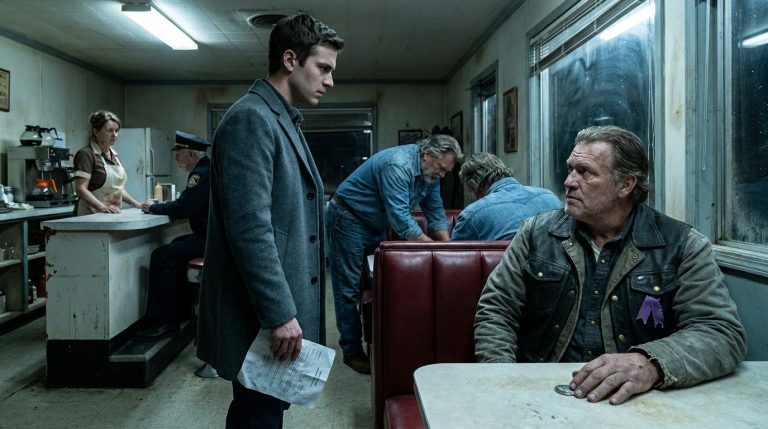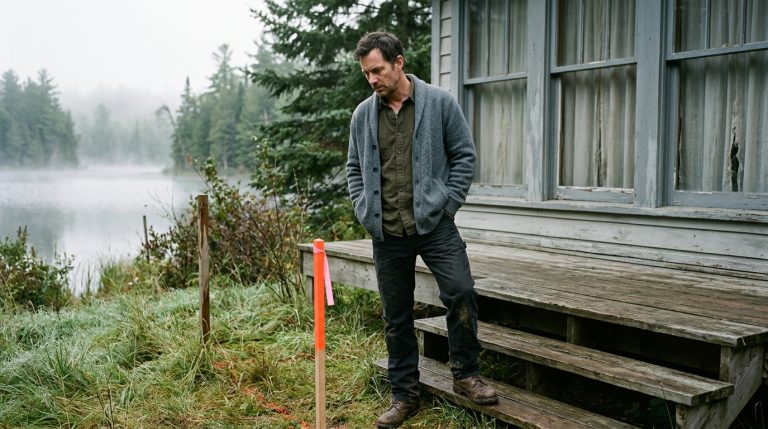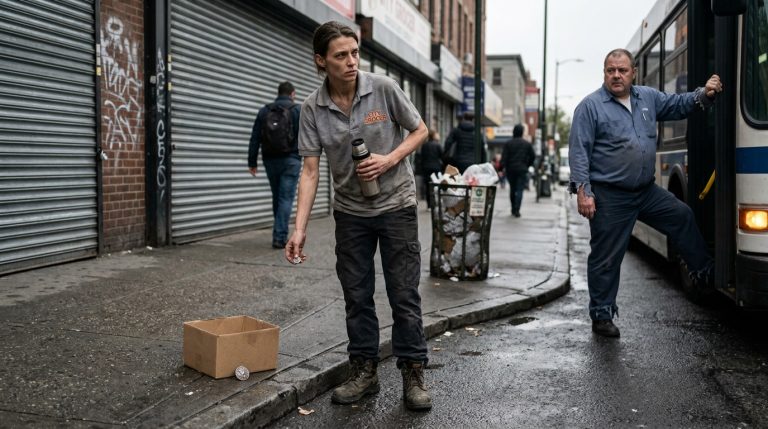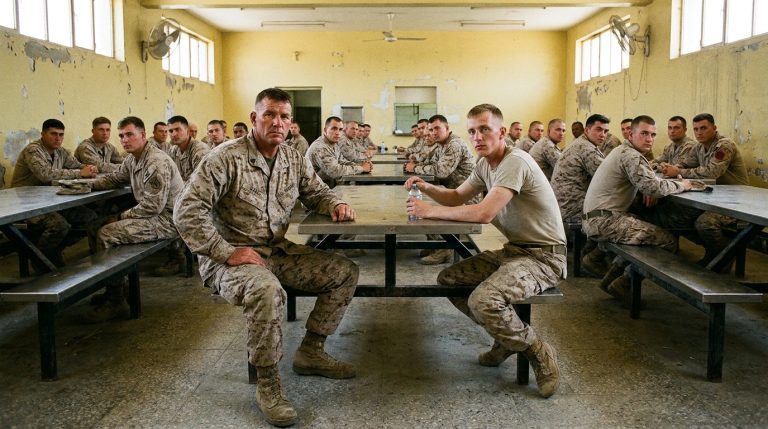
The Weight of Rain and Broken Badges on State Route Sixty-Seven
CHAPTER 1: THE LIQUID HORIZON
The leather of the vest was cold, water-logged, and heavy enough to press the air out of a man’s lungs. Marcus didn’t look at the flashing red and blue light bar that had just torn through the dark. He didn’t look at the black asphalt where the rain was currently washing away the salt from his own skin. His palms were flat against the torn nylon of a state-issued windbreaker, the fabric beneath his thumbs hot and wet with something that didn’t belong on the outside of a human body.
“If I move too fast, she bleeds out,” he said. His voice didn’t rise above the idle of the cruisers or the steady, rhythmic thump of a helicopter that was still three miles out, trying to find a gap in the thunderheads.
The young officer with the shotgun had boots that were too clean for Route 67. They sank into the silt at the edge of the guardrail, the fine desert sand turning into a gray paste around the leather welts. The barrel didn’t waver, but the kid’s eyes did. They darted from the red wing-and-wheel patch on Marcus’s left shoulder to the silver shield pinned crookedly over the girl’s ribs. The metal was dull under the storm, catching only the intermittent white glare of lightning that split the sky over the Black Ridge peaks.
“I said get back,” the kid repeated, but the tone had lost its edge, falling flat against the roar of the wind through the sagebrush.
“He packed the artery,” a voice called out from the darkness behind them. A paramedic, orange slicker catching the strobe of the headlights, dropped a heavy trauma kit into the mud with a wet slap. He didn’t wait for the kid with the gun to make up his mind. He dropped to his knees on the opposite side of the girl, his fingers sliding under Marcus’s hands, replacing the crude pressure of the flannel shirt with a pair of gloved palms. “He’s the only reason she’s got an intake right now. Get that light over here.”
Marcus let his hands be pushed away. The cold hit his bare skin instantly, a sharp, bitter draft that smelled of burnt oil and wet iron. He didn’t stand up immediately; his knees had locked into the gravel, the small stones embedding themselves into the denim of his jeans until his legs felt like they were part of the highway itself. He looked down at the girl—Morales, the name tag said, the plastic letters cracked through the middle by the steering column’s impact. Her face was the color of skim milk under the fluorescent work lights, her lips parted just enough to let a thin hiss of air pass through every four seconds.
“You’re done here, Callahan,” a different voice said. This one belonged to a sergeant whose face Marcus had seen across three separate perimeter lines during the labor strikes in the valley. The man didn’t draw his weapon, but his hand stayed flat on the plastic grip of his holster, his eyes fixed on the evidence bag the medic was already dropping Marcus’s ruined flannel into. “Cruiser’s waiting. Let’s go for a ride.”
Marcus stood up slowly, his spine popping in three distinct places. He didn’t look back at the ambulance as the doors slammed shut, cutting off the sound of the heart monitor’s steady, fragile beep. He looked at the empty space on Morales’s belt where the black kydex holster sat empty, its retention hood sheared clean off, pointing toward the dark desert behind them.
CHAPTER 2: THE AMBER CHILL
“You’re a long way from the clubhouse, Callahan.”
The sergeant’s voice didn’t carry across the linoleum, but it didn’t need to. It was flat, dried out by thirty years of valley dust and cheap coffee. He didn’t offer Marcus a seat, which was fine, because Marcus wasn’t planning on getting comfortable under the buzzing fluorescent tubes of the ICU waiting wing. The air in here smelled of industrial bleach and the faint, copper tang of old blood that never truly left the corners of a county hospital.
Marcus kept his hands wrapped around a paper cup of vending machine coffee. The cardboard was thin, burning his calloused palms just enough to keep the exhaustion from settling behind his eyes. He wore a faded, oversized hospital blanket over his shoulders, its edges frayed into gray strings that caught on the rough metal of the bench.
“The road was wet,” Marcus said, his eyes tracking a slow drop of condensation as it rolled down the vending machine’s plastic display. “I stopped. That’s the whole file, Sergeant.”
“The file says you were twelve minutes ahead of the trucker who called it in,” the sergeant said. He leaned back against the counter, his belt creaking with the weight of his radio and the heavy kydex holster. His fingers tapped a rhythmic, impatient beat against his thigh. “Twelve minutes alone in the dark with a bleeding cop and a missing duty weapon. That looks like an equation with too many variables.”
Marcus took a sip of the coffee. It tasted like burnt beans and iron, lukewarm and bitter. He didn’t look at the sergeant’s face; he looked at the man’s right hand. On the middle finger sat a heavy silver signet ring, the face of it scratched and dull, but the engraving—a stylized crest of the county’s elite interdiction unit—was still sharp enough to catch the amber warning lights reflecting from the parking lot outside. The metal looked cold, a hard edge in a room full of soft, exhausted people.
“If I wanted the gun, I wouldn’t have called the sirens,” Marcus replied, his voice dropping into that low, steady rumble that usually ended arguments in the roadhouses outside town. “And if I wanted her dead, I would’ve just kept riding. The rain would’ve finished her before the trucker even cleared the pass.”
The sergeant paused, his jaw tightening until the skin over his cheekbones went pale. He didn’t have an answer for the math, because the math was clean. But logic didn’t mean much when the badges were sweating.
The double doors at the end of the hall swung open with a soft, rubbery whoosh. A doctor stepped out, his blue scrubs stained with dark, circular patches where the sterile water had hit them during the scrub-down. He looked around the room, his eyes lingering on Marcus’s heavy boots and the oil-stained denim peeking out from under the hospital blanket before settling on the sergeant.
“She’s stable,” the doctor said, wiping a hand across a forehead that looked as gray as the morning sky. “The packing held. Whoever did that knew how a femoral artery tears. Another two minutes of pressure loss and the brain wouldn’t have had enough oxygen to care about the surgery.”
The sergeant didn’t thank him. He just nodded once, a sharp, transactional gesture. “Can she talk?”
“Not for twelve hours. Maybe fourteen. We’ve got her under a heavy sedative to keep the blood pressure from spiking,” the doctor said, already turning back toward the sterile corridor. “You can leave an officer outside the door, but nobody goes in until the morning shift changes.”
Marcus stood up, letting the frayed blanket slide off his shoulders onto the metal bench. The chill of the air conditioning hit his damp shirt immediately, a sharp reminder of the storm that was still rattling the high glass windows of the lobby. He reached into his pocket, his fingers finding the small, plastic claim ticket the forensics tech had shoved into his hand when they took his leather vest for ‘documentation.’
“I’m taking my bike,” Marcus said, looking directly at the sergeant’s silver ring.
The sergeant didn’t move from the counter. He just stared at Marcus, his eyes small and dark under the heavy brows. “Don’t leave the county, Callahan. We’re still looking at the dashcam from her unit. If there’s anything on that tape that doesn’t match the dirt on your boots, you’ll see me again.”
Marcus didn’t answer. He walked past the man, his boots making a heavy, wet clicking sound against the clean tile. As he pushed through the glass exit doors, the first pale light of dawn was breaking over the Black Ridge peaks, turning the desert a dull, desaturated yellow.
He didn’t know what was on that dashcam, but as he looked down at his hands, still stained with the dark crust of Morales’s blood under the fingernails, he knew one thing for certain: the sergeant hadn’t asked a single question about who had run her off the road. They only cared about who had found her.
He reached his motorcycle in the far corner of the lot. The leather seat was soaked, holding a pool of clear water in the center. But as he reached for the handlebars, he stopped. Tucked into the small leather pouch on his frame—the one where he kept his registration—was a small, wet slip of yellow carbon paper. It hadn’t been there when he parked before the chapter meet.
He pulled it out, the wet paper tearing slightly against his thumb. It was a standard department property receipt for a confiscated item, dated three hours ago. The item listed wasn’t his knife or his vest.
It was a serial number that matched a standard-issue Smith & Wesson nine-millimeter. Officer Lena Morales’s missing gun. And at the bottom of the slip, the signature was a messy, illegible scrawl, stamped with the badge number of the night-shift lieutenant.
The highway hadn’t been empty before he arrived. Someone had been there, and they had left a receipt.
CHAPTER 3: THE FRAGMENTED LINE
The applause in the bullpen felt like sand paper scraping against an open wound. It was dry, rhythmic, and entirely hollow. Lena Morales kept her left arm pressed tightly against her ribs, her fingers hooking into the stiff, unwashed wool of her uniform jacket to stop the tremor before anyone in the front row noticed it. The fabric at her waist was still slightly stiff where the commercial laundry had bleached out the worst of the highway mud, leaving a faint, yellowish ring around the seam lines.
“Good to have you back on the line, Morales,” the captain said. His palm was broad and slightly damp as he clapped her on the good shoulder, his voice echoing off the stained acoustic ceiling tiles of the precinct. He didn’t look at her eyes; his gaze stayed fixed on the local news camera crew adjusting their tripod by the water cooler. “A true testament to Black Ridge resilience.”
Lena forced a nod that felt heavy, her jaw tightening against the dull, throbbing ache that still bloomed beneath her ribs every time she took a breath deeper than an inch. “Thank you, sir.”
The crowd broke apart into their usual cliques, the sound of squeaking rubber soles and clicking keyrings filling the room as the morning shift took their places. Lena didn’t head for her old desk. She walked toward the back wall where the fluorescent light fixtures were missing their plastic covers, casting a harsh, unprotected glare over the filing cabinets.
Marcus Grim Callahan stood by the vending machines, looking like a block of uncarved granite against the pale cream paint of the wall. He hadn’t changed out of his riding boots; they were coated in the fine, white alkali dust from the lower basin, a pale crust that fell away in small flakes every time he shifted his weight. His leather vest was back on his shoulders, the red and white lettering of his patch slightly faded from the forensics scrub-down, its edges curled like scorched paper.
“You shouldn’t have come inside,” Lena said, her voice dropping into the quiet pocket between the hum of the old refrigerator and the clatter of the teletype machine.
“They asked,” Marcus said. He didn’t look at her. He was watching the sergeant who sat three rows over, his right hand currently typing a report with slow, deliberate stabs of his fingers. The heavy silver signet ring on the sergeant’s middle finger caught the raw light from the ceiling, throwing a tiny, distorted reflection onto the plastic keyboard. “And you wanted the meeting.”
Lena reached into her pocket, her thumb catching on the rough edge of a small piece of clear plastic she had retrieved from the evidence locker before the morning briefing. It wasn’t more than an inch wide—a jagged fragment of a headlight casing found pressed deep into the crumpled driver’s side panel of her patrol vehicle. The cross-hatch pattern on the plastic didn’t match the standard-issue Ford interceptors her department used. It belonged to an older model utility truck, the kind the interdiction task force used for unmarked border surveillance.
“The dashcam tape from that night is gone, Marcus,” she said softly, her eyes tracking a fly as it crawled across the scratched plastic of the soda machine. “They told me the lightning fried the hard drive in the trunk. But the property clerk didn’t check the internal log. The drive was pulled four minutes before the ambulance even got to the mile marker.”
Marcus shifted his boots, the dry sand on his heels grinding into the linoleum with a faint hiss. “The yellow slip I found on my bike had a signature on it. The name was smudged, but the badge index belonged to the shift lieutenant. He wasn’t on the log for the crash response.”
“He wasn’t on the log because he was already at the hospital when they brought me in,” Lena said. She felt the skin over her collarbone flush hot, a sudden surge of adrenaline that made the surgical scar beneath her shirt itch with a fierce, burning heat. She turned her body slightly, blocking the view from the sergeant’s desk. “The gun they found in your saddlebag… it wasn’t my service weapon. The serial numbers on the recovery report were altered by one digit. They used a confiscated piece from the old drug vault to frame the club.”
Marcus finally turned his head, his gray eyes cold and unblinking beneath the brim of his weathered cap. His internal calculation was plain in the way his jaw didn’t move, his silence far more dangerous than any threat he could have yelled across the room. “They didn’t just want you dead, Officer. They wanted the file closed before the county auditors came down from the capital.”
“Morales!” The sergeant’s voice cut through the bullpen like a wet whip. He stood up from his desk, his chair backing into the metal filing cabinet with a sharp, metallic clang that made three different rookies drop their clipboards. He walked toward them, his boots making a hard, rhythmic sound on the floor, his eyes fixed entirely on Marcus. “The captain’s done with the press line. Biker’s time is up. We’ve got actual work to clear on the board.”
Lena didn’t step back. She let her hand drop out of her pocket, her fingers brushing against the empty leather of her current holster. “We were just finishing the report, Sergeant.”
“The report’s done,” the sergeant said, stopping two feet away. The smell of old tobacco and mint gum came off him in a sour cloud. He looked down at Marcus’s hands, which were loose at his sides, completely still. “Mr. Callahan has a long ride back to his chapter. Wouldn’t want him catching another mechanical failure on the pass after dark. Roads out here get real slippery when you don’t know who’s behind you.”
Marcus didn’t blink. He reached out and took the small, wooden recognition plaque the captain had left on the corner of the desk, his thumb covering the brass lettering until the wood groaned slightly under the pressure. “The roads are fine, Sergeant. It’s the shadows you have to watch out for.”
He turned and walked toward the heavy glass doors, his exit completely silent despite the weight of his boots. Lena watched him go, the pale morning light catching the dust trails his tires had left on the parking lot outside. She knew the decoy secret now—she knew the department had stolen her gun and scrubbed the tape to protect a dirty lieutenant. But as she caught the sergeant’s gaze, she saw something else in the small, dark pupils behind his wire-rimmed glasses: it wasn’t fear of exposure. It was the cold, patient look of a hunter who knew the trap was still set, and that she had just walked back into the middle of it.
CHAPTER 4: THE HORIZON SHIFT
“You should have stayed on the highway, Marcus.”
The voice came from the deep shade of the equipment lean-to behind the precinct, where the older utility trucks sat pooled in grease and rusted gravel. Marcus didn’t turn around right away. He kept adjusting the choke cable on his carburetor, his thumb pressing into the worn rubber sleeve until the dry black coating split under his nail, leaving a mark like a crescent moon. The sun was going down behind the Black Ridge range, bleeding a faint, bruised lavender across the salt flats.
The sergeant stepped out of the shadow, his unbuttoned uniform jacket flapping slightly against his side. His hands weren’t near his belt, but they didn’t have to be. Two other figures stood fifty feet back by the perimeter fence, their silhouettes dark and blurred against the chain-link mesh.
“The girl went looking for her dashcam,” Marcus said, his voice flat against the vast, empty ring of the basin. He finally straightened, his flannel shirt hanging open over his undershirt, stiff with the dried sweat of forty miles of desert riding. “But she found something else. She found out who pulled the drive.”
The sergeant let out a short, dry laugh that sounded like gravel sliding down a chute. He took two steps forward, his boots sinking into the loose, desaturated dirt until the fine gray silt covered the brass eyelets. He held up his right hand, the heavy silver signet ring catching the last dying ray of amber light from the horizon.
“She’s a good kid, Morales. But she doesn’t understand how the county functions,” the sergeant said, his voice dropping into a low, transactional hum. “Those border interdictions keep the lights on in this town. The vehicles we seize, the cash that stays in the vault—it doesn’t go to the state. It goes into the local line items. She wanted to audit the seizure logs from the lower basin. That’s a direct threat to the department’s survival.”
Marcus looked past the man’s shoulder to the old utility truck parked under the corrugated iron roof. The front bumper was painted a flat, non-reflective black, but the lower lip was twisted backward. Embedded in the metal seam was a thin streak of white paint, identical to the primer coat on Lena’s crumpled cruiser door. The friction of the hit had left deep, parallel gouges through the steel.
“You didn’t clip her vehicle by accident,” Marcus said, his hand dropping slowly to the iron handlebar of his bike. “You pushed her into the guardrail and left her to freeze. Then you took her weapon to clear the field.”
“The weapon was the insurance policy,” a new voice said. Lena stepped out from behind the rear wheel of the utility truck. Her uniform hat was gone, her dark hair pinned back tightly with a couple of plastic clips. She held her service weapon—the real one, the one with the cracked plastic grip—leveled steady at the sergeant’s chest. Her left arm was still taped flat against her ribs, the thick gauze padding bulging under her shirt, but her barrel didn’t move an inch. “I found the digital backup of the dashcam in the lieutenant’s locker before the shift change. The log has your vehicle’s transponder ID stamped right on the file.”
The sergeant didn’t reach for his holster. He looked at Lena, then back at Marcus, his face completely devoid of anger or panic. It was the face of a man who had already balanced the budget. “You think the captain doesn’t know about the fund, Lena? Who do you think signed the authorization for the unmarked surveillance units? If this goes to the capital, the whole precinct gets dissolved. Every pension, every cruiser, every job in this valley goes away.”
The static-heavy air between them grew thick, the silence stretching out until the only sound was the distant, muffled thud of the generator behind the main building. Marcus didn’t move. He felt the cold weight of the iron under his fingers, the absolute certainty of the friction that was about to come.
“The club doesn’t care about your budget, Sergeant,” Marcus said, his voice dropping into a dangerous, rhythmic growl. “But you put my name on a dirty receipt. You left your trash in my saddlebag.”
Lena took a step closer, the gravel crunching under her heel. Her face was pale, the faded texture of her skin showing the immense strain of holding herself upright against the internal tearing of her stitches. “The state troopers are already at the county line, Sergeant. I uploaded the backup file to the federal monitor ten minutes ago. It’s over.”
The two officers by the fence shifted their feet, their eyes darting toward the main road where the first faint sound of a siren began to rise against the wind. The sergeant looked down at his silver ring, his thumb tracing the scratched metal face for a long, quiet second before he let his hands drop completely to his sides.
“You’re going to destroy this whole valley for a couple of line items,” the sergeant whispered, his voice disappearing into the dry evening air as the red and blue lights of the state patrol vehicles began to crest the distant ridge line.
Marcus swung his leg over his motorcycle, the cracked vinyl seat groaning under his weight. He didn’t wait for the arrest team to clear the gate. He kicked the starter, the deep, primeval roar of the Harley-Davidson shattering the remaining silence of the yard. As he pulled out into the dirt lane, he looked back once through the swirling gray dust. Lena was still standing there, her gun lowered now, her body framed by the pale, cold glare of the approaching headlights.
The storm had passed three weeks ago, but the ground beneath the Black Ridge precinct had finally split open for good.
CHAPTER 5: THE CORROSIVE ANCHOR
The iron door of the North Basin hangar didn’t slide; it ground against its rusted lower track until the structural steel overhead vibrated with a low, bone-deep hum. Marcus didn’t cut the ignition until his front tire notched into the greasy groove between the concrete floor slabs. The smell of the clubhouse was always the same—stale solvent, primary oil, and the dry, chalky film of desert dust that filtered down through the uninsulated roof panels during the day.
“Lock the gate, Marcus,” a voice called from the mezzanine staircase.
Jack “the Priest” Vance didn’t look down from the iron steps. He was pulling a heavy canvas tarp over a stack of dry-storage crates, his fingers black with industrial grease. The unlit cigar in his teeth moved in a short, angry circle as he pulled the tie-downs taut. On the table below him, the club’s base-station radio was spitting out a flat, unbroken stream of gray static, the dial locked onto an unlisted tactical frequency that usually stayed dark until the county fair deployments.
“The troopers are already at the mile marker,” Marcus said, his voice dropping into the quiet pocket between the engine’s dying heat clicks. He peeled his gloves back, the leather stiff with dried sweat and highway salt. “They aren’t checking registrations. They brought the transport flatbeds from the district yard.”
Jack didn’t drop the canvas. He swung his leg over the rail and came down the stairs three at a time, his heavy silver rings clattering against the iron banister. “The captain didn’t just sign the local seizure logs, Marcus. The state warrant that hit the teletype five minutes ago lists our entire inventory. Parts, frames, the building lease. They’re classifying the whole chapter as a corrupt enterprise under the emergency revenue act.”
Marcus walked over to the workbench, his boots leaving a trail of gray alkali crust on the oil-stained floor. He picked up a flashlight, the aluminum casing cold and pitted with corrosion from being left in the wash-bay. He shined the beam into the dark space beneath the drill press where the club kept their emergency ledger. The plastic container was gone. In its place sat a small, triangular shard of amber glass—the broken corner of a lightbar lens from a state trooper’s pursuit vehicle.
“They were inside before I cleared the bypass,” Marcus said, his thumb tracing the jagged edge of the glass. The texture was smooth on top, but the fracture line was sharp enough to draw blood through a callous. “They didn’t break the padlock. They had a master key from the county garage.”
“They aren’t trying to build a case, Callahan,” Jack said, his voice dropping into that low, flat register that meant the club’s money was already gone. He stood next to the radio, his hand flat on the casing. The static suddenly cut out, replaced by a clean, digital tone that repeated three times before a flat, synthesized voice began reading a list of highway coordinate points. “They’re clearing the books. If the capital auditors find out the interdiction cash was being split between four separate county budgets, the whole district goes into receivership. We’re the write-off.”
The high glass windows along the roofline suddenly turned a dull, flickering orange. It wasn’t the sun; the horizon had been dark for an hour. It was the synchronized burn of three separate flares dropped at the entrance of the access road, their chemical glare casting long, skeletal shadows through the hangar’s rusted structural columns.
Marcus didn’t reach for the iron bar behind the door. He walked back to his bike, his fingers hooking into the worn leather pouch on the frame where the yellow carbon receipt had been. The paper was dry now, its edges curled like a dead leaf against the metal.
“Morales has the digital backup,” Marcus said, looking at the door as the first heavy, rhythmic thuds of a tactical entry ram began to vibrate through the iron frame. “But she’s in the capital. She’s walking into a room full of the same people who bought the trucks.”
Jack didn’t answer. He reached under the counter and pulled out a heavy iron pry-bar, the surface pitted with red rust but the core solid enough to shear a hinge pin. “Then we better get to the pass before the mountain road gets closed for maintenance.”
The iron door groaned again, the lower track buckling inward under the weight of the third strike. The rust fell from the seams in a fine, brown powder, settling over Marcus’s boots like a layer of dry desert soil.
CHAPTER 6: THE TRIBUNAL SPECTRUM
“The recording you provided does not exist within the central server architecture, Officer Morales.”
The words were spoken by a woman whose pressed gray suit looked completely seamless under the cold light of the capital office. Lena sat with her hands flat on the veneer table, her thumbs lightly touching the fraying edge of the medical tape bound tight around her lower ribs. The room smelled of old toner, floor wax, and the dry, warm air pushing through an old, dust-clogged ventilation grate in the corner.
“The file was uploaded directly to the district liaison’s secure queue at zero-four-hundred,” Lena said, her voice dropping into a quiet, raspy rhythm. Every breath felt like a small needle pricking the center of her chest, a reminder of the wet highway shoulder that still felt deeply embedded in her bones. “I verified the transfer certificate myself before leaving the Black Ridge boundary.”
The liaison didn’t look up from her tablet. Her fingers made a soft, rubbery tapping sound on the glass screen, a dull cadence that felt entirely detached from the desert valley two hundred miles away. “The queue was flushed during a scheduled system maintenance cycle at dawn. Without a redundant hardware copy, your statement is simply an uncorroborated narrative regarding an administrative asset discrepancy.”
Lena leaned slightly forward, the stiff fabric of her uniform shirt pulling hard against the stitched skin beneath. On the center of the desk lay a small, transparent evidence pouch she had carried in her jacket lining. Inside was a piece of fibrous, green paper—a page torn from a regional logistics ledger detailing vehicle transfers between three separate counties. It hadn’t been processed through the standard state database. The margins were covered in handwritten initials, the ink faded to a dull, sepia tint, but the badge index at the bottom was perfectly clear. It matched the lead investigator of the capital’s internal affairs division.
“The hardware copy isn’t missing,” Lena said softly, watching the light catch the fine dust settling on the table’s polished veneer. “It’s on a field terminal currently moving north toward the pass. Marcus Callahan has the physical drive.”
The liaison finally raised her eyes, her expression as flat and gray as the concrete parking structures visible through the tinted window behind her. “Mr. Callahan is currently the subject of an active fugitive apprehension warrant issued by the regional director’s office. His involvement effectively invalidates the evidentiary chain of custody. If you continue to align your defense with an outlaw organization, this panel will have no choice but to recommend immediate termination and structural asset forfeiture.”
The door behind Lena clicked open, the soft, rubberized draft of the hallway bringing the faint smell of wet asphalt and heavy exhaust into the room. A young clerk stepped inside, dropping a fresh file folder onto the table before sliding back into the corridor without a word.
Lena reached out with her good hand, her fingers trembling slightly as she turned the first page. It was a mobilization order, signed two hours ago by the state director’s office. It didn’t list a standard roadblock or a public safety perimeter along Route 67. The map coordinates were centered entirely on the abandoned maintenance shed at the highest point of the mountain pass—the exact coordinates Marcus had recorded on the yellow receipt.
“They aren’t setting up a checkpoint,” Lena whispered, her eyes tracking the dark, heavy ink lines of the tactical boundary overlay. The margins showed the deployment of three unmarked interdiction utility vehicles, the same heavy-framed models that left white paint fragments on her cruiser door. “They’re closing the valley from both sides.”
“The state has a responsibility to protect public resources from illicit actors,” the liaison said, her voice rising just enough to match the steady, low hiss of the office radiator. She stood up, smoothing the front of her jacket with a single, transactional movement. “This interview is concluded, Officer Morales. Your credentials are suspended pending the final review. You are advised to remain within the capital district boundaries.”
The panel walked out through the side exit, leaving the heavy oak door to swing shut with a hollow, dead click. Lena stayed on the vinyl chair, her hand pressing hard against her side as a sharp, hot ache bloomed across her abdomen. She looked down at the file left on the desk, her thumb brushing against the unpainted brass staple holding the pages together. It was a rough, non-standard fitting, the kind used by mechanics in the county garage to hold old paper manifests together when the digital logs went down.
The circle wasn’t closing around Marcus; it had already closed around the entire valley before she ever pulled her vehicle onto State Route 67. She stood up slowly, her boots making a soft, scraping sound on the linoleum as she turned toward the main elevator bank. If she stayed inside the capital boundaries, the drive on the mountain pass would be destroyed before the state auditors ever opened a single ledger.
CHAPTER 7: THE HIGHEST GROUND
The radiator of the unmarked interdiction truck didn’t just hiss; it screamed as the coolant hit the red-hot iron of the block. Marcus kept both hands locked onto the steering wheel of the utility vehicle, the steering column rattling so violently against his palms that his wrists went numb. The windshield was gone, blown out by an iron fence post two miles back, leaving only a freezing vortex of mountain air that carried the sharp, bitter smell of burning pine and shredded rubber into the cab.
“The grade is too steep!” Lena shouted over the roar of the ruined exhaust. She was wedged into the passenger side, her boots pressed flat against the floorboards to stabilize herself as the truck slammed through a deep, ice-filmed rut in the dirt pass. Her right hand was still locked around the external hard drive, her knuckles white against the black plastic casing.
“The grade is all we’ve got,” Marcus said, his voice flat, his chest heaving as he fought the manual steering box.
Through the rear-view mirror, the desaturated gray slopes of the mountain were illuminated by the synchronized strobes of three pursuing cruisers. They didn’t have their sirens on. This wasn’t a traffic stop; it was an extraction. Every time the utility truck slowed, a heavy-framed bumper would strike their rear panel with a metallic shriek, throwing a shower of orange sparks into the dark.
The road narrowest at the old logging platform, where the cliff fell away six hundred feet into the salt basin below. Marcus jammed his boot onto the worn clutch pedal, the linkage groaning under the pressure, and shoved the transmission into third gear. The engine snarled, the rusted surfaces of the manifold glowing a dull, dangerous cherry-red in the dark chassis beneath their feet.
“They’re coming up on the left!” Lena cried out, leaning her head down as a spotlight swept through the cab, blinding them in a flash of raw, white glare.
The lead cruiser lunged forward, its front tire clipping the rear quarter panel of the utility truck. The impact was purely physical—friction, weight, and momentum. The truck skidded sideways, the rusted steel of the bed scraping against the granite rock face with a sound like a circular saw hitting iron. Marcus didn’t brake. He turned into the hit, using the utility truck’s heavy chassis to pinch the smaller cruiser against the ledge. The sound of buckling fiberglass and breaking safety glass exploded between the two vehicles before the cruiser lost traction, its wheels spinning uselessly in the loose scree before dropping back into the dust.
Marcus slammed his foot down, forcing the dying truck up the last twenty yards of the incline until the vehicle cleared the crest, its engine finally seizing with a loud, metallic snap that sent a cloud of black oil smoke billowed out from under the hood.
The truck rolled to a stop, dead and silent, right at the boundary line where the state highway met the federal reservation.
From the shadows of the old ranger station, four dark utility vehicles pulled into the road, their long-barreled rifles resting over the hoods, pointed directly down the pass at the pursuing cruisers. The state troopers braked hard, their tires hissing against the gravel as they saw the federal emblems painted on the sides of the waiting units.
Lena slumped back against the cracked vinyl seat, a slow, ragged exhale escaping her lips as she looked down at the intact drive in her lap. The absolute truth of the cartel’s ledger was secure, locked behind the federal boundary line where no county budget or state signature could reach it.
Marcus climbed out of the cab slowly, his boots hitting the cold gravel with a heavy, solid thud. He didn’t look at the federal agents moving past him down the slope, nor did he look back at the ruined valley below. He reached into his pocket and pulled out his heavy leather gloves, the stiff hide smelling of the old storm that had started it all. He looked at Lena, who had managed to stand up against the truck door, her badge catching the very first pale line of a new dawn over the eastern flats.
They had survived the pass, and on the rusted boundary of State Route 67, the narrative had finally run out of places to hide.