The Weight of a Refill: A Story of Fragile Sanctuaries and the Scattered Pieces of Honor
CHAPTER 1: THE BREAKAGE OF QUIET ROUTINES
The steam rose from the dark roast in tiny, fraying ribbons, vanishing before it could touch the yellowed acoustic tiles of the Mason Mug. It was 9:04 a.m. on a crisp Wednesday, the exact sliver of the morning where the light through the front plate glass looked thin and pale, like milk spilled over a wooden table. Grace held the heavy glass carafe by its chipped plastic handle, feeling the familiar, rhythmic weight of it balance against her forearm.
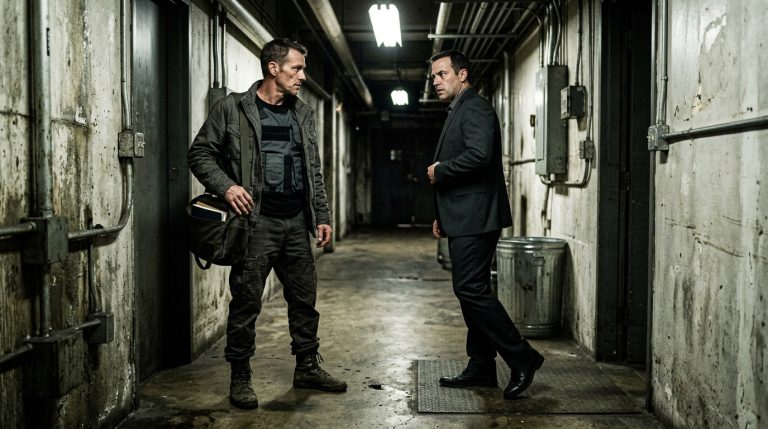
In the corner booth, Ray McMillan didn’t look up. His silver hair caught the cool glare of the window, and his hand, thick-veined and slightly trembling, was hooked around a thick ceramic mug. Beneath the table, the black fur of Shadow’s flank rose and fell against Ray’s worn leather boots. The red canvas vest on the dog’s back was frayed at the edges, the white embroidered letters Service Dog slightly dulled by dust from the Georgia hills.
“That animal,” a sharp voice cut through the low murmur of the morning rush, “is a direct violation of state ordinance 40-13. No domestic beasts in active food preparation areas.”
The voice belonged to a man in a navy blazer that smelled intensely of dry cleaner chemicals and stiff starch. Logan Prescott didn’t look at Grace; he looked at his clipboard, the metal clip clicking against the paper like a small, metallic jaw. He had a small silver pen tucked between his thumb and forefinger, poised like a scalpel.
Grace didn’t lower the carafe. She stepped toward the booth, her blue flannel sleeve brushing the edge of the counter. “He’s a working animal, Mr. Prescott. He’s here under the federal access guidelines. Ray needs him.”
“The state doesn’t issue permits for emotional convenience,” Prescott said, his eyes finally lifting. They were small, grey, and entirely devoid of heat. “Dander in the air is an absolute hazard. You have thirty seconds to remove the animal, or I note a critical non-compliance that will suspend your operating license before noon.”
The cafe went utterly still. The light sound of Louisa’s windchime laugh from three tables over snuffed out instantly. Ray’s knuckles turned the color of old bone against his mug. He didn’t look at Prescott; his eyes stayed locked on the black coffee, his jaw setting into a hard, rigid line that Grace had seen on dozens of men who had crossed the gate from Fort Granger and forgotten how to look soft.
“He stays,” Grace said softly. The voice didn’t shake, but inside her chest, the old, familiar hollow—the one left behind six years ago when the blue casualty assistance uniform had stood on her porch—tightened. “The coffee is hot, Mr. Prescott. You’re welcome to a cup. But the dog stays where he is.”
“And so do the consequences,” a new voice cut from the doorway.
Deborah Lyall stepped into the warmth of the cafe, her heels clicking against the linoleum with a precise, clinical rhythm. Her winter coat was draped over her arm, her regional manager badge gleaming under the fluorescent tubes. She didn’t look at the chalkboards or the photo of Michael hanging above the register. She looked at the inspector’s lowered pen.
“Grace Donnelly,” Deborah said, her tone flat, polished, and perfectly corporate. “You’ve been warned twice this quarter about local deviations from standard brand policy. Disobeying a state compliance officer in front of a full floor isn’t just negligence; it’s liability. Untie the apron. You’re terminated, effective immediately.”
The silence that followed was heavy, smelling of scorched beans and old dust. Grace looked down at the carafe. Slowly, she set it on the nearest saucer. Her fingers were cold as she reached behind her waist, untying the cotton strings of her apron. She folded it twice, smoothing the wrinkled fabric over the laminate counter, right next to the handwritten ledger of birthdays she had kept for six years.
She didn’t look back as she hit the side door, the cool morning air hitting her face like a wet towel. But as the door clicked shut, her eyes caught something through the glass—Ray hadn’t moved, but his hand had slipped from the mug down to the red vest beneath the table, his fingers sinking into the coarse fur, while Prescott’s pen finally touched the paper with a sharp, decisive scratch.
CHAPTER 2: THE ROLLING THUNDER
The gravel at the edge of the lot didn’t just crunch under the tires; it sang a low, synchronized vibrato that shook the condensation right off the driver’s side mirror of Grace’s truck. She hadn’t turned the key yet. Her palms were still marked with the red, woven indentations of her apron strings, a crosshatched pattern fading slowly against her skin like an old scar. Through the cracked glass of her windshield, the Mason Mug looked smaller, its brick facade bleached by three decades of noon-day heat to the color of dried liver. Inside, she could see the vague, watery silhouette of Deborah Lyall moving behind the counter, her corporate binder open like a white plastic shield against the quiet town.
Then the vibration changed from a hum to a physical weight in the center of Grace’s chest.
Main Street didn’t usually witness precision driving, but the four olive-drab boxes rolled through the morning mist in a locked, single-file formation that ignored the speed limit signs by exactly two miles per hour. The tires—heavy, deep-lugged rubber that had seen the salt-flats of distant training grounds—growled against the asphalt. They didn’t park; they occupied. The lead Humvee swung broadside across the entrance, its front bumper painted with the faded white stencil of Fort Granger’s logistically rigid motor pool, effectively cutting off the regional manager’s mid-sized sedan from any hope of exit.
The doors cracked open in a single, sharp snap of steel latches.
Colonel Richard Gaines stepped down first, his boots hitting the gravel with the dry, hollow thud of a man who measured his steps by tactical distance. His dress blues were immaculate, the gold buttons catching the thin Georgia sun like row after row of small, unblinking eyes. His white gloves were tucked under his left epaulet, a stark contrast to the dark, weighted wool of his sleeves. Behind him, two dozen Marines formed up without a word spoken, their chests expanding in unison as they took in the scent of regular grease and stale coffee.
Grace pushed her truck door open, the hinge groaning in the silence. Her favorite blue flannel caught on the door latch, the fabric fraying just a fraction more at the cuff. “Colonel,” she said, her voice thin in the sudden expanse of the lot.
Gaines didn’t halt until he was three feet from her fender. His eyes were the color of stagnant river water, fixed somewhere over her shoulder at the cafe sign. “You’re off schedule, Grace. Heroes Hour doesn’t usually empty out before the second pot is cold.”
“I’ve been retired from the rotation,” she said, trying to find a smile in the pockets of her jeans, finding only a stray rubber band and a receipt from the hardware store. “Corporate compliance. They don’t like the dander.”
The Colonel’s jaw shifted, a small muscle twitching near the base of his ear like a hidden wire. “We’ve been monitoring the logistics of this corner for three seasons, Grace. This isn’t about compliance.” He didn’t explain. He simply turned, his hand rising in a brief, flat gesture that required no secondary confirmation. “Follow.”
Inside the Mason Mug, the air had turned sour with panic. Logan Prescott was trying to slide his silver pen back into his pocket, his fingers clumsy against the starch of his navy blazer. Deborah Lyall stood by the register, her face the color of skim milk as the boots filled the doorway, tracking red clay across her freshly mopped linoleum.
The Colonel didn’t look at the clipboard. He walked straight to the register, his leather soles echoing against the walls. With two fingers, he reached out and took the plastic corporate logo pinned to the side of the menu board—the green-and-tan shield of the parent company—and twisted it until the small brass screws popped out of the soft pine. He handed the broken plastic back to Deborah without looking at her face.
“This post is under relocation,” Gaines said, his voice flat, low, and carrying the heavy, undisputed authority of three combat tours. “The current management has an appointment at base headquarters.”
“This is private property,” Deborah stammered, her fingers clutching the edge of her binder until the plastic split at the seam. “The health department has jurisdiction—”
“The health department doesn’t run the transition grid for the 3rd Battalion,” Gaines cut her off, his eyes turning to Ray, who was still sitting in the corner booth, his large hand motionless on Shadow’s head. The Colonel paused, his head dropping just an inch in a silent, heavy recognition that looked more like a shared funeral than a greeting. “Pack your ledger, Grace. We’re moving the gear.”
Grace reached behind the counter one last time, her fingers brushing the worn leather of her personal notebook. As she lifted it, her thumb caught on something stiff tucked into the back pocket—a small, square brass tag engraved with a series of alphanumeric codes she didn’t recognize, its surface scratched and dull with oil. She slipped it into her pocket, the metal cold against her thigh.
Outside, a Marine was already standing by the driver’s side of her truck, his hand extended for the keys. The sun was fully up now, but it gave no heat, only a flat, grey illumination that made the town look like an old photograph whose edges had already begun to curl.
CHAPTER 3: THE BARE WALLS OF FORT GRANGER
The smell of caramelized sugar and fresh grounds didn’t survive the five-mile transit past the secondary checkpoints. Here, the air was sharp with diesel exhaust and the flat, chemical scent of institutional grey floor wax. Grace kept her fingers coiled around the soft leather edges of her notebook as Colonel Gaines ushered her through the heavy, reinforced steel doors of Building 412. Her truck had been left at the gate, its familiar rusted bumper looking entirely out of place alongside lines of synchronized tactical vehicles.
“This wing was slated for demolition after the initial deployment drawdowns,” Gaines said, his boots striking the faded green linoleum with a steady, unhurried cadence. He didn’t look back to see if she was keeping up. “The plumbing functions intermittently. The electrical is drawn from a tactical generator behind the motor pool. But it possesses a perimeter, and it possesses isolation.”
Grace slowed her pace as they reached a wide, cavernous space that felt less like a sanctuary and more like a vacated warehouse. The paint along the concrete support pillars was dry, curling away from the masonry in pale, brittle flakes that drifted down like gray snow whenever a heavy truck passed on the exterior ring road. A few metal folding chairs stood scattered near a dented water cooler, and three wooden crates of uncatalogued tactical manuals sat rotting quietly in the far corner.
“You want to put them here,” Grace murmured, her voice lifting into the high, uninsulated rafter space. She reached out, her thumb brushing a layer of fine, yellow pine dust off the edge of a disused metal desk. “Colonel, a person doesn’t patch a tear in their mind by sitting inside a concrete bunker. They come to a cafe because they want to remember what a living room feels like.”
“They come to you because you don’t require them to explain why they can’t handle a crowded intersection,” Gaines replied, turning to face her. The pale light from the high, wire-reinforced windows caught the deep, weather-beaten creases around his eyes. “The pilot program has funding for physical assets—mats, instructional whiteboards, diagnostic logs. What it lacks is a spine. The bureaucratic specialists we brought in from Atlanta spent three weeks trying to standardize the intake process. The men took one look at the multi-page questionnaires and went back to their trailers.”
Before Grace could answer, a metallic screech echoed from the rear office alcove. A young woman stepped out, her boots dragging slightly against the floor. Tiffany Rios was twenty-four, but her shoulders curved forward with the protective caution of an old man avoiding a sudden blow. The cuffs of her oversized civilian sweater were pulled down tight over her wrists, yet they failed to fully conceal the thick, shiny texture of skin graft scars that climbed up her left forearm and traced a jagged path toward her jawline. Beside her, a golden retriever puppy in a bright red training vest sat instantly, its tail executing two soft, hesitant thuds against the concrete.
“The inventory doesn’t match the manifests, Colonel,” Tiffany said, her voice small, muffled by the collar of her sweater. She stopped ten feet away, her eyes shifting rapidly from Gaines to Grace, then down to the leather notebook in Grace’s hand. “The local transport logs say three shipments of therapeutic hardware were delivered to the Mason Mug’s corporate storage yard last month. But there’s nothing in our warehouse records.”
Grace felt the small, square brass tag she had pulled from her cafe ledger shift against her thigh. “The storage yard on the east bypass? That’s managed directly by the corporate office in Savannah. The cafe never received any hardware shipments, Tiffany.”
“They logged them as community outreach allocations,” Tiffany muttered, her fingers tightening within her sleeves. She looked directly at Grace now, her gaze dropping to the worn blue flannel. “I… I saw the video from the morning rush. The barista, Lena, she posted it on the regional forum before they pulled the server down. My brother was with the 3rd. He didn’t like standard clinics either. He said the fluorescent lights made his ears ring.”
Grace stepped across the grey linoleum, her steps deliberate and soft. She didn’t offer her hand—she knew better than to force an interaction before the air had cleared. Instead, she leaned against the edge of the disused metal desk, dropping her center of gravity to match the young woman’s posture. “We’ll change the bulbs first,” Grace said quietly. “We’ll get some lamps from the thrift store down on Broad Street. The ones with the cloth shades that diffuse the glare. And we don’t do intake forms here. If you want to sit and look at the wall for an hour, you do it with a full cup.”
Tiffany’s shoulders dropped perhaps half an inch. The puppy watched Grace, its ears twitching as a low, rumbling convoy passed outside.
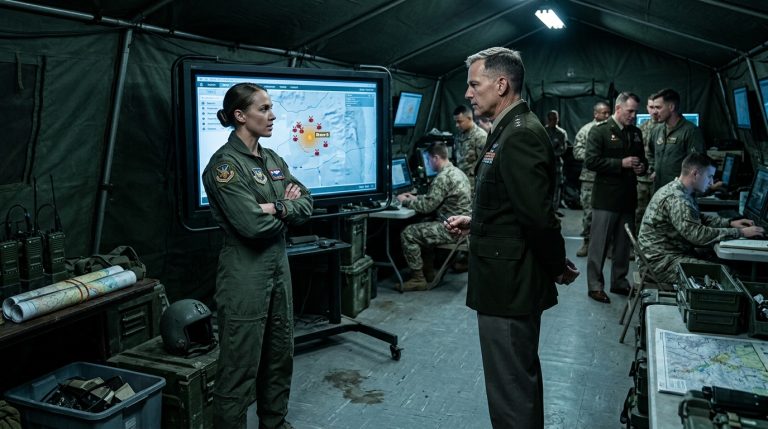
“There’s an administrative desk in the back that needs clearing,” Gaines directed, though his eyes remained fixed on the structural column behind Grace. “Start there. The auditors from the regional compliance board are already tracking the vehicle movements from this morning.”
Grace nodded, walking toward the small, glass-fronted supervisor’s office at the rear of the bay. The desk inside was a grey steel tank from the mid-nineties, its drawers sticking against old grease. She pulled the bottom drawer free, finding only a discarded stack of carbonless military requisitions. But as her hand reached into the dark casing behind the track, her fingers struck a cold, familiar edge.
She pulled it out. It was a second brass alphanumeric tag, identical in weight and font to the one currently tucked into her jeans. The stamped letters read: PLT-3-RECON-04.
A sharp breath caught in her throat. She looked through the scratched glass toward the main bay where Tiffany was carefully adjusting a folding chair. The numbers didn’t belong to a standard base inventory. They belonged to Michael’s old unit designation—the small, tight knit circle that had dissolved into smoke and casualty reports six years ago in the dirt of Helmand Province.
CHAPTER 4: THE SHADOW ON THE CLIPBOARD
The metal chair legs screeched against the unpolished concrete, a harsh, dry sound that rattled the cold coffee sitting in Grace’s ceramic mug. The lead auditor, a man named Vance whose crisp grey suit seemed entirely untouched by the humid Georgia air, didn’t look up from his stack of printouts. His fingers, thin and tipped with perfectly manicured nails, flipped through the pages of the Fort Granger outreach logs with a rhythmic, mechanical snap.
“The numbers don’t track, Mrs. Donnelly,” Vance said, his voice flat and thin, matching the desaturated gray of the office partitions. “We have three separate allocations for specialized operational hardware marked as delivered to the Mason Mug’s corporate perimeter. Yet, the physical inventory in this facility shows nothing but salvaged desks and donated folding chairs. Federal funds require physical receipts, not emotional sentiment.”
Grace leaned forward, her elbows resting on the rough wooden surface of the desk she had spent the last forty-eight hours scrubbing. Her flannel sleeves were rolled to the elbows, the faded blue fabric stained with a mixture of old machine oil and lemon cleaner. “I told you yesterday, Mr. Prescott’s initial health reports were generated using altered compliance codes. The cafe never received those shipments because they were diverted before they ever reached Main Street. If you look at the digital timestamps on the logistics manifest—”
“The logistics manifest is signed by a registered corporate representative,” Vance cut her off, finally raising his eyes. They were cold, heavy with the institutional boredom of a man who viewed human crisis as a rounding error. “We are not here to investigate corporate routing anomalies. We are here to evaluate the viability of this pilot initiative. Right now, your facility is in a state of critical deficit. If these assets cannot be accounted for by the end of the business day, the Department of Defense will freeze the operational accounts. The center will be closed before the weekend.”
Behind the glass partition, Grace could see Tiffany Rios standing motionless by the water cooler. Her fingers were dug deep into the wool sleeves of her oversized sweater, her gaze locked on the concrete floor while the golden retriever puppy pressed its flank against her shin, sensing the heavy, static tension vibrating through the room.
Grace felt a familiar, cold weight settle into the pit of her stomach. She reached into her pocket, her fingertips brushing against the two brass tags—the one from her cafe ledger and the identical one found in the desk drawer. The metal edges were sharp, digging into her palm as she squeezed them. “The signatures on those delivery sheets aren’t mine,” she said softly, her voice tightening. “They aren’t Lena’s either. Someone used the health inspection as a smokescreen to lock the doors of the Mug and clear out the storage yard.”
Vance smiled, a brief, bloodless movement of his lips that didn’t reach his eyes. “That is a matter for the civilian courts, Mrs. Donnelly. Our concern is the paperwork. And according to the printout in front of you, the entity that authorized the asset diversion is the very same holding group currently bidding on the deed to your former cafe.”
He slid a single sheet of paper across the desk. The ink was slightly smudged at the margins, the text dense with corporate jargon, but the name at the bottom of the registration line stood out in sharp, dark characters: Ares Development & Transition Holdings.
Grace picked up the sheet, her thumb catching on the rough edge of the paper. She didn’t look at the financial columns or the projected buyout metrics. Her eyes shifted to the digital metadata printed in small, pale gray type along the bottom border. The authorization code for the transfer matched the alphanumeric stamp on her brass tags exactly: PLT-3-RECON-04.
The room seemed to lose its remaining warmth. The air felt thin, smelling of old carbon paper and the damp stone of the basement walls. This wasn’t a standard corporate acquisition. The entity systematically dismantling her small sanctuary on Main Street wasn’t a nameless conglomerate of faceless executives. It was tied directly to the ghost that had haunted her living room for six years—the final, fragmented remains of Michael’s deployment unit.
“This is a administrative failure,” Vance said, snapping his briefcase shut with two sharp, metallic clicks that sounded like small pistol shots in the quiet office. “I will submit my report to base headquarters by seventeen hundred. I suggest you begin packing your personal items, Mrs. Donnelly.”
He stood, his grey suit unwrinkled as he stepped past her toward the exit. Grace didn’t move. She sat at the desk, the printout heavy in her hand, watching the dust motes drift down through the pale light of the window. The decoy secret had broken open, revealing a calculated financial trap that threatened to erase everything she had built, but the true identity of the hand pulling the strings remained buried deep within the military network, locked away behind a wall of security clearances she couldn’t cross.
She looked up as the outer door slammed shut, the vibration rattling the glass partition. Tiffany was watching her through the pane, her face pale, her scarred hand reaching out to touch the doorframe for balance.
CHAPTER 5: THE SPEECH IN THE BALLROOM
“The metric for a successful integration cannot be measured in quarterly compliance percentages,” Grace said, her voice carrying through the dual-channel amplifiers of the Washington ballroom. The sound didn’t bounce; it flattened against the heavy, faded velvet drapes that flanked the mahogany stage. The room was large, a sea of white linen table coverings, gleaming brass water carafes, and the dark, rigid silhouettes of institutional suits from the Department of Defense.
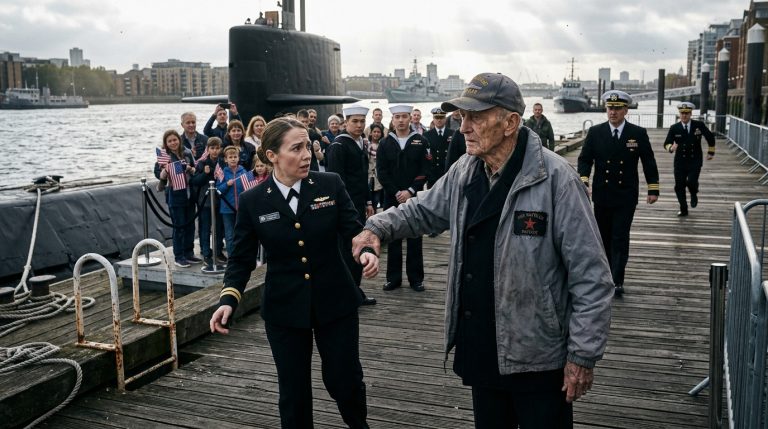
At the back of the hall, Ray McMillan stood with his shoulder pressed against an ornate marble pillar. His dress blues looked older than the ones around him, the wool slightly thin at the elbows, the silver star pinned over his breast pocket caught in the glare of the overhead chandeliers. Shadow lay perfectly still at his heel, a black anchor in a room full of moving papers.
Grace reached down, her thumb catching on the corner of the worn leather notebook she had placed on the edge of the podium. Right beside it sat a small, worn silver chronograph watch with a heavily fractured crystal—an item she had found tucked into her travel bag just before leaving Georgia. It wasn’t Michael’s watch. The engraving on the back plate, which she had tracked with her fingernail during the flight, read simply: Ares-01.
“Six days ago, an audit froze the operational budget of the Fort Granger outreach pilot,” Grace continued, her gaze sweeping over the front row of dignitaries, where Colonel Gaines sat with his hands flat on his knees, his face unreadable. “The administrative failure cited was a lack of physical hardware verification. But human presence isn’t an inventory item. You cannot log the precise moment a soldier decides to stop looking at the exit door and finally tastes their coffee. You cannot file a receipt for silence.”
A low murmur rippled through the middle tables—the soft, collective shuffling of papers and heavy folders. Grace could see the flash of camera lenses from the press desks along the perimeter, their shutters clicking with a dry, mechanical rhythm that sounded exactly like Prescott’s silver pen clicking in the Mason Mug.
“The holding group that initiated the buyout of the civilian properties surrounding Fort Granger uses the registration code of a deactivated scout platoon,” Grace said, her voice dropping into a lower register that forced the amplifiers to hum with a slight, vibrating edge. “They signed for the therapeutic assets that never reached our veterans. They used state compliance mechanisms to close a door that had been left open for six years. They believe that by acquiring the land, they can institutionalize the sanctuary.”
“Mrs. Donnelly,” a sharp voice interrupted from the floor. A man in a dark charcoal suit stood up from the third row, a thick legal brief clutched in his left hand. His name tag identified him as an attache from the corporate oversight committee. “This forum is designated for national civilian service commendations, not for litigating local commercial transactions. Your operational authority at Fort Granger is currently under secondary judicial review.”
Grace didn’t back away from the microphone. She reached into her pocket and pulled out the two brass alphanumeric tags, placing them on the polished oak of the podium with two distinct, metallic thuds that carried through the sound system like small gavel strikes.
“The transaction isn’t commercial,” Grace said, looking directly at the attache. “The metadata on the asset diversion forms matches the terminal stamps from the base headquarters’ logistics mainframe. The person who authorized the shutdown of the Mason Mug didn’t do it for profit. They did it because they were looking for the same thing we are looking for—a place that doesn’t exist on a map.”
She paused, her fingers smoothing the frayed linen edge of her blouse cuff. “But you cannot build a sanctuary out of stolen timber. You cannot force a soldier to heal by locking them inside a private compound funded by the destruction of the very community they fought to protect. The center in Mason will remain open, not because the paperwork is complete, but because the people in this room know exactly what it costs to close it.”
The attache remained standing for three seconds, his jaw clenched, before he slowly slid back into his seat, his legal brief hitting the table with a dull slap.
Grace looked back at the rear of the hall. Ray didn’t cheer; he didn’t join the sudden, scattered applause that began to grow from the sides of the room. He simply raised his right hand to the brim of his cover in a slow, precise motion—a salute that wasn’t directed at the flags behind her, but at the small, broken chronograph sitting on the edge of the podium. The decoy corporate buyout scheme had been laid bare before the entire oversight committee, but the devastating reality of who owned Ares Holdings was now staring back at her from the cracked face of that silver watch. The signature on the purchase orders wasn’t a faceless executive; it was Captain Thomas Miller, Michael’s former platoon commander, the man who had ordered the deployment that changed her life.
CHAPTER 6: THE FULL CIRCLE OF THE CARAFE
The brass key felt unnaturally cold, its teeth biting into the skin of Grace’s palm before the old tumbler clicked inside the side door of the Mason Mug. The air inside had begun to settle into that peculiar, static chill of a room that had been abruptly vacated. Faint squares of pale Georgia sunlight cut through the front plate glass, illuminating a million floating specs of dust that drifted like quiet memories over the laminate counters. The green-and-tan corporate shield she had known for six years was gone, leaving behind only the raw, splintered pine where Colonel Gaines had torn it away.
A shadow broke the light by the window. Sitting in the far corner booth, completely enveloped in the desaturated gray of the afternoon, was Captain Thomas Miller.
He wasn’t in uniform. He wore an old olive field jacket with frayed cuffs, his large hands flat on the scarred wood of the table. Between his palms sat the heavy glass carafe Grace had left on the saucer six days ago. It was empty now, the dark residue at the bottom dried into a faint, fractured pattern resembling cracked porcelain. Beside him, Ray McMillan stood with his back to the door, his jaw tightly set, his large hand resting heavily on Shadow’s red canvas harness.
“You should have stayed in Washington, Grace,” Miller said. His voice was rough, carrying the dry friction of a man who spent too many nights listening to the quiet static of tactical radios. He didn’t look up as she approached. His eyes were fixed on the empty glass of the pot. “The civilian commendation would have secured the federal expansion for Fort Granger. It would have given your center a line-item budget for the next five fiscal years.”
Grace stopped at the edge of the booth. She reached into her flannel pocket, her fingers brushing past the alphanumeric brass tags, and pulled out the old photograph the man in the gray suit had given her by the Potomac. She laid it gently on the table between them. The edges were worn down to soft lint, but the image was clear—Michael, smiling in his flannel shirt, standing right outside this door alongside a younger, unscarred Captain Miller.
“You diverted the therapeutic hardware shipments through Ares Holdings, Thomas,” Grace said softly. The words didn’t carry anger; they carried the heavy, sorrowful resonance of a shared burden. “You used Logan Prescott to create the health violations so the corporate parent would clear the property title. You were trying to buy the entire block.”
Miller’s fingers tightened against the glass handle of the carafe until his knuckles turned the color of chalk. “The base programs are a administrative illusion, Grace. They require a soldier to prove they are broken before they offer a repair kit. I watched Michael take a round in the valley because our logistics grid was waiting for a signed verification form. I wasn’t going to let the men from the 3rd spend their civilian lives filling out questionnaires in a concrete warehouse.”
He finally looked up, his eyes bloodshot, reflecting the pale light from the window. “Ares wasn’t a corporate buyout for profit. It was a private trust. I wanted to purchase this entire corner, hand the deed to you, and build a perimeter where no auditor, no inspector, and no regional supervisor could ever tell a veteran where they were allowed to sit. I used the money from my medical retirement and the corporate shell to insulate it from the defense budget.”
“By destroying the only place they felt human?” Grace asked. She stepped closer, her hand reaching down to touch the cold rim of the empty coffee cup Miller had placed before him. “Look around you, Thomas. You didn’t protect them. You forced Lena to watch a corporate execution. You made Ray feel like a hazard to the community again. You can’t heal a broken platoon by using the same tactical deception that fractured it in the first place.”
Ray cleared his throat from the shadows, his voice low and scraping. “She’s right, Captain. I didn’t need a secure private compound. I just needed to sit by the window and know that nobody was going to ask me about May fifteenth.”
Silence returned to the cafe, deep and unyielding, broken only by the soft, rhythmic thud of Shadow’s tail against the floorboards. The puppy Rios was training had stayed back at Fort Granger, but here, the old service dog seemed to understand that the kinetic energy of the conflict had finally grounded itself.
Miller’s shoulders slowly fell, the rigid, military posture draining out of him until he looked like nothing more than a tired man sitting in an empty diner at the end of a long deployment. Slowly, he loosened his grip on the carafe. His hands slid back across the table, his palms open, completely empty.
Grace picked up the glass pot. She walked behind the counter, her movements fluid and practiced, completely ignoring the dust that had settled over the espresso machine. She turned the valve on the old commercial burner, hearing the small hiss of gas before the blue flame caught with a soft, warm whoosh. She poured fresh water into the reservoir, the sound clean and rhythmic against the silent walls.
“The federal oversight board reinstated the pilot program’s local autonomy this morning,” Grace said over her shoulder, watching the first dark drops of coffee begin to drip into the bottom of the glass. “Colonel Gaines is moving the administrative offices out of Building 412. We’re combining the logistics. The center will handle the medical transition on base, but the living room stays right here on Main Street.”
She walked back to the booth, carrying the pot by its chipped plastic handle. The steam rose between them, warm and fragrant, cutting through the dry smell of old dust and dry-cleaned blazers. She filled Miller’s cup first, watching the dark liquid rise against the cracked white glaze of the ceramic, before filling Ray’s.
“This is a place to be seen, Thomas,” Grace whispered, setting the carafe down on the center of the wooden table, right beside the old photograph of her husband. “Not fixed. Now drink your coffee.”
The three of them sat in the fading light as the afternoon sun dipped behind the maple trees of Main Street, the warmth of the fresh brew slowly softening the sharp edges of the room until the broken pieces of the platoon finally found a place to rest.