The Perimeter Wall: A Tactical Dismantling of Suburbia’s Tyrant Through Cold, Calculated Surveillance Warfare
CHAPTER 1: THE MIDNIGHT BREACH
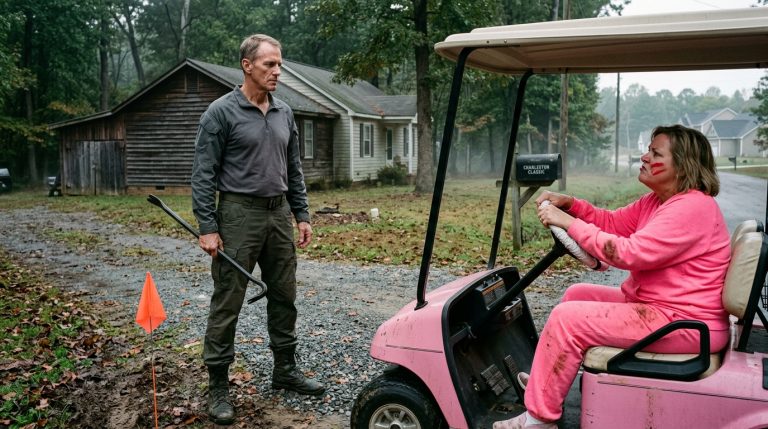
The office was cool, the air smelling faintly of ozone from the server racks tucked into the closet. My eyes locked onto the monitor, the screen bathing the room in a ghostly, monochromatic green. There she was. Karen Thompson, the self-appointed queen of Oakmont Estates, looking significantly less regal while huffing and puffing over the base of my western red cedar post.
The infrared sensors didn’t catch her personality, just her heat signature and the rhythm of her movements. She was frantic, her body jerking in the sharp, unnatural angles of a person who has never done honest labor. Beside her, Gary—her shadow, her enabler, her perpetually terrified husband—held a flashlight with a grip so white-knuckled I could see the tension even through the low-resolution feed.
Every movement they made was a binary data point: Force applied. Structural resistance met. The groan of the post-puller was a high-frequency spike on my audio monitor, a sound I’d heard in a dozen different variations across deserts and jungles. Except here, in the manicured silence of the suburbs, it sounded louder, more invasive.
I watched, my pulse steady. I was calculating. I wasn’t just observing a crime; I was cataloging weaknesses. She put her full weight into the lever. The wood splintered with a sharp, crisp crack—the sound of fiber failing under extreme tension. She stumbled back, the post suddenly loose, the earth around it giving up its hold. She didn’t look like a president of an association; she looked like a scavenger.
A smirk formed on her face—a jagged, ugly thing in the green light. She thought this was a victory. She thought the fence was the problem. She had no idea that every movement she made was being logged to a secure, remote server that would survive even if she burned my house down.
I zoomed in on the tool she was using. A rental mark was barely visible, a scuff of yellow paint on the heavy steel. My mind cataloged the location—the local tool shop on 4th Street. That was a transaction record. That was a witness. That was a piece of the puzzle that would eventually snap shut around her throat.
My phone buzzed in my pocket—a text from Sarah. Everything okay? I thought I heard something.
I didn’t answer immediately. I took a slow breath, the air in my office feeling sharp, metallic. I watched Karen drag the splintered wood aside, her movements erratic and triumphant. The Zeigarnik effect was already pulling at me, the unfinished business of the night gnawing at the edges of my focus. She was doing this to save her image, to protect her precious aesthetics. But as she leaned down to grapple with the next post, I noticed something that didn’t fit the pattern of a petty suburban vandal. A flash of light caught her face, not from Gary’s flashlight, but from her own open purse lying on the grass. A stack of overdue notices, bright neon orange, fluttered in the damp air.
She wasn’t just fighting for curb appeal. She was fighting for survival. And she was losing.
CHAPTER 2: THE PAPER TRAIL
The hum of the server rack in the corner of my office suddenly seemed deafening, a stark contrast to the hollow silence radiating from the screen. My eyes were still fixed on the infrared image of Karen’s open purse. The bright neon orange of those overdue notices burned against the gray, pixelated floor of my driveway like a flare in the dark.
I leaned back, the leather of my office chair creaking—a sound that, in the stillness, felt like a gunshot. My initial, reflexive anger, the kind that had been forged in a dozen firebases and hardened by years of tactical planning, began to cool into something far more dangerous: clinical curiosity.
Karen Thompson wasn’t just a petty tyrant. She was a woman drowning, and she was reaching for the HOA bylaws like a life preserver.
I didn’t move. I watched the recording loop. Karen and Gary, two ghosts in the night, finally disappearing into the shadows of their own lawn. They thought they had left me with a wreckage of wood and concrete. They had no idea they had left me a map of their private collapse. I tapped the keyboard, saving the frame with the notices to a local drive. I’d need to enhance the resolution later, pull the dates, the creditors, the amounts.
The weight of the night began to press against my shoulders. I stood, my joints popping in the quiet room. Sarah was down the hall, wrapped in the fragile, rhythmic breathing of deep sleep. She deserved that sleep. She deserved a sanctuary that didn’t involve me sitting at a desk at three in the morning, playing digital detective against a woman in a tracksuit.
But the “Sapper’s Code” is a stubborn thing. It doesn’t switch off just because you’ve traded a desert combat zone for a manicured suburban cul-de-sac. It demands reconnaissance. It demands the securing of the perimeter. If I walked away now, I was leaving a vulnerability in my own defenses.
I walked to the kitchen, the hardwood floors cold under my bare feet. I grabbed a glass of water, the ice clinking—a sound that seemed to ring through the house. I stood by the kitchen window, looking out toward the darkened street. The moonlight was thin, filtered through the clouds, casting long, skeletal shadows across the yards.
My reflection caught in the glass: eyes tired but sharp, a line of tension etched around my mouth. I saw the man I used to be—the one who spent his days looking for tripwires—staring back at me. I wasn’t just protecting a backyard. I was proving to myself that I could still control the environment. That I could still win.
I returned to the office and opened the “Karen” binder. I pulled out the original architectural approval, the one with her elegant, looping signature at the bottom. I placed it on the desk next to the tablet showing the screen capture of the orange notices.
The contrast was absolute. One document represented the order she claimed to love; the other represented the chaos she was clearly fighting to conceal.
I opened my email and drafted a message to Ben Carter. No hysterics, no emotional venting. Just the facts.
Ben, we have a development. The subject’s property is potentially in financial distress. I have captured visual evidence of past-due notices during the incident. Requesting we verify the HOA’s current financial status before we move on the vandalism report. If she’s under pressure, she might be skimming.
I hovered over the send button. This was the moment where the line blurred. If I sent this, I was going on the offensive. I was moving from protecting my home to hunting a neighbor. The thrill of the calculation hummed in my blood, a familiar, addictive cadence.
I hit send.
I sat in the dark for a long moment, listening to the house settle. A stray cat darted across the driveway, its movement triggering a soft, almost imperceptible click from the exterior camera system—a soundless handshake between the sensor and the server. I had the perimeter. I had the intelligence.
The phone on my nightstand buzzed again—a soft, insistent vibration. I walked back into the bedroom, careful not to wake Sarah. It was a notification from the local property record site. I’d set a watch on the Thompson residence. A notice of default had been filed three days ago.
Karen wasn’t just a bully. She was a cornered animal. And in my experience, cornered animals are the only ones that truly know how to fight.
I climbed back into bed, the sheets cool and smooth, but sleep was a distant prospect. I lay there, eyes open, staring at the ceiling. The rhythm of my own heart was the only thing keeping pace with the calculation running through my mind. I was ready.
CHAPTER 3: THE FIRST SKIRMISH
The sunlight that filtered through the blinds was too bright, too clinical. It lacked the warmth I associated with the morning. I sat at the edge of the bed, the mattress still bearing the ghost of my restless, sleep-deprived tossing. Sarah was still asleep, her arm thrown over the pillow, a picture of domestic tranquility that I was currently dismantling, one binary decision at a time. I stood, my knees popping, and headed for the kitchen.
I didn’t reach for the coffee. I reached for the binder.
The morning air outside was crisp, smelling of wet mulch and the impending promise of a long, humid day. I stepped onto the patio, the cool metal of the sliding door handle grounding me. My gaze immediately drifted to the yard. Four gaping, dark holes in the turf where the cedar posts had been—the jagged geometry of my own property line.
Then, the rumble of a heavy engine pulled me back. A white pickup truck with the insignia of a landscaping company—’Oakmont Professional Care’—rumbled up the cul-de-sac. It slowed, the driver’s side window lowering to reveal a young man, barely out of his teens, wearing a uniform that looked two sizes too large. He stared at my house with a mixture of confusion and nervousness.
I didn’t wait for him to knock. I walked across the dew-slicked grass, my boots sinking slightly into the soft clay. As I crossed the sidewalk, a flash of memory hit me: the sight of a dust-covered road in a forgotten valley, the smell of scorched earth, and the paralyzing, razor-thin tension of checking a path for buried IEDs. My heart didn’t stutter—it locked into the same rhythmic, efficient gear. This wasn’t a minefield, but the risk of miscalculation felt identical.
The foreman, a guy named Leo according to his stitched nametag, shifted the truck into park. He grabbed a clipboard from the passenger seat, his movements jerky. “Mr. Roads?” he called out, his voice cracking slightly.
“That’s me,” I said, stopping six feet from the truck’s front bumper. I kept my hands visible, relaxed, but my posture was coiled. I was the property owner, yet I felt like a combat engineer facing an adversary.
“I have a work order here,” Leo said, stepping out. He held the clipboard like a shield. “Authorized by the Oakmont Estates HOA. We’re here to remove the remaining posts and clear the debris from the… the ‘monstrosity,’ sir.”
He looked at me, hoping for a fight, or perhaps hoping I’d just roll over. I looked past him, at the secondary, older man sitting in the passenger seat—the ‘muscle,’ I assumed. I looked at the bed of the truck, where a set of industrial bolt cutters and heavy-duty wrenches lay ready.
“Let me see the order, Leo,” I said, my voice dangerously calm, the kind of stillness that usually preceded a tactical correction.
He handed it over. The document was a standard HOA work order, but the signature at the bottom—Karen’s signature—was looped and aggressive, the ink pressed so hard into the paper it had nearly torn through the back of the sheet. It was a formal order to trespass. To destroy.
“Leo,” I began, my voice steady, peeling away the layers of his authority. “Do you see this? This is a private property plat. This sidewalk is the boundary. That work order is a private contract between the HOA and your company. It is not a court order. It is not an easement. If you step one inch past that sidewalk, you are trespassing on my property.”
The boy paled. He looked at the clipboard, then at the house, then at me. “But sir, Mrs. Thompson said—”
“Mrs. Thompson isn’t the one who is going to be sued for tortious interference,” I interrupted, my voice sharpening. “I am a former combat engineer, Leo. I know exactly where my property lines are, and I have the survey to prove it. If you damage one more inch of my property, I will not call the HOA. I will call the police, and I will initiate a civil suit against your company that will make your insurance premiums spike for the next decade. Do you really want to be the one who loses his company their contract over a petty HOA dispute?”
The young man’s bravado vanished. He looked at the truck, then back at me. I could see the internal calculation—the fear of the boss versus the fear of a man who looked like he had seen far worse things than a lawsuit.
“I… I just do what I’m told, sir,” he muttered.
“Then go tell the person who told you to do this that Mr. Roads has a lawyer, a police case number, and a full set of high-definition video evidence of the last time someone tried to touch these posts,” I said, keeping my tone flat, devoid of threat, just stating the facts.
He stood there for a heartbeat, his grip on the clipboard loosening. Then, with a frantic, hurried movement, he retreated to the driver’s seat. The engine roared to life—a discordant, harsh sound in the quiet morning. As he backed out of the driveway, he didn’t look back.
I stood there on the edge of the grass, watching the truck disappear around the corner. The silence returned, but it felt different now. It felt like I had successfully established a beachhead. I looked down at the clipboard he had, in his panic, left behind on the edge of my lawn.
I picked it up. Karen had written notes in the margin of the work order: ‘Must be cleared by noon. Do not engage. Just finish it.’
She wasn’t just being a tyrant. She was being methodical. She was trying to erase the evidence before the next board meeting. I held the paper, the texture of it coarse beneath my fingertips. My pulse remained steady, but the adrenaline of the confrontation began to leave a residue of cold, sharp clarity. I had intercepted the first wave.
I turned back toward the house, the gnome Mrs. Gable had given me standing guard on the remaining post—a silent, plastic witness to the morning’s maneuver. I walked inside, the kitchen feeling colder than I remembered. I picked up my phone and dialed Ben Carter. It was time to stop waiting for her to move and start forcing her to make a mistake she couldn’t recover from.
The perimeter was secure, but the war had just entered a new, more dangerous phase.
CHAPTER 4: THE STRAIN OF SILENCE
The dial tone stopped. Ben Carter’s voice was crisp, seasoned by years of high-stakes legal combat, and entirely devoid of the suburban pleasantries that usually defined neighborhood interactions.
“Mark,” he said, skipping the greeting. “I’ve checked the public records. You were right to hold off. The Thompsons are drowning. I’ve found three separate creditors circling them, and the notice of default isn’t just a rumor—it’s a reality. If you play this right, we don’t just win a fence dispute. We force a total collapse of her credibility before she can even mount a legal defense.”
I listened, my eyes tracking a lone beetle crawling across the kitchen linoleum. My hand, the one gripping the phone, felt heavy. “And if I don’t?” I asked.
“Then you’re just another neighbor involved in a petty argument that costs you a few grand in legal fees and three years of your life,” Ben replied, his tone clinical. “You wanted to be the sapper, Mark. You wanted to identify the perimeter. Well, you’ve found the minefield. The question is, are you willing to walk through it?”
I ended the call and placed the phone on the counter. The kitchen felt larger, more empty. Sarah walked in, the soft shuffle of her slippers a sharp contrast to the tactical precision of the last few hours. She stopped, noticing the tension in my shoulders, the way my focus was fixed on the binder—the ‘Karen’ binder—instead of her.
“You’re doing it again,” she said softly.
“Doing what?” I asked, though I already knew.
“You’re calculating, Mark. You’re looking at this house like it’s a firebase, and you’re looking at that woman like she’s an insurgent.” She crossed her arms, her expression a mix of weary empathy and mounting concern. “It’s a fence. It’s a garden. It’s not the war.”
I looked at her, searching for the right words, but the tactical logic in my head was a high, humming wire. I wanted to tell her that if I didn’t hold the line, the boundary would dissolve. I wanted to explain that the ‘Karen’ binder wasn’t just a list of grievances—it was proof that I still had control, that I could still impose order on a chaotic world.
“If I don’t finish this, she doesn’t stop,” I said, my voice lower, stripped of the bravado I’d used with the foreman. “You saw what she did to the yard. She thinks she can dictate what we do on our own property. If I give her an inch, she takes the whole field.”
Sarah sighed, a sound that carried the weight of everything she’d endured during my deployments, the years of waiting and worrying that I’d bring the war home with me. “Is that what you’re really fighting, Mark? Is it her? Or are you just trying to find a reason to feel like you’re still in uniform?”
The question hung in the air, sharp and unanswerable. I didn’t respond. I couldn’t. I felt the familiar, cold pressure of the ‘Sapper’s Code’—the absolute necessity of the mission. I turned back to the kitchen window, the view of the neighborhood now filtered through the lens of threat assessment. I saw the neighbors, the mundane bustle of the cul-de-sac, but I also saw the angles, the cover, the potential points of intrusion.
The silence between us stretched, thick and uncomfortable. I realized then that while I was meticulously dismantling Karen’s empire, I was slowly building a wall of my own—a wall made of documents, sensors, and calculated maneuvers. A wall that was starting to separate me from the very person I was supposedly protecting.
I left the binder on the counter and walked outside, the morning air having lost its sharpness, now settling into a heavy, humid stillness. I paced the length of the ruined yard. I examined the holes where the posts had been, the dirt still loose and disturbed. My hands felt restless, empty without a tool, without a blueprint.
I picked up a shovel, the iron blade dull and heavy. I didn’t need to dig, not yet, but the rhythmic, physical motion of turning the soil helped ground me. One, two, shift. One, two, shift. It was the same rhythm I’d used to clear paths, the same focus that had kept me alive in places where every step could be the last.
I looked toward Karen’s house, two doors down. A car was parked in the driveway—a sedan with the trunk open, suitcases being loaded. Gary, looking smaller and more frantic than ever, was stuffing clothes into the back. Karen was there, too, but she wasn’t moving with her usual, forced authority. She was standing still, watching the house, her hands gripping her elbows.
Even from this distance, I could see the fragility of her posture. The tyrant was packing her bags, or perhaps she was just preparing for a final stand. The ‘decoy’—her pettiness, her rules, her HOA power—was starting to look like a flimsy screen for a much deeper, more pathetic ruin.
I watched her for a long time, the shovel balanced on my shoulder. I wasn’t just watching a neighbor; I was watching an enemy whose position was crumbling. But as I saw the way she looked at her own home, a flicker of something that wasn’t malice crossed her face—a ghost of exhaustion, of fear.
I felt a twinge of something, not quite sympathy, but a recognition of the cost of the conflict. I had wanted a battlefield, and I had created one. I had wanted to fight a war, and I had found my adversary. I had achieved the tactical advantage, but the cost was beginning to accrue in the quiet spaces of my own home, in the look on Sarah’s face, in the way I was forgetting how to exist in a world that didn’t require a perimeter alert.
I dropped the shovel. The metallic thud resonated against the dry, hard-packed earth. It was time to stop the reconnaissance. It was time to force the issue, not because I needed the victory to feel whole, but because the infection had to be excised before it destroyed everything I was trying to build. I walked back toward the house, my pace purposeful, my mind already running the next sequence of operations. The war would be over, but I had to make sure there was still a home left to return to when the dust finally settled.
CHAPTER 5: THE ALLIANCE
The shovel lay where I had dropped it, a dark, heavy scar against the cooling earth. I didn’t look back at the spot. Instead, I walked toward the side gate, the wood creaking—a sound that, in my current state, felt like a warning bell. I needed to move. Staying in the yard meant staying in the past, ruminating on Karen’s sudden retreat and the hollow victory I had almost tasted.
I circled the block. Every house was a data point; every driveway a potential node in the network I was building. By the time I reached the corner of Elm and Oak, I felt the familiar, cold focus settling back into my marrow. I wasn’t just walking; I was patrolling.
The Chang residence was my first stop. They were a young couple, exhausted, the kind of neighbors who usually preferred to keep their heads down. I saw them through the front window—the mother, Julie, pacing with a crying infant in her arms, her husband, Sam, hunched over a laptop on the dining room table.
I didn’t knock. I rang the bell, the chime echoing through the small house. When Sam opened the door, his face was a mask of fatigue. He looked at me, then at the street, his eyes darting toward Karen’s house.
“Mr. Roads,” he whispered, stepping out onto the porch and pulling the door shut behind him. “You shouldn’t be here. She’s been watching the street all afternoon. She knows you’ve been talking to people.”
“She’s watching because she’s losing control, Sam,” I said, my voice low. “She’s loading her car. She’s panicked. But she’s still dangerous.”
“What do you want?”
“I want the folder,” I said. “The one you told me about. The fine notices, the letters, the rejected architectural requests. Every piece of paper she’s used to bully you over the last six months. I have the legal framework to use it. I have Ben Carter on standby. But I need the documentation.”
Sam hesitated. He looked at his wife through the window, then at the empty road. “If I give this to you, and she wins—if she stays president—we’re finished. She’ll make our lives a nightmare.”
“She’s already making your life a nightmare,” I countered, the ‘Sapper’s Code’ taking over. I wasn’t appealing to his neighborly spirit; I was appealing to his survival instinct. “She’s already bankrupting your neighbors. She’s already treating this association like a personal fiefdom. You give me those files, and we end her influence. We don’t just win a dispute; we replace the board.”
Sam stared at me, his jaw tight. He retreated into the house, and I waited on the porch, my pulse thrumming in my ears. The silence of the neighborhood felt artificial, a veneer of normalcy stretched over a festering conflict. A car drove by—a black sedan, slowing down as it passed. It wasn’t Gary’s car, but my breath hitched, my hand instinctively checking the proximity of the porch railing, looking for a cover point.
The paranoia was setting in—that was the V-4 variance, the creeping realization that I was no longer just the hunter. I was the hunted.
Sam returned, handing over a thick, manila envelope. It was heavy, packed with sheets of paper that felt like ammunition. “Take it,” he said. “But if this backfires, we don’t know you.”
I nodded and walked away, the envelope tucked under my arm like a tactical dossier. I didn’t go home. I went to see Mrs. Gable. She was waiting for me, the gnome with the fishing rod sitting on her porch. She didn’t look tired; she looked ready.
“I’ve been expecting you, Mark,” she said, her voice brittle but clear. She opened her door and ushered me in. Her living room was a museum of a different time—lace doilies, porcelain figurines, and a profound, quiet dignity. She pointed to a stack of records on the coffee table. “She thought I would be the easy one. She thought I didn’t have the stomach to fight for my little garden.”
“You were right, Mrs. Gable,” I said, feeling a surge of genuine respect. “She underestimated the whole street.”
“She underestimated the community,” she corrected. “People like her, they think because they hold a gavel, they own the world. They forget that the world is built on the people who actually live in it.”
As I left her house, the sun was beginning to dip below the horizon, casting long, bruised-purple shadows across the cul-de-sac. I had the files. I had the witness testimonies. I had the legal weight. But as I walked back toward my house, I saw Karen standing on her front lawn. She wasn’t packing. She was just standing there, staring at my house, her hands shoved deep into the pockets of her dark gray sweatsuit.
Our eyes locked across the distance. She didn’t look away. She didn’t move. She just stood there, a static, dark shape against the encroaching twilight. It wasn’t a challenge; it was an invitation. She knew I had been moving through the neighborhood. She knew the alliance was forming. And for the first time, I felt the weight of what I had set in motion.
This wasn’t a tactical exercise anymore. It was a collision. I looked at the manila envelope in my hand, then back at her. I didn’t accelerate my pace. I walked toward my house with the measured, deliberate stride of a man who had already committed to the final sequence. The war was no longer just at my fence; it was on my doorstep, and the silence of the neighborhood was about to be broken in ways that neither of us could fully predict.
CHAPTER 6: THE TRAP
The distance between my porch and her lawn seemed to compress, the dark shape of Karen Thompson losing its suburban silhouette and becoming something sharper, more volatile. I stood on my concrete walkway, the manila envelope heavy against my side. I had come home ready to finalize the strategy, to turn the legal screws on the board, but her stillness—that frozen, expectant stance—disrupted my cadence.
I didn’t turn back. I walked toward the front door, the key sliding into the lock with a metallic snap that felt jarringly loud. Inside, the house was dark, the only light coming from the digital glow of the security terminal mounted in the entryway. I checked the display: Perimeter Secure. Zone 1: Clear.
But as I placed the envelope on the mahogany entryway table, my fingers brushed against a sheet of paper that shouldn’t have been there. It was a printed copy of the HOA’s quarterly financial statement—the one I had obtained via David, our forensic accountant. I shuffled through the pages, my mind replaying the day’s reconnaissance.
Something was wrong.
I stopped at page twelve—the landscaping expenditures. There was a gap. A line item for ‘Contractor Maintenance: Q2’ was present, but the corresponding invoice number was missing. I flipped back to the folder I’d brought from Sam’s house. I searched through the discarded notices, looking for the correlating work order. It wasn’t there.
My heart did that familiar, slow roll—the one that occurred when a booby trap was identified just a second too late.
The front door chimed. Not the doorbell, but the alert sensor—the mechanical one I’d rigged to the porch. Someone was walking up the path.
I didn’t move. I didn’t reach for a weapon, but I felt the tension in my hands, a phantom weight of a tool I no longer carried. I walked to the window, keeping to the edge of the frame. Karen was there, standing at the door. She wasn’t holding a post-puller, and she wasn’t wearing the gray sweatsuit. She was wearing a coat—a heavy, beige wool coat that looked entirely out of place in the humid evening. She wasn’t knocking; she was just waiting, her hands clasped in front of her.
I opened the door. The silence between us was so thick it felt pressurized.
“You have the files,” she said. It wasn’t a question. Her voice was flat, devoid of the saccharine authority she usually wielded. It sounded hollow.
“I have enough, Karen,” I replied, keeping my voice level. “The audit is already moving forward. The police report is active. There’s nowhere left to pivot.”
She stepped closer, the light from the entryway illuminating her face. She looked older, the skin around her eyes mapped with fine, jagged lines of pure exhaustion. “You think this is a war, Mark? You think you’re fighting for a fence?”
“I’m fighting for the neighborhood. For the rules.”
“You’re fighting for the order,” she countered, and for a second, her eyes regained a flash of their old, intense focus. “But you’re the one who’s bringing the chaos. Look at you. You’re not a neighbor. You’re a tactical ghost. You’ve turned every house on this block into a potential front line. Do you really think Sarah wants to live in a bunker?”
The words were a direct hit. I felt the sharp edge of the truth, but I pushed it down, burying it under the weight of the mission. “You embezzled funds. You vandalized property. You bullied Mrs. Gable until she was crying in her own garden. Whatever I am, I’m the one responding to your actions.”
She smiled, but it was a broken thing. “I did what I had to do to keep things from falling apart. You think this is the end? You think if you tear me down, you’ll be the savior?” She gestured toward the envelope on the table. “Look closer at those invoices, Mark. You’re looking for evidence of my theft, but you’re not looking at who authorized the payments. Check the signatures again. The ones from last year.”
She turned and walked away, her heels clicking against the sidewalk in a measured, rhythmic tempo. She didn’t look back.
I slammed the door, the vibration shaking the entire entryway. I grabbed the envelope, ripping it open, and spread the documents across the table. I found the Q2 statements. I pulled the master ledger from my own binder, cross-referencing the authorization codes.
My stomach churned. The signatures weren’t just hers. There was a second set of initials on every single high-dollar invoice—initials I recognized from the board roster, the ones I had assumed were just ‘compliant cronies.’ Arthur. The board treasurer. The man who had been the first to distance himself from her at the meeting.
She hadn’t been acting alone. She had been the face of a larger, systemic rot. And by forcing this confrontation, by accelerating the collapse of her administration, I hadn’t just exposed her—I had triggered a secondary, far more dangerous mechanism.
My phone buzzed. It was an email from Ben Carter.
Mark, I just received a call from the board’s new interim legal team. They’re not just settling. They’re claiming the board was defrauded by Karen, and they’re moving to seize all personal assets of anyone involved in the unauthorized ‘investigations’ that led to the escalation. They’re calling our neighborhood alliance ‘harassment.’ They’re using the audit as a weapon.
I looked at the documents, the ink suddenly seeming like a blur of gray shadows. The decoy had been shattered, and in its place, the real threat had emerged. I wasn’t just fighting a neighbor; I was fighting an institution that had already prepared its defense. I had walked straight into a trap that I had helped build.
CHAPTER 7: THE COLLAPSE OF THE PERIMETER
The hum of the server in my office was now a low-frequency growl, a reminder of the thousands of hours of data I had meticulously curated. But as I stared at the screen, the numbers didn’t aggregate into a solution; they dissolved into a mosaic of my own failure. The email from Ben sat open, its clinical language dissecting my life’s work with the efficiency of a scalpels.
They were calling the alliance ‘harassment.’ They were using the audit I had commissioned—the one I thought would be my shield—as the justification for a counter-suit. I stood up, the chair scraping against the hardwood with a screech that sounded like a cry for help.
I walked out of the office and into the hallway. The house was quiet, too quiet. The air felt thin. Sarah stood in the living room, her silhouette framed by the dim light of a table lamp. She didn’t turn around. She was holding a letter—a formal, thick-stock envelope with the Oakmont Estates HOA crest embossed in heavy gold.
“They served us, Mark,” she said, her voice devoid of its usual warmth, carrying instead the brittle, hollow tone of someone who had reached the end of her resilience. “They didn’t just serve you. They served us. A lawsuit. They’re demanding the removal of every single non-compliant item, they’re asking for punitive damages, and they’ve listed our names on a restraining order against the neighborhood board.”
I took the envelope, the paper heavy and slick, and felt the weight of it in my hands. It wasn’t just paper. It was the physical manifestation of the institution I had tried to outmaneuver. “It’s a bluff, Sarah,” I said, though the words felt like ash in my mouth. “They’re trying to scare us into dropping the audit. If we yield now, we lose everything.”
“Look at us, Mark,” she said, finally turning to face me. The lamplight caught the shadows beneath her eyes, the exhaustion etched into her features. “Look at what we’ve become. You aren’t ‘protecting’ this house. You’re fortifying it against the very people who should be our neighbors. You’ve turned our life into a series of tactical decisions, and I’m tired. I’m just so tired of living in a war zone you created.”
The accusation hit harder than any legal filing. It wasn’t just about the lawsuit; it was the realization that in my attempt to control the environment, I had become the architect of my own isolation. The ‘decoy’—Karen’s embezzlement—had been a symptom of a larger, systemic rot that I had foolishly thought I could command. I had been so busy mapping the perimeter that I hadn’t realized the foundation was crumbling beneath my feet.
The phone on the entryway table buzzed. I didn’t reach for it. I watched the screen light up with a notification from the sensor network. Motion detected: Front Porch.
I stepped to the window. Two men in dark suits stood on the porch, their posture rigid, professional. They weren’t there to deliver a letter; they were the enforcement arm of the new board. My hands curled into fists. I felt the familiar, dangerous itch—the instinct to escalate, to move to the next phase of the defense.
But as I looked at Sarah, the instinct stalled.
“They’re waiting for you,” she whispered.
I opened the front door. The cool night air hit me like a physical blow. The men didn’t blink. One of them held up a digital tablet. “Mr. Roads. We’re here on behalf of the Oakmont Estates Association. You have been formally served with a notice of structural non-compliance and a request to vacate the property for the purpose of a forced audit inspection. You have one hour to clear the driveway and allow access to the exterior sensors and the fence line.”
“This is private property,” I said, my voice cold, channeling the last of my defensive resolve.
“It’s subject to HOA covenant 12-B,” the man replied, his tone as mechanical as the drone that hovered above the street, its camera lens tracking my every move. “If you refuse, we are authorized to engage local law enforcement to remove you for obstruction.”
The trap was closed. Every piece of documentation, every ‘calculated’ move I’d made, had been absorbed into their legal architecture. They didn’t need to break me; they were going to systematically dismantle my life using the very rules I had insisted on playing by.
I looked down the street. Karen’s house was dark, but a single light flickered in an upstairs window. She was watching. She had known all along that the system was bigger than her, and that by triggering it, I was ensuring my own eviction. I had been playing a game of chess while the board itself was being taken away.
I turned back to Sarah, the reality of the situation settling over me with a crushing, absolute weight. The war was over, but not in the way I had planned. I had fought to keep my sanctuary, and in doing so, I had forfeited the right to inhabit it. The perimeter was breached, and there was no backup, no extraction point, and no more moves left to make.
CHAPTER 8: THE LAST PERIMETER
The men in suits didn’t wait for my invitation. They stepped onto the threshold, their movements synchronized and impersonal, the kind of professional detachment I had once mastered in the field. I stood in the entryway, the legal papers still heavy in my hand, and watched them begin their work. One of them pulled a handheld scanner from a case, sweeping it along the doorframe—a piece of technology far more refined than the DIY sensor array I had installed.
“Clear,” he said, his voice clipped.
I looked past them, out into the yard. The twilight had fully surrendered to a cold, artificial dark, broken only by the harsh, flood-light intensity of a portable lamp the board had set up near the fence line. I saw Sarah, standing by the back door. She wasn’t crying anymore. She was just watching, her expression stripped of all expectation. She looked like a stranger in her own home.
I realized then that the ‘war’ I had been fighting wasn’t against the board, or Karen, or the HOA bylaws. I had been fighting the transition back to a life that didn’t demand constant vigilance. I had been trying to build a perimeter against the ambiguity of peace.
“Mr. Roads,” the man said, turning to face me. “We’re initiating the teardown of the non-compliant structures. You are required to vacate the premises until the inspection is complete.”
I didn’t argue. I didn’t reach for the binder. I walked to the office, the room that had been my command center for the last three months, and picked up the thumb drive that held the backups. I stood for a moment, looking at the screen, the data streams still active, still logging the vibrations of the neighborhood.
I hit Delete All.
The files didn’t just vanish; they erased in a clean, silent sweep, a digital absolution. I reached down and disconnected the server, the loss of the hum leaving a sudden, ringing silence in the room. I felt a surge of vertigo—not from the threat of the lawsuit, but from the terrifying, exhilarating lack of something to monitor.
I walked out to the kitchen, where Sarah was waiting. I took her hand. It was cold, but when she looked at me, I saw the first genuine glint of connection I’d seen in weeks.
“We’re leaving,” I said. It wasn’t an instruction; it was an admission.
We stepped out the back door, past the men who were systematically dismantling the cedar fence. They worked with hammers and crowbars, the wood giving way—a sound I finally recognized for what it was: the sound of a mistake being corrected. I stopped by the gnome Mrs. Gable had given me—the captain of the guard. It sat on the edge of a post that was about to be pulled. I picked it up, feeling the cheap, molded plastic in my palm, and walked toward the driveway.
Mrs. Gable was on her porch, her garden lights glowing softly, a stark contrast to the floodlights on my property. She wasn’t watching the demolition. She was tending to her flowers. As I passed, she didn’t call out, but she tilted her head in a silent, acknowledgment of the passing storm.
We reached our car, the engine starting with a hum that felt quiet, unremarkable. As we pulled away, I looked in the rearview mirror. The house, our ‘sanctuary,’ looked like a ruin, the fence line stripped bare, the perimeter gone. But as I drove, the weight that had been sitting in my chest since my return from the service finally shifted.
The layer of truth I had been fighting to ignore was simple: I had been trying to map a world that was already gone. I had been fighting an imaginary war to distract myself from the fact that I was already safe. I didn’t need a bunker, and I didn’t need a digital perimeter. I needed to just breathe, without calculating the odds.
We turned onto the main road, the neighborhood fading into the distance. Sarah leaned her head against the window, the tension finally flowing out of her frame. I drove, not toward a new tactical objective, but toward the open, featureless dark of the road ahead. I pulled the gnome from my pocket and placed it on the dashboard. It didn’t look like a sentinel anymore; it just looked like a small, absurd piece of humanity.
The lawsuit would proceed. The legal fallout would be significant. But as the miles increased, the need to win—to be the person who checked the perimeter, who held the ground, who was always right—began to atrophy. I was finally moving through a world where I didn’t need to know where the mines were buried, because for the first time in fifteen years, I had stopped looking for them. I kept my eyes on the road, the headlights carving a simple, temporary path through the night, and for the first time, I was perfectly, entirely content with the fact that I had no idea what was waiting in the dark.