The Weight of Quiet Service: A Master Gunner’s Journey from Invisible Labor to Lasting Legacy
CHAPTER 1: THE STANDING SENTINEL
The auditorium at Naval Base San Diego didn’t hum; it held its breath. Two hundred people sat in rigid, synchronized rows, a sea of starch and medals waiting for a cue. At the front, the air felt thin. Captain Walsh stood on stage, his smile fixed, his hands clasped behind his back, waiting for the three-star admiral to take his seat so the clock could finally start ticking.
Admiral Richard Bennett did not sit.
He stood at the edge of the reserved row, his posture a masterclass in controlled tension. His eyes weren’t on the stage; they were scanning the room with the predatory, rhythmic precision of a man who had spent his life reading maps for ambushes.
Commander Lisa Crawford, the orchestrator of this sterile efficiency, leaned in. She kept her voice at a professional whisper, a pitch calibrated to be heard only by the man beside her. “Admiral, the Captain is ready. The guests are settled. We are five minutes past the threshold, sir.”
Bennett didn’t turn his head. His gaze tracked from the rear exit to the side doors, his jaw tight. “Not everyone is here, Commander.”
Crawford felt a flutter of professional panic—a sensation that usually resulted in a frantic check of the roster. She tapped her tablet. “Sir, the count is precise. Every guest, every dignitary, every officer. The room is at capacity.”
“The room is full,” Bennett corrected, his voice dropping into that low, resonant frequency that had once commanded a fleet. “But someone is missing. And I will not begin until he arrives.”
The silence in the auditorium shifted. It went from the expectant stillness of a ceremony to the heavy, claustrophobic quiet of an interrogation. Whispers began to ripple through the back rows, small, jagged sounds that traveled like static. Captain Walsh, still standing on the dais, shifted his weight. He looked at his chaplain, his eyes searching for a reason for the delay. The chaplain only offered a small, helpless shrug.
Bennett remained a statue of dress-white wool. He was looking toward the cafeteria corridor, a hallway that existed in a different dimension than the one the officers inhabited.
“Sir,” Crawford pressed, her voice trembling just enough to betray her, “who are we waiting for? I can send a detail to retrieve them if you can provide a name.”
Bennett finally looked at her. His eyes were clear, reflecting none of the confusion she felt. They were sharp, searching, and filled with a sudden, aching gravity.
“Vincent Palmer,” he said.
Crawford’s brow furrowed, a flicker of confusion crossing her face. She scrolled through the list on her tablet, her thumb working the glass. “Sir… I’m looking at the guest registry. There is no Vincent Palmer on the official list. Perhaps you meant a member of the staff?”
Bennett didn’t smile. He didn’t blink. He simply turned back toward the doors, his entire focus narrowing down to that single point in space. “He works the line. He’s probably wiping down the steam tables right now. Bring him here, Commander. The ceremony is suspended until he walks through that door.”
As the order left his lips, a man in a navy-blue uniform stepped into the back of the room, holding a roll of paper towels. He looked up, his weathered face mapping the lines of seventy-nine years of sun and labor, and his eyes met the Admiral’s across the distance. In that instant, the room seemed to tilt. The weight of the medals on Bennett’s chest felt suddenly, impossibly light compared to the silence radiating from the old man by the door.
CHAPTER 2: THE INVISIBLE MAN
The sound of Admiral Bennett’s footsteps against the polished auditorium floor was a rhythmic, calculated percussion. Each step forward was a distance traveled away from the safety of the protocol, and every head in the room followed the movement with a hunger born of confusion. Vincent Palmer didn’t move. He stood still, his shoulders slightly hunched, the weight of the apron—a fabric he usually ignored—now feeling like leaden armor. He looked down at the plastic name tag clipped to his pocket. Vince.
He didn’t belong in the front row. He belonged in the back, where the smell of industrial degreaser and burnt coffee neutralized the scent of fresh cut flowers and expensive, sharp cologne.
He didn’t wait for Bennett to reach him. He started to turn, his heels catching on the linoleum, a reflexive, instinctual retreat back toward the cafeteria door. He needed to get back to the steam tables. There, the world was predictable. Trays, silverware, hungry sailors with a shift to finish. That was a world that made sense, a world where he wasn’t a hero, just a cog in the machine of the base’s daily survival.
“Gunny,” Bennett’s voice didn’t rise, yet it cut through the murmurs of the two hundred attendees like a blade through silk.
Vincent paused. He didn’t look back. He felt the phantom pressure of the past pulling at his collar, the same pressure he had spent fifteen years burying beneath the monotonous routine of cleaning trays and wiping counters.
He moved through the cafeteria corridor, the transition from the vaulted, light-filled auditorium to the low-ceilinged, sterile kitchen feeling like an underwater dive. The air here was cooler, heavy with the scent of recycled grease and lemon-scented soap. It was a space of faded textures—the worn-out rubber of the floor mats, the stainless steel tables etched with a thousand microscopic scratches from daily use, the steam rising in lazy, erratic curls from the soup vats.
He set the roll of paper towels on a prep station. His hands, though aged and mapped with deep, sun-etched lines, were steady as he untied the apron strings. He hadn’t changed, not really. He was still the same man who had learned to suppress the urge to look over his shoulder, the same man who had realized long ago that the best way to keep his heart from shattering was to keep his presence invisible.
He reached into his pocket and pulled out his plastic gloves, flattening them on the table. He heard the metallic click of the kitchen door swinging open.
He didn’t turn. He knew the gait. It was the stride of a man who had been a Lieutenant, then a Commander, then an Admiral—a gait that had never lost its precision, even after fifty years.
“I told you,” Vincent murmured, his back to the door, his voice barely audible over the hum of the industrial refrigerator. “I told you I was just working the line, Rick. There was no need for the dramatics.”
Bennett stopped a few feet behind him. The air in the kitchen grew heavy, saturated with the history that stood between them.
“The dramatics, as you call them, were three months overdue,” Bennett said. His voice, stripped of the public resonance he had used in the auditorium, was softer, almost jagged with a hidden, raw regret. “You look tired, Gunny.”
Vincent finally turned around. He leaned back against the steel table, his posture defensive, his gaze fixed on a small, rusted spot on the refrigerator door. “I’m seventy-nine. Tired is a standard condition. Why are you here, Admiral?”
He used the title as a shield. It was a formal wall he had spent fifteen years perfecting, a way to remind both of them that the world had moved on, that the man he once dragged to safety from the mud of Da Nang was not the man standing in front of him now.
Bennett didn’t flinch at the formality. He stepped closer, his immaculate dress whites a jarring, luminous contrast to the dim, utilitarian lighting of the kitchen. “I’m here because I spent fifteen years walking past a hero while I looked for a ghost. I spent those years chasing the man you were, without realizing you were right there, teaching me the very thing I couldn’t understand: that the most important work happens when no one is watching.”
“The work is finished,” Vincent said. He started to walk toward the back office, his stride measured and careful. “I don’t need a parade, Rick. I don’t need the recognition. I just need to get these trays cleared before the afternoon shift arrives. The crew is expecting their lunch.”
“The crew can wait,” Bennett said, his voice firm, refusing to be dismissed. “Everything in this room can wait. I’m not asking you to accept a trophy, Vincent. I’m asking you to acknowledge that you don’t have to carry the weight alone anymore.”
Vincent stopped, his hand resting on the handle of the office door. He looked at the floor, at the scuffed, gray tiles. He felt the familiar, cold ache in his shoulder, a ghost-pain that flared whenever he thought too long about the heat of the ambush. It wasn’t just the physical scars; it was the quiet, persistent, gnawing fear that if he ever truly stopped moving—if he ever truly stopped being ‘Vince’ the cafeteria worker—the silence of his own mind would become deafening.
He couldn’t tell the Admiral that. He couldn’t explain that the cafeteria was his sanctuary from the memories that lived behind his eyes.
“I’m just a guy serving food,” Vincent repeated, his voice quiet, almost pleading. “Go back to your retirement ceremony, Admiral. It’s your day, not mine.”
But as he looked up, he saw that Bennett wasn’t looking at the cafeteria worker. He was looking at the man beneath the apron, the man who had taught him how to survive the darkest hours of his youth. The Admiral’s eyes were filled with an uncompromising, piercing clarity. He knew. He knew that the invisibility wasn’t just a choice—it was a survival strategy.
And for the first time in fifteen years, Vincent felt the strategy failing.
CHAPTER 3: THE CONFRONTATION OF PRESENCE
The office was a closet converted into a workspace. It smelled of stagnant air and the faint, permanent tang of industrial-grade floor cleaner—a scent that had been Vincent’s only perfume for over a decade. He stood in the doorway, his hand still gripping the cold brass knob, the metal cool and unyielding against his palm. Behind him, the hum of the cafeteria was a distant, comforting vibration. Before him, Admiral Bennett stood in the narrow hallway like a beacon of reality he had spent a lifetime trying to navigate away from.
“Vincent,” Bennett said, his voice dropping another octave. He stepped into the tiny space, and the room seemed to shrink. The Admiral’s dress whites were so stark they made the graying paint of the walls look filthy.
Vincent pulled his hand from the door and stepped back, his boots finding their familiar place on the worn-out linoleum. He didn’t look at Bennett’s face. He looked at the floor, at a singular, dark smudge of grease that had been there for years, a permanent fixture of his existence. “I have a shift to finish, Admiral. The mid-day rush is starting. If I’m not on the line, the flow breaks. The sailors don’t get fed.”
“The sailors will get fed, Gunny,” Bennett said. He took another step, his presence dominating the small room. He reached out, his hand hovering briefly before he placed it on the edge of the flimsy metal desk. The gesture was careful, almost apologetic. “I didn’t come here to cause a disruption. I came to ask you why you chose this.”
Vincent’s jaw tightened. He walked to the window—a small, reinforced square that looked out onto the gray concrete expanse of the base. The light coming through was filtered, dusty, and dim. “Why did I choose what? Serving food? Making sure someone had something warm to hold in their hands when the world felt cold? That’s not a choice, Rick. That’s a requirement.”
“Don’t,” Bennett said, his voice sharp now, cutting through the deflection. “Don’t hide behind the altruism. You’re a Master Gunnery Sergeant. You were a warrior. You spent twenty-eight years training men to face the kind of chaos that turns bones to ash. You didn’t come here because you wanted to serve food. You came here because you wanted to forget.”
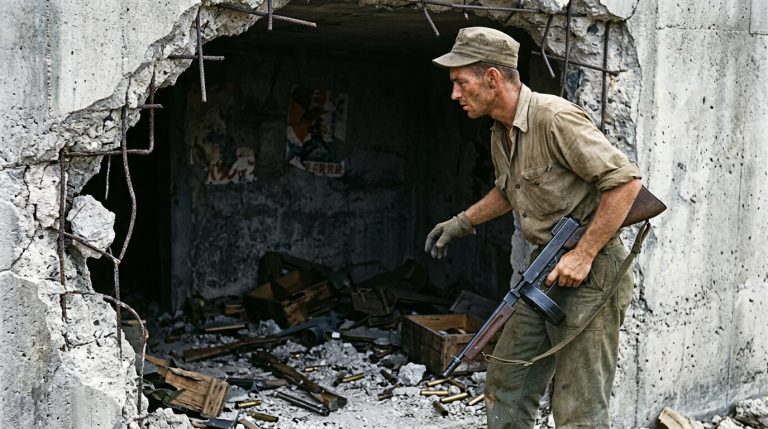
As the word chaos hit the air, the sound of the metal office door latching shut behind them echoed with a sharp, percussive crack. For a split second, the sound didn’t belong to the office. It was a mortar tube firing. The air in the room felt suddenly, violently pressurized. Vincent’s heartbeat spiked, a rhythmic, frantic thud that echoed the frantic pace of 1969. He felt the phantom vibration of a blast against his chest, the smell of cordite replacing the lemon-scented soap.
He gripped the edge of the desk, his knuckles turning white, his eyes fixed on the dust motes dancing in the shaft of light. Keep it down, he told himself. Keep it in the box.
He forced a slow, measured breath, the familiar ritual of suppression that had kept him upright for thousands of mornings. When the room stopped tilting, he turned back to Bennett. His face was a mask of practiced, rugged calm.
“I came here because I was tired of the noise,” Vincent said, his voice low and devoid of emotion. “You talk about training men for chaos. You know what that does? It leaves a resonance. A vibration that never stops. Every door that slams, every voice that rises too high, every sudden movement—it brings it all back. I didn’t want to forget. I wanted to hear myself think without the sound of incoming fire in the background.”
Bennett stared at him, his own expression softening into something uncomfortably close to grief. “So you became a ghost? You let everyone walk past you? You let people treat you like furniture for fifteen years?”
“I was never furniture,” Vincent said, and for the first time, a flicker of something sharp appeared in his eyes—not anger, but a deep, pragmatic resolve. He reached into his apron pocket and pulled out a small, bent silver key—the key to the cafeteria’s walk-in freezer, his only real domain. He held it up. “I was the man who kept the line moving. I was the man who made sure the kids who were just starting their service had a full stomach before they went back out there. Maybe that’s not a Silver Star. Maybe it’s not what you’d put on a plaque. But it was honest. It was quiet. And it was mine.”
He moved past the Admiral, his movements efficient and precise. He didn’t look back as he opened the door to leave the office, stepping back into the hum of the cafeteria. The smell of frying potatoes greeted him like an old friend.
“I’m going back to the line, Admiral,” Vincent said without turning. “The rush is starting. If you want to see who I am, look at the trays. Look at the kids. That’s where I live now.”
He walked out, the sounds of the base—the distant rattle of a truck, the chatter of voices, the clatter of silverware—rushing to meet him. He was back in the texture of his life, the faded, worn reality where every action was small, every impact was muted, and where, for now, the ghosts were kept at a safe, respectful distance.
CHAPTER 4: THE UNMASKING OF THE GUNNY
Vincent stepped back into the heat and humidity of the kitchen. The noise hit him like a physical wall—the clatter of trays, the hiss of boiling water, the muffled roar of the lunchtime rush beyond the swinging doors. It was a chaotic, beautiful, and utterly predictable rhythm. For fifteen years, this noise had been his anchor, a wall of sound that kept the silence of his own memories at bay.
He moved to his station, his hands instinctively reaching for the heavy metal spatula. He was a creature of habit, and the habit was his salvation. But as he glanced toward his small desk in the corner of the prep area—a space he treated with the reverence of a soldier maintaining a foxhole—his eyes snagged on something.
There, resting on the scarred surface of the desk, was a manila folder. It was thick, professional, and entirely out of place in a kitchen where the only paperwork was a duty roster and a supply list.
He hesitated. His pulse, which had just begun to steady, gave a treacherous, irregular stutter. He wiped his hands on his apron—a nervous, unnecessary motion—and walked over to it. The folder wasn’t marked with the usual base cafeteria codes. It was plain, save for a small, embossed seal of the Naval Base command.
He didn’t open it. He just stood there, looking at it, the fluorescent light above flickering with a dying, yellow hum. The folder felt heavy, a concentrated mass of institutional scrutiny. He didn’t need to read the contents to know what it contained: orders, histories, the unearthing of a man who had worked remarkably hard to stay buried.
“Gunny?”
Vincent turned. It was the young corporal he’d seen earlier, the one who had asked about his service. The kid looked hesitant, holding a tray that still contained a half-eaten burger. “Sorry to bother you, Gunny. I just… I wanted to say thanks again. For earlier. I don’t think I’ll ever forget that.”
Vincent’s gaze shifted from the folder to the corporal’s face. He saw the same hunger for purpose, the same terrifying, wide-eyed sincerity that he had seen in thousands of Marines over the decades. It was the look of a man searching for a North Star.
“You don’t need to thank me, son,” Vincent said, his voice flat, trying to keep the agitation from bleeding through. He gestured vaguely toward the folder. “Did you see who put this on my desk?”
The corporal blinked, surprised. “The Admiral’s aide, sir. Just a few minutes ago. Said it was for you.”
Vincent didn’t respond. He waited until the corporal left, then reached out and tapped the folder with his fingertip. It felt cold—a clinical, sterile contrast to the humid, greasy warmth of the kitchen.
He realized then that the mask he had spent fifteen years wearing—the mask of ‘Vince’ the cafeteria worker—wasn’t just slipping. It was being systematically dismantled. The Admiral wasn’t just offering a reunion or a conversation; he was forcing a collision between two worlds that Vincent had fought to keep separate.
He opened the folder. Inside were not just documents, but photographs. Grainy, black-and-white snapshots from 1969. A group of young Marines, dusty, exhausted, leaning against a sandbagged wall. In the center of the group, a younger, harder version of himself was laughing at something off-camera. His hand was resting on the shoulder of a man who looked remarkably like a younger version of Richard Bennett.
He stared at the faces, the textures of the photo—the grit, the sweat, the absolute, terrified clarity of youth. He had forgotten the way the light had looked that day. He had forgotten the sound of that laughter.
The kitchen around him seemed to lose its color, fading into the background. The roar of the cafeteria dimmed to a low, rhythmic pulsing. He wasn’t in the kitchen anymore; he was back on that sandbagged wall, feeling the sun on his neck, knowing that within an hour, the world would turn to fire and smoke.
“Gunny!”
The shout came from the head cook, a sharp, impatient sound that snapped the air in the kitchen like a whip. “We’re backed up! Get back on the line!”
Vincent didn’t look up immediately. He slid the folder into the bottom drawer of his desk, tucked it under a pile of old supply invoices, and took a long, jagged breath. He walked back to the serving line, his hands moving with the familiar, mechanical grace of a man who had learned to survive by doing, not by feeling.
As he stepped back into the line, he saw the Admiral standing near the entrance to the cafeteria, watching him. Bennett wasn’t moving. He was just standing there, a silhouette of white against the busy, chaotic motion of the lunch rush. He wasn’t interfering. He was simply waiting, a silent sentinel who knew that the past couldn’t stay buried forever, and that the man in the apron was finally, inevitably, stepping back into the light.
CHAPTER 5: THE ECHOES OF DA NANG
The dishwasher unit—an eight-foot-long, stainless steel monolith that usually purred with the efficiency of a well-oiled machine—decided that moment to protest. It let out a sound like a shrapnel strike, a sharp, metallic clank-hiss-pop that sent a cloud of caustic, white steam billowing across the kitchen floor.
The immediate result was sensory overload. The roar of the lunch rush in the dining hall outside seemed to amplify. The sound of ceramic trays hitting the concrete floor followed the steam, a symphony of destruction that tore Vincent from the sight of the Admiral.
He didn’t think. The muscle memory of twenty-eight years of service—ten of those in environments where equipment failure could mean the difference between mission success and catastrophe—took over. He lunged for the main power breaker, his boots sliding slightly on the slick film of grease and spilled dishwater that had already begun to pool.
The kitchen had descended into a controlled panic. Steam obscured the line of sight, making the silhouettes of the cafeteria staff move like ghosts in a fog. To Vincent, the haze wasn’t just steam. It was the thick, humid air of the jungle, the way the fog used to swallow the platoon whenever they pushed too deep into the valley. He felt the phantom weight of his ruck, the tightness of his webbing, and the distinct, chilling sensation that something was moving in the mist.
He reached the breaker box, his fingers fumbling with the heavy steel latch. The metal was burning hot, the electrical short clearly sending a surge through the casing.
Stay sharp, the voice in his head sounded like his old Platoon Sergeant—a man who had been dead for forty years. Stay in the present, Gunny.
He slammed the breaker down. The hum of the kitchen abruptly died, leaving only the frantic, ragged breathing of the staff and the distant, muffled noise of the confused diners in the cafeteria. The steam began to dissipate, and the stark, harsh reality of the kitchen reappeared.
Vincent stood there, chest heaving, his hands pressed against the vibrating metal of the wall. He was soaked in sweat. He was shaking. He looked down and saw his hands—the plastic gloves he’d been wearing had torn during the scramble, and a small, jagged piece of metal from the dishwasher’s casing had sliced a thin, crimson line across his palm.
He didn’t feel the cut. He felt the cold.
“Gunny? You alright?”
He looked up. It was Bennett. The Admiral had crossed the kitchen, moving with a grace that bypassed the chaos entirely. He didn’t look like an Admiral; he looked like a soldier checking his brother-in-arms after a near-miss.
Vincent wiped his hand on his apron, leaving a streak of red across the white fabric. “I’m fine,” he snapped, his voice raspy. “Just a busted valve. Keep the staff back. The steam’s still venting.”
“That wasn’t just a valve,” Bennett said, his gaze fixed on Vincent’s trembling hands. He didn’t offer help. He knew better. He stood close, his presence a barrier between Vincent and the curious stares of the cafeteria staff. “You were somewhere else, Vincent. I saw it.”
Vincent turned to face him, the adrenaline beginning to ebb, leaving behind a hollow, aching exhaustion. The ‘Decoy’—the idea that he was just a man hiding from the world because he disliked the politics of the modern military—felt paper-thin now. The reality was much heavier, and the Admiral’s piercing, relentless focus was the weight that was crushing it.
“I’m in a cafeteria, Rick,” Vincent said, his voice dropping to a low, serrated whisper. “I’m surrounded by grease and broken equipment. That’s where I am.”
“Then why is your hand shaking?” Bennett asked. “Why are you looking at the corner of the room like there’s a sniper waiting for you to move?”
The question was a direct hit. It wasn’t an interrogation; it was an act of recognition. Bennett was the only man alive who knew the landscape of that fear. He had been there, in the mud, staring at the same nightmare.
“You want to know why I’m here?” Vincent asked, the words spilling out before he could check them. “Because out there, in the world you live in—with your medals, and your ceremonies, and your ‘heroes’—the noise never stops. People talk about the ‘honor’ of the sacrifice, but they don’t talk about the sound the world makes when it’s breaking. I spent fifteen years trying to drown that sound out with the clatter of trays. I wanted to be invisible because when you’re invisible, you don’t have to carry the legacy of what you’ve seen.”
He looked at the Admiral, his eyes wet and burning. “You want to honor me, Rick? Then stop looking. Let me go back to the line. Let me be the guy who hands out the mash. Because if you pull me out of this, if you make me ‘The Gunny’ again, I have to be that man. And that man… that man doesn’t know how to live in a world that doesn’t have a front line.”
The kitchen fell into a profound, suffocating silence. The staff had backed away, leaving the two of them alone amidst the steam and the smell of ozone.
Bennett reached out, not to salute, not to command, but to rest a hand on Vincent’s shoulder—a gesture of shared, heavy history. “Maybe that’s why we’re here, Gunny. Because the front line didn’t end in 1969. It just moved. And maybe it’s time we both stood on it again. Not as ghosts, but as the only two people left who remember why we stayed there in the first place.”
Vincent looked at the Admiral’s hand, then up at his face. The resolution he had clung to for fifteen years was cracking, revealing the jagged, broken, but undeniably human core beneath. He wasn’t just a cafeteria worker. He wasn’t just a legend. He was a man who had survived, and the cost of that survival was finally, inevitably, coming due.
CHAPTER 6: THE BRIDGE OF PURPOSE
The counseling center was a building Vincent had walked past a thousand times but never entered. It sat at the edge of the base, shielded by a row of ornamental trees that blocked the view of the harbor. Inside, the air was different—it was stripped of the organic, chaotic smells of the kitchen, replaced by a climate-controlled, odorless sterility. It was the smell of bureaucracy, of files and forms and measured, cautious conversations.
Vincent sat in the reception area. The chair was upholstered in a scratchy, synthetic wool that chafed against his uniform sleeves. He watched the second hand of a wall clock, its steady tick-tick-tick sounding like the rhythmic striking of a match.
“Master Gunnery Sergeant Palmer?”
The voice was young, precise, and devoid of the grit that characterized the life Vincent had known. He stood up. His knees felt stiff, the years of standing on concrete floors finally catching up to him in the silence of this place. A woman in civilian clothes—sharp, professional, her hair pulled back into a tight bun—gestured toward an open office.
“I’m Dr. Aris. Please, come in.”
The office was aggressively white. Sunlight bleached the walls, turning the room into a kind of high-exposure laboratory. Vincent stepped inside, his eyes darting to the corner. For a fleeting second, the shadow cast by a bookshelf looked like a man standing at attention, the sharp line of a rifle silhouette against his hip.
It’s just a bookshelf, he told himself. Just steel and wood.
“Admiral Bennett spoke highly of your transition experience,” Dr. Aris said, gesturing to a seat across from her desk. She began sorting through a stack of folders—files of young men and women who were struggling to find their footing in a world that had suddenly become too big and too quiet.
Vincent sat. He didn’t relax. His back remained straight, his hands resting on his knees. “I’m not a counselor, Doctor.”
“We don’t need a counselor, Gunny,” she replied, her tone softening just a fraction. “We need a bridge. We have a Marine—Corporal Miller. He’s twenty-four, two tours in the Sandbox, and he’s currently refusing to leave his barracks room. He’s stopped responding to his chain of command. He’s convinced himself he’s broken beyond repair.”
As she spoke, the sound of a distant door slamming—a maintenance crew somewhere down the hall—vibrated through the floor. The sound was too sharp, too precise. In the back of Vincent’s mind, a voice shouted, “Down, Gunny, take cover!” It was a voice he hadn’t heard in five decades—the voice of Sergeant Miller, a man who had taken a mortar round in Da Nang.
Vincent’s vision blurred. The bright white walls of the office seemed to ripple like heat haze. He squeezed his eyes shut, his fingernails digging into the fabric of his trousers. It’s not here. It’s not then. It’s now.
“Gunny? Are you okay?”
He opened his eyes. Dr. Aris was leaning forward, her brow furrowed in genuine concern. He gripped the arms of the chair, forcing himself to breathe. The smell of bitter, burnt coffee from the reception area drifted into the room, anchoring him.
“I’m here,” he said, his voice sounding thin to his own ears. He took a steadying breath and forced his focus onto the folder she held out.
Inside was a photograph: a young, tired-looking Marine with eyes that held the same hollow, distant look Vincent saw in the mirror every morning. The corporal looked terrified, not of the world, but of the space between the front lines and the base.
“He’s not broken,” Vincent said, his voice regaining its rasping, grounded authority. “He’s just lost the rhythm. He’s been running for so long that he doesn’t know how to stop without the heart failing.”
“Can you reach him?” she asked.
Vincent looked at the photograph. He saw his own hands, calloused and mapped with age, and then he saw the corporal’s hands, clean but shaking. The realization struck him with the force of a physical blow: he wasn’t here to be cured. He wasn’t here to be retired. He was here to translate the language of the silence for someone else.
“I’ll reach him,” Vincent said, standing up. He felt the weight of the silver star—not the one on his apron, but the one he had earned in the mud—settling into his marrow. “But I don’t do it with files and forms. I do it by showing him that the life he lived out there doesn’t have to be the end of the story. It’s just the prologue.”
He walked out of the office, his step steadier than it had been in years. The air in the hallway felt lighter. He wasn’t back on the front line in the way the Admiral meant, but he was back in the service of something that mattered. The ghosts were still there, shifting in the corners, but for the first time in fifteen years, he wasn’t afraid of the noise they made. He was starting to learn how to turn that noise into a song.
CHAPTER 7: THE FINAL REUNION
The sky didn’t just darken; it bruised. Within minutes, the dry, sun-baked air of the base was replaced by the smell of ozone and wet earth. A torrential downpour descended, turning the walkways into rivers and driving everyone toward the nearest cover. Vincent found himself huddled under the rusted, corrugated metal roof of an old equipment pavilion near the harbor.
He wasn’t alone. A dozen other men were there, huddled out of the rain. They were older, their shoulders slumped with the specific, heavy exhaustion that only came from decades of carrying memories that refused to fade. As Vincent wiped the spray of cold water from his face, he realized who they were.
They weren’t just random base staff. They were the men from the battalion reunion.
The air under the pavilion was thick with the scent of wet wool and dampened cigarettes. It was a texture he knew intimately—the smell of a tactical pause in the middle of a long, miserable patrol. The sound of the rain drummed against the metal roof with a relentless, percussive rhythm that felt dangerously like incoming fire.
“Gunny?”
A man at the edge of the group stepped forward. His face was a roadmap of scars, but his eyes were clear. It was Miller, a man Vincent remembered from a jungle patrol that had lasted three weeks too long.
“I didn’t think you’d be here,” Miller said. His voice was gravelly, hesitant. “The Admiral said you were working the counseling center now.”
Vincent looked at the rain. The world outside the pavilion was a blur of gray and white, a chaotic wash that made the concrete of the base look like the shifting landscape of his past. The detour was an inconvenience, but standing here, surrounded by the men he had trained, he felt the decoy narrative of ‘resentment’ completely dissolve. He hadn’t been hiding because he hated the military; he had been hiding because he loved it too much to watch it continue to chew up boys and spit them out as broken men.
“I’m here,” Vincent said. He felt the cold iron of the rusted support pillar behind him. He reached out and gripped it, the rough, flaky metal biting into his palm. It felt real. Grounded. “I’m just… catching up.”
“We all are,” someone else muttered from the darkness of the group. “It’s been a long time, Gunny.”
As the group moved closer, seeking shelter from the wind-whipped spray, the dynamic changed. The space beneath the pavilion became a crucible. The men didn’t talk about their current lives, their jobs, or their families. They talked about the places they’d been. Not in stories of glory, but in the small, tactile details—the way the humidity felt in the jungle, the taste of the cold C-rations, the sound of the wind in the palms.
Vincent listened. He realized that the ‘invisibility’ he had practiced for fifteen years was a shared condition. Every man under this roof had spent their lives trying to reconcile the person they were in the field with the person they were expected to be in the world of soft beds and quiet rooms.
“I stayed in the cafeteria,” Vincent found himself saying. The words were quiet, barely audible over the roar of the rain. “I thought if I kept my head down, if I kept the trays clean and the food hot, I could keep the world from asking me for more than I had left to give.”
Miller leaned against the pillar beside him. “Did it work?”
Vincent watched a trickle of rainwater run down the rusted iron, tracing a path through the flakes of oxidized metal. He thought about the corporal he was supposed to see tomorrow. He thought about the Admiral, who had refused to let him stay hidden.
“No,” Vincent said. “I think the only thing I was really doing was holding my breath. And it’s hard to breathe when you’re underwater.”
The rain intensified, a wall of water that cut them off from the rest of the base. For these few moments, there was no rank, no counseling center, no ‘Master Gunnery Sergeant’ or ‘cafeteria worker.’ There were only men who had shared a fire that hadn’t quite gone out.
Vincent felt the tension in his shoulders ease, replaced by a strange, quiet ache. The ‘deception’ of his simple life wasn’t a failure—it was a period of silence. A necessary, long, painful period of silence.
“We’re going to the memorial tonight,” Miller said, looking toward the dark expanse of the harbor. “The one they built for the guys who didn’t make it back. You coming?”
Vincent looked at the rain, then at the men around him. The ghosts were no longer in the corners of the room; they were standing here with him, tangible, breathing, and real.
“Yeah,” Vincent said, his voice steadying. “I’ll be there.”
As the rain began to taper off into a soft, steady mist, Vincent walked out from under the pavilion. The ground was wet, the base illuminated by the soft, amber glow of the evening lights. He walked toward the harbor, the cold air filling his lungs, his path finally set. The detour was over. The truth of his life—that service wasn’t a choice, but a burden that one learned to carry with grace—was no longer a secret. It was the only thing that remained.
CHAPTER 8: THE QUIET PASSING
The end didn’t arrive with a clash of steel or the roar of an ambush. It came in the middle of a Tuesday night, in the small, unassuming apartment Vincent had called home for the last three years. It was a heart that had been worked too hard, hammered by the stress of two wars and the relentless, grinding pressure of fifteen years of self-imposed anonymity. It simply stopped.
The transition was peaceful, a quiet fading of light from a room that had seen enough fire in its lifetime.
The funeral at Miramar National Cemetery was a landscape of stark, monochromatic order. Two hundred people stood in the grass—rows of dress whites, blues, and civilians in dark, mourning tones. Admiral Bennett stood at the front, his own hair now as white as his dress uniform, his face carved with the deep, permanent lines of a man who had finally learned the full cost of leadership.
The ceremony was a symphony of precision. The 21-gun salute tore through the stillness of the morning, the sound sharp and metallic, yet it didn’t make Vincent flinch. It was just a sound, a mechanical repetition that no longer held the sting of the past. When the bugler sounded Taps, the notes hung in the cool, damp air like frayed threads, weaving together the disparate parts of a life that had finally found its whole.
When the flag was folded—a triangle of disciplined color—and presented to his daughter, Vincent’s daughter, who had traveled from Georgia to say goodbye to a father she had only understood in fragments, the reality of his journey settled over the crowd. She held the flag tightly, her knuckles white, her expression one of quiet, bewildered pride. She had known him as a cafeteria worker, as a veteran liaison, but she had never known the Gunny. Standing there, she finally saw the weight of the man who had been her father.
After the guests began to thin, moving toward their cars in a slow, respectful exodus, Bennett remained. He stood before the freshly placed headstone, his silhouette against the sprawling, green expanse of the cemetery. He stayed there for a long time, the only sound the rustle of dry grass in the breeze.
“You won, Gunny,” Bennett said, his voice quiet, directed at the cool marble of the marker.
He didn’t speak of the Silver Star or the battles. He spoke of the quiet. He spoke of the way Vincent had spent his final years, not as a hero of the state, but as a shepherd to the lost. Bennett reached out and placed a small, tarnished challenge coin on the top of the stone—a souvenir from the battalion reunion.
“You found the peace you were looking for,” Bennett continued. “And you made sure we were forced to look at it, too.”
The Admiral turned away, leaving the headstone in the soft, morning light. As he walked toward the parking lot, he saw a young Marine standing near the edge of the cemetery, a man no older than twenty-five, clutching a handwritten note. It was the corporal from the base, the one who had asked Vincent about his service. The young man stood in silence, his eyes fixed on the grave, his posture reflecting the same steady, quiet resolve that Vincent had taught him.
The service wasn’t over. It had never been about the uniform or the rank or the medals that were now stored in a drawer back in a small, empty apartment. It was about the way the light shifted as the sun rose over the hills, casting long shadows that eventually vanished into the clarity of the new day.
Vincent’s legacy wasn’t in the stones or the ceremonies. It was in the silence of the young Marine’s salute, in the way the Admiral walked with a lighter step, and in the way the world continued to turn, fed and cared for by those who had learned, from a man who hid in plain sight, that the greatest act of leadership is to be present, to be quiet, and to serve until the very last light fades.
The cemetery returned to a state of profound, natural stillness. The wind died down, and the only sound was the distant, rhythmic hum of the base, a pulse that continued, constant and steady, in the world Vincent Palmer had spent his entire life helping to protect. He was finally at rest, his purpose fulfilled, his story told, and his name, once invisible, now etched into the ground for all to see: a leader who served, and a man who finally, truly, came home.