The Language of Shadows and the Sovereign Code of Sacred Protection
CHAPTER 1: SHADOWS OVER THE ESPRESSO MACHINE
The brass handle of the portafilter bit cold into my palm. I locked it into the group head, pulled the lever, and let the dark espresso drip into two porcelain cups, keeping my eyes fixed strictly on the counter.
Across the street, parked directly in front of the dry cleaner’s hydrants, the black SUV hadn’t turned off its engine in three hours. The exhaust curled thin and grey into the damp October air.
“You’re going to burn the milk, Soph,” Rachel whispered, nudging my elbow with a tray of fresh mugs. “You’ve been staring at that curb since noon.”
“It’s the same car from the subway stop,” I said, wiping the stainless-steel steam wand with a damp rag. “And the same one from my street last night.”
“Did you call the precinct?”
“And tell them what?” I scraped a splash of dried foam off the counter with my thumbnail. “That a high-end vehicle is sitting on a public road? They’d laugh me off the line before I finished my zip code.”
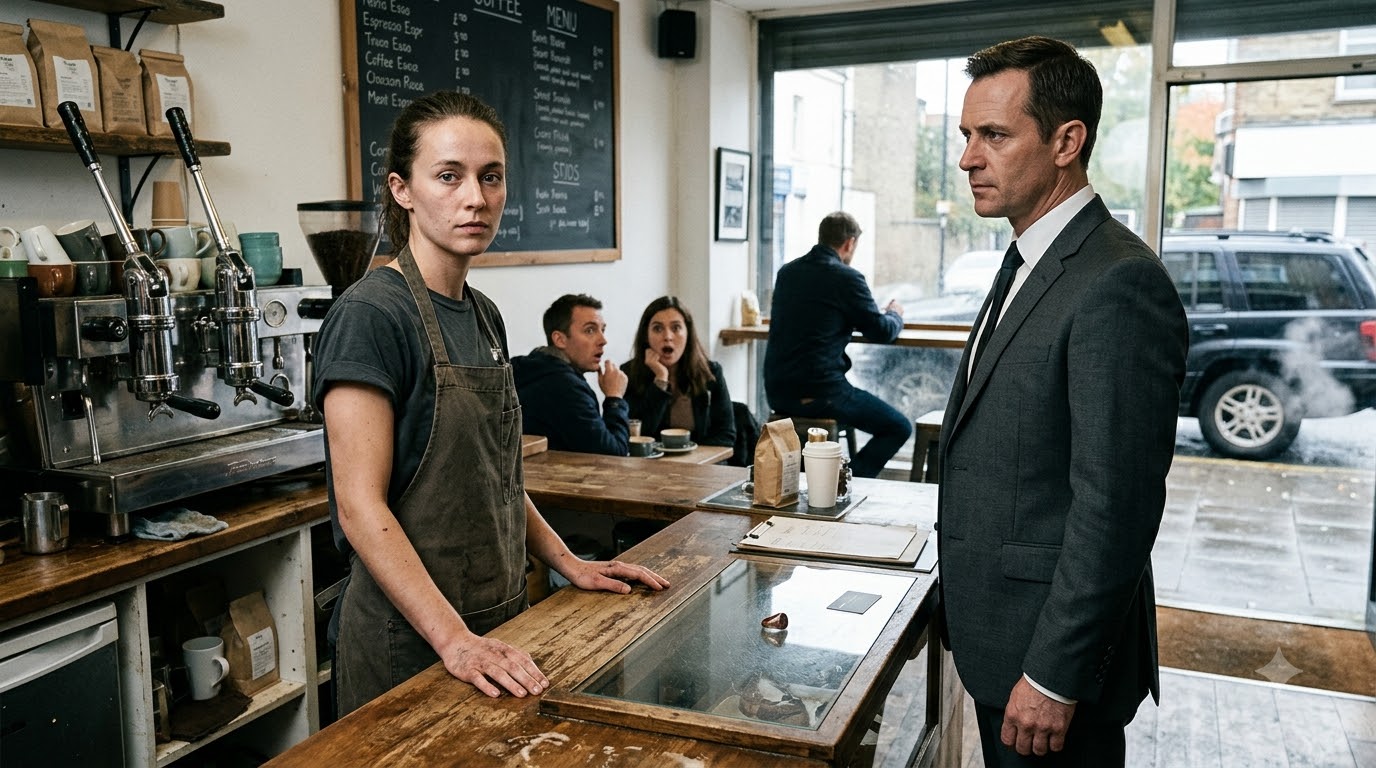
The bell above the shop door chimed. I didn’t look up immediately, letting my hands finish wiping down the grinder, but the shift in air pressure was obvious. The casual chatter at table four died instantly.
A man in a sharp charcoal suit stepped inside. He didn’t order coffee. He didn’t look at the chalked menu above my head. His eyes swept the small room once—checking the emergency exit, the kitchen kitchen door, the counter layout—before settling directly on me.
“Miss Blake,” his voice was clipped, carrying a slight European cadence that rasped against the hum of the refrigerator. “Mr. Russo requests ten minutes of your time.”
“I’m on the clock until six,” I said, my voice flatter than I felt. I set the rag down, deliberately placing my hands flat on the edge of the wooden counter. “And I don’t know a Mr. Russo.”
“You found his son in the park yesterday,” the man said simply. He didn’t move closer, but his posture blocked the narrow aisle between the display case and the front entrance. “He prefers to express his gratitude without an audience.”
“Tell him I don’t need a reward for helping a lost child.”
The man reached into his breast pocket. I tensed, my fingers tightening on the lip of the wood, but he pulled out only a small, heavy square of off-white cardstock. He laid it flat on the glass display case between two trays of biscotti.
“Nine-thirty tomorrow morning. The vehicle outside will bring you.” He turned on his heel and walked out, the bell chiming once as the heavy door swung shut.
I didn’t pick up the card immediately. I watched through the window as he crossed the street, opened the rear door of the idling SUV, and climbed inside. The black glass rolled up, completely sealing the interior from view.
When I finally reached across the counter to lift the card, something small and heavy rolled out from beneath its edge, clinking against the glass.
It was a tarnished copper signet ring, its crest worn completely smooth by decades of friction.
CHAPTER 2: THE TERMS OF NONNEGOTIABLE SANCTUARY
The suite didn’t smell like a corporate office. It smelled of old paper, cold tea, and the faint, bitter edge of beeswax polish.
Behind a desk carved from a single slab of dark walnut sat Alessandro Russo. He didn’t look like a tabloid monster or a cinematic kingpin. He looked like an exhausted man in a tailored navy suit who hadn’t slept a full four hours in months.
“Miss Blake,” he said, setting down a heavy fountain pen. “Thank you for coming.”
“I came because a man in a four-thousand-dollar suit dropped a dead man’s ring on my counter,” I said, stepping past the plush leather armchairs and stopping three feet from his desk. I kept my coat zipped. “And because your vehicles are destroying the parking turnover on my block.”
Alessandro turned the silver Zippo in his right hand, the metal clicking once against his thumb—clack. He didn’t smile, but the tension around his mouth shifted slightly.
“Direct,” he observed softly. “Marco said you were practical. Sit, please.”
“I’ll stand.” I reached into my pocket, pulled out the copper signet ring, and set it on the polished wood between us. “You want to thank me for finding Luca? Consider it done. We’re even. Keep your men off my street.”
Alessandro looked down at the ring, then up at my eyes. His gaze was dark, almost uncomfortably still.
“I offered you a formal arrangement,” he said, sliding a crisp, single-page document toward the edge of the desk. “Language instruction. Four afternoons a week. A standard contract.”
I didn’t even look at the paper. “I don’t sell my time to men who run private security details out of unmarked SUVs, Mr. Russo. And I don’t take money from people who intimidate coffee shop patrons.”
“There is no figure on that page, Miss Blake,” he replied, his voice dropping into a quiet, raspy register. “Look at it.”
I glanced down reluctantly. The line for financial compensation was typed with a clean, definitive zero. Below it, in precise print, were terms for personal security protocols, transport boundaries, and zero-liability clauses.
No salary. No monthly retainer. No life-changing payout.
“You think I want to work for free?” I asked, a dry laugh escaping my throat.
“I think you value your independence far too much to let me pay you,” Alessandro said, resting his elbows on the desk. The Zippo clicked again in his palm. “If I pay you, I am your employer. You answer to me. If you come to my house strictly to help a motherless boy speak the only language that brings him peace—on your own terms—then we are equals.”
“We are not equals,” I corrected flatly. “You have three armed men waiting by the elevator.”
“Those three men aren’t there to keep you in this room, Sophia,” he said, using my first name for the first time. The cadence was low, carrying the weight of an inescapable truth. “They are there to ensure the people who left that ring on your counter don’t take you out of it.”
The air in the room seemed to thin out instantly. I looked from his face down to the tarnished copper crest resting on the dark walnut.
“That ring didn’t come from my family,” Alessandro said softly. “It belonged to an informant who died in a federal holding cell twelve years ago. The people looking for his debts think you inherited more than his name.”
CHAPTER 3: THE BROKEN CIPHER OF THE TOWNHOUSE
The iron door didn’t yield easily. When the latch finally clicked, Teresa—the elderly housekeeper with a sharp, guarded posture—stood in the dim entry hall holding a folded linen towel.
“You’re wet, Miss Blake,” she said softly, not offering a smile. She handed me the cloth, her knuckles swollen with arthritis. “The boy is in the sunroom. He hasn’t touched his lunch.”
I wiped the cold drizzle from my forehead and unzipped my coat. “Did his father leave?”
“Mr. Russo is in his study until four,” Teresa stepped aside, her boots squeaking faintly on the marble floor. “He said you weren’t taking a wage. That makes you either very brave or completely out of your mind.”
“It keeps things clean,” I said, setting my wet bag on the wooden bench by the umbrella stand.
The sunroom at the back of the house was bright despite the grey rain beating against the overhead glass panels. Luca sat cross-legged on a faded Persian rug, staring at a half-finished wooden tower. He didn’t look up when the heavy oak door closed behind me.
“Il castello ha bisogno di un ponte,” I said quietly in Italian, stepping onto the edge of the carpet. The castle needs a bridge.
The five-year-old froze. His small shoulders dropped two inches, the rigid tension in his back melting instantly. He looked up, his dark eyes wide under a fringe of damp hair.
“Sophia?” he whispered, his voice tiny, rough from disuse.
“Sono qui,” I sat on the floor, keeping three feet of space between us. I reached for a loose pine block, rolling the rough wood between my fingers rather than crowding him. “Show me where the gate goes.”
For twenty minutes, the only sounds were the rain striking the glass above and the soft clatter of pine blocks against the rug. He spoke in short, hesitant Italian sentences—asking about the park, about the dog he had chased, about whether the men in suits were going to stay outside forever.
“They’re just standing by the gate, Luca,” I told him, fitting a roof piece onto his tower. “To make sure no one trips on the steps.”
He looked at me solemnly, then reached into his small jacket pocket. He pulled out a piece of heavy paper, creased four times along the seams, and handed it to me without a word.
I unfolded the square. It wasn’t a child’s drawing.
It was a photocopied page from an old municipal court ledger, dated nineteen years ago. At the bottom, listed under official state evidence exhibits, was a single item description typed in faded ink: Item 4-B: Tarnished Copper Crest Ring, Property of Informant E. Blake.
The air in my chest turned to lead. My father’s full name was Edward Blake.
I didn’t scream. I didn’t drop the paper. I folded it back along its original creases, precise and slow, until it was a small square again.
The door to the sunroom opened. Alessandro stood in the frame, his navy jacket removed, his white shirt sleeves rolled twice to expose forearms corded with muscle and pale scars. He held his silver Zippo between his index and middle fingers, unlit.
“Teresa said you were working through the lesson,” he said, his eyes dropping immediately to the small paper square resting beside my knee on the rug.
“The lesson is moving fine,” I stood up slowly, keeping my hands at my sides. I looked Alessandro straight in the eyes, ignoring the low hum of the rain above us. “Your house has an envelope problem, Mr. Russo. Things keep slipping into places where a five-year-old can reach them.”
CHAPTER 4: KINETIC THRESHOLD AT THE ALLEYWAY
The tires screeched against damp cobblestone, the sharp scent of burnt rubber filling the cabin through the air vents.
Marco didn’t panic. His jaw stayed set, a muscle ticking under his ear as he threw the steering wheel hard to the left.
“Keep your head down, Miss Blake,” he said, his voice flat, devoid of emotion.
Behind us, a grey sedan without license plates clipped the brick corner of a warehouse. Sparks showered across the passenger side window as the metal scraped along the wall, but the driver didn’t slow. He accelerated, intent on forcing our rear bumper toward the alley’s dead end.
I didn’t duck. I pressed my back hard against the seat, bracing my heels against the floorboards.
“There’s a delivery ramp two hundred feet up on the right,” I told Marco, pointing with a steady finger. “It’s blocked by steel refuse bins. Hit the iron frame, not the plastic.”
Marco glanced at the side mirror, then at the ramp ahead. He slammed his foot down.
The SUV hit the steel dumpster with a deafening metallic roar. The heavy bin buckled, sliding six feet across the wet concrete and wedging itself sideways across the narrow alley lane.
The grey sedan slammed straight into the obstructed barrier. The impact folded its front bumper inward like accordion paper, steam instantly erupting from its shattered radiator in a thick white cloud.
Marco brought our SUV to a controlled halt fifty yards past the wreck. He didn’t pull a weapon. He didn’t jump out screaming. He put the vehicle in park, locked all four doors with a heavy electric click, and reached for the radio unit mounted on the center console.
“Corner of Tenth and Washington,” Marco spoke into the microphone, his breathing completely steady. “The tail made its move. Vehicle disabled. No local authority contact needed.”
The sedan’s driver door forced itself open against the bent fender. A man stepped out into the rain, wincing as he favored his left leg. He wore a dark oilskin jacket, his hands empty, but his eyes locked onto our rear window with cold, systematic focus.
He didn’t run. He didn’t shout threats. He pulled a wet envelope from inside his coat, slapped it flat onto the hood of his smoking car, and weighed it down with a heavy iron bolt from the debris.
“He wants you to see it,” Marco observed, watching the man limp toward the street mouth. “He knows we won’t leave the vehicle.”
“I know what’s in it,” I said, my knuckles white against the armrest. “It’s the rest of my father’s file.”
The man reached the main street and vanished into the rain, leaving the smoking wreck blocking the alley behind us.
Marco switched the engine off, the quiet hum of the dashboard dying instantly. The storm pounded against the reinforced glass above my head.
“Mr. Russo is already on his way,” Marco said, not turning his head. “He told me to tell you something if this happened.”
“What?”
“He said your father didn’t die owing money to the syndicate,” Marco’s voice was almost lost under the drumbeat of the rain. “He died holding the ledger that proved the syndicate owed everything to him.”
CHAPTER 5: THE CORNERED RATS FINAL GAMBIT
Rain ran in steady rivulets off the rim of his oilskin cap, dripping onto the concrete floor between us. He didn’t look like a shadow anymore; up close, his collar was frayed, his skin flushed red with exertion and the bite of the autumn cold.
“You’re Edward Blake’s girl,” he said, his voice grating like gravel under a heavy boot. He didn’t drop the file. He held it against his chest like a shield. “You think because Russo lets you walk into his house that you’re clean? Your old man took three hundred thousand out of our union vault before they put him in the ground.”
“My father died in a federal holding cell with two dollars in his coat,” I said, stepping forward until the damp chill off his coat hit my face. I didn’t reach for a weapon. I didn’t call for Marco, who stood ten feet behind me in the shadows, his arms crossed, waiting. “And he didn’t take union money. He recorded every serial number your boss washed through the dockworkers’ pension fund.”
The man’s mouth twitched, a nervous spasm pulling at the corner of his lip. “It doesn’t matter what he wrote down! The debt follows the blood. Russo thinks he can cover you? Russo’s getting squeezed by the board right now because of this.”
“He’s not covering me,” I said flatly. “I don’t work for him. I don’t take his checks. And I don’t pay debts manufactured by men who run out of steam after a ten-yard dash.”
He sneered, shifting his weight, his boots squeaking against the wet floor. “You’ve got no standing here, lady. You’re a coffee shop worker playing house with a family that’ll throw you to the wolves the second the DA issues a subpoena. Hand over the original ledger copies your father left in the Queens safe deposit box, or this city turns into a very small room for you.”
I reached into my pocket. He flinched, taking half a step back, his hand tightening around the paper folder until the cardboard creaked.
I pulled out my phone. The screen was black. I laid it on a rusty iron oil drum between us, tapping the glass once with my fingernail—tap.
“There are no copies in Queens,” I told him, keeping my cadence low, measured, and entirely unbothered by his posturing. “The originals were submitted to the Southern District grand jury three hours ago by Edward Blake’s estate executor. Me.”
The man’s breath hitched, a harsh gasp that rattled in his throat. His eyes darted past my shoulder toward Marco, then back to the phone on the drum.
“You’re lying,” he rasped, though the sudden pale drain of blood from his cheeks said otherwise. “You wouldn’t risk your own neck—”
“—My neck was on the line the moment you dropped that copper ring on my counter,” I interrupted, leaning in over the drum. “You weaponized my father’s memory because you thought I was desperate for a payday or protection. You thought I’d run to Russo and hide behind his money. But I don’t use his money. And now your paper trail is sitting on a prosecutor’s desk with your name on the cover page.”
He didn’t scream. He didn’t rush me. He slammed the dossier onto the iron drum, his chest heaving as the absolute failure of his leverage collapsed around him.
“You ruined it,” he spat, his fingers trembling as he backed toward the open archway and the pouring rain outside. “You ruined the whole leverage structure!”
“Get out of my sight,” I said, turning my back on him before he even cleared the door.
CHAPTER 6: THE QUIET NORMAL OF THE QUIET ROOM
The hum of the refrigerator kicked off, leaving the room in a calm, heavy silence.
No black SUVs sat idling by the fire hydrant down on the curb. No men in charcoal suits waited in the stairwell. The grand jury had unsealed the indictments late yesterday afternoon, sweeping away the rival syndicate’s board members and their petty extortionists in one clean, institutional stroke.
I took a slow sip of black coffee, letting the heat settle deep into my chest.
The phone on the laminate table vibrated twice against the grain of the wood. I picked it up without rushing.
“Sophia,” Alessandro’s voice came through the speaker, raspy, low, but completely stripped of the jagged edge that had carried through his words for weeks. “Marco said he delivered the file copy back to your father’s estate attorney.”
“He did,” I said, leaning back against the wooden chair frame. “It’s filed.”
“Luca asks if you are coming at two,” he paused, the faint, familiar metallic snap of his silver Zippo clicking unlit in the background—clack. “He built another bridge. He says this one doesn’t fall down.”
“Tell him I’ll be there at two sharp,” I said. “And tell him we’re using pine blocks today, not cardboard.”
A low, rare sound came through the line—Alessandro laughing quietly into the receiver. “He’ll have them ready.”
“And Alessandro?”
“Yes?”
“Don’t send a car,” I set my mug down, the ceramic base settling onto the coaster with a firm, solid thud. “I’m taking the subway.”
“I know,” he replied softly. “I’ll see you at two, Sophia.”
I hung up, laying the phone flat beside my mug. I reached over, lifted the worn copper signet ring off the windowsill where it had sat all week, and dropped it into the small wooden drawer where I kept my spare keys and coffee filters.
I pushed the drawer shut until the latch caught tight.
The sun moved another inch across the floorboards. I picked up my mug, took one last sip of hot coffee, and listened to the peaceful, quiet morning of my own home.