The Price of Gold and Butter: A Billionaire’s Secret Shield for a Stolen Childhood
CHAPTER 1: THE GLASS AND THE FROSTING
The late afternoon humidity clung to the pavement like grease.
Nathan thumbed the cracked face of his mother’s silver pocket watch inside his tailored jacket, feeling the sharp ridge of the dent near the winding stem. His driver was idling the Mercedes sixty feet down the avenue, hazards blinking against the neon glare of downtown shopfronts. In twenty minutes, his sister would expect him at the Grand Regency ballroom, where a hired quartet was currently tuning violins for a seven-year-old’s birthday party.
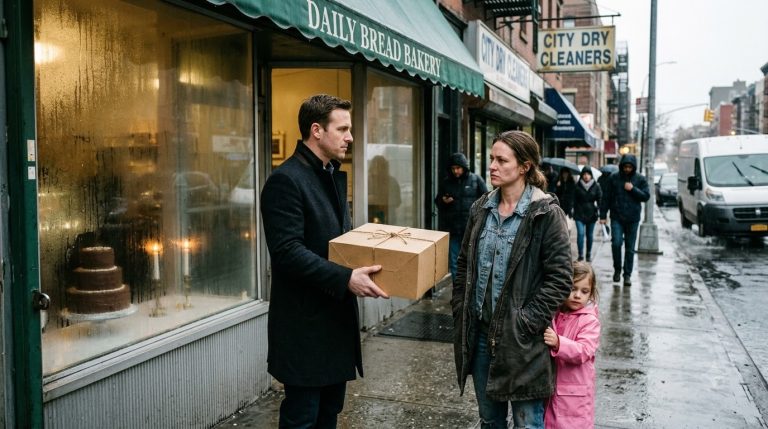
Then the little girl in the faded pink sweater pressed her forehead against the glass of Sweet Dreams Bakery.
“It’s okay, Mama,” the child said. Her voice was too small for the street, but it cut straight through the low rumble of a passing city bus. “We have to pay for the apartment first.”
The mother didn’t cry. She just stayed on one knee on the dirty concrete, her faded jeans frayed at the cuffs where they met worn sneakers. She smoothed down the child’s hair—dark, slightly damp from the muggy air—with a hand that bore the red, dry knuckles of someone who washed industrial diner trays for twelve hours a shift.
“I know, sweetie,” the woman murmured, her posture stiff with the desperate, quiet dignity of a person trying not to break in public. “Maybe next year.”
Nathan stopped three feet behind them. The asphalt beneath his leather soles was hot. On the other side of the display glass, a three-tiered buttercream confection sat on a silver pedestal, ringed with hand-piped roses and white chocolate ribbons. A gold card beside it read: Reserved for Henderson Nuptials.
The mother stood up, taking the girl’s hand. The child didn’t throw a fit. She just gave the cake one last, lingering glance—the kind of look that belongs to a person who already knows the world doesn’t make exceptions for them—and turned toward the bus stop.
Nathan’s fingers clamped tight over the watch in his pocket. The silver bit into his palm.
He didn’t call after them. He turned on his heel and pushed through the glass door of the bakery, the overhead brass bell clinking sharply above him.
“Mr. Crawford!” The counter clerk, a woman in a flour-dusted apron, blinked in surprise, her hands dropping from a stack of pastry boxes. “We didn’t expect—is your sister’s order missing something?”
“The three-tier display cake,” Nathan said. His voice was flat, carrying the cold, quiet cadence of a board meeting. “Box it.”
The clerk paused, her smile faltering. “Sir? That’s a custom display piece for a wedding tomorrow morning. The head pastry chef spent three days on those sugar ribbons.”
“Then call him in to start another one tonight,” Nathan said. He pulled a black corporate card from his billfold and set it flat on the glass counter. “Double his rate. Triple the shop’s daily overhead. Pay whatever rush delivery fee it takes to get the flowers replaced by dawn.”
“Mr. Crawford, we can’t just—”
“I am not asking for a discount,” Nathan said, leaning forward slightly. The air in the bakery smelled of vanilla essence and hot sugar, heavy enough to choke a man. “I am buying that cake, right now, along with the labor to remake it. Put a blue number six candle in the top box.”
The clerk looked from the black card to Nathan’s eyes. She didn’t argue a second time.
Five minutes later, Nathan stepped back onto the muggy sidewalk carrying a heavy, reinforced cardboard box that smelled of rich butter and spun sugar. His driver saw him and immediately shifted the car into drive, pulling up to the curb with the rear door popping open.
Nathan ignored the open door. He walked right past the vehicle, his eyes locked on the two figures half a block down, moving slowly past a laundromat toward the bus line.
“Mr. Crawford?” his driver called out, leaning out the window. “Your sister called twice. They’re cutting the ice sculpture.”
“Tell her I got delayed by a board matter,” Nathan said without looking back. “Go to the venue. Leave the car.”
He picked up his pace, the heavy cake box held level against his chest, the cardboard absorbing the heat of his hands.
CHAPTER 2: THE SIXTH FLOOR WALKUP
The hallway smelled of scorched vegetable oil and old plaster. A single bare bulb hummed against the water-stained ceiling, flickering every time someone turned on an appliance behind the hollow-core doors.
Nathan shifted his grip on the box, the heavy pastry shifting half an inch inside. Jessica was already four steps ahead, her key ring jangling in her hand—a cheap plastic tab with two brass keys and no fob.
“It’s dirty,” she said, her voice dropping into a flat, protective monotone as she jammed the key into a dull silver deadbolt. “The super hasn’t swept the stairwell since June. You don’t have to come inside.”
“The box lacks handles, Jessica,” Nathan said, keeping his tone measured, perfectly level. “If I drop it now, six years of waiting ends up on your linoleum.”
She froze for a fraction of a second, her hand still on the brass knob. She didn’t look back at him. She just pushed the door inward, releasing the sharp, clean scent of lemon floor cleaner mixed with old paper.
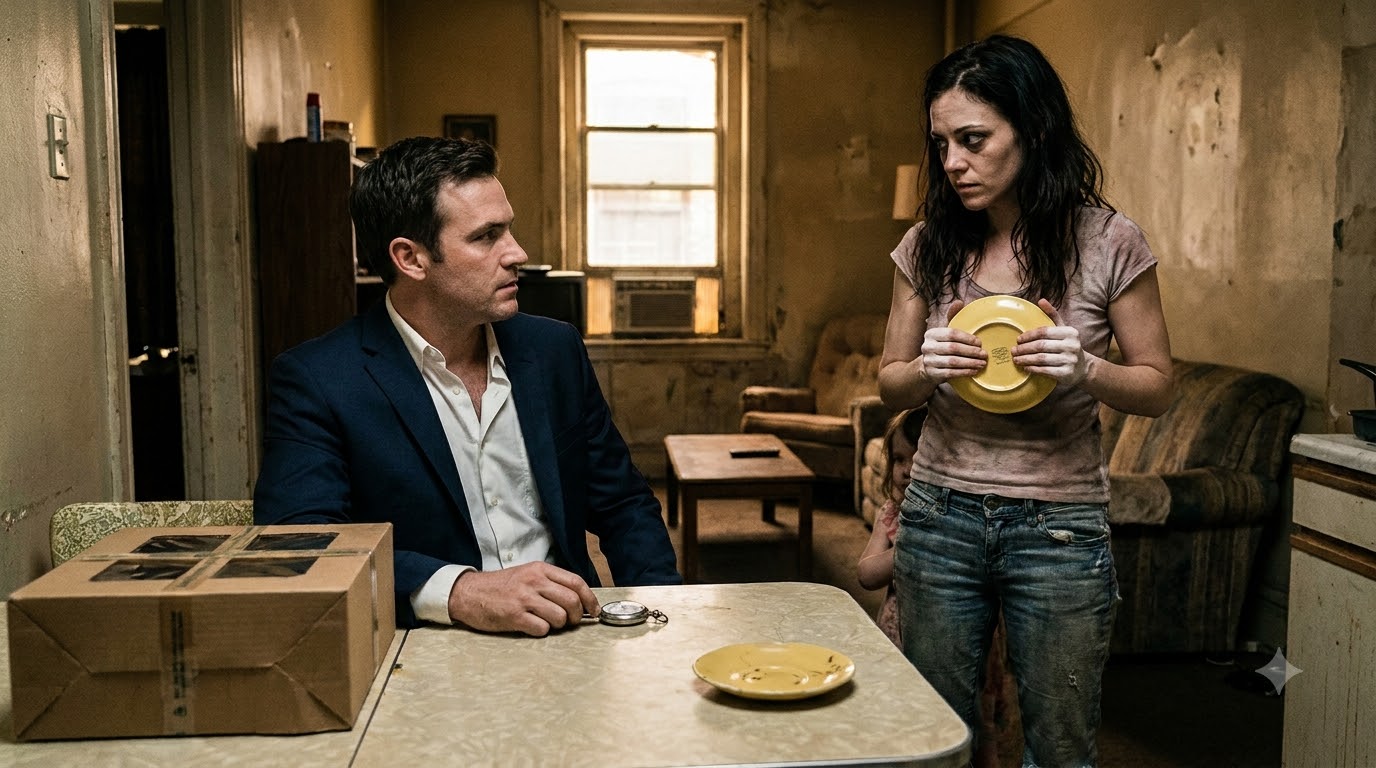
The apartment was ninety square feet of surviving.
A single sofa with a grey fleece throw draped over a frayed arm took up half the living room. On the windowsill, three glass pickle jars held handfuls of yellow dandelions, their stems fading to pale green in tap water. Natalie slipped past Nathan’s hip like a ghost, her small sneakers making no sound on the scrubbed floorboards as she went straight for the small laminate table in the corner.
“Here, Mr. Nathan,” she whispered, her hands clasped behind her back. “This is where we eat.”
Nathan walked carefully, his leather soles catching slightly on a loose strip of metal trim near the kitchen threshold. He set the heavy box down dead-center on the small formica table, the legs groaning under the weight.
He didn’t pull back his hands right away. He kept his palms flat against the sides of the cardboard, feeling the cool moisture of the bakery’s cooling pack against his skin. His eyes swept the small room in four seconds—a habit formed over fifteen years of assessing asset valuations and distressed balance sheets.
No television. A single desk fan in the window, its plastic blades whirring with a rhythmic, metal-on-metal ticking sound. On the counter, a plate held three slices of white bread and a jar of store-brand peanut butter with a knife scraped clean against the rim.
“I don’t have proper dessert plates,” Jessica said. She was standing by the sink, her back turned as she pulled three mismatched stoneware saucers from a cupboard with a squeaky hinge. “I have these. My mother gave them to me when I moved out.”
“They’ll do fine,” Nathan said.
He unbuckled his navy suit jacket, unbuttoning it with one hand while keeping the other anchored to his pocket, where the dented silver watch pressed against his thigh. He pulled a chair out—the wood was light, cheap pine—and sat down, adjusting his posture so his knees didn’t knock against the table’s low frame.
Natalie pulled up a small plastic step-stool, sitting on it with her chin barely clearing the formica edge. Her eyes were fixed on the blue ribbon sealing the top flap of the box.
“Is the number six inside?” she asked softly.
“It is,” Nathan said, reaching for the ribbon. He didn’t untie it with a flourish. He pulled the knot straight, the silk sliding through his calloused fingers with a soft rasp. “And it’s blue.”
Jessica set the three saucers down on the table, her thumb lingering on the chipped edge of the yellow one. She didn’t sit. She stood three inches behind her daughter’s shoulder, her posture rigid, her eyes fixed on Nathan’s face with a fierce, quiet suspicion that no amount of free sugar could melt.
“Who are you, really?” she asked, her voice barely louder than the whir of the window fan. “Men who own cars like yours don’t carry bakery boxes up six flights of stairs for strangers.”
Nathan lifted the top flap of the box, letting the rich, dense scent of real vanilla fill the small, hot room.
“I’m a man who knows what an empty table looks like on a Tuesday,” Nathan said.
CHAPTER 3: A SEAT AT THE BROKEN TABLE
“I know what it costs to keep the lights on when nobody is coming through the door,” Nathan said, his voice low enough that Natalie had to tilt her head to catch the words.
Jessica didn’t move from behind her daughter’s shoulder. Her fingers tightened on the edge of the chipped yellow saucer until the skin over her knuckles turned white.
“We don’t need charity, Mr. Crawford,” she said. Her tone was sharp, trimmed thin by years of turning down condescending handouts from municipal agencies and well-meaning supervisors. “I work forty-eight hours a week at the diner. I pay my bills.”
“You pay your rent,” Nathan corrected gently, sliding a wedge of buttercream cake onto the yellow plate. He handed the first slice to Natalie, who took it with both hands as if it were glass. “Your transmission is slipping in second gear. I heard it when you pulled away from the curb three blocks back.”
Jessica’s jaw set into a rigid line.
She picked up the second saucer, her eyes locked on his navy suit, taking in the hand-stitched lapels and the silent, heavy reality of a man who had never had his water shut off on a Friday afternoon.
“And you think buying a bakery cake gives you the right to run an audit on my life?”
“No,” Nathan said, pulling the dented silver watch from his jacket pocket and setting it flat on the formica between them. The cracked glass face caught the dim yellow glare of the ceiling bulb. “It gives me six minutes to eat a piece of cake on a Tuesday. The rest is just common sense.”
Natalie took a cautious bite, her eyes widening instantly as the ganache met the heavy vanilla sponge. A small speck of white frosting landed on her chin.
“Mama,” the girl whispered, nudging her mother’s hip. “It tastes like actual sugar. Not the store kind.”
Jessica looked down at her daughter. The hard, protective set of her shoulders faltered for a fraction of a second—just long enough for a deep, ragged breath to pass through her nose. She reached out, her thumb catching the speck of frosting from Natalie’s chin, but she didn’t sit down.
“Why the watch?” Jessica asked, her voice losing its combative edge, replaced by a weary curiosity.
Nathan turned the silver casing with the tip of his index finger.
“My mother wore it until the winding stem broke,” he said, keeping his eyes on the cracked face. “She worked three jobs in Chicago after my father left. On my seventh birthday, she was so tired she fell asleep on the bus ride home and left the groceries under the seat. No cake. No candles.”
Jessica watched the way his thumb traced the dented silver.
“And a billionaire remembered that?”
“A billionaire can’t buy back a seven-year-old’s Tuesday,” Nathan said. “I can’t hand you a check, Jessica. Your pride wouldn’t let the ink dry, and frankly, cash doesn’t fix a broken engine or a landlord who ignores your maintenance calls.”
As if summoned by his words, a heavy, metallic thud echoed from the hallway outside, followed by the sharp, authoritative slap of a paper flyer being taped directly to the hollow-core wood of the apartment door.
CHAPTER 4: THE NOTICE ON THE DOOR
Jessica was at the door before the heavy footsteps down the hall had even cleared the third step.
She yanked the door open, the brass lock clicking hard against the frame. No one was in the hall—just the echo of steel-toed boots descending the concrete stairwell two floors below.
Plaster dust drifted down onto the red piece of paper taped at eye level.
Jessica peeled it off, the cheap scotch tape pulling a strip of faded white paint with it. Her eyes scanned the black block text once, twice, before her breathing went shallow and fast.
“Three days,” she whispered, her fingers crumpling the corner of the sheet. “He gave us three days to clear out.”
Nathan didn’t rise from his chair immediately. He picked up his mother’s silver watch, slipped it back into his jacket pocket, and stood up with unhurried precision. He stepped into the doorway, taking the red paper from her hand without asking.
NOTICE OF IMMEDIATE LEASE TERMINATION & STRUCTURAL EVICTION.
The letterhead bore a crest in heavy ink: Vanguard Residential Management. Below it, a line cited uninspected plumbing violations and unpaid municipal surcharges dating back four months—an arbitrary, fabricated legal pretext designed to force low-income tenants into instant default.
“I paid July on the second,” Jessica said, her voice shaking as she grabbed a manila folder from the top of the refrigerator. She shoved three carbon-copy receipts under Nathan’s face. “Look. Money order receipts. Stamp from the building office. I don’t owe them a dime.”
“They don’t want your rent, Jessica,” Nathan said, turning the paper over to check the notary stamp at the bottom. The notary’s seal belonged to a shell firm he recognized instantly from a merger portfolio three months ago. “They want the building empty by Friday so the demolition permits clear without public hearings.”
“I have nowhere to take her in three days,” Jessica said, looking back at Natalie, who was sitting very still on her stool, watching them with wide, silent eyes. “First and last month’s deposit on a new place is two thousand dollars. I have eighty-four dollars in checking.”
“You aren’t moving,” Nathan said flatly.
“You don’t understand how these people work!” Jessica’s voice cracked, dropping into an urgent, fierce whisper. “They turn off the water. They lock the front gate. If you fight them in court, they drag it out until you lose your job from missing shifts!”
“I know exactly how they work,” Nathan said. He pulled his mobile phone from his inner pocket, his thumb sliding across the screen to pull up his executive directory. “Which is why you aren’t going to court, and you aren’t paying a single dollar out of pocket.”
“Mr. Crawford—”
“Vanguard Residential is a subsidiary of Apex Urban Holdings,” Nathan said, his voice entirely stripped of warmth, replaced by the cold, razor-sharp authority that built his fortune. “Apex owes eighty million dollars on an unsecured line of credit to a commercial bank whose board I chaired until last November.”
He dialed a three-digit extension, setting the phone to speaker as he held it between them.
“They think they’re clearing a rundown block for luxury condos,” Nathan said, looking Jessica straight in the eye as the ringback tone sounded twice through the small speaker. “They don’t know who just sat down at your table.”
CHAPTER 5: THE SILENT MACHINERY
“Crawford?” David’s voice came through crisp, punctuated by the background clatter of keyboard strokes. “Where are you? Your sister called my desk three times. She said you missed the ice cutting.”
“I’m standing in an apartment on Riverside Drive,” Nathan said, his voice level as he smoothed the crushed corner of the red eviction paper against his thigh. “Who holds the debt package on Vanguard Residential?”
A brief pause stretched over the speaker line, the sound of rapid typing resuming.
“Vanguard?” David muttered. “Hold on. They’re under Apex Realty Group. We restructured their commercial paper back in March. Twelve-year note, quarterly compliance reviews.”
“Check the default clause under Section 4B,” Nathan said, watching Jessica’s knuckles white-out around her manila folder. “The clause regarding municipal code misrepresentations and tenant harassment.”
“Why am I checking 4B on a regional housing portfolio at seven in the evening?”
“Because Vanguard just slapped a forged three-day eviction notice on a door in this building,” Nathan said, his eyes fixing on the faded brass padlock resting inside his open desk memory—the same corporate stamp Vanguard used on fifty buildings across the ward. “And if Apex is falsifying code violations to bypass public hearings, their whole debt package is in material breach by midnight.”
On the other side of the small kitchen, Jessica took a slow step backward, her shoulder touching the refrigerator frame as she listened to the cold, methodical exchange.
“If I call their managing partner right now,” David said, his tone shifting instantly from confused to razor-sharp, “Apex will freeze Vanguard’s operating account before the morning shift.”
“Don’t just freeze it,” Nathan said. “Issue a formal demand for an immediate third-party audit of every lease in this block. Tell them if a single tenant gets locked out or has their utilities tampered with, the bank accelerates the whole sixty-million-dollar principal.”
Silence hung over the line for two long beats.
“They’ll fire the regional property manager by breakfast,” David said simply. “And the landlord will be tied up in regulatory discovery for eighteen months.”
“Make it two years,” Nathan said, and hung up.
He set his phone back into his inside pocket and looked at Jessica. She hadn’t dropped her folder, but her posture had shifted—the rigid, defensive wire in her back slacking just enough for a deep, shaky breath to fill her chest.
“They’ll come back,” she said, her voice small, testing the reality of what she’d just heard. “People like that always find another angle.”
“They won’t,” Nathan said. “The bank owns their leverage now. But you still need a job that doesn’t ruin your knees for forty hours a week.”
“I told you,” Jessica said, her defensive edge flaring instantly like an old habit. “I don’t take charity.”
“It’s not charity, Jessica,” Nathan said, reaching for his jacket on the back of the pine chair. “It’s an opening in customer logistics at my distribution hub on Forty-Fifth. Full benefits, fixed morning shifts, and tuition assistance for dependents. Human Resources receives about two hundred applications a month.”
He paused, setting his Mother’s silver watch back into his pocket with a quiet click.
“Your application is going to be at the top of the stack tomorrow morning,” he said. “Whether you choose to interview is entirely up to you.”
CHAPTER 6: THE LONG ECHO
The fan in the window gave a soft, rhythmic click as the late evening breeze finally cut through the muggy air, stirring the paper dandelions in their jar.
Jessica didn’t drop her manila folder, but she set it down on the formica table right beside the blue number six candle. Her hands were still, her fingers resting flat against the laminate wood.
“My shift starts at six tomorrow morning,” she said, her voice quiet, entirely free of the guarded tension that had held her shoulders tight for three years. “I’ll have to give two weeks’ notice to the diner.”
“Take the full two weeks,” Nathan said, adjusting the cuffs of his shirt as he stepped toward the door. “Work your hours. Leave with your head up and a clean record. The corporate office on Forty-Fifth doesn’t move anywhere.”
Natalie set her fork down on the saucer with a soft chink. She slid off her plastic step-stool and walked over, stopping two feet from where Nathan held his jacket.
“Mr. Nathan?” she asked, her voice clear in the quiet room.
“Yes, Natalie?”
“Is the cake man coming back next year?”
Jessica let out a tiny, breathless sound—half a laugh, half a quiet catch in her throat—and reached down to smooth her daughter’s collar.
Nathan looked at the small girl, then pulled his mother’s cracked silver watch from his pocket one last time. He didn’t turn the casing. He just held it in his palm, feeling the steady, unbroken tick of the internal spring against his thumb.
“The cake man won’t need to come back,” Nathan said, looking up to meet Jessica’s eyes. “Your mom has everything under control.”
He slid the watch back into his pocket, turned the brass deadbolt, and pushed open the heavy front door.
The red eviction paper was gone from the wood, leaving only a tiny square of torn white paint where the tape had been. Down the hall, the building was quiet, the bare bulb above the stairwell humming steadily against the concrete ceiling.
Nathan walked down the six flights of stairs, his leather soles making a rhythmic, deliberate sound against the stone treads.
When he pushed through the glass front doors of the building, the humid night air hit him, carrying the scent of asphalt and river water. His Mercedes was still idling at the curb sixty feet down, its hazards blinking silently against the dark shopfronts across the street.
He didn’t get into the back seat.
Nathan walked around to the driver’s side, knocked twice on the glass, and waited for his driver to roll the window down.
“Mr. Crawford?” the man asked, looking back in surprise. “Your sister called four more times. The party ended twenty minutes ago.”
“Tell her I’m on my way,” Nathan said, opening the driver’s door and stepping out onto the pavement. He reached into his pocket, took out the silver watch, and set it carefully in the cup holder between the front seats. “And tell her I’ll be driving myself home tonight.”
He shut the door, adjusted his rearview mirror, and pulled out into the slow evening traffic, leaving the Riverside block behind in the quiet dark.