The Silent Marine Refused to Speak, Until an Entitled General Forced Her Hand
CHAPTER 1: THE COLD INTERROGATION
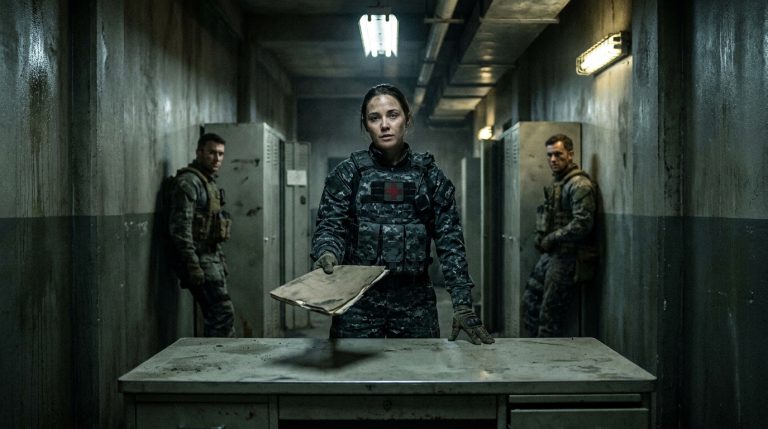
The room had no windows and no warmth.
Fluorescent lights buzzed overhead, casting a flat, sickly glow across navy walls and a single metal table bolted to the concrete floor. Three wall-mounted cameras watched from the corners, their red indicators blinking in slow, patient rhythm.
I sat alone at that table, my palms resting flat against the chilled steel. I didn’t shift. I didn’t fidget. I kept my posture straight, taking a slow breath in for four counts, holding for two, and letting it out for six. Across the table, a paper cup filled with lukewarm water sat untouched—my only physical anchor in a room built to strip away composure.
Lieutenant General Harold Vance leaned forward in his leather chair, elbows resting comfortably on his desk. He flipped open my service folder, smiling like a man about to deliver a punchline to an audience that was already in on the joke.
“Let’s talk about your kill count, Staff Sergeant,” Vance said, his voice easily carrying across the room.
A few junior colonels near the back chuckled on cue. I didn’t blink. I didn’t lower my eyes to match their grins. I stared straight past Vance’s left shoulder, keeping my face as blank as a fresh sheet of paper.
“Just enough, sir,” I replied. My voice was low, flat, and devoid of heat.
The quiet chuckle died instantly. Vance’s smile didn’t fade, but it hardened around the edges, turning brittle. He tapped a manicured fingernail against the top page of my record—a page so heavy with thick black lines it looked like a barcode.
“That’s a cute line for the barracks, Vale,” Vance said, leaning back and lacing his fingers over his stomach. “But on paper, your career reads like a clerical error. Three deployments with no unit attachments, two commendations with no unit citations, and eight months completely unaccounted for in the Arabian Sea.”
He looked around the room, inviting the legal officers and observers to share in his disbelief.
“To anyone else, this looks like favoritism,” Vance continued, his voice dripping with false concern. “Or maybe someone high up was hiding a problem child. Care to enlighten the board why your records read like a travel brochure with the pages torn out?”
I reached out with my right hand, sliding my index finger along the damp, soft rim of the paper cup. I didn’t drink. I just aligned the seam of the cup with the edge of the metal table, using the physical friction to bleed off the cold surge of anger rising in my throat.
“I am not authorized to discuss operational parameters, General,” I said cleanly.
“That seems to be your favorite song,” Vance snapped back, the friendly mask slipping just a fraction. “We’re not asking for state secrets, Sergeant. We’re asking for accountability. Who did you report to? What was your function? Were you even necessary?”
The word landed like an iron boot on a thin board. I felt the pulse in my jaw tighten once, hard, before I forced the muscle to relax. I kept my eyes locked on the wall behind him.
“I fulfilled every lawful order assigned to me,” I said.
“That’s a dodge, not an answer,” Vance said, leaning over the table, his eyes narrowing as he tried to catch a crack in my mask. “In my military, people who do real work leave a trail. People who hide behind redactions are usually hiding from their own failures.”
He turned a page in the file, his eyes sweeping over the sanitized lines. He thought he was backing a cornered dog into a wall. He didn’t know I was counting the seconds until he overreached.
CHAPTER 2: THE TRAP NARROWS
My index finger remained anchored to the damp paper seam of the water cup, my body locked at a rigid ninety-degree angle to the cold steel table.
General Vance leaned forward until his gold stars reflected the harsh glare of the overhead fluorescents. “Let’s narrow the lens, Staff Sergeant,” he said, his tone dropping into a rehearsed, soothing purr meant to sound like mercy. “Your last assignment before this administrative review. Attachment to a Navy maritime task unit. Persian Gulf, correct?”
“I am not authorized to confirm or deny operational theatres, General,” I said, keeping my eyes fixed on the wall space two inches above his left shoulder.
“Right, right. The oath,” Vance said, waving a hand lazily as if brushing away a fly. “A very convenient shield. But let’s look at the logistics record—something that isn’t classified.” He pulled a fresh sheaf of paper from a manila folder, sliding it toward the center of the desk with a sharp, paper-on-wood rasp. “You were issued full combat kit, specialized maritime insertion gear, and three times the standard ammunition loadout for a standard liaison officer.”
A Navy captain sitting to Vance’s right leaned in, eyes narrowing at the sheet. A junior legal officer paused her pen mid-stroke, watching me for the slightest flinch.
“Liaisons file manifests and arrange supply lines,” Vance said, his voice dropping into a dry, mocking edge. “They don’t draw night-vision optics and three extra magazines of armor-piercing nine-millimeter. Unless, of course, you weren’t a liaison at all. Unless you were operating entirely off the books.”
I didn’t answer. I slowly shifted my weight from one hip to the other, feeling the cold steel of the chair bite through my uniform trousers. My lungs expanded in a slow, silent four-second count.
“Or maybe,” Vance continued, tapping his desk with two fingers in a steady, rhythmic thud, “you were just riding along. Taking up a slot that belonged to a qualified Marine, collecting combat pay while hiding in the tactical operations center.”
“I carried out my assigned duties, sir,” I repeated, my voice flat, unyielding, and devoid of inflection.
“That is not a response to a direct inquiry from a general officer!” Vance slammed his palm onto the desk, the sharp crack echoing off the bare concrete walls like a pistol shot.
The legal officer jumped. The junior colonels straightened instantly. I didn’t even blink. I just tightened my grip on the paper cup by a fraction of a millimeter, feeling the damp cardboard yield slightly under my thumb.
“You sit there like a statue because you know if you open your mouth, the whole lie falls apart,” Vance hissed, leaning across the gap between us until I could smell the stale coffee on his breath. “You are an administrative ghost, Vale. A paper exercise. And I am going to ensure your discharge papers reflect exactly what you are.”
He was trying to make me break. He wanted an outburst—a angry defense, a slip of the tongue, anything he could frame as insubordination or a breach of operational security. He needed me to give him the excuse his missing paperwork couldn’t provide.
“The record stands as written, sir,” I said softly, meeting his glare for the first time.
Vance’s jaw twitched. He pulled the manila folder back toward his chest, his fingers digging into the paper edge so hard it creaked.
CHAPTER 3: THE UNRAVELING PAPERWORK
My right hand relaxed off the damp paper cup, my knuckles settling against the cold steel table while my eyes remained locked on General Vance’s glare.
Vance scoffed, turning back to his open folder to retrieve another sheet. He flipped the thick manila flap over, exposing the interior pocket. The heavy paper caught the bright fluorescent light at a sharp angle.
On the lower left corner of the internal folder sleeve, stamped directly onto the cardboard, was an ink mark. It was a dark, dried crimson seal—a round stamp with a double-bordered ring and a specific batch code across the center.
Joint Task Force 88 logistics.
It was an obsolete red-ink stamp, phased out three years ago after the unit’s final deployment in the North Arabian Sea. Standard administrative files from regional boards never touched JTF-88 stock. My eyes tracked the red ink, noticing how the black ink of my “redacted” service timeline ran directly over the edge of that crimson stamp.
My file hadn’t been blacked out by classified channels above my pay grade. It had been pulled from Vance’s personal archives and freshly scrubbed with a standard black marker right here in his office.
“You seem very interested in my administrative history, General,” I said, my voice low and steady.
“It’s my job to be interested in anomalies, Sergeant,” Vance said, leaning his forearms on the desk, cover-to-cover with his evidence. “And your record is one massive anomaly.”
“Then perhaps you can clarify something on page four of the exhibit you just presented,” I said.
Vance frowned, his bushy eyebrows knitting together. He tapped the top page. “Page four is a standard unit movement log.”
“The border seal at the bottom of the sleeve,” I said, keeping my posture entirely still. “The red batch ink. That stamp belongs to the JTF-88 deployment office. That unit was decommissioned after the 2021 Gulf interdiction.”
The Navy captain beside Vance frowned, slowly turning his head to look at the folder on the table. The legal officer paused, her fingers hovering above her keyboard.
Vance’s face didn’t go pale, but the corners of his mouth twitched, a tiny muscle near his jaw tightening into a hard knot. He instantly slammed the manila folder shut, pulling it back across the desk toward his body.
“The origin of the folder material is irrelevant to this inquiry,” Vance snapped, his voice rising a fraction of an octave. “We are discussing your conduct, not administrative stationary.”
“The black lines on page two overlap that seal, sir,” I replied, taking a slow, quiet breath through my nose. “Which means those redactions weren’t placed by Department of the Navy archive security. They were placed after the document was placed in a JTF-88 folder.”
A heavy silence settled over the room. The three overhead cameras hummed, their red lights blinking steadily, recording every word.
CHAPTER 4: THE TACTICAL LEVER
My hands remained flat against the chilled metal table as my gaze drifted slowly from the shut folder to General Vance’s face.
“Are you accusing my office of chain-of-custody tampering, Staff Sergeant?” Vance asked, his voice dropping into a tight, dangerous register. “Because that is a heavy accusation for a Marine facing administrative separation.”
“I am asking for procedural clarification on the record, General,” I said, my voice steady, carrying clearly across the table. “Under Department of Defense Instruction 5200.01, any physical document bearing a decommissioned Joint Task Force seal must be logged into the national archive registry prior to unclassified board review.”
The Navy captain beside Vance shifted in his chair, reaching forward to grab a thick leather-bound manual resting near his elbow. “She’s right, Harold. If that file came out of JTF-88 stock, it requires a clearance verification log attached to Exhibit A.”
“I am fully aware of the regulations, Captain,” Vance snapped, not taking his eyes off me. A tiny bead of sweat broke near his hairline, glinting under the harsh overhead fluorescent tubes. “This board was convened to evaluate Sergeant Vale’s unaccounted operational timeline, not to audit administrative supply folders.”
“With respect, sir,” I said, leaning forward just half an inch, “my operational timeline is that folder. If those pages were altered in a non-secure facility, then discussing their redacted contents in an open room with un-cleared personnel present constitutes a direct violation of executive security protocols.”
The legal officer stopped typing entirely. Her head snapped up, her eyes wide as she looked at Vance, then at the three wall-mounted cameras overhead, their red lights blinking silently.
“Are you threatening this panel?” Vance demanded, his palms slamming against the desk as he stood up, towering over the table.
“I am executing malicious compliance, General,” I said, keeping my posture entirely still, my pulse hovering at a quiet, practiced beat. “If you order me to answer questions regarding JTF-88 deployment logs, I will comply. But every word spoken in this room is being captured on camera three. And if those files were improperly handled, every officer present on this board is now legally part of an unauthorized spill.”
Vance opened his mouth to shout, but the words froze in his throat. The Navy captain closed his manual with a sharp, heavy thud.
“Cut the recording,” Vance barked toward the corner wall.
“Sir, the board recorder is hardwired to base security,” the legal officer whispered, her voice trembling slightly. “Only the convening authority’s legal counsel can pause the feed.”
Vance turned his glare back to me, his chest heaving under his stiff dress jacket, his eyes burning with the rage of a man realizing the floor beneath him was thin ice.
CHAPTER 5: THE SYSTEMIC COLLAPSE
I remained sitting rigid at ninety degrees, my hands flat on the cold steel table, staring directly into General Vance’s enraged eyes as he leaned over the desk.
“This hearing is recessed!” Vance shouted, his face flushing dark red as he grabbed the manila folder and shoved it into his leather briefcase. “Staff Sergeant Vale is remanded to base brig custody pending formal charges of insubordination!”
“On what authority, General?”
The Navy captain stood up, placing a firm hand on top of Vance’s briefcase, stopping him from pulling the latch shut. “The record feed is active. You just ordered a physical file with decommissioned JTF-88 seals introduced into an open administrative review, and now you’re detaining the primary witness before legal counsel reviews the transcript.”
“She’s playing word games, Captain!” Vance spat, his voice cracking as he tried to jerk the briefcase away. “She was attached to a rogue operational element that cost three men their careers, and she sits there acting like she’s untouchable!”
“The three men from JTF-88?” I asked, my voice cutting through the shouting like a quiet blade. “The ones whose operational logs were scrubbed from the regional server three days before this board was convened?”
Vance froze, his fingers locked around the brass handle of his case.
The legal officer leaned back from her screen, her face drained of color as she stared at the live system diagnostic. “The base legal director just joined the encrypted network feed from HQ,” she murmured, her fingers trembling over the keys. “They’re flagging Exhibit A for an immediate security hold.”
“Shut it down!” Vance barked, stepping toward her console.
The Navy captain stepped directly into Vance’s path, his shoulder blocking the desk. “Touch that terminal, Harold, and you’re stepping outside the Uniform Code. Stand down.”
Vance glared around the room, looking at the junior colonels who were already backing away toward the heavy metal door, refusing to make eye contact with him. The entitled confidence that had filled his posture an hour ago was completely gone, replaced by the wild, desperate twitching of a cornered man realizing his leverage had evaporated into the record.
He looked back at me, his breathing shallow and jagged under his starched uniform collar. I didn’t smile. I didn’t offer a word of triumph. I just sat at the table, steady, unmoved, and silent.
CHAPTER 6: THE QUIET NORMAL
I stood smoothly from the cold metal table, brushing a microscopic speck of dust from my uniform sleeve before smoothing down my jacket.
Behind me, the raised desk sat empty, the leather chairs turned at awkward angles where the panel members had abandoned them. Vance’s briefcase was gone, taken along with his security badge by base legal officers forty minutes prior. The overhead fluorescent lights no longer buzzed with that oppressive, heavy glare; they were just lights, illuminating a plain, sterile room.
I walked toward the opened double doors, my boots making clean, measured clicks against the polished linoleum floor.
Two days later, I stood in a functional conference room on the third ring of the Pentagon. Bright digital maps projected across the far wall, displaying shipping lanes and radar clusters in the Gulf of Oman. A dozen analysts and junior officers sat around a long oak table, notebooks open, pens poised.
There were no cameras in the corners. No red indicator lights blinking rhythmically. No audience looking for a show.
A Navy commander at the head of the table clicked a remote, zooming in on a tight cluster of radar contacts near a maritime choke point. “Sergeant Vale, these movement signatures match the 2021 interdiction logs you reviewed. Do you assess this as a decoy pattern?”
I leaned forward slightly, resting my palms flat on the warm wood of the conference table.
“The spacing between the lead vessel and the escort is too wide for standard commercial transport,” I said, my voice quiet, clear, and unhurried. “They’re attempting to draw attention away from the southern channel. It’s an old tactic, but it works if you only look at the primary radar feed.”
The commander stared at the map for a second, then nodded slowly, taking a red marker and circling the southern corridor. “Adjust the satellite pass for zero-three-hundred. Let’s make sure we have eyes on that channel.”
Nobody asked about my service record. Nobody asked why three years of my file looked like a wall of black ink. In this room, the work didn’t care about medals, political maneuvering, or broad general’s stars. The work only cared about the truth on the map.
When the briefing ended, the room emptied without fanfare. I stayed behind for a moment, organizing my notes into a neat stack and placing my pen inside my front pocket.
I picked up a porcelain mug of warm black coffee, feeling the heat radiate through the ceramic into my fingers. I took a slow sip, looking out the narrow glass window at the courtyard below, where soldiers and sailors walked in steady, quiet rhythm.
The silence wasn’t a cage anymore. It was just peace.