The Concrete Ledger: How One Veteran’s Quiet Resilience Crushed a Toxic Worksite Culture
CHAPTER 1: DUST AND SCORN
The midday heat of Houston pressed down like a lead weight on the asphalt.
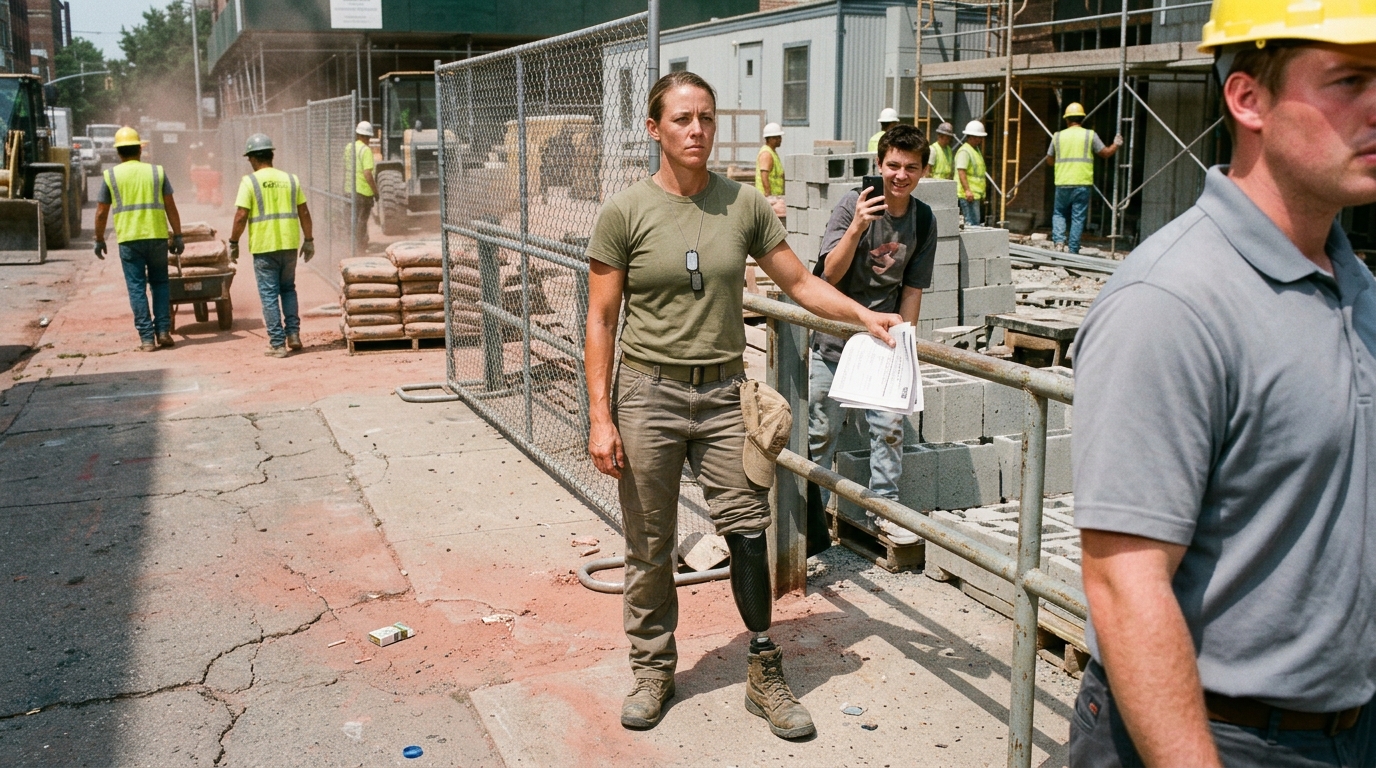
Ava Morgan kept her eyes fixed straight ahead, her fingers clamped tight around the brim of her sun-faded Marine cap inside her pocket.
From the second-floor scaffolding, Rick Tanner’s voice cut through the roar of diesel engines and pounding hammers.
Someone call the VA, we’ve got a stray.
Laughter erupted from the neon-vested crew, sharp and juvenile, bouncing off the stacks of cinder blocks.
Ava didn’t break stride.
Her left leg, matte black and forged from carbon fiber, struck the concrete with a soft, rhythmic click.
She had dragged wounded men through fire in Fallujah; a few men shouting crude jokes on a sidewalk were just noise.
She reached into her collar, pressing her thumb against the warm metal of her dog tags.
Tanner spat a toothpick onto the dirt, leaning over the fence rail with a sneer.
Looks like one of their windup toys got loose.
Ava’s jaw tightened, the muscle ticking once beneath her sun-darkened skin.
She kept her shoulders squared, refusing to turn her head or give them the satisfaction of a reaction.
The sidewalk beneath her boots felt rough, unyielding, matching the heavy rhythm of her own discipline.
A teenager nearby held up a smartphone, grinning as she recorded the humiliation for online views.
Ava walked past them all, stepping out from the shadow of the fence and turning the corner toward the clinic, her mind already calculating the miles ahead and the quiet weight of endurance.
CHAPTER 2: THE UNSEEN LEDGER
The quiet interior of her two-room apartment offered little sanctuary from the thoughts churning behind her eyes.
She dropped her olive duffel onto the narrow cot, the zipper clinking softly against the metal frame.
Every Tuesday routine had brought her past that gate, but today the casual cruelty of the workmen lingered like smoke in a closed room.
She pulled a worn blue notepad from the outer pouch, its pages filled with neat, handwritten logs of medical appointments and bus schedules.
Her left prosthetic leg clicked against the linoleum as she walked to the small kitchenette to pour a glass of tap water.
The water ran cool, but her mind stayed locked on the site foreman, Rick Tanner, and the assistant manager who had watched the abuse without a flicker of interference.
That indifference wasn’t just poor manners; it mirrored the exact bureaucratic coldness she had faced when seeking civilian employment after her discharge.
She opened a metal filing box on the low wooden table, sorting through municipal zoning pamphlets and contractor compliance regulations she had printed out weeks prior.
A folded sheet slipped from beneath a stack of city codes—a public notice regarding commercial building permits and mandatory safety officer contacts for Harris County.
Ava traced the printed phone numbers with a calloused finger, her common-sense pragmatism cutting through the anger.
If the management on site refused to police their own behavior, the oversight boards would have to do it for them.
She didn’t need military backup or a dramatic confrontation to shift the balance.
She needed paper, a paper trail, and an unyielding adherence to the rules they thought they were above.
The wall clock ticked off the seconds in steady, unhurried beats as she picked up a pen and began drafting a formal, detailed inquiry regarding site safety protocols and public right-of-way harassment.
CHAPTER 3: THE BROKEN THRESHOLD
The morning air smelled of baked asphalt and stale diesel exhaust as Ava walked back down the cracked sidewalk toward the perimeter of the Houston construction site.
Her carbon-fiber prosthetic clicked against the concrete curb with a quiet, regular beat that matched the cold calculation in her chest.
She stopped near the temporary chain-link gate where a yellow warning sign hung askew from a plastic zip-tie.
Inside the fence, workers moved through the red dust, hauling bags of mortar and maneuvering scaffolding under the blinding Texas sun.
None of them looked her way, though a few shifted uncomfortably when they saw her standing motionless by the barrier.
She wasn’t here for the crew who had shouted juvenile jeers days prior; her target was the administrative authority that allowed that rot to flourish.
A young man in a clean gray polo shirt and a hard hat stamped with the corporate logo emerged from the temporary site trailer.
It was Marcus Vance, the assistant site manager, carrying a clipboard under his arm and checking his wristwatch with an expression of pinched impatience.
Ava stepped directly into his path, blocking the metal ramp leading down from the trailer door.
Marcus stopped short, his boots scraping against the aluminum grating with a harsh screech.
Look, we’re closed to public inquiries today, so take the complaint form to the main office downtown—he muttered, trying to sidestep her left shoulder.
Ava didn’t move an inch, her weight planted firmly on her solid footing while her prosthetic absorbed the impact of the uneven ground.
Her gaze locked onto his eyes, stripped of any warmth or hesitation.
You watched a veteran get harassed on public property last week while on the clock, and your logbook shows zero safety entries for that hour.
Marcus blinked, his face flushing red beneath his safety strap as his authority was challenged by a civilian standing right in his workspace.
That’s an internal personnel matter, and you’re trespassing on active commercial property—he snapped, his voice rising enough to draw the attention of nearby laborers.
Ava pulled the folded municipal copy from her pocket and tapped it against the edge of the metal railing.
Code violations regarding right-of-way harassment and unlogged site incidents aren’t internal matters when the county zoning board reviews them tomorrow morning.
Marcus stared at the document in her hand, his swagger evaporating as the reality of a municipal audit hit him squarely in the chest.
CHAPTER 4: THE COMPLIANCE TRAP
The interior of the site trailer smelled strongly of cheap coffee and stale tobacco smoke.
Marcus Vance had stepped outside to check a concrete pour, leaving the front office empty except for the hum of a portable desk fan.
Ava stepped inside, her prosthetic leg clicking softly against the worn linoleum floor as she scanned the stacked paperwork.
A thick, leather-bound compliance binder sat half-hidden beneath a pile of delivery manifests near the edge of the desk.
She opened the cover, her eyes tracking down columns of unverified safety signatures and missing injury reports from the past three months.
The pages revealed a deliberate pattern: structural mishaps and worker injuries were systematically logged as minor slip-ups to bypass municipal inspection fees.
This wasn’t just poor management; it was an institutionalized paper trail of negligence designed to protect profit margins at the expense of basic human safety.
A shadow fell across the aluminum doorway as heavy boots hit the metal ramp outside.
Rick Tanner filled the entranceway, his face red under his sweat-stained cap, chewing furiously on a wooden toothpick.
What do you think you’re doing in here, sweetheart?—he growled, stepping forward to block the narrow exit.
Ava didn’t flinch, her thumb resting directly over the incriminating signature page inside the open binder.
I’m just reading your company’s unfiled safety ledger, Rick—she replied, her voice steady and flat.
Rick’s jaw clenched, his hand slapping down hard against the desktop with a loud, ringing crack that shook the loose paperwork.
Get out of my trailer before I call the sheriff and have you hauled off for corporate espionage—he shouted, his face darkening with rage.
CHAPTER 5: THE COLLAPSE OF LEVERAGE
The air inside the trailer grew thick with heat and trapped dust as Rick Tanner stepped closer, his heavy work boots grating against the floorboards.
You’re playing a dangerous game with the wrong people—he growled, leaning down so his red face was inches from hers.
Ava didn’t blink, her thumb pressing down hard on the unfiled accident logs beneath her palm.
Ignoring safety audits to pad your bonus isn’t a game, Rick, it’s a paper trail straight to the state labor board—she replied, her voice remaining low and entirely level.
Rick’s breathing hitched, a bead of sweat cutting a clean path through the dust on his forehead as he realized his intimidation tactics were bouncing off solid armor.
He snatched at the edge of the binder to rip it from her grip, but Ava shifted her balance instantly, using her carbon-fiber prosthetic to anchor her stance against his sudden lunge.
You can call whoever you want, but this book stays right here until the inspectors arrive—she said, her fingers locking tighter over the leather spine.
Outside the trailer windows, several laborers stopped working, turning their heads to watch the muffled shouting match spill through the thin aluminum walls.
Rick’s face mottled from crimson to a pale, furious gray as he recognized the trap closing around him.
He opened his mouth to launch another threat, but the distant wail of municipal vehicle sirens began to echo up the asphalt street.
CHAPTER 6: THE FINAL POUR
The county inspectors pushed through the trailer door, their clipboards held out like shields against the stale heat.
Rick tried to shove past them, shouting that the compliance binder was stolen property, but his voice cracked under the weight of the open ledger.
You’re looking at six months of unlogged site violations and systemic safety fraud—one inspector stated flatly, running a finger down the missing signatures.
The corporate office in downtown Houston received the audit reports within the hour, leaving management with no room to cover up the negligence.
Rick Tanner was stripped of his foreman badge and reassigned to distant, off-site duties before the afternoon sun began to dip.
One month later, the construction site completed its foundation pour under new supervision and strict municipal oversight.
At the front entrance, workers embedded a single polished steel plaque into the fresh concrete, marking the boundary with uncompromising permanence.
Ava stood across the street on the cracked sidewalk, her carbon-fiber prosthetic clicking softly as she took a slow, measured step.
She reached down to the collar of her shirt, brushing her thumb lightly against her dog tags as a quiet breeze moved through the dusty air.
The world had tried to laugh her off, but common sense and unyielding endurance had carved a permanent truth into the ground.
She turned her shoulders square and walked forward, her head held high, leaving the noise behind her.