The Quiet Weight of Rusted Steel: A Forgotten Soldier’s Stand Against Arrogance
CHAPTER 1: THE SCUFFED FLOOR
The morning air at Fort Bragg smelled of diesel exhaust and damp pine.
I pushed the gray plastic bucket across the terrazzo, the rubber wheels squeaking in rhythm with my breathing. My knees ached, a dull, grinding throb that no amount of ibuprofen could touch.
At sixty-eight, you learn to live with the friction of your own body.
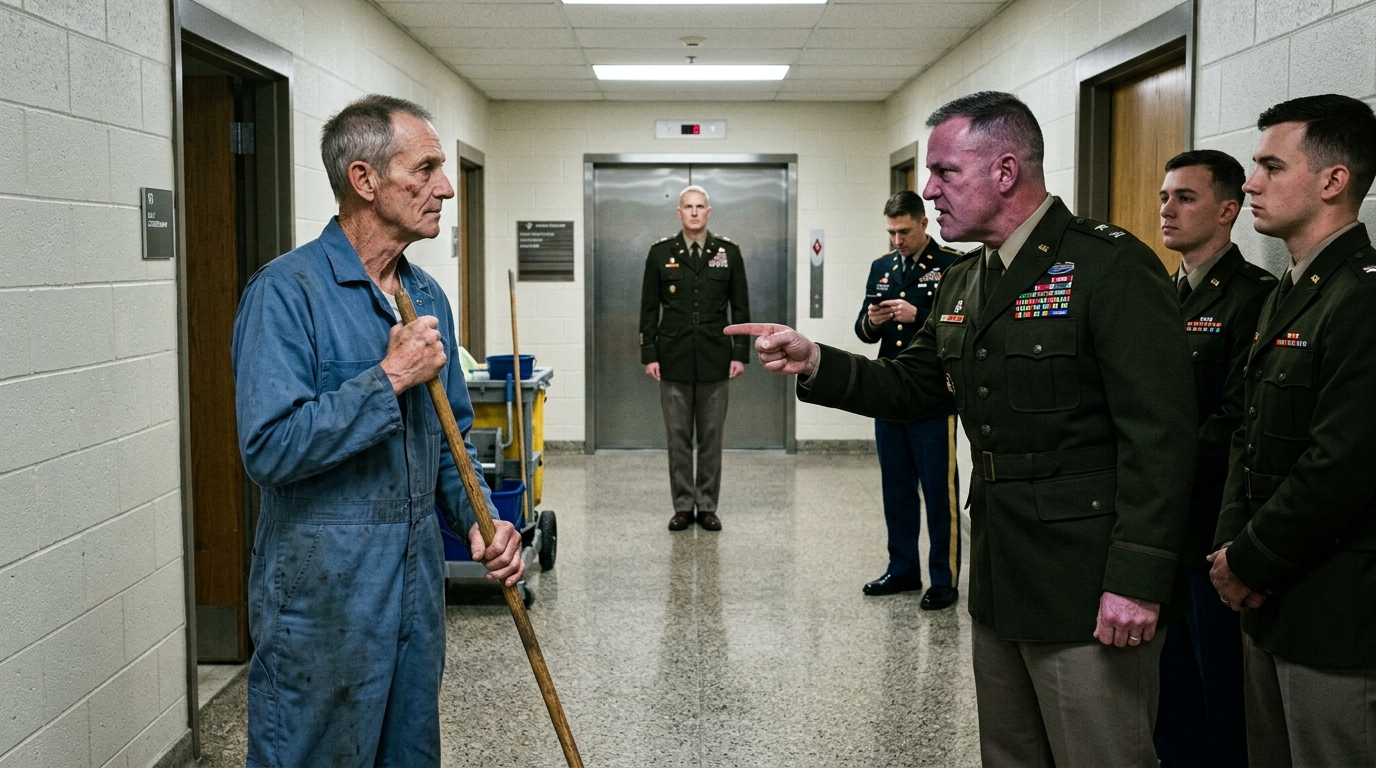
The heavy oak doors at the end of the hall swung wide. Lieutenant General Thorne strode through them like he owned the concrete beneath his polished shoes, flanked by two junior officers who practically had to jog to keep pace.
His dress uniform was immaculate, every ribbon aligned with terrifying precision.
He was shouting into a smartphone about deployment timelines and readiness metrics. I did what I always did. I pulled the bucket tight against the baseboard, kept my chin down, and waited for the wind to pass.
Invisible. That was the uniform.
Thorne’s boots stopped dead against the damp floor. The squeak of rubber soles echoed off the cinderblock walls.
“You,” Thorne snapped, lowering his phone. “This floor is a hazard. Someone’s going to take a spill.”
I straightened slowly, letting go of the mop handle to ease the pressure in my lower back. “Sir, I put out the yellow wet-floor signs every ten feet.”
Thorne’s eyes narrowed, scanning my faded blue jumpsuit and the slight tremor in my fingers. “I don’t care about your signs, old man. I care about results. How old are you? Shouldn’t you be out playing golf somewhere?”
“I’m retired, sir. This is just—”
“Let me guess. Supply clerk? Motor pool?” Thorne let out a short, dry laugh, glancing at his aides to share the joke. “And now you’re wandering around a Special Operations facility getting in the way of people who actually matter.”
The major to his left shifted his weight, his eyes dropping to the floor.
A cold weight settled in my chest. Not anger. Just the familiar, heavy weariness of dealing with men who had never seen the dark side of a map.
“I served, sir,” I said quietly.
“I’m sure you did,” Thorne sneered, stepping closer until I could smell his expensive cedarwood cologne. “Every box-checker thinks they’re a war hero. Did you even deploy, or did you spend your career guarding a gate in Germany?”
The major cleared his throat, his face tight. “General, we’re running late for the briefing.”
Thorne held up a hand, his gaze locked onto mine with cruel satisfaction. He wanted a reaction. He wanted me to shrink.
My fingers rested lightly against the smooth wood of the mop handle. The grain was worn down by my own palms, smooth and predictable.
“I deployed,” I said.
Thorne grinned, stepping into my space. “Oh? Where? Guarding the PX?”
CHAPTER 2: THE SCRUBBED REGISTRY
The heavy oak doors down the hall muffled the distant hum of the command center, leaving only the sound of our breathing.
Thorne stepped closer, his chest swelling beneath his immaculate ribbons as if sheer arrogance could force the world to bend.
“Major, I asked you a question,” Thorne snapped, his voice echoing off the concrete floor. “What kind of nonsense game are you playing with this custodian?”
Reeves ignored him entirely. His gaze remained locked on my face, sliding past the faded blue fabric of my shirt to examine the faint, chemically burned scars across my knuckles.
“The terminal on my desk,” Reeves muttered, his voice barely audible over the hum of the fluorescent lights overhead. “The secure historical server at Fort Meade. It doesn’t throw that flag unless…”
“Unless what, Major?” Thorne’s face flushed a mottled purple, his hand reaching out to shove Reeves’s shoulder. “Report!”
Reeves didn’t flinch, but his eyes hardened as he finally looked at the general. “Sir, you need to step back.”
“I am a general officer in the United States Army!” Thorne shouted, jabbing a manicured finger toward my chest. “I command this wing, and I will not have my staff standing around gawking at an old man who missed his retirement home!”
My fingers remained curled lightly around the worn wood of the mop handle. The grain was smooth, cold, and entirely predictable.
I didn’t blink. In 1982, when the comms link went dead over the Zagros Mountains, panic got good men killed; standing still kept you breathing.
Reeves pulled a secure-net tablet from his tactical pouch, his thumb sliding across the glass with practiced speed. The screen flared with a harsh amber light, casting long shadows across his jaw.
“The call sign is active in the deep archive,” Reeves said, his voice dropping into a flat, monotone register. “Not decommissioned. Active.”
Thorne laughed, though the sound lacked its earlier conviction. “A janitor? Active?”
“The designation bypasses regular command channels,” Reeves continued, staring at the amber readout. “It links directly to the oversight committee that hasn’t existed on paper since the final days of the Cold War.”
The young captain standing behind Thorne paled visibly, pulling out his own phone with trembling hands. “General… look at the server stamp. It’s not a clerical error. The authorization code matches a directive signed by the Secretary of Defense thirty years ago.”
Thorne sneered, slapping the captain’s arm down. “Put that away before I write you up for insubordination. It’s a stolen valor stunt. Look at him!”
I didn’t say a word. I simply leaned my weight into the mop bucket, letting the dirty water lap against the plastic rim.
The silence in the hallway grew heavy, thick with the realization that the man standing in front of them with a mop wasn’t just a retired clerk, but an untamed variable they couldn’t scrub away.
Reeves looked up from his tablet, his eyes dark and fixed on my face. “You weren’t just in Panama, were you, Sergeant?”
CHAPTER 3: THE COLD CORRIDOR
General Thorne didn’t blink at the vibration, though his posture stiffened as the silence in the corridor lengthened.
“Major, put that ridiculous gadget away,” Thorne barked, his face darkening as he tried to reclaim the authority of his rank. “We have an inspection to finish, and I will not have my command disrupted by field-grade theater.”
Reeves didn’t look up from the display. His thumb tapped a single key, accepting the high-priority override code that had just pushed through the base firewall.
“General,” Reeves said, his voice completely flat. “The priority channel is open to the Pentagon. They are asking who authorized your presence in this sector during an active asset query.”
Thorne took a sharp step forward, his jaw tight. “I am the ranking officer of this installation. No one questions my presence.”
I kept my hands resting lightly on the wooden handle of the mop, feeling the cool, damp texture of the floor beneath my work boots.
There was no anger left in me, only the quiet, heavy patience of a man who had seen hundreds of arrogant commanders mistake a quiet exterior for weakness.
The elevator doors at the end of the long concrete hallway gave a sudden, metallic ding.
A sharp footstep rang out against the terrazzo as Colonel Hayes stepped out of the cab, his face pale and tightly controlled.
Hayes didn’t look at Thorne at first. He walked straight toward my mop bucket, stopped three paces away, and came to a rigid, flawless military attention.
“Sir,” Hayes said, his voice tight with suppressed tension. “Colonel Hayes, JSOC liaison. The Secretary of Defense is on a secure conference link with the Chairman of the Joint Chiefs.”
Thorne’s mouth opened, but no words came out. His eyes darted from Hayes to my faded custodial jumpsuit, the raw disbelief finally cracking his polished composure.
“Hayes, have you lost your mind?” Thorne sputtered, his voice rising in panic. “He’s a civilian custodian! He mops these floors!”
Hayes turned his head slowly, his eyes locking onto Thorne with a cold, unforgiving glare.
“General,” Hayes said, his voice dropping into a dangerous whisper. “Did you, within the last five minutes, threaten or insult this man?”
CHAPTER 4: THE DUSTY OFFICE
I didn’t reach for the phone.
Instead, I let my hand slide off the wooden mop handle and dipped it into the gray plastic bucket, rinsing my fingers in the cold, soapy water.
“I’m off the clock in twenty minutes, Colonel,” I said quietly, the water dripping back into the basin with a soft, steady plop.
General Thorne took a half-step back, his face draining of all its bluster as the full weight of the radio link settled over the cinderblock walls.
“See here, Hayes,” Thorne stammered, his voice lacking its previous sharp edge. “There’s been a misunderstanding. I didn’t realize the man was—”
“You didn’t look,” Hayes cut him off without turning around, his eyes fixed entirely on my face. “That’s the uniform you wear, General. Not the one in your closet, but the one that requires you to know who shares your turf.”
The handset in Hayes’s grip hissed as the voice on the other end of the encrypted line grew louder, demanding an update.
I picked up the mop, pushed the heavy wheels past the cluster of frozen officers, and headed down the corridor toward the janitor’s closet.
The silence behind me was absolute, broken only by the squeak of rubber wheels against the floor.
I didn’t need Washington to tell me who I was, and I certainly didn’t need an apology from a man who measured his worth in ribbons.
The small, windowless closet smelled of pine cleaner and old wool.
I hung the mop on its metal bracket, wound the cord of the buffer tight, and sat down on a low plastic bucket in the dim light.
My phone buzzed against my thigh, a cheap prepaid model with a cracked screen that had never seen a secure network in its life.
It buzzed again, vibrating against the plastic rim of the bucket.
I pulled it out, stared at the unknown number blinking on the display, and let it go dark.
CHAPTER 5: THE UNSEEN LEDGER
Outside the thin wooden door of the supply room, heavy combat boots scraped against the terrazzo.
General Thorne’s voice cut through the partition, high and tight with frantic self-preservation.
“I’m telling you, it’s an administrative glitch,” Thorne snapped at someone in the hall, his tone swinging wildly between panic and authority. “The man is a contractor. His file was archived twenty years ago. I’ll have his contract terminated by the hour.”
A second, deeper voice answered—Colonel Hayes, cold and clipped.
“Try it, General. The Secretary’s office is currently freezing every personnel movement in your command cluster until this audit clears.”
I didn’t blink. I set the phone face down on the cleaning supplies shelf, letting the plastic rattle against the tin.
Thorne was thrashing now, looking for any lever, any petty rule or administrative loophole to salvage his crumbling prestige.
It was the classic move of a man who had never faced a real consequence in his life.
When your only tool is a title, you try to beat the concrete with it until your hands bleed.
The doorknob rattled, shaking loose a small drift of gray dust from the upper hinge.
“Mitchell,” Thorne’s voice hissed through the narrow gap under the door, dripping with venom. “You think this protects you? You’re hiding in a broom closet like a coward. When this blows over, you’ll still be sweeping floors for minimum wage.”
I stood up slowly, letting my joints pop in the damp air.
“You’re welcome to try, General,” I said softly, loud enough to carry through the wood. “I’ve cleaned up worse messes than you.”
The doorknob went dead still.
CHAPTER 6: THE RUSTED THRESHOLD
The handle turned with a dry, metallic click, but I didn’t pull the door open.
Outside, General Thorne’s breathing sounded ragged, the rhythmic pacing of his polished boots finally halting against the concrete.
“You can’t do this, Colonel,” Thorne’s voice cracked, losing its iron veneer as the administrative trap closed around him. “I have a career. I have thirty years of service—”
“Service that just ended, General,” Hayes replied, his voice carrying through the wood with brutal clarity. “The Inspector General’s office is already pulling your logs. You’re relieved of command, effective immediately.”
Silence settled over the corridor, heavy and absolute.
There were no more orders to bark, no more subordinates to intimidate, and no more unearned authority to hide behind.
I let go of the brass handle and stepped back into the dim interior of the supply room.
My prepaid phone sat on the shelf, its screen dark, the frantic calls from Washington finally silenced by my own quiet refusal.
I didn’t need their grand pageantry, their medals, or their back-channel pensions to tell me who I was.
Some debts are settled in gold, and others are paid in the quiet peace of a floor well-swept.
I picked up my gray plastic bucket, hoisted it onto its rubber wheels, and pushed open the side door leading out to the loading dock.
The afternoon air was cool against my face, carrying the scent of pine and distant rain.
I stepped out into the sunlight, pulled the heavy metal door shut behind me, and locked it tight.