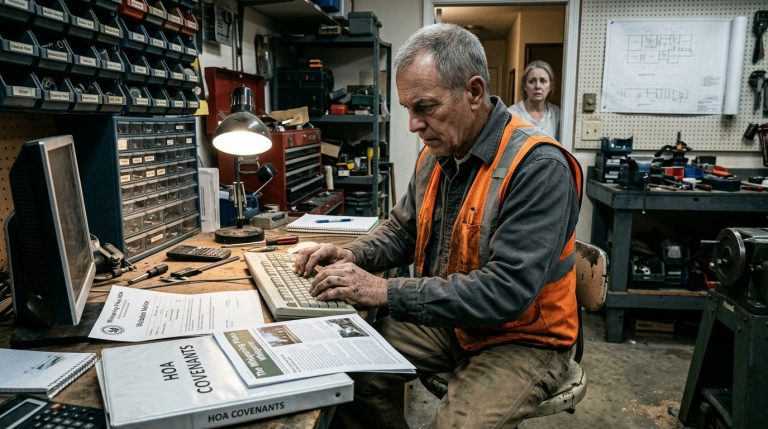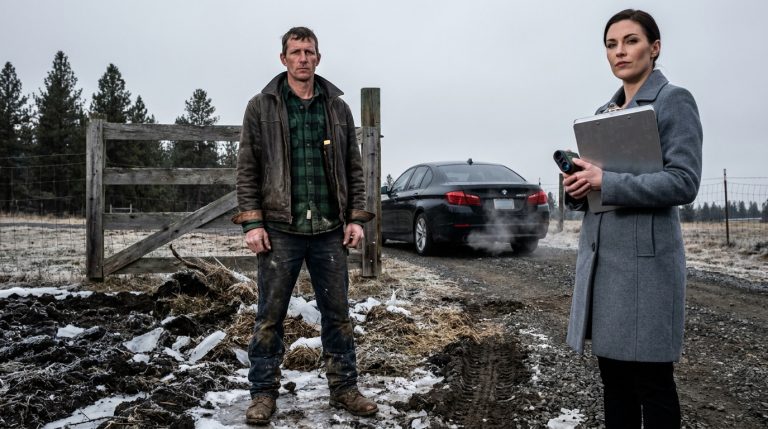
The Frozen Cut of Black Ice and the Cold Reckoning at the End of the Block
CHAPTER 1: THE ORANGE SEAL
The drift against the bottom of the garage frame hadn’t moved. That was the first wrong detail. Natural wind left scalloped edges; this was a flat, packed wall built by a plow blade dumping uphill run-off straight across my property line.
A boot heel crunched on the ice behind me. Cold air smelled like diesel exhaust and wet wool.
“You’re out of compliance,” Miranda Holt said. She didn’t offer a greeting. She didn’t lift her eyes from the leather-bound clipboard tucked under her arm.
I didn’t turn around. I kept my scraper wedged under the crust on the driveway apron, feeling the vibration of frozen asphalt straight up my forearms. “The plow dumped three tons of packed slush across the turnaround.”
“The private contractor clears according to board priority,” Miranda said. Her voice had the thin, dry rasp of someone who spent eight hours a day in heated boardrooms reading bylaws. “Your mechanical melting unit is in direct violation of Section 4-B. Environmental contamination.”
“It’s a propane burner,” I said, standing up slow. The small of my back popped once. “It melts snow into storm drains.”
“Runoff carries road salt into the soil bed along the Blackwood Line,” she snapped. Her thumb pressed hard against the metal clip on her board, turning the nail white. “The board voted on Tuesday. Effective immediately.”
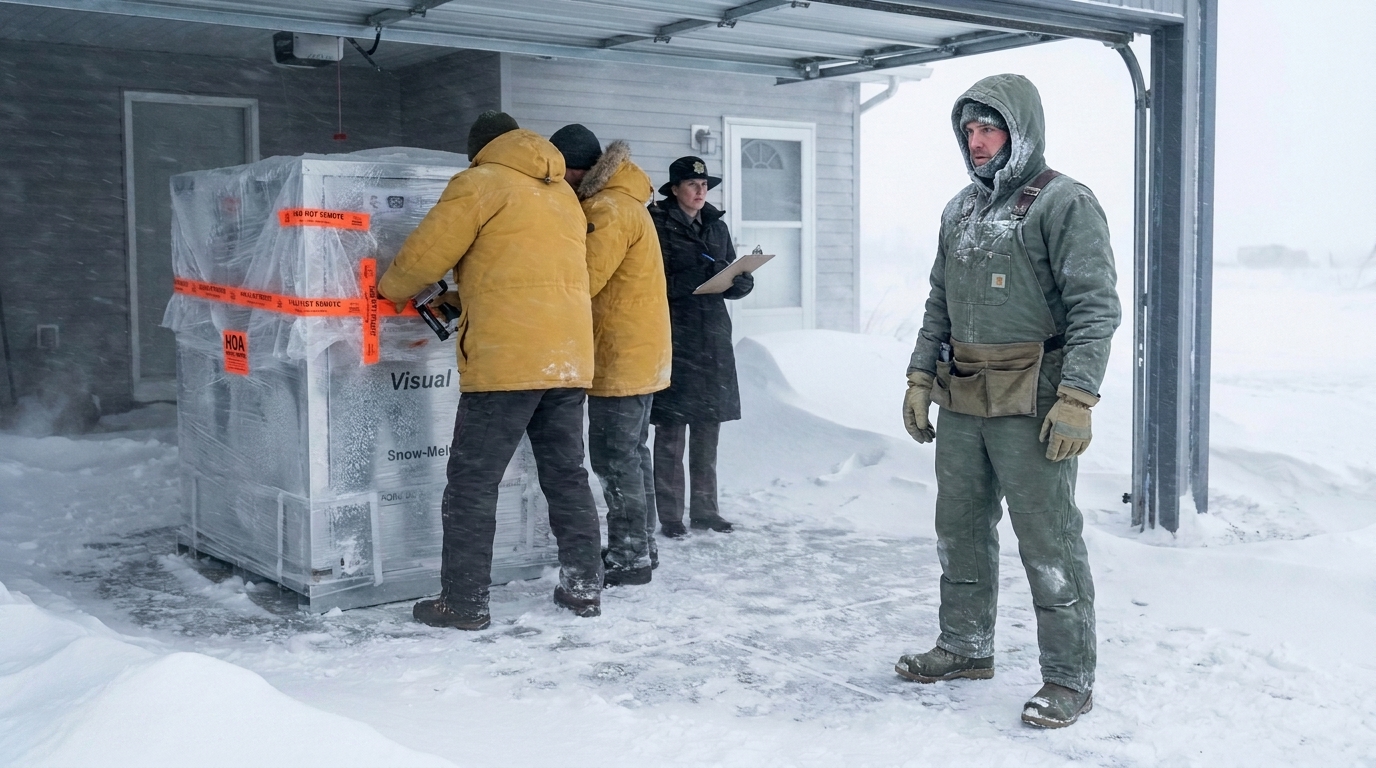
Two men in heavy yellow parkas stepped out from behind her commercial SUV. One carried a roll of heavy clear plastic. The other held a staple gun and a roll of high-tack orange adhesive tape.
“Don’t touch the rig,” I said.
Miranda didn’t look at the rig. She looked at my front door. “The fine is seven hundred and fifty dollars for the first twelve hours. Daily escalation applies until the unit is wrapped, sealed, and verified by an inspector.”
“The street is three days away from being completely blocked,” I said. “If an ambulance comes down this hill, it doesn’t get back up.”
“Emergency services adapt,” Miranda said. She pulled a bright orange sheet from her stack, slapped it against the cold glass of my storm door, and smoothed the edges with a gloved palm. “Compliance avoids consequences.”
The man with the staple gun moved past me, his boots sliding slightly on the black ice beneath the powder. The first sharp thwack of steel into wood echoed off the bare siding of the garage.
I rolled a loose orange tag between two fingers, feeling the aggressive chemical stickiness on the backing.
“You cut the municipal plow contract,” I said softly.
Miranda’s jaw tightened just enough to shift the line of her collar. “The board manages funds according to fiduciary duty.”
“You cut it three weeks ago,” I said, stepping closer until the heat off her coat met the freeze in the air between us. “Before the storm dropped.”
She didn’t back up. Her eyes stayed cold, level, and entirely empty of doubt. “Check your app for the violation notice. Comments are disabled.”
She turned on her heel, her boots carving shallow, brittle grooves into the gray ice as she walked back up the hill. Behind her, the staple gun went off three more times, sealing the heavy plastic over the steel-framed melter like a corpse in a bag.
I stood on the apron, watching the wind sweep a fresh layer of fine, dry snow over the orange paper on my door. The storm wasn’t slowing down. And neither was the trap.
CHAPTER 2: THE PAPER TRAIN
The red tail lights of Miranda’s SUV dissolved into the curtain of white at the top of the ridge, leaving only the sharp scent of unburnt diesel lingering over the ice. In my hand, the adhesive backing of the orange violation tag stiffened, the chemical glue losing its tack as the freezing air set in.
I rolled the tag into a tight cylinder and shoved it deep into my coat pocket. The plastic-wrapped snow melter behind me stood like a jagged headstone under the yellow streetlight, its heavy plastic sheath snapping against the steel frame whenever the wind surged down the slope.
The cold didn’t just bite; it settled into the bones of the cul-de-sac. Down here at the bottom, every house sat lower than the main artery, designed thirty years ago as a quiet dead-end. Now, it was a catch-basin. The plow from the upper ridge had shoved another foot of dense, gray slush right to the edge of my apron, locking the lower three driveways behind a solid, frozen knee-high ridge.
Inside the house, the radiator groaned, a metallic ping-ping-ping echoing through the floorboards. I didn’t turn on the overheads. I sat at the kitchen table with a mug of black coffee that lost its steam before I finished the first sip.
My phone buzzed against the formica. An alert from the neighborhood app.
HOA Notice: Violation #1094 Issued. Unauthorized Mechanical Equipment. Section 4-B Environmental Contamination.
Below the automated text was a compressed photo. It showed my garage, the rig, and the orange tag slapped on the glass door. The caption was signed M. Holt, Board President. Comments were disabled, but the view counter was already climbing.
I leaned back, pulling up my email archive on the laptop.
Two weeks ago, the board had sent out the quarterly statement. A standard PDF with clean blue headers and sanitized line items. But buried in the thread from the general distribution list was an unedited attachment—an internal budget draft that Miranda had forwarded to the finance committee before realizing the full resident list was copied on the thread. She’d recalled the email four minutes later, but the raw file was already cached in my local storage.
I opened the document: Draft_Reserve_Ledger_8B.xlsx.
I scrolled past the landscaping maintenance and the pool chemical line items down to Winter Operations & De-Icing.
The allocated figure for the season was zeroed out. Not reduced. Erased.
A second column, marked Emergency Capital Transfers, showed a line item moving forty-two thousand dollars straight out of the snow removal reserve and dropping it into an unlisted escrow account flagged simply as Legal / Collections Realignment.
I stared at the numbers while the wind rattled the single-pane glass of the kitchen window.
They hadn’t just forgotten to pay the private plow contractor. They had intentionally stripped the contract weeks before the first cold front crossed the state line. They knew the storm was coming. The weather service had flagged the arctic plunge ten days out.
A sharp knock rattled the storm door downstairs. Not the heavy, authoritative thump of an HOA inspector, but a light, erratic tapping.
I closed the laptop half-way and went down the hall.
Old Man Miller stood on the porch, wrapped in a faded green parka that smelled of mothballs and stale tobacco. His boots were unlaced, his hands raw and red where his wool gloves had split at the thumb.
“They put paper on your door,” Miller said. His voice was a thin whistle against the gale. “I saw them from the window.”
“They put paper on the machine, too,” I said, holding the door open just enough to block the wind. “Go inside, Miller. It’s eight below out here.”
“My wife’s oxygen concentrator,” he said, not moving an inch. His eyes were wide, watery from the glare of the snow. “The power flickered twice while I was making tea. If the line drops at the top of the hill, the utility trucks can’t turn around down here. You know how the drift catches at the turn.”
“I know,” I said.
“They aren’t going to plow it, are they?” Miller looked past my shoulder toward the plastic-wrapped shape in the driveway. “Miranda said on the app that the main road is open. But the main road is half a mile up. We’re buried down here.”
I reached out, took him by the elbow, and pulled him an inch closer. “Get back inside. Turn the thermostat up two degrees now while the compressor is still drawing current. Keep the spare O2 tank by the front door. If the line goes, don’t wait for the app. Flash your porch light three times.”
Miller swallowed, his Adam’s apple bobbing over the frayed collar of his shirt. He looked at me, then at the orange seal glinting on my storm door under the streetlamp. “You’re not going to turn it on.”
“Not yet,” I said. “Go home, Miller.”
He turned and shuffled back across the icy path, his boots dragging through the powder, leaving two dark, uneven furrows behind him.
I went back inside, locked the deadbolt, and pulled up the app again.
A new notification had popped up on the board’s public feed. Another bright orange image file.
Second Notice Issued: Property #412. Failure to remediate non-compliant mechanical device within initial window. Daily penalty escalated to $1,500. Continued non-compliance subject to property lien under Bylaw 12-C.
Five hundred dollars a day was standard. Fifteen hundred was a execution sentence for anyone on a fixed income.
I looked back at Reserve Ledger 8B on my screen. The line for Legal / Collections Realignment had a sub-note attached in red font: Targeted Property Acquisition / Lien Recovery.
They weren’t trying to save money on plowing. They were building a bottleneck. If the street stayed buried, if the houses at the bottom were cut off, every single violation issued down here would stack up untouched, un-appealable, and un-payable before the roads ever cleared.
I picked up my phone and dialed the county non-emergency dispatch line.
The line rang four times before a tired voice answered. “County Emergency Services, state your location.”
“I’m reporting a blocked municipal access at the lower cul-de-sac of Blackwood Drive,” I said clearly, staring out the window at the ridge of ice blocking the street. “The road is completely impassable for emergency vehicles due to private contractor snow dumping.”
“Is there an active life-safety emergency at this address sir?”
“Not yet,” I said. “But access is fully compromised.”
“Sir, public works is currently prioritizing primary transit corridors under the severe weather warning,” the dispatcher said, reading from a rehearsed script. “Private subdivision roads are the responsibility of your local management board until a civil emergency is declared.”
“Note the obstruction,” I said. “Timestamp it. My name is on the record.”
“Logged,” she said, and the line went dead.
I saved the call log, pulled a fresh sheet of paper from my printer, and wrote down the exact time, the dispatcher’s operator ID, and the file number.
Outside, the wind shifted from the north to the east, howling down the narrow corridor between the houses. A fresh wall of white blew off the upper roofs, sweeping down the asphalt and packing itself tight against the frozen base of the lower driveways.
The street was sealing shut, inch by inch, layer by cold layer.
I walked to the closet, pulled out my heavy work boots, my insulated coveralls, and a pair of heavy wire cutters. I laid them on the kitchen table right beside the printed copy of the HOA bylaws and the budget file.
Then I sat down in the dark and waited for the temperature to drop.
CHAPTER 3: THE MIDNIGHT ICE
The kitchen light flickered twice—a dull yellow drop in voltage that hummed inside the refrigerator coils—and died completely.
Silence hit the room like a physical impact. The steady, rhythmic clanking of the radiator stopped. The only sound left was the gale outside tearing against the aluminum downspouts and the dry, rasping crunch of snow settling into the foundation vents.
My phone vibrated on the laminate tabletop. The screen glowed bright blue in the pitch dark.
Miranda Holt.
I let it buzz four times, my thumb hovering an inch above the glass while I pulled my fleece collar up over my chin. On the fifth vibration, I tapped the screen and pressed the speaker button.
“The power’s out,” Miranda said. Her voice didn’t have the crisp, mechanical edge from six hours ago. It was ragged at the fringes, thin, vibrating with a rapid, shallow tempo. “The main transformer at the top of Blackwood Drive blew out.”
“I heard the pop twenty seconds ago,” I said. “The line’s down across the upper drainage.”
“My son went out to the garage,” she said, her words rushing together without pauses for breath. “He was trying to start the portable generator. The automatic garage door won’t lift. The track is frozen solid at the base.”
I picked up the wire cutters, feeling the cold steel handle settle into the palm of my glove. “Pull the manual release cord.”
“He did,” she snapped, a sudden flare of panic breaking through the frost in her tone. “The bottom seal is iced to the concrete. The whole door is bowed inward under four feet of packed snow from the plow’s second pass. He’s inside. He can’t get the side access door open either—the drift blew right into the alcove and frozen hard.”
“Tell him to stand clear of the door and wait,” I said. “I’m calling the county line.”
“I called them!” Her voice cracked, turning into a harsh, dry cough. “They put me through to dispatch. Dispatch put me on speaker with the unit supervisor. They can’t get a truck down the hill. The municipal plow backed off at the upper ridge because the drift is waist-high and frozen solid. They said it’s a four-hour wait for a heavy loader.”
I walked to the kitchen window. Down the cul-de-sac, Miranda’s two-story colonial was entirely black except for a pale, erratic beam of light sweeping back and forth inside her garage window—a flashlight bouncing against frosted glass.
“He started the engine, didn’t he?” I asked quietly.
There was a two-second pause on the line. Just the dry rasp of her breathing.
“The generator,” she whispered. “He started it to check the fuel line before he realized the door wouldn’t clear the floor. The exhaust… the exhaust vents inside if the lower seal isn’t open.”
“Turn off the breaker from the outside meter,” I said.
“The meter panel is behind the side drift!” she yelled, her voice breaking entirely into a sob. “I can’t reach it! I tried to shovel through the bank and my hands… I can’t feel my fingers. Please. He’s nineteen. He’s not answering his cell phone now.”
I looked at the kitchen table. The printed PDF of Reserve Ledger 8B lay beside my notebook, the red font of Targeted Property Acquisition illuminated by the fading backlight of my phone screen. Beside it sat the two orange violation notices—twenty-two hundred and fifty dollars in accrued fines, signed by her hand.
“You signed the cease-and-desist under County Emergency Mandate 10-A,” I said, my voice dead flat. “You put three seals on the burner frame. You noted police involvement if the plastic was cut.”
“I don’t care about the seals!” she shrieked into the phone. The sound was distorted by the tiny speaker, drowned out by a massive gust of wind that rattled my storm door. “Cut them! Cut whatever you want! Just bring the machine down here!”
“You disabled the comments on the app, Miranda,” I said, reaching down and zipping my heavy canvas coveralls to the throat. “You told Miller that emergency services would adapt.”
“I was wrong!” she screamed. “Do you hear me? I was wrong! He’s pounding on the door—I can hear him from the driveway, but it’s getting softer! He’s stopping!”
I didn’t answer. I dropped the phone into my pocket, leaving the line open.
I picked up the wire cutters, stepped out into the freezing darkness of the garage, and walked straight to the wrapped steel frame resting on the concrete floor.
The clear plastic sheath was stiff as sheet metal from the sub-zero chill. The orange HOA seals glinted under the narrow beam of my headlamp, their thick adhesive edges frozen into brittle yellow ridges.
I hooked the jaws of the wire cutters under the first seal, squeezed the handles together until the heavy plastic snapped with a sound like a pistol shot, and pulled the entire shroud free in one violent, tearing motion.
The heavy steel burner frame emerged from the plastic, unmarred and cold. I reached for the brass valve on the propane tank, cracked it open half a turn, and listened to the sharp, hiss of pressurized gas filling the manifold.
Outside, the storm howled through the trees along the ridge, but inside the garage, the only thing that mattered was the smell of cold iron, propane, and the ticking of a clock that had already run out of room.
CHAPTER 4: CUTTING THE LINE
The electronic igniter clicked three times, a sharp spark blue against the dark, before the burner caught with a deep, hollow roar. Heat hit my face like an open oven, instantly melting the frost clinging to the fringe of my hood.
I dragged the steel cart out of the overhead bay, the heavy rubber wheels grinding over the ice apron. The blue flame hissed underneath the manifold, channeling twelve thousand BTUs straight into the snowbank at the edge of my driveway. Steam billowed up in a dense white wall, smelling of sulfur, wet asphalt, and scorching cold.
Outside, the storm had turned into a solid white wall, the wind screaming through the electrical wires along the ridge.
I leaned my weight into the push-bar. The leading steel plate of the melter bit into the three-foot packed drift left by the private plow. A violent crack echoed through the metal frame as frozen slush hit the heating element, instantly turning into a rushing torrent of gray, salty water that flowed down the slope toward the storm drain.
Ten feet out. The trench opened up behind me, black asphalt emerging from beneath the ice like a raw wound.
Halfway down the slope, a figure stumbled out into the roadway, waving a flashlight with erratic, frantic jerks. Miranda Holt was wearing a short wool coat that was already soaked through, her bare head plastered with melting snow. Her boots slipped out from under her on the wet slope, and she went down hard on one knee, her hands catching her in the slush.
“Hurry!” she screamed over the roar of the burner. She scrambled back up, her eyes wild, her face dead-white except for bright red patches on her cheekbones. “The sound… the pounding inside stopped two minutes ago!”
I didn’t answer. I kept my shoulder wedged against the steel frame, forcing the rig forward inch by inch. The melter carved through the packed ridge, heat radiating off the steel until the air around us shimmered.
“You can’t… you’re pushing it too fast!” Miranda yelled, running alongside the machine, her gloved fingers clawing at the hot metal frame to pull it forward. “The side door! Go to the side door!”
“The side door is under six feet of drift,” I said, my voice low and steady through the mask. “The main door track is where the air is trapped. We melt the base or he suffocates.”
We reached her driveway apron. The snow here was five feet high, packed solid where the upper plow had turned around and dumped its blade twice.
I jammed the melter’s nose dead-center into the ice wall sealing her garage door.
A wall of superheated steam exploded upward, scalding the air between us. The blue flame roared against the solid ice base, turning the hard pack into slush within seconds. Water poured off the paneling in heavy, steaming sheets, uncovering the bottom lip of the overhead door.
The metal of the door was bowed inward, creaked under the immense weight of the drift above it. The rubber weather seal at the bottom was frozen solid to the concrete threshold, locked in a jaw of clear black ice.
I shut off the propane flow to the secondary jets and focused the full flame array straight at the bottom seal.
Crack.
The ice shattered. A plume of black, acrid carbon monoxide exhaust hissed out from the micro-gap under the door, smelling strongly of unburnt gasoline and copper.
Miranda choked, stepping back and covering her mouth with her sleeve. “He’s in there! Oh God, he’s right behind the door!”
I shoved the melter aside, grabbed the steel crowbar strapped to the cart’s frame, and wedged the flat tip under the center lip of the garage door.
“Get ready to lift,” I told her.
“I can’t… my hands are frozen—”
“Lift!” I growled, putting my entire body weight onto the bar.
The steel door groaned, the icy seal tearing free with a sound like ripping metal. The door lurched upward six inches, binding hard in the bent side tracks, opening a dark, foul-smelling gap into the black garage.
Inside, slumped against the interior bumper of a silver sedan, a shape lay motionless in the pale glow of a dying flashlight.
CHAPTER 5: THE BREAKING POINT
I shoved my boot into the gap under the door, using the steel toe to wedge the frame open before the bent rollers could bind back down. Gasoline fumes and the hot, suffocating stench of carbon monoxide rolled out into the freezing storm, making my eyes water and my throat burn instantly.
“Grab the lip!” I spat at Miranda over the scream of the wind.
She jammed her bare, frost-bitten fingers under the sheet metal, her feet skidding on the slush as we heaved together. The door shrieked along its frozen tracks, rising three feet—just high enough to clear a man’s shoulders.
I dropped to my knees, slid under the frame, and grabbed the boy by the collar of his heavy winter coat. He was dead weight, his face pale gray, his lips a dark, bruised purple under the beam of my headlamp. I dug my heels into the oily concrete floor and hauled him backward, his boots dragging across the sill until his head cleared the threshold into the open air.
Miranda dropped to her knees beside him in the snow, sobbing hysterically as she pulled his face into her chest. “Jason! Jason, wake up! Please!”
“Get his chest up,” I growled, grabbing him under the armpits and propping him against the icy fender of the sedan. I struck his sternum twice with a closed fist. “Breathe, kid. Come on.”
He gasped—a ragged, wet rattle that tore through his chest—and vomited clear liquid into the snow. He didn’t open his eyes, but his breathing caught, shallow and rapid, as his lungs fought against the poisoned air.
Headlights cut through the whiteout at the top of the ridge.
A high-clearance county emergency unit crawled down the black, steaming corridor I had melted through the ice wall. Behind it was a marked sheriff’s cruiser, its tires gripping the slush on the open asphalt.
The county vehicle ground to a halt ten yards away. Two paramedics in navy parkas jumped out, carrying a portable oxygen rig and a backboard. Behind them, a county deputy stepped down into the slush, his eyes scanning the melted trench, the idling propane burner, and the orange violation seals floating in the gray runoff.
“County Emergency Services,” the deputy called out, his voice crisp over the wind. “Who called in the road obstruction?”
“I did,” I said, standing up slow, my arms trembling from the strain. “Four hours ago. And again at midnight.”
The paramedic shoved an oxygen mask over Jason’s face, checking his pulse while Miranda hovered over them, her hands shaking so violently she couldn’t keep her coat pulled shut.
The deputy walked over to the open garage, taking in the bowed door, the frozen tracks, and the smell of exhaust still venting from the interior. He looked down at the bright orange paper sticking out of my coat pocket, then at Miranda.
“Are you Miranda Holt?” the deputy asked, pulling a leather notebook from his breast pocket. “Board President for the Blackwood Homeowners Association?”
Miranda swallowed hard, her jaw quivering as she looked from her son to the deputy. “Yes.”
“We received a broadcast override under County Emergency Mandate 10-A twenty minutes ago,” the deputy said flatly. “The county supervisor executed an administrative takeover of civil transit corridors in this district. Your private contractor’s snow dumping and the unauthorized enforcement actions on this street are currently under formal investigation.”
Miranda’s hand went to her collar, her fingers twitching against the wet wool. “We… we were enforcing Section 4-B. Environmental contamination along the Blackwood Line…”
“I have the county engineer’s report right here in the CAD file, ma’am,” the deputy interrupted, his voice dropping into a hard, professional monotone. “The Blackwood Line drainage is municipal property. The HOA has no jurisdiction to seal access roads during an active winter weather warning.”
He turned his head toward the top of the hill, where an orange municipal plow was already backing down the cleared corridor, its wing blade widening the lane I had carved.
“Furthermore,” the deputy continued, looking directly at the clipboard tucked under her limp arm, “county legal was forwarded a copy of Reserve Ledger 8B two hours ago by a resident record request. The district attorney’s civil division has issued an immediate stay on all pending HOA liens, fines, and foreclosure proceedings in this subdivision.”
Miranda’s mouth opened, but no sound came out. She looked at me, her eyes wide, hollowed out by the sudden, absolute collapse of her authority.
“Your son is stabilized, ma’am,” the paramedic called out, lifting the stretcher toward the back of the rig. “We’re transporting him to County General for observation. You need to come with us.”
She didn’t move for three seconds. She stood frozen in the slush, staring at the black, steaming pavement beneath her boots—the road that hadn’t existed an hour ago, cleared by the very machine she had fined, sealed, and outlawed.
“Go with your kid, Miranda,” I said quietly, leaning my crowbar against the melted wall of snow. “The paperwork can wait until morning.”
She turned without a word and climbed into the back of the emergency vehicle. The doors slammed shut, and the red tail lights moved slowly back up the hill, trailing a thin cloud of exhaust through the clearing storm.
CHAPTER 6: THE BLACKWOOD LINE
The red tail lights vanished over the crest of the ridge, leaving the lower cul-de-sac suspended in an eerie, ringing silence.
Steam still drifted off the black asphalt, curling upward toward a sky where the storm clouds were finally beginning to fracture. A pale, freezing dawn light filtered through the tears in the gray cover, glinting off the raw edges of the snowbanks that flanked the street like carved limestone walls.
I stood beside the snowmelter, my gloves resting on the cool rubber grips of the push-bar. The propane burner idled with a soft, steady hum, the intense blue flame turned down to a low pilot glow.
The street was wide open. A six-foot-wide swath of bare, wet pavement stretched all the way from my driveway apron, past Miranda’s garage, and straight up to the municipal connection at the top of the block.
A front door clicked open down the street.
Miller stepped out onto his porch, wrapped in his green parka. He didn’t look at the snow or the sky. His eyes were locked on the black lane carved through the center of the road. He took three cautious steps down his walkway, his raw hands tucked deep into his pockets, and stopped at the edge of the asphalt.
He reached out with the toe of his boot and tapped the bare road, as if checking to see if it was real.
“The line held,” Miller said quietly. His voice carried across the dead air, crisp and clear.
“The power’s coming back on,” I replied, pointing toward the transformer pole at the corner where a utility truck’s orange strobe had just begun to flash.
I reached down to the manifold, shut off the gas valve entirely, and listened as the flame sputtered once and died. The metal frame gave off a series of rhythmic, ticking contractions as the steel cooled in the arctic draft.
I pulled the wet, folded sheets of paper from my inner coat pocket—the ones I’d taken off the kitchen table before coming out.
Reserve Ledger 8B.
The numbers on the spreadsheet hadn’t changed, but the context had solidified into something concrete and irreversible. The forty-two thousand dollars shifted into Legal / Collections Realignment wasn’t a random administrative transfer. It was an intentional leverage play designed to starve the lower street, trap properties behind un-cleared snow walls, and trigger automatic daily fines under Bylaw 12-C until property liens could be attached along the entire Blackwood Line.
They had gambled on the storm hiding the maneuver. They had counted on bureaucracy and fear keeping everyone behind locked doors until the liens were filed with the county recorder.
Instead, the paper trail was already sitting in the county attorney’s digital queue, backed by four separate timestamped calls to emergency dispatch and an administrative order signed under County Emergency Mandate 10-A.
Miller walked over, his unlaced boots making a soft slosh-slosh in the wet runoff. He looked down at the paper in my hand, then up at the county plow that was now systematically clearing the remaining shoulders of the turnaround.
“What happens to the board?” Miller asked.
“The county froze their operating account at six this morning,” I said, folding the sheets back into my pocket. “An independent receiver takes over management on Monday. The fines are voided. All of them.”
Miller took a long breath, the cold air filling his lungs, his chest expanding under the worn green coat. He didn’t smile, but the tension that had held his neck stiff for three days slowly melted out of his shoulders. “My wife’s concentrator cycled back on three minutes ago.”
“Good,” I said.
I picked up the crowbar resting against the snowbank, slid it into the storage clips on the melter’s frame, and wiped a smear of black grease off the ignition switch with my thumb.
The tool was worn—the paint chipped along the pry tip, the steel scarred from years of biting into frozen gravel and ice—but the structure was sound. A simple, functional piece of iron meant to apply leverage where things were jammed shut.
“Need a hand pushing it back up to the garage?” Miller asked, stepping up to the frame.
“No,” I said, setting my boots against the wet asphalt and taking the weight of the frame into my arms. “I’ve got the line.”
I turned the rig around on the bare pavement, the rubber wheels rolling smoothly over the cleared road, and guided it back toward my driveway under the quiet, breaking light of the morning.