When the Mountain Freezes, Power Is Measured in Tensile Strength, Cold Steel, and Unforgiving Receipts
CHAPTER 1: COLD STEEL AND CURVED GLASS
Snow came sideways. It hit the windshield like crushed quartz, erasing lane markers and turning the switchbacks of Highgate County into a graveyard for heavy iron.
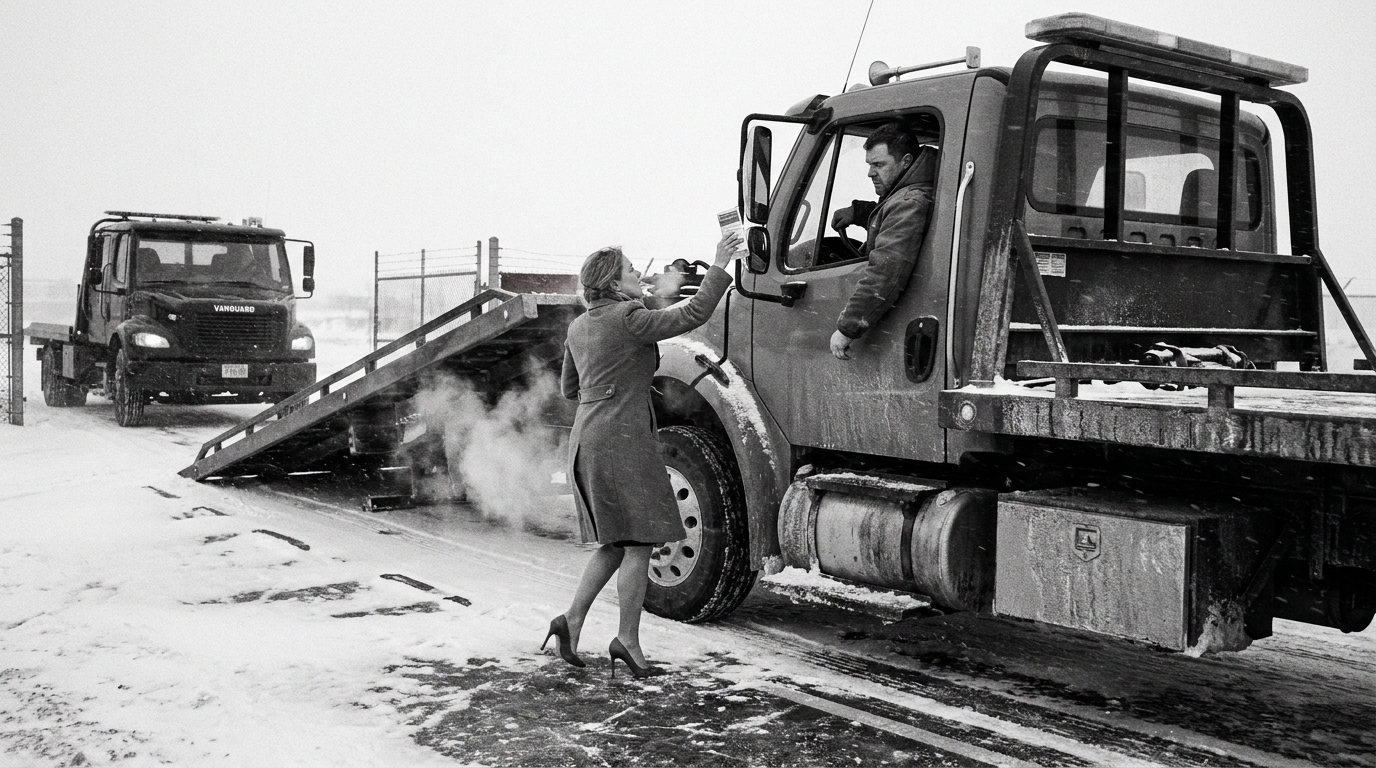
I sat idling at the gate of Frostline Terrace. My flatbed ramp was down halfway, locking pins caked in brown road salt. Through the whiteout, a twin-cab commercial rig sat parked inside the red zone. No county decals. No rotation numbers. Just fresh vinyl lettering on the door: Vanguard.
My radio chirped on the dash. Static, then nothing.
A white SUV slid past the entry pillar, tires locking, hard rubber screeching on polished black ice until the front bumper stopped two inches from my steel bed. The driver’s side door slammed open.
Marin Holt didn’t wear a winter coat. She wore tailored wool and high heels that skidded on the packed drift as she marched into my headlights. Her glove hit the heavy steel ramp with a flat thud.
“Tow my SUV first,” she said. Her voice cut straight through the roar of the PTO winch. “Mine. Right now.”
I didn’t turn off the diesel. I leaned out the cab window, ice biting the left side of my face. “I’m on county rotation, Marin. Clear the entry.”
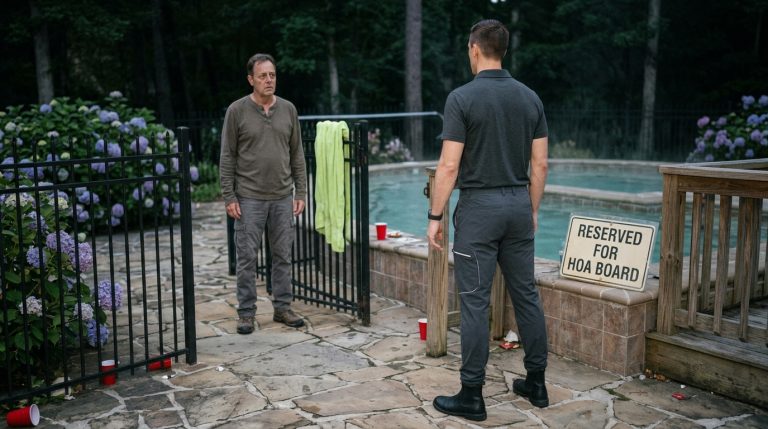
“My driveway is iced over. My vehicle is stuck against the retaining wall.” She stepped closer, her breath plume mixing with the grey exhaust. She reached up, slapping a laminated tag against my side mirror. “HOA Emergency Priority. I don’t care who else you’re helping. You rescue my vehicle first.”
The dash unit blew wide open. Speaker cone vibrating against the plastic casing.
“All units, Code-9 on Mile 9 switchback. Vehicle rollover, multiple occupants trapped, vehicle hanging off the ledge. Nearest operator respond.”
Mile 9. No guardrail. Three hundred feet of sheer shale dropping straight into the creek bed.
I reached for the hydraulic lever, pulling the ramp up. Steel ground against steel. The heavy red tow hook chain hanging from the headache rack clinked twice—six pounds of forged alloy swinging in the draft.
Marin didn’t step back. Her perfume—sweet, artificial, heavy—cut right through the smell of raw diesel fuel.
“Ignore my SUV,” she said, dropping her voice until it was almost lost to the wind, “and I’ll terminate your access contract in this neighborhood by morning.”
“People are trapped on the ridge,” I said. My thumb brushed the rough edge of a worn brass pocketknife in my coat jacket, rubbing the smooth notch near the rivet over and over.
“You operate inside Frostline Terrace,” she said. Her face stayed perfectly still. “That makes you subject to HOA compliance during weather events. You refuse this call, I write you up for a twelve-thousand-dollar non-compliance fine. And I recommend your removal from the county list.”
“You don’t run county dispatch.”
“I run this mountain,” she said. “You’ll be invisible by sunrise.”
I pulled the shifter hard into drive. The transmission clunked under the cab.
“Move your rig, Marin.”
She smiled. It was thin, tight, completely devoid of heat. She took one step back, her heel catching the lip of the asphalt, but she didn’t fall. She just watched me with those dead, pale eyes as the hydraulic bed locked into place with a heavy iron latch.
I punched the gas. The rear dualies spun, grabbed salt, and threw two roostertails of grey slush across her pristine white bumper as I surged out onto the main road, heading straight up into the dark.
CHAPTER 2: THE PAPER FINE
The red tow hook chain swung on its iron bracket, clicking against the glass of the rear cab window every time the dualies fought the slush on Mile 9.
I didn’t slow down. The diesel engine roared in second gear, water temp needle creeping toward the red line as the turbo whined under the load. Through the sideways snow, the emergency flashers of a Highgate County Sheriff cruiser cut weak, orange tunnels into the whiteout.
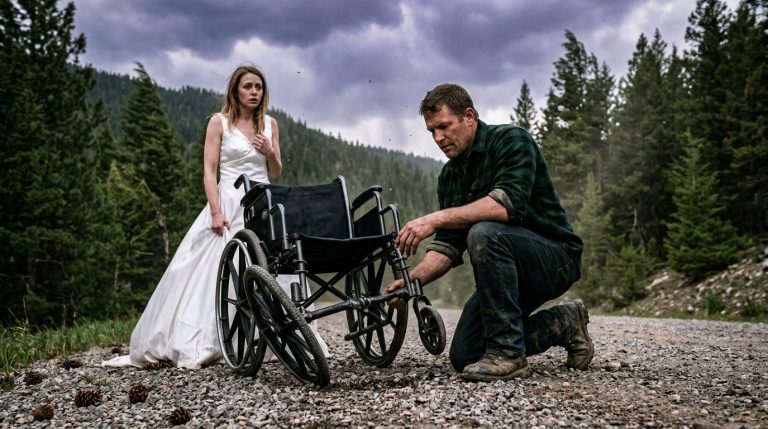
The SUV wasn’t just off the road—it was suspended. The front bumper rested against a pair of mountain pines, its rear wheels hanging over three hundred feet of dark, empty air. Inside, a kid’s face was pressed against the glass of the back window, pale and wide-eyed.
I didn’t talk. I didn’t announce myself. I set the air brakes, dropped the flatbed, and dragged forty feet of winching cable through the snow, my boots digging into the ice crust until my thighs burned.
“Get the line on the rear axle!” the deputy yelled, his voice torn away by the wind. “She’s slipping!”
I shoved my arm under the frozen frame, metal grinding against my heavy coat sleeve, and snapped the alloy hook around the solid iron housing. “Stand back!”
The hydraulic winch groaned as the steel cable took the strain. The braided wire sang under three tons of tension, spitting ice as it straightened. The pine branch snapped with a crack like a rifle shot, but the cable held. The SUV’s frame creaked, slid back onto the shoulder asphalt, and settled.
By the time the family was inside the paramedic van and the rig was strapped to my bed, my hands were raw, locked in stiff curves inside my wet leather gloves. My thumb found the brass pocketknife in my pocket again, rubbing the cold rivet.
Vanguard. The name on that unbadged rig at the gate kept rolling in my head like a loose bolt in a cylinder.
I rolled back down the mountain at dawn. The snow had stopped, leaving Highgate County buried under a foot of sharp, blinding crust.
My driveway was clear, but my garage door wasn’t empty.
A bright yellow sheet of laminated cardstock was taped dead-center at eye level. It didn’t flap in the morning draft; it was stuck fast with blue contractor’s tape.
I stepped out of the cab, my knees popping from three hours in the driver’s seat. I didn’t pull the paper off immediately. I stood there, smelling the burnt oil from my exhaust, and read the bold black font:
NOTICE OF COMMERCIAL NUISANCE & IMMEDIATE FINE
Property Address: 412 Frostline Pass
Violation: Operation of unauthorized heavy commercial machinery during declared community quiet hours.
Assessment: $12,000.00
Status: PENDING BOARD HEARING (MANDATORY ATTENDANCE TONIGHT)
Authority: Protocol Frostline-4 / M. Holt (Pres.)
There it was. Frostline-4. A rule that didn’t exist in the county registry when I signed my deed four years ago.
My phone vibrated in my pocket. Once. Twice. A steady stream of pinging alerts that didn’t stop.
I pulled it out with stiff fingers. A link had been forwarded to me three times by local drivers. It was a community forum post, complete with a crisp, high-resolution photo of my flatbed leaving the front gate the night before. My license plate was circled in bright red.
The caption read:
“While neighbors froze and requested emergency assistance, this commercial operator refused service to HOA leadership and fled the property. Is this who we want on our roads?”
Forty comments under it already. Some calling for an immediate ban. Others asking why a tow truck was parked in a residential neighborhood at all.
I stood on the frozen driveway, the yellow paper cold beneath my palm as I peeled it off the wood. The glue on the tape pulled away with a dry tearing sound.
She wasn’t just trying to collect twelve grand. She was building a wall around the neighborhood, using the storm as the cement. And if I didn’t pay the toll, she was going to make sure nobody on this ridge ever called my number again.
I folded the yellow cardstock once, snapped the crease clean between my thumb and forefinger, and shoved it into my coat next to the brass knife.
“Tonight,” I muttered to the empty street.
The diesel engine behind me gave a final, metallic cooling click in the freeze.
CHAPTER 3: THE TWENTYFOUR THOUSAND DOLLAR CHOKEHOLD
The folded yellow cardstock sat stiff against my ribs, sharp corners pressing through the lining of my canvas coat as I stepped into the Frostline Terrace community center.
The air inside smelled of radiator paint, wet wool, and cheap coffee burning in a styrofoam cup. High fluorescent tubes hummed overhead, casting a stark white glaze over six long folding tables arranged in a tight horseshoe.
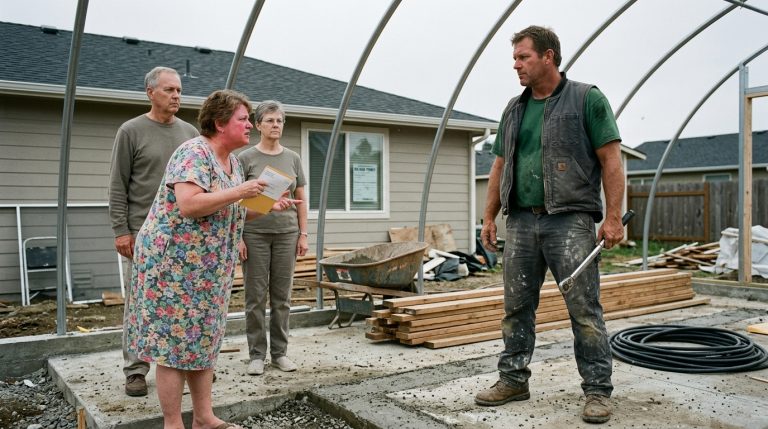
Marin Holt sat at the apex. She wore a dark grey blazer, her posture rigid, a thin silver pen balanced horizontally between her forefingers. To her left, two board members sat with their shoulders hunched, staring at manila folders like they contained live wire.
Nobody offered a chair. I didn’t look for one. My work boots left grey, salty tracks across the blue carpet as I stopped ten feet from the table, my hands staying deep inside my coat pockets. My right thumb traced the cold brass rivet of my pocketknife.
“You’re late,” Marin said. She didn’t look at a clock. She didn’t look at my face. She looked at the wet road salt caked around the steel toes of my boots.
“I was pulling an oil pan off the rock on Mile 9,” I said. “You wanted to talk about a fine.”
“We are here to discuss compliance.” Marin clicked her pen once. The small metallic snap carried clean across the empty room. “This community operates under shared standards. During weather emergencies, individual commercial interests do not override collective safety.”
“I was dispatched by Highgate Emergency Services,” I said. “Code-9.”
“You were present inside Frostline Terrace boundaries,” she countered, her voice dropping into a rhythmic, practiced cadence. “Under HOA rule Frostline-4, any commercial transport or heavy equipment vehicle staging within our perimeter during a declared storm event must maintain active, primary availability for resident infrastructure.”
She pulled a fresh document from the stack in front of her. White paper. Thick bond stock. She didn’t throw it; she slid it across the folding table until it stopped two inches from the edge.
“What is that?” I asked.
“Your compliance pathway,” Marin said. “A twenty-four thousand dollar winter operations bond. Deposited into the community emergency reserve fund. Payable within forty-eight hours.”
The board member to her left shifted, his chair leg scraping loudly against the floor. He cleared his throat, opening his mouth as if to speak, but Marin’s silver pen tapped the table once, and he clamped his jaw shut.
“Twenty-four thousand,” I repeated. My voice stayed low, flat, stripped of anything she could use as leverage.
“If you wish to maintain your residential parking permit for a commercial flatbed,” she said, leaning forward just enough to bring her face into the direct glare of the fluorescent light, “and if you wish to operate within our gates without facing daily citations. Otherwise, your vehicle will be logged as a commercial eyesore and towed at your expense. Furthermore, a formal notice of non-compliance will be submitted to Highgate County Emergency Management detailing your abandonment of community priorities.”
I didn’t reach for the paper. I let it sit on the edge of the laminate table.
“You don’t have the authority to pull a contractor off a county dispatch line, Marin.”
“I have the authority granted by the deed restrictions you signed when you bought four hundred and twelve Frostline Pass,” she said. Her lips curved up at the edges—not a smile, just a mechanical adjustment of her mouth. “You have forty-eight hours to post the bond or remove the rig from the property.”
“And if a resident freezes on the switchback while my rig is parked at the bottom?”
“Then they should hope the service provider contracted under our priority tier arrives first,” she said.
She turned a page in her binder. The conversation was over.
I didn’t argue. I didn’t raise my voice. I reached out, picked up the white bond document by its top corner, folded it precisely in half to match the yellow fine notice already in my pocket, and turned on my heel.
As my hand hit the heavy crash-bar of the exit door, a woman standing near the coffee urn—a resident I’d seen walking her dog along the ridge road—leaned sideways. Her eyes stayed glued to the floor, but as I passed, her lips barely moved.
“She’s already brought in another fleet,” the woman whispered, her voice almost lost beneath the hum of the overhead lights. “Vanguard. They’re staging near the lower maintenance shed.”
I didn’t stop. I pushed through the door into the biting mountain air, the heavy steel crash-bar swinging shut behind me with a solid, echoing latch.
CHAPTER 4: THE VANGUARD LEAK
The exit door slammed shut with a heavy iron latch, locking the hum of the community center behind me.
Snow crunching under my soles was the only sound on the empty plaza. I walked straight to my truck, my coat collar turned up against the biting draft that swept off the ridge. Inside the cab, the air was bitter cold, frost already feathering across the corners of the windshield.
I didn’t turn the key. I sat in the dim cabin, pulled the white bond agreement out of my canvas coat, and unfolded it against the steering wheel. The yellow fine notice fell out with it, landing face-up on the gearshift console.
Protocol Frostline-4.
My phone buzzed in the cup holder, its screen lighting up the ice on the side glass. An email notification flashed from an unindexed, throwaway domain: [email protected].
The subject line was four words long:
Look at what she’s doing.
I tapped the screen with a stiff thumb. Three PDF attachments loaded slowly over the weak cell tower signal, blue light reflecting off the chrome rim of the dashboard gauges.
The first file was an internal spreadsheet labeled Preferred Response Partners. Clean rows. Dates. Dollar figures running five digits deep in the right-hand column under a header marked Community Infrastructure Initiative. At the bottom sat a recurring monthly disbursement, $12,000 flat, paid directly to an entity called Vanguard Logistics LLC.
Underneath the payment schedule was a single line of bold text:
Dispatch priority confirmed / County rotation override authorized under Protocol Frostline-4.
My left thumb rubbed the cold brass rivet of my pocketknife over and over inside my jacket pocket. Vanguard wasn’t a local operator taking overflow calls. It was a single-rig outfit registered three months ago under a residential address two streets over from Marin’s property—the same white twin-cab rig I’d spotted idling in the red zone at the entry gate.
I opened the second attachment. A scanned PDF of the official HOA board resolution establishing Protocol Frostline-4.
It was stamped with an official Highgate County clerk Seal at the top, complete with a registration number and a cursive filing signature. But when I zoomed in on the bottom margin, the digital watermark told a different story. The layout template wasn’t from the county recorder’s office; it was created on a desktop publishing program four days prior, exported from an account labeled M. Holt (Admin).
The stamp was a fake. The rule was a lie.
She hadn’t just written an arbitrary HOA policy—she had forged a county emergency access document to create the illusion of legal authority, using it to push independent rotation drivers off the mountain while funneling resident “operations bonds” straight into Vanguard’s accounts.
A third file loaded at the bottom of the screen. A draft press release scheduled for broadcast to the county news outlets at midnight, framing my business as an uncertified operator undergoing criminal investigation for abandoning stranded residents during a Code-Red winter event.
She wasn’t waiting for the forty-eight-hour deadline. She was dropping the hammer tonight.
I saved the three files to my local drive, backed them up to an offline thumb drive pulled from the glovebox, and plugged the drive directly into the dash computer’s external port.
The diesel engine turned over on the first crank, the starter motor whining twice before the big motor fired, sending a steady, heavy vibration through the floorboards.
I didn’t head home. I pulled the shifter into low gear, turned the wheel hard toward the ridge road, and pointed the flatbed down the slick, unplowed descent toward the county line.
CHAPTER 5: FRICTION ON THE SWITCHBACK
The tires bit into fresh powder covering a layer of glare ice on the lower switchback.
Shadows stretched across the dashboard as thirty minutes of steady, crawling descent through the whiteout ended when the flatbed’s tires finally crunched on the gravel pull-off near Mile 7.
An unmarked Highgate Sheriff patrol vehicle sat angled on the shoulder, its overhead bar casting dim, revolving red pulses through the thick falling snow. Next to it, an auxiliary rescue truck stood idling, its exhaust tailpipe spitting thick rings of sulfur-heavy smoke into the freezing air.
I pulled the air brake lever. The valve popped with a sharp hiss.
I stepped down into two feet of drifted powder. The cold hit my lungs like swallowed glass. A tall deputy in an insulated parka stepped away from the cruiser’s rear door, his flashlight beam slicing through the whiteout to paint a bright circle on my cab door logo.
“You’re the rotation flatbed out of Frostline,” he said. He didn’t lift his visor, but his voice came through thick, clipped by the wind.
“I am,” I said. “Road’s clear down to the creek bed, but the upper shelf is icing over again.”
The deputy adjusted his gun belt, his thick gloves making a dry leather-on-leather rasp. “County Emergency Management’s been getting calls for two hours. Someone’s putting out automated radio broadcasts claiming Frostline Terrace is under a private access closure under something called Frostline-4.”
My right hand went into my canvas coat, thumb finding the brass rivet on my knife. “It’s an HOA document. Formatted to look like a county ordinance.”
“We know,” the deputy said flatly. “Captain Mercer over at Fire and Rescue got a copy ten minutes ago. He wants to know why a private outfit named Vanguard is blocking the lower access gate and telling state ambulances they need HOA clearance to pass the threshold.”
I pulled the black metal thumb drive from my pocket, the cold aluminum sticking slightly to my damp skin. “The rule is a fake. The county stamp at the top was forged on a desktop printer four days ago. I’ve got the raw metadata, the board financial ledger, and the broadcast schedule sitting right here.”
The deputy looked at the small rectangle of metal in my palm. He didn’t reach for it immediately. He looked up toward the dark, unseen ridge where the lights of Frostline Terrace flickered like dying embers in the storm.
“Mercer’s opening an official dispatch interference docket,” the deputy said, his voice dropping an octave as the wind picked up, whipping a cloud of dry snow off the embankment. “If those files show she used forged authority to delay a Code-Red response on Mile 9, this isn’t a civil property dispute anymore. It’s felony obstruction.”
“She’s dropping a public press release at midnight,” I said. “Slandering the county rotation to cover the Vanguard contract.”
The deputy took the drive. His gloved fingers closed around it with a stiff, heavy snap.
“Get your rig down to the secondary staging lot at the base of the pass,” he said, turning back toward his cruiser. “Captain Mercer wants you off the road when the county attorney issues the cease-and-desist. Things are about to get loud up on that hill.”
I didn’t answer. I climbed back into the cab, the heater blowing lukewarm air against my boots as I watched the deputy’s red tail lights disappear into the swirling whiteout ahead.
The storm wasn’t backing down, but the air inside the cab suddenly felt different—lighter, sharper, cold as a drawn blade.
CHAPTER 6: THE EVIDENCE PACKET
The red tail lights of the deputy’s cruiser dissolved into the whiteout, leaving only the steady thrum of my idling engine and the cold drafts seeping past the door seals.
I pulled the flatbed into the secondary staging lot at the base of the pass. The cab heater blew dry, hot air against my shins, but the air around my face stayed sharp enough to freeze the condensation on the inside of the side glass.
I flipped open my laptop on the passenger seat. The screen glow lit up the salt-stained fabric of my coat.
The thumb drive I’d handed the deputy was only half the file. The raw data—the timestamped GPS tracks from my rig during the Code-9 call, the dashcam audio from the front gate, and the complete financial ledger of Vanguard Logistics LLC pulled from the public registry—sat loaded in an outbound queue on my encrypted client portal.
My right index finger hovered over the trackpad.
I didn’t call Marin. I didn’t send a warning text to the board. My thumb rubbed the brass rivet of the knife in my pocket once, feeling the small, cold metal ridge near the hinge.
I selected the distribution list. Every homeowner registered in the Frostline Terrace directory. The Highgate County Prosecutor’s Office. Captain Mercer at Fire and Rescue. The Highgate County Emergency Management Coordinator.
I attached two files to the front of the packet:
First, the audio file from the gate confrontation. Five seconds long. Marin’s voice, unedited, cutting clean through the sound of the howling blizzard:
“Ignore my SUV, and I’ll end your contract… I decide who gets rescued in this community.”
Second, the side-by-side verification certificate from the County Recorder’s Office, confirming that Protocol Frostline-4 was an unregistered document carrying a counterfeit notary stamp.
I hit Send.
The progress bar moved steadily across the screen. 10%. 45%. 80%.
A single chime confirmed delivery. Forty-two homeowner inboxes updated simultaneously. Three government servers logged the incoming files.
My phone on the dash didn’t ring immediately. It sat quiet for two full minutes in the dark cab while the snow continued to pile against the wiper blades.
Then the screen burst open. A wave of incoming notifications stacked on top of one another so fast the processor stuttered. Group chat alerts from residents. System bounces. A direct call from an unlisted board number that rang four times and cut to voicemail.
I didn’t answer. I reached across the console, closed the laptop lid, and slipped the computer into its heavy padded canvas sleeve under the seat.
Outside, down the mountain pass, the distant siren of a Highgate County Sheriff unit wailed through the storm, its pitch rising as it climbed the steep grade toward the gates of Frostline Terrace.
I pulled the heavy gearshift lever down into drive, releasing the air brakes with a loud pneumatic hiss that blew a cloud of snow out from beneath the chassis.
It was time to go back up the hill.
CHAPTER 7: CAPTAIN MERCERS AUDIO
The pneumatic hiss of the flatbed’s brakes was still settling over the packed snow when I pushed open the double doors of the community center.
Inside, the room was packed three rows deep. Forty residents stood or sat along the folding tables, their faces illuminated by the blue light of mobile phones. Every screen in the hall displayed the evidence packet delivered ten minutes prior.
Marin Holt stood at the head table. Her silver pen was jammed into the spine of her leather binder. Her knuckles were white where her hands braced against the laminate wood.
“This meeting is an informal executive session!” Marin’s voice cracked across the room, higher and faster than before. “External digital broadcasts distributed during an active emergency carry no official standing—”
The heavy rear doors swung wide.
Captain Elias Mercer stepped through the threshold. He wore his heavy turnout coat, ice crusting the shoulders, his navy Highgate Fire and Rescue cap pulled low over his forehead. Behind him stood the deputy from Mile 7 and a county investigator holding an official manila file strap.
The room went completely silent. The hum of the overhead heaters was the only sound left in the building.
“It became official, Ms. Holt,” Mercer said, his voice flat and steady as he walked down the center aisle, “when your forged document diverted an active unit during a Code-9 rollover.”
Marin didn’t flinch, but her right shoulder hitched inward—an involuntary micro-action that betrayed the sharp edge of her composure. “That is a mischaracterization of community management protocol. The HOA board acted within its statutory rights under—”
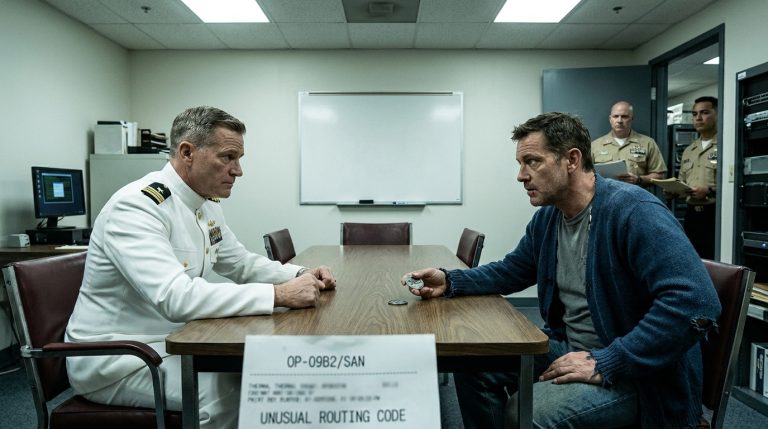
“Under Protocol Frostline-4?” Mercer interrupted. He stopped two feet from the board table, pulled a ruggedized field tablet from his inner coat pocket, and laid it flat on the wood. “A document that exists nowhere in the Highgate County Register. A document stamped with a fraudulent seal.”
Marin turned toward the board members sitting beside her. Neither of them looked up. One man was staring intently at his own knuckles; the other was reading the PDF printout of the Vanguard Logistics LLC disbursements.
“You have no authority to audit private HOA operational funds,” Marin said, her voice dropping into a razor-thin hiss. “We retain independent legal counsel.”
“We aren’t auditing your funds, Ms. Holt,” the sheriff’s deputy said, stepping up beside Mercer. “We’re executing a state warrant for obstruction of emergency services, extortion under color of authority, and forgery.”
Mercer tapped the screen of his tablet twice.
The room filled with the raw, unedited audio from my dashcam. The speaker on the tablet spat the exact words Marin had uttered in my headlights three nights ago:
“Ignore my SUV, and I’ll end your contract in this neighborhood… I decide who gets rescued in this community.”
A wave of low murmuring rolled through the seated residents. A woman near the front row stood up, holding her phone toward Marin, her face tight with anger.
Marin looked directly at me for the first time since I’d entered the hall. Her eyes weren’t frantic; they were cold, calculated, and filled with a desperate, sharp fury.
“You think this saves your business?” she whispered, loud enough for the first row to hear. “You think you can operate on this mountain when every property owner knows you brought law enforcement into our private enclave?”
“The property owners already read the ledger, Marin,” I said, my hand resting quietly in my coat pocket, fingers light against the cold metal of my knife. “They know where the twenty-four thousand dollar bonds were going. They know about Vanguard.”
The board chair to Marin’s left finally cleared his throat, picked up his gavel, and laid it down gently on the felt pad without striking it.
“By unanimous consent of the remaining board,” he said, his voice trembling slightly, “Marin Holt is stripped of all administrative access and relieved of her presidency effective immediately.”
Marin didn’t reach for her binder. She didn’t pack her silver pen. She pulled her hands back from the table, smoothed the lapels of her dark grey blazer with a single stiff gesture, and walked straight past Captain Mercer toward the rear exit.
Nobody moved out of her way, but nobody touched her either. They just watched her heels strike the wet floor tile until the double doors swung shut behind her, leaving the cold wind of the storm outside to whistle through the gap.
CHAPTER 8: THE WEIGHT OF THE CHAIN
The double doors clicked shut behind Marin Holt, sealing her out in the biting mountain storm.
Inside the hall, nobody moved for five seconds. Then the silence broke—not with shouting, but with a collective, heavy exhale that rustled through forty paper packets on the folding tables.
The board chair didn’t strike his wooden gavel. He laid it flat beside the financial printouts, adjusted his wire-rimmed glasses, and looked straight down the center aisle toward Captain Mercer and the county investigator.
“The board will cooperate fully with the Highgate County Prosecutor’s Office,” the chair said, his voice flat, drained of every drop of political theater. “All bank accounts associated with the community infrastructure reserve are frozen as of this moment.”
Captain Mercer gave a single, firm nod. He picked up his ruggedized field tablet from the table, slid it back inside his heavy turnout coat, and turned to look at me.
“County Emergency Management issued an emergency stay twenty minutes ago,” Mercer said, his words carrying clearly through the quiet hall. “Protocol Frostline-4 is nullified across all county dispatch records. Every commercial rotation operator stays on their assigned grid. No private entity overrides a Code-9 call. Ever.”
“And the Vanguard contract?” the deputy asked, taking a step toward the doorway.
“Injunction served at their lower staging shed five minutes ago,” Mercer replied. “The county frozen-asset order covers their rig. They’re done on this pass.”
A quiet hum of conversation started to ripple through the rows. The resident who had whispered near the coffee urn stepped forward, her hands buried in her fleece pockets, looking at my salt-crusted work boots.
“We didn’t know,” she said softly, not looking directly at my face. “The posts on the neighborhood forum… she made it sound like you were holding us hostage during the storm.”
“People believe what’s printed on letterhead when the power goes out,” I said. My hand rested inside my canvas coat, thumb tracing the worn rivet on my brass pocketknife. “Rules look real until you ask to see where they’re filed.”
I didn’t stay for the rest of the board’s administrative cleanup. I didn’t wait for the formal vote to expunge the illegal fines. I turned on my heel, pushed through the heavy exit bar, and stepped out into the dark.
The storm was finally dying down. The sideways blizzard had thinned into fat, lazy flakes drifting straight down through the amber glare of the high-pressure sodium streetlights.
My flatbed sat idling on the shoulder of the maintenance lot. The diesel motor ran smooth and steady, exhaust rising in a thin, grey plume against the black pine canopy.
I walked to the passenger side, unlatched the heavy tool chest mounted behind the cab, and pulled out an oily rag and a bottle of gear solvent.
The six-pound red tow hook chain hanging from the headache rack was caked in grey road salt and frozen mud from the Mile 9 winching run. I didn’t rush. I took each link between my fingers, wiping away the grit, letting the solvent dissolve the ice until the bare alloy steel showed dark and unpitted beneath the streetlights.
Link by link, I cleaned the chain. The cold metal stung my bare fingers, but the mechanical work was clean, predictable, and solid.
Across the valley, down on the lower switchback where the pines framed the county line, the red and blue strobe lights of the sheriff’s cruisers flickered through the trees—a silent, orderly rhythm moving down the mountain toward the courthouse in Highgate.
I draped the heavy red hook over its iron storage cleat. It settled with a deep, solid metal-on-metal clack that anchored the night.
I climbed into the cab, pulled off my wet leather gloves, and laid them across the heater vent. My radio on the dashboard chirped once—a crisp, clear tone that broke through the quiet cabin.
“County Dispatch to Unit 4. Switchback at Mile 12 is clear. Storm warning downgraded. Regular rotation resumes.”
I reached out, pressed the transmit button on the side of the mic, and spoke into the grid.
“Unit 4 copy. Heading up the ridge.”
I released the air brakes, shifted the heavy transmission into gear, and pulled out onto the quiet, white road, the heavy iron bed rolling smooth beneath me in the snow.