The Iron Boundary Line Where False Deeds Fall and Sovereign Dirt Demands Its Due
CHAPTER 1: THE RED LINE ON THE DIRT
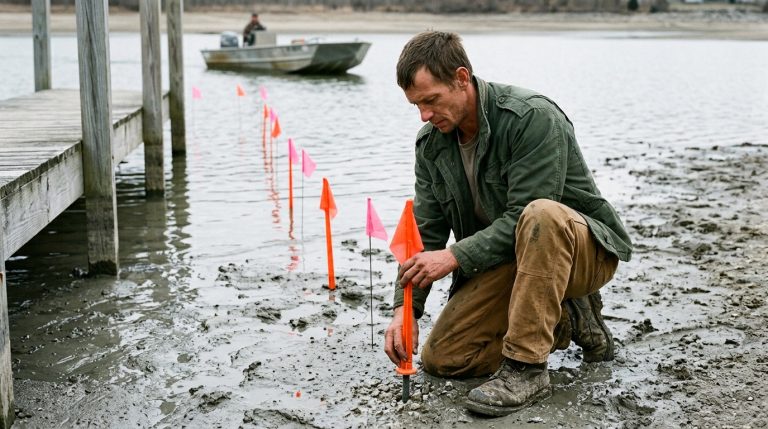
The brass plumb bob in my right coat pocket weighed eleven ounces. Its pointed steel tip clicked against the zinc ruler in my palm with every breath I drew. Three feet past the rot-blackened cedar pickets of my rear fence, an iron rebar stake sat driven fresh into the soil. The paint on its head was wet. High-vis orange. Still tacky enough to stain a thumb.
It didn’t belong there. The county pin was six yards south, buried under eight inches of damp pine needles and packed clay.
Behind the fence, someone slammed a heavy glass bottle into an empty plastic recycling bin. A engine revved—a straight-piped V8 idling rough in the brush—followed by the slurred, high-volume laughter of four men who thought three hundred yards of dark trees made them invisible.
Then the red and blue strobes hit the wet oak leaves above my roof.
I didn’t run. I didn’t reach for a flashlight. I walked down the gravel driveway toward the gate, my thumb tracing the deeply notched scale on the brass bob.
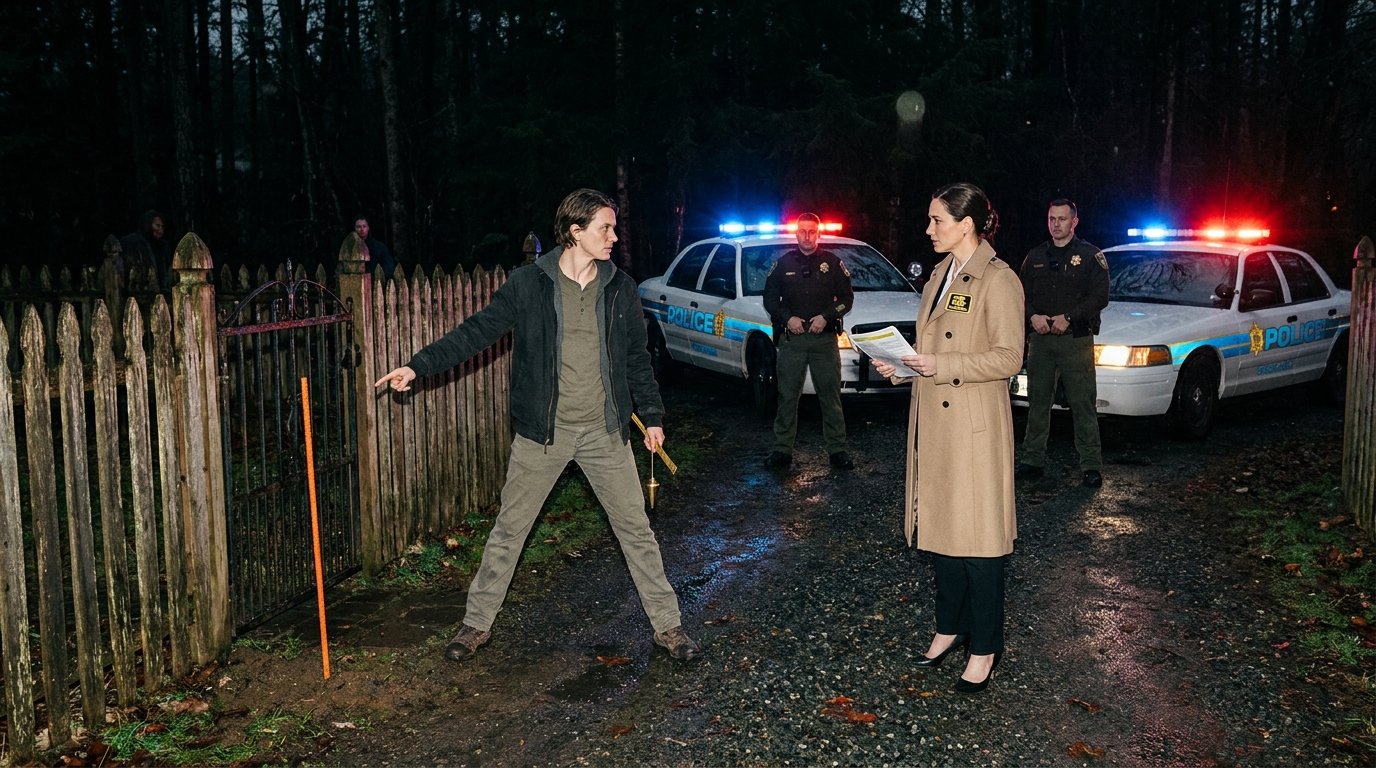
Two patrol cars blocked the street. A deputy stood by the driver’s door of the lead vehicle, his hand resting flat against the leather snap of his holster. Behind him, standing on the elevated curb in low heels and a crisp wool trench coat, was Celeste Harrow. The gold-plated Sage Brook Ridge HOA emblem pinned to her lapel caught the flashing red lights like a pulse.
“Stay right there,” the deputy said. His voice was flat, practiced, trained to flatten civilian tempers before they spiked.
I stopped four feet back from the iron gate. “My property line ends six yards past that cedar fence.”
“It does not,” Celeste said. Her tone was smooth, polished, the exact pitch she used to run quarterly budget readings. She didn’t look at me. She kept her eyes on the officer’s left shoulder. “Deputy, this homeowner has been harboring unauthorized individuals and hostile non-residents on common community land. My son and his guests are conducting a permitted neighborhood watch patrol.”
“Your son is twenty-two,” I said, my voice dropping an octave into the quiet air. “He’s drinking cheap bourbon out of a brown bag and tossing the glass onto my lot.”
“It’s an HOA easement corridor,” she cut in. She pulled a laminated sleeve from under her arm and held it out. “Section 4, Paragraph B. Clear access rights reserved for community security and maintenance.”
The deputy didn’t take the paper. He pulled a heavy rubberized tablet from his belt, tapped the screen twice with a gloved thumb, and squinted at the parcel overlay.
A bottle shattered behind the trees. A sharp, rhythmic impact—glass on stone.
The deputy’s eyes flicked toward the dark woods behind my roofline, then back down to the glowing grid on his screen. “This address is Lot 17, Juniper Bend.”
“Correct,” I said.
“According to the county GIS feed…” The deputy paused, rotating the tablet ninety degrees. He frowned, his brow furrowing under the brim of his campaign hat. “The Sage Brook Ridge boundary terminates at the ditch line. This back lot isn’t in your HOA jurisdiction, ma’am.”
For three seconds, the air between us went dead silent. The engine behind the fence sputtered and died.
Celeste didn’t flinch. Her grip on the binder tightened just enough to buckle the plastic sleeve. A thin, artificial smile formed at the corners of her mouth—cold, precise, and entirely devoid of heat.
“The digital registry is undergoing an administrative update,” she said softly. “The board approved the corridor acquisition last spring. If this individual refuses to clear the land, he is actively interfering with an ongoing security assessment.”
She stepped past the deputy’s bumper, her heels clicking sharp against the asphalt, and looked me dead in the eye through the chain links.
“Remove yourself from the gate,” she whispered. “Or we enforce the daily non-compliance tariff before the sun comes up.”
My fingers tightened around the brass plumb bob until the steel point bit into my palm. I didn’t move an inch.
CHAPTER 2: THE FIVEFIGURE PAPER TRAP
The deputy’s boots shifted on the gravel, a dry crunch that broke the standoff just enough for him to step between us. He didn’t unholster his sidearm, but his hand hovered two inches above the retention strap.
“That’s enough for tonight,” the deputy said, his voice dropping into a register meant to end arguments before they turned into reports. “Ma’am, take your son and his friends off the back lot. If there’s a property dispute regarding boundary lines, that’s civil. Take it up with the county assessor or the civil court. We aren’t clearing private land without a signed order.”
Celeste didn’t blink. The rain had started—a thin, freezing mist that beaded on the wool lapels of her coat and turned the dirt near her heels into dark grease. She looked at the officer, then slowly turned her head toward me.
“Civil,” she repeated softly. The word sounded like a threat in her mouth. “Of course. We follow the rules here, Deputy.”
She turned and walked back toward the road without checking on the woods behind my fence. No shouting. No call for her son. Within ninety seconds, the V8 engine in the brush killed its lights, groaned in reverse through the wet undergrowth, and pulled onto the paved road half a mile down the ridge.
The red and blue strobes faded down Juniper Bend, leaving only the yellow glare of my porch light cutting through the drizzle.
I stayed at the gate until the sound of tires died completely. The brass bob in my pocket had warmed against my thigh, but the steel point had left a crescent-shaped indentation in the meat of my thumb. I didn’t rub it. I walked back to the kitchen, laid the plumb bob on the oak table alongside the county parcel printout from three years ago, and locked the deadbolt.
At 6:12 a.m., the front door didn’t rattle. There was no knock. Just a sharp, metallic thunk against the aluminum frame.
I opened the door to six degrees of damp mountain air. Taped flat against the center panel was a manila envelope sealed inside heavy clear plastic to protect it from the fog. The header was printed in bold, unyielding sans-serif: SAGE BROOK RIDGE HOMEOWNERS ASSOCIATION — NOTICE OF IMMEDIATE NON-COMPLIANCE & FINANICAL ASSESSMENT.
I didn’t read it on the porch. I brought it inside, set it beside the brass weight, and sliced the top edge with a kitchen knife.
The numbers weren’t designed to negotiate. They were designed to liquidate asset reserves.
Violation 1: Unauthorized Obstruction of Community Easement Corridor — $750/day.
Violation 2: Hostile Interference with Board-Sanctioned Security Protocol — $750/day.
Violation 3: Unapproved Installation of External Monitoring Devices (Rear Lot Surveillance) — $250/day.
Retroactive Effective Date: October 14th.
At the bottom, above a digital rendering of Celeste Harrow’s signature, the text shifted to heavy boldface: Failure to remit total accrued fines within 72 hours will trigger an immediate statutory lien against Lot 17 under Section 12-A of the Master Covenants, up to and including foreclosure proceedings to recover legal and administrative costs.
Three thousand dollars a day. Backdated four days. Twelve thousand dollars on a paper notice left while the sun was still under the horizon.
My phone buzzed on the counter. An automated system alert from the Sage Brook Ridge community portal. The subject line read: Safety Warning & Boundary Clarification — Juniper Bend Sector.
I clicked the link. The portal’s main bulletin board, usually reserved for lawn mower schedules and lost retriever notices, featured a high-resolution map. The boundary line for Lot 17—my lot—had been pulled back fifty feet. The green shaded area labeled “Common Access Easement” now covered the entire oak grove, the drainage ditch, and the exact clearing where the V8 had been idling six hours ago. At the bottom of the page, a small logo for Vanguard Realty Trust was listed as the digital mapping contractor for the administrative update.
I pulled up my actual county deed file on the secondary monitor. The boundary lines hadn’t moved an inch on the official state server. The county seal was crisp, stamped in black ink, completely untouched by whatever administrative hand had edited the portal’s PDF.
Outside, a low diesel engine rumble vibrated through the floorboards.
I walked to the front window, keeping behind the heavy linen curtains. A dark blue Ford F-250 with a magnetic decal on the door—COMMUNITY SECURITY SERVICES—had pulled up onto the grass shoulder directly across from my driveway.
The driver didn’t get out. He adjusted a heavy telephoto lens mounted to a window bracket, pointed it straight at my front door, and pressed the shutter. The sharp, mechanical click of the mirror lockup was audible even through the double-pane glass.
They weren’t trying to win a legal argument. They were building a paper file fast enough to force a summary lien before a judge ever looked at a county map.
I reached down, picked up the brass plumb bob, and felt the heavy, unyielding balance of the metal.
They wanted a fight over noise and fences. But people don’t spend twelve thousand dollars in forged paperwork and hire private security contractors just to let a twenty-two-year-old drink bourbon in the woods.
I unlocked the drawer under the counter, pulled out a fresh pad of yellow legal paper, and wrote down three words: County Clerk. Surveyor. Title Insurance.
Then I walked back to the window and let the curtain fall shut.
CHAPTER 3: THE UNSIGNED LAYER
The linen curtain settled back against the oak trim with a faint whisper of cloth on wood. Across the street, the diesel engine of the F-250 gave a throaty tap of the throttle, its wide tires crunching over the gravel shoulder as it rolled fifty yards north to park beneath the shadow of a dying pine.
I didn’t watch it clear the driveway. I stepped back to the counter, took the yellow legal pad, and slid it into a battered leather courier bag alongside the county deed printout and my brass plumb bob.
Forty minutes later, the heavy brass-and-glass doors of the County Records Annex swung shut behind me, cutting off the damp drizzle of the street. The lobby smelled of damp floor mats, floor wax, and forty years of decomposing paper.
Behind a counter topped with scuffed green laminate, a senior clerk with round wire-rimmed glasses sat tapping a pencil against a stack of property transfers. Her name tag read M. DAVIS.
“Lot 17, Juniper Bend,” I said, placing my physical deed flat on the laminate between us. “Parcel ID 884-09.”
She didn’t look up immediately. She finished her stroke with the pencil, set it down, and pulled my paper toward her with two fingers. “Boundary dispute or tax assessment?”
“Cadastral discrepancy,” I said evenly. “An administrative boundary overlay was pushed to an HOA portal twelve hours ago. It clips fifty feet off my southern line.”
Davis grunted, swinging her monitor on its heavy steel arm toward her eyes. Her fingers moved across her keyboard with rhythmic, mechanical speed. The clatter echoed in the high-ceilinged room.
“Lot 17,” she murmured, watching the glowing screen. “Recorded boundary certified seven years ago. Iron pin set at the southwest corner, six yards past the cedar fence line. No active county amendments.”
“Check the digital upload log,” I said, leaning forward until my forearms rested against the cool laminate edge. “Section 12 easement filings.”
Her fingers paused over the keys. She squinted through her bifocals, clicking three times with a clunky plastic mouse.
“There’s an administrative vector layer uploaded yesterday,” she said, her voice losing its routine monotone. She shifted her glasses down her nose. “Timestamped 4:14 p.m. Upload source listed as an external third-party contractor—Vanguard Realty Trust.”
“Under what authority?”
Davis rotated the monitor another three inches toward me so I could see the high-resolution countyGIS interface. The official blue boundary line of Lot 17 sat clean and sharp on the map. But ghosted over the top was a red hatched zone—the exact easement corridor Celeste Harrow had printed on her laminated sheet.
“Look at the signature field,” Davis said, pointing a clipped thumbnail at the bottom left corner of the digital record.
The box for County Surveyor Approval was empty. The box for Licensed Engineer Seal contained a line of raw gray text: PENDING_ADMINISTRATIVE_REVIEW_VRT.
“That’s not an approved boundary modification,” Davis said, her tone hardening into professional irritation. “That’s an unverified draft filing dropped into the portal’s public viewer cache. It has zero legal standing. It doesn’t even have a valid surveyor license ID attached.”
“Then why is an HOA enforcing daily fines based on it?”
“Because most people don’t come down to this desk with their original deed,” she snapped, pulling the monitor back toward her side of the counter. “They see a red line on a portal map with a official-looking header and they panic or pay.”
She pulled a heavy steel stamp from a ink-pad tray, slammed it onto a fresh copy of my parcel map, and signed her name in tight blue ink across the seal.
“This is your certified plot,” she said, sliding the paper across the laminate. “If someone is putting stakes on your grass based on that unverified upload, they’re trespassing on private property under state land statutes. And if they’re charging you money based on an unsigned record, they’re stepping into fraud.”
I took the certified copy, folded it cleanly into thirds, and slid it into my courier bag beside the brass weight.
“Who authorized Vanguard Realty Trust to access the county portal submission queue?” I asked.
Davis hesitated, her hands resting on the edge of her keyboard. She looked at the door behind me, then back at my face.
“The submission came through a municipal infrastructure improvement easement draft,” she said softly, lowering her voice below the hum of the overhead lights. “A regional drainage assessment filed under Culvert-88. The applicant on record wasn’t the county. It was a private contingency account managed directly through the HOA board.”
My thumb pressed through the leather of my bag, finding the cold, unyielding point of the plumb bob inside.
“Line-Item 404,” I said quietly, reading the administrative tag printed at the top of the unverified draft.
Davis didn’t confirm it out loud. She just pulled her pencil back into her hand, turned her screen away from the counter, and went back to her stack of paper transfers.
“Have a good afternoon, sir,” she said.
I turned and walked back toward the heavy glass doors, the certified plot locked safely in my bag, while outside on the wet pavement, the blue Ford F-250 was waiting at the corner curb, its engine idling in a steady, heavy pulse.
CHAPTER 4: HANDTOHAND AT THE TREE LINE
The heavy glass doors of the Annex clicked shut, but the cold weight of the stamped paper inside my leather bag felt like an anvil against my hip. Across the street, the blue Ford F-250’s exhaust blew a pale plume into the drizzle, its side mirror tracking my steps until I reached my truck.
I didn’t head for a lawyer’s office. Not yet. I drove straight back to Juniper Bend.
By 9:00 p.m., the fog had rolled off the ridge, thick and smelling of wet limestone. I killed all the interior lights in the house, pulled a dark wool cap over my ears, and sat on an inverted five-gallon bucket in the dark corner of my rear porch. The certified survey map rested flat on my knees beneath a rubber mat. In my right hand, I held a small night-vision optic—no infrared illuminator to give off a red glow, just raw light amplification.
At 10:14 p.m., the brush behind my property line rustled.
No headlights. No loud V8 revving this time. Just the wet squelch of work boots stepping over the ditch where Culvert-88 opened into the creek bed.
I brought the optic to my eye. The green phosphor screen bloomed to life, grainy and sharp.
Three figures moved through the pine trunks, twenty yards past my cedar pickets. One was Celeste’s son—tall, slouched, wearing a dark canvas jacket with the hood pulled low. The other two were older, broader across the shoulders, moving with a deliberate, practiced stillness that didn’t belong to college kids out drinking bourbon.
One of the men reached down into the mouth of the concrete culvert pipe. He didn’t pull out a beer bottle. He dragged out a waterproof pelican case, yellow plastic smeared with river mud, roughly the size of a tool chest.
Celeste’s son stepped closer, pulling a thick paper envelope from his inner pocket. His hands were shaking—even through the green optic, the rapid, nervous jerk of his wrist was obvious.
The second man took the envelope, flicked the corner open with a thumb, and slid two fingers inside to feel the thickness of the stack. Cash. Cold, clean paper. He didn’t count it. He nodded once, handed the pelican case to the kid, and reached into his own coat to pull out a small, heavy nylon pouch.
Hand to hand. A crisp, three-second exchange.
The kid took the nylon pouch, jammed it deep into his pocket, and turned toward the fence line. The beam of his pocket flashlight flicked on for half a second—just long enough to illuminate the high-vis orange rebar stake Celeste had driven into my soil the night before.
They weren’t claiming an easement to clean a ditch or protect a neighborhood. They were using the unmapped concrete culvert on my unmonitored back lot as a blind drop point. And Celeste’s fake boundary map on the HOA portal was the shield that kept the county out and gave them exclusive right to clear anyone who looked too closely.
I shifted my weight on the bucket. My boot heel caught a loose deck screw—a tiny, sharp click of iron against pine.
The broad-shouldered man at the culvert froze instantly. His head snapped toward my dark porch.
In the green glow of the viewfinder, I saw his right hand drop smoothly toward his waistband, his fingers hooking under the hem of his jacket. He didn’t shout. He didn’t ask who was there. He took two fast, silent strides toward my fence line, his eyes scanning the pitch-black shadows of my yard.
My pulse hammered once against my throat. I didn’t drop the optic. I didn’t run inside.
I reached into my bag on the floor, lifted the eleven-ounce brass plumb bob by its braided nylon cord, and let the heavy metal tip swing once, striking the cedar fence rail with a dull, solid thunk.
“You’re sixteen feet past the iron pin,” I called out into the dark, my voice low, flat, and steady as cold iron. “And the county clerk signed my survey at two o’clock.”
The man stopped five feet short of the fence. His shadow blocked the pale light of the fog. For four long seconds, neither of us breathed. Then he slowly pulled his hand out from his jacket, turned his head toward Celeste’s son, and gestured toward the trees.
“Pack it up,” the man muttered softly.
They vanished into the dark toward the road, the mud sucking at their boots until the woods went dead silent again.
My fingers were locked so tight around the brass weight that the cold had seeped straight into my knuckles. I pulled out my phone, opened the camera log, and confirmed the three high-resolution stills saved to the local drive: the pelican case, the cash envelope, and the clear face of Celeste’s son holding the nylon pouch beside the orange stake.
The decoy of a noisy neighbor party was dead. The real game had just started.
CHAPTER 5: THE PAPER TRAP SPRINGS
The fog didn’t lift by dawn. It clung to the cedar fence in fat, oily droplets that dripped onto the wet soil where the orange rebar stake still stood.
Inside, I sat at the kitchen table with my phone tethered directly to my laptop. The three stills from the night-vision optic—crisp, grainy, timestamped 10:14 p.m.—were laid out in a grid beside the certified county parcel map. The yellow plastic pelican case pulled from Culvert-88 was undeniable in green phosphor.
At 8:03 a.m., my inbox chimed. A high-priority notification from the Sage Brook Ridge resident distribution list.
The subject line read: OFFICIAL NOTICE — EMERGENCY BOARD ACTION & ENFORCEMENT HEARING.
Attached was an automated thread notification. But someone on the administrative side had made a fatal blunder—a careless “Reply All” on an internal draft that caught the entire Juniper Bend resident sector before the board administrator could recall it.
I clicked the raw header and expanded the message tree.
The top email was from Celeste Harrow, sent at 11:42 p.m.—less than an hour after I’d dropped the brass weight against the cedar rail in the dark.
TO: BOARD_EXEC_SAGEBROOK
FROM: [email protected]
SUBJECT: RE: Juniper Bend Boundary Control
If we don’t lock down the easement title at tomorrow’s emergency hearing, he’ll keep bringing county deputies to the back lot. The boundary update in the portal must be ratified as permanent board policy before the county surveyor processes his formal audit. Security expenses are already running hot. Approve the drawdown from Line-Item 404 under the emergency infrastructure reserve.
Below it was a response from the board treasurer, timestamped twenty minutes later:
APPROVED. Drawdown of $14,500 transferred to Vanguard Realty Trust for site monitoring and administrative legal filings. Ensure the Culvert-88 drainage access remains clear of resident interference until the transaction clears.
I didn’t smile. I didn’t cheer. I felt a cold, hard clarity settle into my chest, heavy as lead.
They weren’t just misusing authority to cover a son’s reckless habits. They were funneling community reserve funds through Line-Item 404 to pay a private contractor—Vanguard Realty Trust—to secure a blind distribution hub under the guise of an easement dispute. The $750-a-day fines leveled against my home were a blunt instrument designed to force me into default before anyone looked at where the money was flowing.
My fingers moved across the trackpad. I selected the entire raw email header, including the IP origin stamps and internal server routing logs.
I printed three physical copies on heavy paper.
First copy: slid into a manila folder alongside the certified county map stamped by M. Davis.
Second copy: scanned and encrypted, sent directly to the personal portal of a senior investigator at the State Attorney General’s Real Estate Fraud Division.
Third copy: slid flat into the front pocket of my courier bag, resting right beside the brass plumb bob.
Outside, tires crunched on the wet gravel of Juniper Bend. A silver sedan pulled onto the shoulder, followed by two dark SUVs. The board members were gathering at the clubhouse early, setting up the folding chairs for the 10:00 a.m. emergency hearing meant to strip my rights to the land behind my fence.
I picked up the leather bag, slung the strap over my shoulder, and felt the heavy brass weight slap once against my hip.
They thought they were holding a trial. They didn’t know they’d built their courtroom over an open trapdoor.
CHAPTER 6: THE CHECKMATE AT THE CLUBHOUSE
The air inside the Sage Brook Ridge Clubhouse smelled of stale urn coffee, damp floor runner, and harsh industrial bleach. Forty metal folding chairs scraped against the linoleum as residents crammed into the narrow aisles, whispering behind raised palms.
At the front folding table, Celeste Harrow sat behind a microphone, her spine rigid, her hands folded flat over a pristine white binder. Her gold HOA badge pinned to her coat lapel caught the glare of the overhead fluorescent tubes. Beside her, the board treasurer stared fixatedly at a glass of water, his fingers twitching against his thigh.
I didn’t take a seat in the back row. I walked down the center aisle, the heavy brass plumb bob in my courier bag striking my leg with every measured pace, and stopped six feet from the board table.
“This emergency hearing is called to order,” Celeste said, her voice dropping into the microphone with loud, metallic authority. She didn’t look at my face; her eyes stayed pinned to the top edge of her binder. “Under Section 12-A of the Master Covenants, the board will formally ratify the administrative boundary refinement for Lot 17 and enforce outstanding safety assessments.”
“The boundary isn’t a refinement,” I said. My voice wasn’t raised, but in the low-ceilinged room, it cut through the room’s low hum like a saw blade. “It’s a forgery.”
Celeste’s knuckles went white where her hands met on the binder. “You are out of order. Sit down or you will be removed by community security.”
I unbuckled the leather flap of my bag. I didn’t pull a weapon. I pulled three printed sheets, setting them flat on the laminate table directly over her open binder.
“Certified parcel map, stamped yesterday at 2:00 p.m. by M. Davis at the County Records Annex,” I said. “The county line sits six yards south of my cedar fence. Your upload to the public portal was unverified, unsigned, and filed without surveyor credentials.”
A ripple of low murmurings stirred through the third row. An elderly man in an oilskin coat leaned forward, squinting toward the table.
Celeste didn’t look at the map. Her jaw tightened, a tiny muscle beneath her ear twitching violently. “Internal administrative updates are backed by board contingency allocations. The public portal is a draft interface—”
“It’s not a draft interface,” I said, leaning down until my hands rested on the edge of the table. “It’s the cover for Culvert-88.”
The treasurer’s glass of water rattled against the wood as he jerked his arm back.
“You drew fourteen thousand five hundred dollars out of the reserve fund last night,” I continued, speaking clearly toward the open microphone. “Line-Item 404. You wired it directly to Vanguard Realty Trust to pay private security contractors to guard a concrete drainage pipe on my unmonitored back lot.”
Celeste stood up so fast her metal chair shrieked against the floorboards and tipped backward, slamming flat onto the linoleum. “That is confidential internal board correspondence! You gained access to board communications illegally—”
“You sent it to the entire neighborhood distribution list at 11:42 p.m.,” I said. “And the Attorney General’s Real Estate Fraud Division received the raw IP headers thirty minutes ago.”
The double doors at the rear of the clubhouse swung open with a dull thud.
Two men in dark suits stepped into the room, followed by a county deputy with a clip-board and a radio strapped across his chest. The lead investigator didn’t ask for permission. He walked down the center aisle, his eyes locked on Celeste.
“Celeste Harrow?” the investigator asked, his voice low and uncompromising. “We have a court order for all administrative server logs, banking records for Vanguard Realty Trust, and a warrant to access the drainage easement at Culvert-88.”
Celeste’s face turned the color of wet chalk. Her lips moved, but no sound came out. She looked at the treasurer, but he had already pulled his hands back into his lap, staring at the floor, completely silent.
“My son…” she whispered, her voice cracking for the first time, losing every drop of its polished, administrative cadence. “He was just… we were trying to clear the property line…”
“Your son is currently being detained at the county line,” the deputy said calmly, stepping forward with a pair of steel cuffs. “He had a yellow waterproof pelican case in the trunk of his car.”
The room erupted into overlapping shouts, chairs scraping backward as neighbors stood up to get a view. Celeste didn’t fight as the deputy took her arms. Her eyes flicked toward me—not with anger anymore, but with a vacant, hollow shock as she was led out through the side exit into the damp morning fog.
By 4:00 p.m., the clubhouse was locked and dark.
The rain had finally stopped, leaving a quiet, cool stillness hanging over Juniper Bend. I stood in my back lot, six yards past the cedar fence, looking down at the creek bed where Culvert-88 opened into the rock.
The orange rebar stake Celeste had driven into the ground was gone. I had pulled it up with a pair of fencing pliers, leaving only a neat, round hole in the damp clay.
I pulled the brass plumb bob out of my pocket. The steel tip was slightly dulled from hitting the fence rail the night before. I sat on a moss-covered log, pulled a small strip of oil-soaked emery cloth from my pocket, and slowly polished the metal point until the brass gleamed yellow under the overcast sky.
The noise was gone. No V8 engines idling in the dark. No private security trucks parked beneath the pine trees across the street. The county boundary pin—dark, rusted, and immovable—sat buried four inches deep beneath the pine needles at my feet.
I slid the plumb bob back into my pocket, felt its solid, eleven-ounce weight settle against my hip, and walked back toward the house to fix the broken fence rail.