The Weight of the Canopy: A Veteran’s Measured Siege Against the Architects of Suburban Ruin
CHAPTER 1: THE SOUND OF IRON
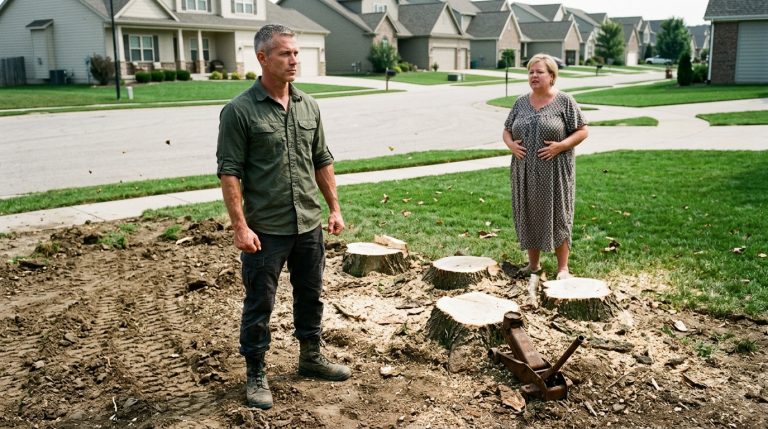
The silence that followed the chainsaws was worse than the noise. It was a heavy, pressurized quiet that made my ears ring, a vacuum where the swaying branches of my great-grandfather’s oaks should have been. Now, there were only jagged, weeping stumps—raw wood exposed to the harsh light, bleeding sap onto the manicured grass.
Karen stood five feet away. She held her clipboard like a tactical shield, her posture stiff, her gaze fixed on the space where the canopy had once filtered the afternoon sun. She didn’t look at me. She looked at the horizon, as if her duty was to keep the sky clear for satellites and her own sense of order.
“Your trees were a violation,” she repeated, her voice a practiced, sterile drone. She didn’t blink. “Section 14, subsection C. The board’s decision is final.”
I didn’t argue. I didn’t raise my voice. I pulled the brass compass from my pocket and flicked it open with my thumb, the metal cold and pitted with age. The mechanism grated—a dry, rhythmic friction that felt like a heartbeat. My eyes traced the line of the stumps. The cuts were sloppy, aggressive, done with the haste of a mercenary crew who didn’t care about the long-term health of the timber.
“They weren’t just trees, Karen,” I said. My voice sounded foreign to me, stripped of the warmth I usually reserved for my wife. It was the voice of a man conducting a post-action survey. “They were structural. They held the soil. They were the center-point of the property survey lines drawn in 1924.”
“They were an obstruction,” she snapped, finally looking at me. Her eyes were hard, devoid of the doubt I had expected to find. There was no fear there, only the cold, unyielding resolve of a functionary. “The bylaws exist to ensure the visual integrity of the community. You should have read them before you assumed ownership of this house.”
I looked down at the compass. The needle flickered, struggling against the magnetic interference of the wood chipper nearby. It was a relic of a time when boundaries meant something, when land was something you stewarded rather than managed.
“I didn’t assume ownership,” I said quietly, keeping my eyes on the jagged wood. “I inherited it. And with it, I inherited a responsibility to protect what’s rooted here.”
She turned, her polyester blouse rustling as she signaled the crew to clear the debris. The orange-vested men moved with a mechanical efficiency, their loaders tearing up the sod as they dragged the branches toward the chipper. The sound of grinding wood filled the air—the sound of history being reduced to mulch.
I felt a surge of something hot and sharp behind my ribs, but I suppressed it. I took a slow breath, letting the smell of sawdust and stale exhaust settle into my lungs. This wasn’t a riot; it was a demolition. And in every demolition, there were blueprints.
“You’re overstepping, Karen,” I said, my voice steady. “You didn’t just trim. You damaged the structural integrity of the entire plot.”
She didn’t stop. She began walking away, back toward the pristine, sterile rows of houses that made up our neighborhood. “We’ll send you the invoice for the removal, Mr. Thorne. It’s a standard levy. Don’t worry—it’s all in the bylaws.”
She didn’t look back. She didn’t need to. She believed the rules were a wall. She didn’t realize that a wall is only as strong as the foundation it rests on—and I was just beginning to dig.
I stood there for a long time, the cold brass of the compass pressing into my skin, watching the last of the branches disappear into the machine. The lawn was scarred, deep gouges in the earth where the equipment had turned. I looked at the house—my home—and then at the empty, jagged stumps.
Something was missing. Beside the largest stump, half-buried in the churned mud, was a scrap of yellow surveyor’s tape that didn’t belong to my property. It was marked with a code—Project Alpha-9—and a date that was only two days old.
My jaw tightened. This wasn’t just about a satellite dish or a neighbor’s complaint about shade. This was a site preparation.
CHAPTER 2: THE ARBORISTS LEDGER
The rain began as a tentative tapping against the remaining oak leaves, but within minutes, it deepened into a rhythmic, relentless drumming against the roof of my porch. I didn’t retreat inside. I stayed on the edge of the deck, my boots caked in the mud of my own land, watching the surveyor’s tape dance in the rising gusts. Project Alpha-9. The designation felt like a brand. It wasn’t the language of homeowners associations or lawn maintenance; it was the vocabulary of developers, the shorthand of men who looked at a century of history and saw only cleared acreage.
I pulled the brass compass out again. In the shifting grey light, the needle didn’t just flicker; it spun. The proximity of the hidden survey markers, metallic stakes likely driven deep into the root zone of the fallen giants, was playing havoc with the aging magnet. It was a physical, jarring friction that mirrored the sudden, sharp tension in my gut.
I needed someone who could see what I couldn’t. I needed a man who could look at a stump and read the history of the soil.
Ben Carter arrived exactly as the sky turned the color of bruised iron. His truck, a rust-flecked workhorse, pulled into the driveway, its tires chewing through the sod I had fought to keep perfect for years. He stepped out, his tall, wiry frame wrapped in a heavy, grease-stained canvas coat, his eyes already scanning the perimeter with the intensity of an engineer sizing up a collapsing bridge.
“Marcus,” he greeted, his voice a low gravel that seemed to fit the atmosphere. He didn’t offer a platitude about the trees. He walked straight to the largest stump, his hands—calloused, map-lined—brushing away the wet sawdust to expose the inner grain.
I followed him, the mud sucking at my heels. “There’s more than just a bad pruning job here, Ben,” I said, pointing to the piece of yellow tape I’d retrieved and pinned to the trunk of a younger sapling.
He took the tape, held it close to his eyes, and cursed under his breath. He didn’t say a word for a long, agonizing minute. He circled the stumps, his boots crunching on the debris, stopping occasionally to press a specialized soil probe into the earth. The rain grew heavier, plastering his hair to his forehead, but he seemed oblivious to it.
“This isn’t an HOA remediation, Marcus,” he finally said, his voice hard. He stood up, wiping his hands on a rag that did nothing to clean them. “Look at the pattern. These weren’t topped for ‘sightlines.’ They were cut to a specific height, a clear corridor. If you were looking to run, say, high-capacity utility conduits or foundation supports for a heavy-duty structure, this is exactly where you’d clear the path.”
“A foundation?” I felt the cold realization settle in, sharper than the rain. “In a residential buffer zone?”
“Not residential. Look at the depth of the soil samples I’m pulling.” He gestured to a set of glass vials filled with dark, damp earth. “This ground is being prepped for something that carries weight. Something industrial. These trees were the only things anchoring the water table here. You take them out, you kill the resistance. The ground becomes compliant for the developer.”
I felt the brass compass click shut in my pocket. The friction of the metal against my leg was a steadying, grounding pain. The HOA’s “compliance” wasn’t just a racket for fines; it was the clearing of the battlefield. Karen wasn’t just the queen of a suburban fiefdom; she was the scout for a project that would erase the very foundation of this neighborhood.
“I need a ledger, Ben,” I said, my voice barely audible over the roar of the downpour. “I need the appraisal, the botanical impact, and a formal assessment of the land’s structural readiness for development. If they’re playing a long game, I’m going to make the cost of that game higher than the potential profit.”
Ben nodded, his expression grim. “I’ll get it to you. But you need to understand one thing, Marcus. Once you put this on paper—once you challenge the development potential—you aren’t just fighting a neighbor anymore. You’re stepping onto a rail track. You need to make sure you’re the one holding the switch.”
He turned back to his truck, his silhouette sharp and weary against the grey mist. I stood alone by the mangled stumps as the rain intensified, turning the scarred earth into a slick, dark soup. The compass was warm in my pocket now, a small, heavy anchor in a world that felt like it was shifting beneath my feet.
The wind howled through the empty space where the canopy had once broken the storm. I walked toward the house, my pace deliberate, my mind already calculating the variables. The HOA had acted with a sense of untouchable momentum, but momentum is only dangerous if you stay in its path. I wasn’t going to be in the path. I was going to be the obstacle.
I reached the porch and looked back. In the flickering light of a nearby streetlamp, I saw a sedan pull slowly to the curb. It was Karen’s, sitting in the dark, her windows coated in mist, watching my property. She wasn’t just observing. She was checking the progress of the clearing.
I didn’t turn away. I stood still, letting the rain soak through my jacket, watching her watch me. The rusted surface of the neighborhood was flaking away, exposing the iron-hard reality underneath. I touched the brass compass one last time. It was time to start digging, not just into the soil, but into the bedrock of her little kingdom.
CHAPTER 3: THE BATTLEFIELD ANALYSIS
The study was my bunker. My dining room table was buried under a topography of paper—CCRs, amendment logs from the last decade, and the dense, technical reports Ben Carter had delivered in a sealed envelope earlier that morning. The air in the room was stagnant, smelling of old dust and the sharp, chemical tang of the printer toner I’d been running for hours.
I sat with the brass compass laid flat on the table, its needle shivering as I cross-referenced the 2005 amendment logs with the property records I had pulled from the county archives. Karen’s authority was built on the premise that the board was an extension of the state—a minor, bureaucratic arm of the law. But as I traced the ink of the signatures on the original incorporation documents, I saw the rust in the machinery.
“They aren’t following the law, Marcus,” Sarah whispered, leaning over my shoulder. She wasn’t holding a cup of tea this time; her hands were occupied with a stack of bank statements she’d been tracking for weeks. “They’re reinventing it. Look at these timestamps.”
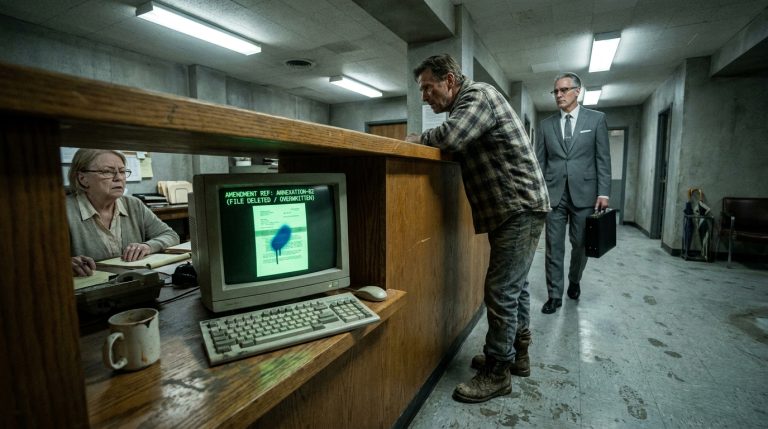
I leaned into the desk lamp, the light casting harsh, angular shadows across the pages. She was right. The amendment that supposedly granted the HOA the power to “remediate” private property without an architectural review wasn’t signed by a majority of the neighborhood. It was signed by four people, three of whom were current board members, and the fourth was a developer shell corporation that had been dissolved in 2007.
The signature of the developer’s agent, a name I didn’t recognize, was a perfect, repetitive facsimile. It was a forgery, executed with the cold, mechanical precision of someone who didn’t fear discovery because they didn’t believe anyone would ever care to look.
“They didn’t just break the rules,” I murmured, my voice scraping against the quiet. “They manufactured the tools to break them.”
I pulled the compass closer, using the edge of the casing to pin down a crucial line in the bylaws. My knuckles were white. The friction of the work was addictive. Every discrepancy I found was a piece of shrapnel I could pull from the structure of their defense. If the amendment was invalid, the entire authority under which the trees were cut vanished. The trespass was no longer a regulatory dispute; it was criminal.
I reached for my phone. It was time to stop operating in the dark. I didn’t call the police—they would see this as a civil matter, a noise complaint, a neighborhood squabble. I needed someone who knew how to turn a paper trail into a weapon.
“David Miller,” I said, watching the phone screen light up.
“Thorne,” the voice on the other end was dry, precise. “I’ve been reviewing the arborist’s report. It’s substantial. But you mentioned something about an underlying structural anomaly in the property’s development.”
“I have more than an anomaly,” I said, my eyes tracing the forged signature. “I have a systemic breach. They’ve been using a defunct corporation to rubber-stamp every overreach they’ve made for the last fifteen years. And I think I know why.”
I laid out the connection—the depth of the probes, the specific corridor they’d cleared, the strange yellow tape marked Alpha-9. The line went silent, but it wasn’t the silence of confusion. It was the silence of a shark that had just caught the scent of blood in the water.
“If you’re right,” Miller said, his tone shifting into something dangerously sharp, “this isn’t just about an HOA anymore. This is a land-use conspiracy. If they’re clearing that corridor, they’re not just looking for a satellite view. They’re trying to bypass a municipal zoning bottleneck that would cost them millions in infrastructure compliance fees. By clearing your land, they’re creating the path of least resistance.”
“And they’re doing it using the homeowners’ own money,” I added.
“Exactly. They’re using the HOA as a vehicle for corporate development. It’s elegant, in a malicious sort of way. But it’s also a federal issue if we can prove the interstate nature of the development financing.”
I hung up, the room feeling smaller, the weight of the house pressing in around me. My war had expanded. It was no longer a personal vendetta against a woman built like a filing cabinet. It was an investigation into the machinery of growth that had been silently encroaching on our lives for years.
I stood up and walked to the window. The street was quiet, the rain-slicked pavement reflecting the sterile orange glow of the streetlights. Somewhere in that darkness, Karen was likely planning her next move—a fine, a warning, a new bylaw. She was a master of the micro-tension, a predator of the mundane. She had no idea that I had stopped looking at her and started looking at the earth beneath her feet.
I didn’t need to yell. I didn’t need to storm her door. I needed to wait for her to overextend. And every time she signed a new document, every time she invoked a rule that didn’t exist, she was just adding a link to the chain she was forging for herself.
I went back to the table, my hand steady as I picked up the pen. The rust was already starting to show on her armor. I just had to make sure the structural collapse happened on my terms.
CHAPTER 4: THE SILENT DEMAND
The morning air was thick with a damp, metallic chill that smelled of early frost and wet gravel. I didn’t drive. I walked. The distance to Karen’s house was only a few blocks, but each step felt like crossing a threshold into a different kind of territory—a zone of suburban civility that hid a rot deep in its foundation. I carried the demand letter in a leather portfolio, the paper stiff and crisp. It was a formal, sterile instrument, but it carried the potential for an explosion that would leave nothing of her current life standing.
My boots crunched on the manicured pavement, the sound sharp and intrusive in the quiet cul-de-sac. Karen’s house sat at the end of the road, a pristine monument to her own self-importance. The lawn was a flawless, artificial green, trimmed to a height that suggested military precision. There were no trees here, no shadows to break the glare of the morning light. It was a house built on rules, and it felt as fragile as glass.
I reached the front door and hesitated. The brass knocker was polished to a mirror finish, reflecting a distorted, wide-angled view of my own face—a face I barely recognized, hardened by the weeks of documentation and the cold, mechanical process of building a case. I didn’t knock. I slid the envelope through the mail slot.
As I pulled my hand back, the heavy oak door creaked open.
Karen stood in the threshold, a steaming cup of tea in one hand, her face transitioning from a look of morning boredom to a flicker of genuine irritation. She was wearing a silk robe, her hair perfectly styled even at this hour. She saw me, her eyes dropping to the envelope resting on the floor inside her entryway, then back to my face.
“Mr. Thorne,” she said, her voice dripping with the familiar, condescending weight of her authority. “Trespassing on a private residence before eight in the morning is a violation of the community noise and privacy statutes. I would advise you to rethink your approach.”
“It’s not a trespass, Karen,” I said, my voice low and steady, lacking the heat of our previous encounters. “It’s a delivery. You should read what’s inside. It’s a summary of the compliance issues you’ve been overseeing, specifically regarding the financial management of the Oak Haven Estates fund.”
She didn’t move to pick up the envelope. She stood like a sentinel, her jaw tight, her gaze icy. For a second, I saw it—the flash of something that wasn’t smugness, but calculation. She was assessing the risk, weighing the envelope against the reality of her own actions. She knew, at least at a subconscious level, that the game was changing.
“You’re making a mistake, Marcus,” she said, her voice dropping to a sharp, transactional whisper. “This neighborhood is a machine. You think you’re fighting for a tree, but you’re fighting against a structure that is far larger than you. The trees were a minor maintenance issue. You’re turning it into a tragedy. It’s an inefficient use of your energy.”
“It’s not energy,” I replied, feeling the brass compass in my pocket, its weight a reminder of the heritage she had tried to bulldoze. “It’s arithmetic. I’ve done the math on the Compliance Solutions contracts. I’ve read the forged bylaws. The structure isn’t as solid as you think.”
She didn’t react. She didn’t flinch. She simply looked at me with a profound, terrifying vacancy, as if she were looking through me at a horizon only she could see. She knew the fraud was documented; she knew the shell companies were visible. And yet, she held her ground, her confidence seemingly drawn from a source I hadn’t yet reached.
“The board meeting is in three days,” she said, finally stepping back to let the door hover partially closed. “You’re welcome to attend. Bring your documents. We’ll see how the rest of the neighborhood feels about your little arithmetic.”
She shut the door, the latch clicking with the finality of a prison bolt. I stood on the porch for a moment, the cold wind whipping at my coat. I had expected a reaction—a shout, a denial, a moment of fear. Instead, I got a invitation to a public confrontation. She wasn’t running; she was preparing a trap.
I walked back down the driveway, the smell of iron and damp earth filling my senses. I had delivered the opening volley of the siege, but I could feel the ground shifting. She was no longer a petty tyrant holding a clipboard; she was a cornered operator, and the neighborhood I thought I was liberating was about to become the theater for a very different kind of fight.
My pulse was steady, cold and measured. I had the ledger, I had the evidence, and now, I had the timeline. Three days until the board meeting. Three days to ensure that when I walked into that room, I wouldn’t just be the one asking questions—I’d be the one providing the answers that would dismantle her world.
CHAPTER 5: THE BOARDROOM INFILTRATION
The clubhouse was a space designed to discourage thought—an expanse of beige walls, low-pile industrial carpet, and the perpetual, sour aroma of coffee that had been burnt on the burner for hours. I arrived twenty minutes early, moving through the hollow silence of the hallway. My footsteps felt heavy, the sound dampened by the cheap padding beneath the rug.
This was the environment where Karen reigned, where the rules were printed on laminated sheets and the power flowed from the gavel down to the sycophants sitting at the table. I found a seat in the back row, not as a victim this time, but as a surveyor. I took out my notebook, the leather cover worn smooth by years of use, and began to map the room.
I was looking for the structural weaknesses—not in the walls, but in the people.
Glenn, the retired insurance salesman, was the first to arrive. He moved with a practiced, hollow bounce in his step, already arranging his papers with the rigid symmetry of a man who needed to believe the system was perfect. Beside him was Martha, the secretary, whose fingers constantly tapped against the side of her laptop as if she were waiting for a signal.
My past in the dust of distant places pushed into my thoughts—a sudden, sharp memory of a perimeter check, the feeling of a weapon’s cold weight, and the way you learned to read a man by the way he held his ground. Here, the “weapons” were agendas and bylaws, but the posture of the combatants was identical. They were scared. They were trying too hard to look like they belonged in a seat of power.
Karen didn’t arrive until the last possible second. She swept into the room with the practiced arrogance of a queen, her clipboard held tight against her chest like a breastplate. She didn’t look at the crowd; she looked at the space above our heads. When her gaze finally landed on me in the back row, it didn’t stutter. It sharpened. She knew what was in the portfolio I had left at her door. She had clearly spent the last forty-eight hours reinforcing her bunkers.
“Welcome,” she said, her voice cutting through the low murmur of the arriving neighbors. “Let’s proceed with the agenda.”
The meeting was a performance. A dance. She moved through the budget reports, her voice steady, ignoring the fact that the treasurer’s numbers didn’t match the bank statements Sarah had dug out of the county records. Glenn interjected with rehearsed questions, creating a facade of transparency. It was a masterclass in obfuscation.
I kept my mouth shut. I listened to the way Martha’s typing pace accelerated whenever Karen mentioned the “Compliance Solutions” vendor contract. I watched the way the attendees—most of them hesitant, unsure of how to voice their frustrations—shifted in their seats. They felt the tension, but they didn’t have the map.
“Moving on to the issue of property maintenance at 12 Patriot Way,” Karen said, her eyes locking onto mine. There was a challenge in her tone, a lure. “The board has reviewed Mr. Thorne’s recent… inquiries. We find them to be both unfounded and disruptive to the orderly conduct of our community.”
She was baiting me. She wanted a scene. She wanted me to explode, to lose my cool, to invalidate myself in front of the witnesses so she could have me escorted out by the local police who were likely idling in their cruisers down the street.
I stood up slowly, the movement controlled, the feeling of the brass compass in my pocket reminding me to stay anchored. The silence in the room deepened, the air growing heavy with the smell of stale carpet and the hum of the overhead lights.
“I’m not here to be disruptive, Karen,” I said, my voice projecting easily across the beige desert of the room. “I’m here for the record.”
I walked toward the head table. I didn’t rush. I didn’t look at the board members; I looked at the folder I was holding. Martha’s hands went still on the keys. Karen’s smile remained fixed, a brittle, dangerous thing.
“I have questions regarding the 2005 amendment,” I said, placing a single, highlighted page on the table in front of her. “Specifically, the signature of the corporation that was dissolved two years prior. I think the neighbors would be very interested to know how a dead company managed to approve the seizure of their property rights.”
The room inhaled as one. Karen didn’t look at the paper. She didn’t have to. The mask was cracking, and for the first time, I saw the genuine, raw panic beneath the polyester armor. She tried to reach for the gavel, but her hand trembled, missing the handle.
I leaned in, my voice a low, steady hum. “The game isn’t finished, Karen. But it’s definitely changed.”
CHAPTER 6: THE FINANCIAL DISCOVERY
The room didn’t just go silent; it turned into a vacuum. Every breath, every shift of a folding chair, felt amplified. Karen was shaking, but it was a controlled tremor, the kind that preceded a calculated strike. Her eyes swept the room, searching for an ally, but the sycophants were already receding, their postures retreating into the shadows of their own seats.
“Mr. Thorne,” she finally breathed, her voice a thin, sharp blade. “You have clearly mistaken this community meeting for a courtroom. I will not have my reputation smeared by a man who cannot even maintain a simple plot of land.”
“It’s not a smear, Karen,” I said, my voice cutting through the room’s tension. “It’s a balance sheet.”
Before she could speak, the projector—which had been flickering with a PowerPoint of ‘Community Beautification’—gave a final, dying rasp. A thick smell of ozone and burnt plastic filled the air, and the image on the screen collapsed into a chaotic wash of static. The loss of light felt like a sudden shift in the tactical landscape. The room plunged into a grey, dim reality, leaving us standing in the center of a gathering that was no longer a meeting, but a tribunal.
I didn’t wait for her to regain control. I pulled a tablet from the portfolio—a device I’d pre-loaded with the digitized contracts between the HOA and ‘Compliance Solutions LLC.’ I walked to the table, my steps measured, and set the tablet down firmly. The screen displayed the invoice logs, the signatures, and the corresponding bank withdrawals that linked the community funds to Frank Peters’ accounts.
“Look at the dates,” I directed, my voice calm, projecting to the room. “The repairs to the drainage systems were billed three times, always at premium rates. None of the work was ever verified by an independent third party. It was all processed through your husband’s firm.”
Martha, the secretary, stood up, her laptop hitting the table with a loud, jarring crash. She didn’t look at me; she looked at Karen, her face a mask of betrayal. “You told me the invoices were pre-vetted by the management company,” she stammered, her voice rising in panic. “You told me we were following the regional standard.”
“Sit down, Martha,” Karen commanded, but the authority was gone. It was just a command, and in this light, it sounded small.
I leaned over the table, my shadow stretching long and dark across the wood. The smell of the burnt projector still clung to the air, a scent of failing infrastructure that seemed to mirror the collapse of Karen’s little empire. “The regional standard doesn’t include funneling homeowner dues into personal retirement funds. That’s not a standard. That’s a felony.”
I felt a surge of cold satisfaction. This was the friction I had been looking for—the point where the lie finally met the weight of the truth. Karen reached for the tablet, her intent to swipe it off the table clear, but I placed my hand over it. She looked at me, her gaze darting to the back of the room where the neighbors were standing, their expressions hardening from confusion to anger.
“This meeting is over!” she shrieked, the poise finally shattering. She grabbed the gavel and brought it down hard, the wood cracking against the table’s edge, sending a splinter of mahogany flying. “I am the president of this board! I have the authority to maintain order!”
“You don’t have a board anymore, Karen,” I said, my voice barely above a whisper. I stood up straight, feeling the weight of the brass compass in my pocket, a steady, unyielding pressure. “You have a list of names and a paper trail that leads directly to a cell.”
She looked around the room, finally registering the scale of the isolation. The people she had bullied for years weren’t cowering anymore. They were standing. They were moving closer, the floorboards groaning under their collective weight. It was the sound of a structural failure—not of the building, but of the social contract she had spent years exploiting.
She looked at me one last time, her eyes wide, the vacancy finally being replaced by the frantic, animal instinct of someone who had nowhere left to run. She turned to leave, pushing past Glenn who stood frozen near the door, but she stopped. She stared at the projection screen, now just a blank, grey square of static, a reflection of the future she had built for herself.
I didn’t move. I didn’t gloat. I simply watched as the weight of her own actions caught up to her, the friction of the truth finally grinding her down to nothing.
CHAPTER 7: THE PUBLIC UNRAVELING
Karen didn’t run. She walked toward the exit with a stiff, unnatural rhythm, her heels clicking on the industrial carpet like the ticking of a countdown clock. She reached the double doors and paused, her hand hovering over the panic bar, but she didn’t push. She turned back to look at the room, her gaze sweeping over the faces of the neighbors who had finally stopped looking down.
“You think this is a victory?” she asked, her voice cracking, stripped of its usual veneer of professional detachment. She wasn’t talking to me anymore; she was talking to the collective shadow of the room. “You think you’ve uncovered some grand conspiracy? You’re playing with forces you don’t understand. This neighborhood wasn’t designed for your convenience. It was designed for stability. And I was the only one holding the structural integrity together.”
She leaned against the door, her composure fraying at the edges. I saw her glance at the stack of documents I’d placed on the table—the forged signatures, the shell company contracts—and the way she looked at them was almost detached, as if she were a general observing a lost battle that no longer held any personal meaning.
“The trees,” she whispered, her eyes drifting toward the window. “You think they were a casualty of greed? They were a necessary cost. The ground beneath them wasn’t stable. The developers needed the corridor cleared to bypass the primary water line reinforcement. If they hadn’t, the entire block—your house included, Marcus—would have been condemned within five years due to drainage failure.”
The confession hit the room like a physical blow. The silence shifted, hardening from confusion into a cold, jagged realization. She wasn’t just admitting to fraud; she was revealing the core truth I had only begun to suspect. Layer 2. The trees hadn’t just been in the way of a view; they were the only thing preventing a catastrophic structural failure of the neighborhood’s sewage and water systems—a failure that the board had been suppressing for years, likely while profiting from the private development that necessitated the cover-up.
My breath hitched. The pieces locked into place with a sickening clarity. The “remediation” was never about satellite dishes or petunias. It was an emergency infrastructure hack, paid for by the homeowners, to save the developer the cost of a proper reinforcement project.
“You didn’t save us,” I said, my voice low, my hand tightening on the brass compass in my pocket, the metal now pulsing with the heat of my own fury. “You sacrificed the landscape to cover up the fact that the entire foundation of this project is failing.”
Karen’s smile was small, thin, and entirely devoid of life. “I didn’t sacrifice it. I managed the decay. And now, you’ve exposed the rot to the light. Do you really think that makes you a hero? You’ve just devalued every single deed in this room by half.”
She pushed the door open, the heavy steel frame swinging wide to reveal the dark, damp night beyond. She stepped out into the shadows, leaving the room in a state of stunned, paralyzed silence. She hadn’t just walked away from a defeat; she had left us with a catastrophe that was no longer hers to manage.
I walked to the window, watching her disappear toward her car. The neighborhood stretched out before me, the houses quiet and deceptively stable. I looked down at the documents on the table—the trail of fraud was clear, but the cost of the victory was just beginning to manifest. The rot wasn’t just in the board; it was in the earth.
My pulse was no longer a rhythm of tactical pursuit; it was a slow, heavy thrum of survival. The next move wasn’t a lawsuit. It was an inspection. We had torn down the dictator, but in the ruins, we had found the real problem, and it was going to require more than a court date to fix. I looked at the neighbors, their faces reflecting the dawning realization of the crisis we were now all collectively responsible for.
The siege was over, but the war had only just entered its most difficult phase. I opened the brass compass, the needle now spinning wildly, disconnected from any sense of north. The project, Alpha-9, was real. And tomorrow, we were going to find out exactly how much of our lives was still standing on solid ground.
CHAPTER 8: THE SETTLEMENT OF EARTH
The morning after the board’s collapse, the neighborhood looked different. It wasn’t the manicured, sterile vista of a week ago. The sunlight hit the pavement with a different angle, revealing the cracks that had been ignored for years—fissures in the asphalt, the slight tilt of the curbs, the subtle unevenness of a foundation struggling under the weight of long-term neglect.
I didn’t wait for the lawyers or the interim board. I picked up a shovel from the garage—an old, steel-headed thing, its handle worn to a polish by years of work. I walked out to the spot where the largest oak had once stood. The stump was a massive, stubborn reminder of what had been lost, but the earth around it was finally mine to manage.
I began to dig. It wasn’t about clearing debris; it was about exposing the truth.
Ben Carter arrived an hour later, his truck loaded with young, hardy maples and a set of heavy-duty soil aerators. He didn’t speak, just moved to the far edge of the corridor—the path the developers had so desperately wanted to clear for their shortcut. Together, we worked in the rhythm of men who understood the language of the ground. We moved through the layers of topsoil, and as we hit the deeper subsoil, we found the evidence.
The developer’s mark was there, buried in the dark, compacted clay: a series of makeshift, non-compliant drainage pipes that had been installed during the “remediation” phase. They were brittle, thin-walled, and already failing. This was the shortcut Karen had been protecting—a cheap, unauthorized patch job that would have collapsed under the weight of the next heavy rainfall, taking half the neighborhood’s drainage along with it.
I stood there, sweat stinging my eyes, looking at the rusted joints of the pipe. The revelation wasn’t a roar; it was a quiet, suffocating truth. The greed wasn’t just the embezzlement of the dues; it was the sacrifice of our safety for a development profit that would have bankrupted us all in structural repairs.
I stood up and pulled out my phone, dialing the state inspector we’d been in contact with since the board meeting. I didn’t need to shout. I just gave them the coordinates.
The final weeks moved with the slow, deliberate speed of justice. The state investigation was exhaustive, confirming everything Ben and I had unearthed. The developer was barred from the county, their projects seized to cover the cost of the infrastructure restoration. Karen and Frank were arrested in a quiet, early-morning operation that was as efficient and clinical as the life she had once forced on us.
But the victory was found in the spaces between the headlines.
We held the final planting on a Saturday. The air was crisp, the scent of fresh mulch and damp earth thick and promising. We didn’t just plant trees; we repaired the drainage, we resurfaced the pathways, and we spent the long, hard hours of labor rebuilding the neighborhood’s actual, physical integrity.
I was at the center of the lawn, the steel shovel leaning against the base of the new red oak. My hands were rough, my muscles aching in a way that felt honest. The neighborhood had gathered—not as a collection of isolated households, but as a community. The Millers were working on the swing set, the iron chains oiled and smooth. Mrs. Diaz was in her garden, the new roses already holding the weight of the morning dew.
Sarah walked up behind me, resting a hand on my shoulder. She didn’t say a word. She just watched the progress, the way the community moved together, the way the ground itself seemed to settle into a sense of order.
I reached into my pocket and pulled out the brass compass. The needle was still, pointing with absolute, unwavering precision to the center of the new tree. It wasn’t a navigation tool for the world anymore; it was a reminder of the weight I had carried and the work I had done to put it down. I walked to the stump of the old oak—the one we had left as a monument—and set the compass into a small, carved notch in the wood, a permanent marker of the boundary we had protected.
The work was finished. The infrastructure was sound, the ground was stable, and the fear that had defined our lives for so long had been replaced by the quiet, heavy work of stewardship. I looked up at the canopy of the young maples, their leaves shimmering in the sun. They would take a hundred years to reach their full height, but they were rooted deep, and this time, they were planted in soil that had been cleared of the rot.
I felt a sense of peace—not the sterile, enforced silence of Karen’s order, but a living, breathing quiet that comes from knowing exactly where you stand, and who you stand with. I walked back to the porch, the shovel held firmly at my side, ready to leave it there for the next time it was needed. The war for the trees was over, and in the space they had left, we had grown something that was finally, truly ours.