The Architect of Silence: How One Veteran Dismantled a Kingdom Built on Paper and Petty Rules
CHAPTER 1: THE GEOMETRY OF ANGER
The silence of a suburban evening is a fragile thing. Usually, it was filled with the rhythmic hum of distant sprinklers or the muffled drone of a lawnmower, but tonight, the silence was heavy, vibrating with the specific frequency of impending confrontation. I sat on my patio, the cool, powder-coated steel of the ramp’s railing under my palm, watching Denise march up the driveway. She moved with a jerky, over-caffeinated energy, her heels clicking against the concrete like the cocking of a hammer.
I didn’t move. I had learned a long time ago that in a chair, you are already occupying a position of vulnerability. Moving too quickly only signaled that you were afraid. I kept my breathing shallow, focusing on the scent of dry grass and the metallic tang of the railing.
“That needs to come down.” Her voice was sharp, a scalpel edge cutting through the humid air.
I turned my head slowly, giving myself the extra second to calculate the geometry of her posture. She was standing at the boundary of my property, her feet planted with deliberate, aggressive spacing. She didn’t have a welcome basket; she had a laminated sheet of paper clipped to a board that looked like it had been handled by someone with a compulsion for control.
“Excuse me,” I said, my voice steady, stripped of the reflexive surprise I might have felt a lifetime ago.
“The ramp,” she said, pointing with a pen that seemed to tremble with the force of her indignation. “It’s an unauthorized structure. Unauthorized modifications are a violation of the community covenants. You have thirty days to dismantle it, or the fines will be levied automatically.”
I looked at the ramp—my lifeline, my literal bridge to the outside world. The contractor had done an excellent job, color-matching the trim to the townhouse, ensuring the grade was perfect for the arc of my reach. It was a masterpiece of utility.
“It was approved,” I said, the words falling like stones into a well. “I have the letter from the management company in the file cabinet inside. Everything was submitted before the closing.”
Denise smiled. It was a tight, joyless expression, the kind that didn’t reach her eyes. Her skin was pulled too thin over her cheekbones, and she held the clipboard tighter. “I am the president of the board,” she replied, her voice dropping into a tone of patronizing patience, the way one might talk to a child who had misunderstood a basic instruction. “If it had been approved, I would have seen it. There is no record of an approved request for this structure. I suggest you get started on the removal immediately to avoid a two-hundred-dollar-a-day fine.”
She turned on her heel, her posture rigid, and marched back toward her own house three doors down. She didn’t look back. She didn’t care that I was still sitting there, digesting the sheer, irrational audacity of the claim.
My hand tightened on the railing. I could feel the cold metal biting into my skin, grounding me. She hadn’t come here to solve a problem; she had come here to exercise a muscle. She wanted to see if I would buckle, if I would apologize for existing in a way that didn’t suit her visual landscape.
I looked at the ramp. It was perfectly level. It was perfectly legal.
But as the front door of her house clicked shut with a sharp, final sound, I realized the ramp wasn’t the issue at all. The issue was that she had decided I was the kind of person who could be erased with a piece of paper. And that, I realized with a sudden, icy clarity, was a miscalculation on her part that she would eventually come to regret. I sat in the gathering dusk, watching her windows light up, and began to calculate the cost of the coming fight.
CHAPTER 2: THE PAPER TRAIL
The silence in my living room was thick, the kind that presses against your eardrums until you can hear the frantic, uneven rhythm of your own pulse. Denise had left behind a void, a space where the threat of a two-hundred-dollar-a-day fine now hung suspended, waiting to drop. My hands, which had been perfectly steady while I faced her, now felt a tremor of residual adrenaline. I turned my wheelchair around, the tires humming softly against the hardwood, and navigated toward the office corner.
I didn’t reach for the phone. I didn’t reach for a drink to dull the edge of the encounter. I reached for the file cabinet. My movements were methodical, a sequence of actions designed to displace the rising tide of anger. I pulled the drawer open, the metal sliding with a dry, metallic rasp that sounded deafening in the quiet house. I flipped through the labeled tabs until I found it—the “HOA ACCESSIBILITY” folder.
My fingers brushed against the thick, cream-colored cardstock. I pulled out the original request packet. Everything was there: the contractor’s blueprints, the material samples, the signed and dated approval letter from the management company. I spread the documents out on the desk, the edges sharp and clean.
I looked at the signature on the approval letter—a cramped, illegible scrawl from a property manager who I hadn’t spoken to since moving in. The date was three years old. A lifetime, really. My mind drifted, unbidden, back to the sterile, white-walled room at the VA. I could almost hear the steady, rhythmic ticking of the wall clock and the calm, measured voice of my therapist, Sarah. She used to tell me that anger is a high-interest loan—eventually, the debt catches up with you. She taught me to decompose the feeling, to look at the “bad moment” as if it were a physical object on a table, something to be turned over, measured, and eventually dismantled.
I looked at the document again. If Denise was the board president, if she was as involved as she claimed to be, how had this slipped through? Her dismissal of the letter hadn’t been a clerical confusion; it was a deliberate erasure. She hadn’t said the file was lost; she had claimed it was invalid. The distinction was critical. It suggested that there was a power dynamic at play that transcended the simple, documented reality of my approval.
I leaned back, the leather of my chair creaking. The room felt suddenly smaller, the walls pressing in with the weight of the encroaching deadline. Thirty days. She had given me a countdown, a deadline designed to induce the very panic she expected me to show.
I took a breath, holding the air in my lungs until my chest ached, then let it out slowly. I needed to see the management company. Not over the phone, not through a portal, and certainly not through a letter that could be intercepted or ignored by an HOA president who acted like she owned the very air in the neighborhood. I needed a physical record, a trail of ink that couldn’t be easily scrubbed by a tight, joyless smile.
I spent the next hour documenting. I took photos of the documents, high-resolution shots where the ink was sharp and the stamps were legible. I cross-referenced the HOA’s stated architectural guidelines with the local municipal codes I had printed when I first moved in. The discrepancy was subtle but profound: the HOA had a “review” process, but the municipal code emphasized that for accessibility modifications, the “reasonableness” of the request was the final arbiter, not the aesthetic preference of a board.
My stomach knotted. It wasn’t just a disagreement; it was a test of strength. Denise wasn’t just enforcing rules; she was establishing a perimeter. She was trying to see how much of my autonomy I was willing to sacrifice to avoid a headache.
I looked out the window. The sun was dipping below the horizon, casting long, angular shadows across the patio. The ramp sat there, catching the fading light, looking solid and grounded. It was a piece of engineering, a solution to a problem. She viewed it as a flaw.
I reached for my laptop, my fingers hovering over the keys. I wasn’t going to send an email to Denise. I wasn’t going to acknowledge her demand for removal again. Instead, I began to write a formal request for information to the management company, cc’ing the regional director. I kept the language clinical, stripped of all personal emotion. I asked for the minutes of the board meeting where my architectural request was supposedly reviewed. I asked for the name of the person who had signed the initial approval. I asked for the specific policy clause that allowed a board president to retroactively declare an approved structure invalid.
I hit send. The sound of the notification chime was final, a solitary note in the hollow house.
I turned my chair and rolled toward the window. Outside, the neighborhood was still. No one was out, no one was watching. But I knew, with a certainty that burned cold in my gut, that the next thirty days would not be about the ramp. It would be about the structural integrity of the entire community, and I had just set the first stone in motion. The fight hadn’t just begun; it had become an inevitable, grinding process, and I was, for the first time in a long time, entirely ready to see what was underneath the polished, beige surface of this quiet little town.
CHAPTER 3: THE FORCED PERFORMANCE
Two days later, the summons to the hearing arrived, though it felt less like a notification and more like an invitation to a staged execution. The letter was formal, printed on heavy stock with the HOA crest embossed at the top, a small, aggressive detail meant to signal authority. It commanded my presence at the community center on Thursday evening.
I spent the morning preparing. I didn’t rely on memory or temper. I organized my folder—the one that felt heavy enough to stop a bullet—with tactical precision. Behind the plastic tabs, I had the original approval, the contractor’s initial survey, the municipal guidelines, and a stack of printed emails I’d sent to the management company. My responses had remained professional, sparse, and devoid of the righteous indignation that Denise clearly craved. If she wanted a fight, I would give her a debate, not a brawl.
The community center was a short distance away, but for me, it was a journey of logistics. I drove my vehicle to the parking lot, the asphalt smooth under my wheels. The center itself was a dated, low-slung building of beige siding and dark trim, matching the aesthetic of the neighborhood with a stifling, monotonous consistency. As I rolled toward the entrance, I noticed the ramp—a narrow, steep piece of concrete that looked more like an afterthought than an accessibility feature. It was uneven, the concrete cracked where it met the threshold, and the handrail was loose, rattling slightly in the breeze.
I stopped my chair at the base of the ramp and stared at it. It was a violation of the very standards Denise preached to me. If she were truly the guardian of community uniformity and safety, this ramp would have been her first priority. Instead, it sat in neglect, a silent witness to her hypocrisy. I pulled out my phone and snapped a quick, clear photo, then another of the narrow, heavy door at the top.
I entered the meeting room. The air inside was chilled, the hum of the air conditioner fighting against the late afternoon heat. Three members of the board sat behind a long, skirted table at the front. Denise was in the center, her clipboard already on the table, her posture rigid, her eyes tracking my movement across the floor like a security camera. To her left was a man who looked perpetually uncomfortable, his gaze fixed on a stack of papers, and to her right was a woman I’d only seen at the neighborhood mailboxes, a person who usually avoided eye contact at all costs.
“You’re here for the violation hearing,” Denise said. Her voice wasn’t a question. It was a prompt for me to apologize.
“I’m here to resolve the status of my home’s entryway,” I replied, rolling to the designated spot in front of the table. I placed my folder on the floor beside me.
“The board has reviewed the file,” Denise continued, her eyes flickering toward the man on her left. “We’ve found that the approval previously issued was an error in judgment by the former management firm. It was never reviewed by a quorum of this board, and therefore, it is invalid.”
The man on her left cleared his throat but didn’t look up. “It’s standard procedure,” he mumbled, his voice devoid of conviction.
I opened my folder, slowly, deliberately. I didn’t pull out the approval letter first. Instead, I pulled out a copy of the official HOA bylaws, a document I had spent all night reading.
“According to the bylaws in Article IV, Section 2,” I said, my voice measured and calm, “the board is required to issue a written notice of any procedural error within ten days of the discovery of such an error. My ramp was installed over two years ago. May I ask when this discovery occurred, and why no formal notice of the review was ever provided to me as the resident?”
Denise’s tight smile flickered. She hadn’t expected me to cite the bylaws. She had expected me to plead. “The board is not required to provide a timeline of internal audits to residents,” she said, her voice sharpening.
“I believe the bylaws would disagree,” I replied, sliding the highlighted document across the table.
She didn’t look at it. She didn’t have to; she already knew what it said. She looked at me, and for a fleeting second, the mask slipped. There was a flicker of something beneath the arrogance—a flash of pure, unadulterated annoyance that I was still talking, that I was still sitting there, and that I refused to look away.
“This isn’t about your reading of the bylaws,” she said, her voice dropping into a low, dangerous tone. “This is about the fact that your ramp is an eyesore that detracts from the value of this community. We are here to enforce the rules, not to debate them.”
“And yet,” I said, gesturing toward the door I had just navigated, “you seem to have a rather flexible definition of the rules when it comes to the community center’s own accessibility. The ramp outside does not meet basic federal or local standards. If we are talking about enforcement, are we discussing the entire community, or just my property?”
The man on the left flinched. Denise stood up, her movement sharp, the clipboard clattering against the table. The air in the room felt ionized, charged with the static of a secret beginning to tear at the seams. She looked at me, and I saw it then—the way she looked at the other board members, a quick, almost frantic glance that wasn’t about the rules, but about maintaining a narrative.
“This hearing is concluded,” she announced. “The board will vote in private. You will receive our decision in writing.”
“I am requesting a formal record of this meeting,” I said, my voice steady.
“There is no record,” she snapped, turning her back to me to gather her papers.
I looked at the woman on her right, who suddenly found her handbag extremely interesting. I knew then that the missing minutes weren’t just a mistake. They were a deliberate omission. Denise wasn’t just ruling by fiat; she was actively destroying the paper trail, and in that moment, I realized I had the leverage I needed. I didn’t need to win the argument; I just needed to start documenting the silences.
CHAPTER 4: THE POLICE AT THE PORCH
I steered my chair out of the community center, the wheels clicking against the threshold with a hollow, rhythmic sound that echoed in the empty foyer. The transition to the outdoors was abrupt. A sudden squall had rolled in, turning the gray sky into a bruised purple, and the air was thick with the scent of ozone and wet pavement. I moved toward my vehicle, the rain beginning to drum against the metal frame of my chair with a persistent, percussive force.
I didn’t rush. The wet pavement was a liability, and I knew better than to treat gravity with anything less than deep, tactical respect. I reached the car, transitioned with practiced, efficient economy, and secured the chair in the rack. As I turned the ignition, the interior filled with the warmth of the heater, a stark contrast to the biting dampness pressing against the glass.
I was three blocks away from the community center when my phone buzzed against the center console. I glanced down—an alert from my home security system. A motion-triggered recording. I pulled over into the parking lot of a local transit hub, the rain shielding the car in a private, gray cocoon. I tapped the screen.
The feed was grainy, washed out by the downpour, but the figures were unmistakable. Two uniformed police officers stood on my porch, their posture formal, their hands resting near their belts. One of them was looking down at the ramp, his head tilted as if he were trying to read a blueprint or a warning. The other was knocking on the door, a slow, deliberate sound that I could almost hear through the digital delay of the feed.
The knot in my stomach tightened, not with fear, but with a cold, sharpening clarity. Denise hadn’t wasted a second. She had escalated from a board meeting to the police in less than an hour. She wanted the threat of state force to act as a physical weight, a way to cow me into submission before the ink on her “decision” was even dry.
I turned the engine off and sat in the silence, listening to the rain hammer the roof. This was the moment where the “rules” of the neighborhood were being discarded for the “rules” of the state. I didn’t want a confrontation. I wanted a resolution. I took a steadying breath, my fingers curling around the steering wheel until the leather groaned, and then I picked up the phone. I didn’t call a lawyer—it was too early for that, and too expensive. I called the local precinct’s non-emergency line.
“My name is [Protagonist Name],” I said, my voice as level as a spirit level. “I am a resident at [Address]. I’m currently observing a police presence at my home via my security system. I’m a disabled veteran, and I’m currently in transit to my residence. Could you please advise if there is an active call regarding my property?”
The dispatcher’s voice was professional, clipped. “Hang on, sir. I’m looking at the log… Yes, we have a report of a code violation and a potential trespass regarding an unauthorized structure.”
“I see,” I said. “I have the architectural approval for that structure in my possession. It is not an unauthorized structure. It is an ADA-compliant accessibility modification. I will be home in approximately ten minutes. I request that the officers wait for my arrival so I can present the documentation that the HOA board is currently attempting to suppress.”
The dispatcher paused. I could hear the faint, muffled sound of a radio in the background. “Understood, sir. I’ll relay that to the officers on the scene.”
I hung up and started the car. The drive back was a blur of neon streaks and wet asphalt. When I pulled into my driveway, the rain had slowed to a steady, rhythmic drip. The two officers were still there, huddled under the shelter of the porch overhang, looking distinctly unimpressed by the weather.
As I maneuvered out of the car and back into my chair, the younger officer approached, his expression a mix of professional detachment and genuine reluctance. He was the one who had rubbed his neck earlier, a telltale sign of someone who knew the paperwork they were being asked to file was absolute nonsense.
“Sir,” he started, his voice barely audible over the sound of the gutters. “We received a complaint from the HOA president. She’s claiming this structure is a safety hazard and that you’re in violation of a standing order to remove it.”
I looked at him, then up at the ramp. It stood there, dark and slick with rain, reflecting the dim light of the porch. It wasn’t a hazard. It was a bridge.
“The HOA president is mistaken,” I said, my voice steady, projecting a calm that I didn’t entirely feel. “Or perhaps, she’s lying. I have the signed approval documents, the contractor’s plans, and a record of my attempts to resolve this with the board. If you’d like to see them, I’d be happy to open the door.”
The older officer, a man with graying temples and a face lined by too many years of resolving civil disputes, stepped forward. “We aren’t here to judge your architecture, son. We’re here to respond to a report of a violation. If you have the paperwork, it’s a civil matter. We don’t take down ramps.”
“I understand,” I said. I looked past them, toward Denise’s house down the street. Her front curtains were drawn, but I knew she was there, watching, waiting for the flashing lights to intimidate me into a surrender.
“I appreciate your patience,” I said, turning to the officers. “I know this isn’t how you want to spend your evening. I’ll have the copies for you in a moment.”
As I unlocked the door, the younger officer hesitated. “She’s been very insistent, sir. She’s claiming this is about liability.”
“Liability,” I repeated, the word tasting like ash. “She’s not worried about liability. She’s worried about control.”
I opened the door, the warm, dry air of the house rushing out to greet me. I didn’t invite them in—I stayed on the threshold, a line I had drawn for myself. I handed them the folder, the documents protected in their plastic sleeves. As they stood on my porch, flipping through the pages in the dim light of the overhead fixture, I knew that this wasn’t the end. It was the beginning of the erosion. They wouldn’t touch my ramp, but the fact that Denise had tried to bring the state into her petty war on my porch was a sign of desperation. She was losing her grip, and the next move, I realized, wouldn’t be on the porch. It would be in the records, and I was going to find out exactly what she was so desperate to hide.
CHAPTER 5: THE SURVEY OF SINS
The rain had settled into a fine, persistent mist, the kind that turned everything it touched into a blurred, monochromatic landscape. I sat on my porch, the folder of police-verified documents resting on my lap like a shield. My skin felt cold, my fingers stiff, but my mind was operating with a crystalline, almost clinical detachment. The encounter with the police had been a tactical victory, but it had also been a warning. Denise was finished with polite correspondence. She had moved to weaponizing the state.
I didn’t go inside. I grabbed my camera, my notepad, and the heavy, yellow-cased steel tape measure. I knew I couldn’t stay on the defensive; the only way to neutralize a tyrant was to find the cracks in their foundation, and every community—especially one as obsessed with appearance as this one—had cracks. They were just hidden behind the manicured hedges and the strict architectural covenants.
I rolled out of my driveway, the rubber tires humming against the damp asphalt. The neighborhood was eerily quiet. Streetlights flickered on, casting long, sickly yellow cones of light onto the wet pavement. I made my way to the community park, the centerpiece of Denise’s “pristine” vision.
The park was empty, a ghost town of expensive, underutilized plastic equipment. I approached the entrance. There was a gate, a heavy, wrought-iron thing that looked more appropriate for a manor house than a playground. I pulled out the measuring tape, the steel tongue hissing as I extended it. The gate opening was thirty-one inches wide.
I wrote it down in my notepad, the ink bleeding slightly into the damp paper. Standard width for a standard wheelchair was thirty-two inches minimum, and that was without the extra clearance needed for someone to actually maneuver through. This gate wasn’t just a design choice; it was a physical exclusion.
I moved to the playground. It was surrounded by a decorative border of landscape timbers, elevated six inches off the ground. There were no curb cuts. No ramp. To reach the swings, one had to traverse a bed of loose, uneven woodchips. I extended the tape again, recording the height of the border, the lack of path access, the distance from the sidewalk to the nearest piece of equipment. My movements were rhythmic, a systematic tallying of institutional failure.
Every measurement I took felt like a pulse check on the community’s morality. As I circled the playground, the sense of paranoia began to settle in. I caught myself glancing toward the houses lining the park. In the glow of a porch light, I thought I saw a curtain twitch. A car drove slowly past, its headlights sweeping across the playground, lingering for a second too long on my chair before continuing on its way. It was probably just a neighbor heading home, but in the new reality of the last few days, every casual observation felt like a report being filed. Was someone watching? Was I becoming a nuisance to them, too?
The feeling was corrosive, a subtle, creeping doubt that made me question the very air I was breathing. I pushed it down. I reminded myself of the police officers on my porch, their faces lined with the shame of being used for a personal vendetta. I wasn’t the enemy; I was the auditor.
I reached the community restroom. The door was heavy, the threshold high. Inside, the stalls were narrow, the handrails flimsy and poorly anchored. I took photos of everything: the cracks in the tiles, the rusted fixtures, the complete lack of accessible signage.
As I worked, I noticed something else—a small, laminated placard near the maintenance door of the pool building. It was an invoice holder for the contractor who did the “community improvements.” I’d seen the name before: J.D. Services.
I pulled out my phone and searched the name. The registration address was a P.O. Box in the next county over. I dug deeper, finding a public record of a business filing. The registered agent for J.D. Services wasn’t a contractor I knew; it was a woman named Jennifer D. Miller.
I paused, the measuring tape hanging limp in my hand. The name felt familiar. I racked my brain, trying to place it. Then, I remembered a conversation I’d overheard at the neighborhood mailbox a year ago—someone talking about the HOA president’s sister moving in.
I looked at the invoices on the board. The costs were astronomical—thousands of dollars for “aesthetic landscaping” that consisted of replacing perfectly healthy shrubs with slightly more expensive varieties, or “structural reinforcement” that looked suspiciously like standard trim painting.
The realization hit me with the force of a physical blow. This wasn’t just about my ramp. The “unauthorized” nature of my structure wasn’t about the law; it was about the budget. If I brought in my own contractor, if I followed the actual, legal process for accessibility, I was bypassing their contractor. I was denying them the opportunity to inflate the costs of every single project in the neighborhood.
I stood there in the damp dark, the measuring tape retracted and locked, the camera hanging heavy around my neck. I had found the decoy—the financial corruption. It was clear, it was documented, and it was a motive as old as greed itself. But as I looked at the dark, silent pool area, I realized something else. If Denise was willing to mobilize the police to protect a kickback scheme, what would she do if she thought someone was actually digging into the foundations of the houses themselves?
The decoy was just the skin of the onion. There was something harder, something much colder beneath it, and I suddenly felt the weight of the secret pressing against my chest. I wasn’t just fighting a petty tyrant anymore. I was tracking a rot that went all the way down to the bedrock of this place.
CHAPTER 6: THE ARCHITECTURE OF DECEIT
The glow of the scanner was the only light in my office, a rhythmic, pulsing bar of white that cut through the darkness of 3:00 AM. I had been awake for nearly twenty hours, my eyes burning, my posture aching, but the fatigue was nowhere near as sharp as the adrenaline. On my desk sat a stack of documents I had spent the last three hours cataloging—invoices from J.D. Services that I had managed to pull from a public records portal I’d accessed using the credentials of a former board member whose email had been left active on a local civic site. It was an oversight, a tiny, negligent crack in their security, and I was going to leverage it until the whole system groaned under the weight.
I fed another invoice into the tray. Landscaping maintenance: $8,500. I looked at the photos I had taken of the playground. The shrubs were wilted, the mulch was uneven, and the “structural reinforcement” was nothing more than a fresh coat of cheap latex paint on the playground fence. The cost was a lie, and the math was insultingly simple: someone was siphoning community dues into a private pocket.
My phone screen flickered—an email notification. It was from the management company, a curt, formal response to my request for the board meeting minutes. They were denied, citing “board privacy regulations.” I leaned back, the leather chair groaning in the silence. They were hunkering down. They knew I was digging, and their response wasn’t to clarify; it was to conceal.
I turned my attention to the property tax records, a separate window open on my monitor. I was searching for the original developer, the firm that had built the community eight years ago. Miller & Associates. The name pinged a memory. Jennifer D. Miller. J.D. Services.
I pulled up the corporate filings for the developer. It was a defunct entity now, dissolved shortly after the community reached a 90% ownership threshold—the classic “hit-and-run” development maneuver. But the registered agent for the original firm, the man whose signature was on every single structural disclosure document, was Robert Miller. Denise’s husband.
The air in the room seemed to lose its oxygen. I stared at the screen, the cursor blinking like a heartbeat. The ramp wasn’t just an eyesore to her. It was a reminder. If an accessibility audit were triggered—if a formal, state-sanctioned review of the entire community’s compliance were forced—the inspectors wouldn’t just look at my ramp. They would look at the original development plans. They would see the discrepancies between the blueprints and the final build. They would see that the community had been built with systemic, massive violations of accessibility law, violations that Miller & Associates had papered over to get the occupancy permits signed.
If my ramp stood, it created a precedent. If the HOA were forced to comply with accessibility standards, they would have to open the books on the entire community. And if they opened the books, they would find that the developer—Denise’s husband—had been negligent, perhaps criminally so, in the original build.
I stood up, the movement stiff, and walked to the window. The neighborhood was silent, the houses dark and uniform, a testament to the illusion of order. They were built on a foundation of hidden debt and legal corners cut in the dark. Denise wasn’t defending her property values; she was guarding a tomb. Every fine, every violation, every call to the police was a frantic, desperate effort to keep the inspectors away from her front door.
I looked at the invoices again, then at the development filings. The connection was undeniable. The “aesthetic” rules were a smoke screen. The financial corruption was a side hustle. The real crime was the original construction, and if I could prove that the HOA was knowingly covering up a pattern of past negligence, the legal shield she’d been using—the “private community” defense—would shatter.
I picked up the phone and dialed the number for the disability rights attorney. It was too early for a human to answer, but I left a voice mail. I didn’t ramble. I gave her the facts: the name of the original developer, the link to the shell company, and the pattern of retaliation.
“We don’t need a settlement,” I said into the receiver, my voice rasping from lack of use. “We need an audit. The entire community, from the curb cuts to the pool gate. We force the hand, and we see what falls out.”
I hung up and returned to the desk. The sun would be up in an hour. My hands were steady now. The fear, the paranoia, the feeling of being watched—it had all evaporated, replaced by the singular, cold satisfaction of a plan coming together. I wasn’t going to dismantle her kingdom with a lawsuit. I was going to let the truth do the work for me. She had wanted to treat my ramp like a crime; I was going to treat her community like a crime scene.
CHAPTER 7: THE CRACK IN THE FACADE
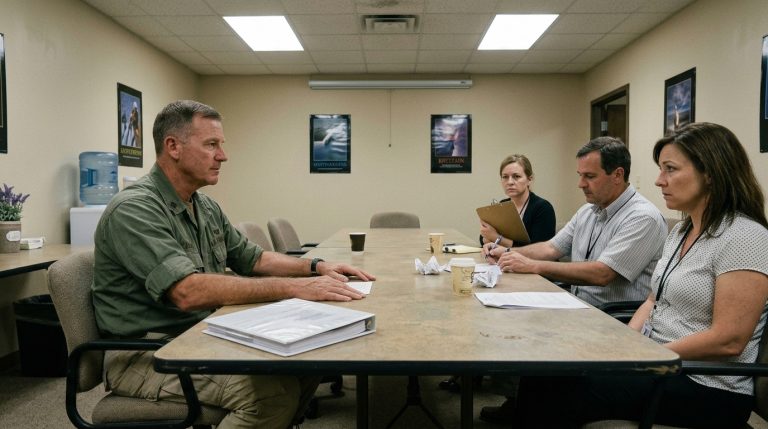
The room was small, soundproofed, and smelled faintly of floor wax and stale coffee. I sat in the chair, my wheelchair positioned at the end of a long, laminated table that seemed designed to emphasize the vast distance between myself and the opposing counsel. Across from me sat Denise, her posture no longer the confident, clipboard-wielding stance of the HOA president. She looked tired, the skin around her eyes thin, her hands clasped tightly on the table. Beside her, an attorney in a charcoal-gray suit hovered, a man whose only purpose was to ensure that Denise’s inevitable collapse was managed with legal discretion.
“The purpose of this deposition,” the attorney began, his voice a drone, “is to establish the sequence of events regarding the architectural modification at the residence of the complainant.”
I watched Denise. She wouldn’t look at me. She was staring at a notepad, her pen moving in small, nervous circles. The lawyer began his line of questioning—it was a performance, a series of scripted prompts designed to paint me as an irrational, non-compliant resident. Denise played her part, citing “community standards” and “safety concerns” with a practiced, hollow cadence. But I could see the tremor in her wrist.
I didn’t argue. I didn’t interrupt. I let the lawyer weave his narrative, waiting for the specific thread I needed to pull.
“Mrs. Miller,” my own attorney said when her turn came, her voice deceptively soft, “you’ve maintained that the board was unaware of any past negligence regarding the community’s accessibility compliance. Is that correct?”
Denise stiffened. “Yes. We have followed all current regulations.”
My attorney slid a document across the table. It was the original developer disclosure from eight years ago, the one I had spent the night dissecting. “This document, signed by your husband, Robert Miller, identifies specific building requirements that were required by the municipal code at the time of development. These requirements were never implemented. Were you aware of these omissions when you initiated the violation against my client?”
Denise glanced at her attorney. The silence in the room was absolute, the kind of silence that usually precedes a verdict. She opened her mouth to speak, but the words faltered.
“I… I wasn’t involved in the development,” she said, her voice barely a whisper.
“But you were involved in the HOA management,” my attorney countered. “And we have these invoices—J.D. Services—signed by you, listing the very construction firms that were supposed to be completing these mandatory accessibility requirements. You weren’t just managing the HOA. You were acting as the agent for the shell companies that were absorbing the community’s repair funds.”
Denise’s face went pale. The “sanctity of order” she had fought so hard to protect was suddenly, violently irrelevant. The facade wasn’t just cracking; it was shattering. The lawyer beside her tried to intervene, but the momentum had shifted. I saw her look toward me—not with the condescension of a tyrant, but with the raw, desperate panic of a cornered animal. She realized then that this wasn’t about a ramp. It was about her husband’s reputation, her own future, and the hollowed-out carcass of a community she had tried to build on a lie.
She didn’t surrender, though. She pivoted. “You think you’re so smart,” she hissed, her voice suddenly devoid of its performative polish. “You think that because you can measure a curb, you understand how this works? You destroyed a neighborhood’s cohesion to feed your own ego. You think this is justice? It’s just destruction.”
“It’s not destruction, Denise,” I said, my voice quiet, cutting through the sterile hum of the room. “It’s maintenance. You stopped maintaining the foundation, so the building was going to fall regardless. I just pointed out where the rot was.”
She stared at me, and in that gaze, I saw the truth of her existence—she had spent her entire life trying to polish the surface of things, believing that if she couldn’t see the decay, it wasn’t there. But the rot was real. It was concrete, it was ink, and it was now officially a matter of record.
The attorney beside her began to gather her papers, his face flushed with the sudden, ugly reality of the liability they were facing. The deposition was effectively over. Denise was no longer the president of a kingdom; she was a witness in a case that was going to cost her everything.
As I pushed my chair back from the table, the sound of the wheels against the hard linoleum felt like a release. I didn’t feel a surge of triumph. I felt an immense, overwhelming sense of clarity. The fight was almost over, and the outcome had been earned, measurement by measurement, page by page. I rolled toward the exit, the light of the hallway spilling into the room, and left her sitting there in the dark, surrounded by the paper trail that would finally, inevitably, bring the walls down.
CHAPTER 8: THE WEIGHT OF THE SETTLEMENT
I sat on my patio, the morning air crisp and tasting of damp earth. The view was different now. Instead of the polished, beige perfection that Denise had once enforced with such obsessive zeal, the community was a landscape of controlled disruption. Just down the street, at the community center, a crew was hard at work. The sound of a jackhammer bit into the morning silence—a rhythmic, industrial beat that didn’t feel like a nuisance, but like a heartbeat. They were cutting into the sidewalk, creating the curb cuts that should have been there years ago.
It had been six weeks since the deposition. The settlement hadn’t been a sudden explosion; it had been a slow, grinding inevitability. Once the developer filings were laid bare, the HOA’s insurance carriers didn’t wait for a jury. They moved to contain the liability, and that meant folding. They paid for the legal fees, the damages, and most importantly, they funded the total accessibility overhaul of the entire common area.
Denise was gone. She had resigned within forty-eight hours of the deposition, her departure marked by a hollow, two-sentence statement that blamed “irreconcilable differences” with the board. She had tried to hold onto the narrative until the end, but the neighborhood wasn’t listening. Too many people had seen the invoices, too many had finally realized that the “aesthetic” rules they had been subjected to were merely tools for a family’s private enrichment.
I watched a young woman push a stroller toward the pool, navigating the new, wide gate with a ease that was entirely new. She stopped for a moment, looked at the ramp, and smiled—not at me, but at the sheer, simple utility of it. It was a small thing, a piece of engineering that bridged the gap between frustration and function, but it represented a shift in the gravity of the whole neighborhood.
The settlement required the HOA to undergo an annual accessibility audit for the next five years. My ramp was now the gold standard, inspected, measured, and officially recorded in the community’s master architectural file.
I turned my chair and rolled toward the front door. My contractor, the same one who had installed the ramp in the face of Denise’s threats, was back, this time to add a small, custom landing extension. I had asked for a slight modification, a small shelf to place my belongings when I unlocked the door—a minor detail, but one that made the transition from the world outside to the sanctuary inside feel just a little bit more natural.
He looked up as I approached, his face etched with the grime of the job. “Almost done,” he said, tapping the railing with his hammer. “The concrete is set. It’s solid.”
“Thanks,” I said. I reached out and touched the railing. It was cool, sturdy, and unyielding—a physical manifestation of the fact that I had stood my ground.
I went inside, the quiet of the house feeling different today. It didn’t feel like a fortress anymore; it felt like a home. I moved to the kitchen, the light spilling through the windows in wide, clean bands. I found the old, battered measuring tape in the drawer—the one I had used in the middle of the night to record the sins of the community. I held it for a moment, the yellow plastic worn smooth, then I set it back. I didn’t need it for measuring grievances anymore.
I walked to the living room and pulled the file folder from the cabinet—the one thick enough to stop a bullet. I looked at the papers inside: the police reports, the correspondence, the architectural plans. I didn’t need them, either. I carried them to the kitchen and dropped them into the recycling bin, a final, deliberate act of letting go.
Later that afternoon, the phone rang. It was an older woman from two streets over—the one who had told me she’d asked for curb cuts for years and had been ignored. She wanted to invite me to a small gathering at the community center, a sort of neighborhood “get-to-know-you” that the new board was organizing.
“We’d love for you to be there,” she said. “We want to make sure the board understands what ‘community’ actually means.”
“I’ll be there,” I said.
I hung up and stepped back out onto the patio. The construction crew had finished for the day. The street was quiet, the dust settling. The jackhammer had stopped. I sat there in the late afternoon sun, watching the light play against the ramp. My spine ached, a familiar, grounding dullness, but my mind was at peace. The rot had been dug out, the structure was sound, and for the first time since I’d moved here, I felt like I was part of a neighborhood rather than a target.
I looked down at the concrete. There, near the base of the ramp, was a tiny, jagged crack—a flaw in the new work. I smiled, reaching down to trace the line with my finger. It wasn’t a problem; it was just life, settling into its own imperfect, real-world shape. I was done fighting. I was done measuring. I was finally, simply, home.