The Iron Boundary: A State Trooper’s Fight to Reclaim Home from a Calculated Suburban Predator
CHAPTER 1: The Morning Invasion
The vibration was the first thing to reach me—a rhythmic, thumping bass that traveled through the floorboards and settled deep into my marrow. Years of service had hardwired my body to interpret sudden, violent noise as an alarm, a call to check the perimeter, but there was no perimeter to check. Not here. I was on leave, and the walls of my home were supposed to be silent.
I pushed off the sofa, my breath catching in my throat as I reached for the side table. My fingers brushed empty wood where the weight of my service pistol should have been. The realization that I was unarmed in my own living room didn’t settle me; it sharpened my focus. If there was a breach, I would handle it with whatever was at hand.
I crossed the room, my bare feet cold against the hardwood, and reached for the blinds. I didn’t pull them back all the way—habit dictated that I expose as little of myself as possible. Through the narrow gap, I scanned the yard.
My gravel driveway, a path I had meticulously maintained for three years, was gone. Buried under a strip of cheap, vibrant red carpet that seemed to bleed color into the morning gray. Folding chairs had been snapped open in precise, military rows, and an arch of garish, helium-filled balloons was anchored to my fence, straining against the morning breeze. A man in a sweat-darkened polo was hunched over a cotton candy machine, his hands fumbling with a metal nozzle right next to my hydrangeas.
And in the center of the chaos, like a queen surveying a conquered territory, stood a woman. She was draped in high heels and oversized, mirrored sunglasses, wearing a glittery sash that read HOSTESS in bold, jagged font.
I didn’t wait for coffee. I didn’t wait for permission. I pushed the front door open, the hinges protesting in the silence of the street, and stepped onto the porch. The air was thick with the cloying, artificial scent of burnt sugar.
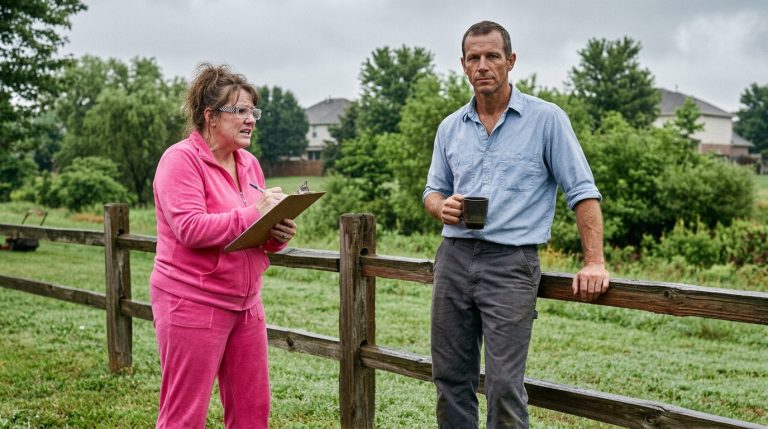
The woman turned. She didn’t look startled; she looked inconvenienced, as if I were a waiter who had arrived at the wrong table. Her gaze raked over me—my worn-out joggers, my faded t-shirt—with a chilling, clinical detachment.
“You can’t park that there,” she said, her voice sharp and brittle, pointing a manicured finger toward my truck.
I blinked, the absurdity of the moment hitting me like a physical blow. “Park what?”
“That truck,” she snapped, not bothering to hide her irritation. “It’s blocking the entrance.”
I looked at the truck, then back at her, feeling the heat rise in my chest—not the heat of anger, but the cold, focused burn of a professional spotting a target. “This is my driveway,” I said, my voice steady, stripped of all warmth.
She waved a hand, a dismissive gesture that dismissed the very concept of ownership. “We cleared it with the HOA. It’s communal.”
I stared at her, the silence stretching between us until the humming of the margarita blender was the only sound left. I knew every deed, every line of the survey, and every square inch of this property. There was no HOA. But as I watched her pull out a phone, her thumb hovering over the screen, I realized she wasn’t just a woman with a bad idea. She was looking at my house, and she saw a vacancy.
Then, she looked up, her expression hardening into a familiar, practiced malice. “You’re being very aggressive,” she said, tapping her screen. “I’m calling the police.”
I watched her, my mind already cataloging the scene, but as I looked past her shoulder to the workers unloading more equipment, I caught a glimpse of something tucked into her purse—a stack of documents printed on heavy, official-looking cardstock that didn’t match the local city seal.
CHAPTER 2: The Logic of the Breach
I didn’t reach for the paperwork in her purse. I didn’t need to. I watched her hand tighten around the leather strap, her knuckles pale against the darkness of the bag, and I knew with the clarity of a veteran—this wasn’t just a local dispute over a balloon arch. It was a structural intrusion.
“I’m calling the police,” she repeated, her voice dripping with the faux-indignation of someone who had practiced the performance in a mirror.
“Do it,” I said. My voice was a flat, low-frequency rumble, the kind that usually stopped a roomful of grunts in their tracks. “But I wouldn’t bother with the non-emergency line, Karen. I know the patrol rotation in this sector. You’re going to get Officer Rojos, and I’ve got three years of property tax receipts, a county-stamped survey map, and a doorbell camera that hasn’t missed a motion-trigger since the day I moved in.”
The mention of the camera made her flinch, a microscopic contraction of the muscles around her eyes. She hadn’t noticed the lens tucked beneath the eaves of the porch, but the moment the possibility of surveillance entered her mind, her composure frayed. It was the same look I’d seen on people who thought they were crossing a border unseen, only to realize the shadows had eyes.
She turned on her heel, her designer heels sinking into the gravel of my driveway with a crunch that sounded far too much like bone on stone. She marched toward the workers, who had paused their unloading to watch the theater.
“Ignore him,” she commanded, her voice raised just enough for me to hear. “The permits are valid. We move the equipment. Now.”
I stayed on the porch, my hands shoved deep into the pockets of my joggers. My fingers brushed the cold, textured surface of a steel key ring, and for a split second, the driveway shifted. I wasn’t standing in front of my house in suburbia anymore; I was back in a theater of operation, looking at a breach point in a defensive perimeter, waiting for the enemy to show their hand. The phantom weight of a sidearm pulled at my hip, a ghost limb of a life I’d left behind, but the reality of the gravel and the smell of ozone from the cotton candy machine anchored me back to the present.
This wasn’t an accident. You don’t just decide to host a gala on someone else’s land. You survey it. You check the foot traffic. You time the response of the authorities. The “event planner’s cousin, Derek,” wasn’t just a name—he was the ghost in the machine, the ghostwriter of this fake reality.
I stepped off the porch. I didn’t rush. I walked with the measured pace of a man inspecting his own line, my boots crunching on the gravel with deliberate, rhythmic force. Every step was a declaration.
“You’re on private property,” I said, stopping ten feet from the woman. I kept my distance, staying within the zone of my own tactical awareness. I looked at the extension cord snaking from my exterior outlet, across the driveway, and into the margarita blender.
“You’re drawing power from my house,” I continued, pointing at the cable. It was a thick, industrial-grade orange line, snaking through the dust like a copper-cored viper. “That’s theft. I don’t care what your imaginary permit says. That’s a line you don’t cross.”
She turned back to me, her sunglasses sliding down the bridge of her nose to reveal eyes that were sharp, predatory, and entirely devoid of apology. She didn’t look like a charity host. She looked like a technician. “You really want to make this difficult?” she asked, her voice dropping into a register so devoid of pretense it was unnerving. “There are people waiting. Vendors have been paid. You’re just a man with a grudge and a plot of land that’s sitting empty.”
“Empty is a state of being,” I countered, my eyes tracking her movements, her posture, the way she didn’t look at the house, but at the potential of it. “Trespassing is a crime.”
She didn’t answer. Instead, she reached into her bag, pulled out a second phone, and tapped a single, long sequence into it without looking down. She was signaling someone.
I didn’t retreat. I stood my ground, watching the horizon where the street met the cul-de-sac. The air grew still, the morning haze settling over the red carpet and the inflatable swan, and for a fleeting, terrifying moment, I understood the true scope of the breach. This wasn’t about the event. It was about the test. They were testing the friction. They were testing to see how long it took for the homeowner to fold.
I turned back toward my door, not to surrender, but to arm myself with the only weapons that mattered in this theater: the truth, the paper trail, and the unwavering, iron-clad record of exactly who owned the ground beneath our feet.
CHAPTER 3: The Swan in the Driveway
The silence that followed her phone call was worse than the bass had been. It was the silence of a held breath, a sudden, unnatural stillness that seemed to suck the oxygen out of the driveway. I stood my ground, my feet planted firmly on the loose gravel, watching the woman—Karen—as she slipped the phone back into her purse. She didn’t look at me. She didn’t look at the vendors. She stood perfectly still, her eyes fixed on the empty space of the cul-de-sac, waiting.
The workers, who had been scrambling to unload speakers and fold out tables, suddenly stopped. It wasn’t the hesitation of employees being told to wait; it was the synchronized pause of soldiers in a formation. They stood, hands hovering near equipment, looking toward the street.
I felt the shift in my gut. This wasn’t a neighborhood dispute anymore. It was a mobilization.
I stepped back, keeping my gaze locked on the woman, and retreated toward the side of my garage. I needed the angle. I needed to see what she was looking for. My hand reached for the latch on the garage door, the cold metal biting into my skin—a familiar, grounding sensation. I had spent years in a world where you didn’t question a threat until you were already behind cover. Old habits don’t just die; they hibernate.
As I watched, a delivery van, nondescript and white, rounded the corner. It didn’t pull into my driveway. It stopped precisely at the edge of my property line, the engine idling with a low, mechanical growl that echoed the bass from earlier.
The woman’s posture changed. She straightened, her shoulders snapping back, and she began to move toward the van with a proprietary gait. She wasn’t an intruder anymore; she was a manager overseeing a delivery.
I ducked behind the corner of the garage, the rough brick scraping against my shoulder. I pulled my own phone out, my movements sharp and efficient. I didn’t call the police. Not yet. I called Nate.
“Marshall,” Nate’s voice came through, sounding tired, already burdened by a long day of code enforcement. “Tell me you’re not calling about the noise again.”
“Nate,” I kept my voice low, a tactical whisper. “The woman on my property. She just signaled a support vehicle. White van, no markings, parked at the property line. She’s not just running a scam. She’s scaling it.”
“Scaling it? Marshall, it’s a charity event, not an invasion.”
“Look at the infrastructure, Nate. You’ve seen the photos I sent. She’s not just using the driveway. She’s using the electricity, the water line, and now she’s bringing in logistics support. If I don’t stop this now, I’m not just dealing with a trespasser. I’m dealing with a permanent fixture.”
I risked a glance around the corner. The van doors were open, and the men—not the teenagers in volunteer shirts, but the men who had been unloading the speakers—were moving crates, not from the van to the party, but from the van to the side of my house.
My blood ran cold. They were setting up another connection point.
I stepped out from the cover, not toward the woman, but toward the van. “Hey!” I shouted, the command hitting the air with enough authority to make the driver freeze. “That’s my property line. You move that van, or I start marking your tires for tow.”
The woman spun around, her face twisted into a mask of pure, unadulterated annoyance. She didn’t look afraid. She looked like someone whose schedule had been interrupted by a minor clerical error. She stepped directly into my path, a barrier of high heels and oversized sunglasses.
“You are being incredibly disruptive,” she said, her voice rising, drawing the attention of a group of people who had begun to gather on the sidewalk—guests, or perhaps scouts. “This is a public matter now.”
“A public matter,” I repeated, the irony not lost on me. I looked at the van, then back at her. “You have no permit. You have no legal standing. And as of thirty seconds ago, you have a formal notice of trespass.”
She laughed. It was a sharp, brittle sound, completely devoid of humor. “Notice? You think a scrap of paper matters? Look around, Trooper.” She gestured toward the growing crowd on the sidewalk, the balloon arch now swaying in the rising wind, and the inflatable swan—a giant, grotesque creature that looked like it had been inflated to fill the entire space between my garage and the street. “This is what people see. They don’t see a driveway. They see an event. They see value. And you? You’re just the man trying to stop the party.”
The realization hit me then, and it was more unsettling than the van or the forged documents. She didn’t fear the law because she didn’t believe the law applied to her. She believed she had manufactured a new reality, one where she was the authority, and I was merely an obstacle to be managed.
She turned back to the van driver, gesturing for him to continue, completely ignoring my presence. It was a power move, a total dismissal that was meant to provoke. She wanted me to lose my temper. She wanted me to play the role of the “aggressive homeowner” so she could record it, document it, and sell the narrative.
I took a deep breath, the air smelling of stale cotton candy and the metallic tang of the extension cord. I wouldn’t give her the reaction she wanted. I wouldn’t provide the footage. I turned and walked back into my house, my steps measured, my mind cataloging every detail—the license plate on the van, the logo on the crate, the way the driver looked at the house.
I closed the door, the heavy lock clicking into place. I went to the security monitor in my den. Every camera was still rolling. I sat in the dim light, the glow of the screens illuminating my face, and began to compile the logs. If she wanted to build an empire, I would ensure she had a foundation of evidence that would bring the whole thing crashing down.
I wasn’t just defending my driveway anymore. I was dismantling a machine, piece by piece. And the next piece, I realized as I watched the van driver begin to run a cable toward my basement window, was going to be the most important one yet.
CHAPTER 4: The Administrative Siege
I didn’t turn the monitors off. The glow of the multi-cam array cast long, jagged shadows against the walls of the den, turning the room into a cockpit of cold, digital light. On the main screen, the white van had pulled slightly forward, its rear doors hanging open like a hungry maw. Two of the men—the ones I had seen earlier—were hauling something heavy, shielded by the oversized inflatable swan, toward the exterior utility panel of my house.
My hand tightened on the armrest of the chair. They weren’t just tapping into my power. They were installing something. A jumper, likely, or a secondary line to ensure that when they finally cut the main breaker, they would still have their own internal loop of electricity to keep the event running. It was sophisticated, bold, and entirely illegal.
I didn’t storm out there. Not anymore. I grabbed my camera, a high-aperture lens I hadn’t touched since my last deployment, and adjusted the settings. I wouldn’t stop them by shouting. I would stop them by capturing the exact moment of the violation.
I moved to the back door, staying low, keeping to the shadows of the hallway. The house was quiet, the only sound the faint, distorted beat of the bass pulsating through the walls. It was an intrusive, rhythmic heartbeat that didn’t belong in my sanctuary. I unlocked the back door, the deadbolt sliding with a heavy, metallic click that I muted with my palm, and stepped into the cool evening air.
The yard was a graveyard of discarded event supplies. In the rush to set up, they had left a pile of cardboard boxes and paper near the flowerbeds. I moved toward them, keeping my profile tucked against the side of the house.
I found the “permits” Karen had shown earlier. They were crumpled, half-buried under a plastic catering tray. I knelt, the damp gravel pressing into my knees, and smoothed them out. Under the dim porch light, I studied the document. It was a masterpiece of amateur deceit. The city logo was blurred, a telltale sign of a low-resolution digital grab, but it was the watermark that caught my eye.
I held the paper at an angle. The crest, usually embossed and sharp, was reversed—a mirror image of the authentic seal. It wasn’t just a forgery; it was a digital print job done in a hurry, likely on a portable inkjet.
A twig snapped behind me.
I didn’t jump. I froze, my body shifting into a defensive crouch. I looked up, scanning the perimeter. A few yards away, near the fence line, one of the workers was standing, holding a heavy-duty cable. He was looking at the ground, at the mess of debris, and then his gaze moved toward the shadows where I was crouched.
“Hey,” he called out, his voice sounding thin against the heavy thrum of the music. “You lose something?”
I didn’t answer. I slid the papers into the inner pocket of my jacket. I had what I needed. I stood up, slowly, making sure he saw my hands—empty, open, and calm. I wasn’t the homeowner he expected; I was the threat he hadn’t accounted for.
“I’m just checking the property line,” I said, my voice projecting with the practiced authority of a man who owned the ground he stood on. “And I think you’re in the wrong place.”
He hesitated. He looked toward the white van, then back at me. He was a small cog in a machine that relied on fear, on the assumption that nobody would push back, that everyone would just accept the intrusion as an inevitable tax on their time.
“Look, man,” he muttered, stepping back. “I’m just doing a job. You got a problem, talk to the girl.”
“I’m done talking to the girl,” I said. “And I’m done with the job.”
I turned and walked back toward my house, not fast, not slow, just steady. The air felt charged, a static buildup before a lightning strike. I reached the back door and stepped inside, closing it and locking it behind me. I wasn’t going to go out there again. I had the physical evidence of the fraud, and I had the photographic record of the utility theft.
I sat back down at the monitor. The screen showed the men abandoning the installation near the utility panel, likely spooked by the confrontation. They were retreating to the van. The party was still going, the music still playing, but the rhythm had changed—there was a frantic, discordant edge to it now, the sound of a plan beginning to fracture.
I picked up the phone. I didn’t call Nate this time. I dialed a number I hadn’t used in two years—an old contact in the County Investigator’s office.
“Marshall?” The voice was groggy, surprised. “What time is it?”
“It’s time to stop a circus, Frank,” I said, leaning back in the chair, my eyes glued to the monitor. “I’ve got the documents. I’ve got the evidence of utility theft. And I’ve got a group of people who are currently engaged in a massive, coordinated fraud across my property. Are you in?”
The line went silent for a moment, then, the sound of a keyboard clicking. “What’s the address?”
“You already know the address,” I said. “Just bring the warrant.”
I hung up. I looked at the screen, at the woman—Karen—pacing near the red carpet, her hands on her hips, her gaze scanning the street, looking for the support she now knew wasn’t coming. The house was mine. The ground was mine. And the reality she had tried to impose was about to meet the iron-clad friction of the law.